-
Lot 0243
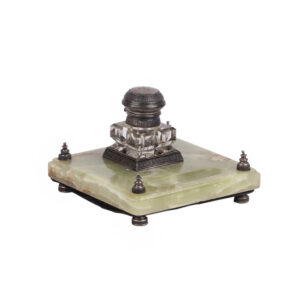
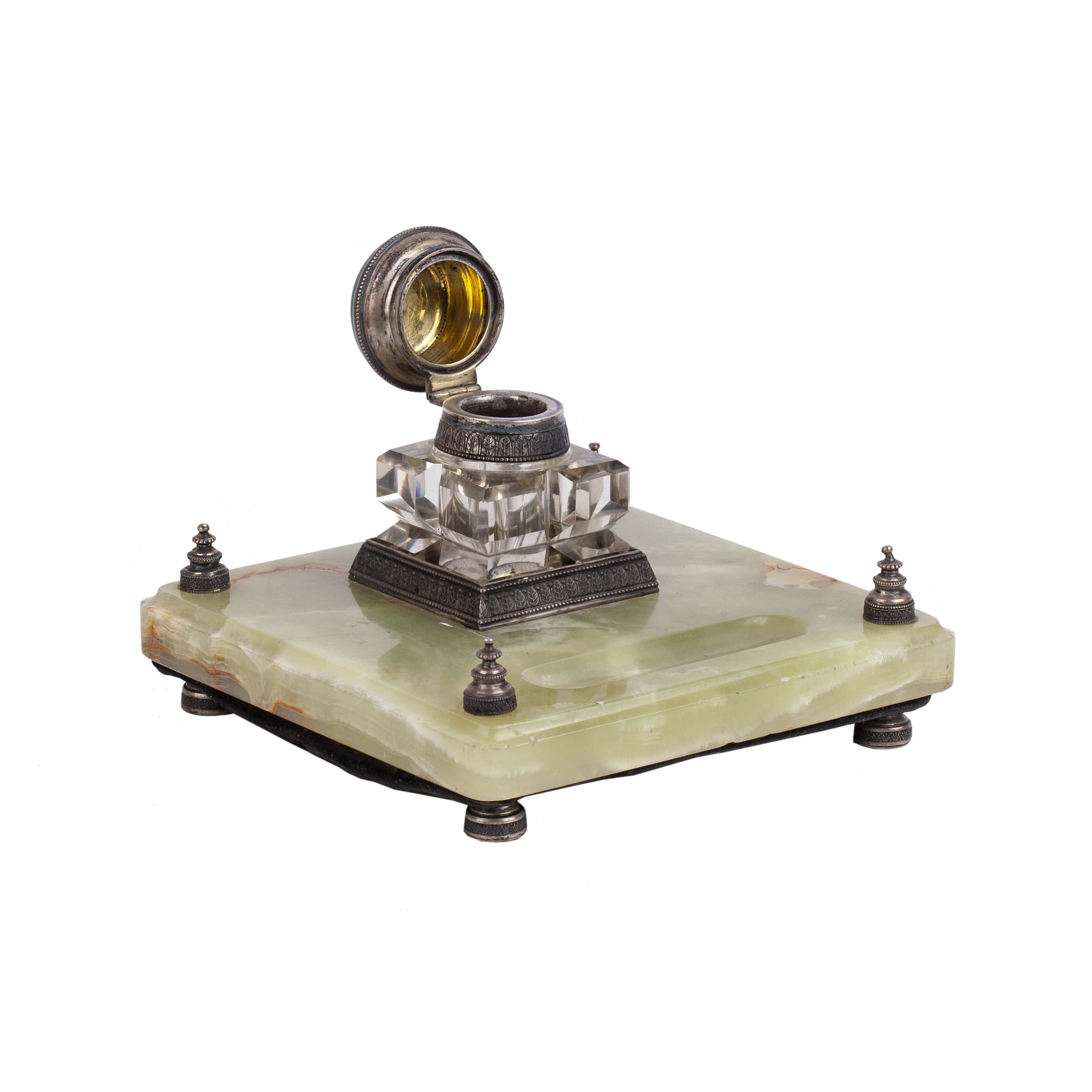
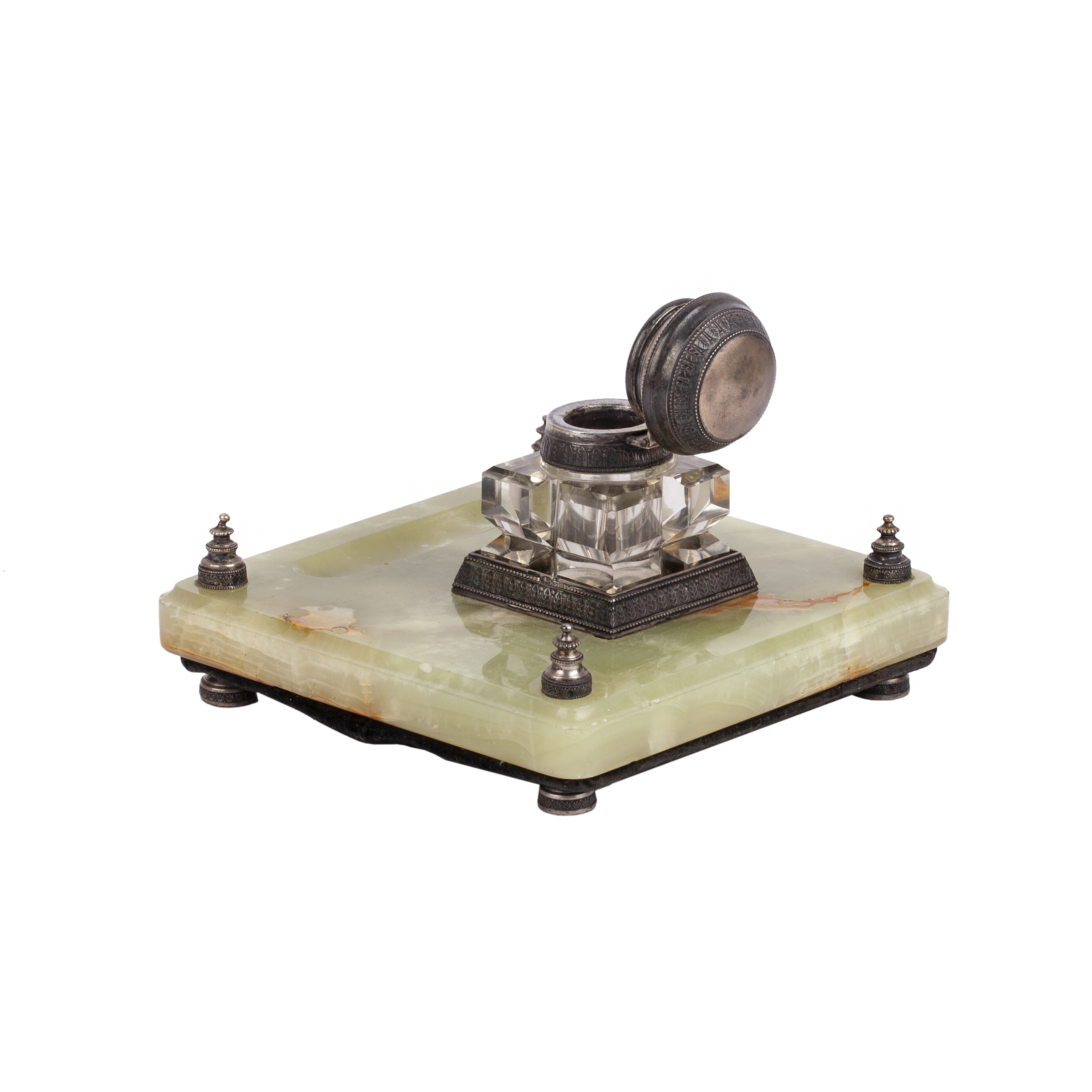
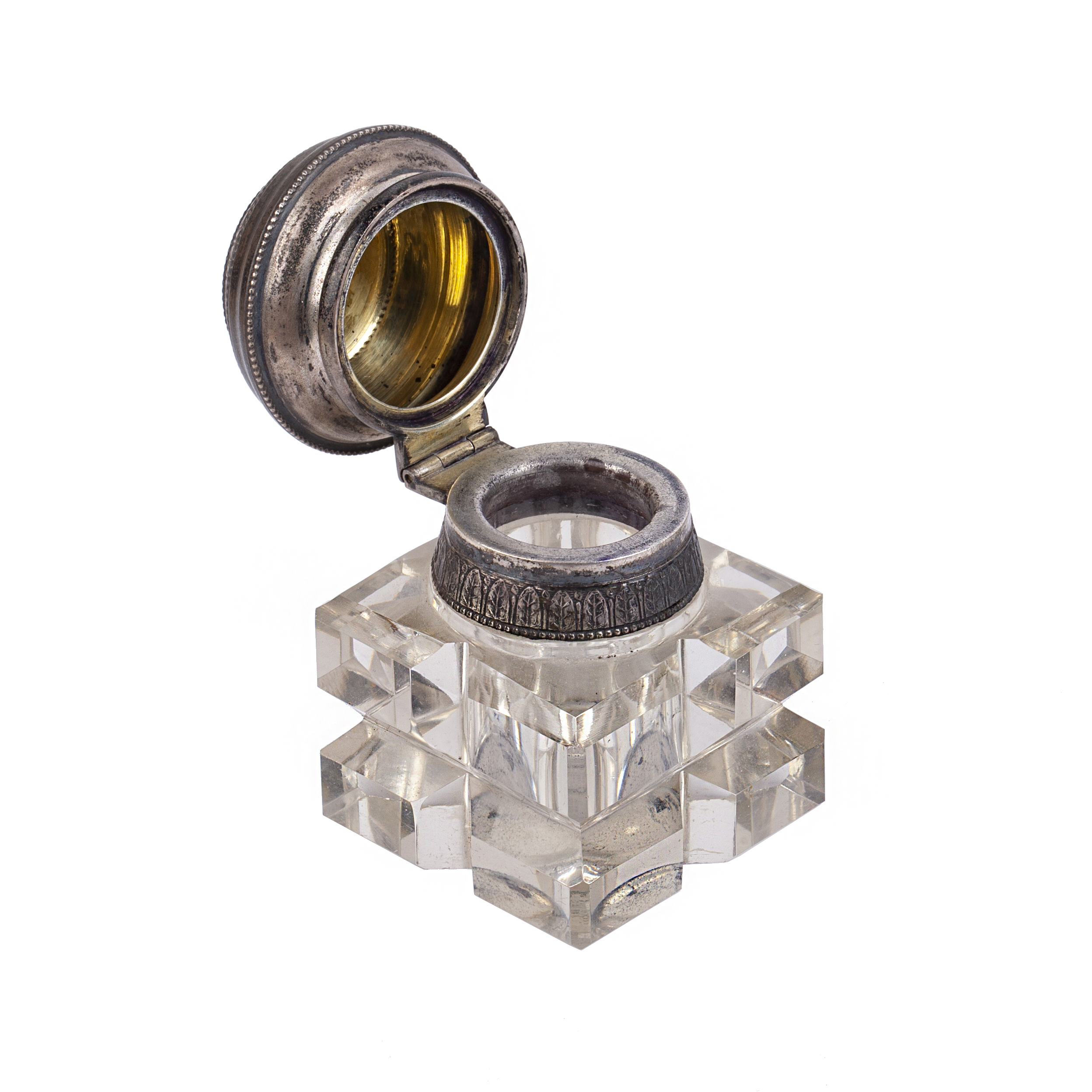
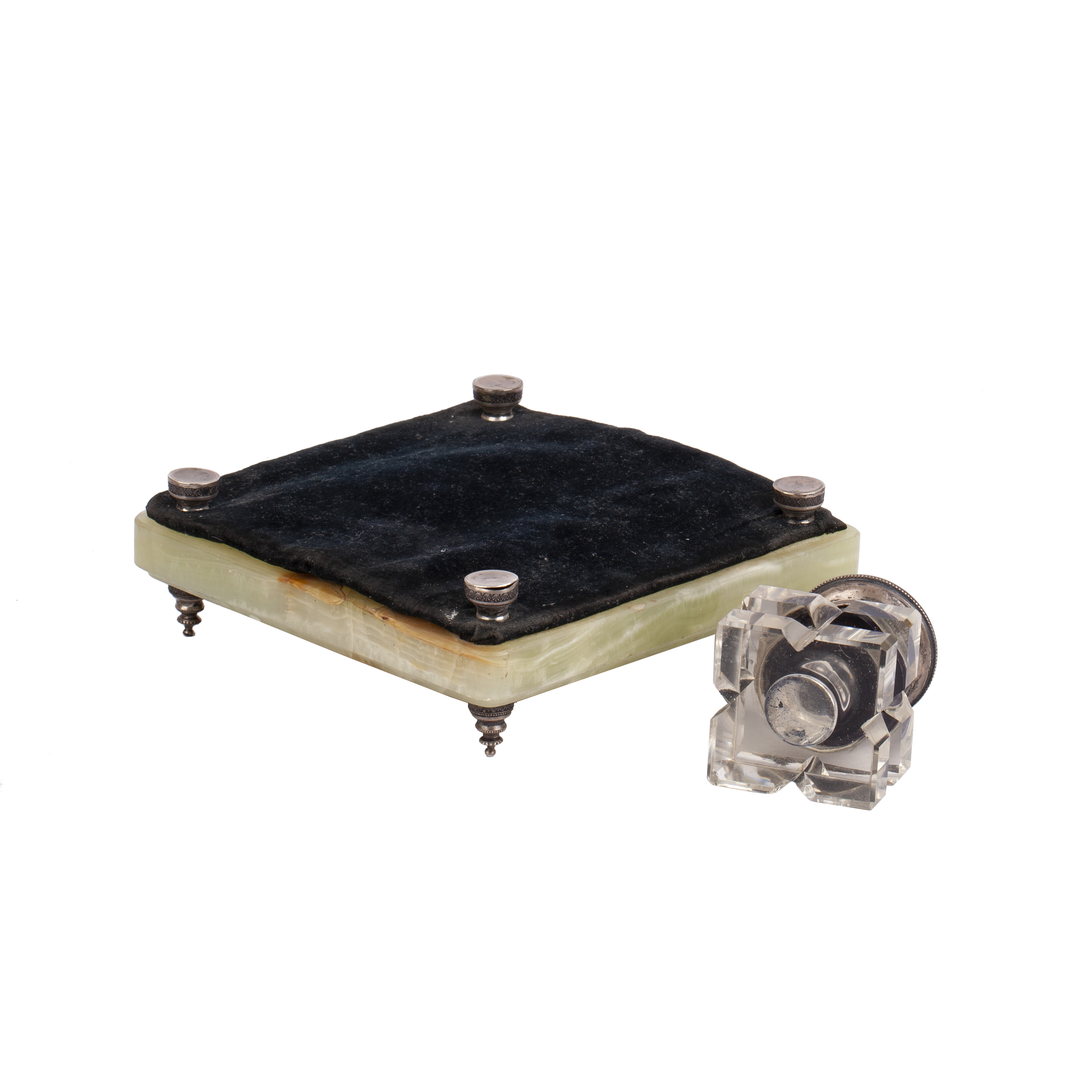
Faberge Silver-Gilt and Onyx Inkwell by Julius Rappoport
Estimate: 2500-3500€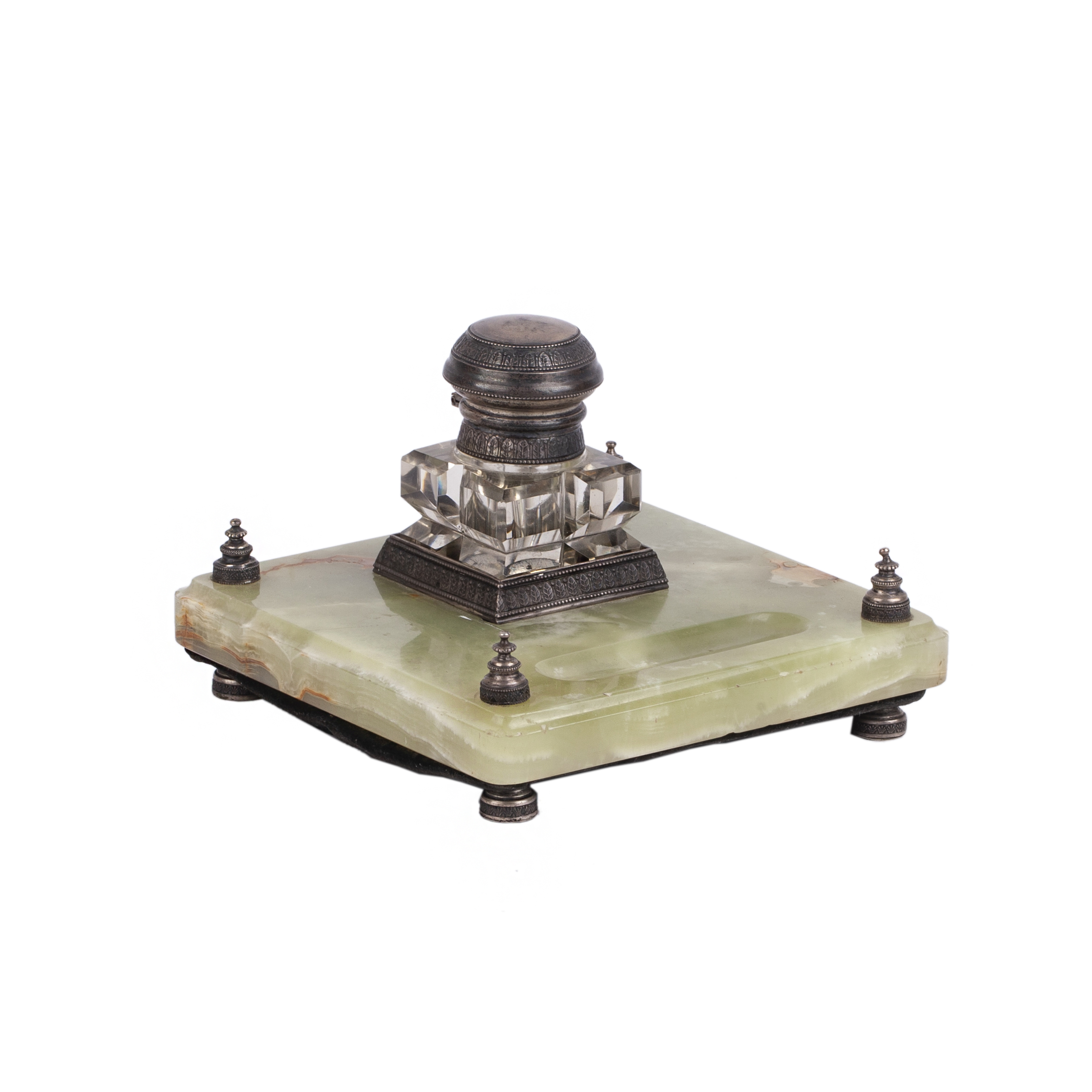
Lot 0243
Faberge Silver-Gilt and Onyx Inkwell by Julius Rappoport
Estimate: 2500-3500€Faberge. Neoclassical style inkwell.
Silver, cut-crystal, onyx.
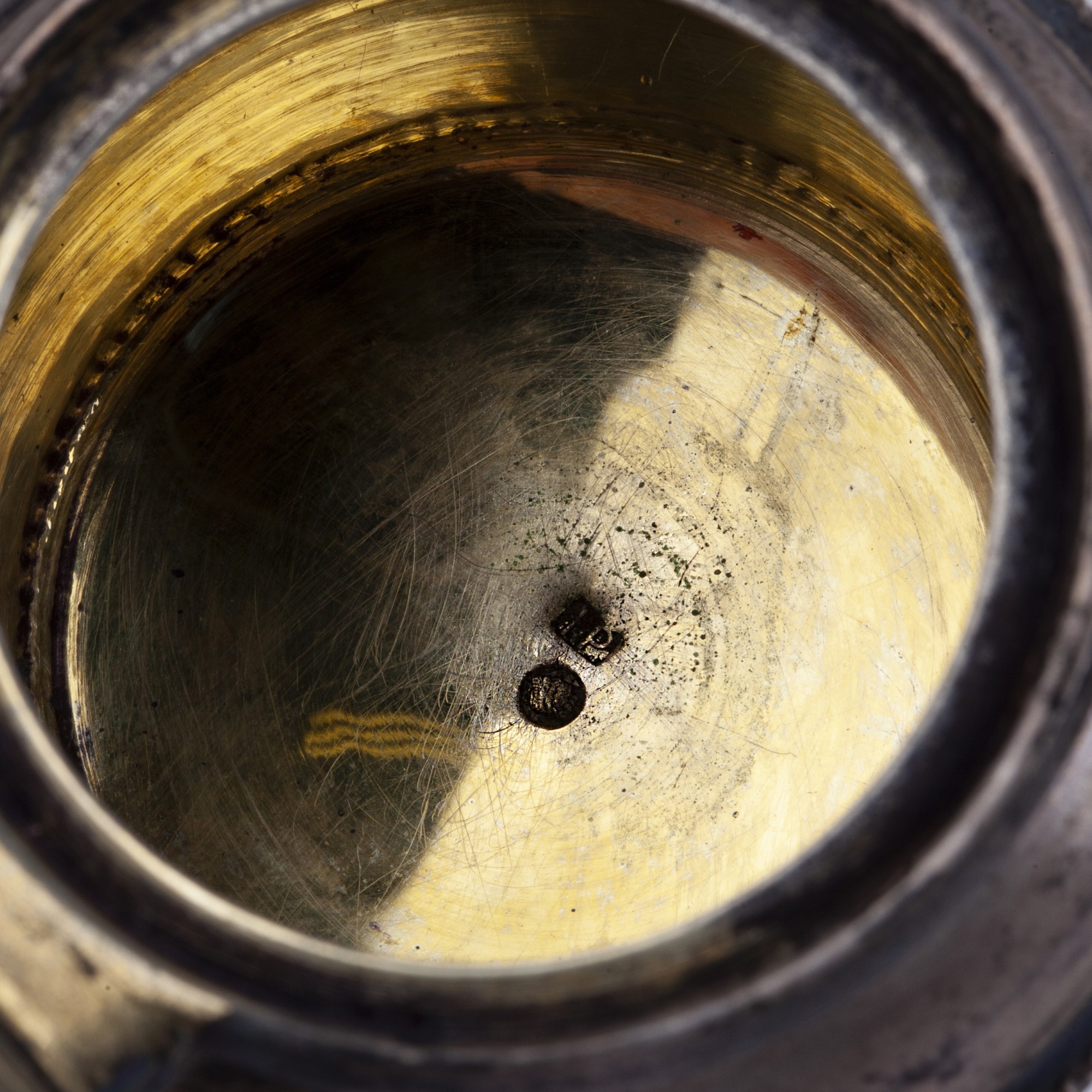
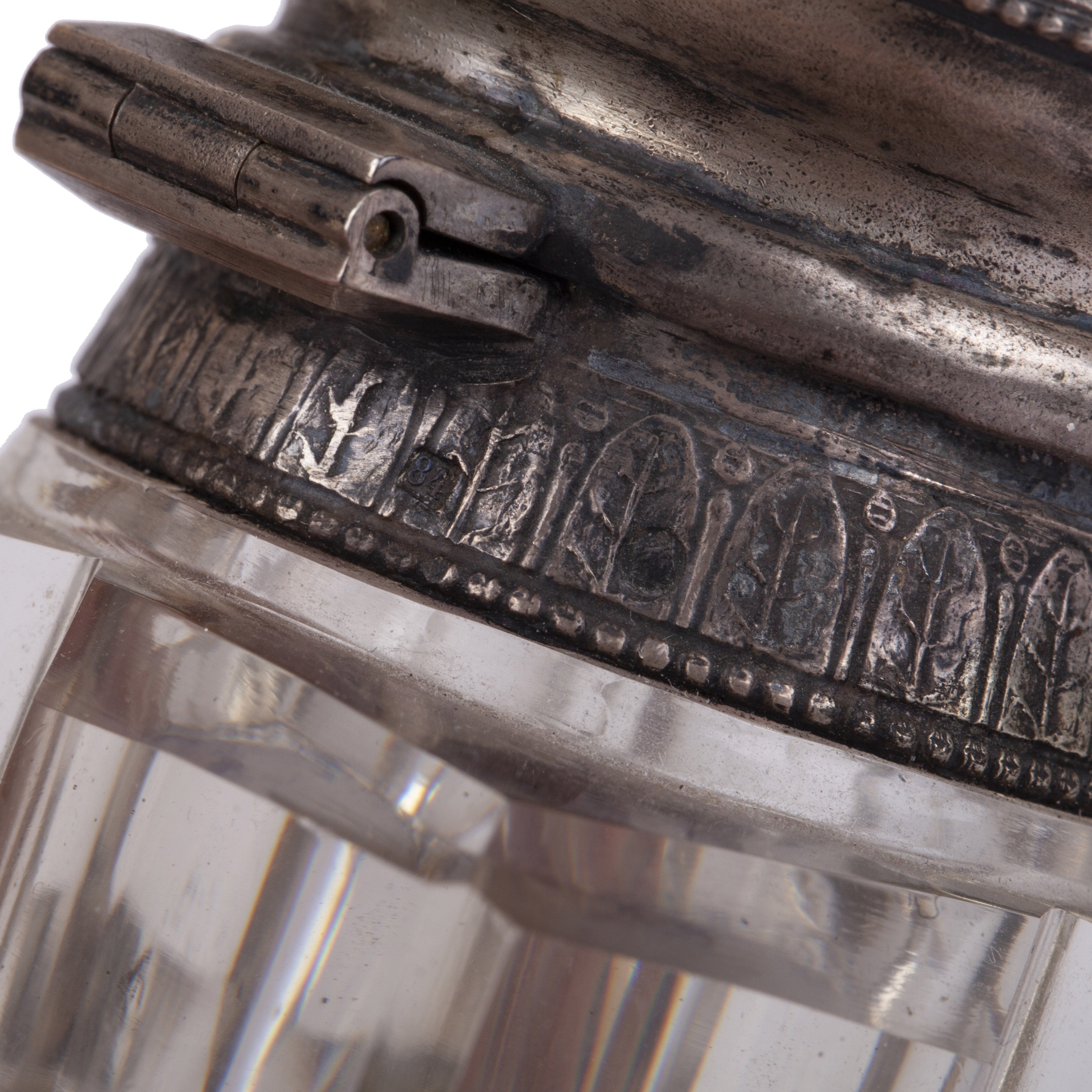
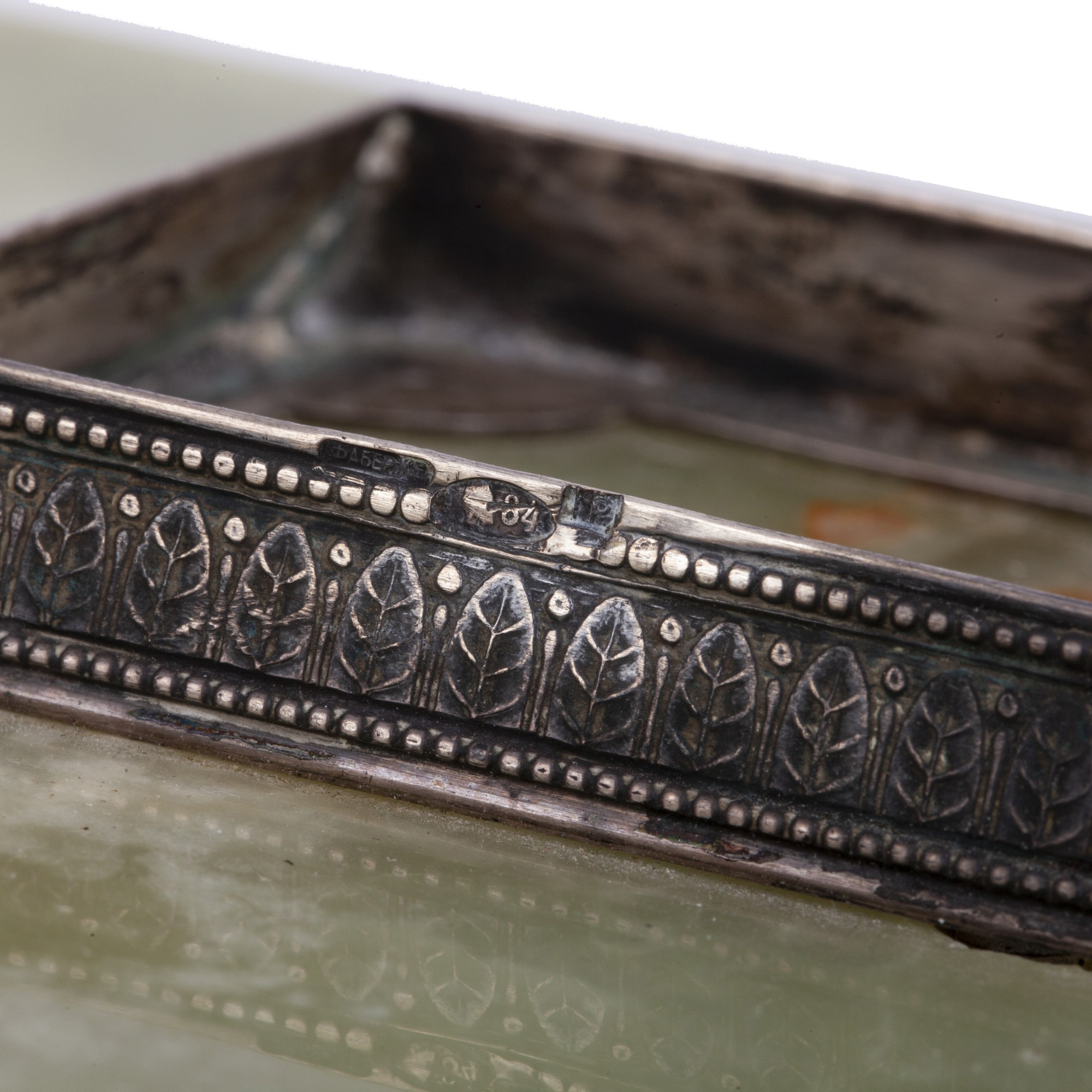
Makers marks of «Faberge» and «IP». Petersburg, circa 1908.
Dimensions: 12 x 16.3 x 16.3 cmA square inkwell composed of a carved onyx base with silver mounts and corner finials, supporting a faceted cut-crystal ink container with a silver hinged cover. The refined combination of hardstone, crystal, and precious metal reflects the luxurious character of Fabergé’s desk accessories, intended both for practical use and as symbols of status and taste. Julius Alexander Rappoport was one of the most important Fabergé workmasters in St. Petersburg. A trained silversmith of Jewish origin from Kovno (now Kaunas, Lithuania), he established his own workshop in the 1880s and soon entered into exclusive collaboration with the firm of Carl Fabergé.
Rappoport specialized in silver and hardstone objects, including desk sets, tableware, and presentation pieces, often combining richly worked silver with materials such as crystal and nephrite. He regularly performed exclusive commissions for the firm of Carl Fabergé, the most important of which were wedding services for Emperor Nicholas II and for the dowry of Grand Duchess Xenia Alexandrovna, both in 1894.Starting price: 1500€
Estimate: 2500-3500€
Hammer Price: Not sold -
Lot 0244
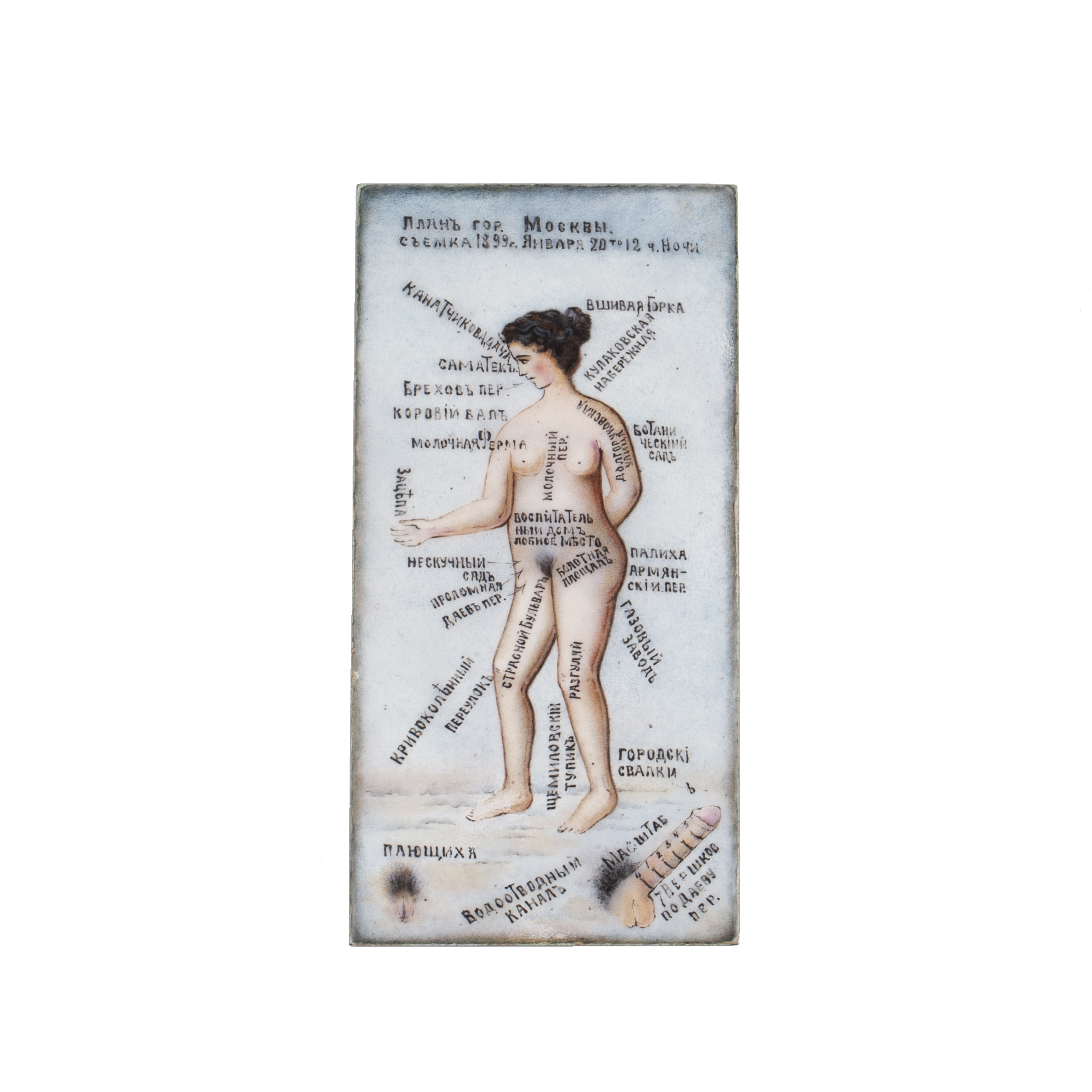
Imperial Stroganov School. Silver and Enamel Plaque with Erotic Map of Moscow
Estimate: 18000-25000€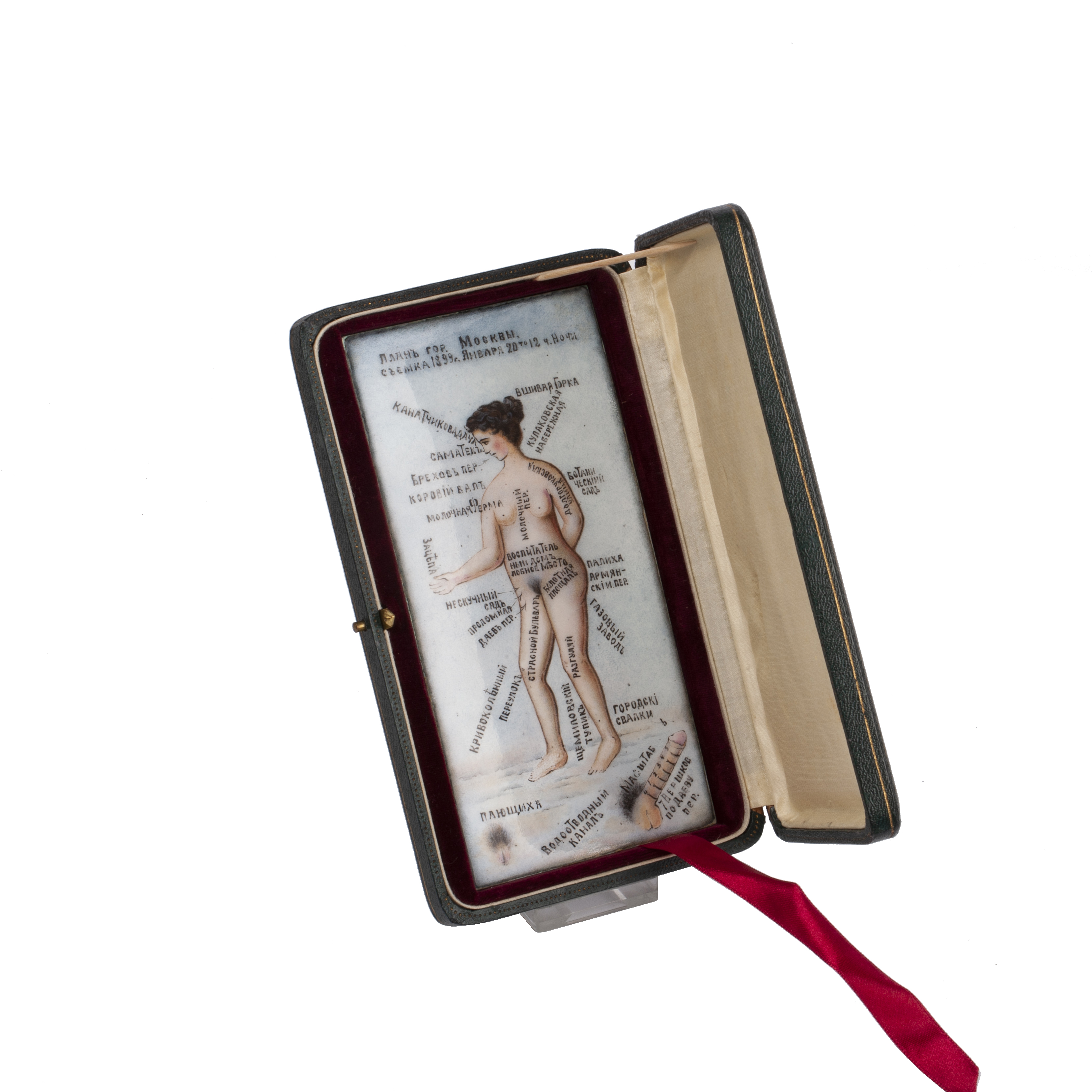
Lot 0244
Imperial Stroganov School. Silver and Enamel Plaque with Erotic Map of Moscow
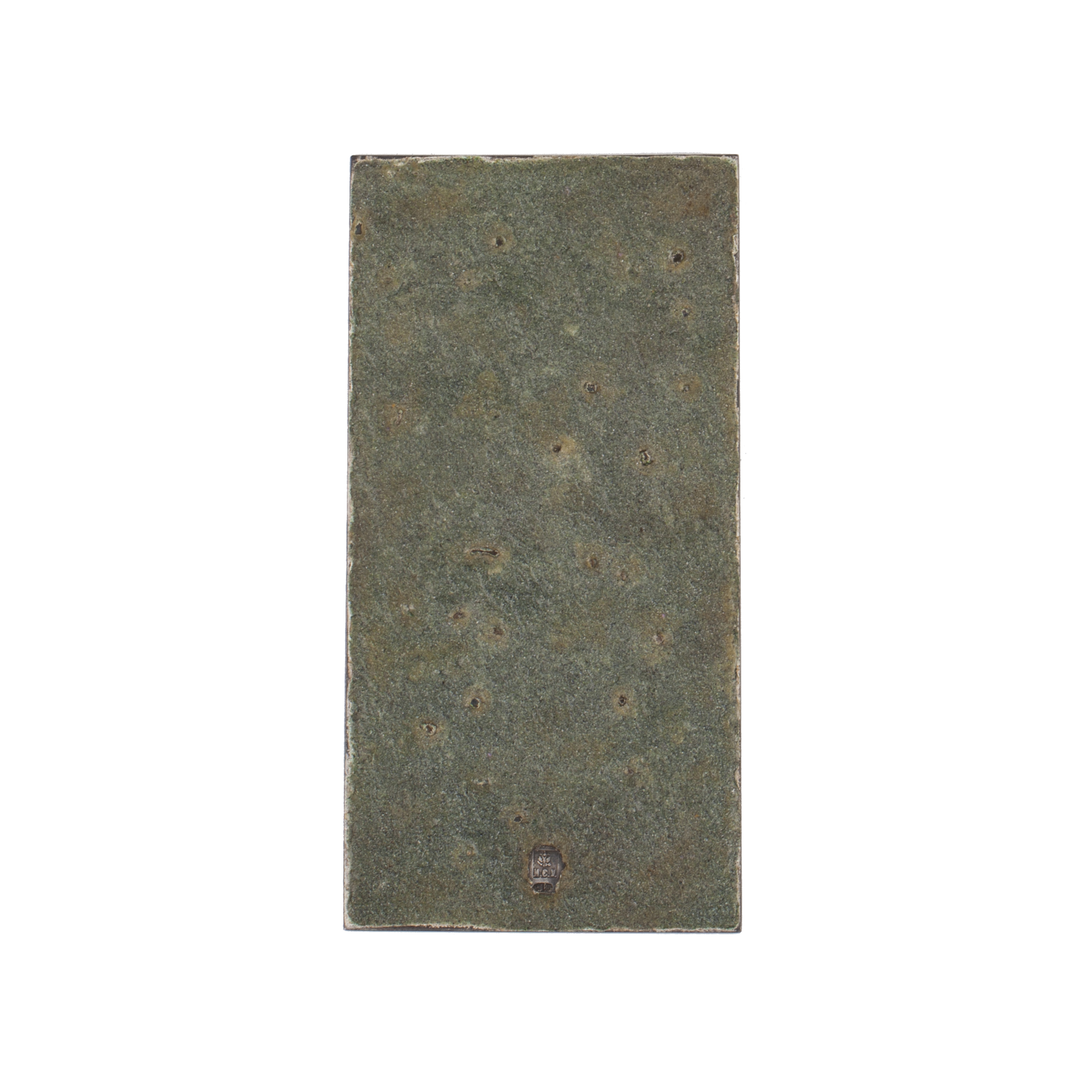
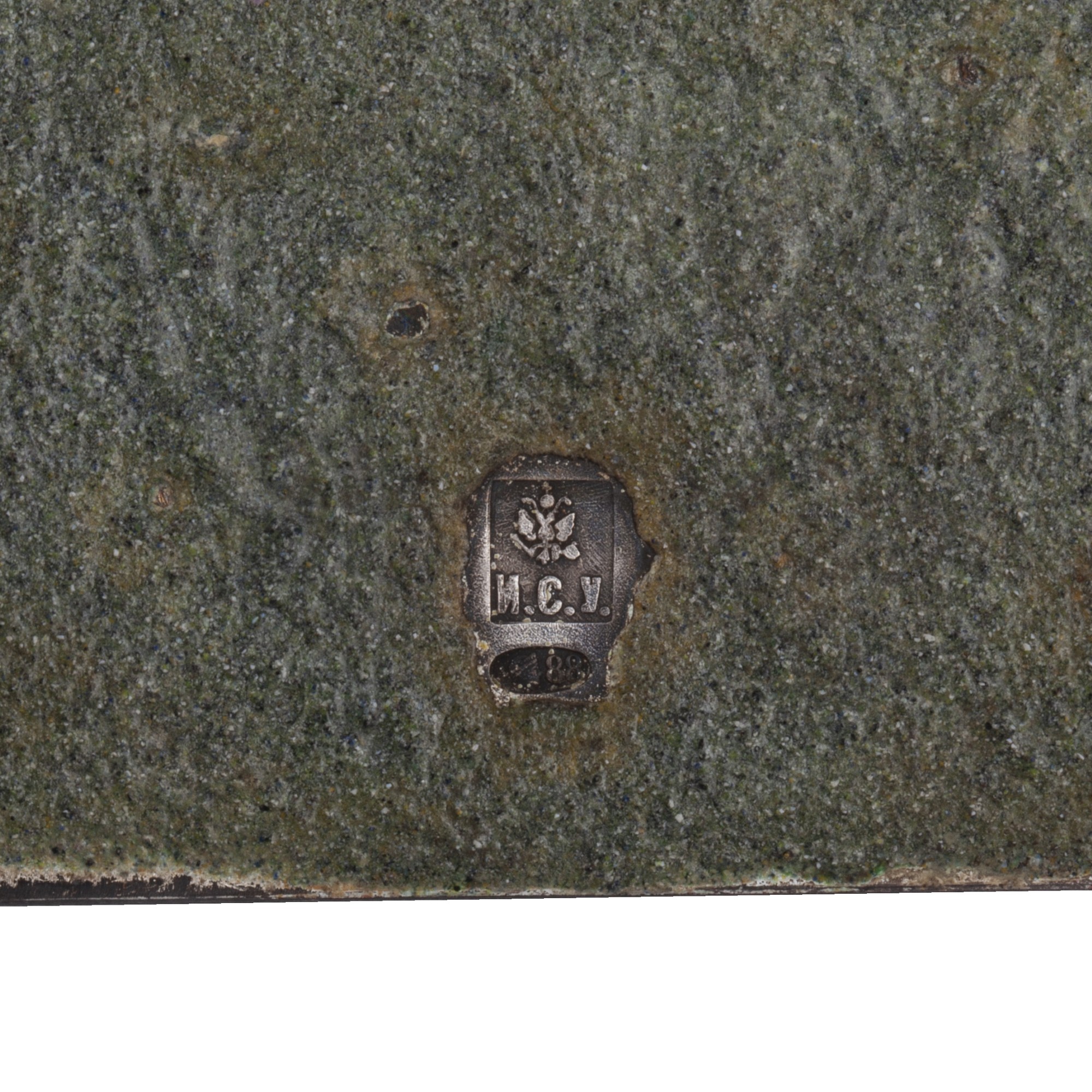
Estimate: 18000-25000€Imperial Stroganov School. Silver and Enamel Plaque with Erotic Map of Moscow in original case. Silver, en-plein enamel.
Makers mark of «ISU» with Imperial warrant. Moscow, 1908-1917. Dimensions of the box: 18.2 х 11.3 х 2.5 cm. Dimensions of the palque: 16.4 х 8.2 cm.
This rare enamel plaque combines technical mastery with biting satire and playful eroticism. It presents a female nude figure whose body is inscribed with the names of Moscow districts, transformed into risqué metaphors and humorous associations. At the top, the inscription records a “plan of the city of Moscow, survey of January 27 to 12 o’clock at night, 1899,” underlining the parody of cartographic precision.
In 1900, on its 75th anniversary, the School was granted the title Imperial Stroganov Central School of Industrial Art. By this time it operated eighteen workshops, including those for metalwork, enameling, jewelry, and casting, where students combined theoretical study with practical training. Guided by renowned masters, students produced works of remarkable quality, marked with the School’s special hallmark with Imperial warrant. These objects were presented as gifts, exhibited internationally, and sold through the School’s shop. Today, they are rare treasures, reflecting the peak of the national-romantic style in Russian decorative art.
Similar: https://www.christies.com/en/lot/lot-6078035Starting price: 15000€
Estimate: 18000-25000€
Hammer Price: Not sold -
Lot 0245
Very Rare Fabergé Medallion with a Minerva Cameo on a Stand in the Shape of an Easel by Henrik Wigström
Estimate: 35000-45000€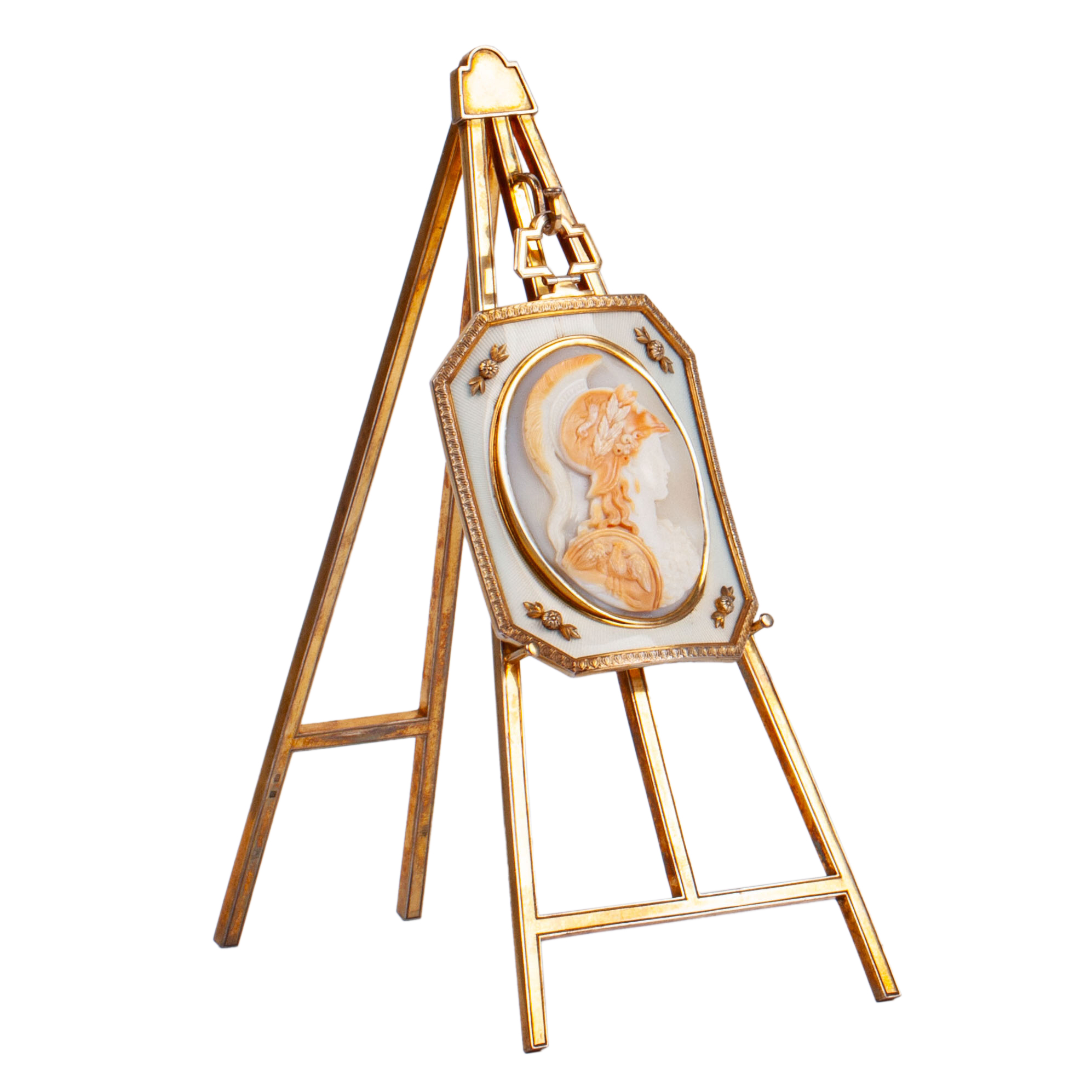
Lot 0245
Very Rare Fabergé Medallion with a Minerva Cameo on a Stand in the Shape of an Easel by Henrik Wigström
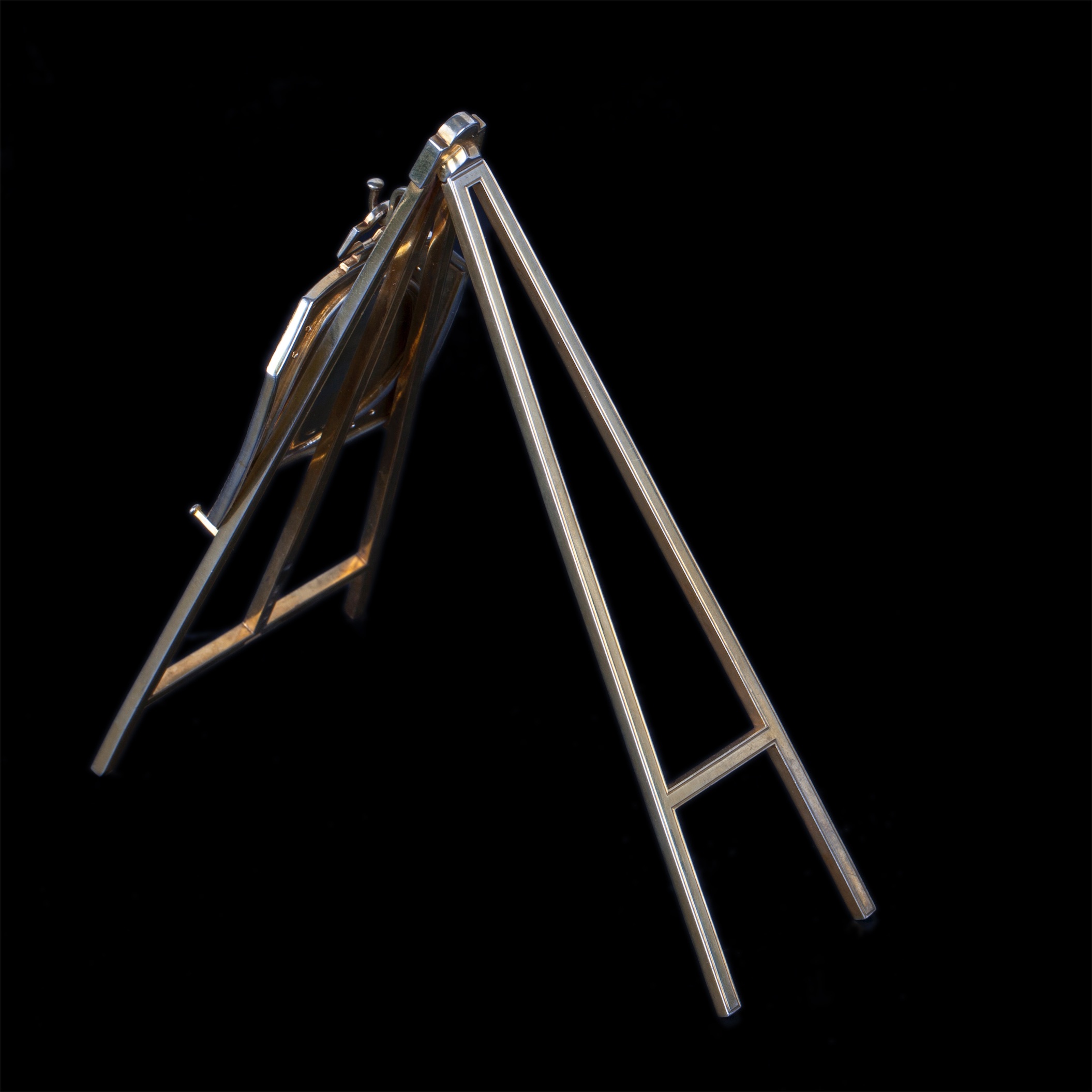
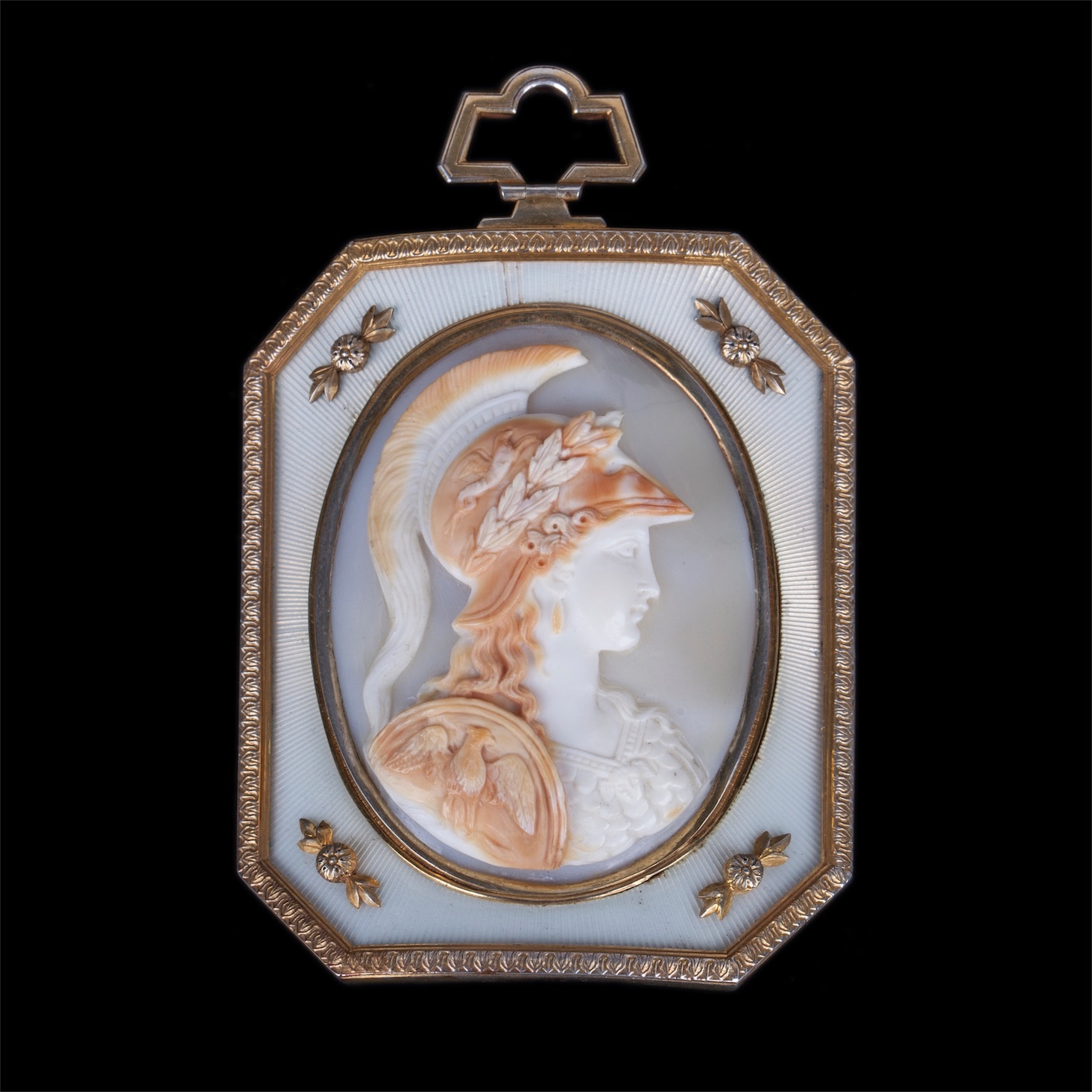
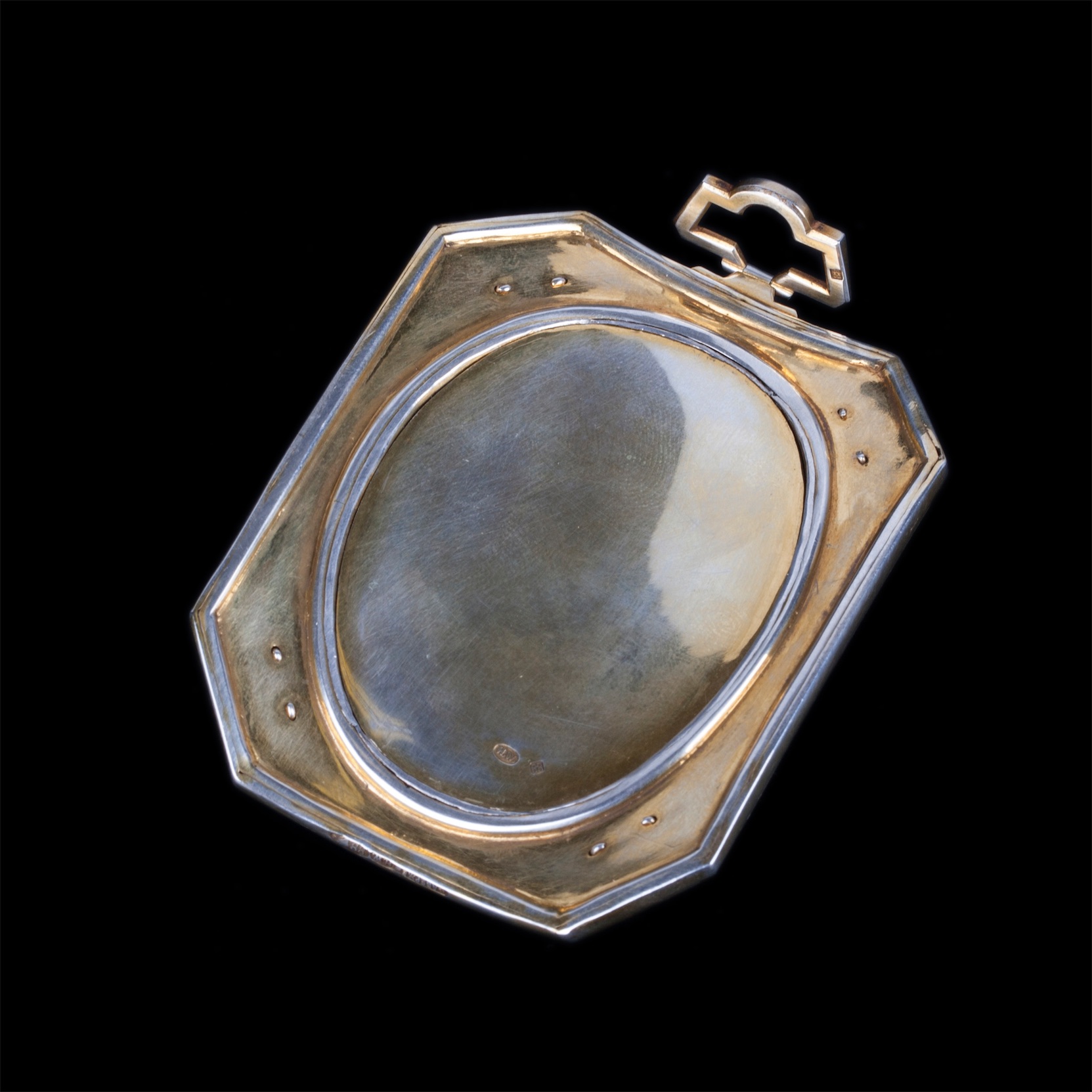
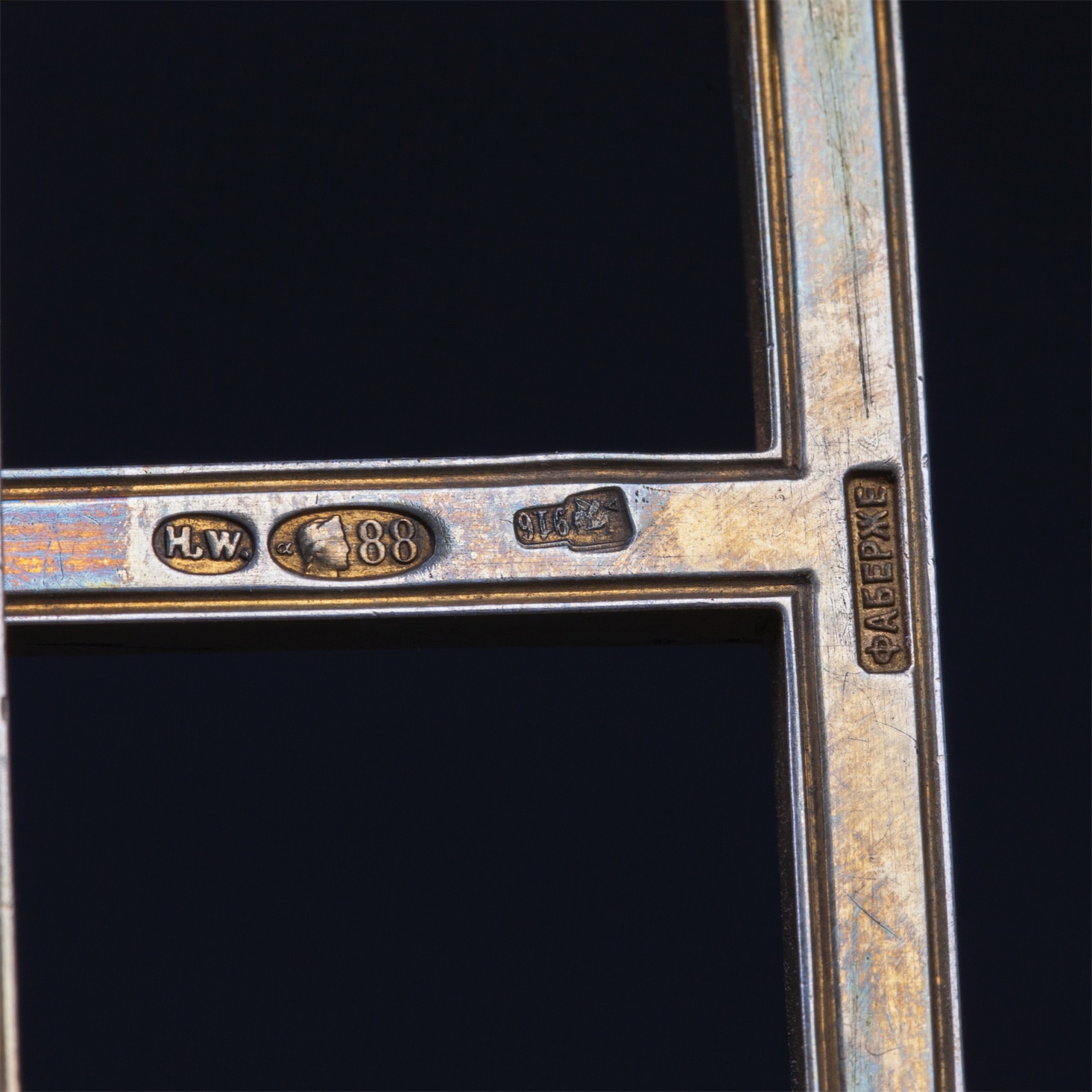
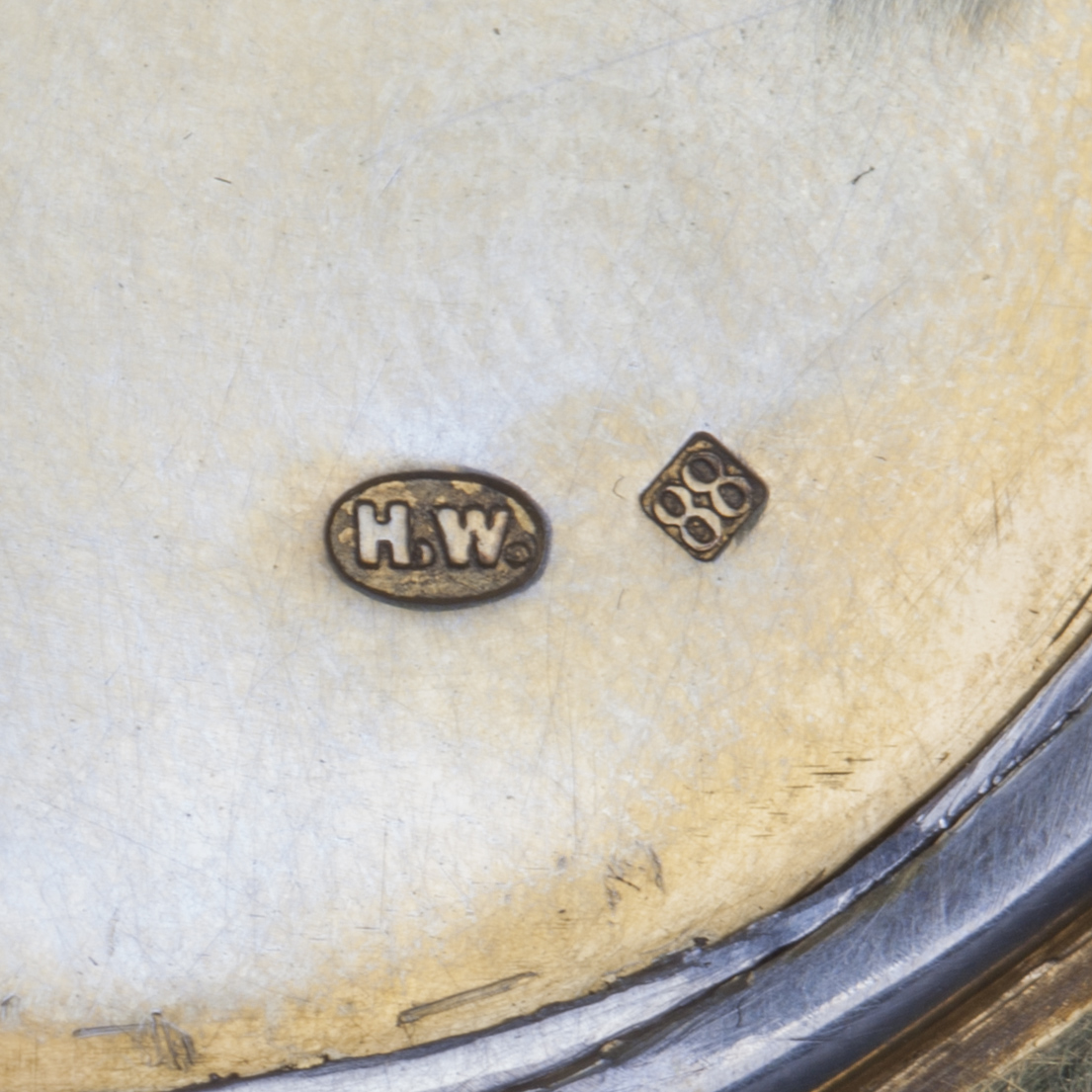
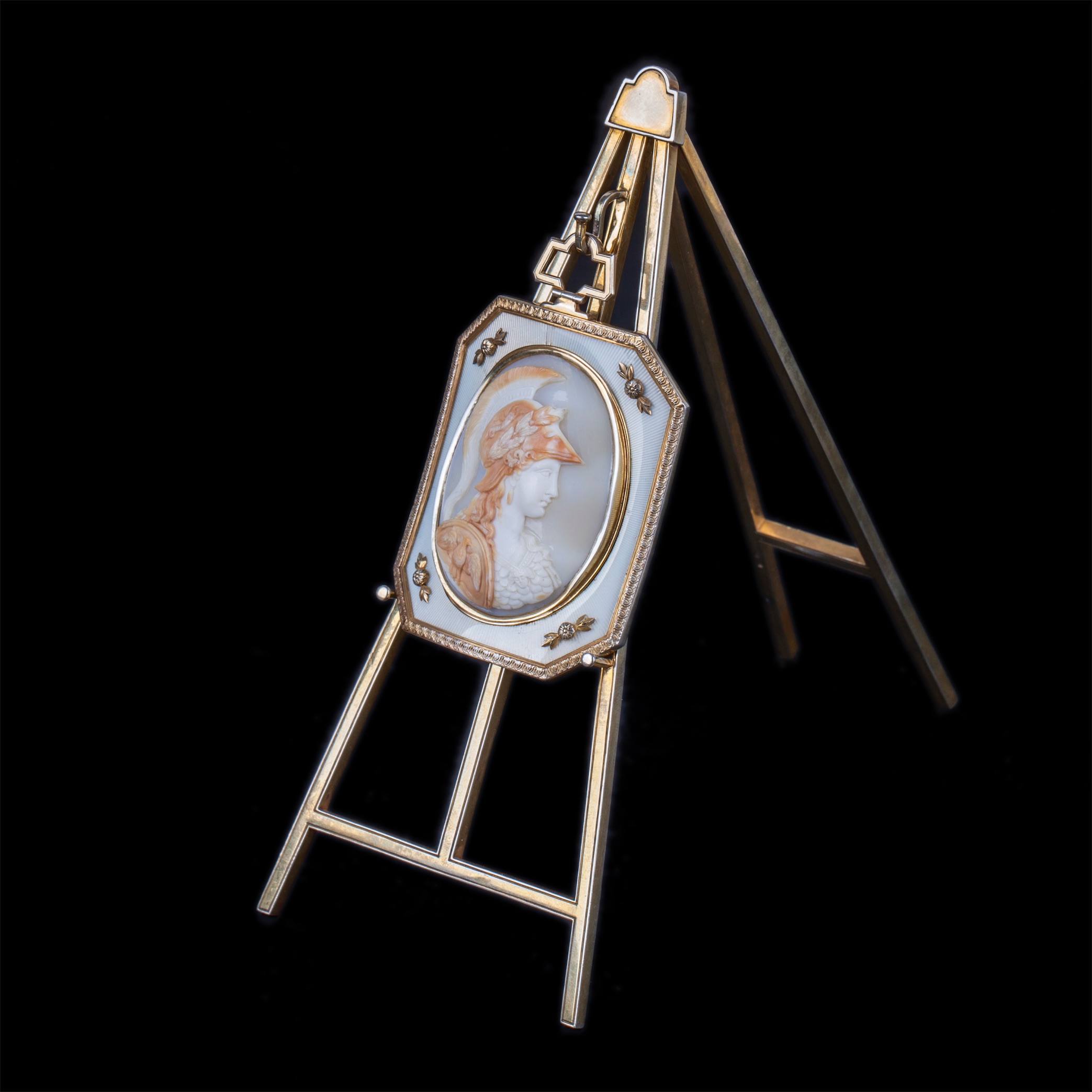
Estimate: 35000-45000€A rare Fabergé Medallion with Minerva Cameo on Easel Stand . Workmaster Henrik Wigström, St. Petersburg, 1908–1917 . Silver, gilt, guilloché enamel, carved cameo. Easel dimensions: 18.5 × 8 cm; medallion: 8.6 × 6 cm
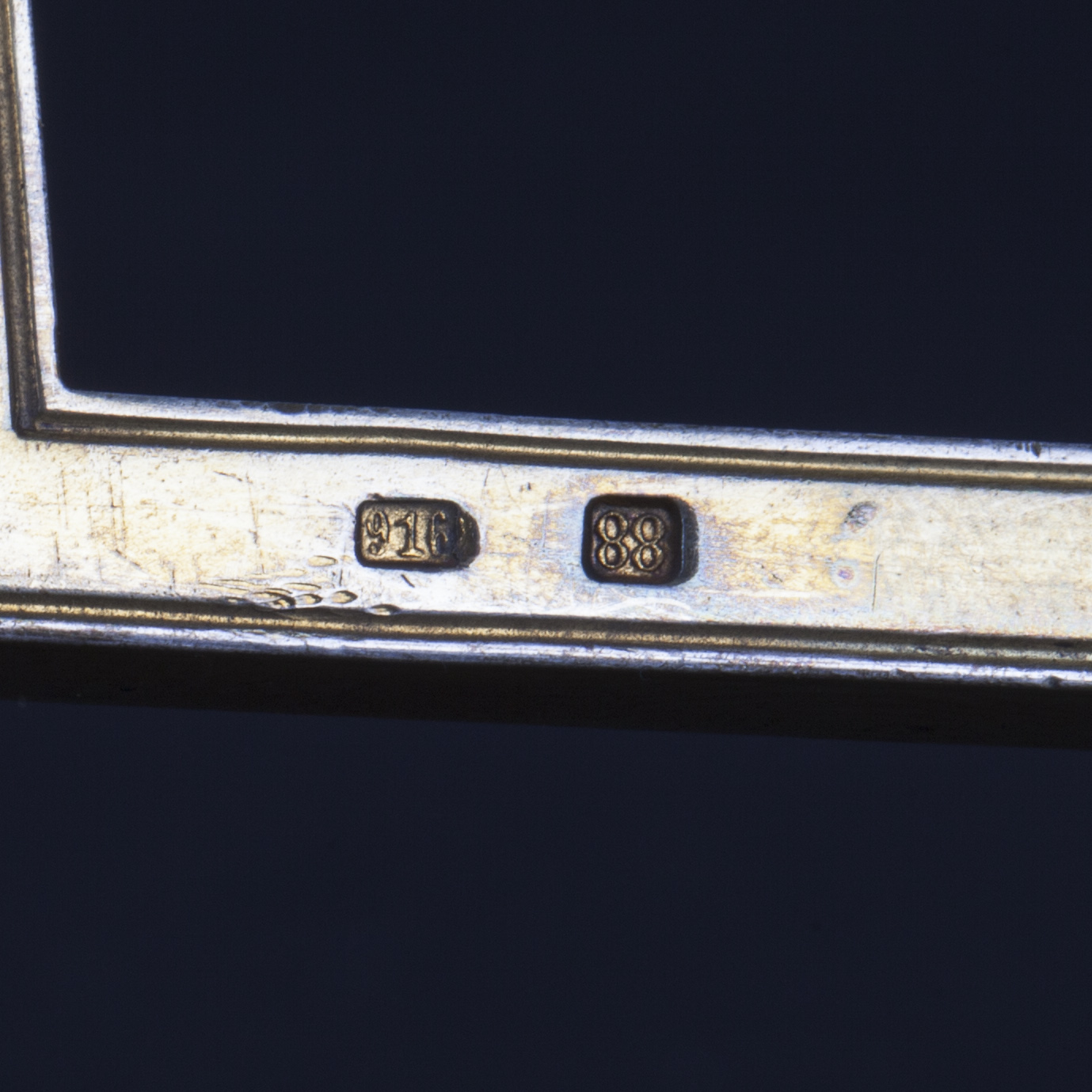
A highly rare Fabergé creation, this object unites a finely carved cameo of Minerva, goddess of wisdom and war, with an elegant silver-gilt easel mount enriched with translucent guilloché enamel. Designed by the firm’s chief workmaster Henrik Wigström, the piece exemplifies Fabergé’s ability to combine classical imagery with refined decorative settings. Comparable examples are known only from the most distinguished collections, including a related work sold at Christie’s (A Selection of Fabergé Masterpieces from the Harry Woolf Collection, 9 November 2021, lot 32 SOLD GBP 137,500). Henrik Wigström is regarded as one of the most important workmasters of the House of Fabergé, alongside his predecessor Michael Perkhin. Born in Finland, Wigström began his training as an apprentice to the local jeweler and goldsmith Peter Madsen. Through Madsen’s professional connections in Russia, he moved to St. Petersburg in 1886, where he joined the Fabergé workshops as an assistant to Perkhin, the firm’s leading workmaster at the time. Following Perkhin’s death in 1903, Wigström succeeded him as head workmaster.Under his supervision, Fabergé’s workshops produced some of their most sophisticated creations in the Louis XVI and Neoclassical styles. He was highly prolific: approximately half of the Imperial Easter Eggs, as well as the majority of miniature hardstone animals, flowers, boxes, and cigarette cases made between 1904 and 1917, bear his mark “H.W.”
Wigström was also responsible for a remarkable series of objets de fantaisie, including miniature furniture inspired by 18th-century European decorative arts. These delicate, doll-like creations—crafted in gold and enamel—blur the line between functional objects and pure ornament.
One notable example is the bonbonnière in the form of an Empire-style gondola chair, produced around 1911–1912 and now in the Fabergé Museum Collection.
Starting price: 30000€
Estimate: 35000-45000€
Hammer Price: Not sold -
Lot 0246
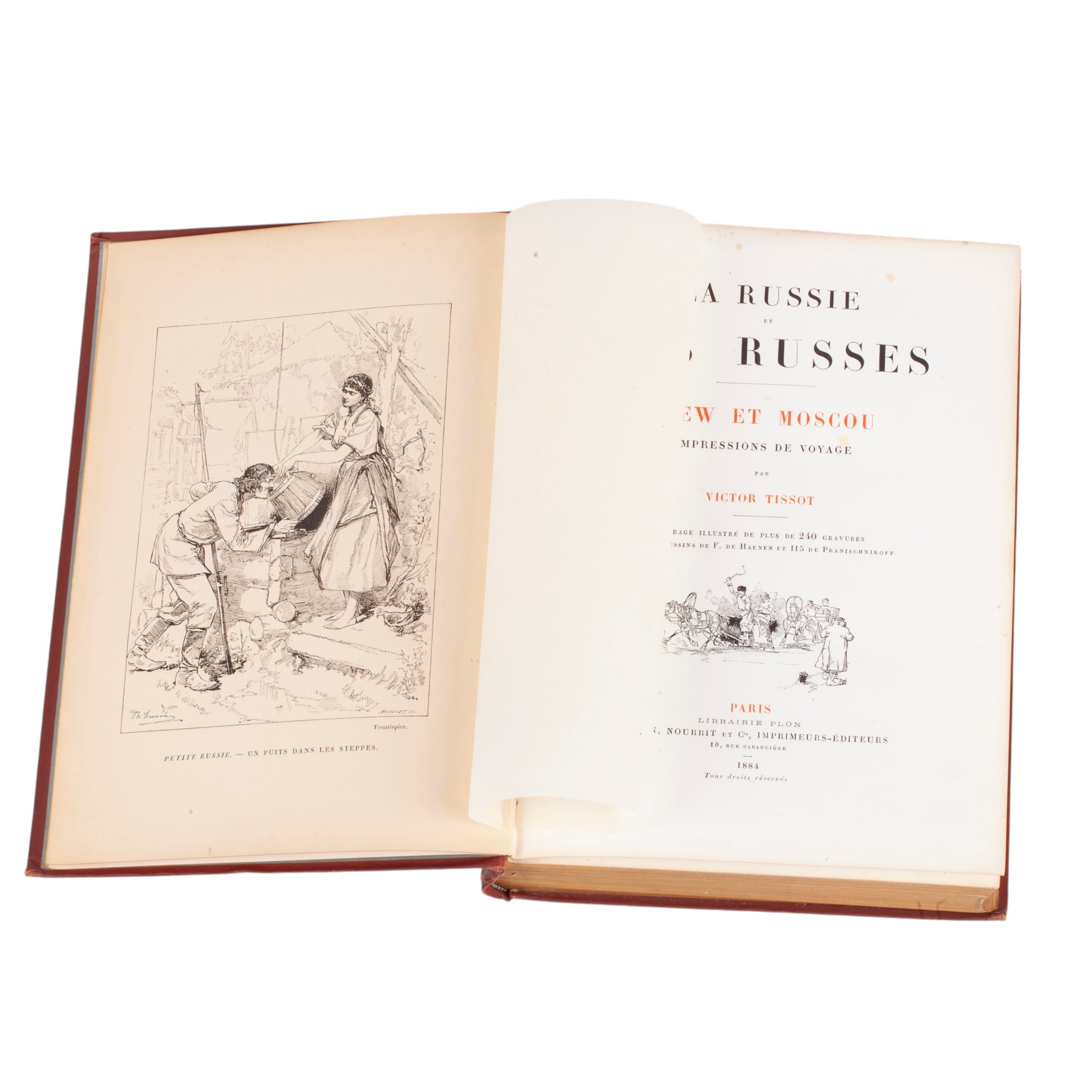
Victor Tissot, La Russie et les Russes, Paris, 1884, Illustrated Edition in Original Cloth Binding
Estimate: 300-350€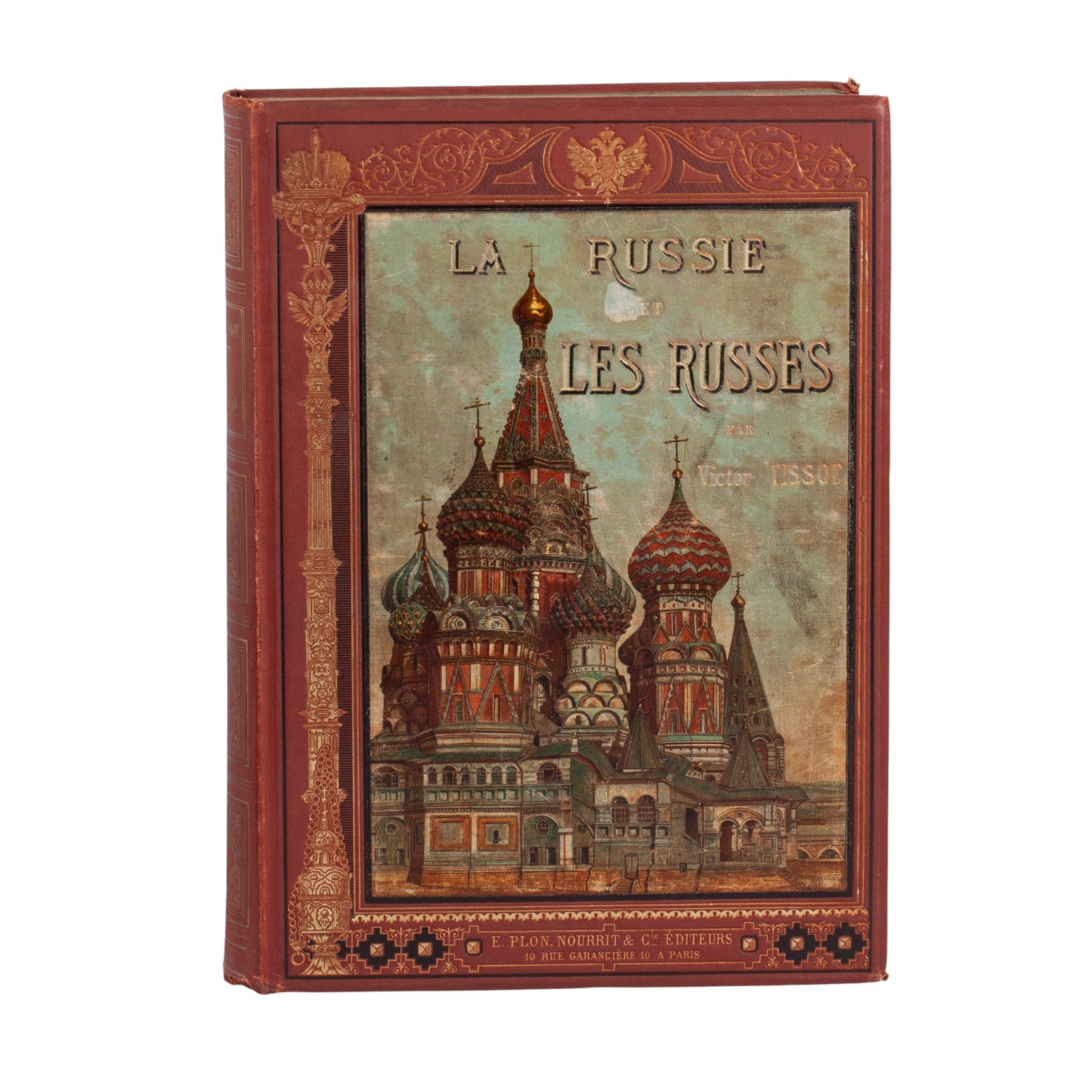
Lot 0246
Victor Tissot, La Russie et les Russes, Paris, 1884, Illustrated Edition in Original Cloth Binding
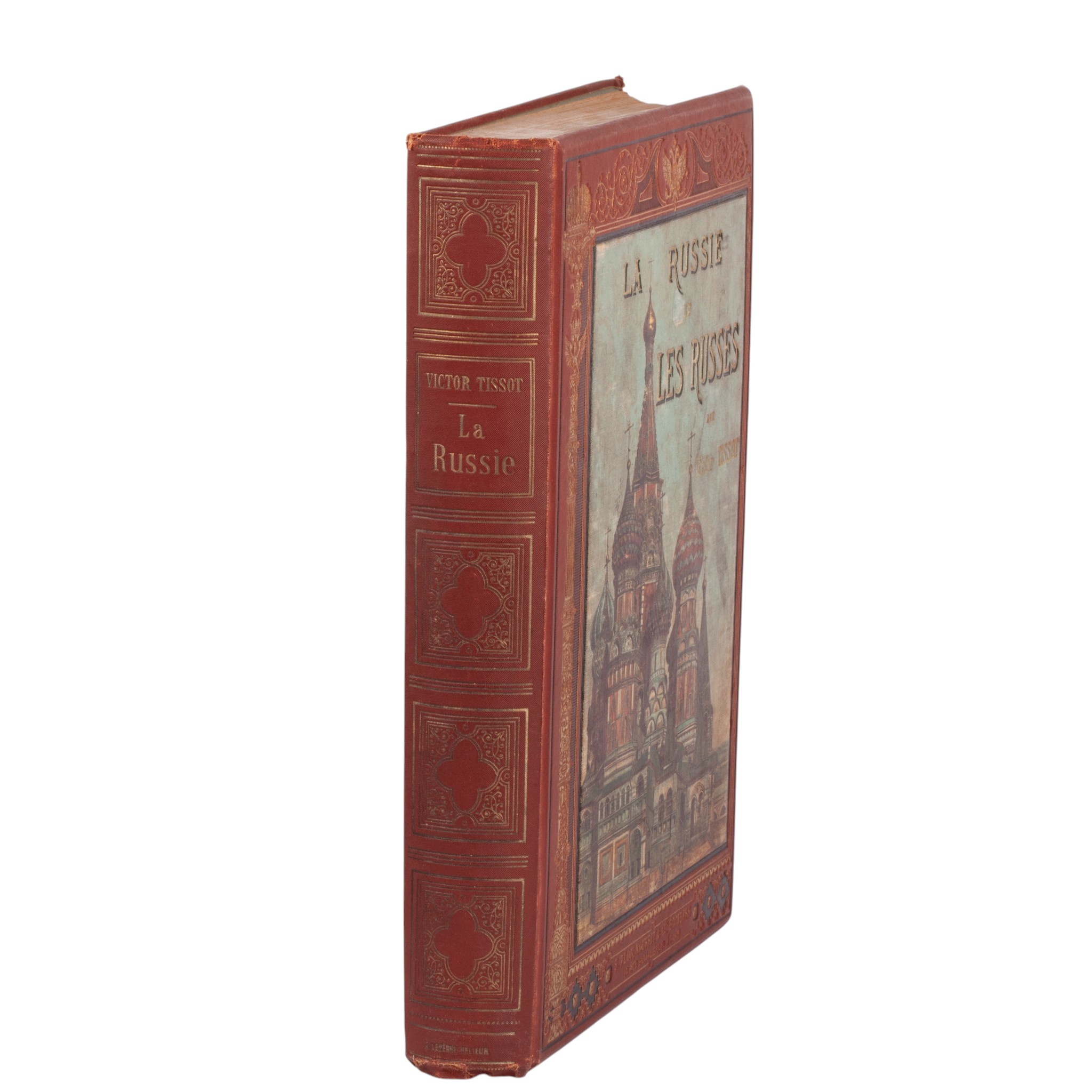
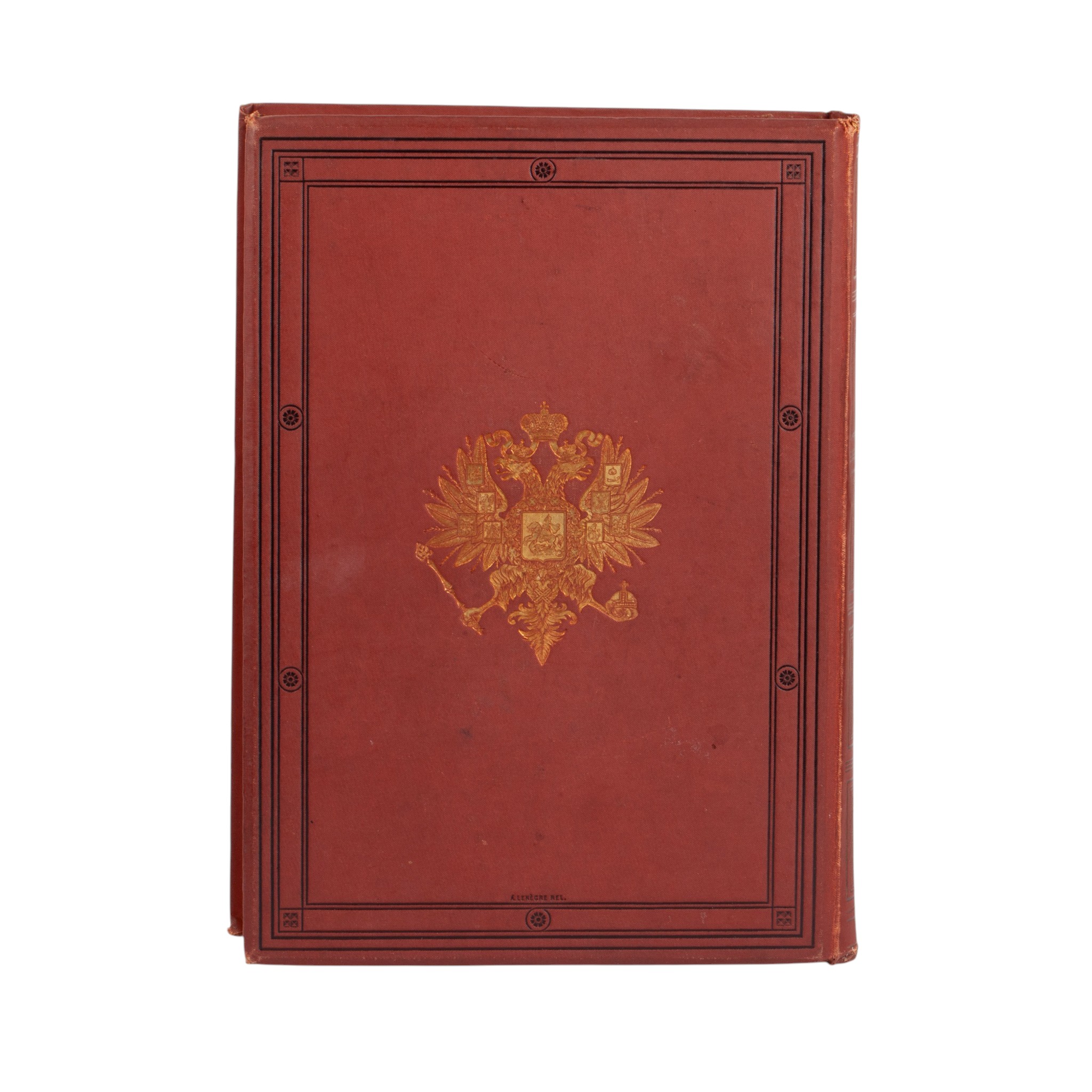
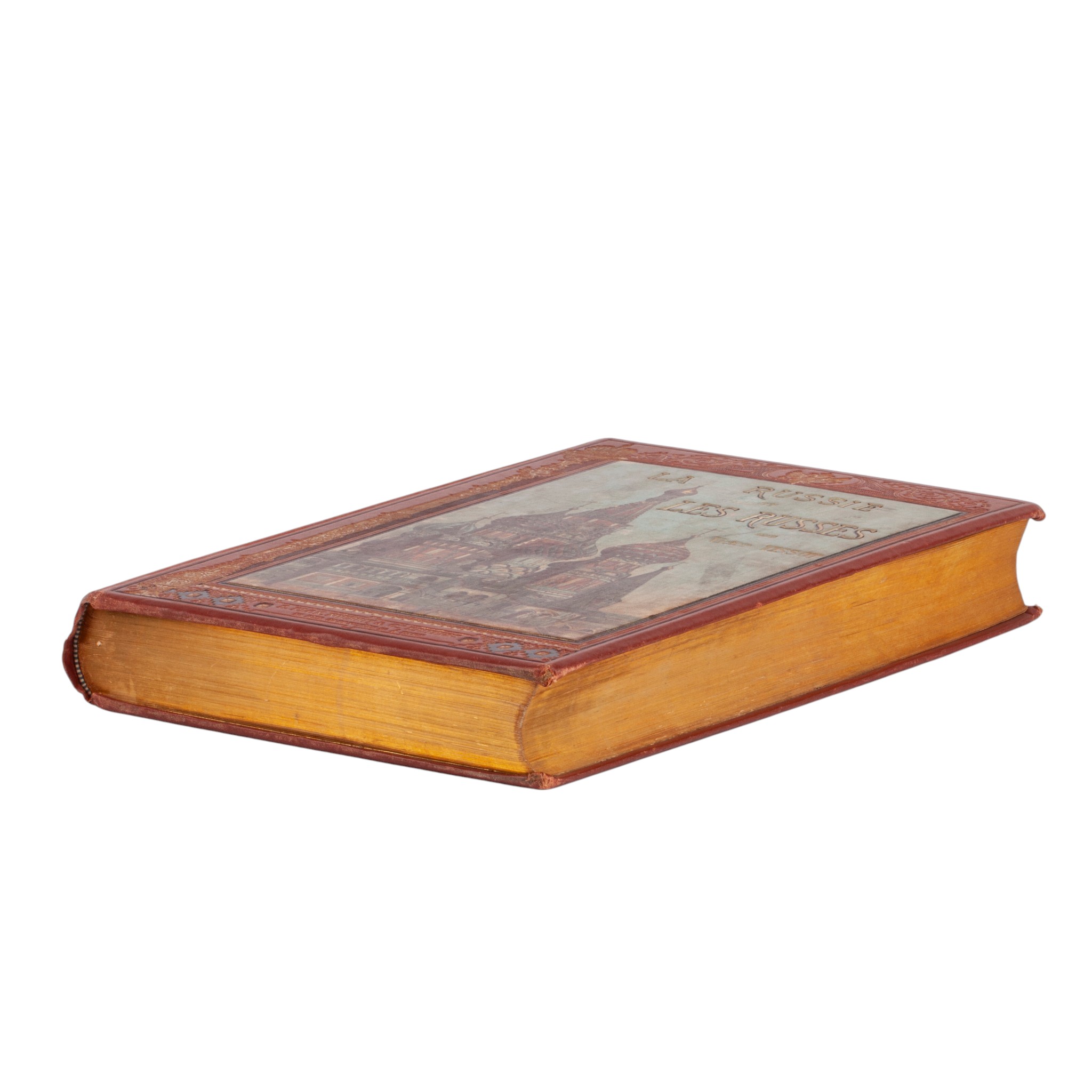
Estimate: 300-350€Victor Tissot, La Russie et les Russes. Kiev et Moscou. Impressions de voyage. Paris: Librairie Plon, 1884. Richly illustrated edition with more than 240 gravures, in the original publisher’s decorative red cloth binding with gilt and polychrome cover design depicting Saint Basil’s Cathedral, and imperial double-headed eagle on the rear cover.
A striking late 19th-century travel book on Russia, retaining its highly decorative original binding.
Dimensions: 28.3 × 21 × 4 cm
Starting price: 250€
Estimate: 300-350€
Hammer Price: Not sold -
Lot 0247
Karl Gahn. Gold Pendant with Official Archival Sketch
Estimate: 700-900€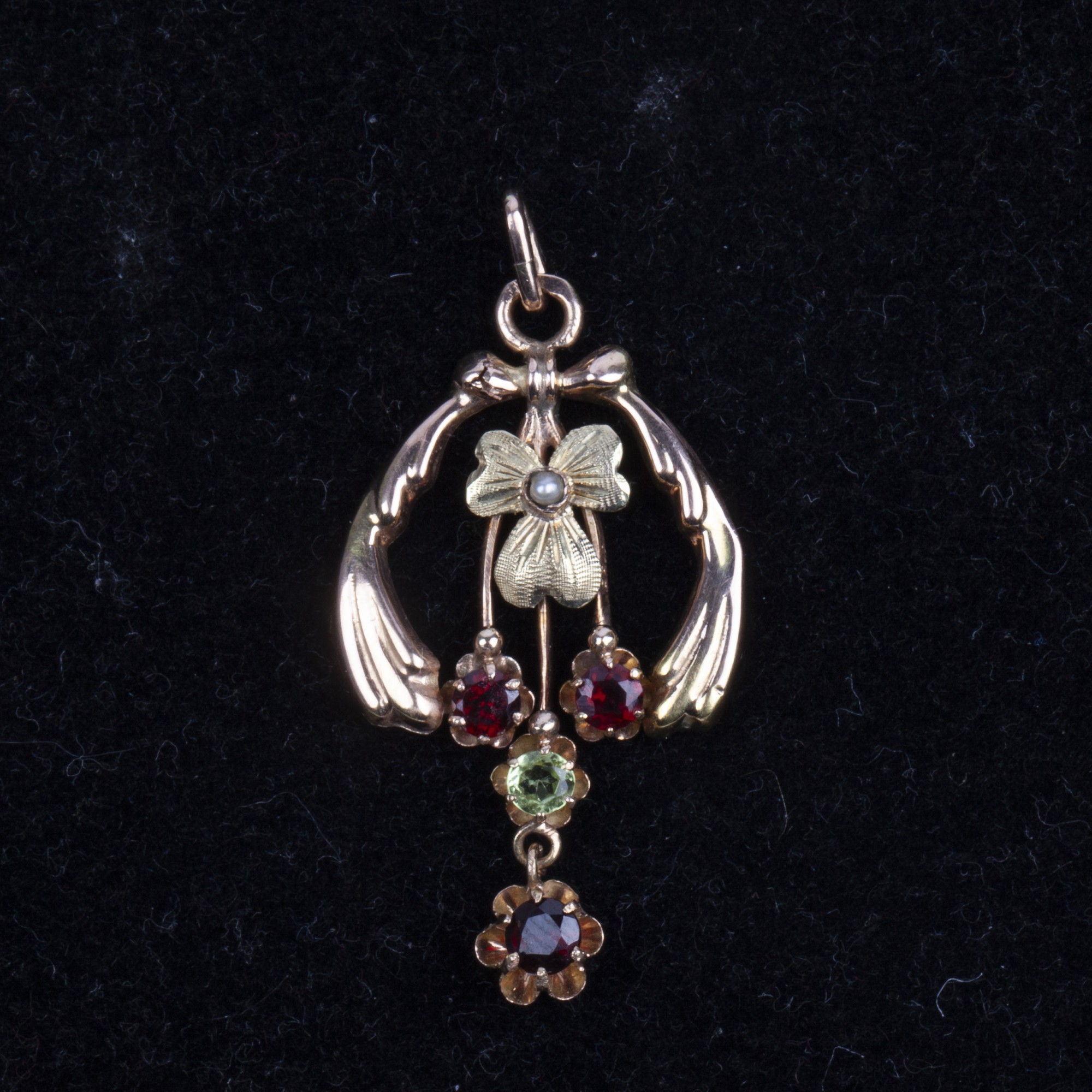
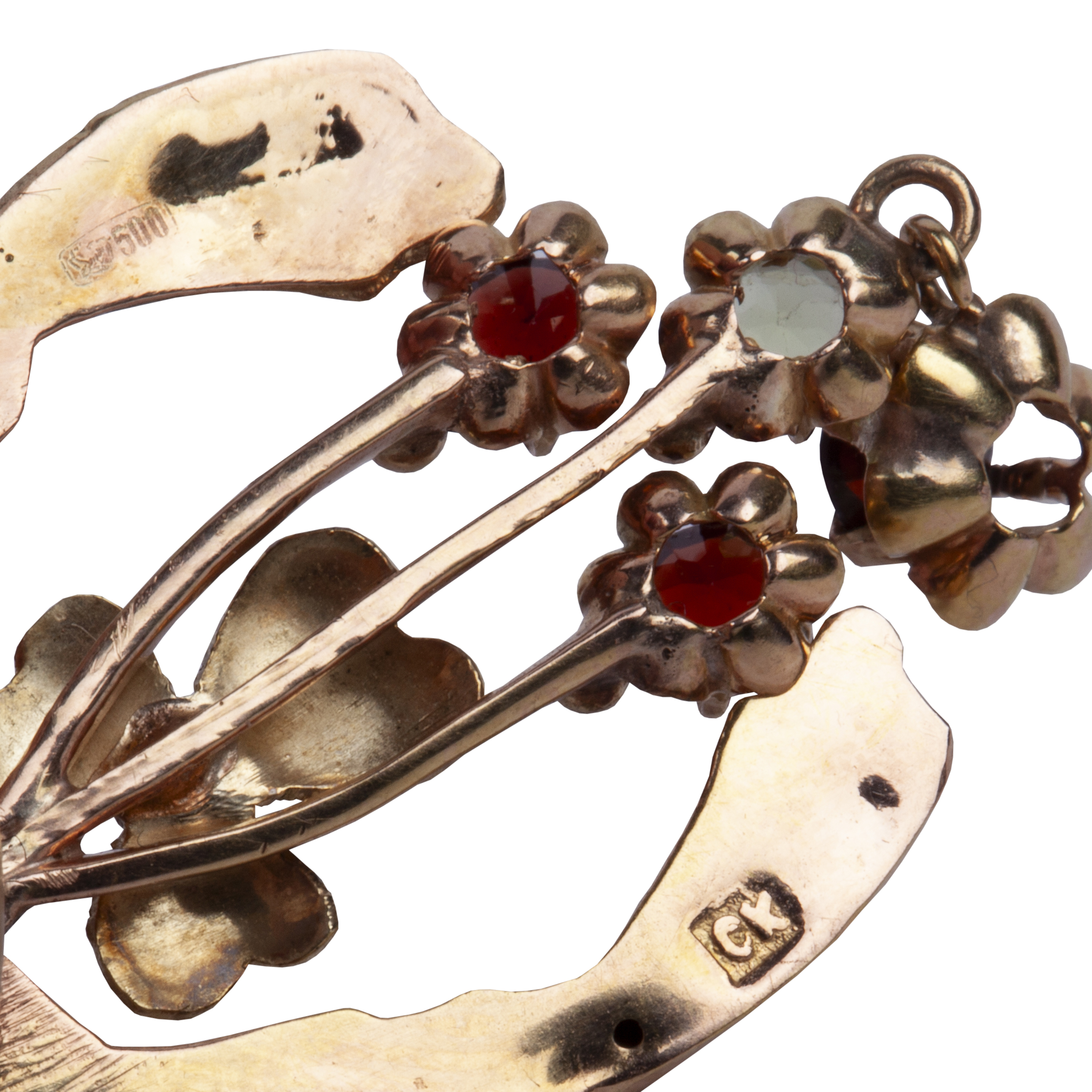
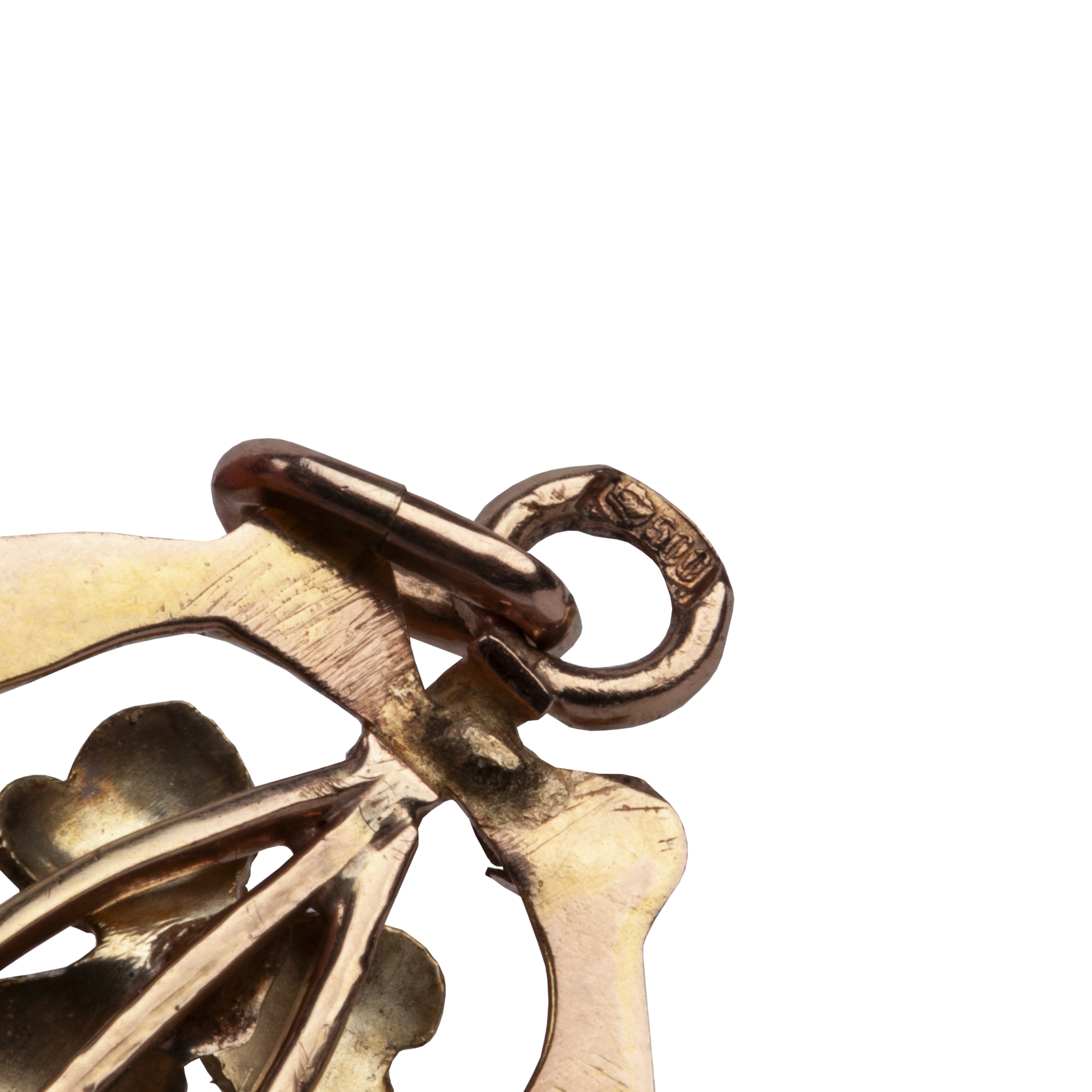
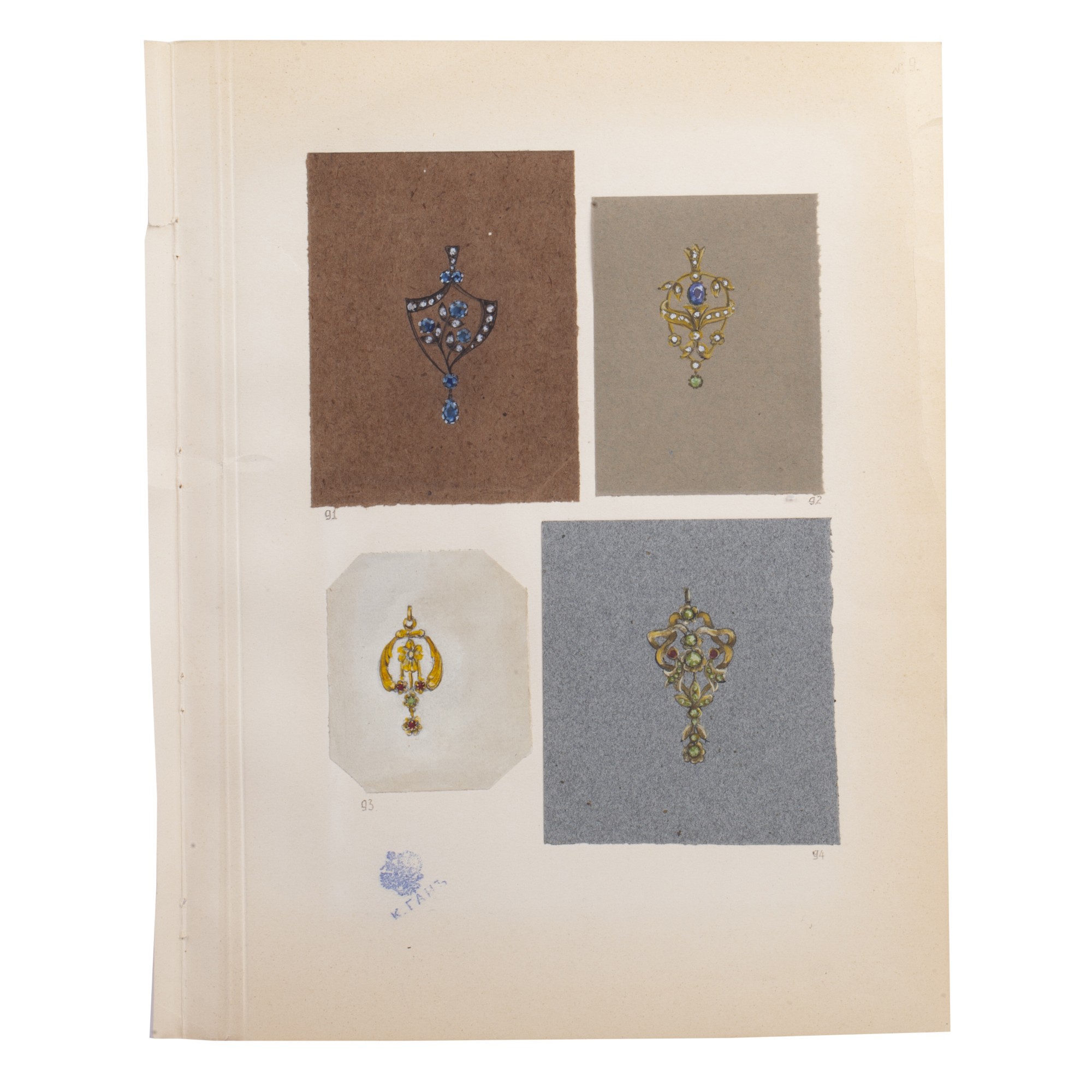
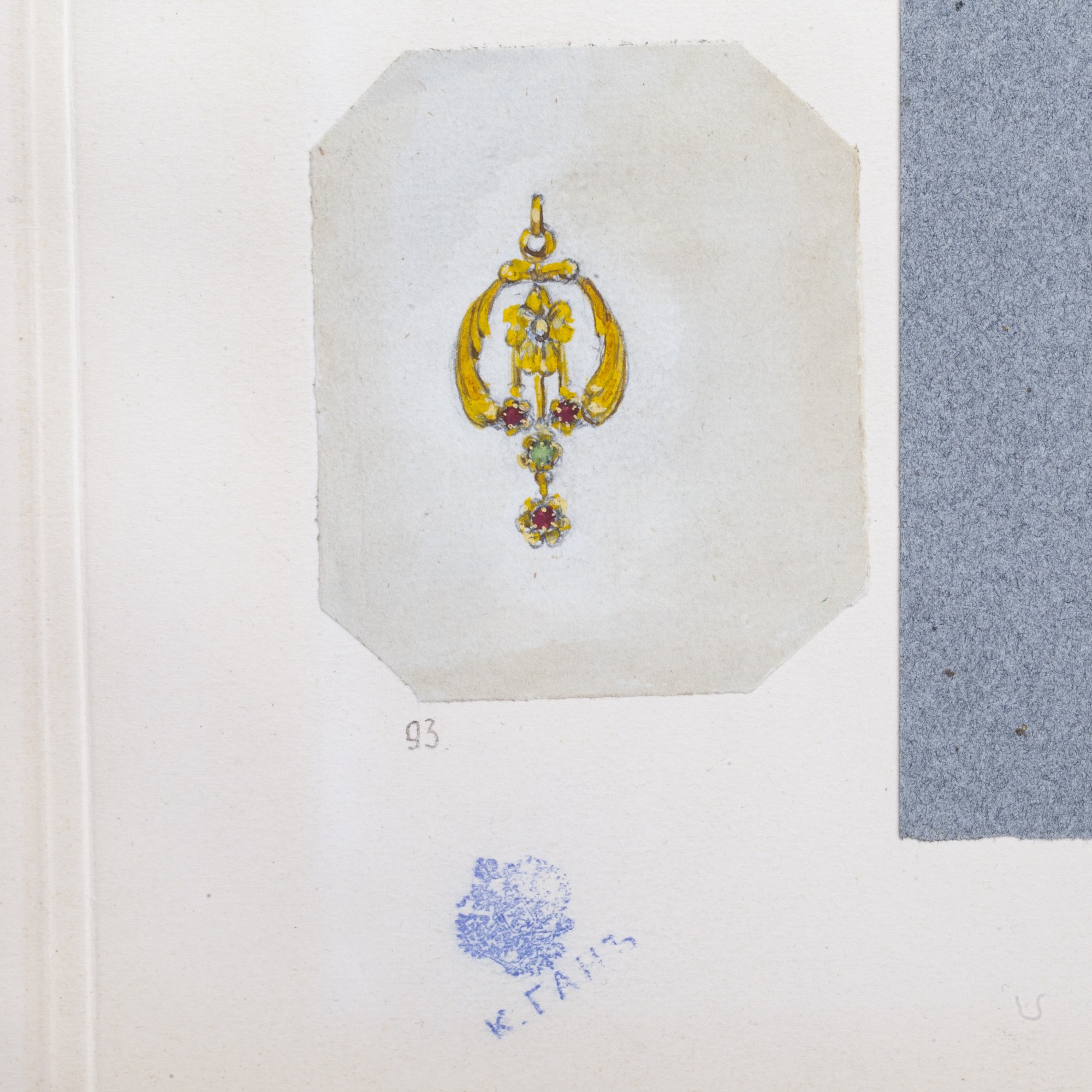
Lot 0247
Karl Gahn. Gold Pendant with Official Archival Sketch
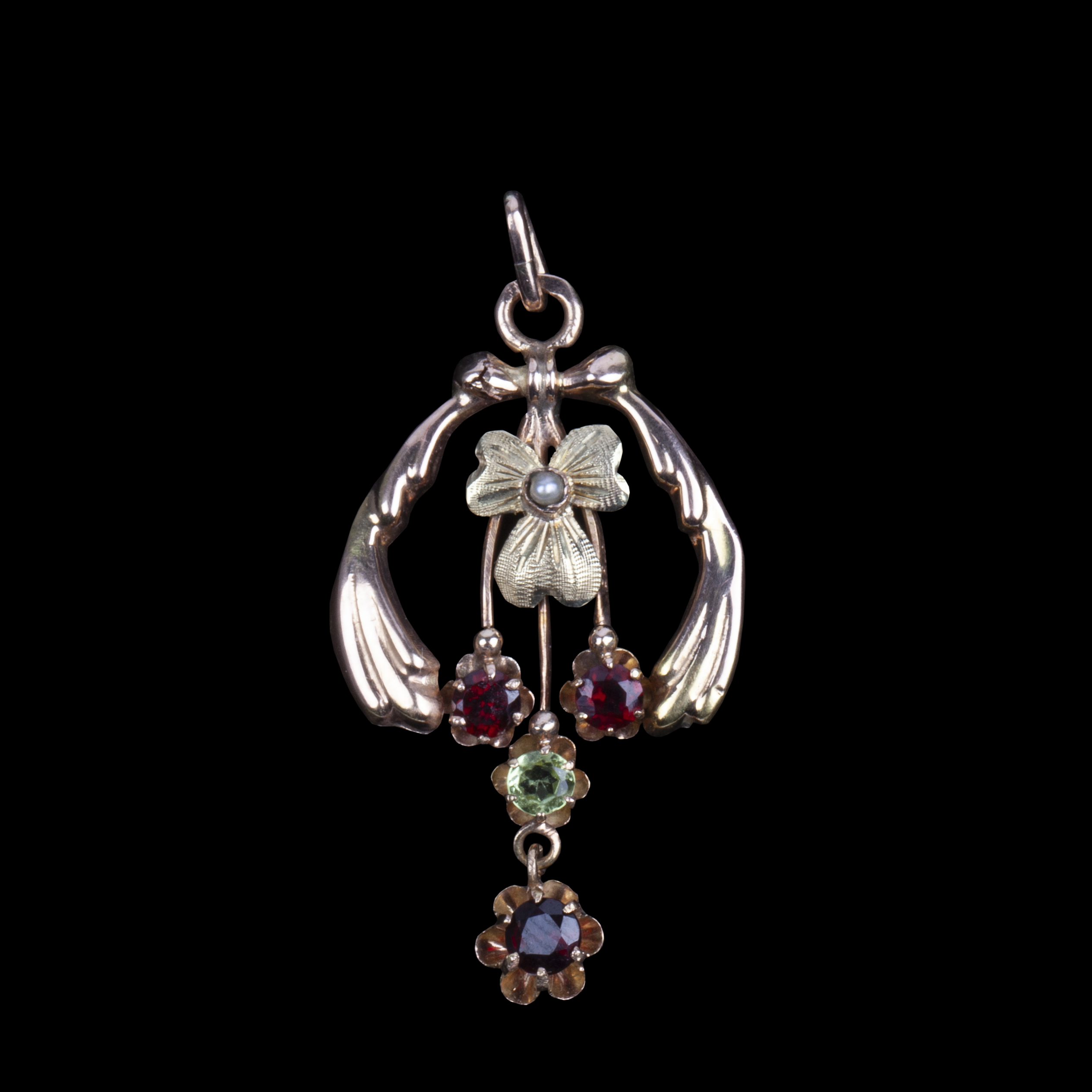
Estimate: 700-900€Karl Gahn. Gold Pendant with official archival sketch.
Firm of Carl Gahn
St. Petersburg, late 19th – early 20th century
Gold, rubies, emerald, pearl; engraved and polished
Dimensions: 4.3 x 2.3 x 0.5 cm.
Total weight: 3.1 gThis delicate Art Nouveau pendant combines gold with colored gemstones — rubies, an emerald, and a small pearl. The stylized floral motif and graceful symmetry reflect the refined taste and craftsmanship characteristic of Carl Gahn’s workshop.
Carl August Ferdinand Gahn (1836–1899) was an Austrian-born goldsmith and jeweler who founded the firm K. Gahn in St. Petersburg in 1873. His shop on Nevsky Prospect quickly gained recognition for the sophistication and technical precision of its designs. In 1895, Gahn was appointed Jeweler to the Imperial Court, creating pieces for the Russian royal family and aristocracy. His firm was considered one of the leading jewelry houses of the Empire, standing alongside Fabergé in artistry and reputation.Starting price: 600€
Estimate: 700-900€
Hammer Price: Not sold -
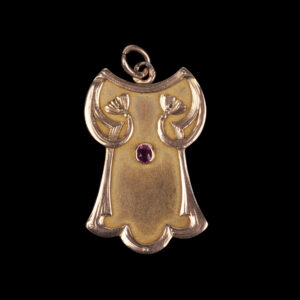
Lot 0248
Karl Gahn. Gold Pendant with Official Archival Sketch
Estimate: 700-900€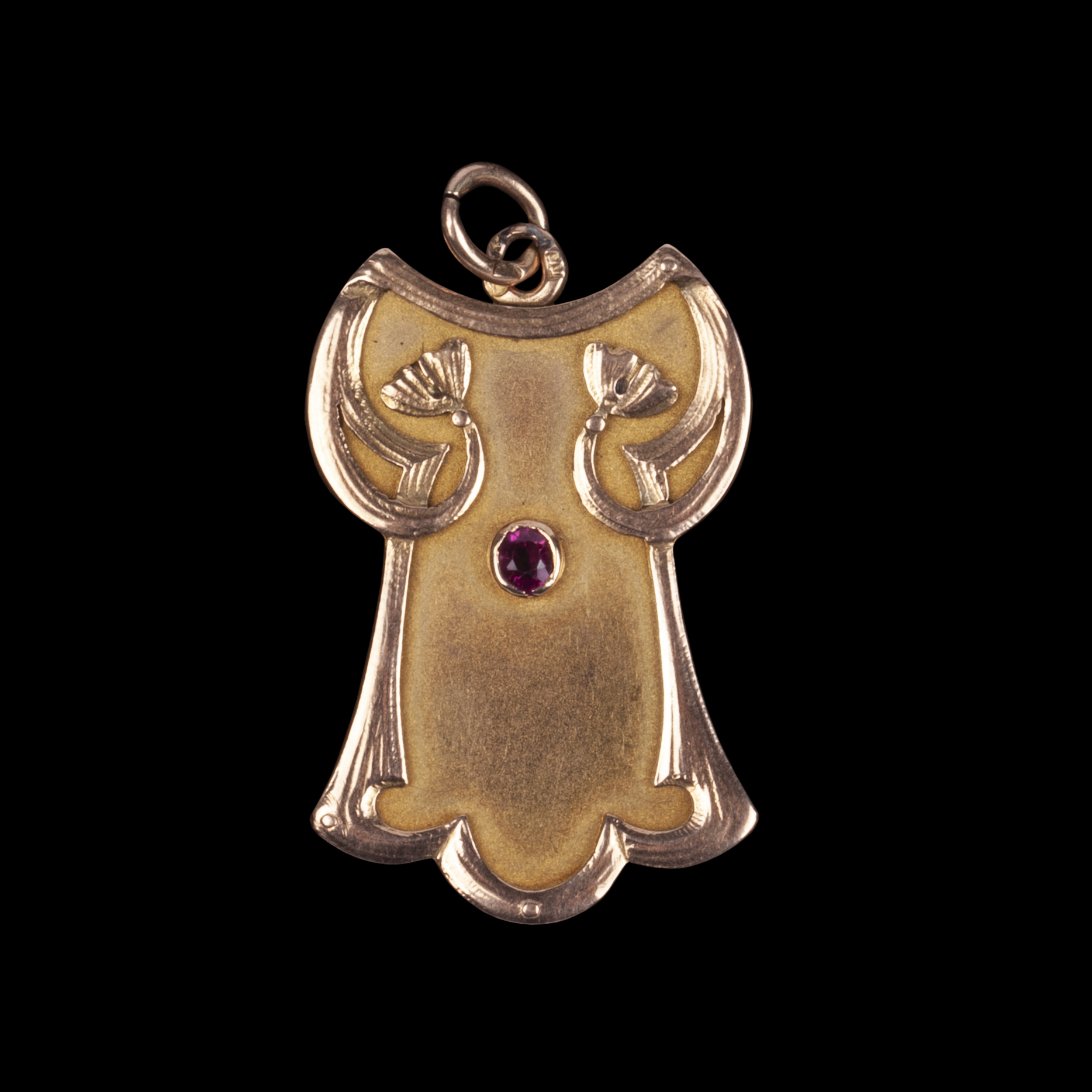
Lot 0248
Karl Gahn. Gold Pendant with Official Archival Sketch
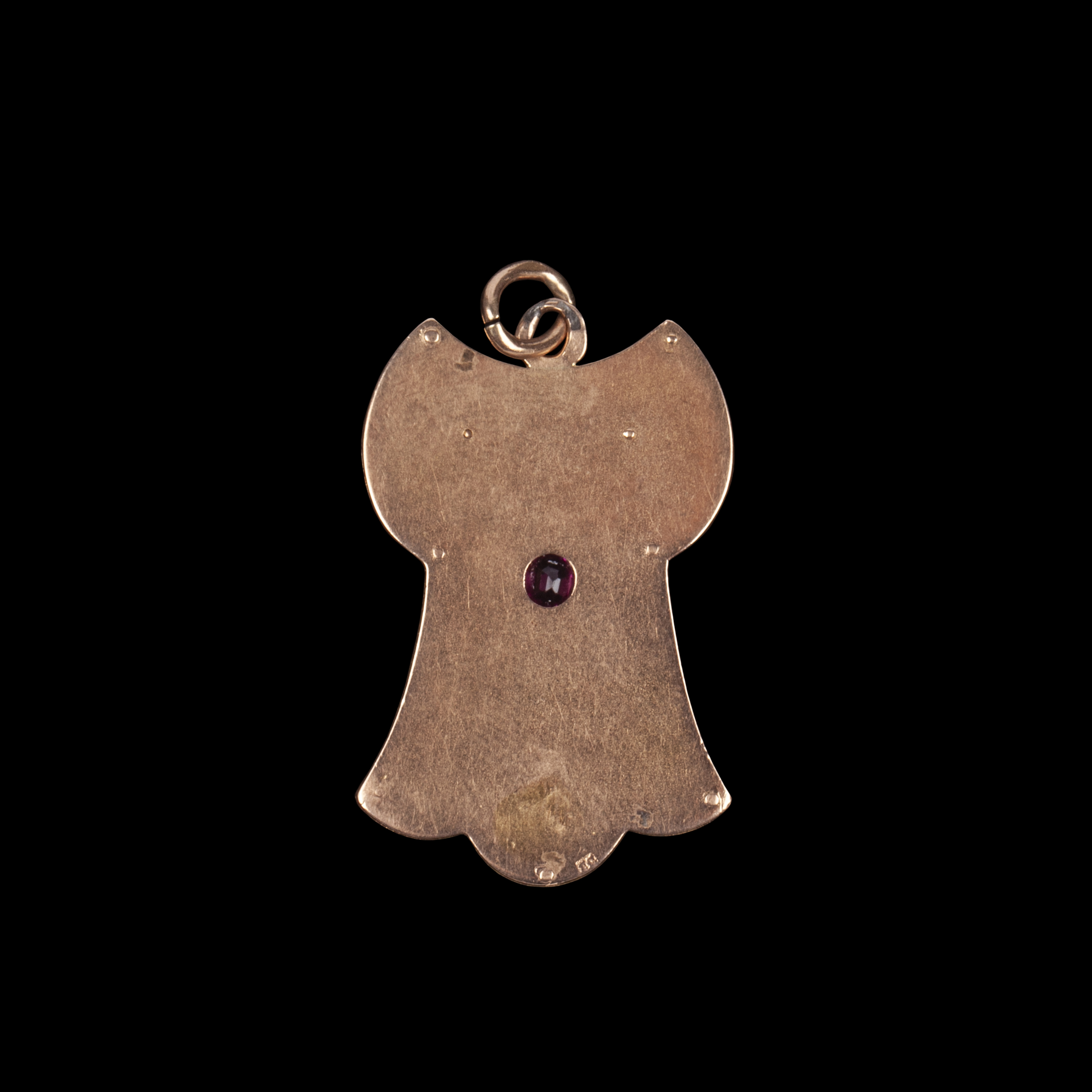
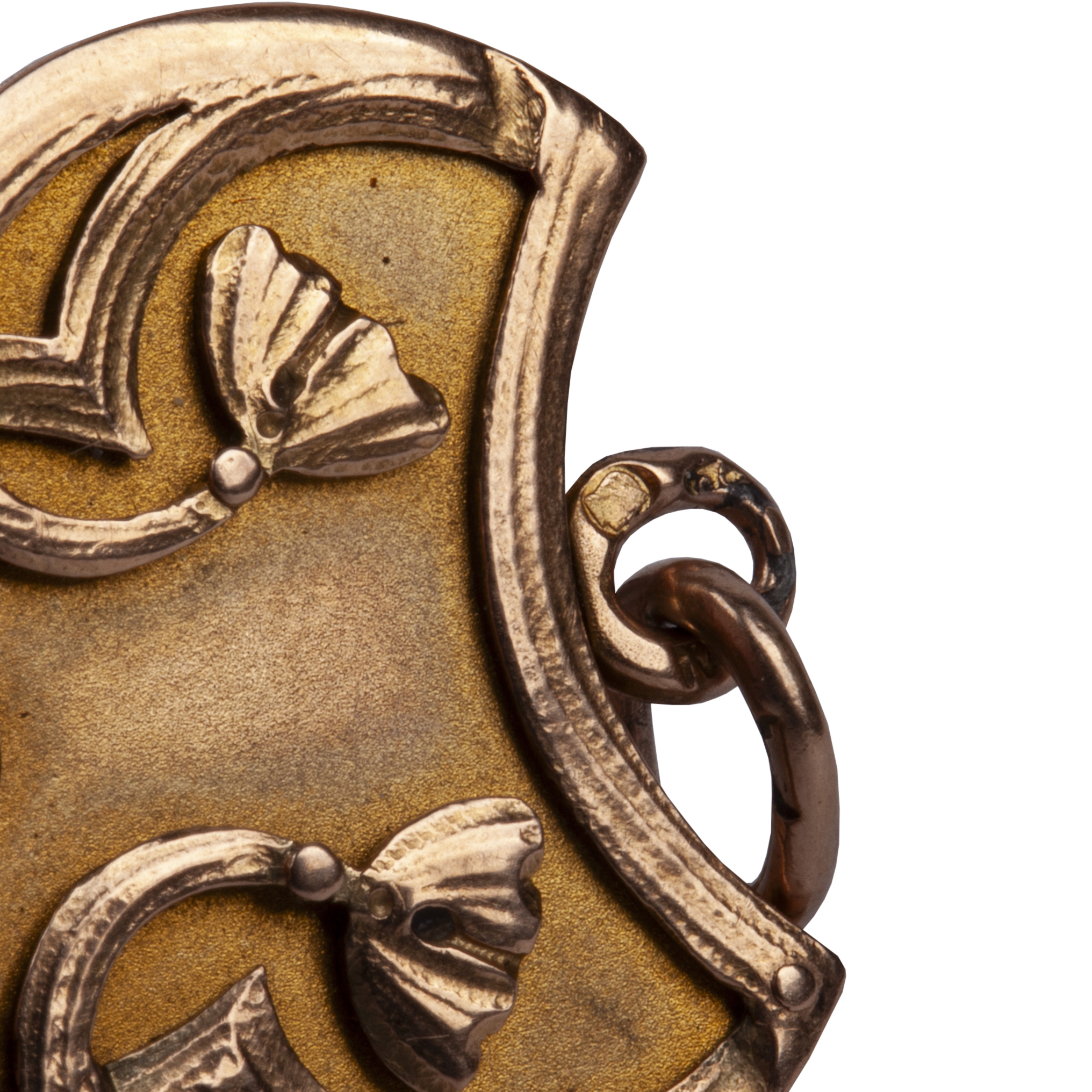
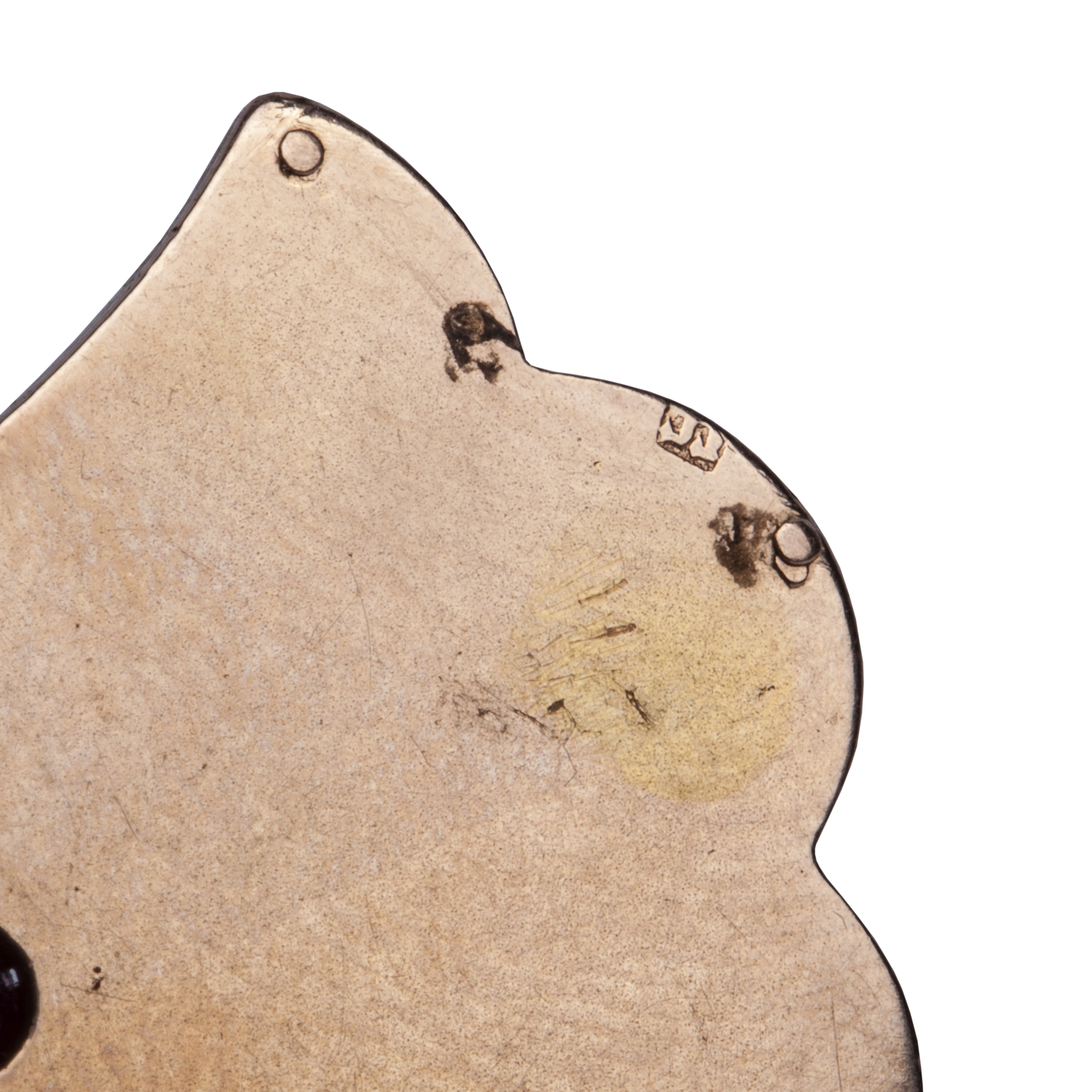
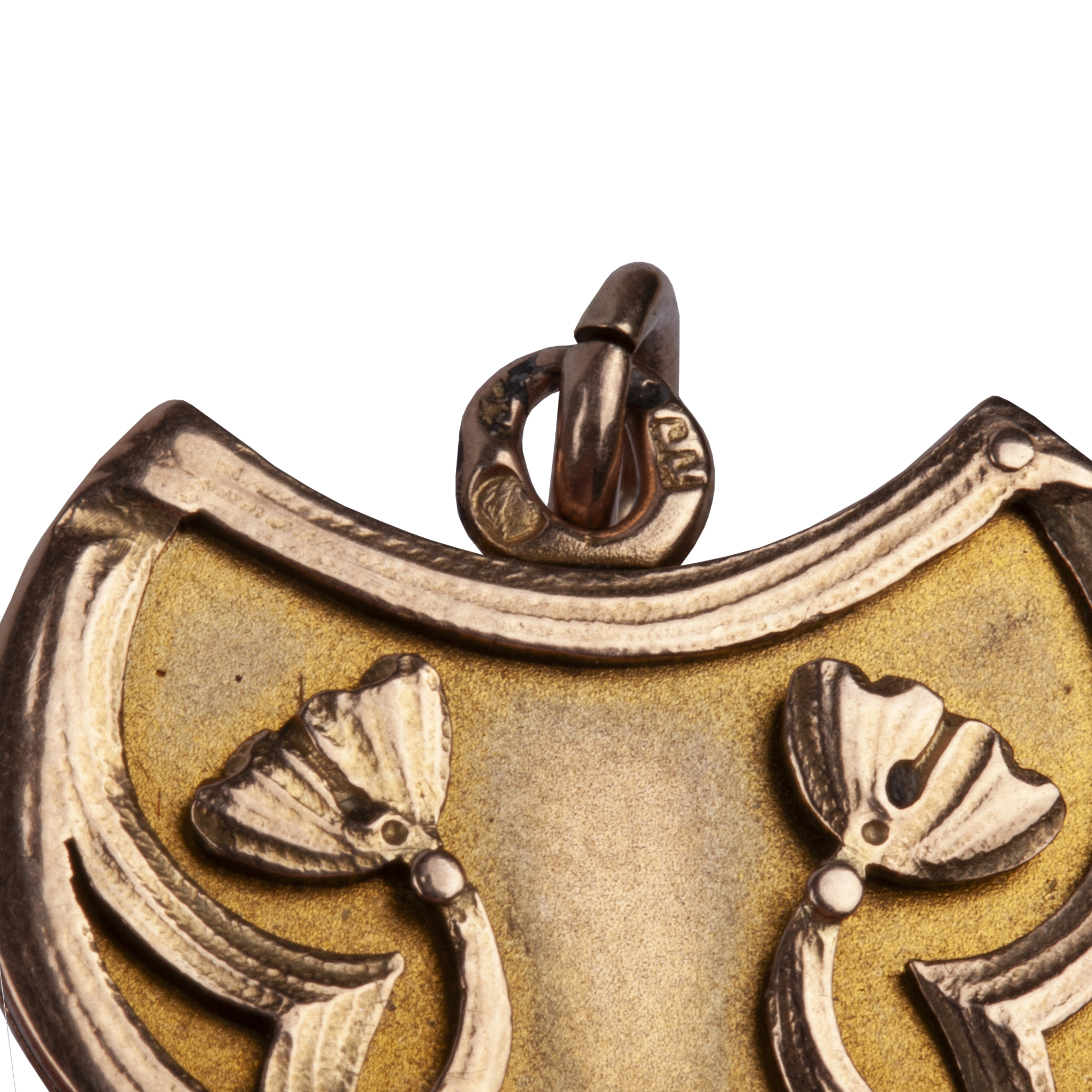
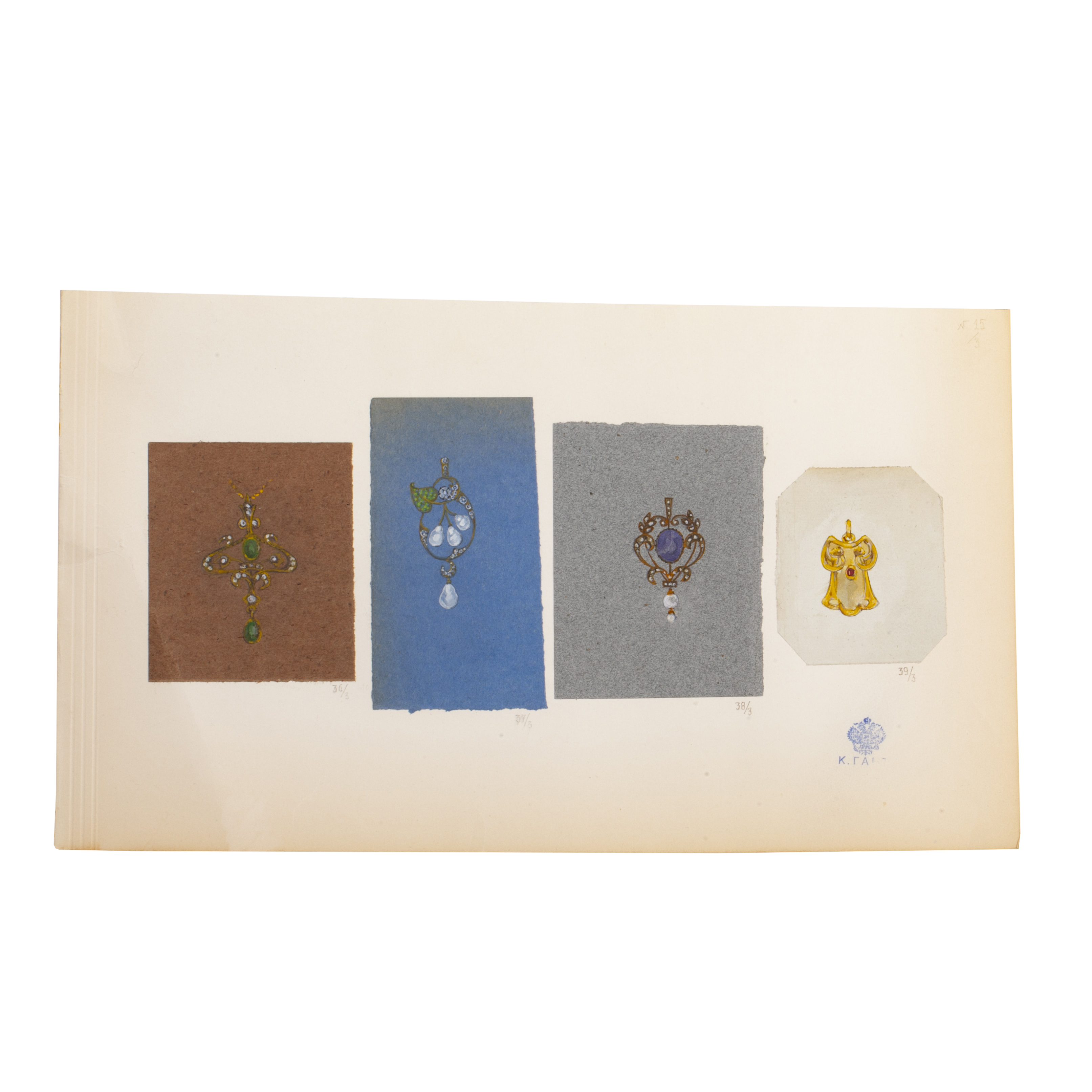
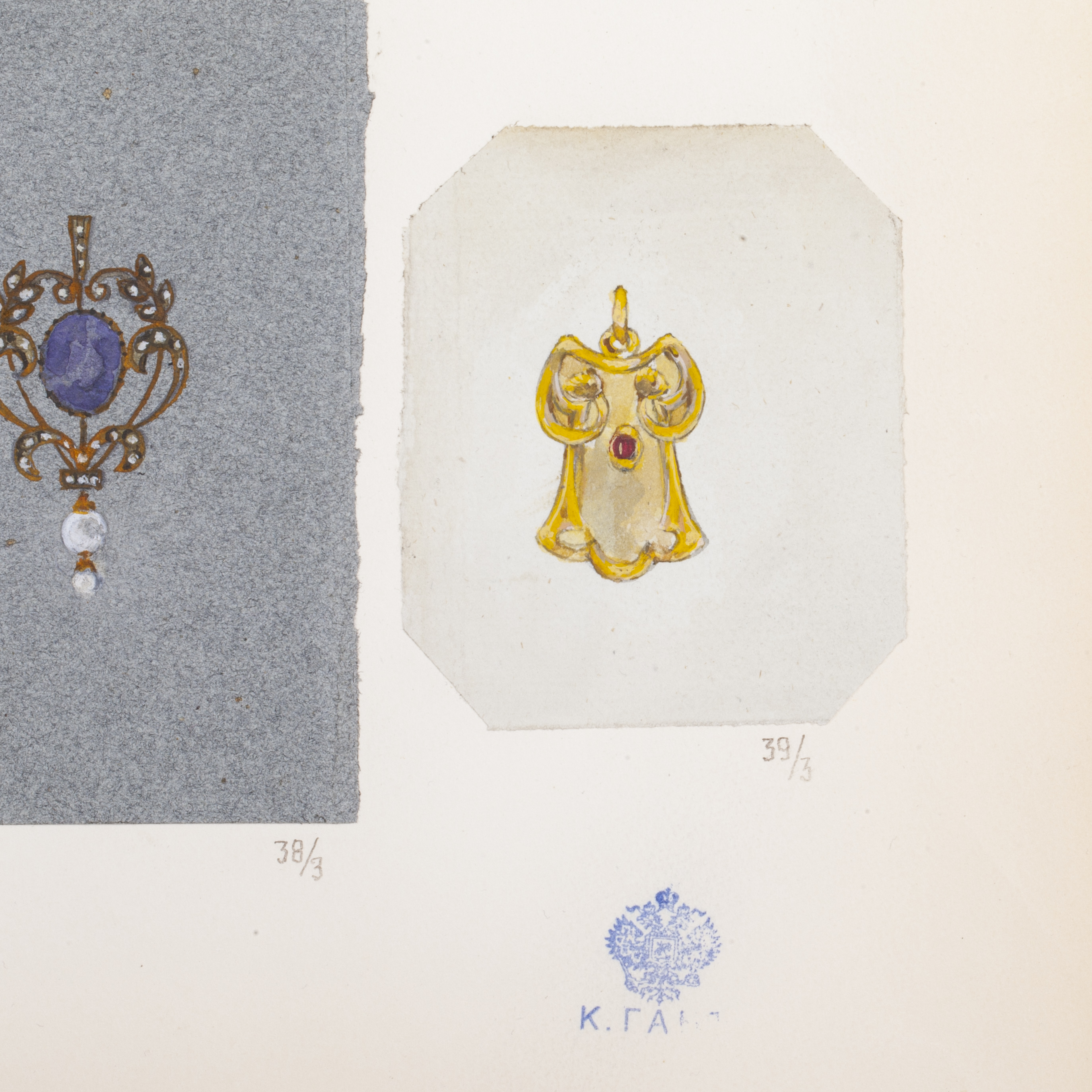
Estimate: 700-900€Karl Gahn. Gold Pendant with official archival sketch.
Makers mark of “CG”
St. Petersburg, late 19th – early 20th century
Gold, ruby; chaised and polished
Dimensions: 3.9 x 2.3 x 0.2 cm.
Total weight: 5.9 gThis Art Nouveau–style pendant, executed in gold with a central ruby, reflects the elegant plasticity and organic motifs characteristic of the period. The stylized floral form and soft contours embody the harmony of line and material that defined Carl Gahn’s work.
Carl August Ferdinand Gahn (Karl Gahn) was a renowned St. Petersburg jeweler and goldsmith. Born as Austrian, he became a Russian citizen in 1892. In 1873, he founded the jewelry firm K. Gahn, which soon gained prominence for its finely crafted gold and silver objects—cups, cigarette cases, and tableware—often enriched with enamel and gemstones.
Gahn’s artistry and precision earned him recognition at the Imperial Court, where his firm became an official supplier in 1895. His creations combined technical mastery with refined aesthetics, placing his workshop among the foremost jewelers of the Russian Empire, alongside Fabergé.
Starting price: 600€
Estimate: 700-900€
Hammer Price: Not sold -
Lot 0249
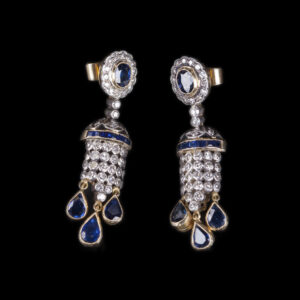
Art Deco Style Gold 56 Earrings with Sapphires and Diamonds
Estimate: 1300-1500€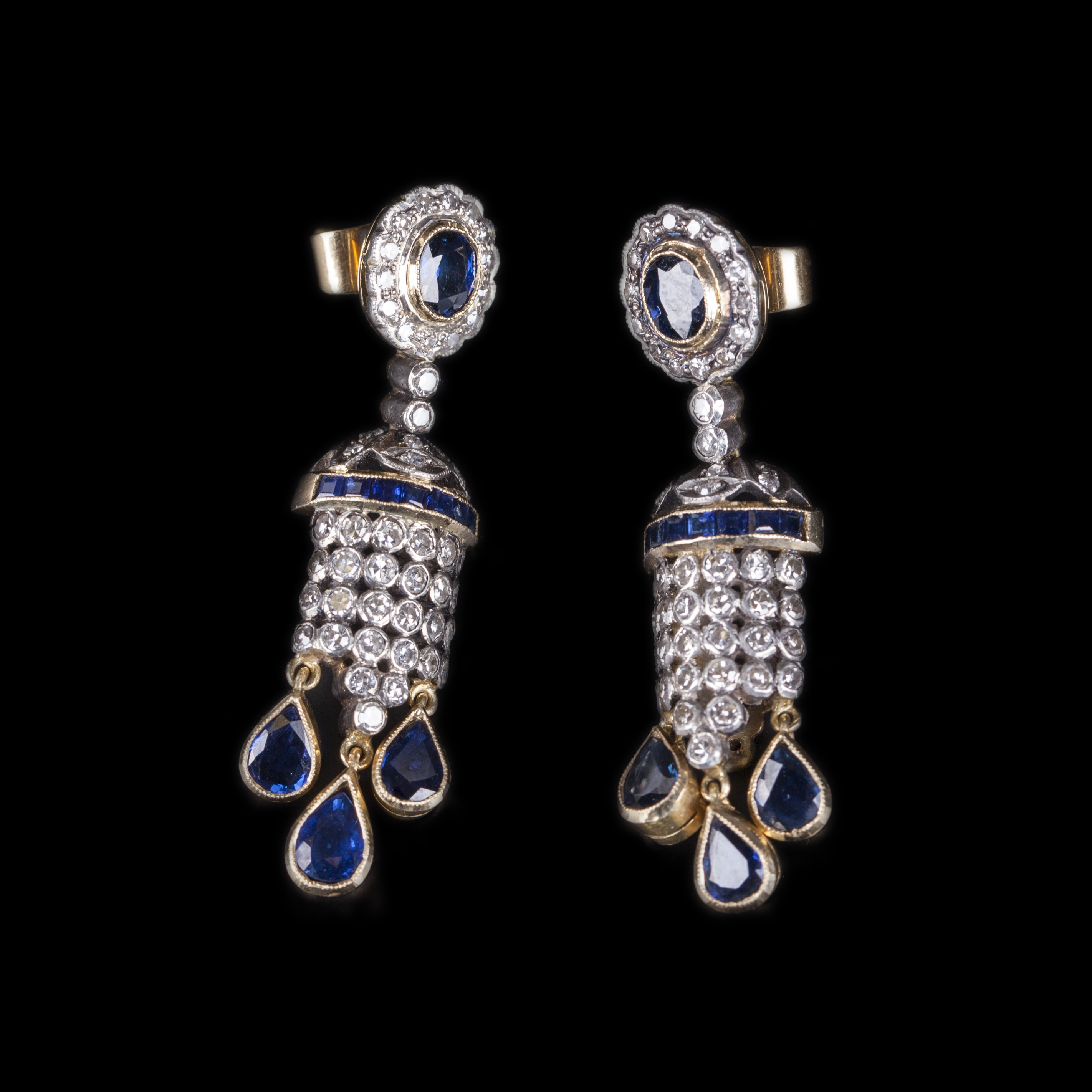
Lot 0249
Art Deco Style Gold 56 Earrings with Sapphires and Diamonds
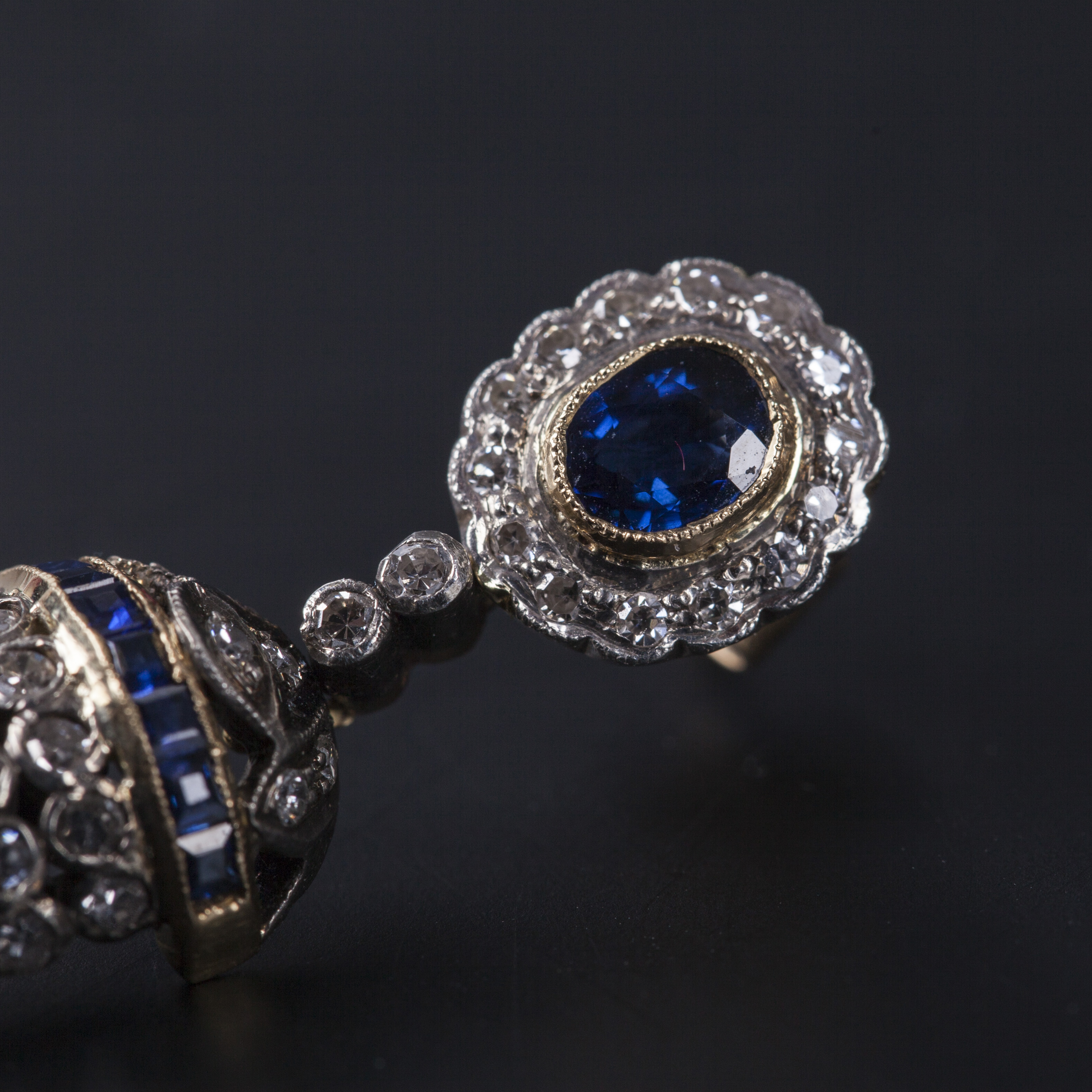
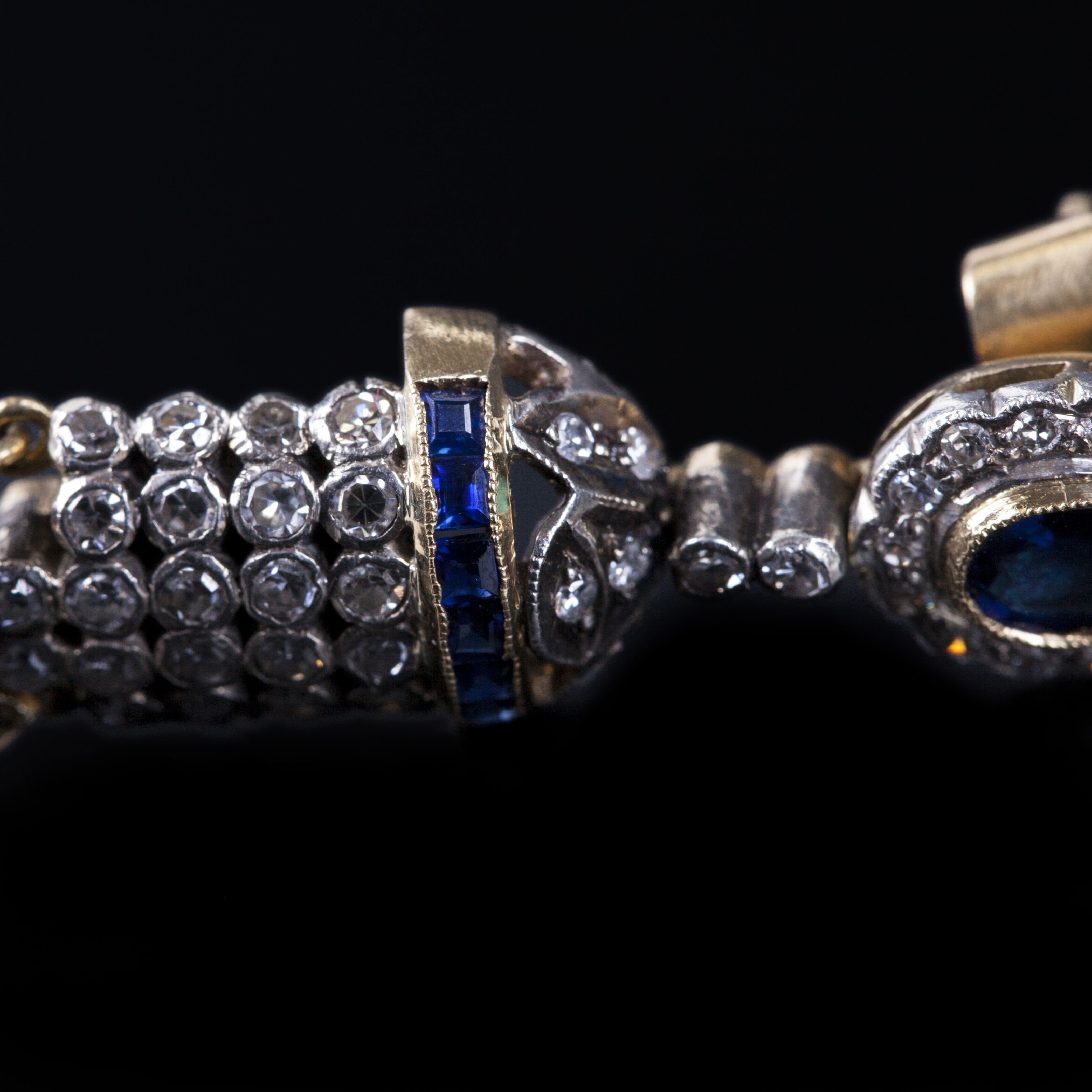
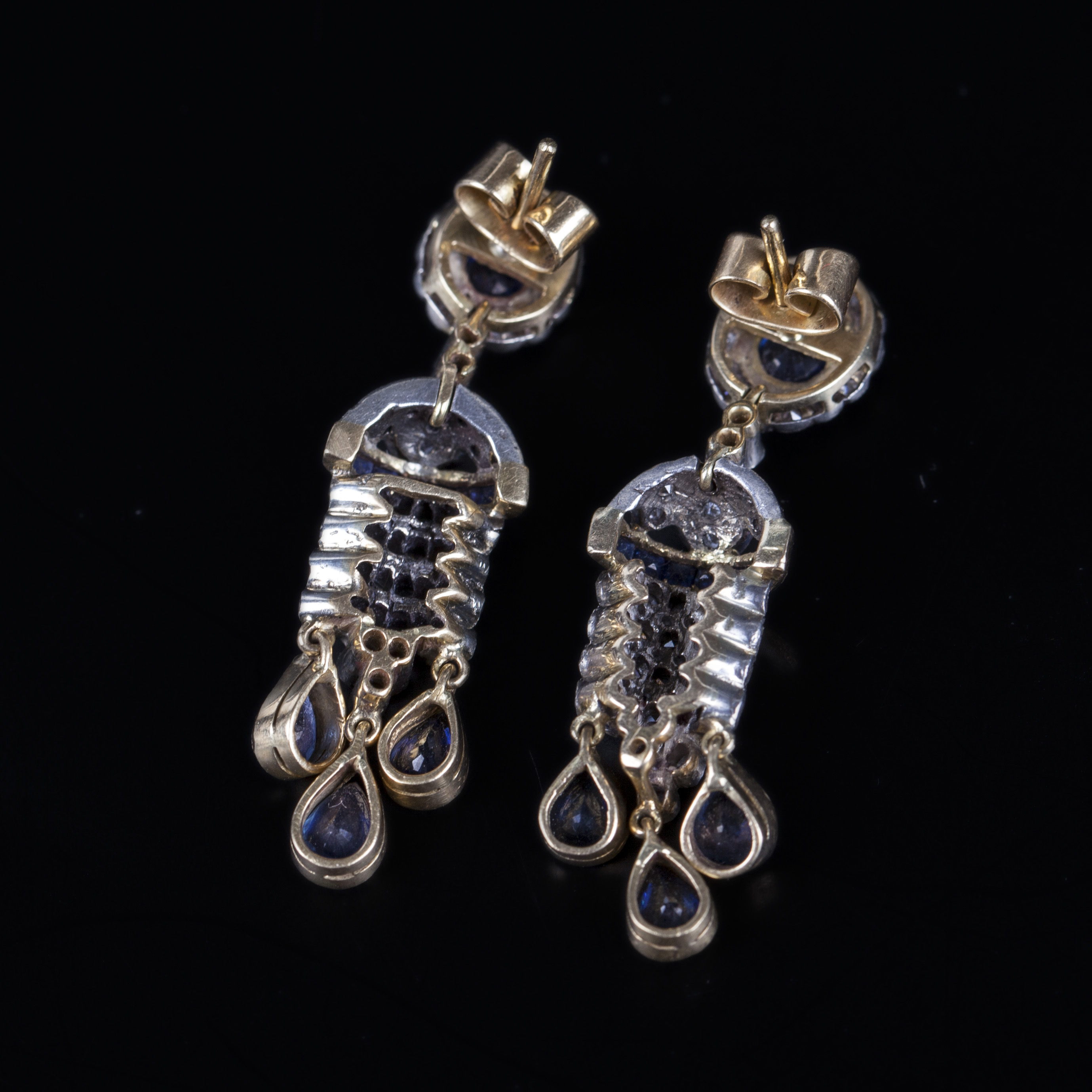
Estimate: 1300-1500€Earrings
Russia or Western Europe, early 20th century
Gold (56 zolotnik), sapphires, diamonds
Weight: 10.8 g Height: 40.5 mmA pair of Art Deco–style gold earrings set with brilliant-cut diamonds and richly hued sapphires. The geometric precision, contrasting tones, and tiered composition embody the elegance and modernity of early 20th-century design.
Starting price: 1200€
Estimate: 1300-1500€
Hammer Price: 1 400 € -
Lot 0250
Faberge Gold and Enamel Cufflinks by Oskar Pihl
Estimate: 3000-3500€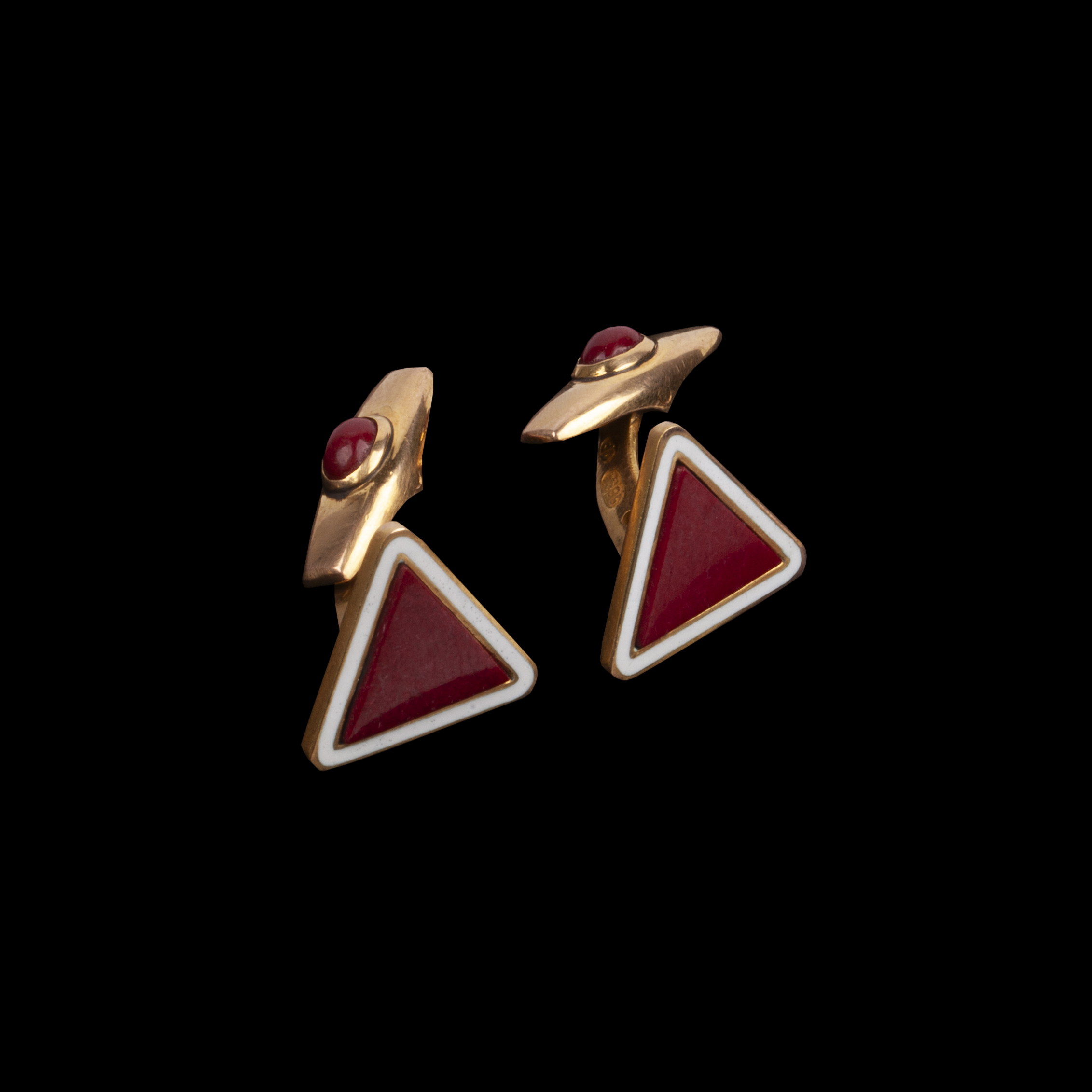
Lot 0250
Faberge Gold and Enamel Cufflinks by Oskar Pihl
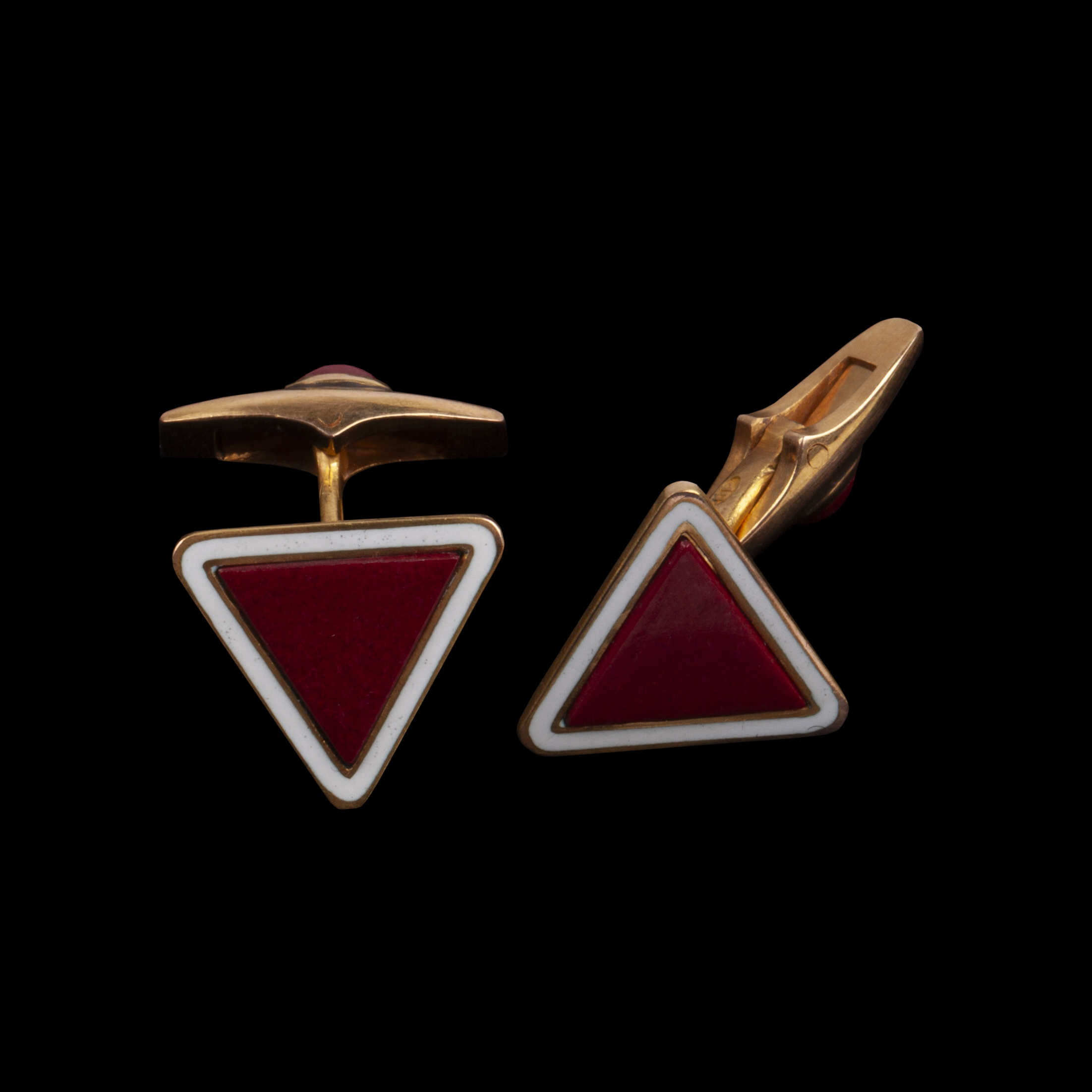
Estimate: 3000-3500€Faberge. Gold cufflinks.
Gold, guilloche and cloisonné enamel, ruby.
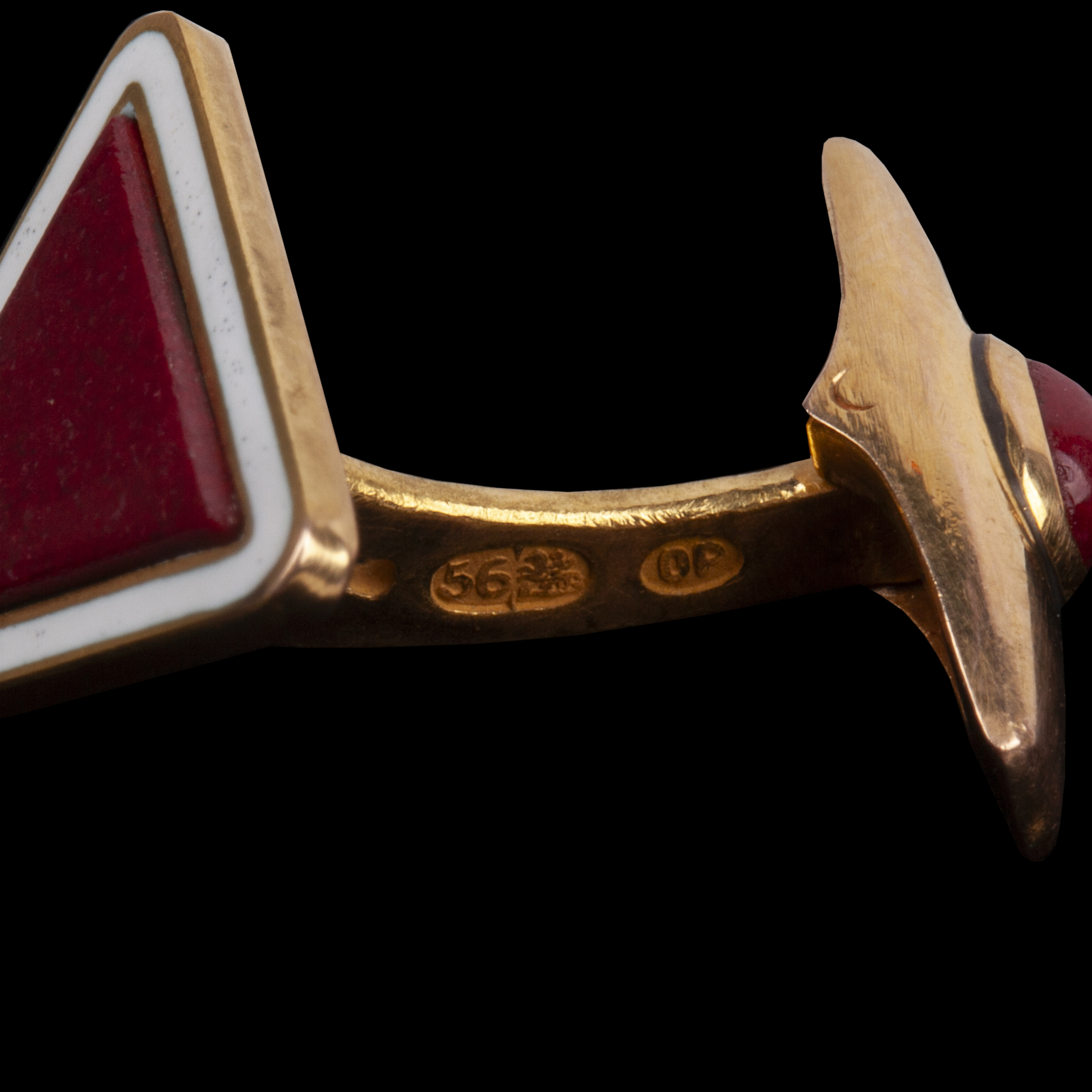
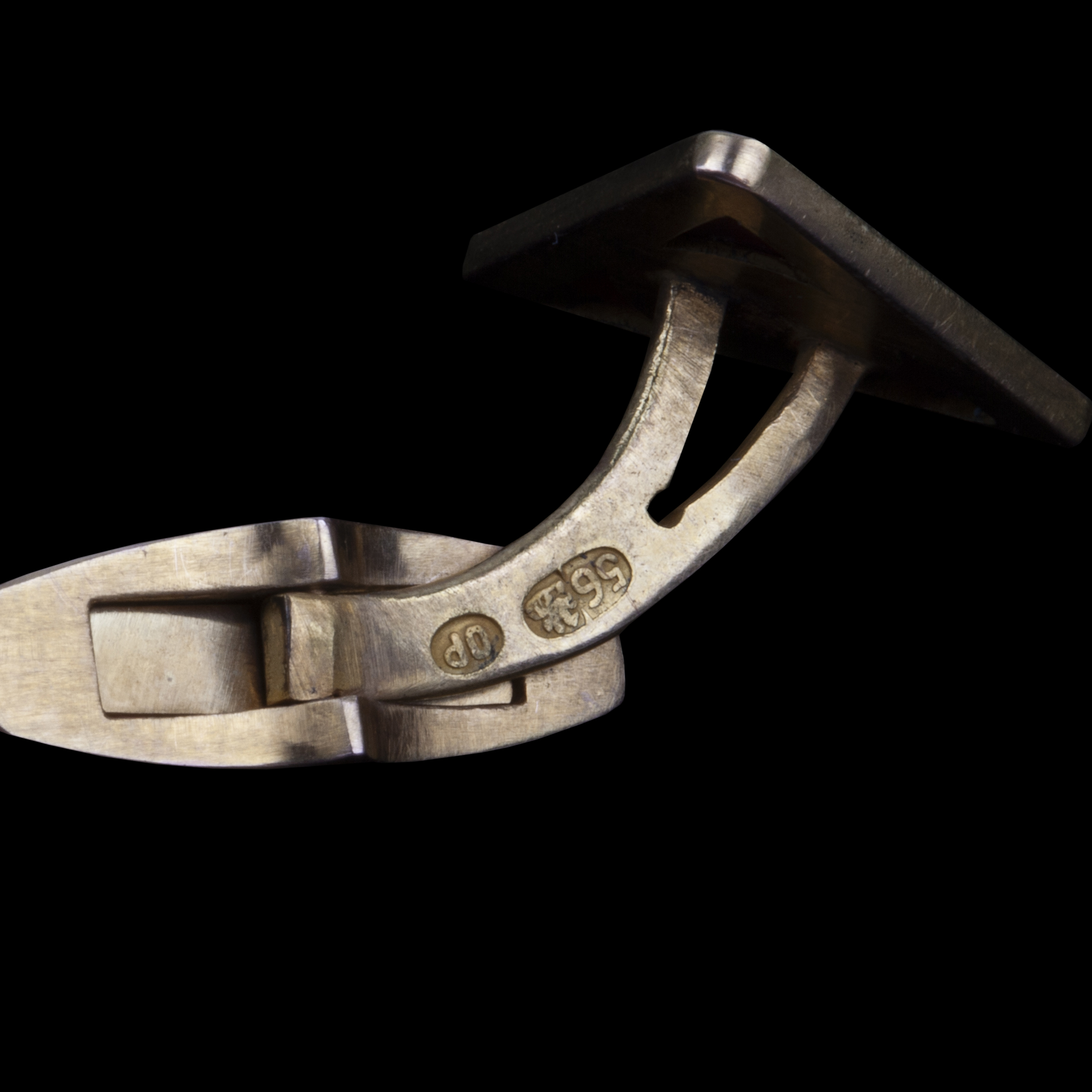
Makers mark of «OP», Moscow, circa 1890s.
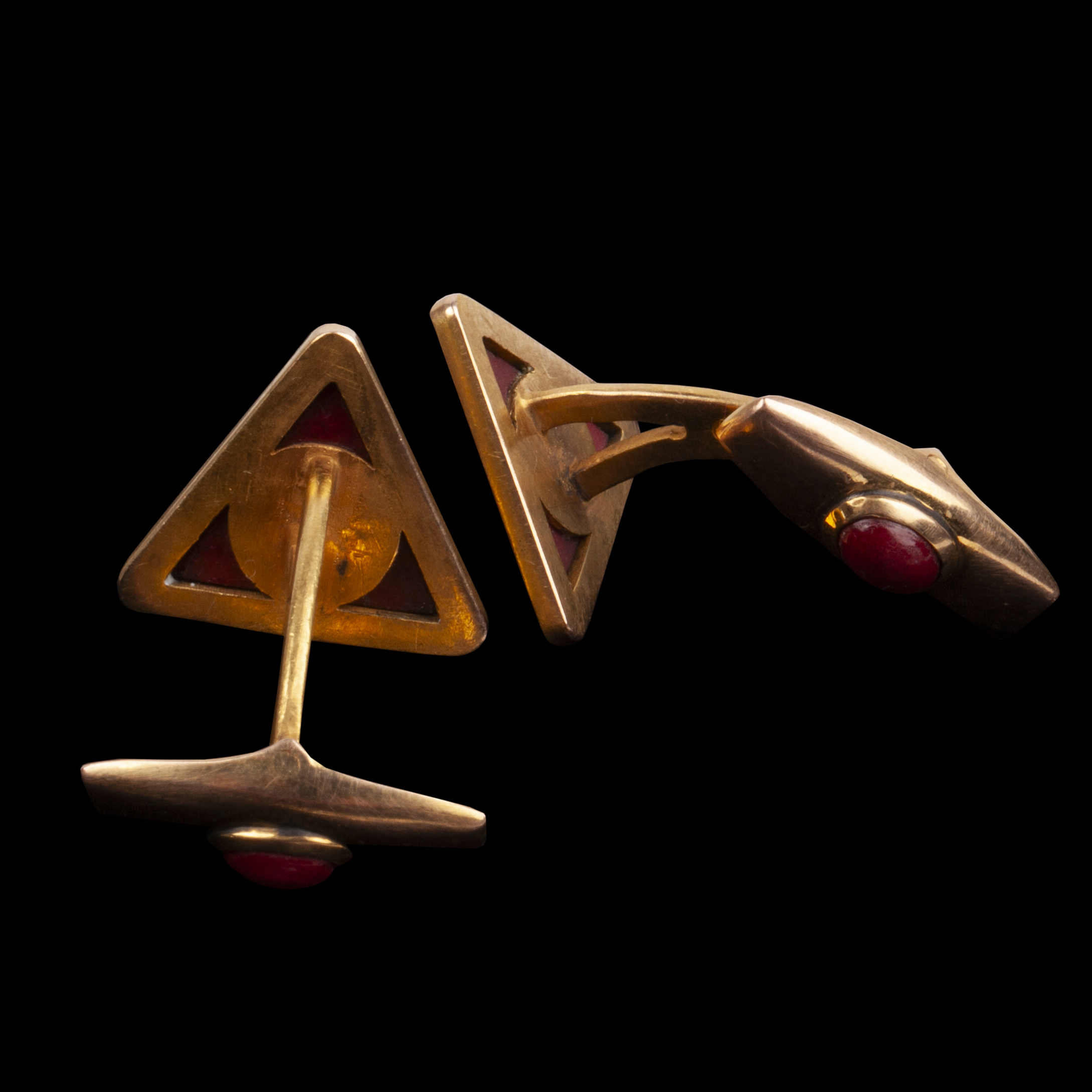
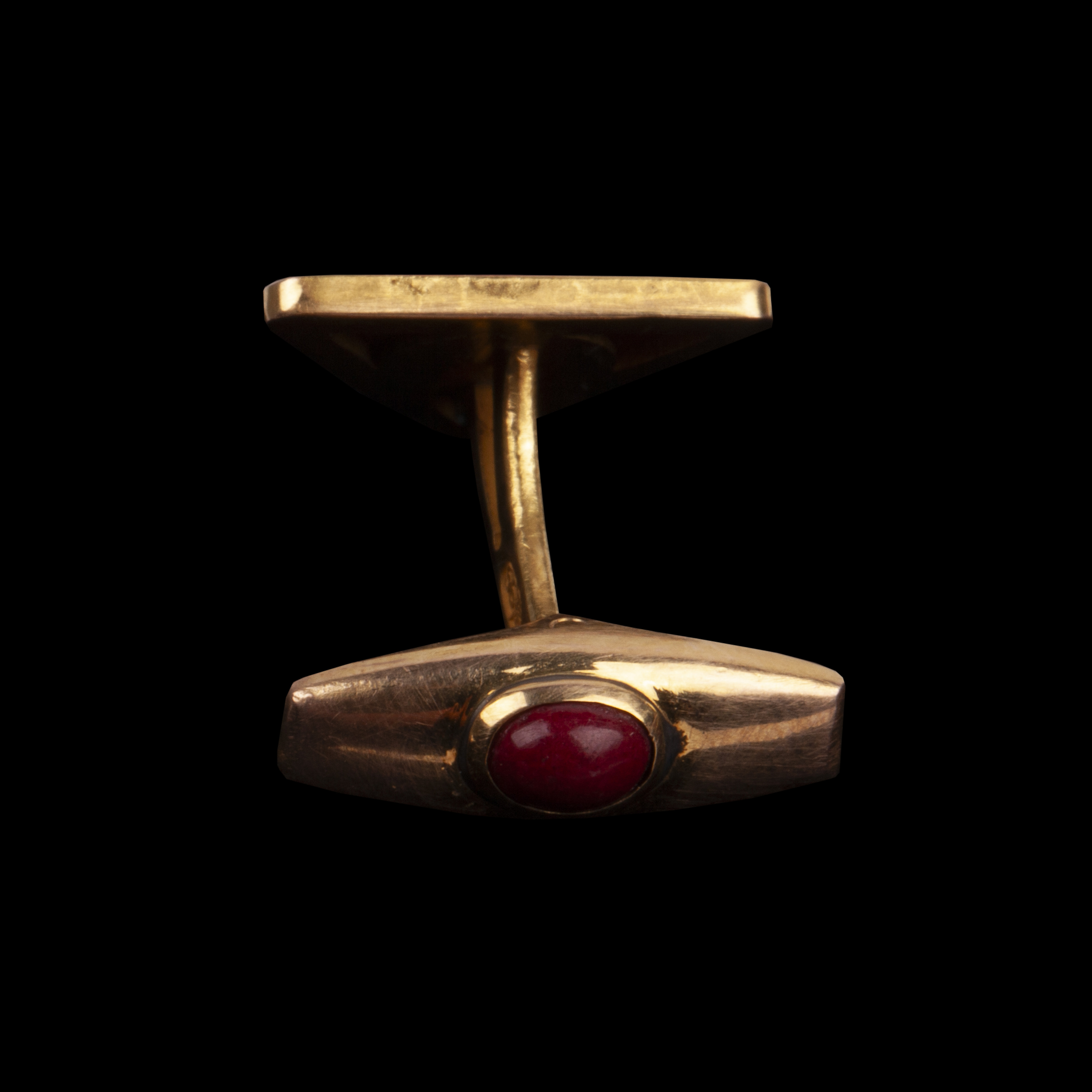
Total weight: 9.4 gGold cufflinks decorated with translucent red guilloché enamel framed in white enamel. The equilateral triangular design emphasizes clarity and symmetry. The reverse side features a cabochon stone in ruby, echoing the color of the enamel.
Knut-Oskar Pihl (1860–1924) was a Finnish jeweler and head master of the Moscow branch of the House of Fabergé between 1887 and 1897. At the age of six, Pihl was sent from Finland to St. Petersburg to live with his uncle, a watchmaker. He later trained in the workshop of the renowned Finnish jeweler August Holmström. His skill and precision so impressed Holmström that in 1887 he arranged the marriage of his daughter Fanny to Pihl and recommended him to Carl Fabergé.
See similar: https://www.sothebys.com/en/auctions/ecatalogue/2009/russian-art-n08538/lot.297.html
https://collectiononline.kreml.ru/entity/OBJECT/444161?rubrics=3169211&index=11Starting price: 2500€
Estimate: 3000-3500€
Hammer Price: 2 500 € -
Lot 0251
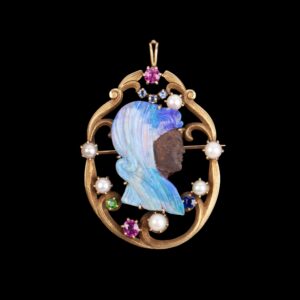
Art Nouveau Gold Brooch Pendant with Opal Matrix Cameo and Gem Set, 14K (585), late 19th–early 20th century
Estimate: 10000-15000€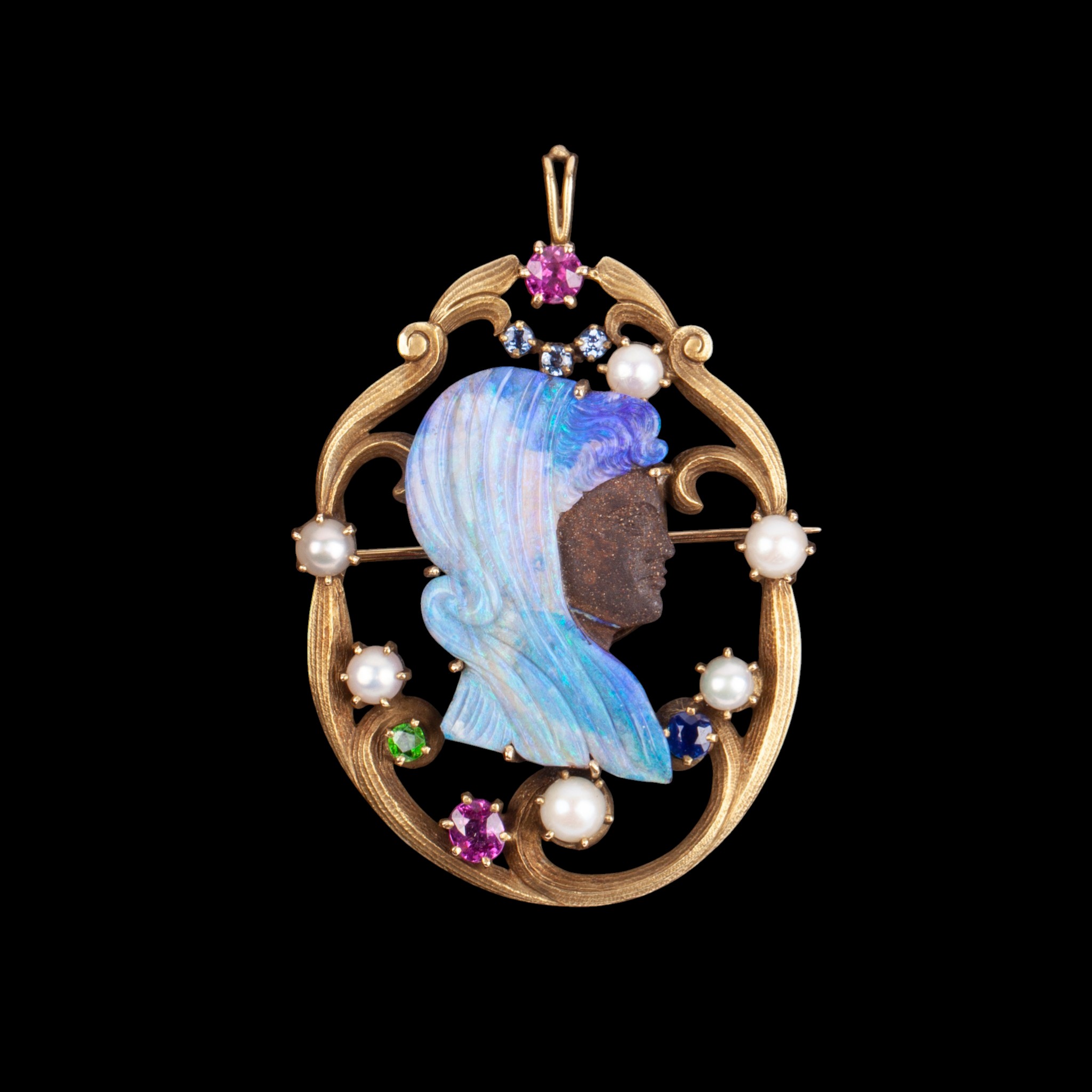
Lot 0251
Art Nouveau Gold Brooch Pendant with Opal Matrix Cameo and Gem Set, 14K (585), late 19th–early 20th century
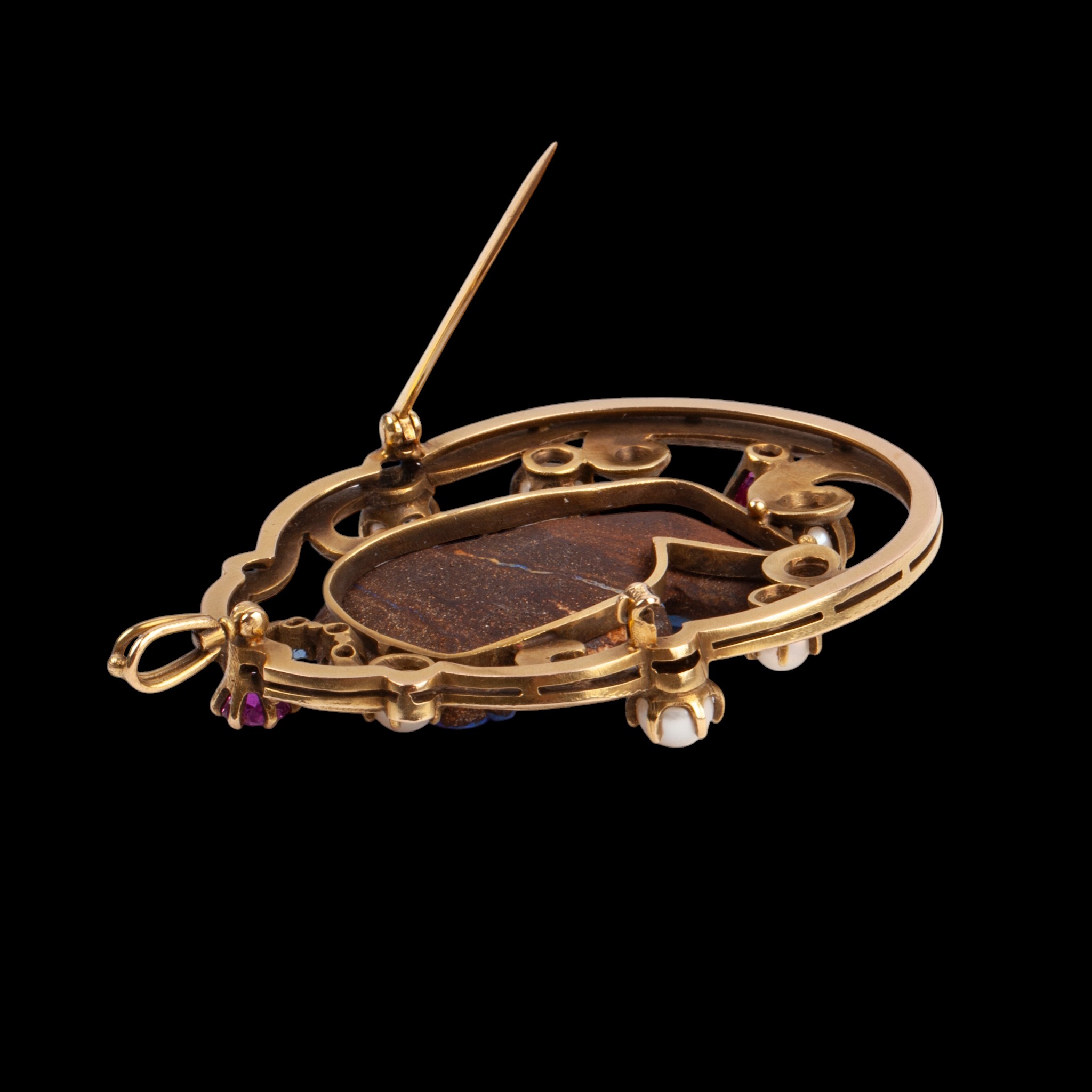
Estimate: 10000-15000€Art Nouveau Style Gold, Opal Matrix and Gem-Set Cameo Brooch Pendant
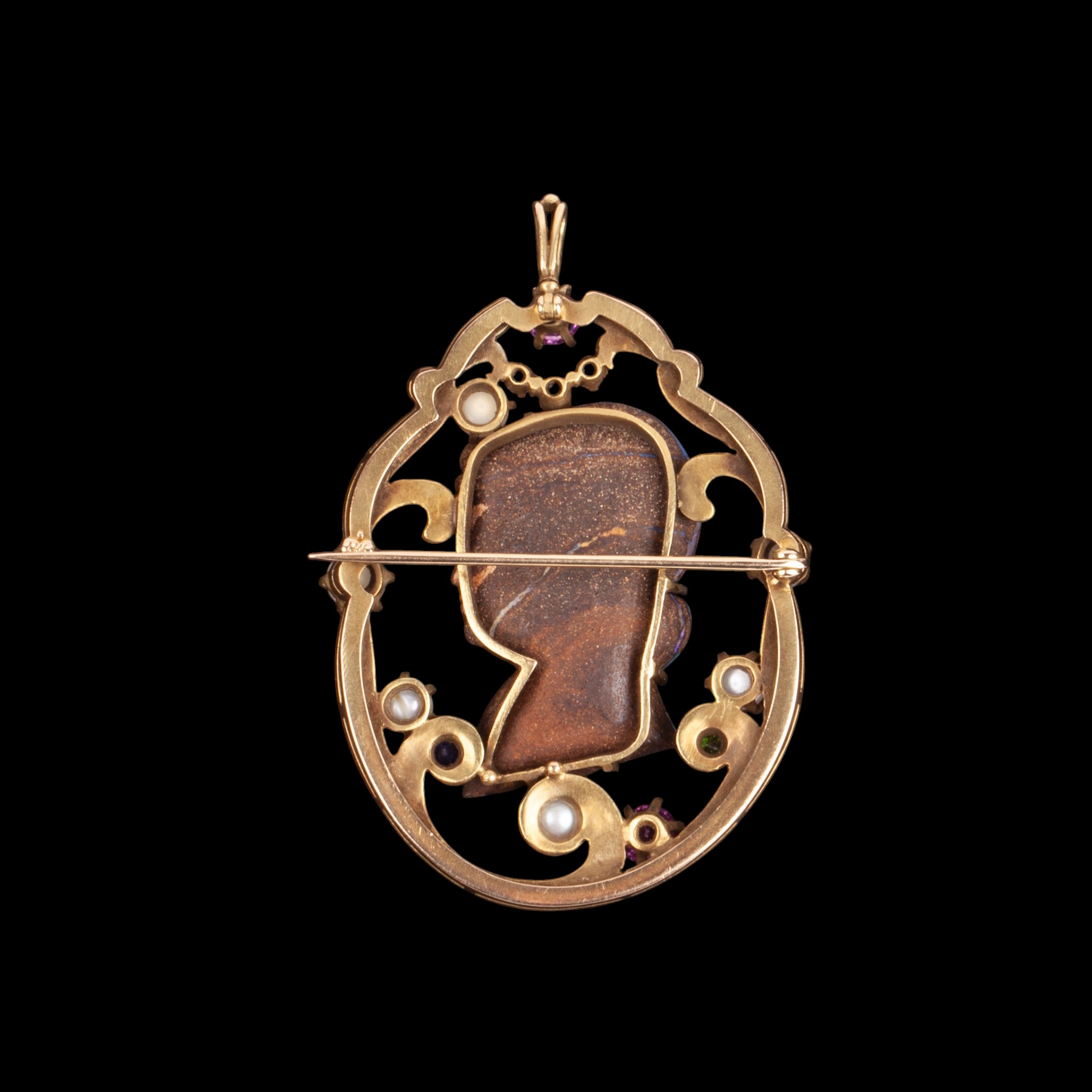
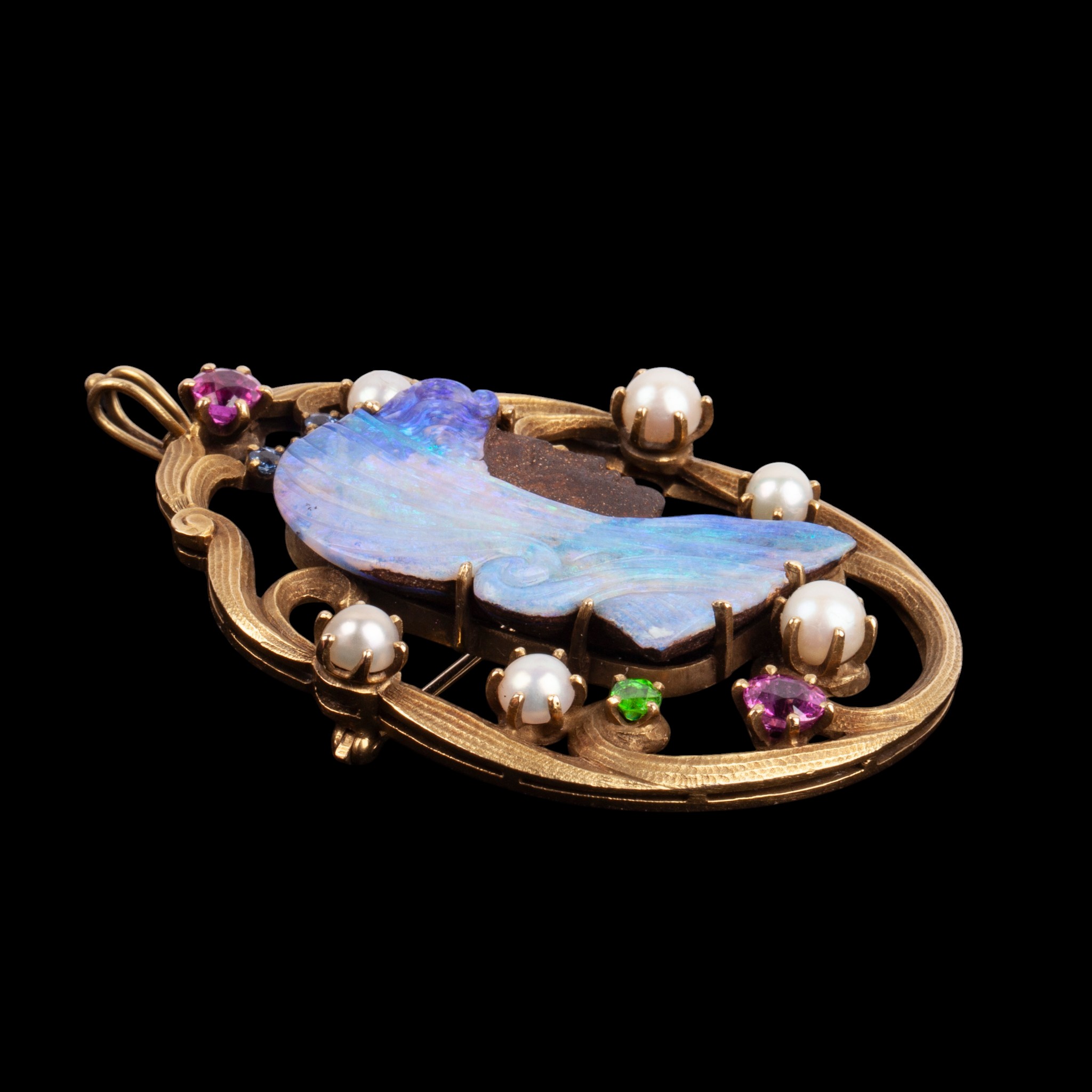
An unusual gold brooch pendant designed as an openwork oval frame enclosing a female profile cameo, carved in opal matrix with vivid blue iridescence and set against a darker natural stone ground. The flowing mount is highlighted with seed pearls and further accented with coloured stones, including pink and blue gems and a small green stone. The reverse fitted with a brooch pin, while the suspension loop allows the piece to be worn also as a pendant.
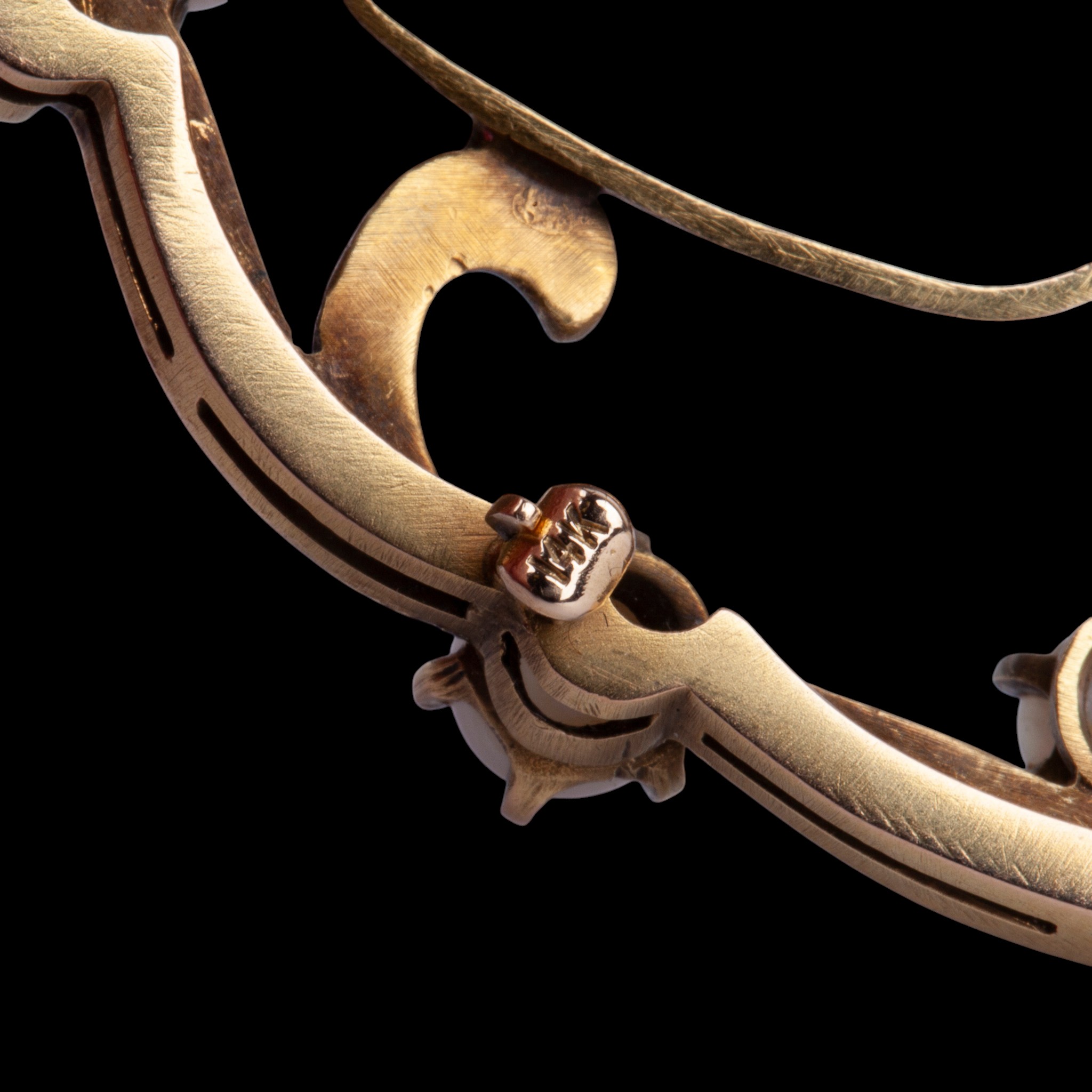
The reverse bears a 585 mark, indicating 14 karat gold.
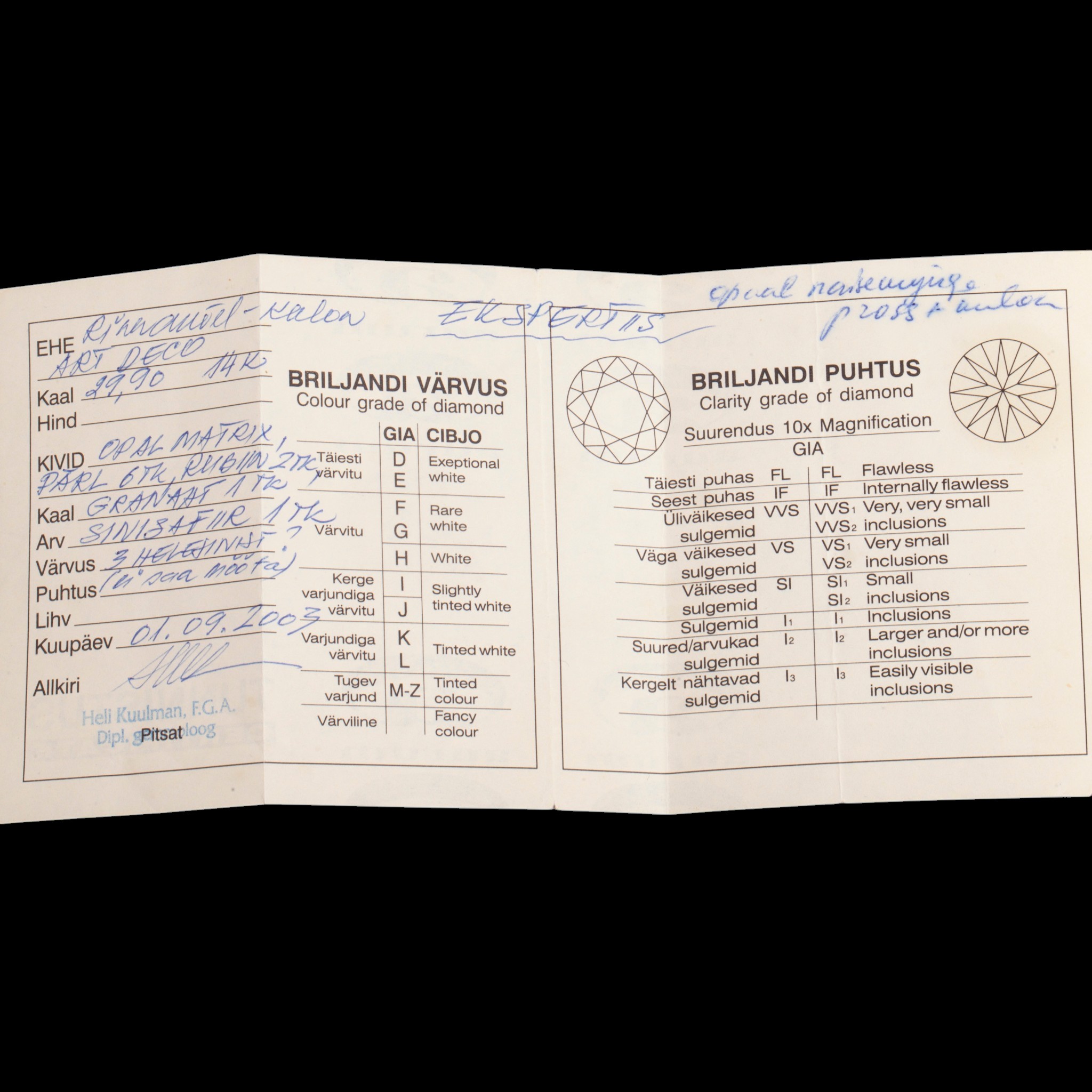
Accompanied by an older handwritten gemmological note in Estonian. According to this note, the piece was described as set with opal matrix, pearls, rubies, a garnet, a blue sapphire, and small diamonds; this attribution is not independently confirmed and should be treated as provisional pending modern gemmological examination.
A decorative and distinctive jewel, likely inspired by late 19th- to early 20th-century Art Nouveau models.
Material: 14K gold (marked 585)
Stones: opal matrix cameo, pearls, assorted coloured stones
Dimensions: 6.8 × 4.8 × 1.1 cm
Weight: 29.9 gStarting price: 8000€
Estimate: 10000-15000€
Hammer Price: Not sold -
Lot 0252
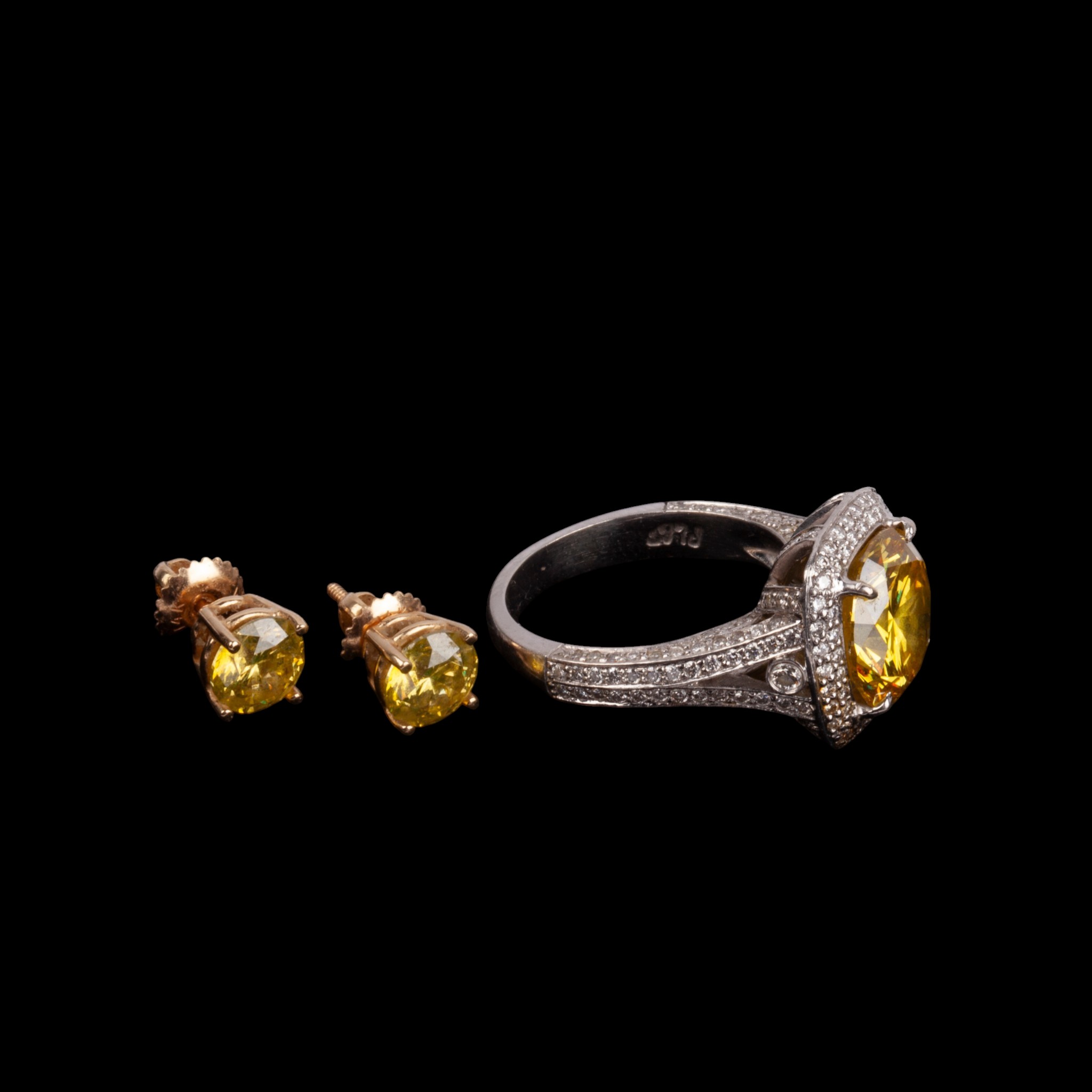
Estate Platinum Ring and Canary Diamond Earrings Set with Certificates, contemporary estate jewelry
Estimate: 60000-70000€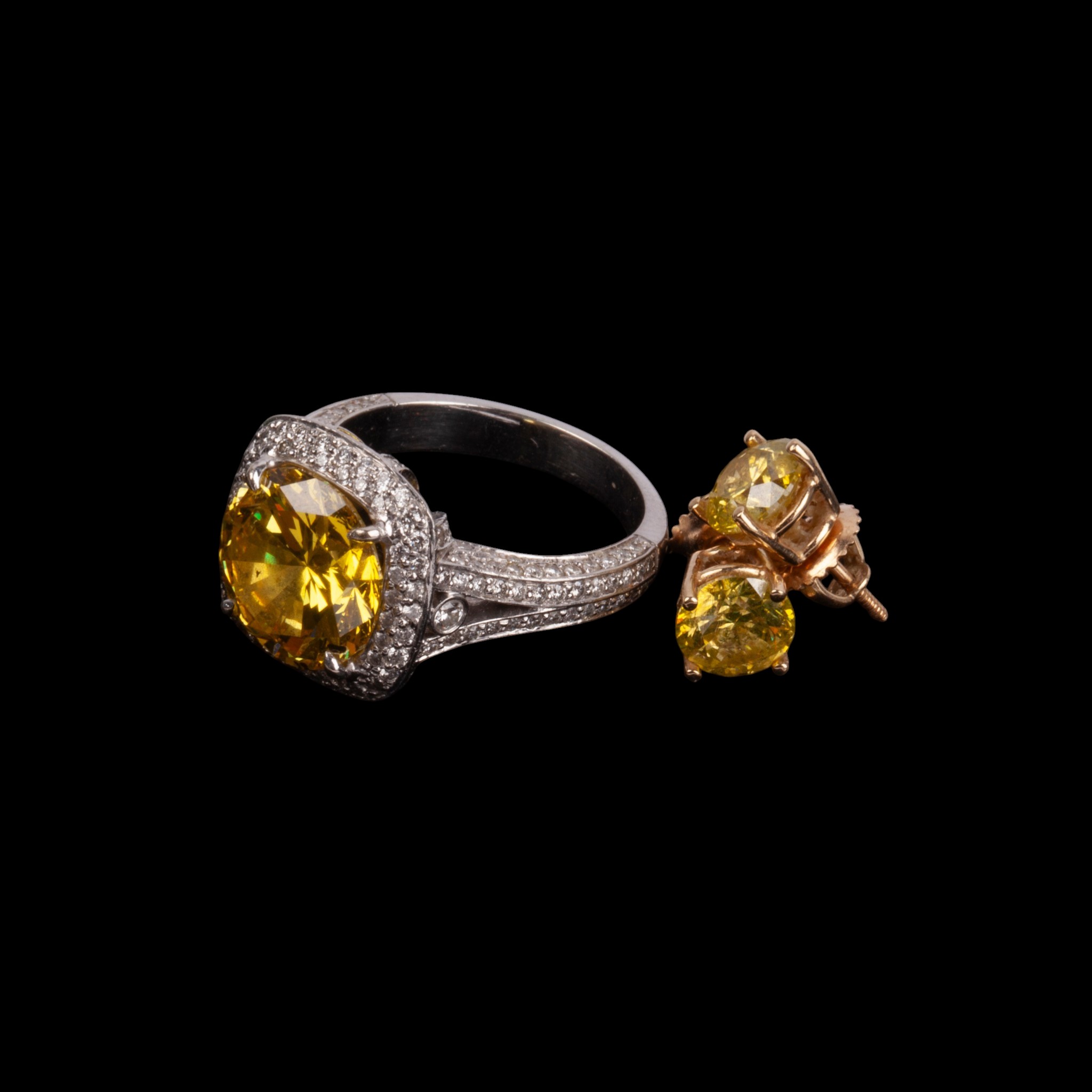

Lot 0252
Estate Platinum Ring and Canary Diamond Earrings Set with Certificates, contemporary estate jewelry
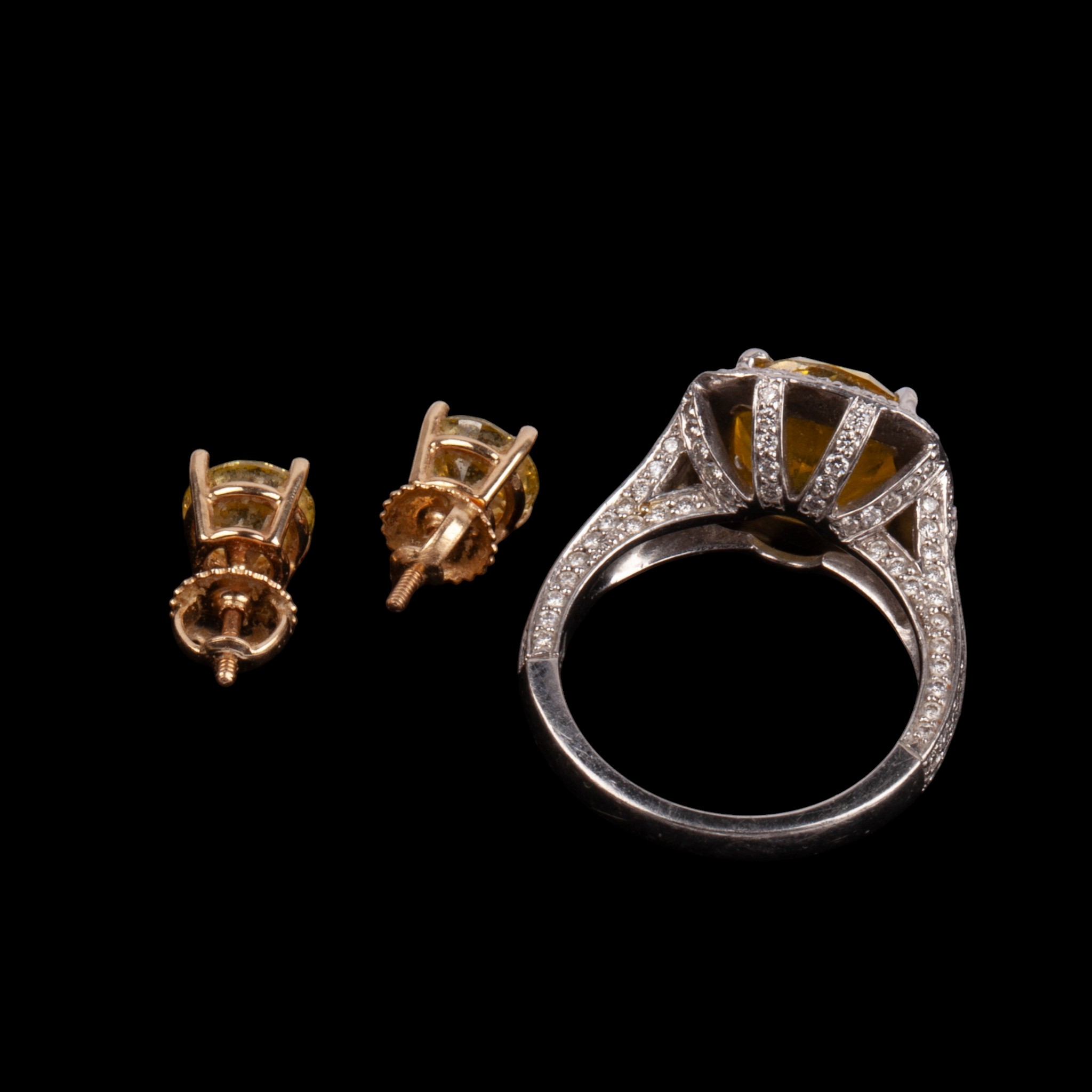
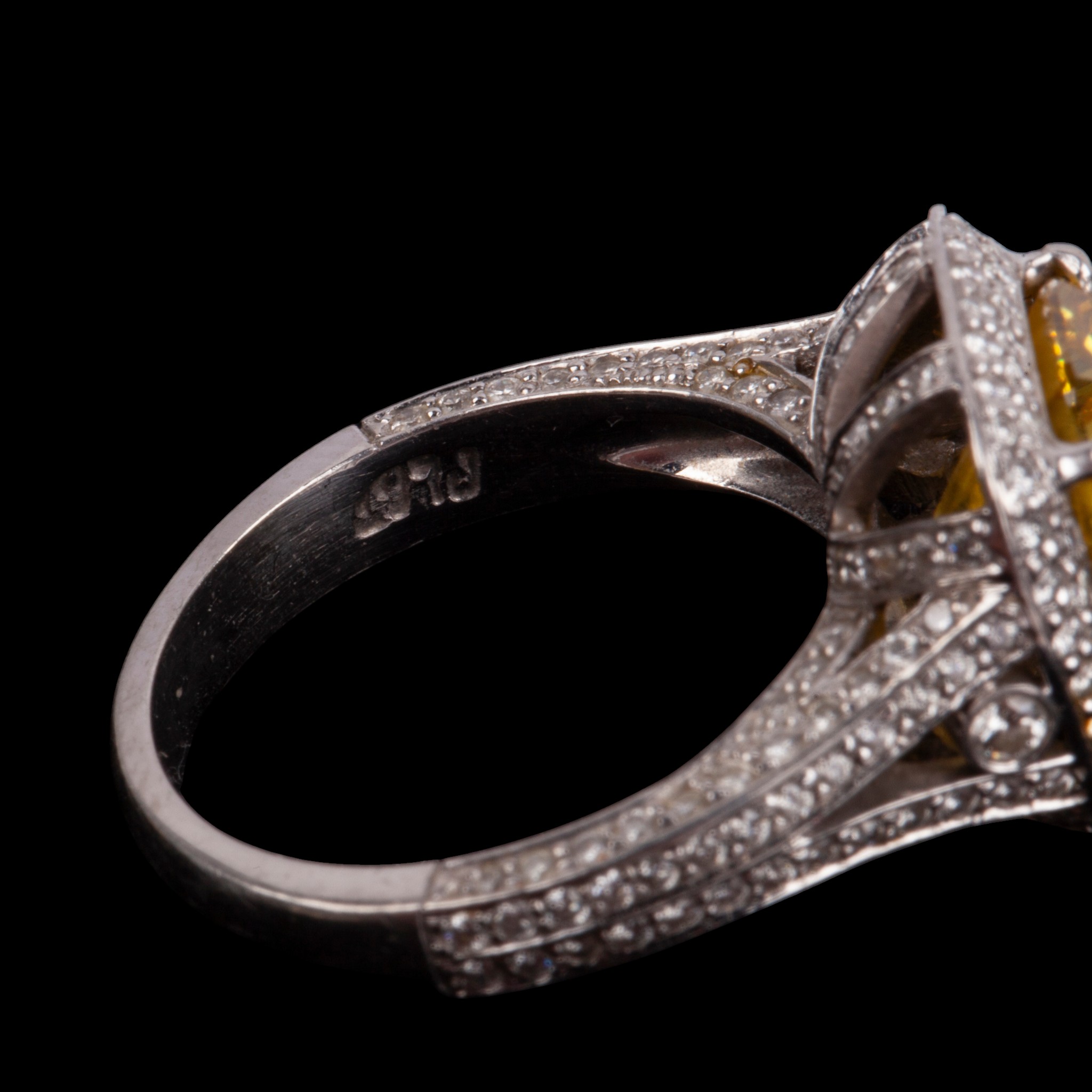
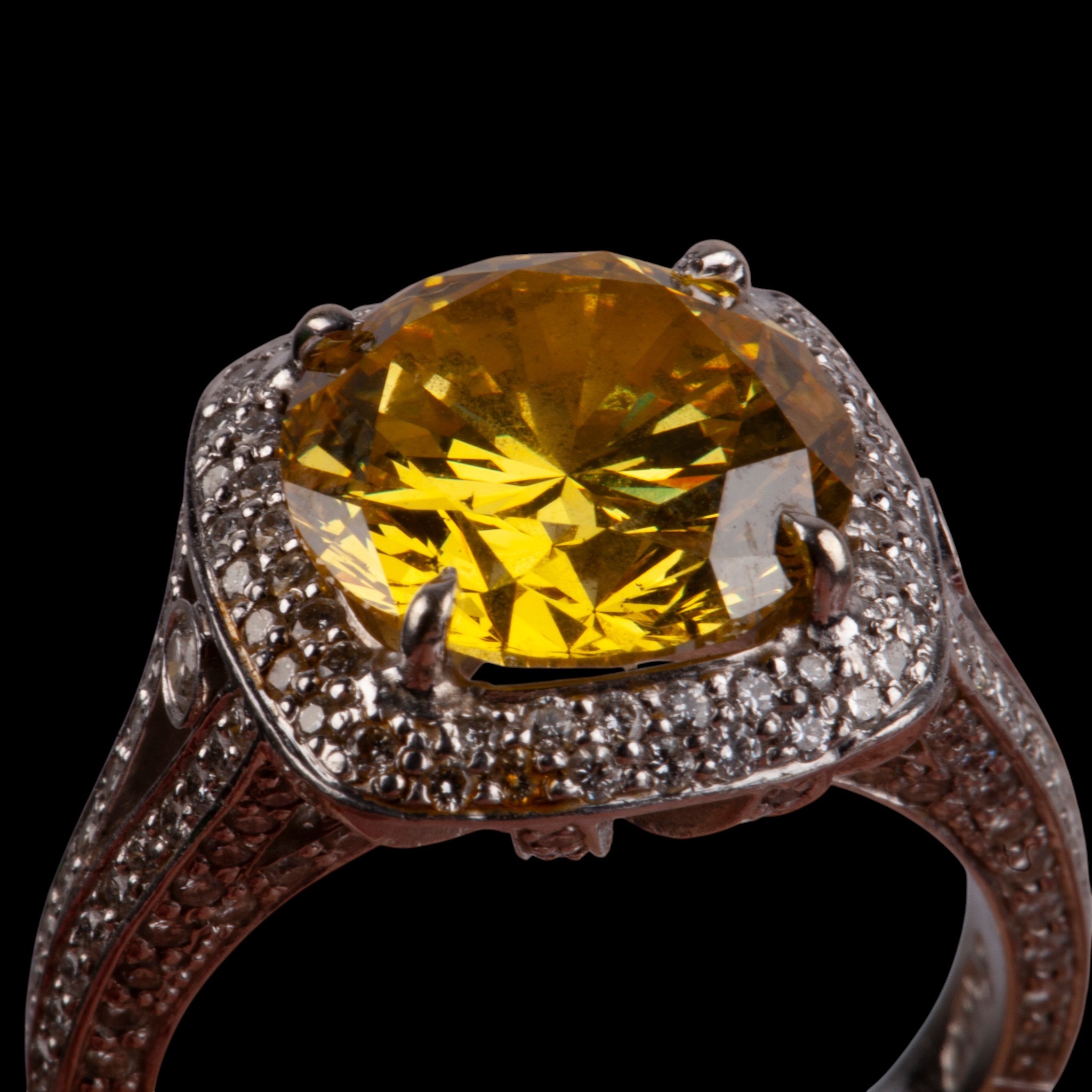
Estimate: 60000-70000€Estate Platinum Ring and 14K Gold Canary Diamond Earrings, with Certificates
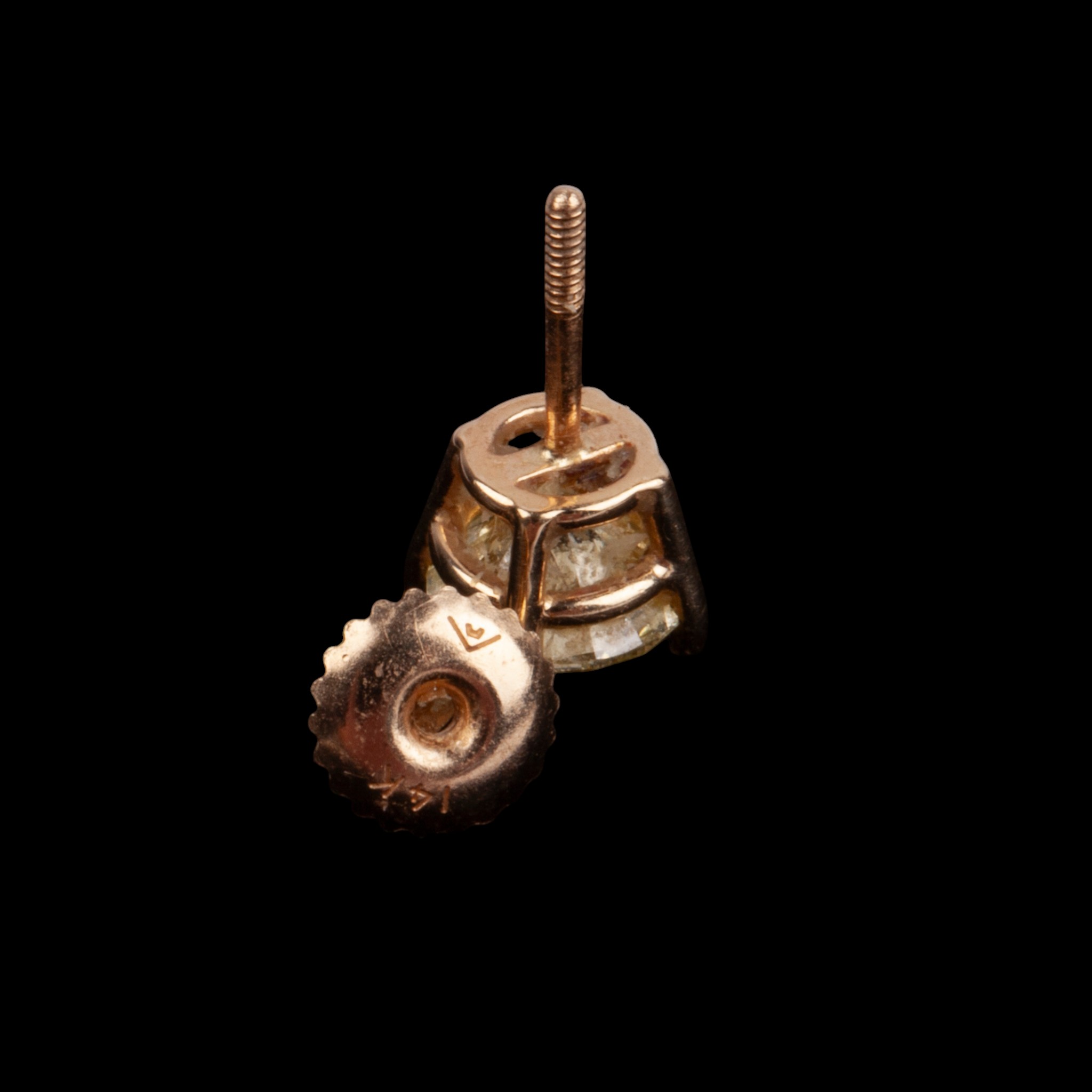
Striking jewelry lot comprising an estate platinum ring and a single 14K yellow gold stud earring, both set with canary-color diamonds and accompanied by certificates.
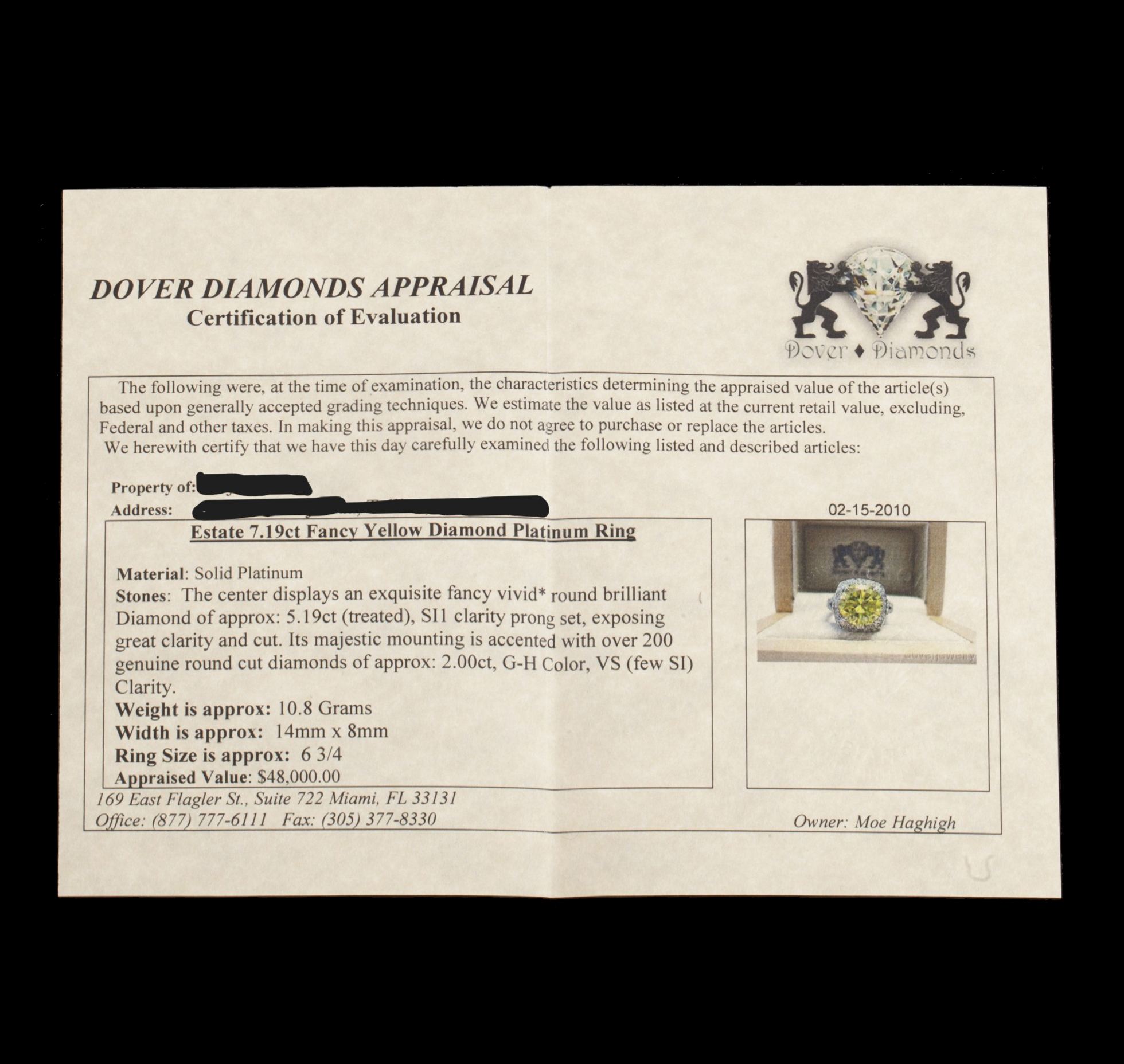
According to the accompanying Dover Diamonds Appraisal, the ring is an Estate 7.19 ct Fancy Yellow Diamond Platinum Ring, featuring an approximately 5.19 ct treated fancy vivid round brilliant diamond, accented by approximately 2.00 ct genuine round cut diamonds, stated as G–H color and VS (few SI) clarity. The ring is described as solid platinum, with an approximate weight of 10.8 grams, width of 14 x 8 mm, and ring size 6 3/4. The appraisal lists a stated value of $48,000.
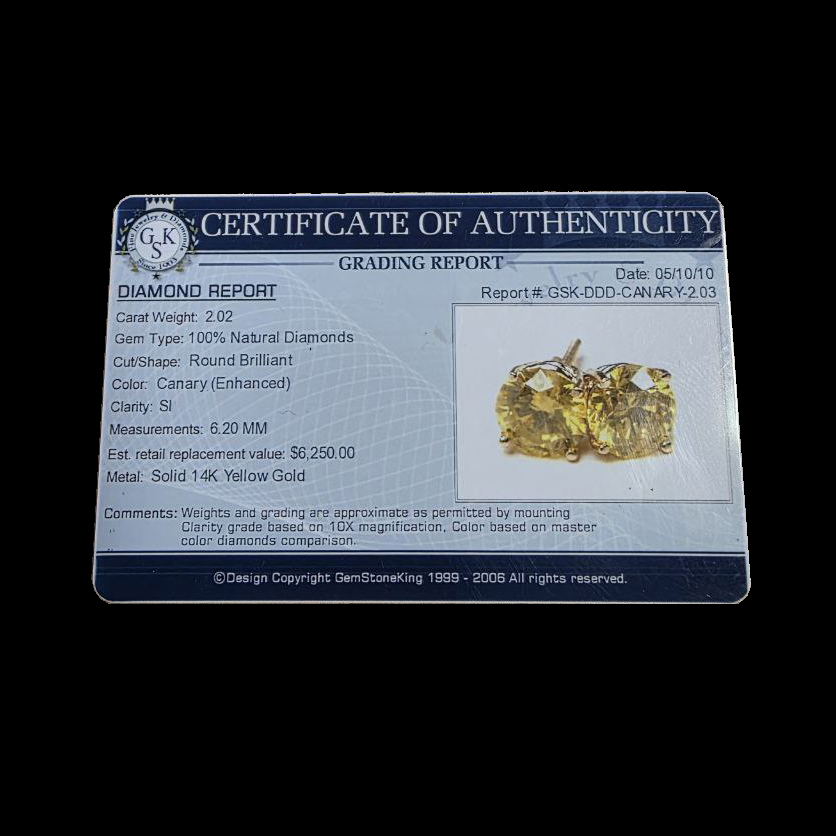
The accompanying GSK grading report for the earring identifies it as a 2.02 ct round brilliant canary (enhanced) diamond, SI clarity, measuring approximately 6.20 mm, mounted in solid 14K yellow gold, with an estimated retail replacement value of $6,250.
An impressive and highly decorative set, offered together with its accompanying documentation.
Material:
Platinum ring; 14K yellow gold earring
Stones (per certificates):
Ring: approx. 7.19 ct total, including approx. 5.19 ct treated fancy vivid yellow diamond and approx. 2.00 ct accent diamonds
Earring: approx. 2.02 ct canary (enhanced) diamond
Size / Dimensions:
Ring size: 6 3/4
Ring width: approx. 14 x 8 mm
Earring stone measurement: approx. 6.20 mm
Weight:
Ring: approx. 10.8 gCondition:
Good overall used condition with minor wear consistent with age and use. Accompanied by certificates.Starting price: 55000€
Estimate: 60000-70000€
Hammer Price: Not sold -
Lot 0253
14K White Gold Aquamarine and Diamond Cocktail Ring
Estimate: 12000-15000€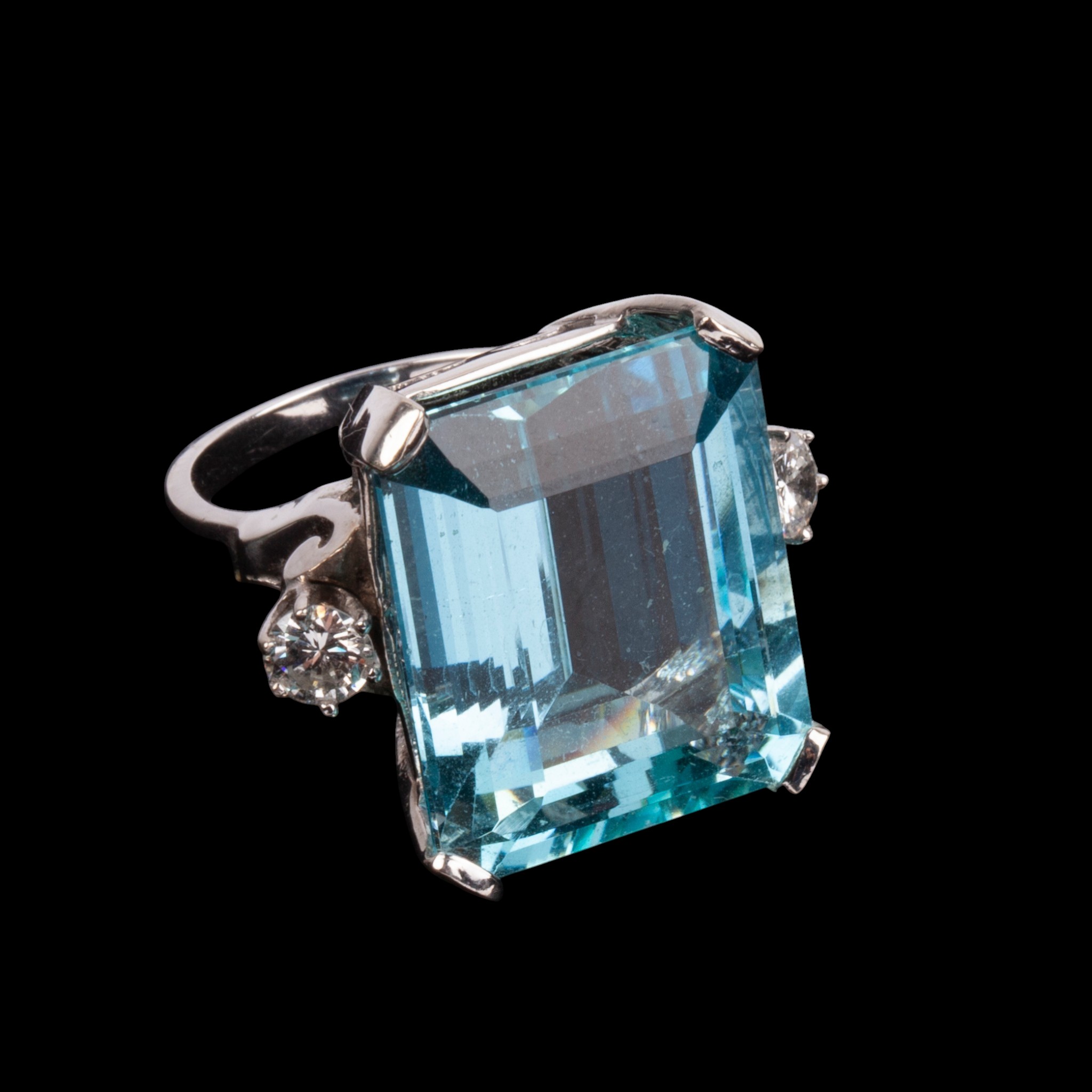
Lot 0253
14K White Gold Aquamarine and Diamond Cocktail Ring
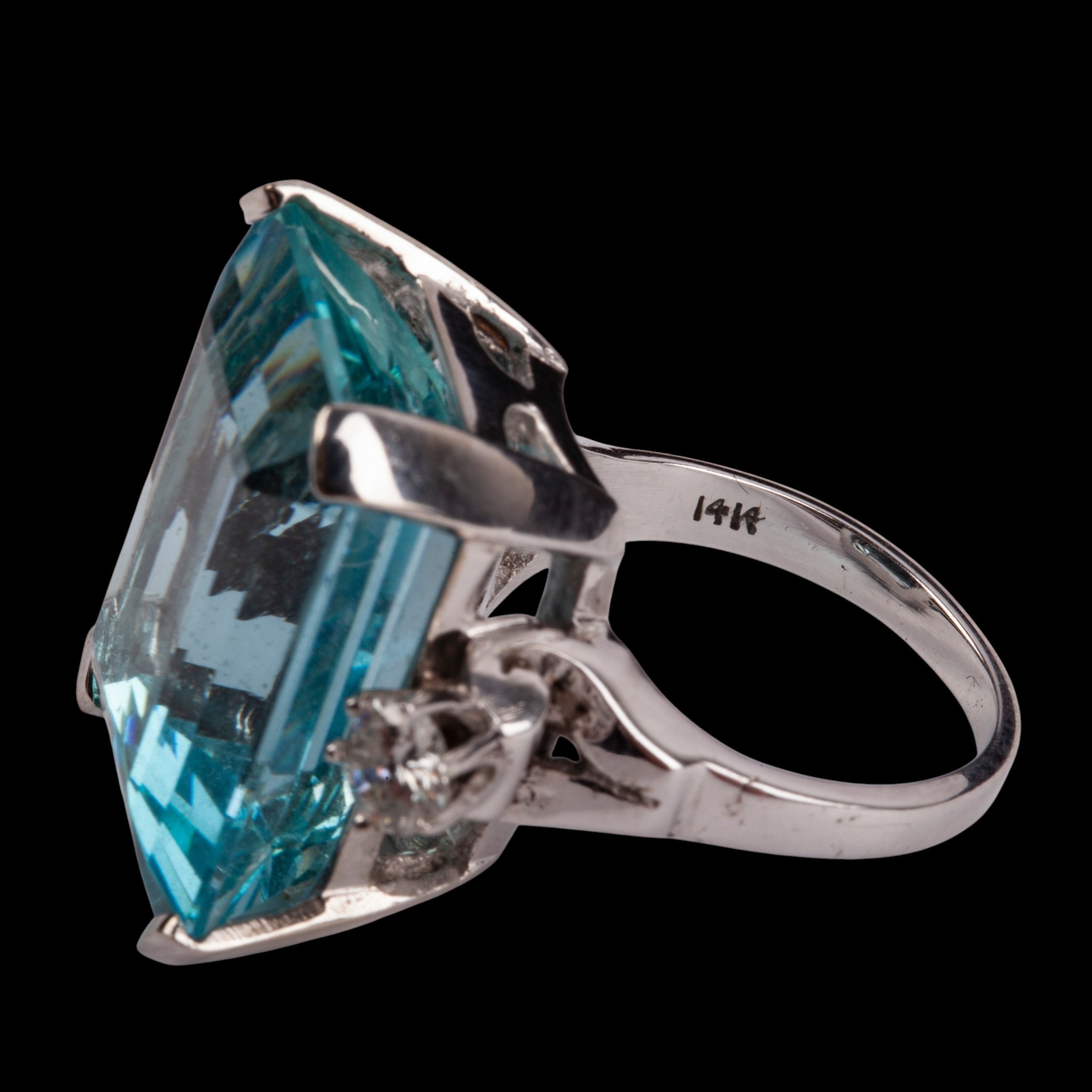
Estimate: 12000-15000€14K White Gold Aquamarine and Diamond Ring
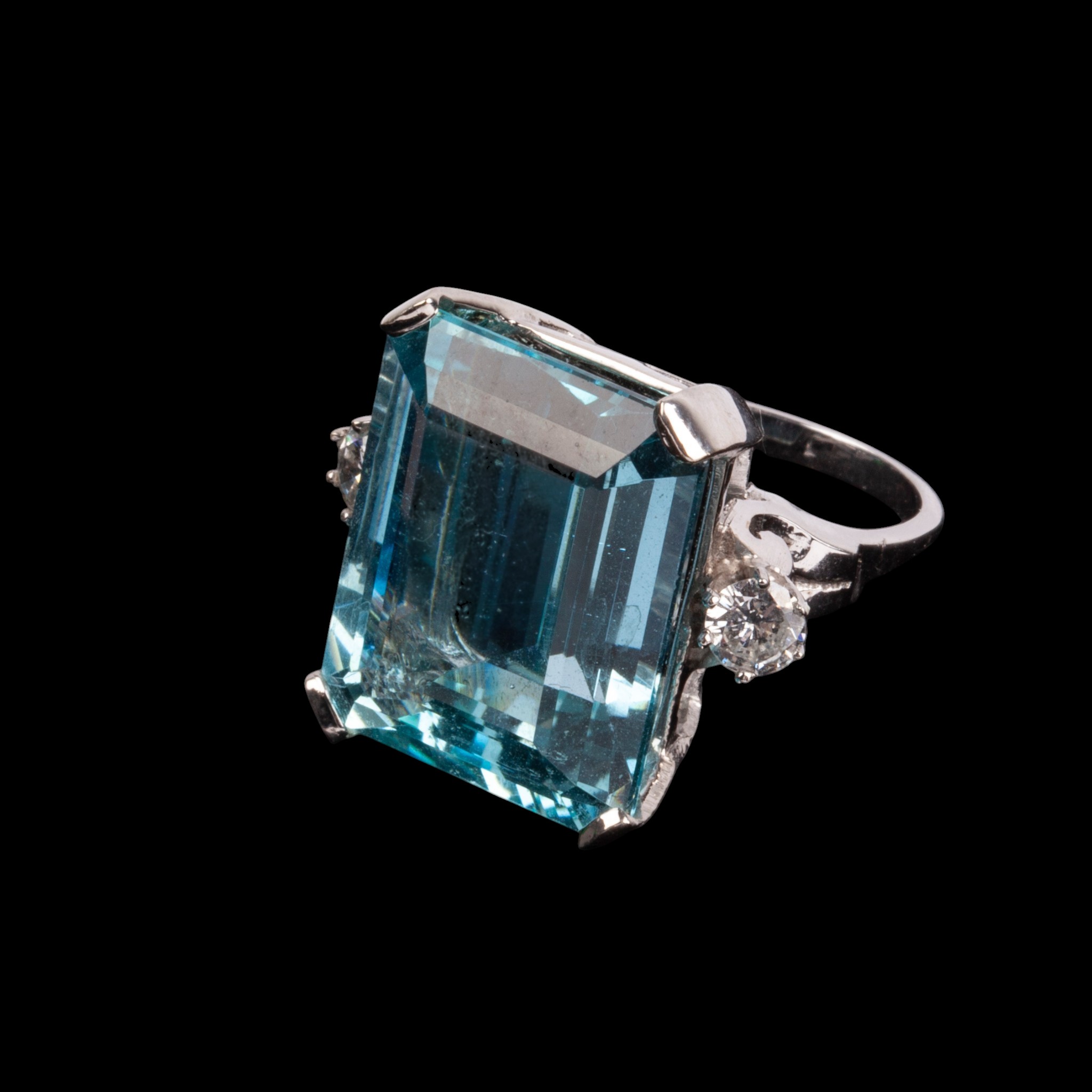
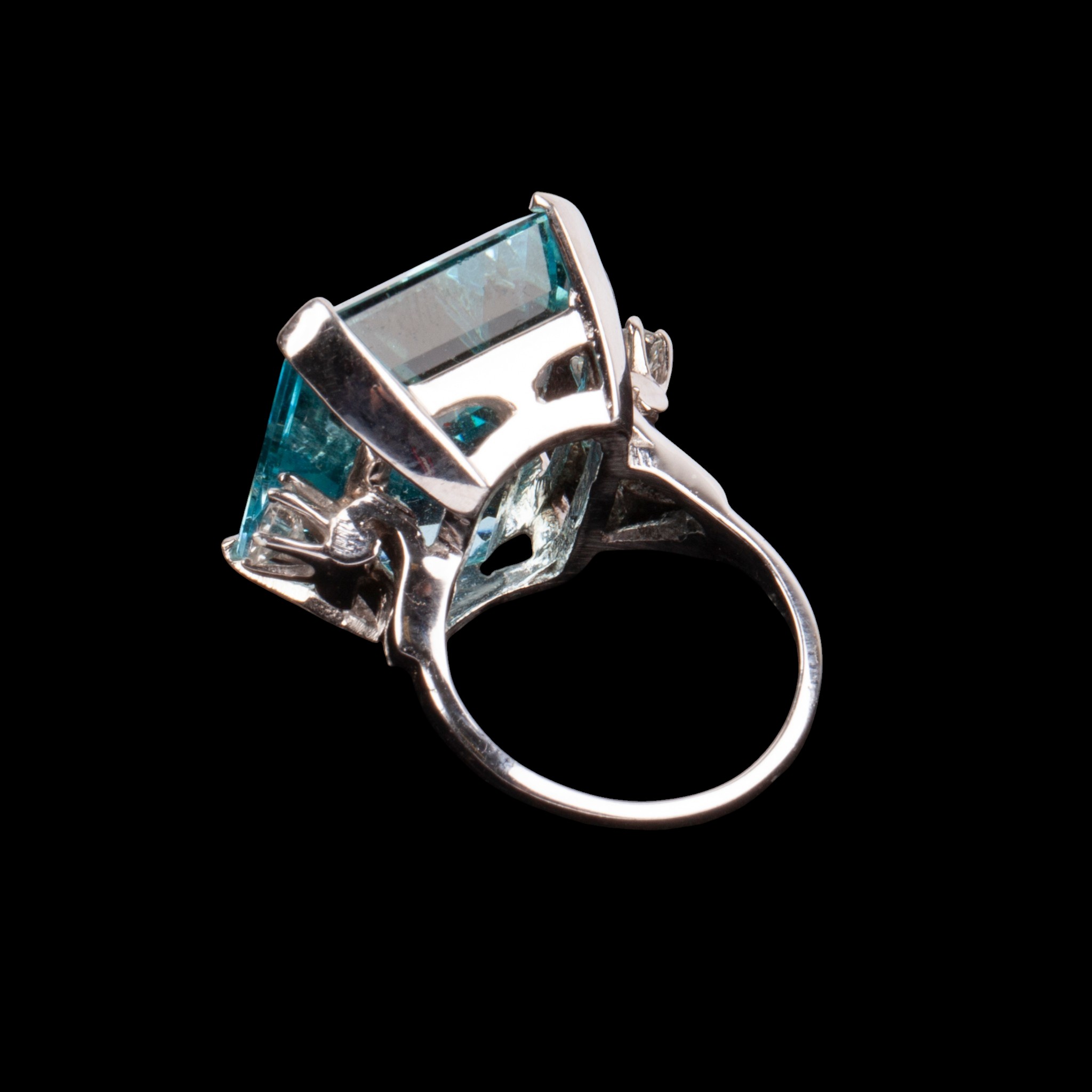
A striking 14K white gold ring set with a large emerald-cut aquamarine in four claw mounts, flanked by two round brilliant-cut diamonds. The ring has a bold mid-century cocktail-ring presence, the impressive rectangular aquamarine elevated in an openwork setting that allows the stone’s light blue tone and transparency to show to full effect.
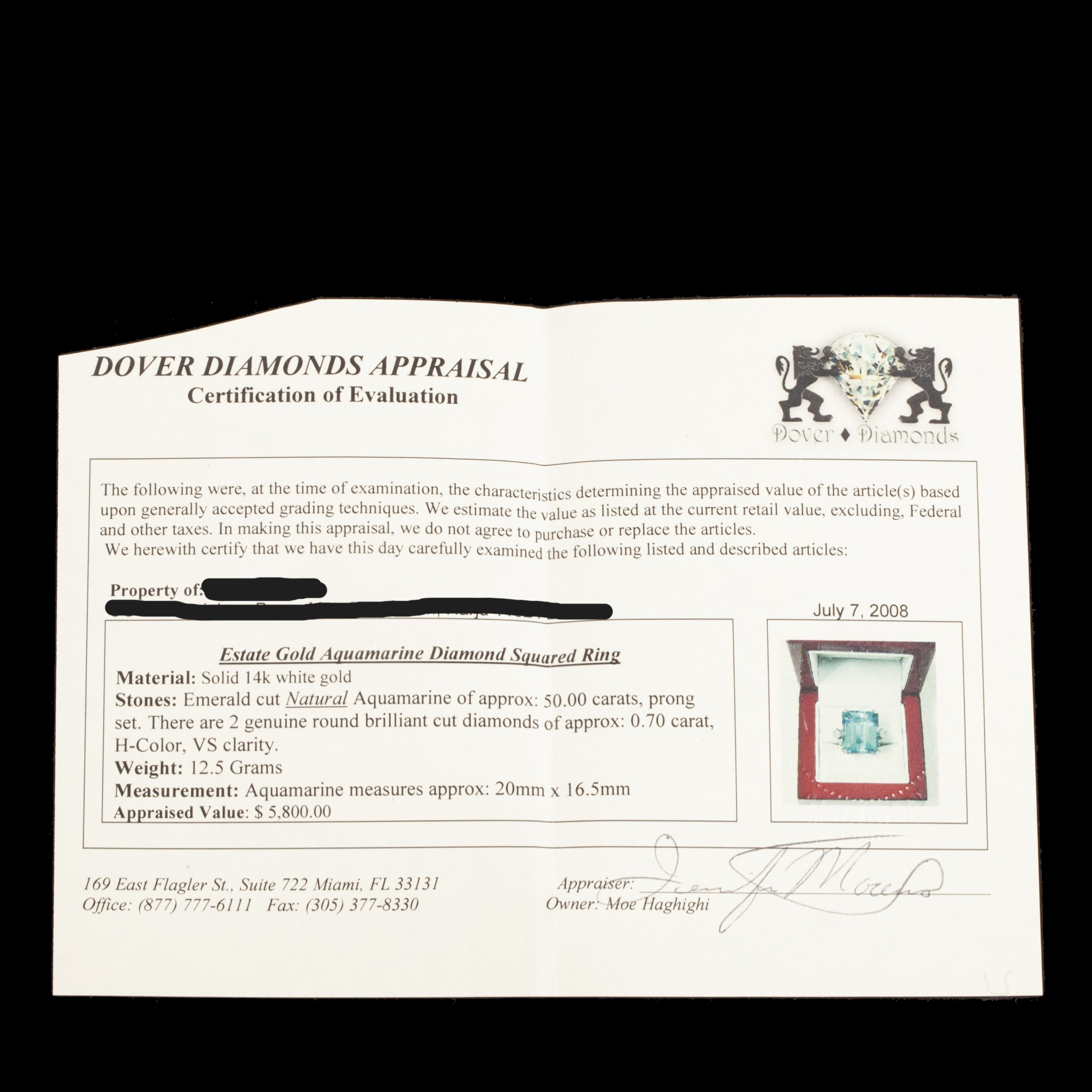
The shank is stamped 14K. An accompanying 2008 appraisal describes the center stone as a natural aquamarine of approximately 50.00 carats, measuring about 20.0 × 16.5 mm, with two round brilliant-cut diamonds totaling approximately 0.70 carat, graded H color, VS clarity, and gives a then retail appraisal of $5,800.
Material: 14K white gold
Stones: emerald-cut aquamarine, two round brilliant-cut diamonds
Aquamarine measurement: approx. 20.0 × 16.5 mm
Weight: 12.5 gCondition: visible wear consistent with age and use. Sold as viewed.
Comparable: Freeman’s, Boutique Jewels and Luxury Accessories, 14 June 2023, Lot 3, A Ladies Platinum and Aquamarine Diamond Ring, Price Realized: USD 17,640.Starting price: 10000€
Estimate: 12000-15000€
Hammer Price: Not sold -
Lot 0254
Art Deco Style Platinum, Aquamarine and Diamond Pendant Necklace
Estimate: 25000-30000€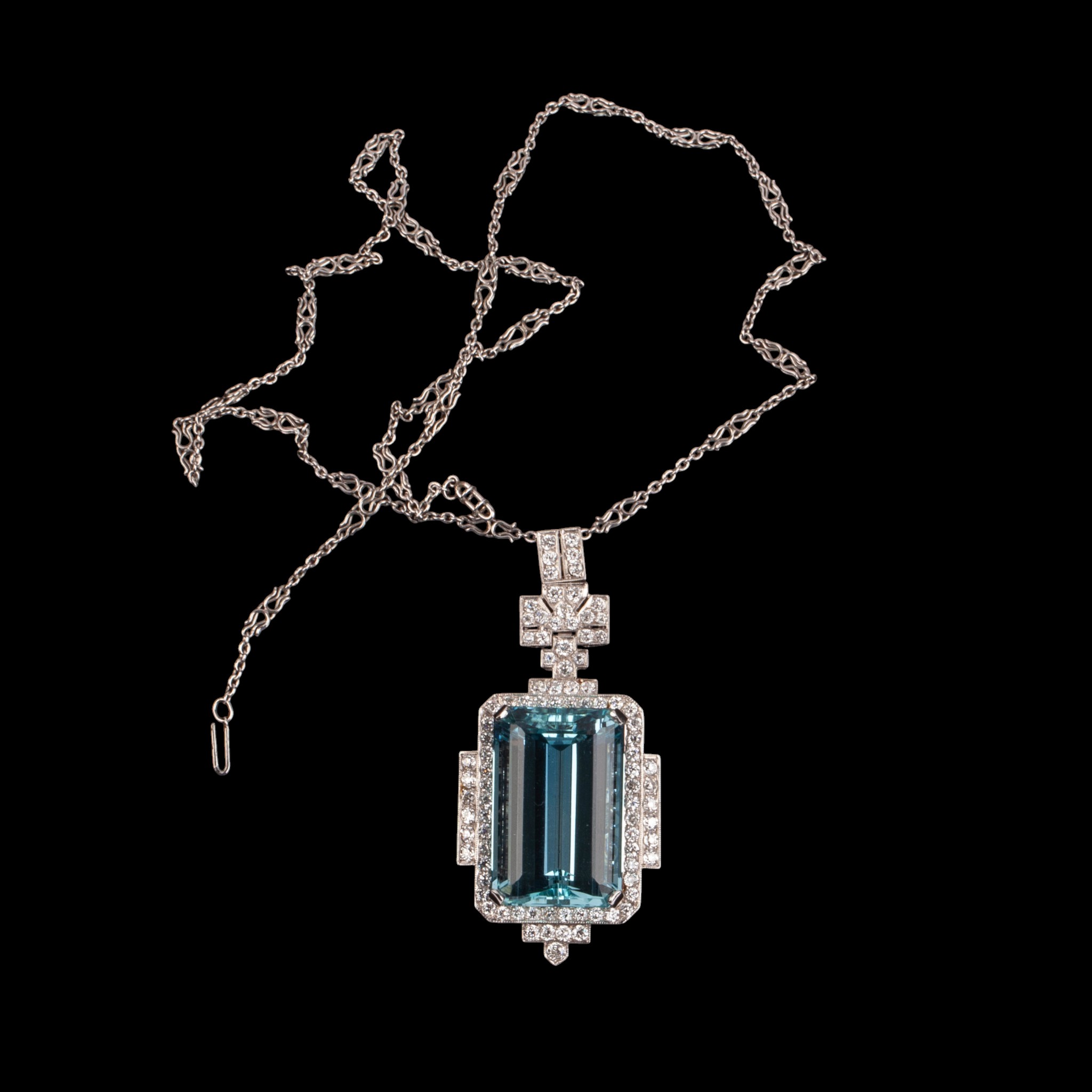

Lot 0254
Art Deco Style Platinum, Aquamarine and Diamond Pendant Necklace
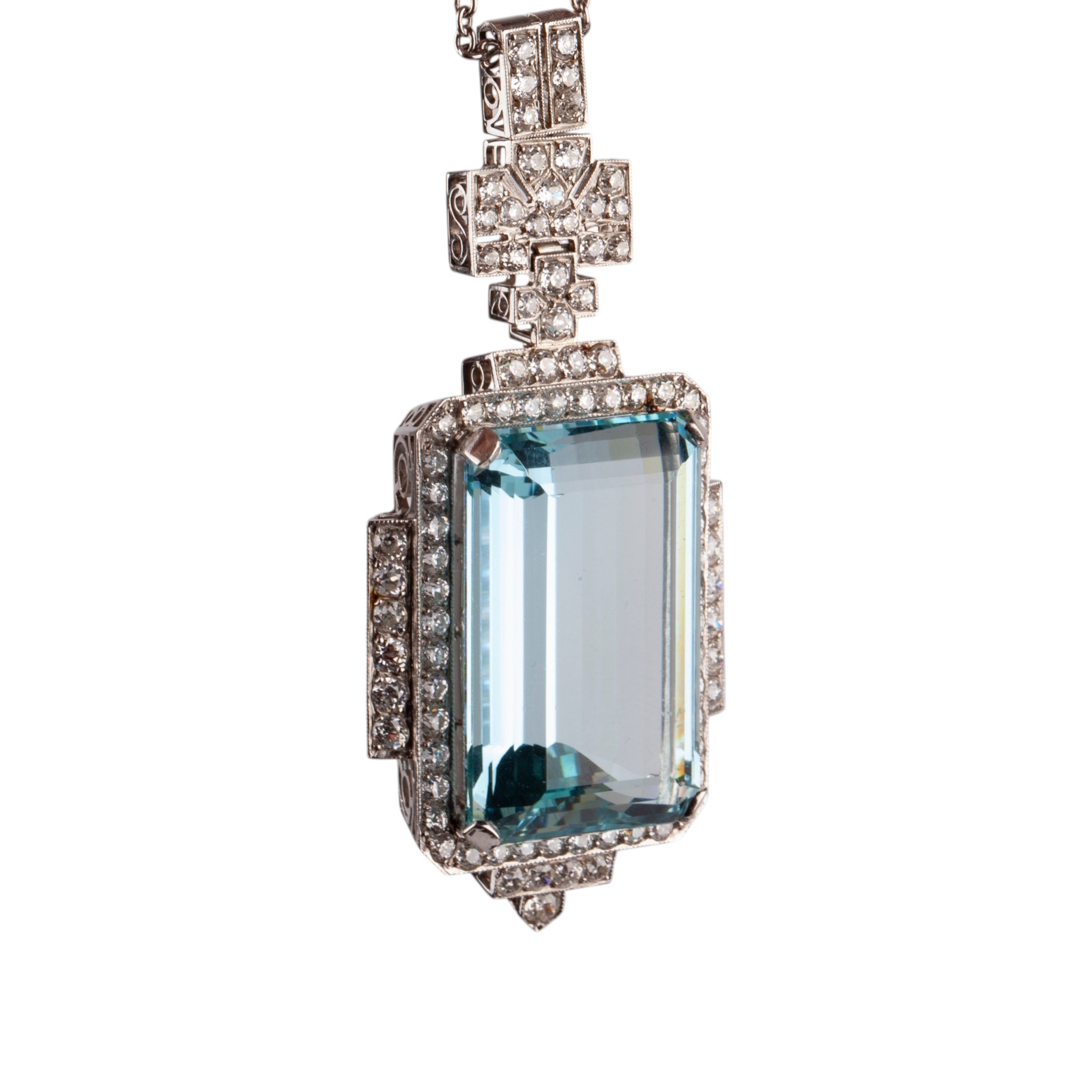
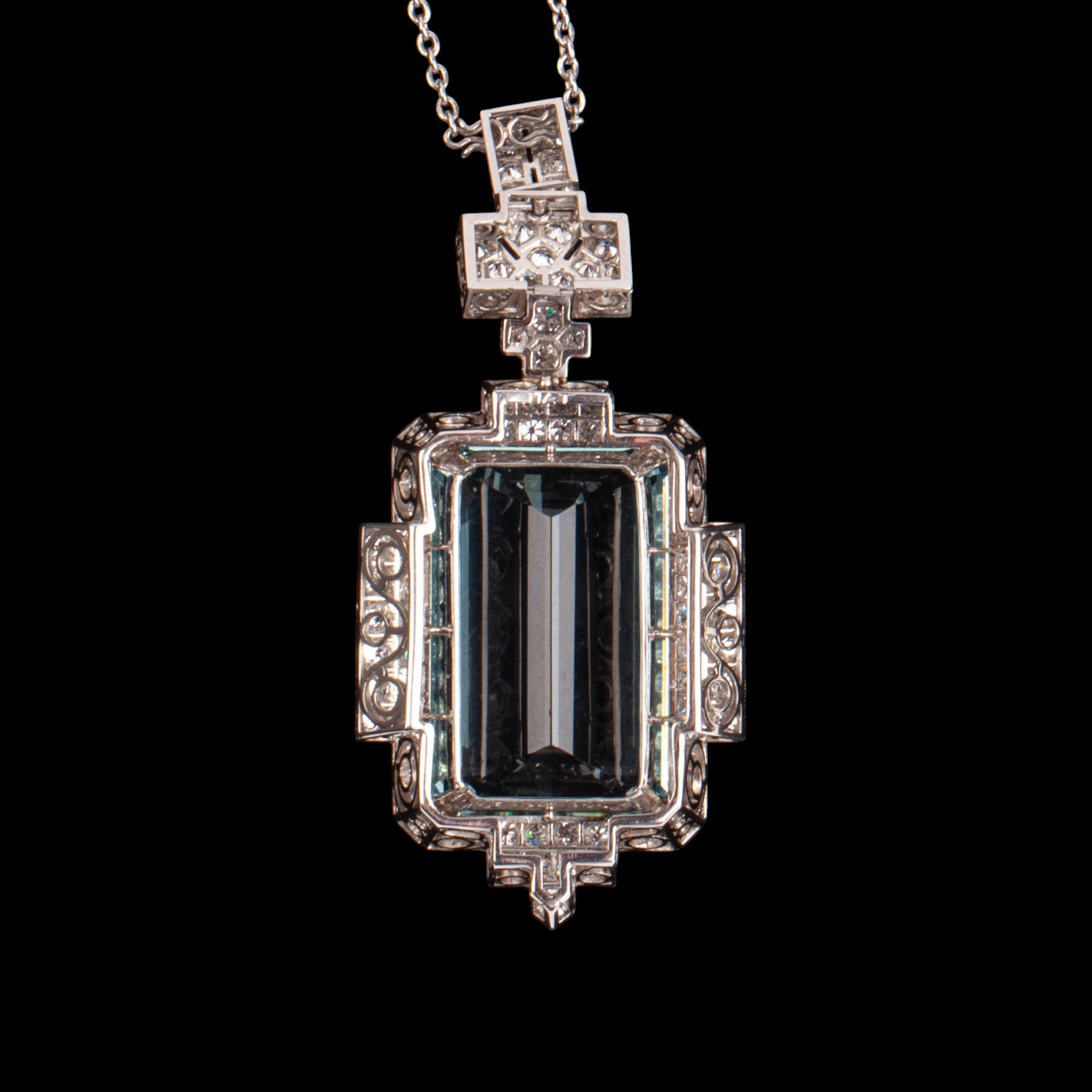
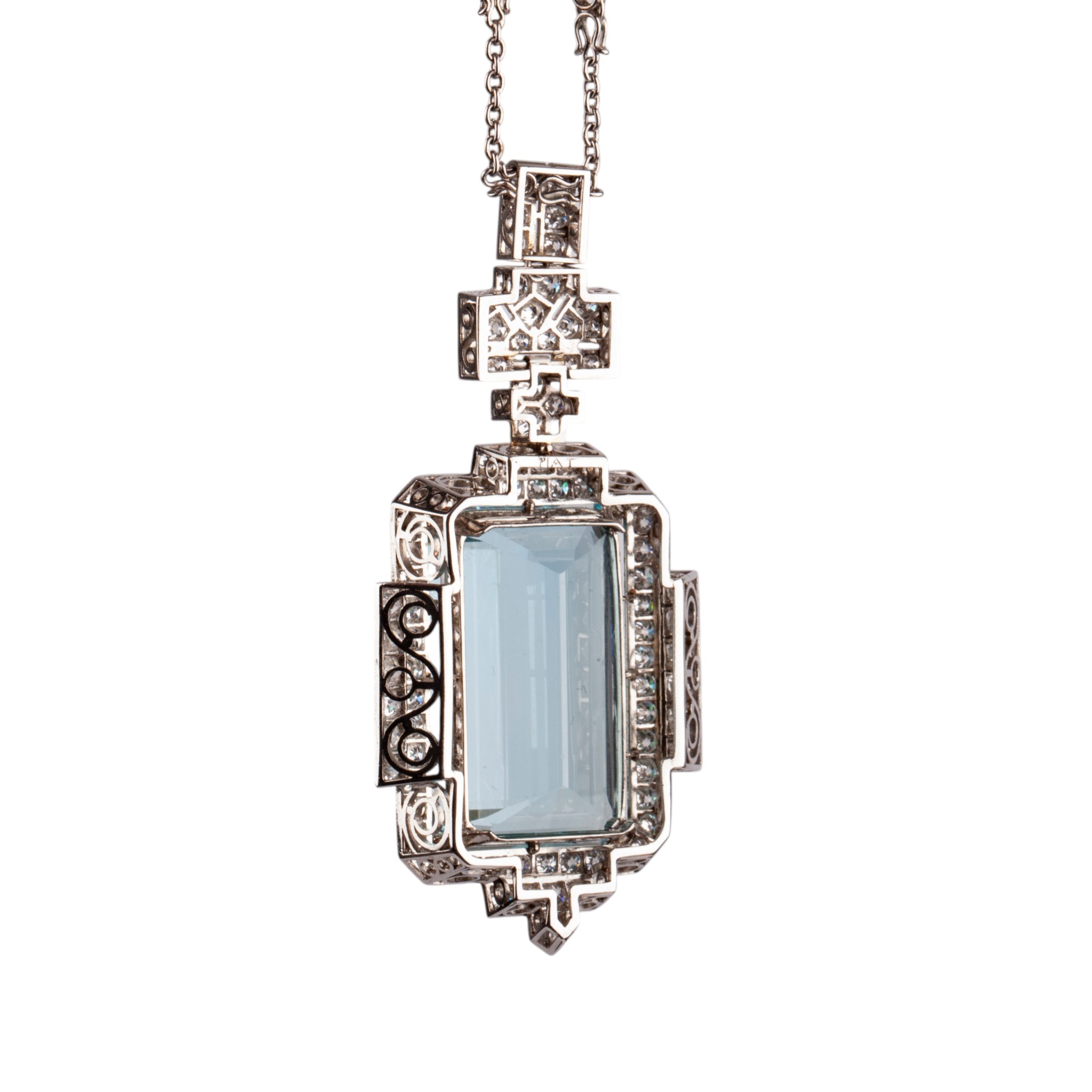
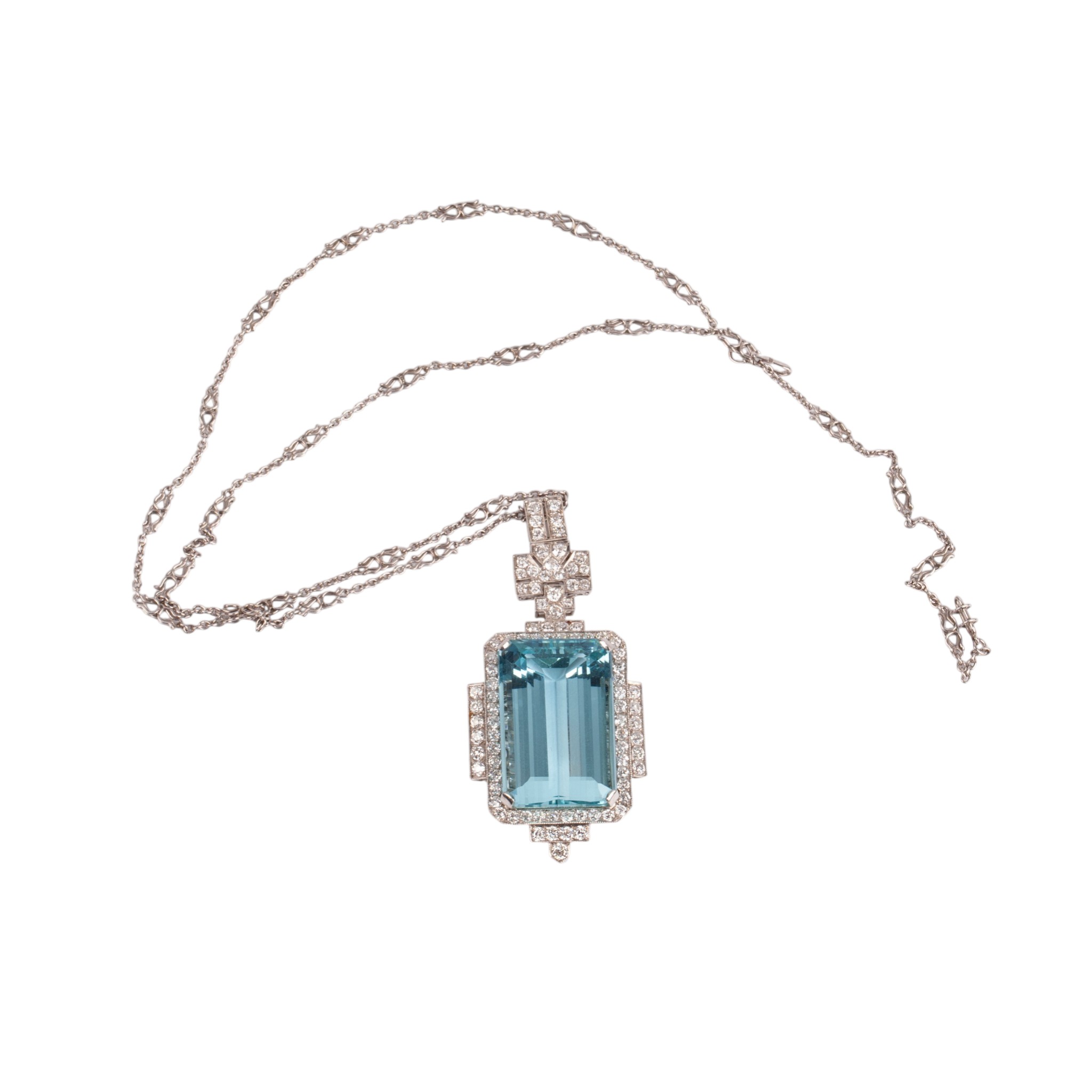
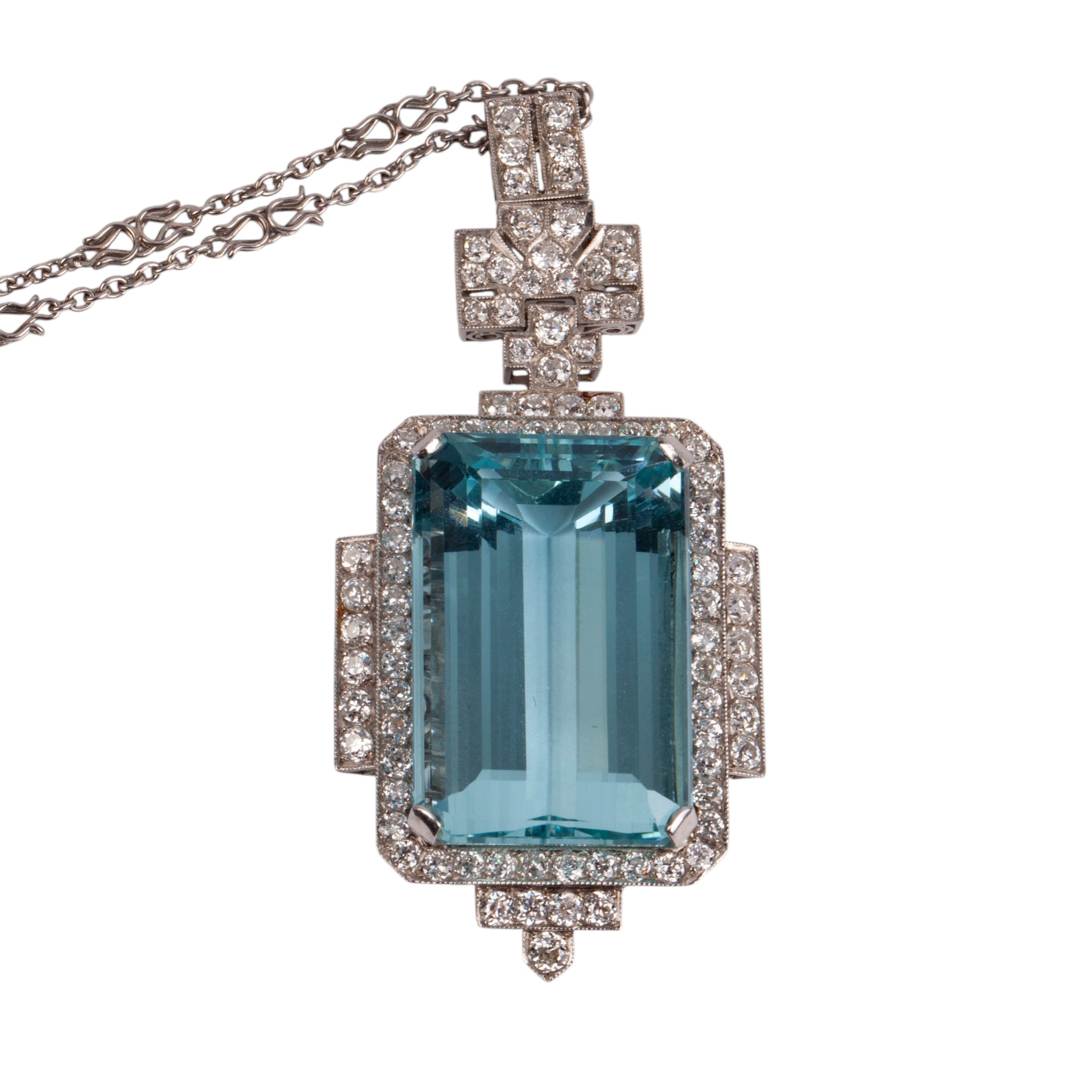
Estimate: 25000-30000€Art Deco Style Platinum, Aquamarine and Diamond Pendant Necklace
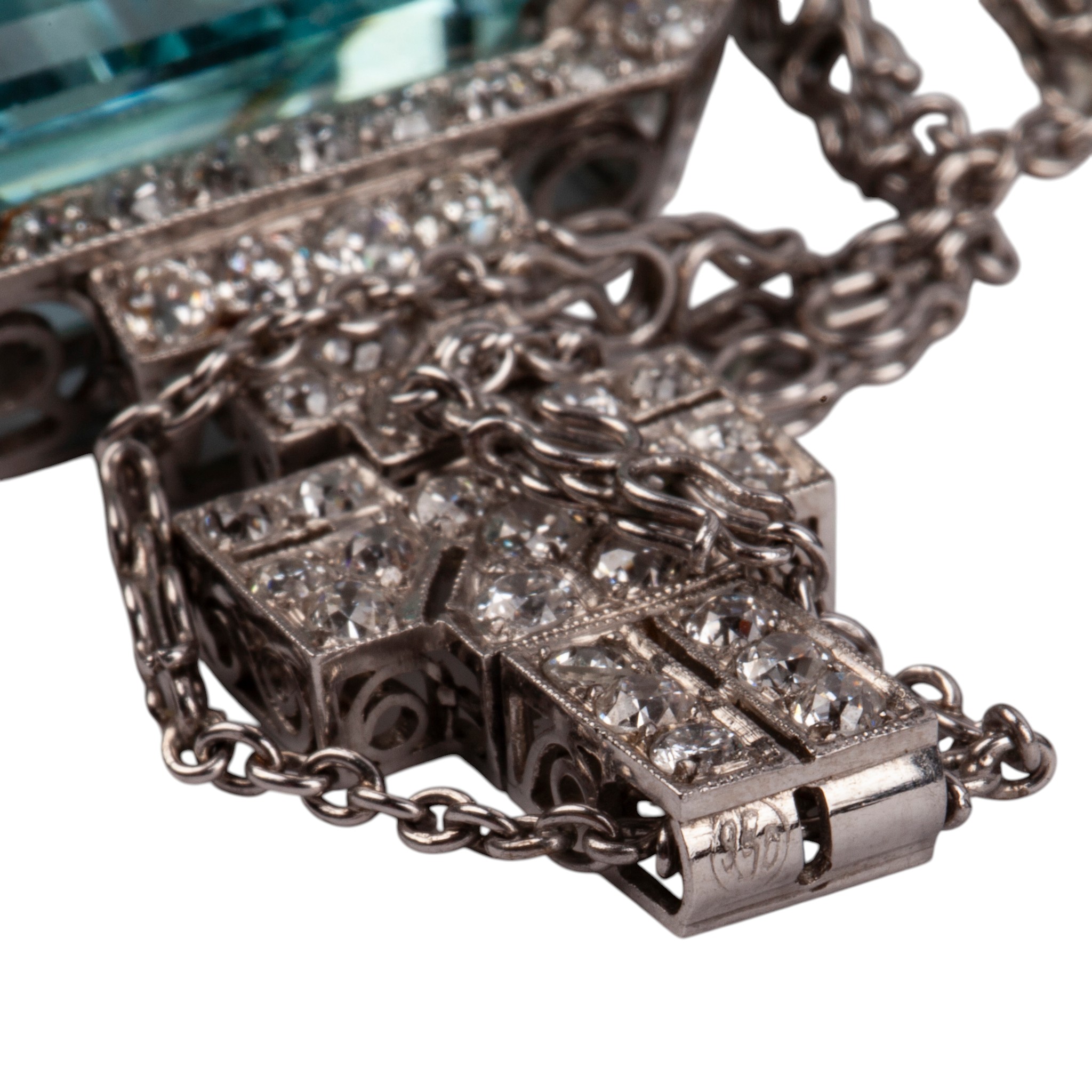
An impressive platinum pendant necklace of strongly geometric Art Deco style, centered by a large emerald-cut aquamarine within an architectural diamond-set frame, the stepped outline further enriched with diamond-set side panels and a diamond-set articulated surmount. The pendant is suspended from a platinum chain with decorative openwork links, complementing the period-inspired design.
The reverse and side views show pierced and millegrain-style detailing characteristic of high-quality geometric jewel mounts. The clasp appears marked 950, consistent with platinum fineness, while the accompanying 2008 appraisal describes the jewel as solid platinum.
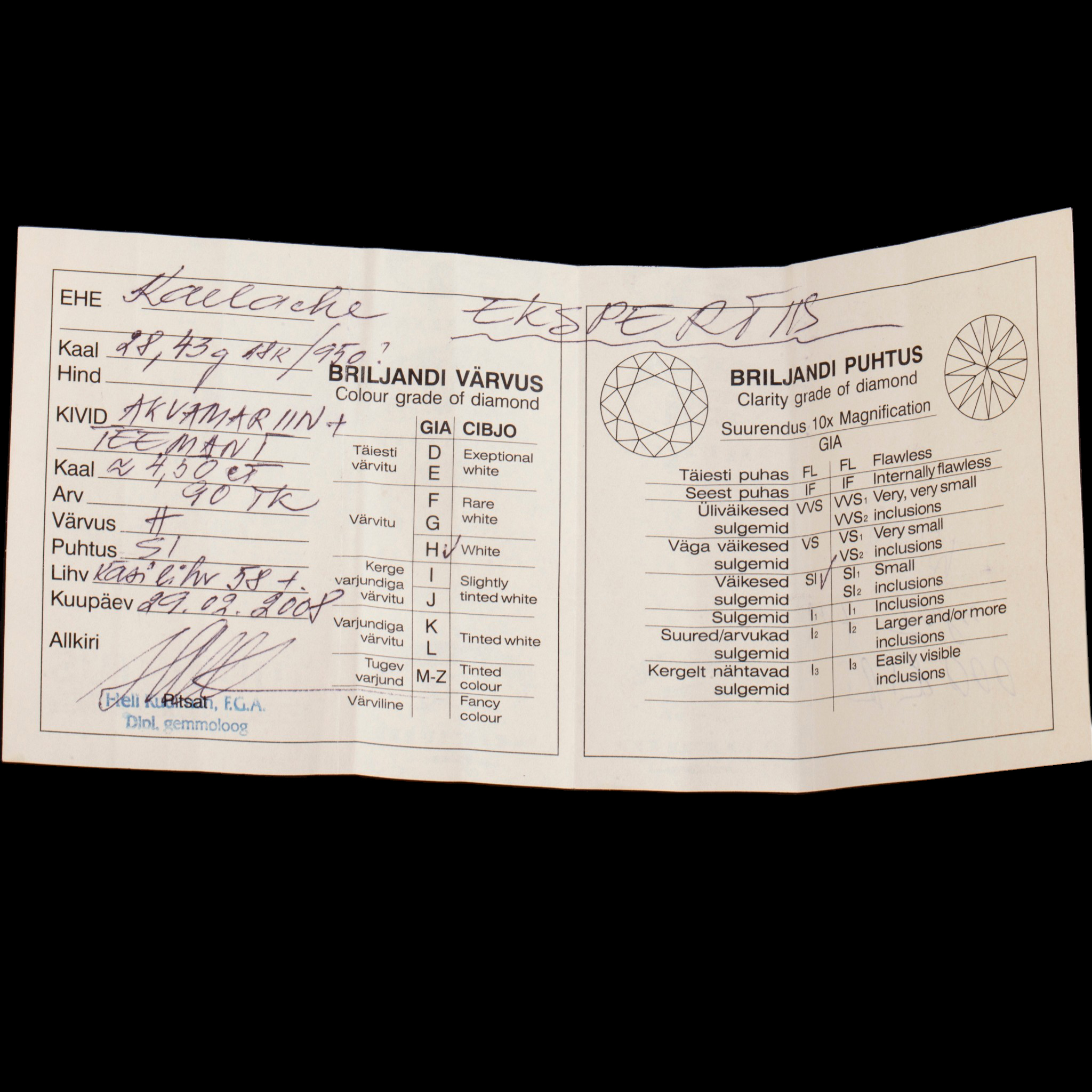
Accompanied by a 2008 Dover Diamonds Appraisal, which describes the necklace as set with one genuine blue aquamarine of approximately 40.00 carats and 90 European-cut diamonds of approximately 4.50 carats total, graded H–I color, VS clarity; the appraisal also notes a gross weight of approximately 28.7 grams, pendant length of about 2¼ inches, chain length of about 20 inches, and an appraised value at that time of USD 17,500. A separate gemmological note in Estonian appears to repeat broadly similar information, including aquamarine, diamonds, approximately 40 pcs, H/I color, VS clarity, and a combined stone weight notation around 4.50 ct, but this handwritten note is not fully legible in all parts. These documents are useful supporting papers, though I cannot independently confirm the exact stone weights, natural origin, or grading without a modern gemmological report.
Material: platinum
Stones: one large emerald-cut aquamarine, numerous diamonds
Pendant length: approx. 2¼ in. / approx. 5.7 cm
Chain length: approx. 20 in. / approx. 50.8 cm
Weight: approx. 28.7 g
Auction Comparison:
For comparison, Bonhams sold an Aquamarine and Diamond Pendant/Necklace, circa 1940 in the Knightsbridge Jewels sale on 26 November 2025 as Lot 361, for £20,480 including premium. Bonhams described that example as set with a step-cut aquamarine weighing approximately 27.70 carats and diamonds totaling approximately 3.00 carats. By contrast, the present necklace is accompanied by an appraisal describing its aquamarine at approximately 40.00 carats, indicating a substantially larger center stone than the Bonhams example.Starting price: 20000€
Estimate: 25000-30000€
Hammer Price: Not sold -
Lot 0255
Pilgrimage Icon of Saint Catherine the Great Martyr on Stone, Palestine, late 19th century
Estimate: 5000-7000€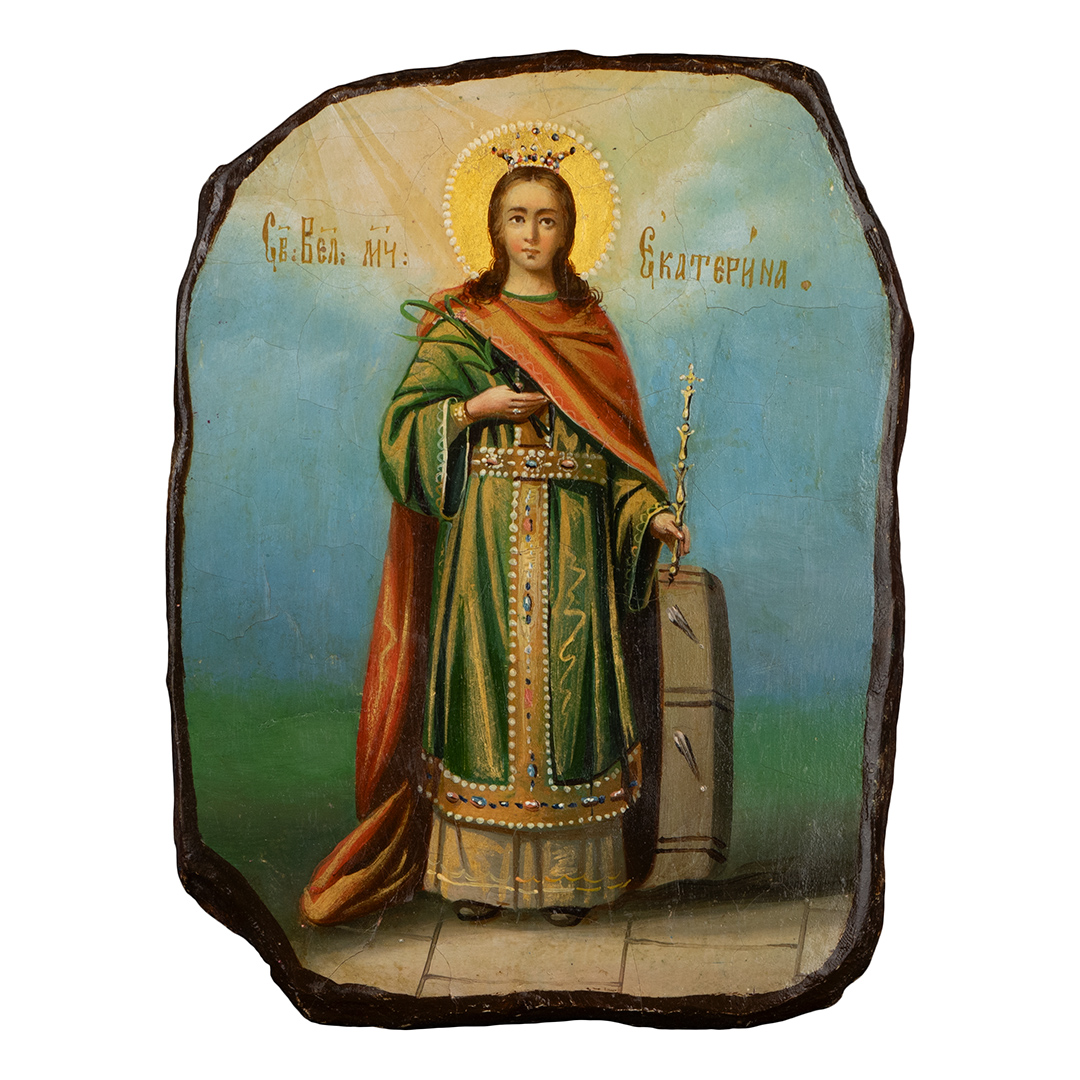
Lot 0255
Pilgrimage Icon of Saint Catherine the Great Martyr on Stone, Palestine, late 19th century
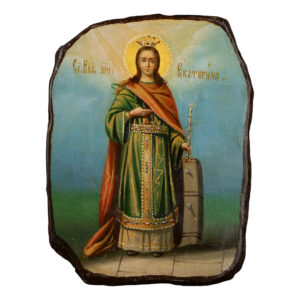
Estimate: 5000-7000€Pilgrimage Icon of Saint Catherine the Great Martyr. Palestine, late 19th century. Stone, oil paint. Dimesniosn: 14.5 × 11 cm.
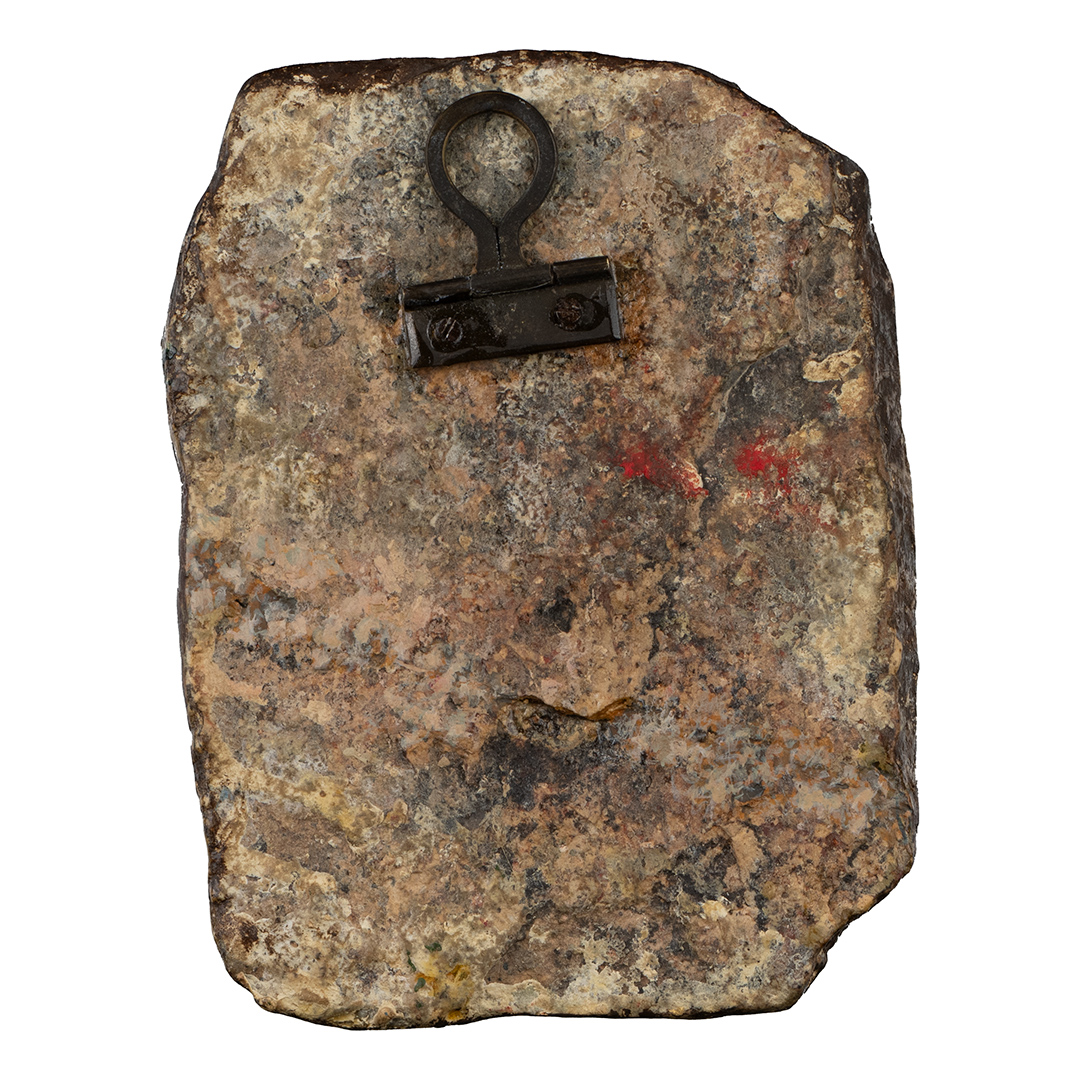
A pilgrimage icon painted on a naturally shaped stone plaque, depicting Saint Catherine the Great Martyr standing full-length against a simplified landscape ground. The saint is shown crowned and haloed, vested in richly ornamented garments, with her traditional attribute of the martyr’s wheel placed beside her. The irregular contour of the support, together with the plain reverse fitted with a suspension loop, preserves the character of the object as a devotional souvenir brought from the Holy Land.
Such icons, acquired by pilgrims in Jerusalem and other sacred places, held a particular place in Russian Orthodox devotional culture. They functioned not only as commemorative eulogiae, but also as intimate objects of private piety. Kept in domestic icon corners, donated to churches and monasteries, or handed down as family relics, they were valued for their direct material connection with the sacred geography of Palestine. In works of this kind, the tangible substance of the stone itself, often believed to have come from the banks of the River Jordan or other holy sites, intensified the devotional meaning of the image and transformed a modest painted object into a cherished relic of pilgrimage.Starting price: 4000€
Estimate: 5000-7000€
Hammer Price: 7 000 € -
Lot 0256
Pilgrimage Icon with the Agony in the Garden on Olive Wood, Jerusalem, Russian workshop, 2nd half of the 19th century
Estimate: 4000-6000€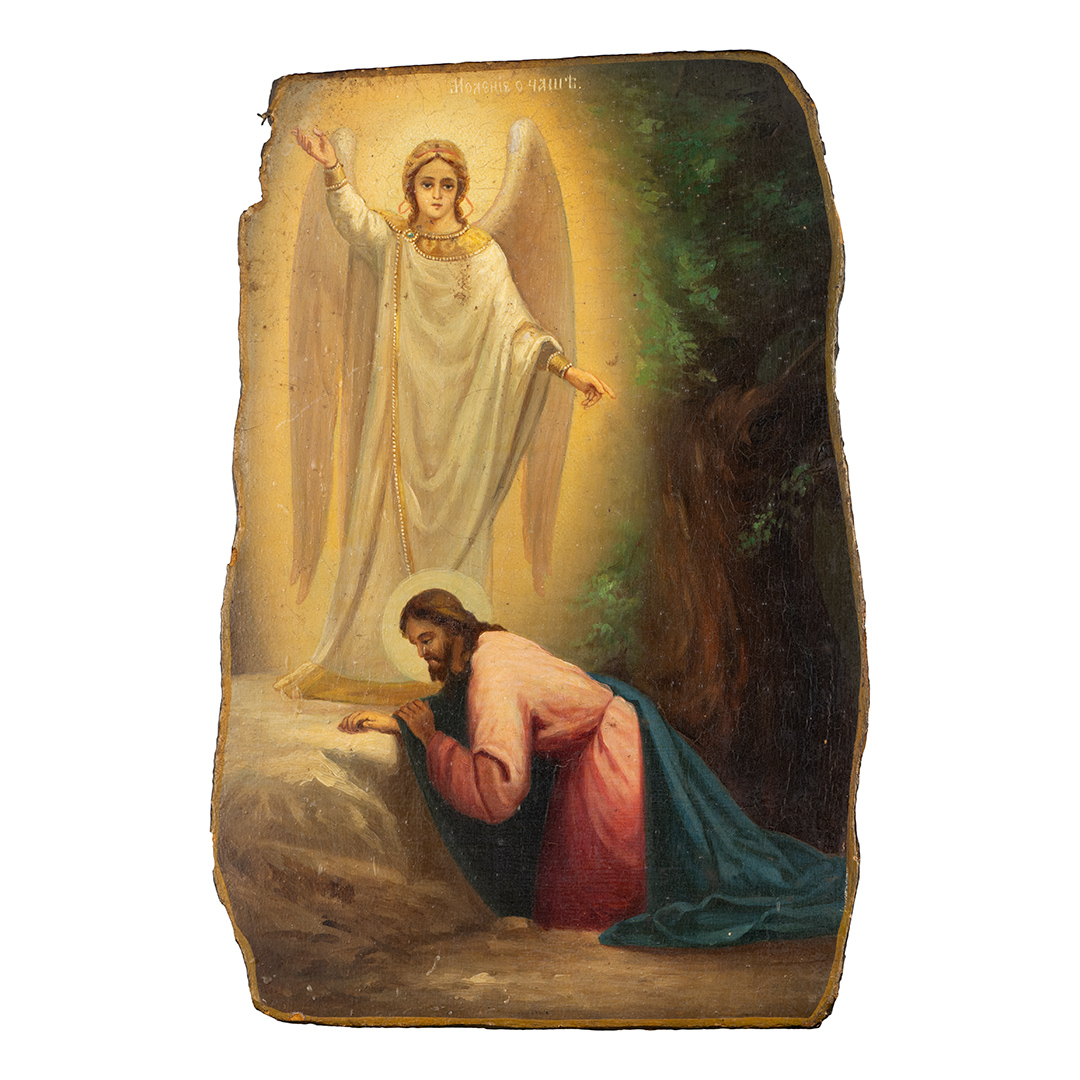
Lot 0256
Pilgrimage Icon with the Agony in the Garden on Olive Wood, Jerusalem, Russian workshop, 2nd half of the 19th century
Estimate: 4000-6000€Pilgrimage Icon with the Agony in the Garden Jerusalem. Russian icon painter, second half of the 19th century. Olive-wood slice, oil paint. Dimensions: 24.5 × 16.5 cm.
A pilgrimage icon painted on a naturally cut slice of olive wood, depicting Christ in prayer in the Garden of Gethsemane before the apparition of the angel. The composition is rendered in an academic manner, with Christ shown kneeling in the foreground, draped in rose and deep blue robes, while the angel, vested in luminous white, appears above in a burst of soft golden light. The irregular contour of the olive-wood support preserves the character of the object as a devotional work intimately bound to the sacred landscape of the Holy Land.
Icons painted on sections of olive wood were among the most characteristic forms of pilgrimage production in Jerusalem during the second half of the 19th century. Their material carried a particular resonance, recalling the trees of Gethsemane and thus giving the image an added devotional immediacy. The present example stands out for its unusually large size and for the quality of its execution, which elevates it above the more modest, mass-produced eulogiae commonly brought back by pilgrims.
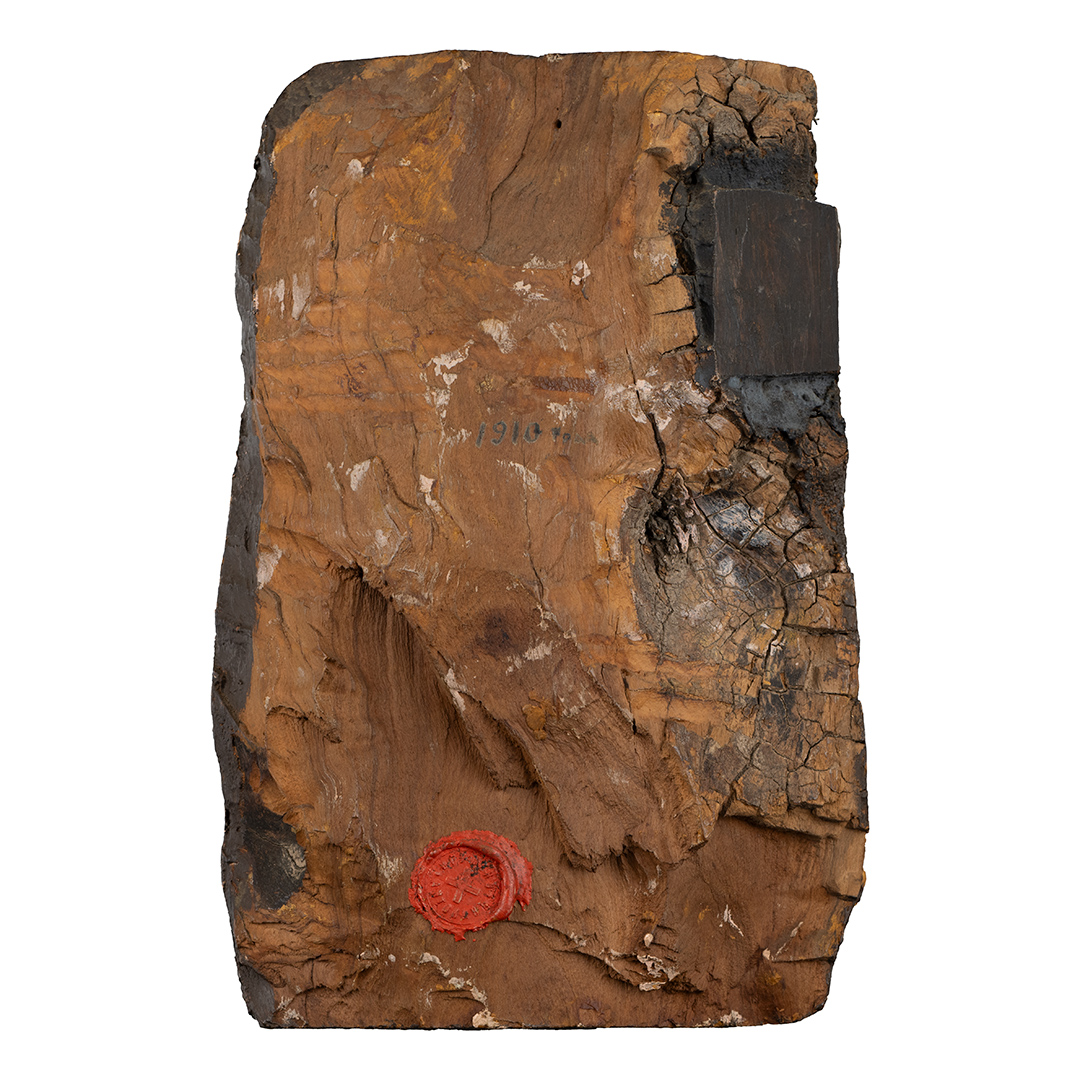
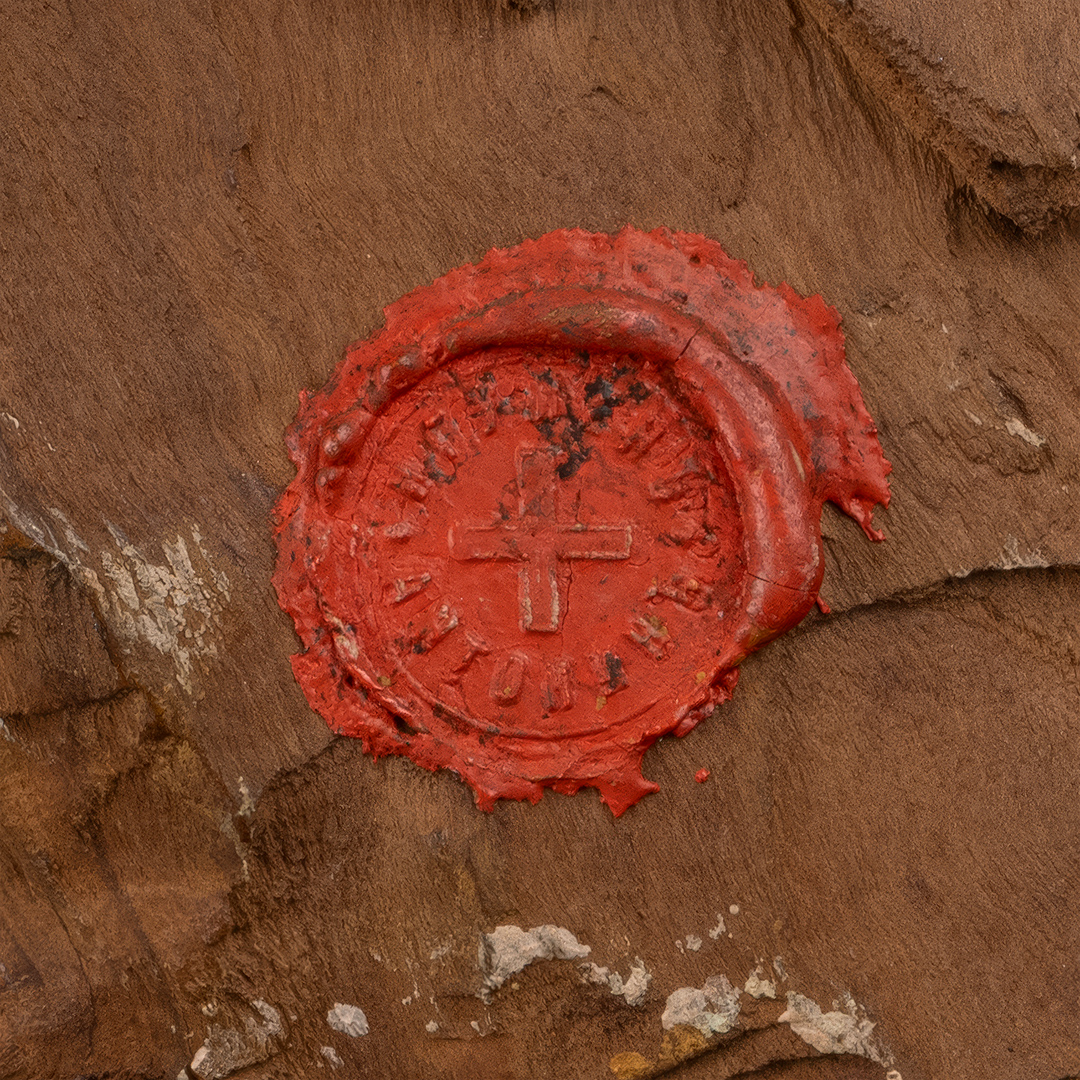
Of special interest is the reverse, which bears a red wax seal with initials surrounding a four-pointed cross, together with the handwritten date “1910.” This inscription likely records a later moment in the history of the icon, perhaps its presentation or donation. The seal has been associated, with some caution, with the circle of the Russian ecclesiastical mission in Jerusalem and may relate to the legacy of Archimandrite Antonin Kapustin, the honoured head of the Russian Spiritual Mission in the Holy Land and one of the principal architects of Russian pilgrimage culture in Palestine. In this way, the icon may be understood not only as a personal object of devotion, but also as a tangible relic of the Russian religious presence in Jerusalem.Starting price: 3500€
Estimate: 4000-6000€
Hammer Price: 5 000 € -
Lot 0257
Icon of the Mother of God “Skoroposlushnitsa (Gorgoepikoos)”, Mount Athos, circa 1900
Estimate: 7500-9000€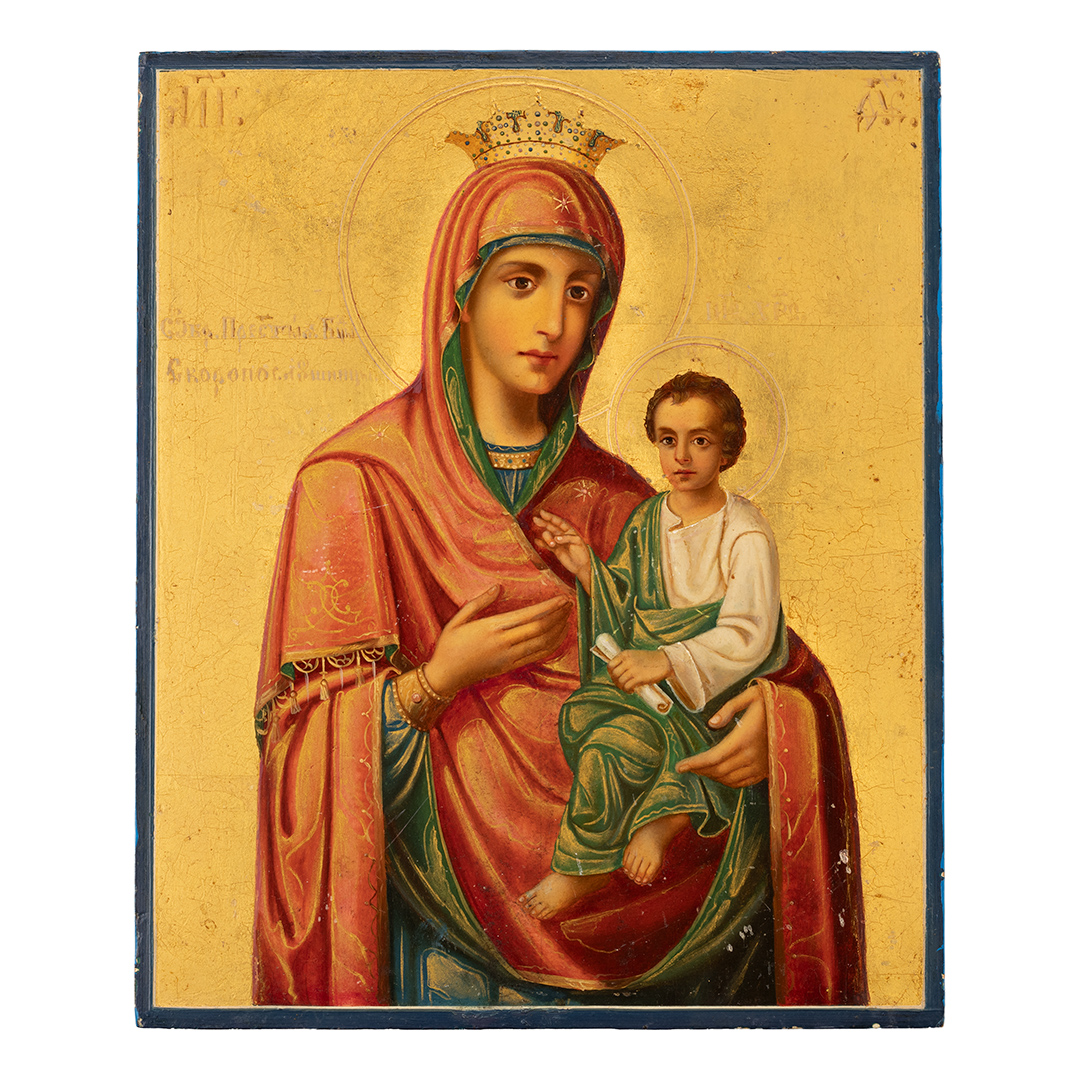
Lot 0257
Icon of the Mother of God “Skoroposlushnitsa (Gorgoepikoos)”, Mount Athos, circa 1900
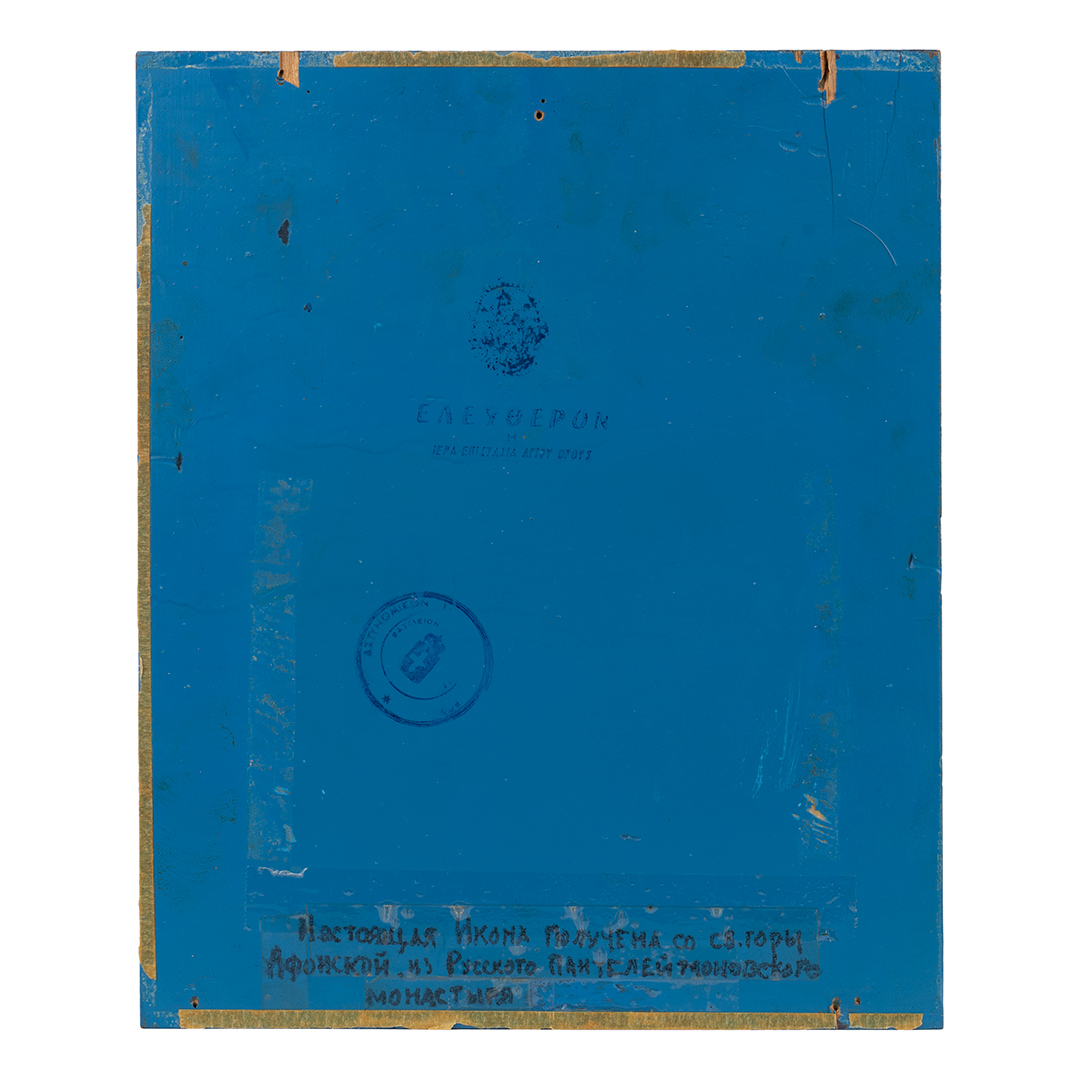
Estimate: 7500-9000€ICON OF THE MOTHER OF GOD “SKOROPOSLUSHNITSA” (Gorgoepikoos)
Greece, Mount Athos, circa 1900. Wood, gesso, oil, gilding. Dimensions: 26.5 × 22 cm
Inscriptions and stamps: on the reverse, a stamp of the Holy Mountain of Athos (Iera Epistasia, “ΕΛΕΥΘΕΡΟΝ”) and a circular seal; below, an ink inscription in Russian: “This authentic icon was received from the Holy Mount Athos, from the Russian Panteleimon Monastery.”
This icon represents the Mother of God in the Hodegetria type, the Guide or She Who Shows the Way. The Virgin, crowned and half-length, supports the Christ Child on her left arm and gestures toward Him with her right hand, directing the viewer’s devotion to the Incarnate Logos. The Christ Child, seated frontally, holds a rolled scroll. The background is entirely gilded, while the haloes are subtly tooled, lending the surface a restrained ceremonial brilliance. In the field appear the customary inscriptions: the Greek abbreviations for the Mother of God, the Christogram beside the Child, and, at left, the title identifying the image as the Most Holy Mother of God “Skoroposlushnitsa.”
The icon is an Athonite replica of the miracle-working Skoroposlushnitsa image displayed at the Monastery of Dochiariou. The original prototype was a wall painting of the 10th or 11th century, located near the entrance to the monastery refectory. Its special veneration is connected with the well-known Athonite tradition of the cellarer Nilus, who in 1664 received both rebuke and healing through the voice of the Mother of God. From that time onward, the image acquired fame as a wonderworking shrine, especially revered for its swift response to prayer.
Particularly significant are the marks on the reverse, which preserve the devotional biography of the present work. The official Athonite stamps indicate authorization for its departure from the Holy Mountain, while the inscription confirms its association with the Russian Monastery of Saint Panteleimon. Such details place the icon within the wide circulation of Athonite blessing images produced for pilgrims and benefactors, yet this example rises above the merely documentary by virtue of its refined execution and its well-preserved liturgical character.
The history of the Russian veneration of the Skoroposlushnitsa is closely linked with Hieromonk Arsenii (Alexander Minin, 1823-1879), a noted spiritual writer and publisher from the Russian Panteleimon Monastery on Athos. Having come to Russia in 1862 to collect donations for the monastery, he brought to Moscow in 1866 a portion of the relics of the Great Martyr Panteleimon together with an icon of the Mother of God Skoroposlushnitsa. From that moment the cult of this image spread widely in Russia. At first the holy objects were housed in the Epiphany Monastery in Moscow; in 1870 a special Athonite chapel was erected for them at the corner of Nikolskaya Street and Bogoyavlensky Lane. The chapel was closed and demolished in 1929.Starting price: 6000€
Estimate: 7500-9000€
Hammer Price: 6 000 € -
Lot 0258
Icon of the Mother of God Khtitorissa of Vatopedi with Saints John the Theologian and Parthenios, Mount Athos, late 18th–early 19th century
Estimate: 4000-6000€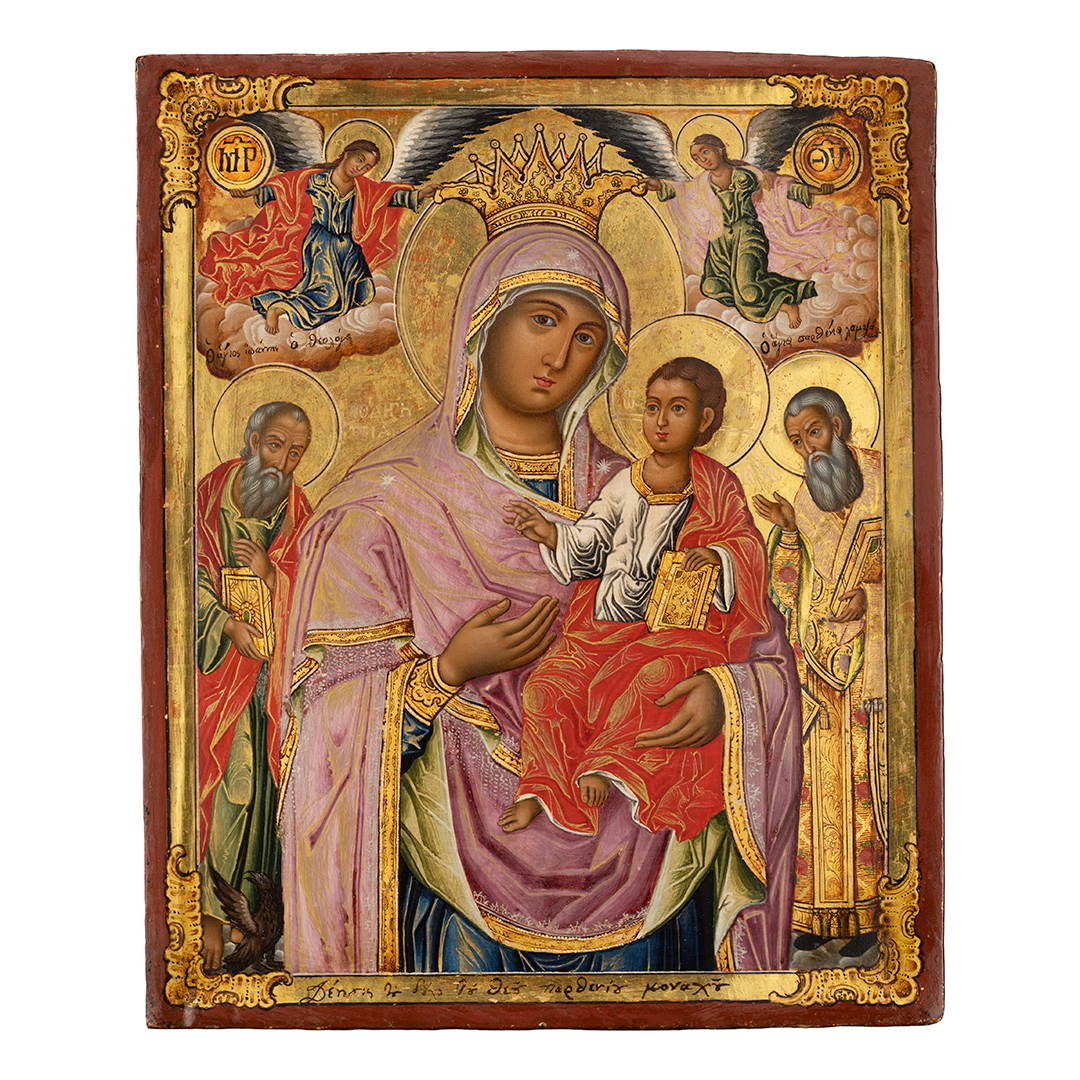
Lot 0258
Icon of the Mother of God Khtitorissa of Vatopedi with Saints John the Theologian and Parthenios, Mount Athos, late 18th–early 19th century
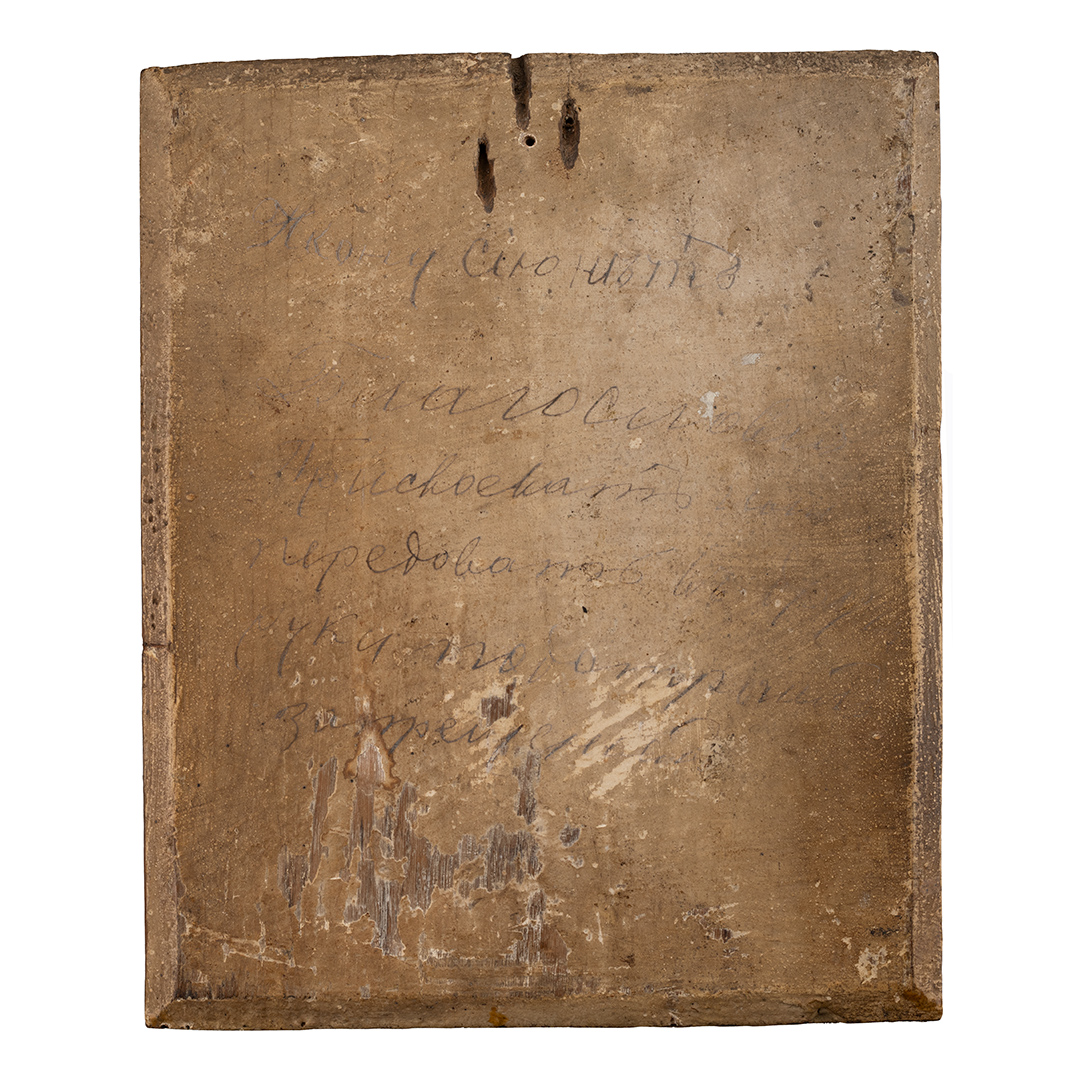
Estimate: 4000-6000€ICON OF THE MOTHER OF GOD KHTITORISSA OF VATOPEDI WITH SAINTS JOHN THE THEOLOGIAN AND PARTHENIOS, BISHOP OF LAMPSAKOS
Greece, Mount Athos (?), late 18th to early 19th century. Wood, levkas, tempera . Dimensions: 28.5 × 23 cm
Provenance: formerly in the possession of the Greek monk Parthenios.
This icon presents a refined and unusually elaborate variant of the Vatopedi Khtitorissa iconography. The Virgin enthroned with the Christ Child occupies the center of the composition, while two angels descending in cloud-borne segments place a crown upon her head. In the miraculous prototype of the Vatopedi monastery, the crown belongs to the revetment; here it has been fully integrated into the painted image, lending the composition greater ceremonial splendor. The Christ Child, instead of the customary scroll, holds a Gospel bound in a precious cover, a variant known in later painted replicas of revered miracle-working icons.
At either side of the central group stand two full-length saints, compressed into the narrow vertical spaces between the principal composition and the side margins. To the viewer’s right appears Saint John the Theologian, accompanied below by his symbolic eagle. To the left stands Saint Parthenios, Bishop of Lampsakos. Along the lower border runs a cursive owner’s inscription which may be translated: “Supplication of the servant of God, the monk Parthenios.” The icon was most likely ordered by an Athonite monk named Parthenios, probably a member of the Vatopedi monastery, who wished to possess an image of the monastery’s venerated wonderworking shrine, joined with the figure of his name saint, Saint Parthenios of Lampsakos, shown in prayerful intercession before the Mother of God.
The inclusion of Saint John the Theologian may also reflect the patron’s Greek devotional identity. The Evangelist’s close association with the island of Patmos, where according to tradition he received and wrote the Apocalypse, would have carried particular resonance for a Greek monk and pilgrim milieu. The icon thus unites personal piety, monastic devotion, and local sacred geography within a single, carefully conceived image.Starting price: 3500€
Estimate: 4000-6000€
Hammer Price: 9 000 € -
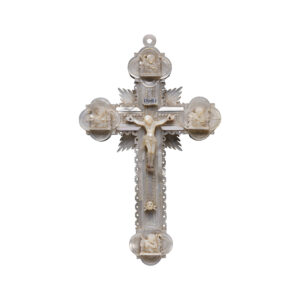
Lot 0259
Rare Jerusalem Mother-of-Pearl Pilgrim Crucifix with Russian Monastic Inscription, 2nd Half 19th Century
Estimate: 3500-5000€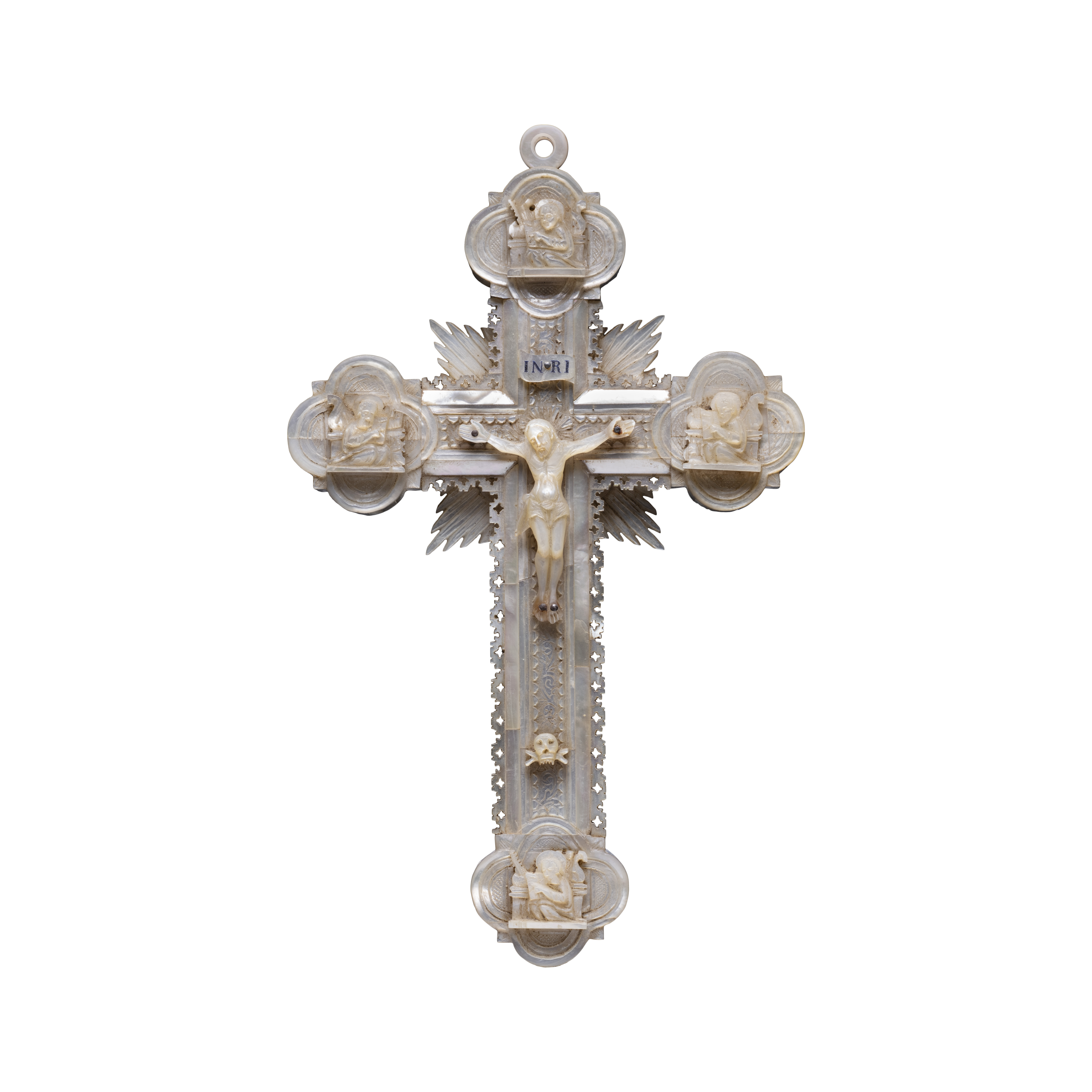
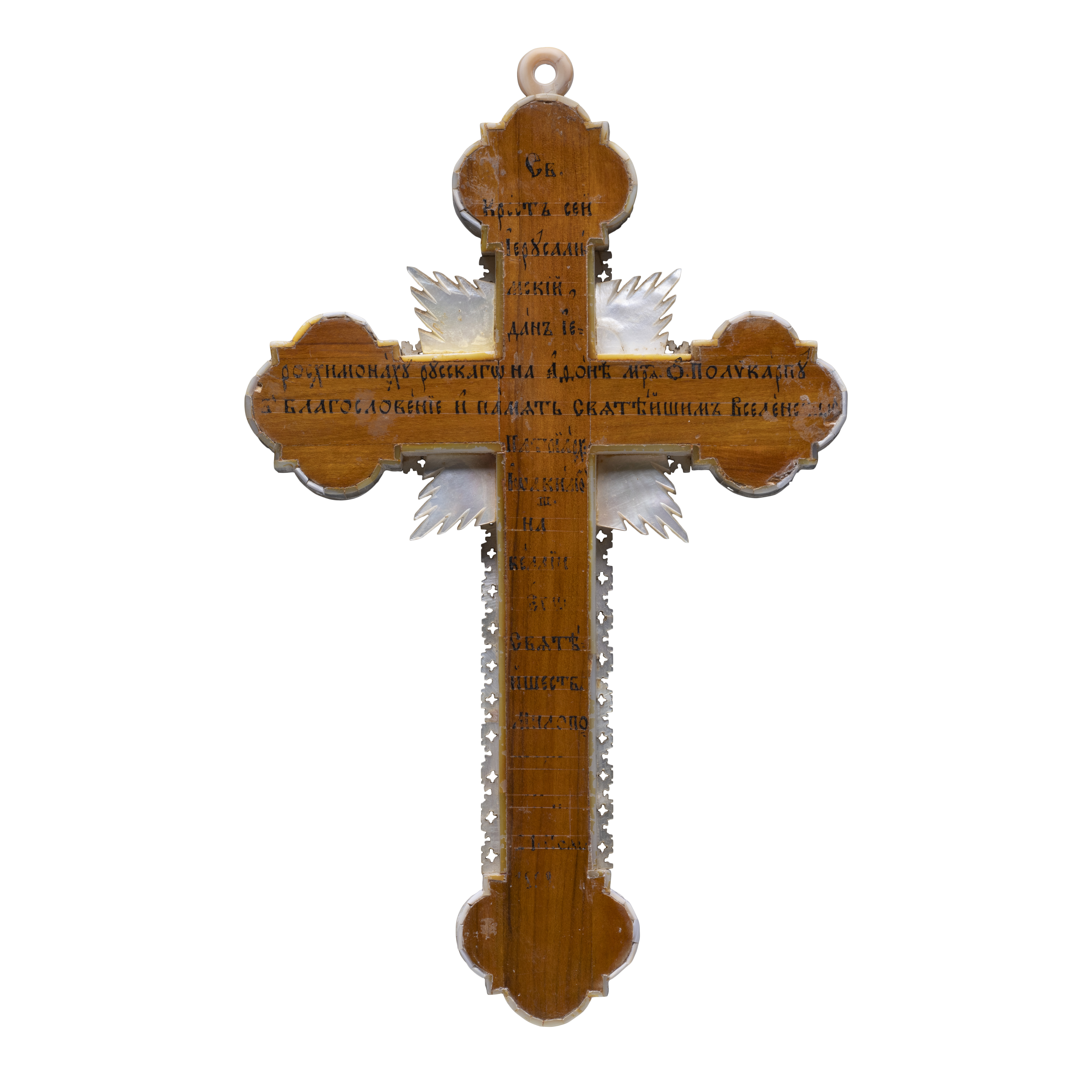
Lot 0259
Rare Jerusalem Mother-of-Pearl Pilgrim Crucifix with Russian Monastic Inscription, 2nd Half 19th Century
Estimate: 3500-5000€Rare memorial pilgrim Cross with the Crucifixion
Palestine, probably Jerusalem, second half of the 19th century
Wood, mother-of-pearl; carved and pierced relief
Dimensions: 22 x 13,5 x 5,5 cm.
A wooden four-ended cross with expanded, shaped terminals, clad on the front and along the edges with finely carved mother-of-pearl plaques. At the center is a high-relief representation of the Crucified Christ. Above His head appears the titulus with the inscription INRI, while below is the skull of Adam, the traditional symbol of Golgotha and of Christ’s redemptive sacrifice. The four terminals contain carved representations of the Evangelists, each shown seated within an architectural setting. Pierced borders and radiating mother-of-pearl elements lend the object a refined silhouette and enhance the shimmering quality of its surface.
This type of object belongs to the group of Christian pilgrimage souvenirs known as eulogiae, that is, blessed devotional keepsakes acquired at major sacred centers. In 19th-century Palestine, especially in Jerusalem, workshops produced a wide range of such objects in mother-of-pearl, from small crosses and icons to more elaborate liturgical works. The present example is characteristic of that tradition in both material and iconography.
Of particular importance is the handwritten Cyrillic inscription on the reverse, now partly faded. It may be read approximately as identifying the object as a “Jerusalem cross” given to Hieromonk Father Polycarp of the Russian monastery on Mount Athos “as a blessing and in remembrance of the most holy places.”Starting price: 2500€
Estimate: 3500-5000€
Hammer Price: 4 000 € -
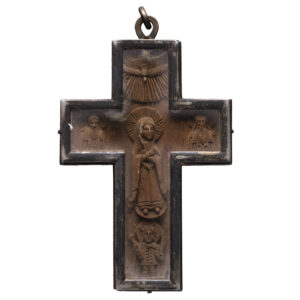
Lot 0260
Trinity-Sergius Lavra Reliquary Crucifix with Silver Mount, 17th–18th Century
Estimate: 4500-6000€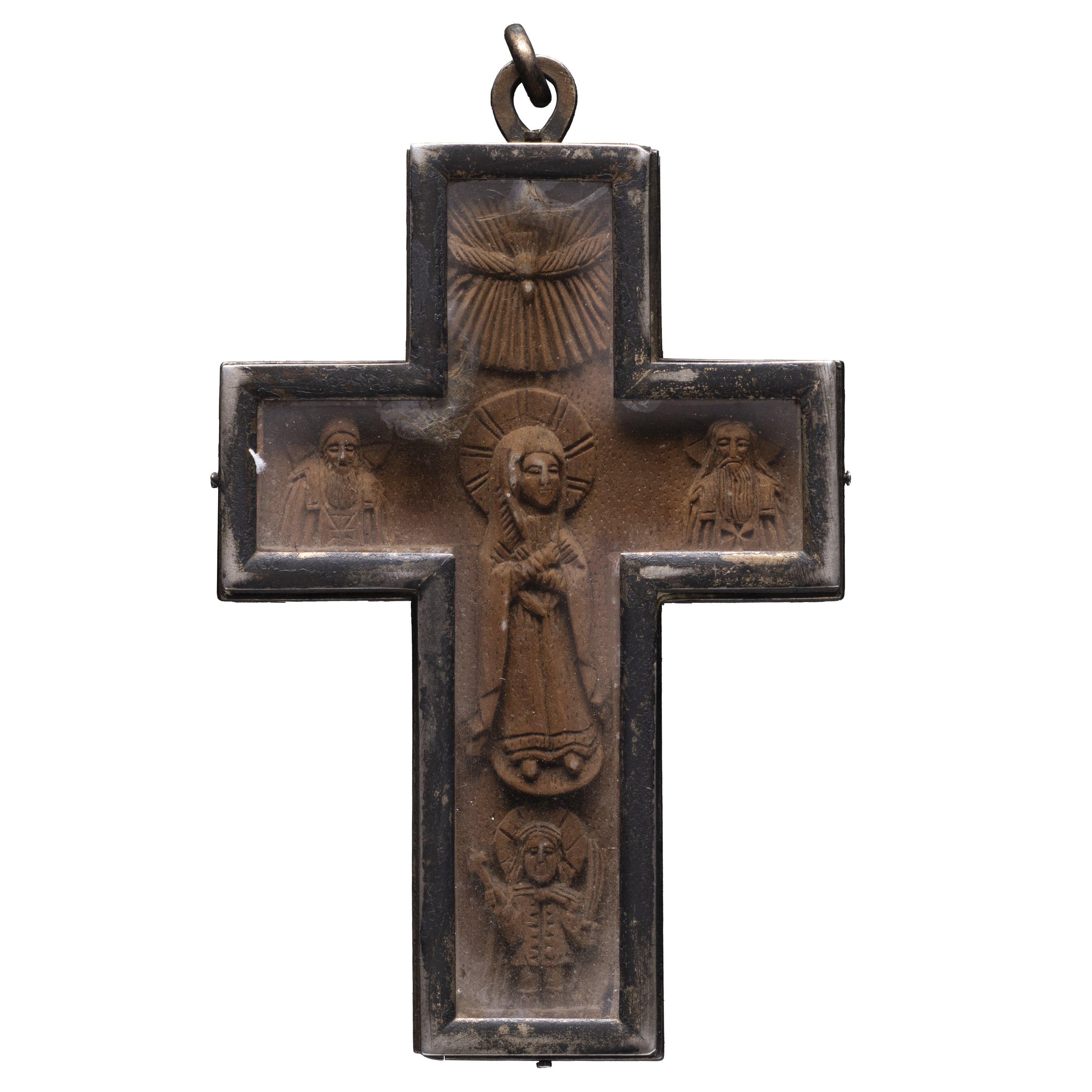
Lot 0260
Trinity-Sergius Lavra Reliquary Crucifix with Silver Mount, 17th–18th Century
Estimate: 4500-6000€Rare reliquary Cross with the Crucifixion. Workshops of the Trinity-Sergius Lavra, 17th-18th century. Wood, silver; carving
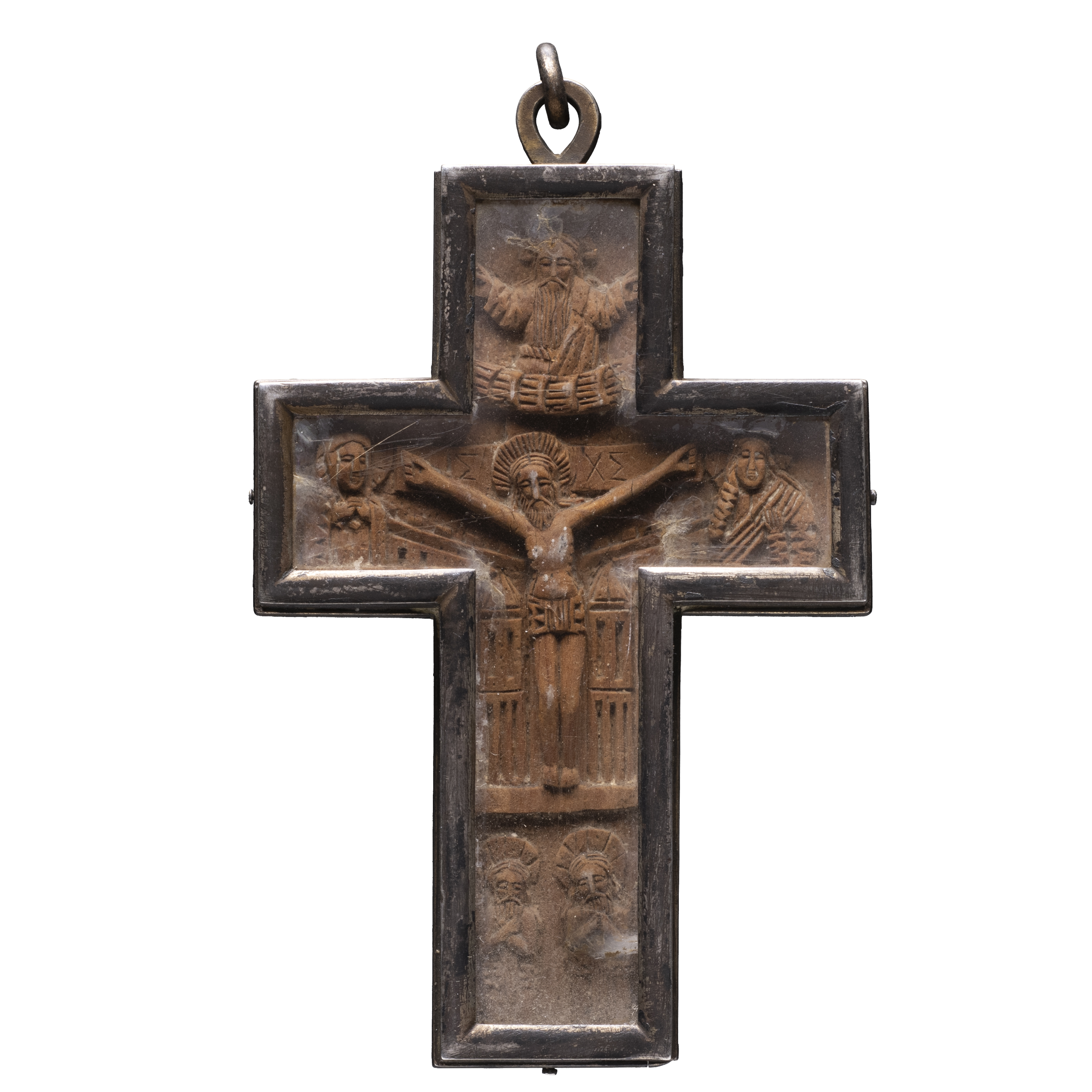
Dimensions: 11 x 7 x 2,5 cm . A four-ended wooden reliquary cross, enclosed within a broad silver frame that follows the contour of the arms. The obverse is carved with the composition of the Crucifixion: Christ is shown on the Golgotha Cross, flanked by standing figures of the Virgin and Saint John the Theologian. In the upper terminal appears a bust of God the Father, while the inscriptions IC XC placed on the crossbeam and above Christ’s head. The lower section contains additional haloed figures, completing the devotional program of the front.
The reverse is centered by a full-length image of the Mother of God. Above is the Dove of the Holy Spirit in rays, while the lateral and lower terminals are occupied by further carved saintly figures. The cross is fitted with four screws at the terminals, and a suspension loop is attached to the upper screw, indicating that it was intended as a hanging devotional object. Its construction also points to a reliquary function.
The combination of a carved wooden core and a severe silver mount is characteristic of the devotional works associated with the workshops of the Trinity-Sergius Lavra. See similar items in Sergiev Possad and Pereslavl-Zalesskiy State museums.Starting price: 3500€
Estimate: 4500-6000€
Hammer Price: 6 000 € -
Lot 0261
Russian Travel Triptych with Saint Nicholas the Wonderworker, Brothers Markov, Moscow, 1898–1908
Estimate: 3000-4500€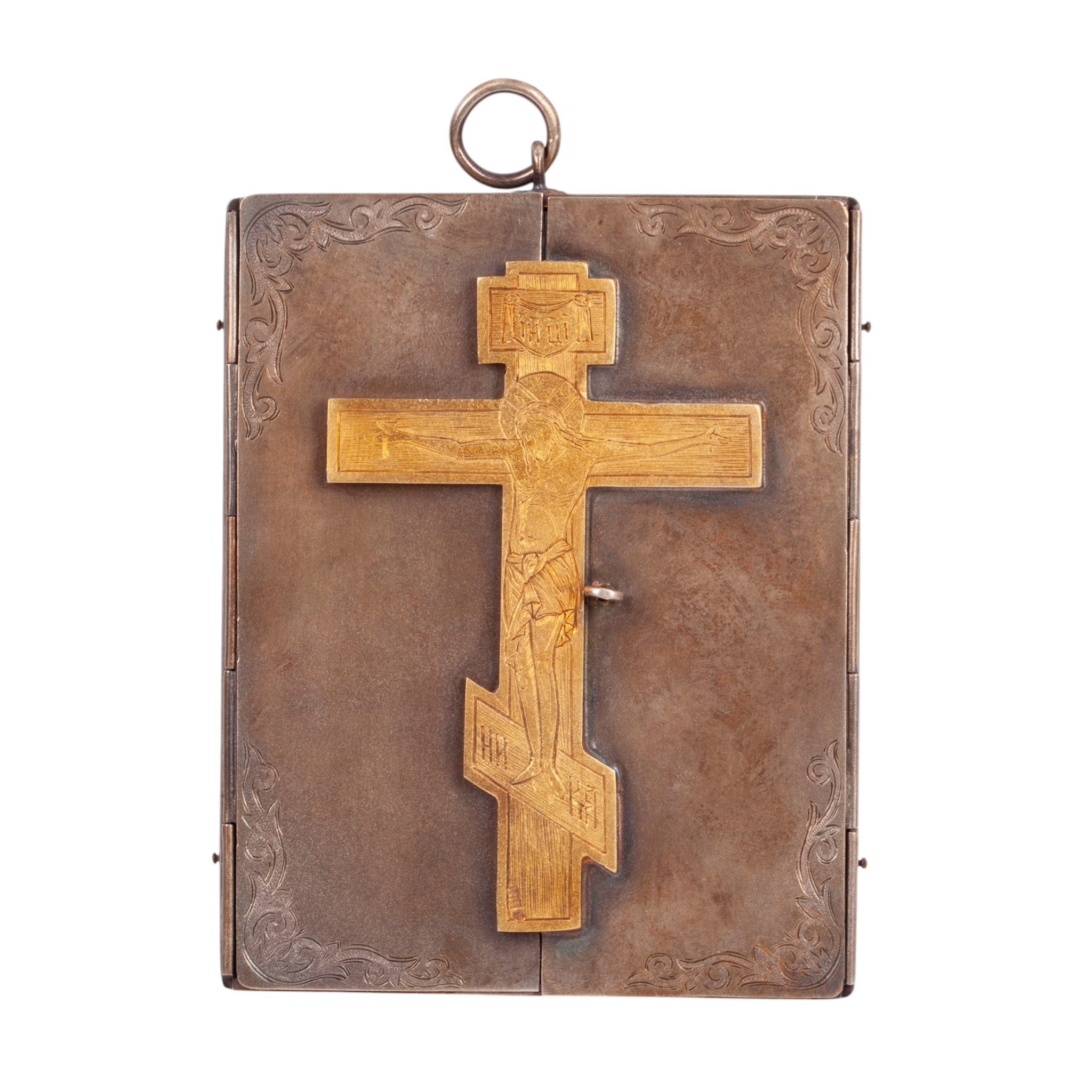
Lot 0261
Russian Travel Triptych with Saint Nicholas the Wonderworker, Brothers Markov, Moscow, 1898–1908
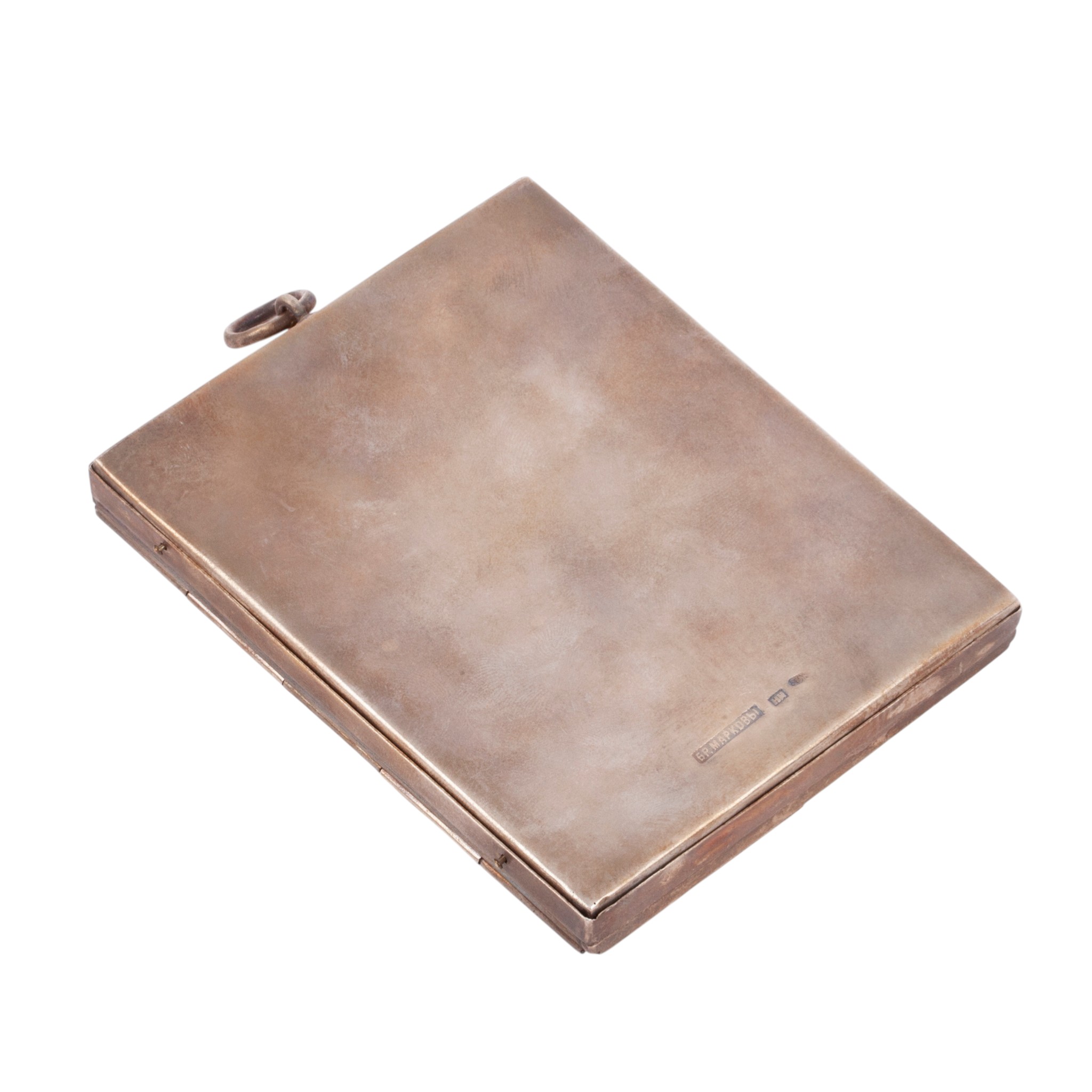
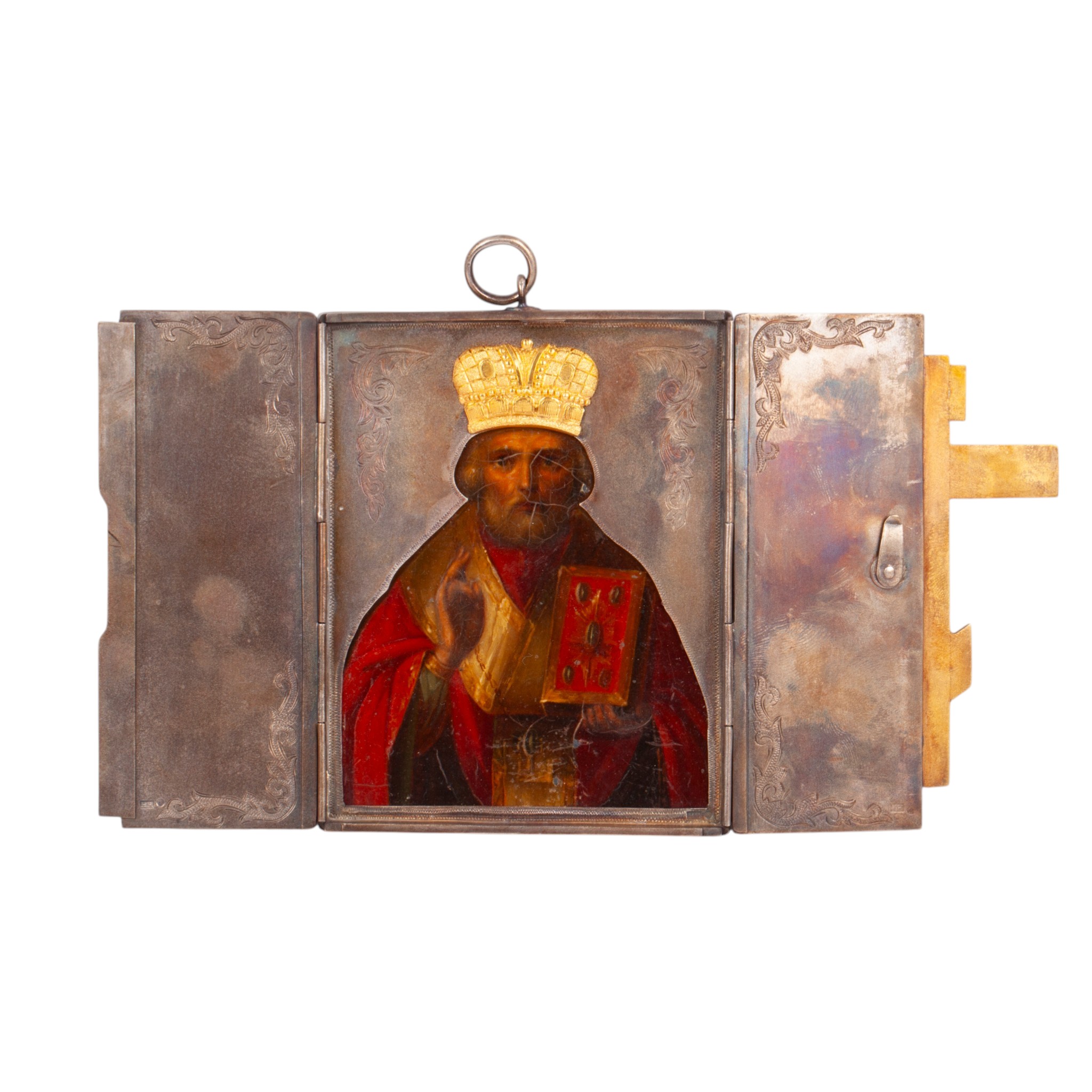
Estimate: 3000-4500€A Russian Travel Triptych with Saint Nicholas the Wonderworker
Moscow, Brothers Markov, 1898-1908.
Silver, gilding, wood, oil.
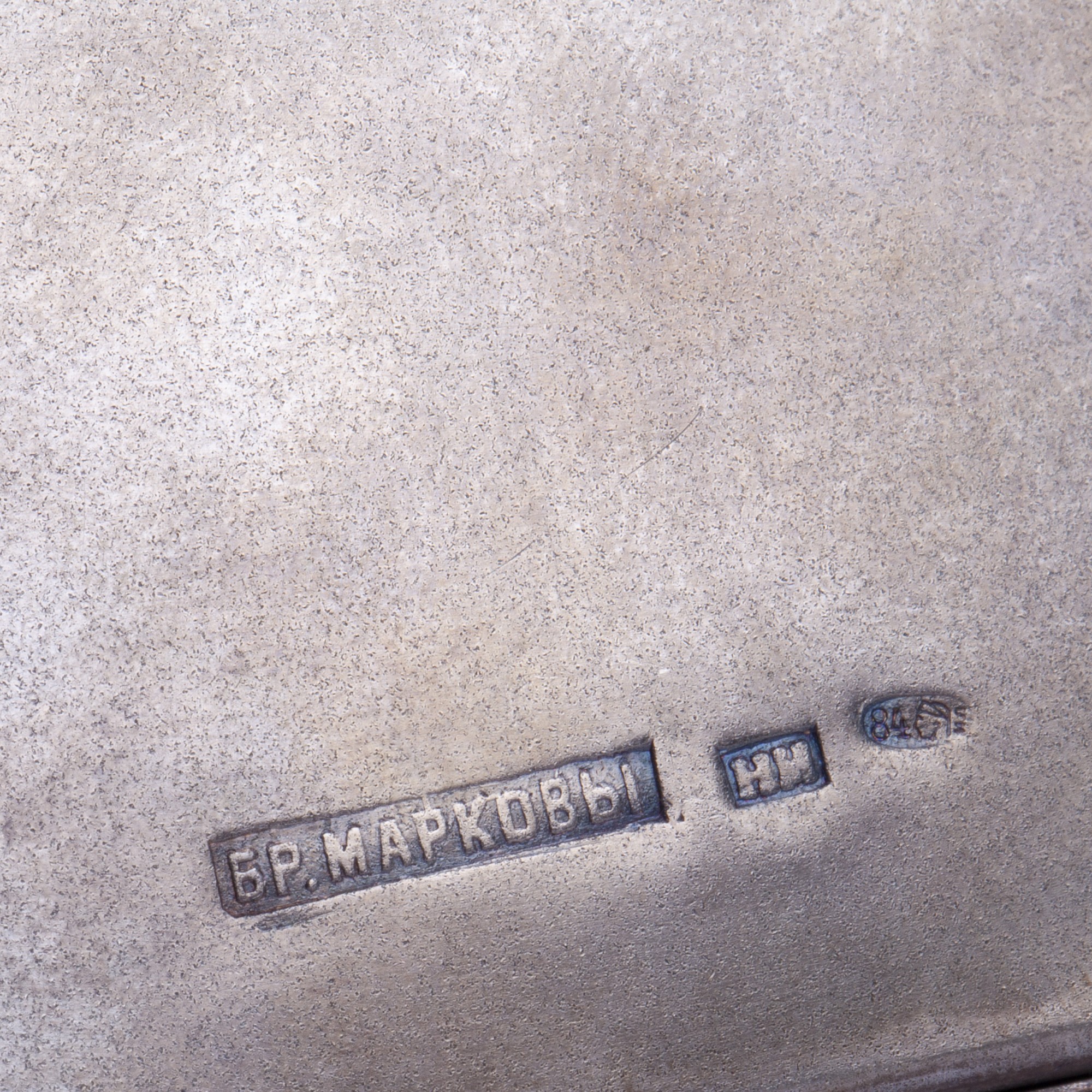
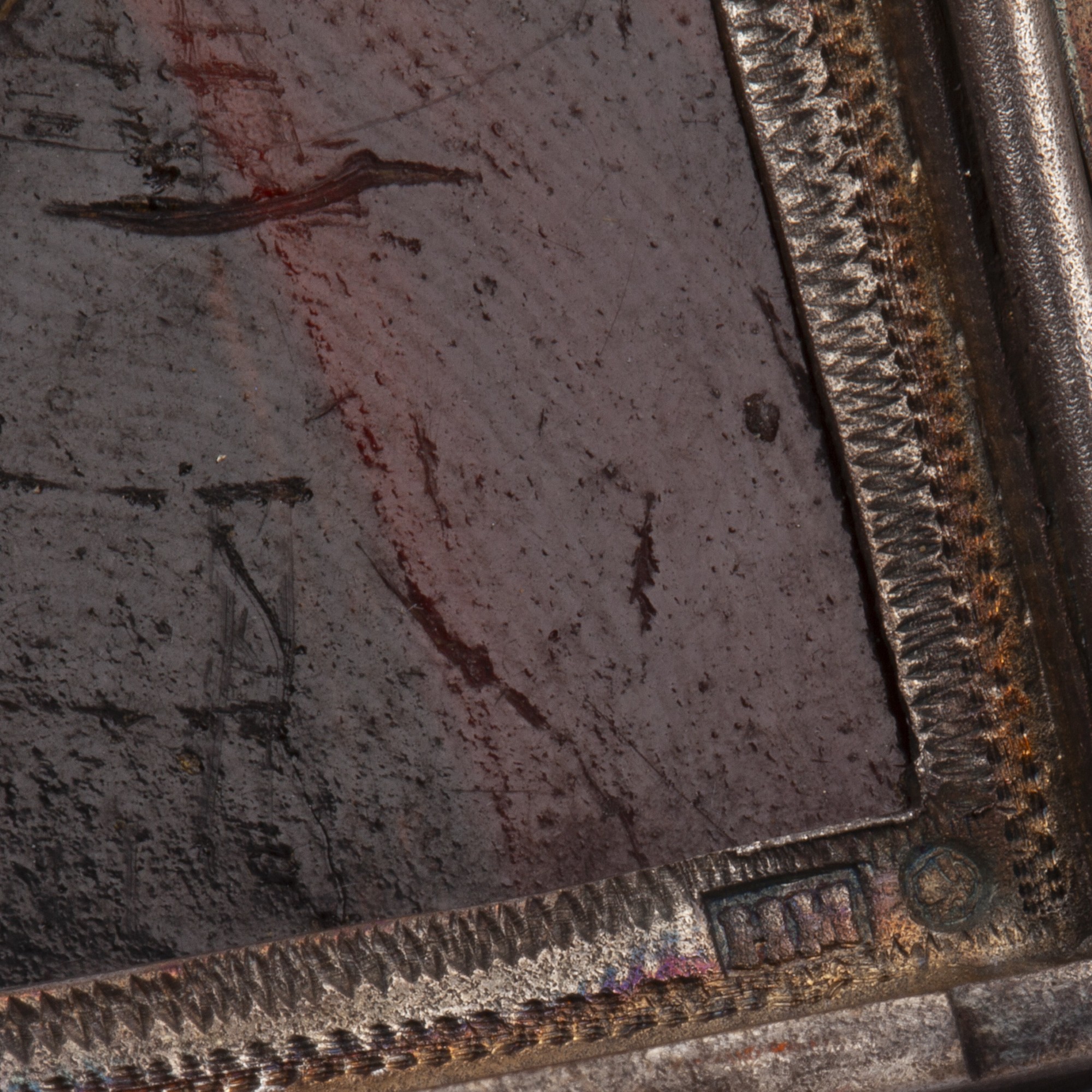
Marked: firm’s mark of the Brothers Markov, 84 zolotnik silver standard, assay mark of Moscow. Dimensions (closed) with suspension: 12,5 x 9,5 x 1,7 cm. Dimensions(opened): 12,5 x 21,7 x 1,2. Total weight: 326 g.
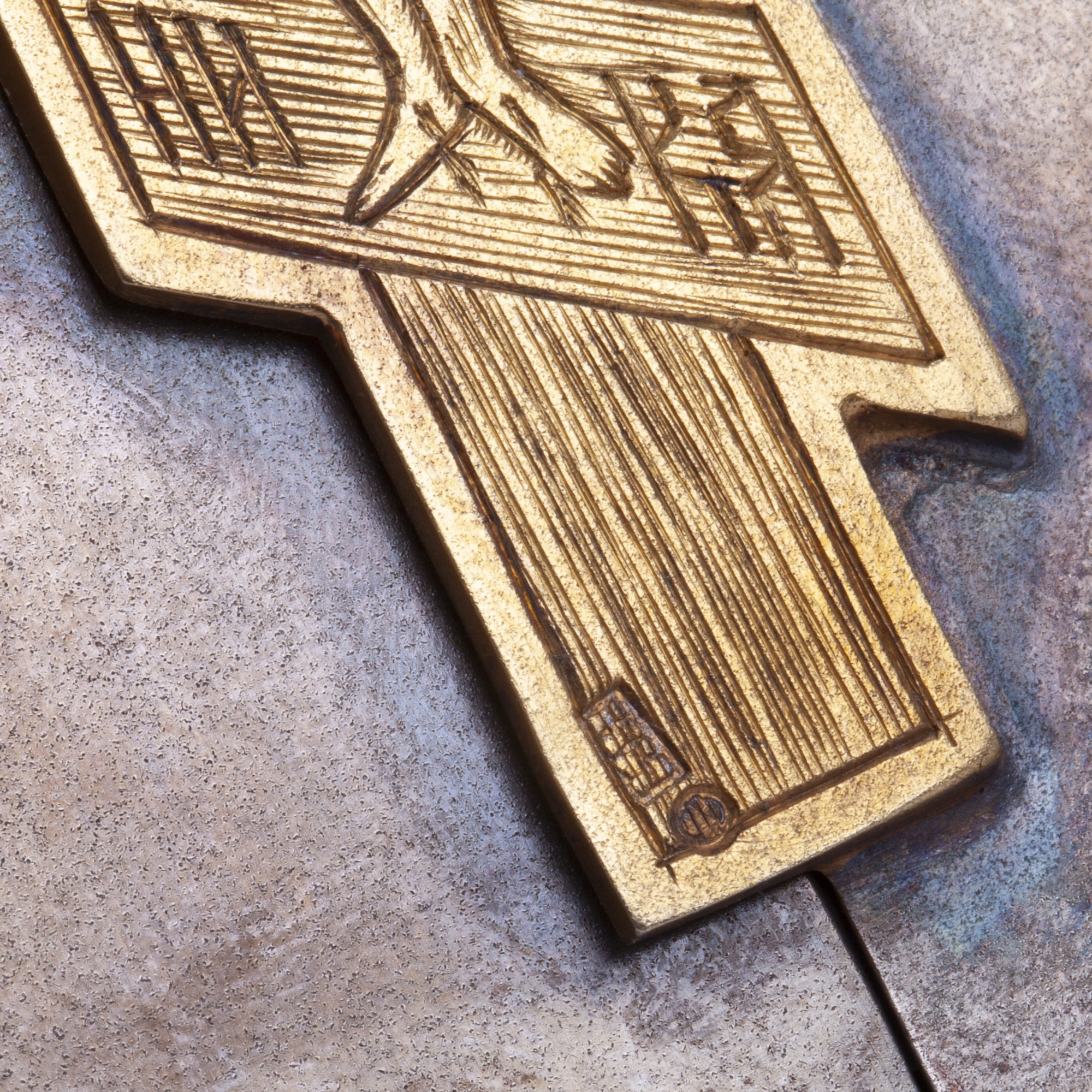
A finely executed Russian portable travel triptych centered on an icon of Saint Nicholas the Wonderworker, shown half-length in episcopal vestments, raising his right hand in blessing and holding the Gospel in his left. The painted image, set within a silver folding case, is framed by engraved borders and surmounted by an applied gilt cross with the Crucified Christ. Compact in scale and fitted with a suspension ring, the triptych was intended for private prayer during travel, combining practicality with precious workmanship.
The triptych was produced by the honorable Moscow firm of the Brothers Markov, founded by Pavel and Fyodor Markov, proprietors of one of the major jewellery and silver enterprises of their time. Established on Ilyinka street, with additional branches on Nikolskaya Street and in Cherkassky Lane, the firm was known for its wide range of diamond, gold, and silver wares, icons, clocks, and table silver, as well as for the consistently high quality of its materials and craftsmanship.Starting price: 2500€
Estimate: 3000-4500€
Hammer Price: Not sold -
Lot 0263
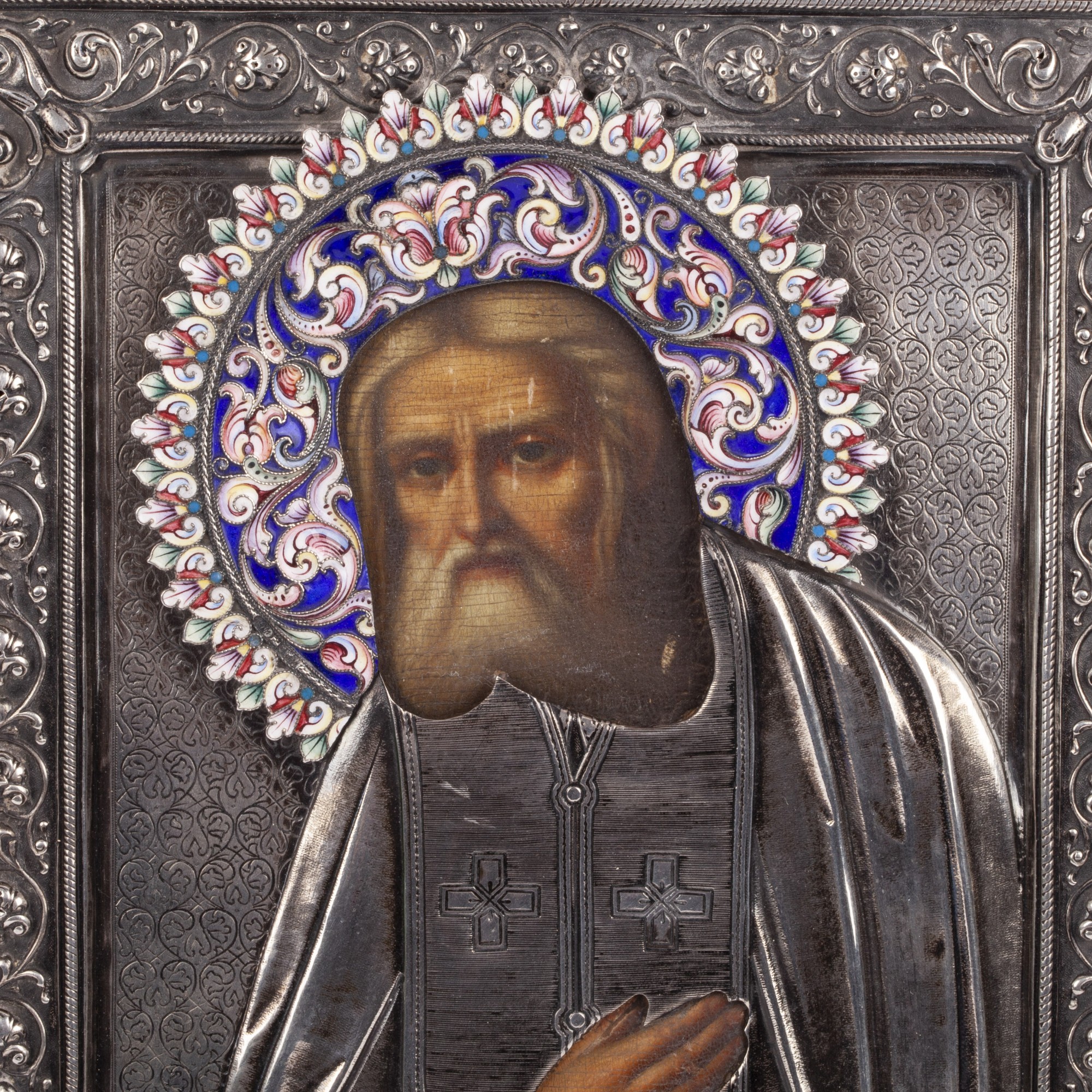
Russian Icon of Saint Seraphim of Sarov with Silver Oklad and Enamel, Ivan A. Alexeev, Moscow, 1899–1908
Estimate: 8000-12000€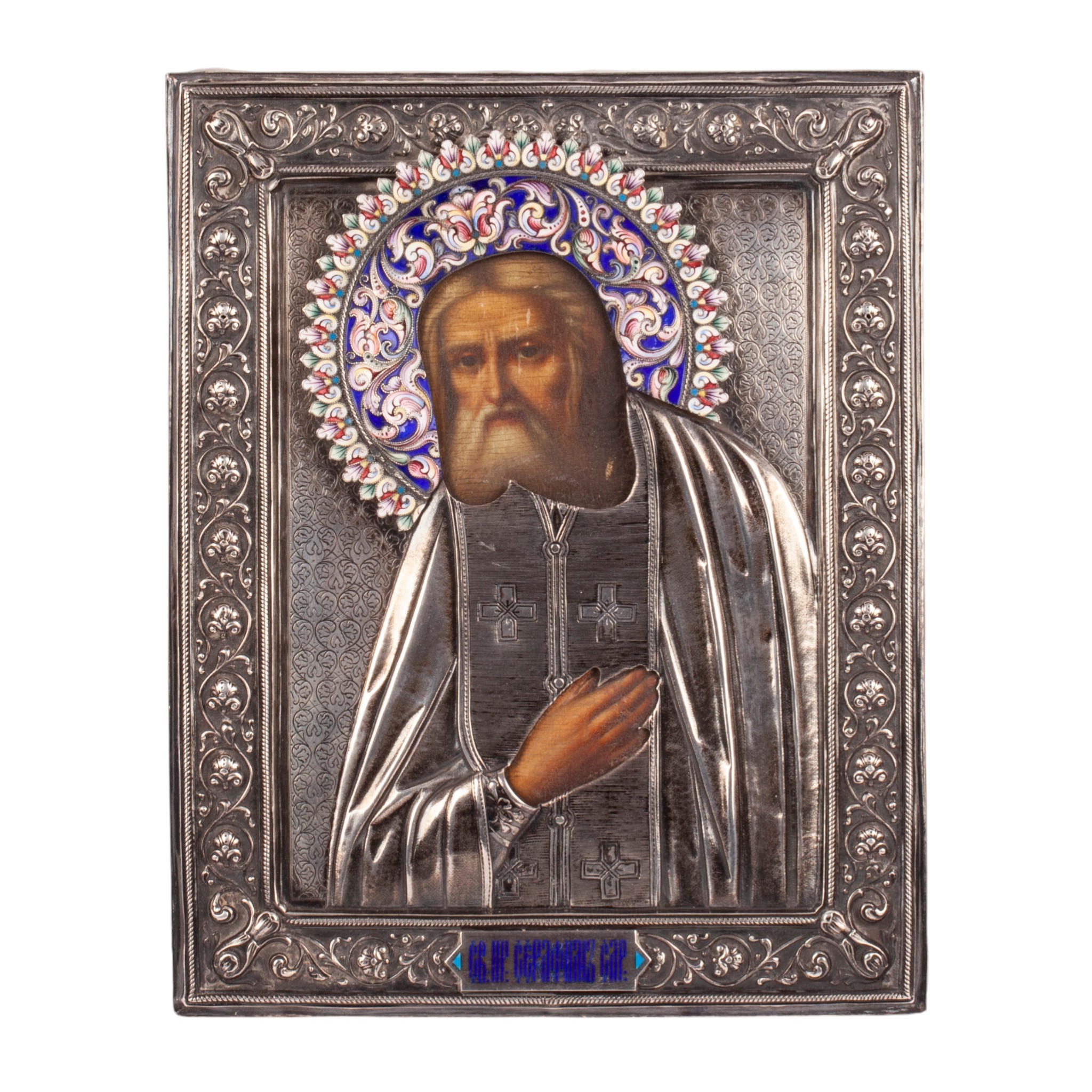
Lot 0263
Russian Icon of Saint Seraphim of Sarov with Silver Oklad and Enamel, Ivan A. Alexeev, Moscow, 1899–1908
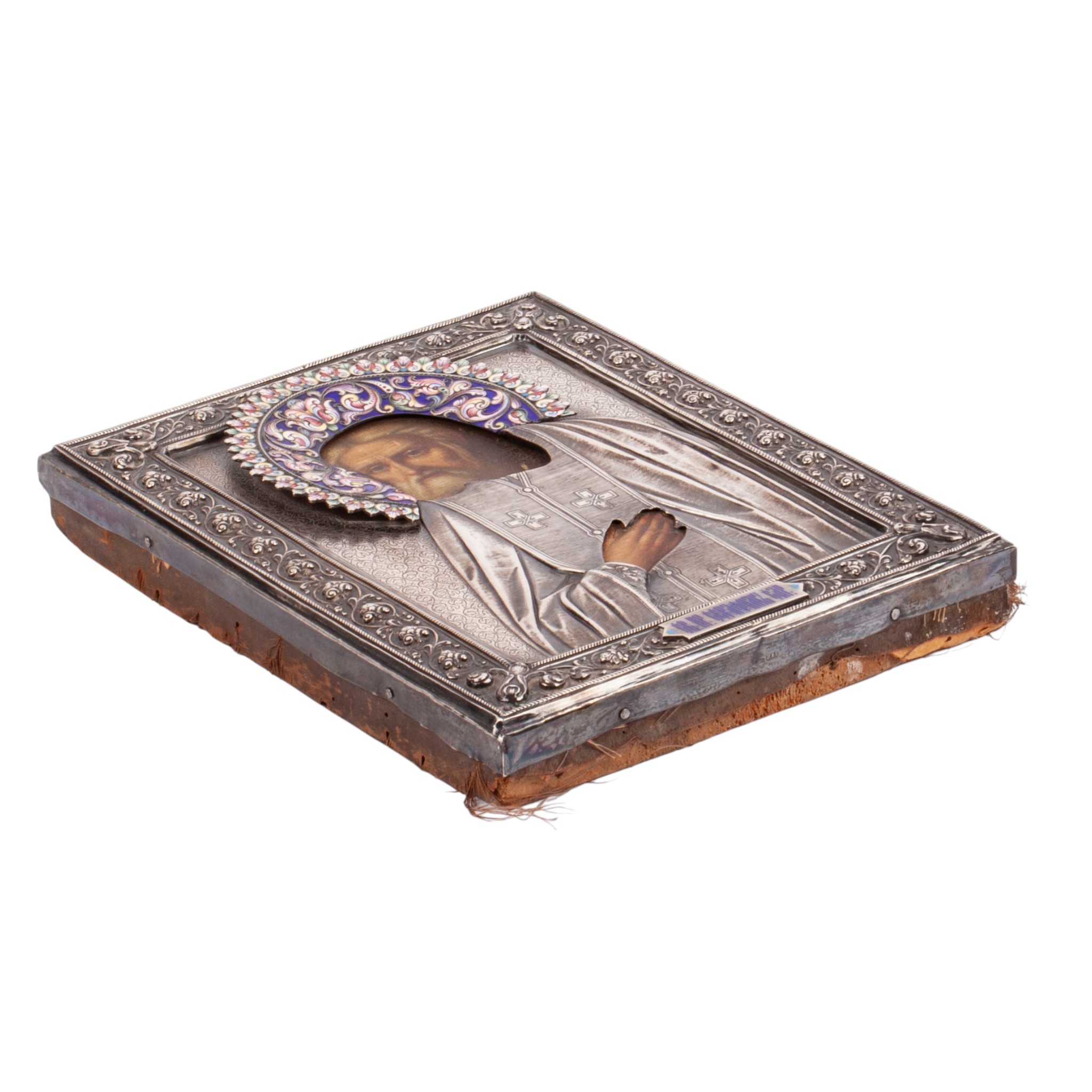
Estimate: 8000-12000€Russin Icon of Saint Seraphim of Sarov
Moscow, Ivan Alexeevich Alexeev, 1899-1908.
Tempera on wood, silver oklad, enamel.
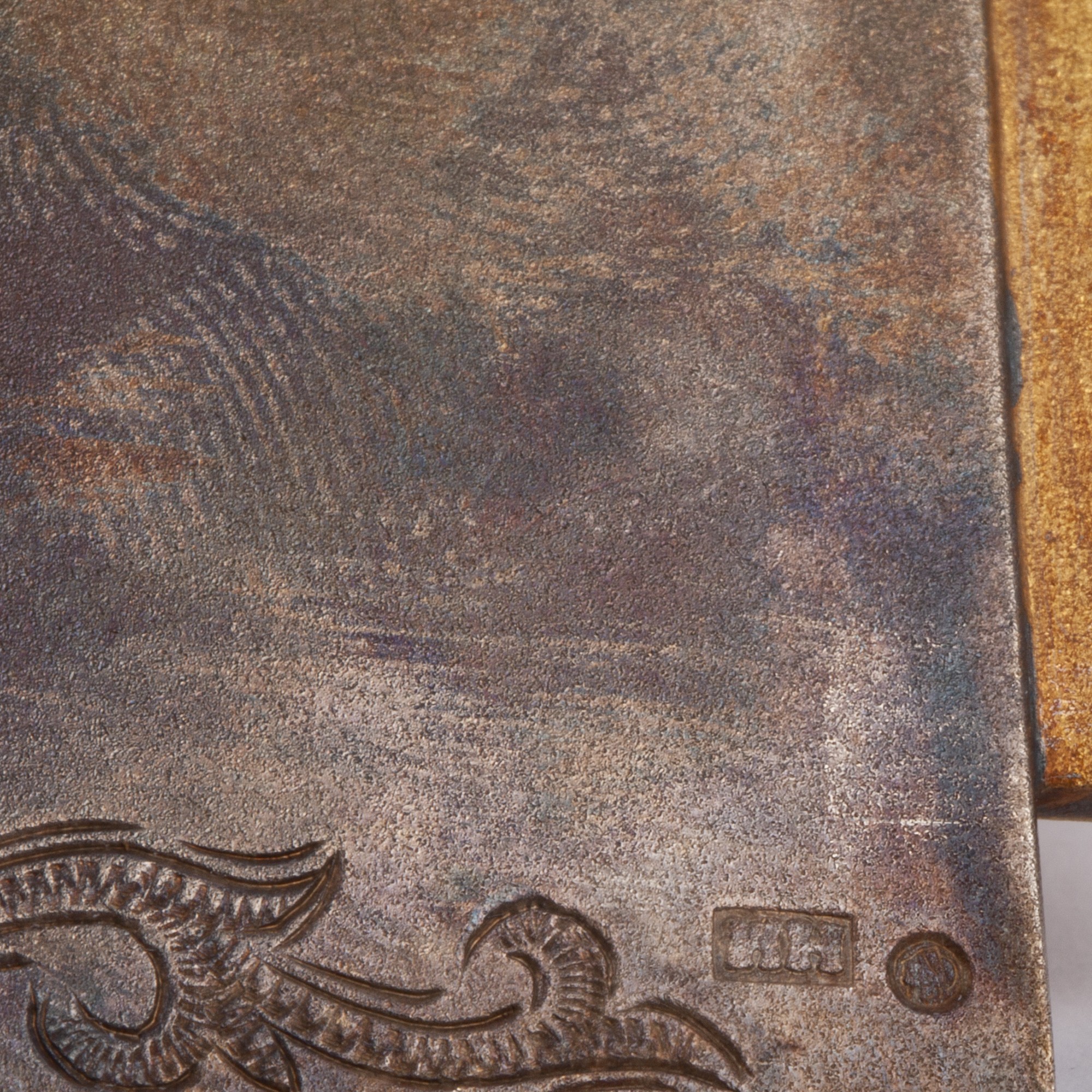
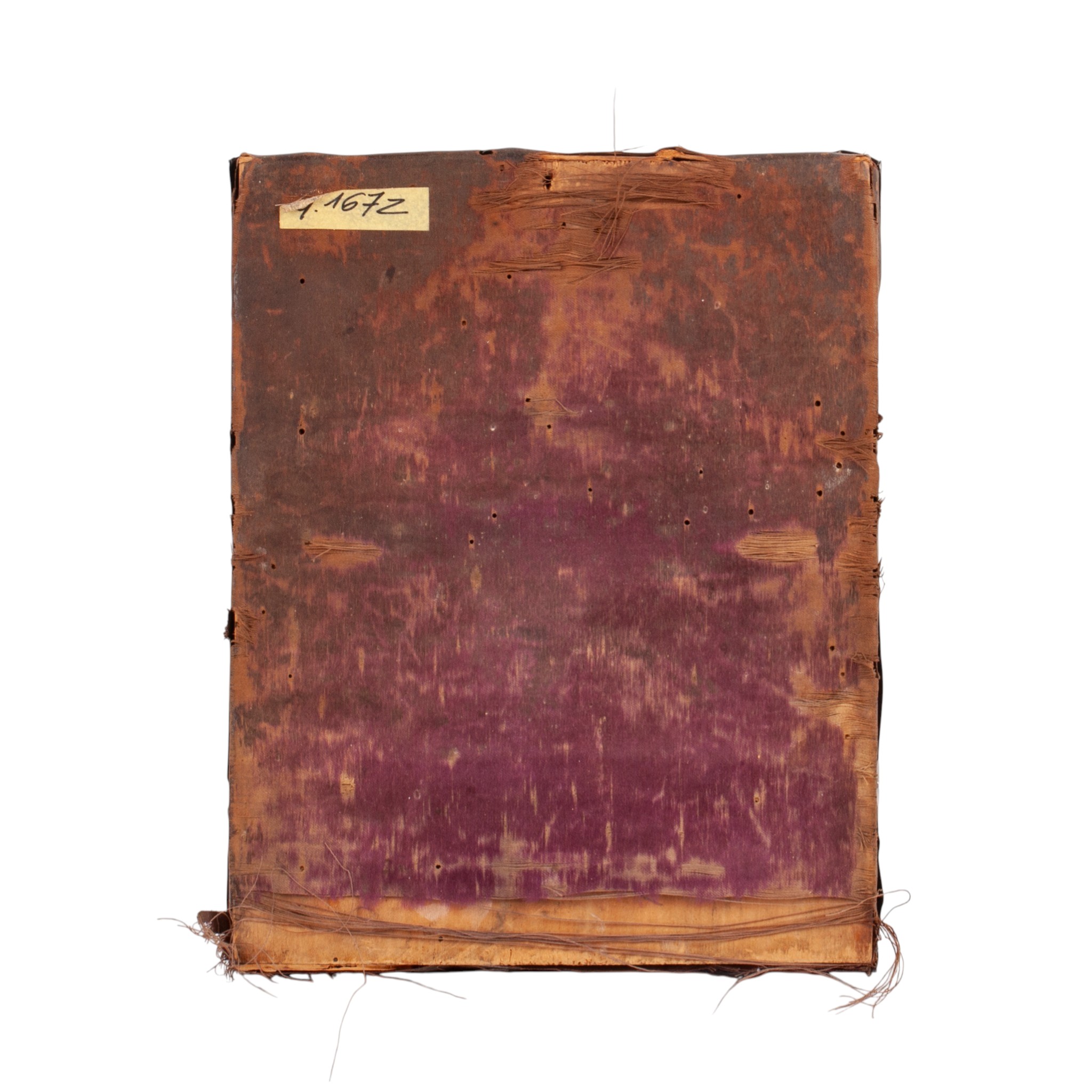
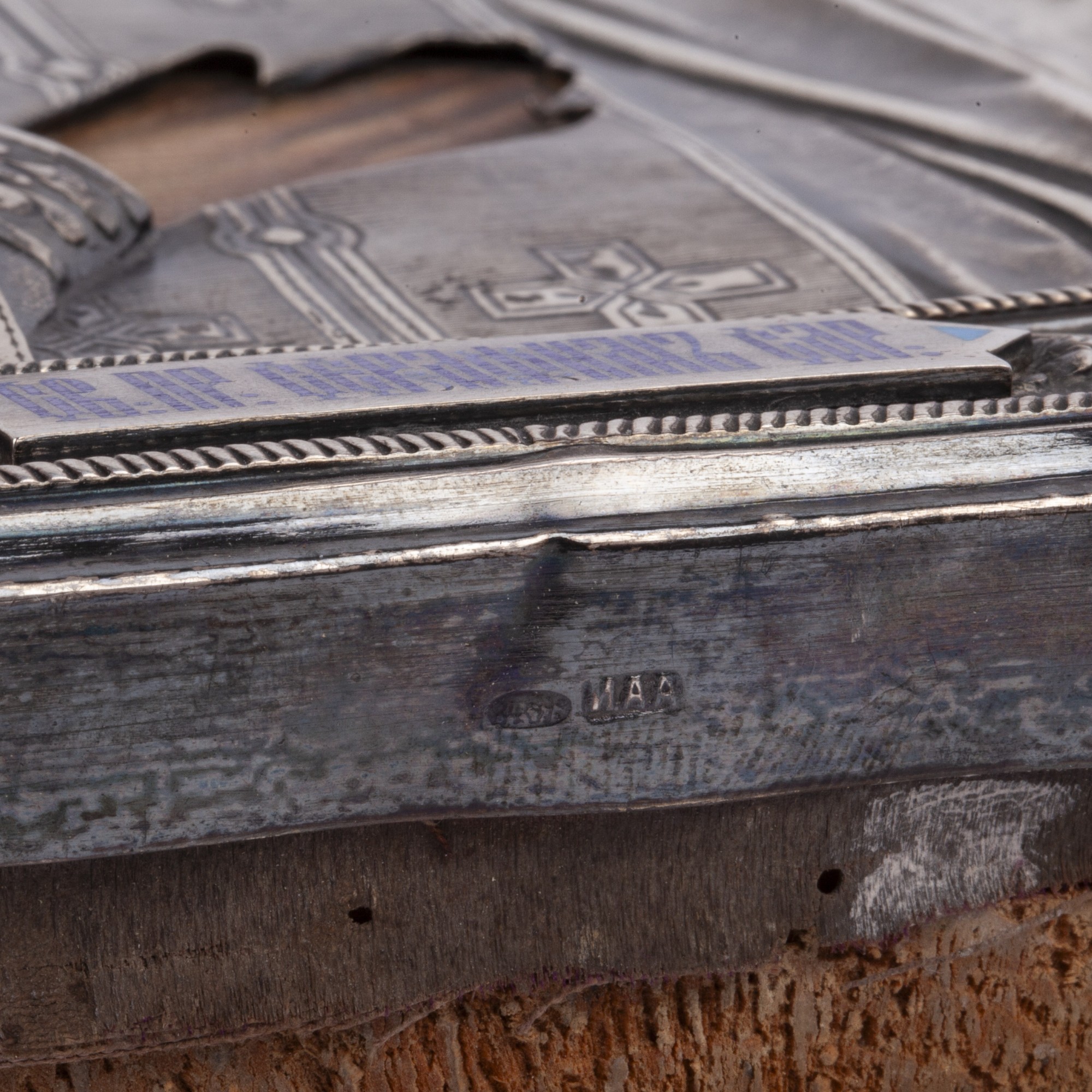
Marked: maker’s mark of IAA; 84 zolotnik silver standard, Moscow assay mark. Dimensions: 22,7 x 18 x 3,3 cm.
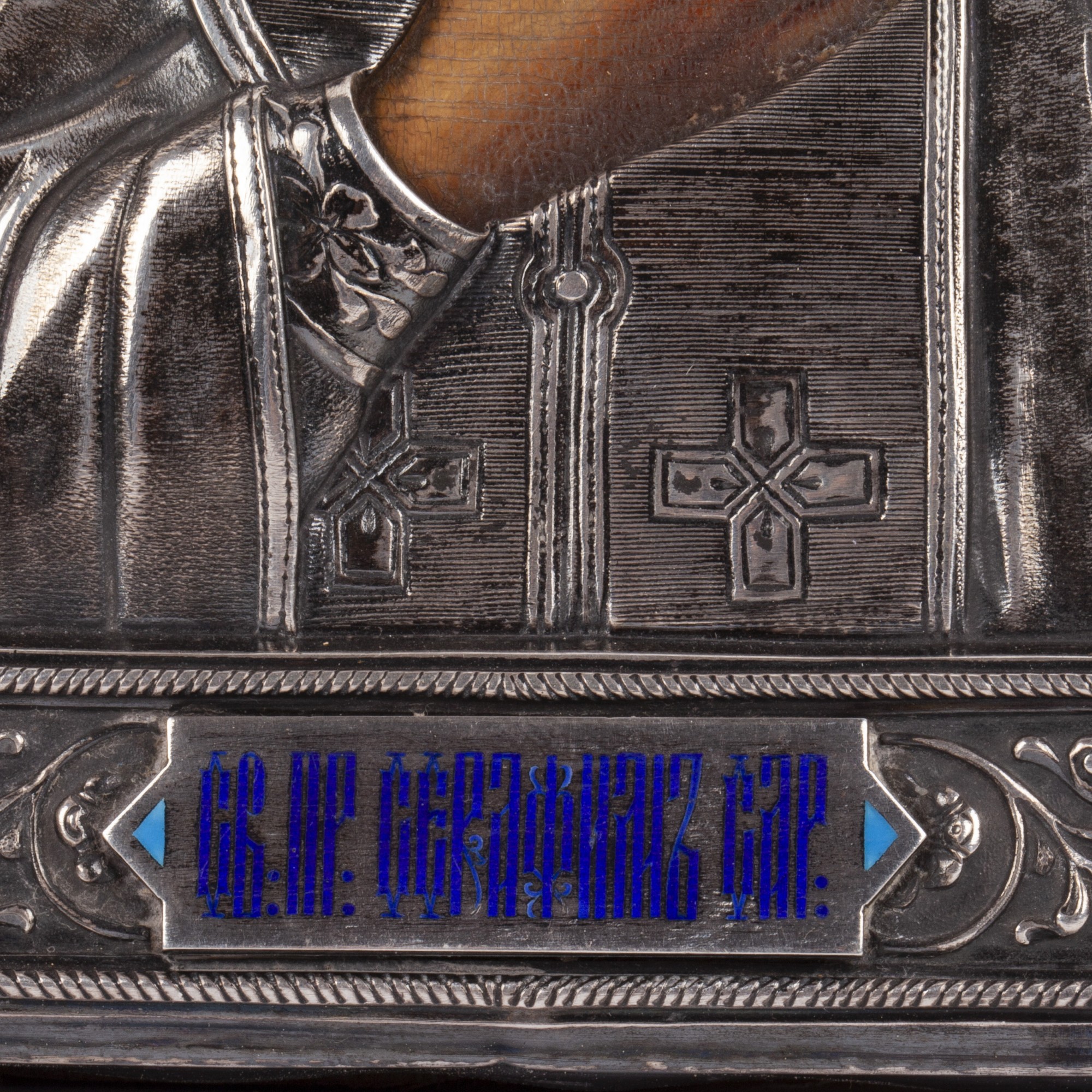
A refined icon in pseudo-russian style depicting Saint Seraphim of Sarov, shown half-length in monastic habit and epitrachelion, with his right hand placed upon his chest in a gesture of prayerful humility. The saint’s ascetic face, softly modelled and framed by a long pale beard, is set within an elaborate silver oklad, while the halo is enriched with polychrome enamel ornament of stylised foliate scrolls in blue, white, red, and pale green. At the lower border – plaque with the saint’s name in blue cloisonne enamel.
The icon was produced in the workshop of Ivan Alexeevich Alexeev, a Moscow silversmith and owner of a factory founded in 1876, known for silver icons, folding shrines, and other devotional objects in 84 standard silver. Alexeev’s works, marked “И.А.” or “И.А.А.”, are valued for the quality of their execution and for their characteristic combination of silver mounting and enamel decoration.
Comparable items: https://www.sothebys.com/en/buy/auction/2025/faberge-imperial-revolutionary-art-l25113/a-parcel-gilt-cloisonne-and-champleve-enamel-icon-2 https://www.christies.com.cn/en/lot/an-important-cloisonne-enamel-silver-gilt-triptych-icon-6321969/?intObjectID=6321969&lid=3Starting price: 6000€
Estimate: 8000-12000€
Hammer Price: Not sold -
Lot 0264
Icon of Saint Paraskeva with 18th-Century Silver Riza, Balkans, 17th–18th century
Estimate: 1200-1500€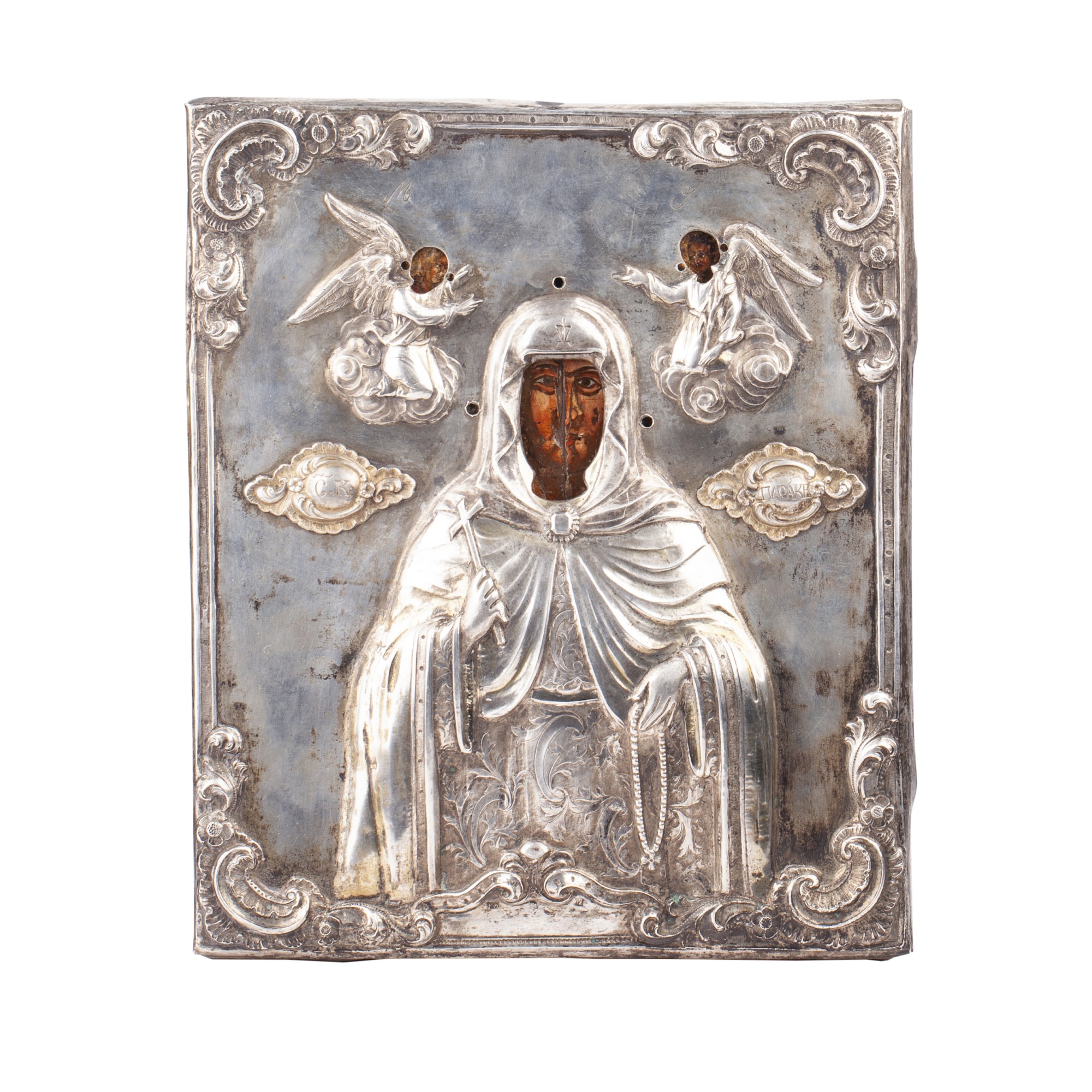
Lot 0264
Icon of Saint Paraskeva with 18th-Century Silver Riza, Balkans, 17th–18th century
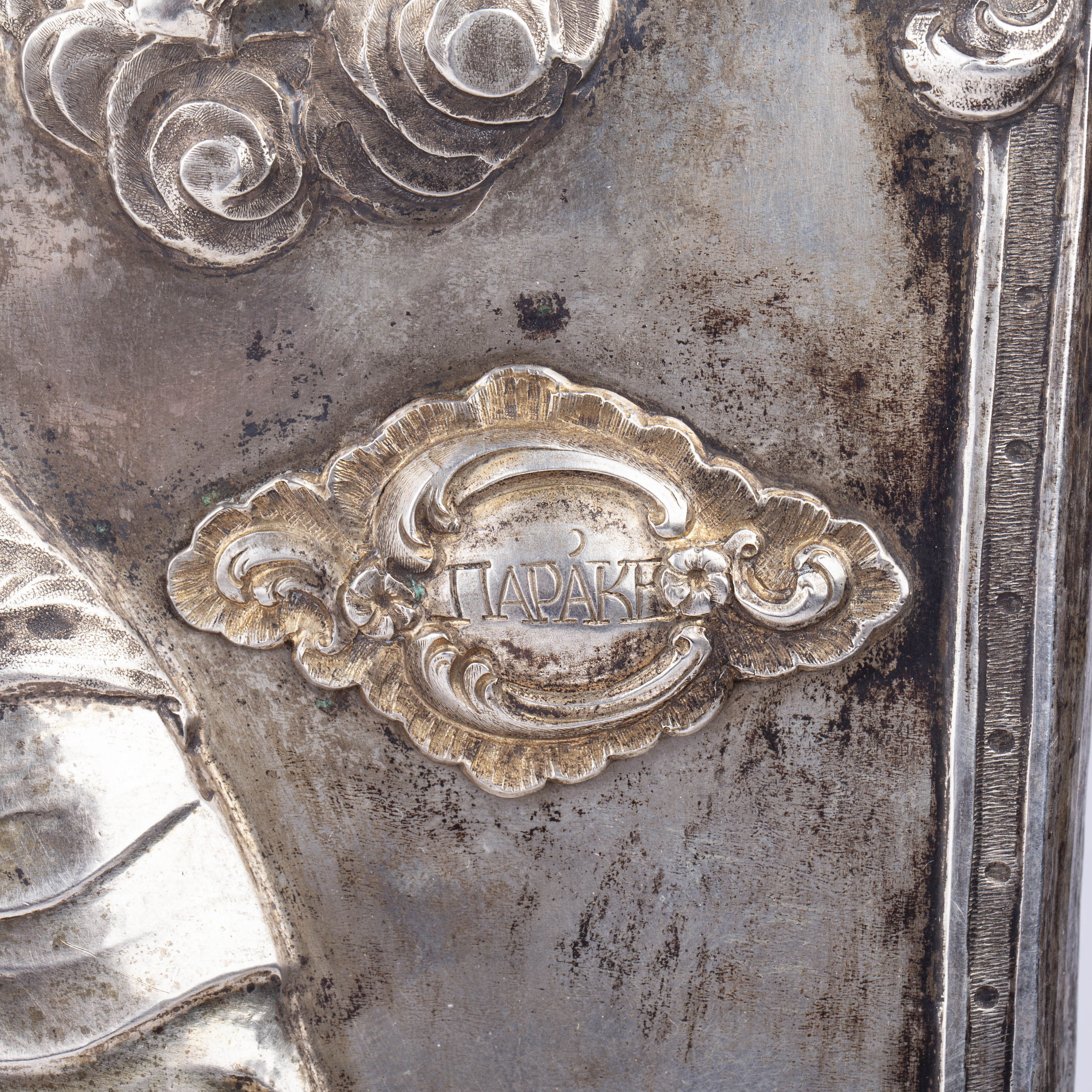
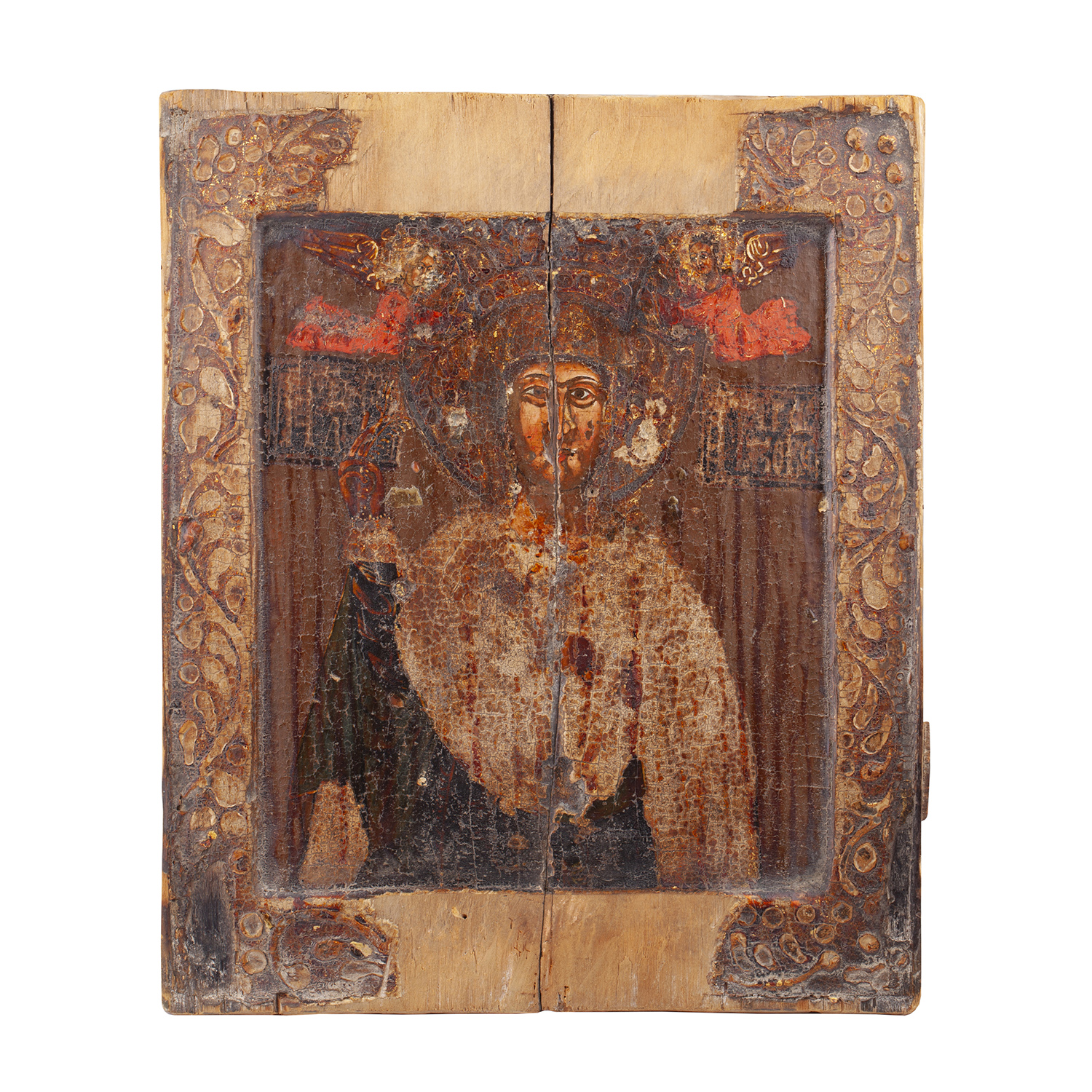
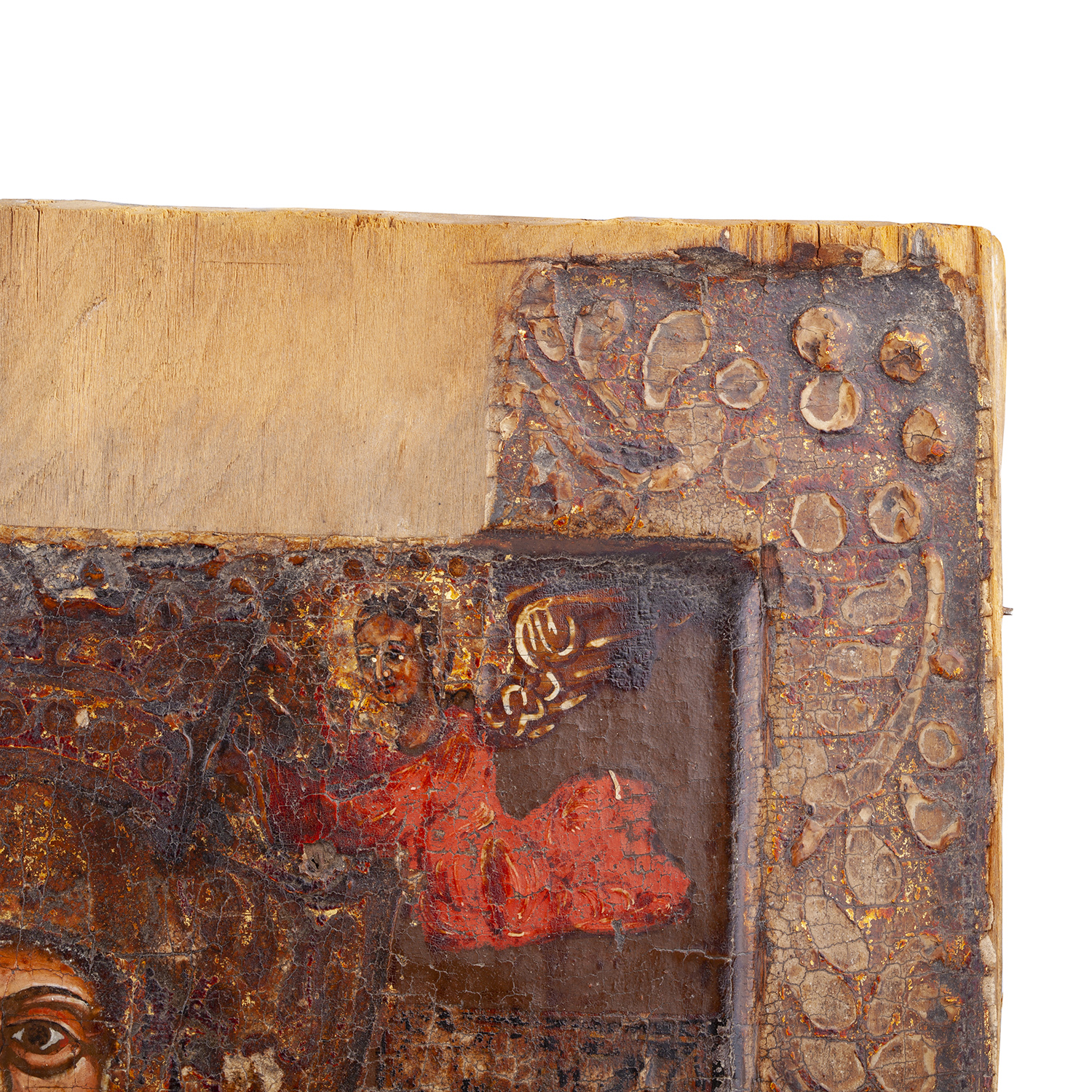
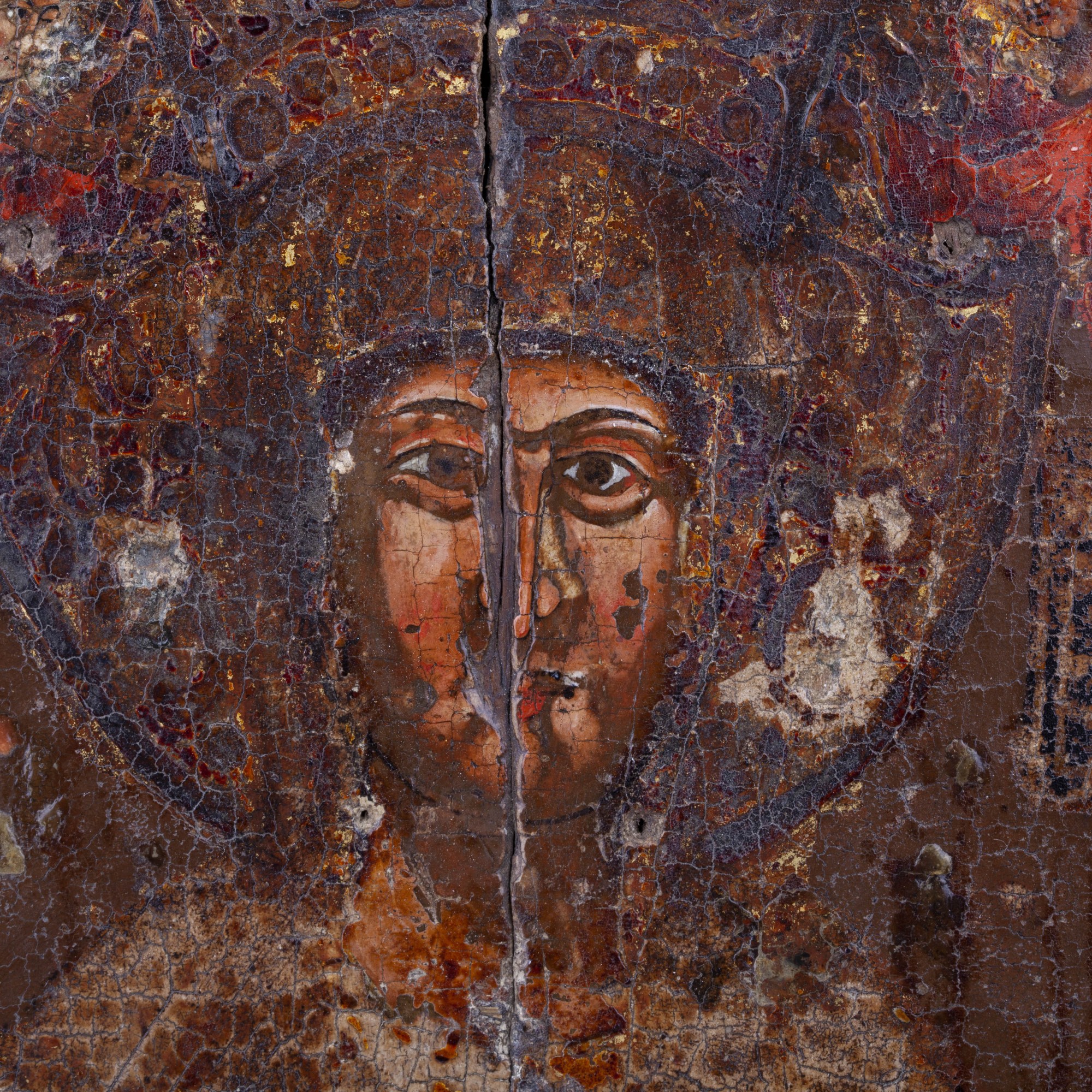
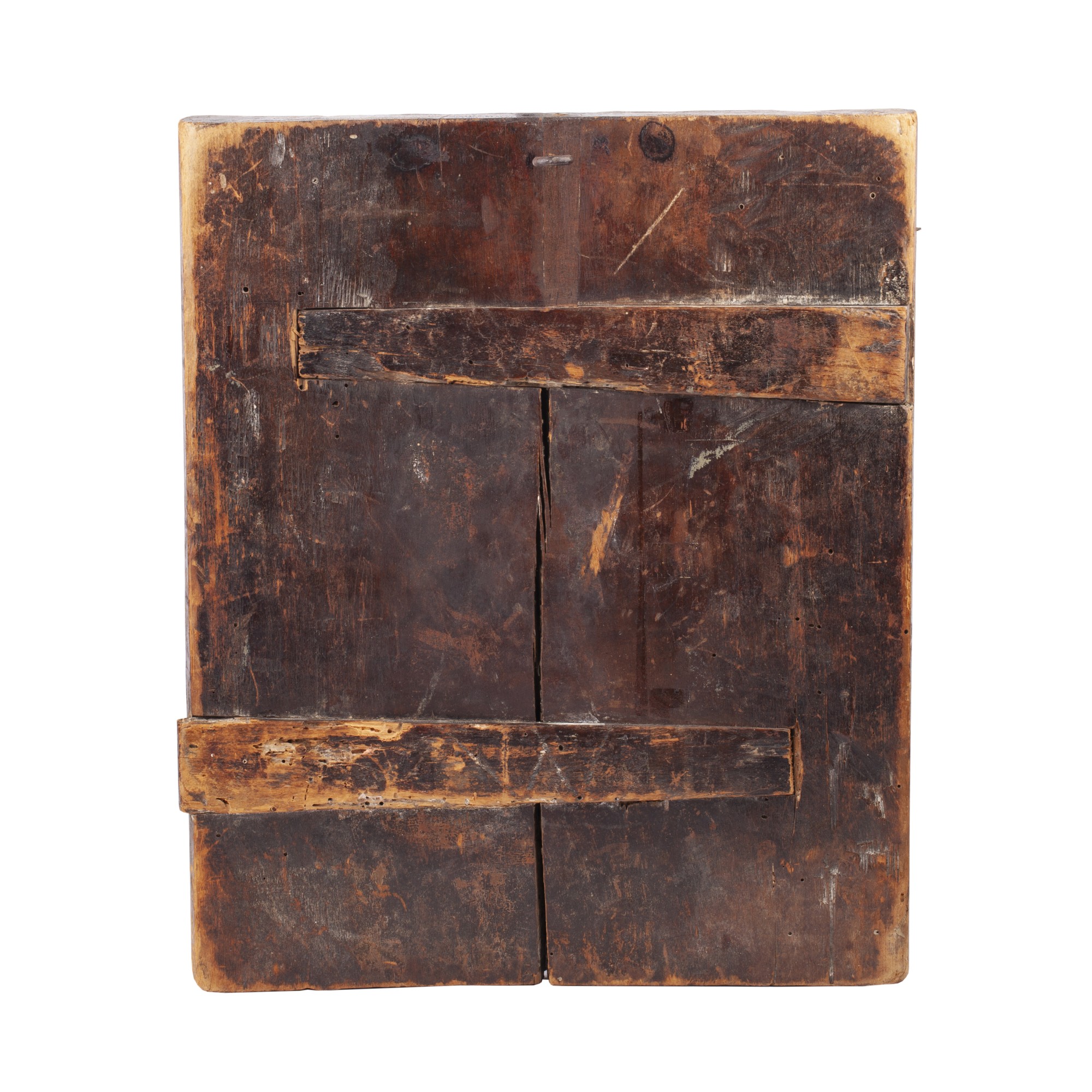
Estimate: 1200-1500€Icon of the Holy Martyr Paraskeva with Silver Riza
Balkans, 17th–18th century
Icon: tempera on wood, 17th century
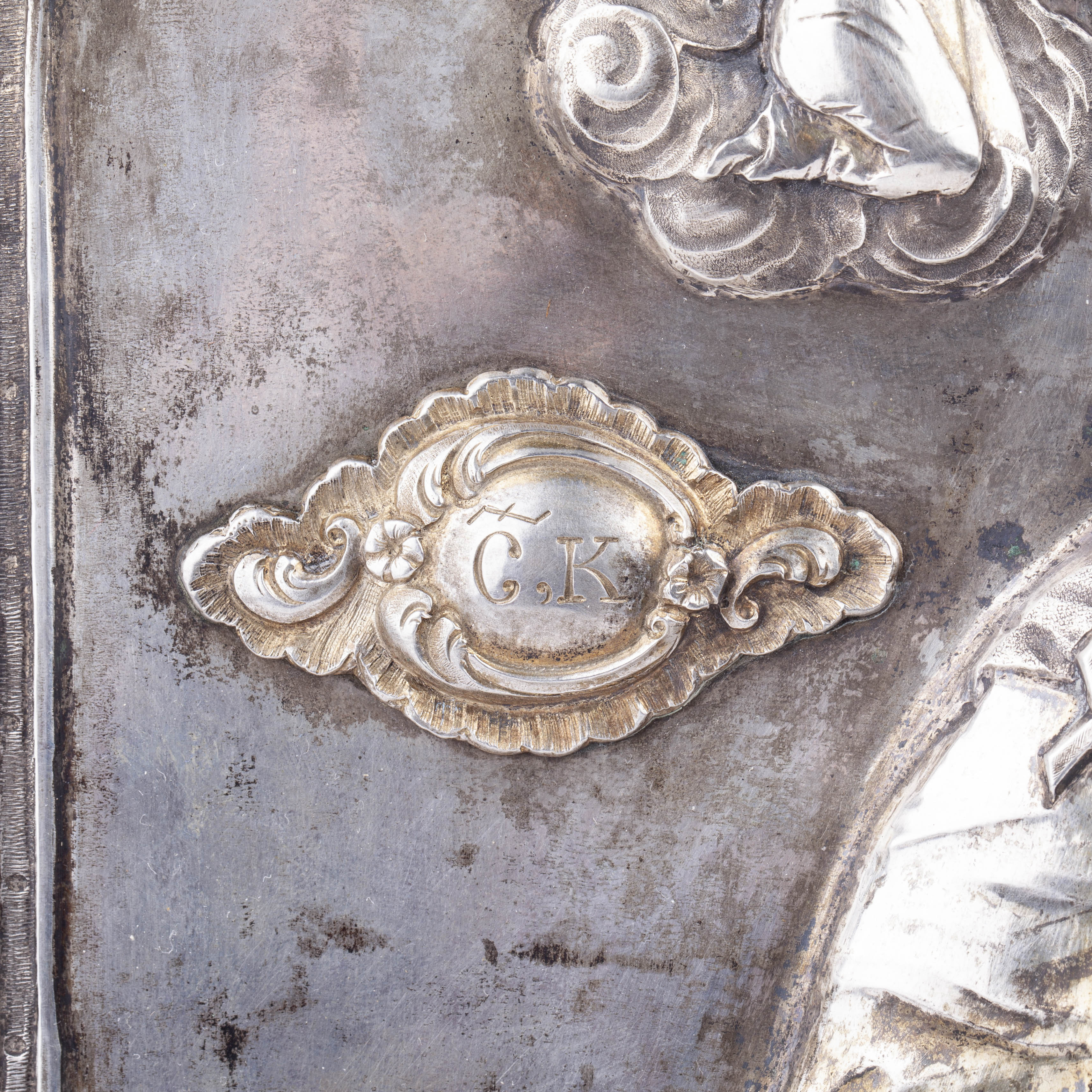
Riza: silver, repoussé and chased, 18th century
Dimensions: 32 × 27 × 4.5 cm
Riza weight: 860 gThis remarkable icon represents Saint Paraskeva (Paraskevi) of the Balkans, a revered Christian martyr known for her piety, compassion, and miracles. The saint is depicted holding a cross as a symbol of her martyrdom, flanked by two angels bearing crowns of glory.
The underlying icon, likely dating to the 17th century, retains the expressive intensity of early post-Byzantine Balkan iconography, characterized by elongated proportions, austere modeling, and a deep spiritual gravity.
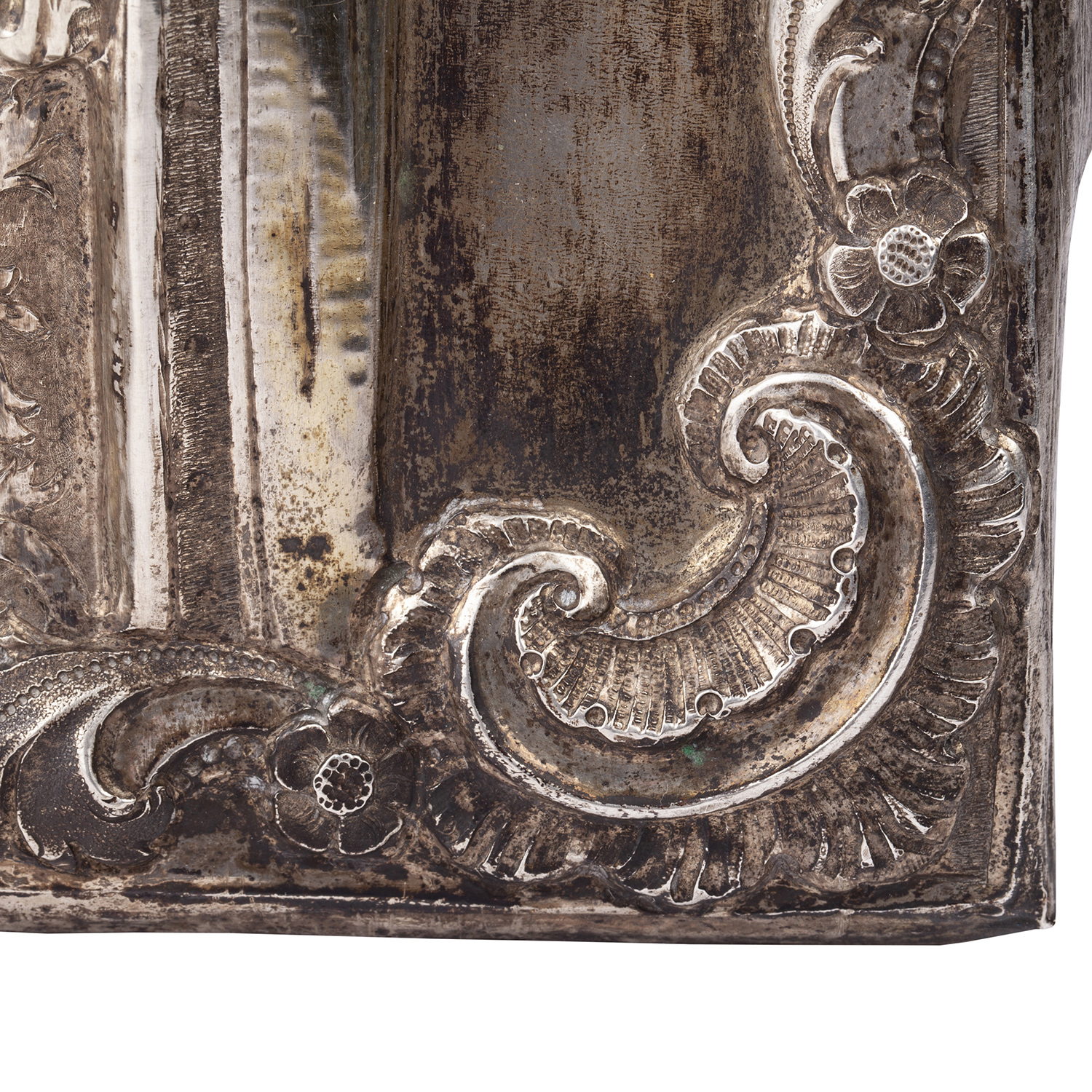
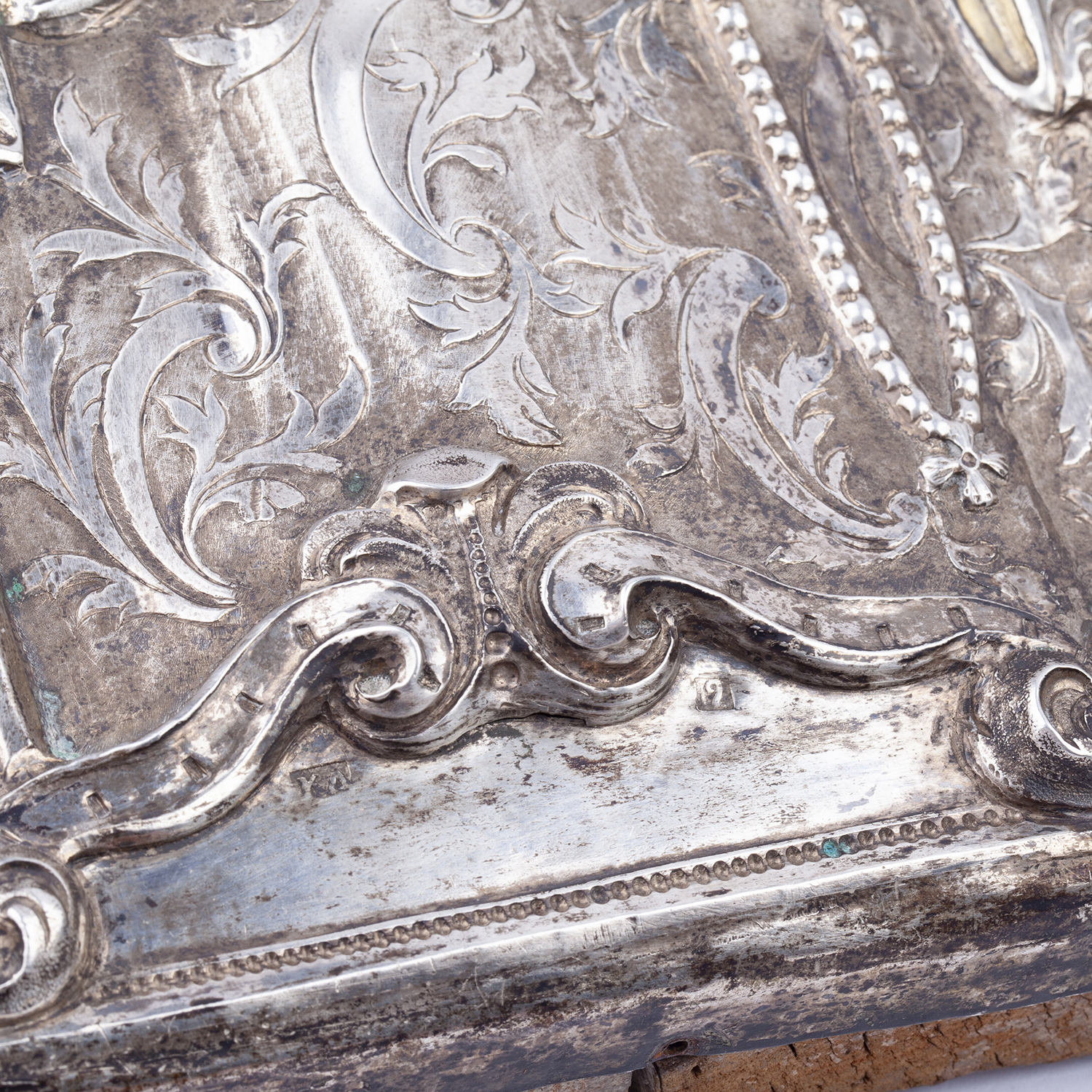
The silver riza, executed in the 18th century, complements the image with richly embossed baroque ornamentation—cartouches, clouds, and acanthus motifs—framing the saint in a celestial setting.
Starting price: 1000€
Estimate: 1200-1500€
Hammer Price: Not sold -
Lot 0265
Russian bronze travel icon of St. Nicholas of Mozhaisk, 19th century.
Estimate: 150-200€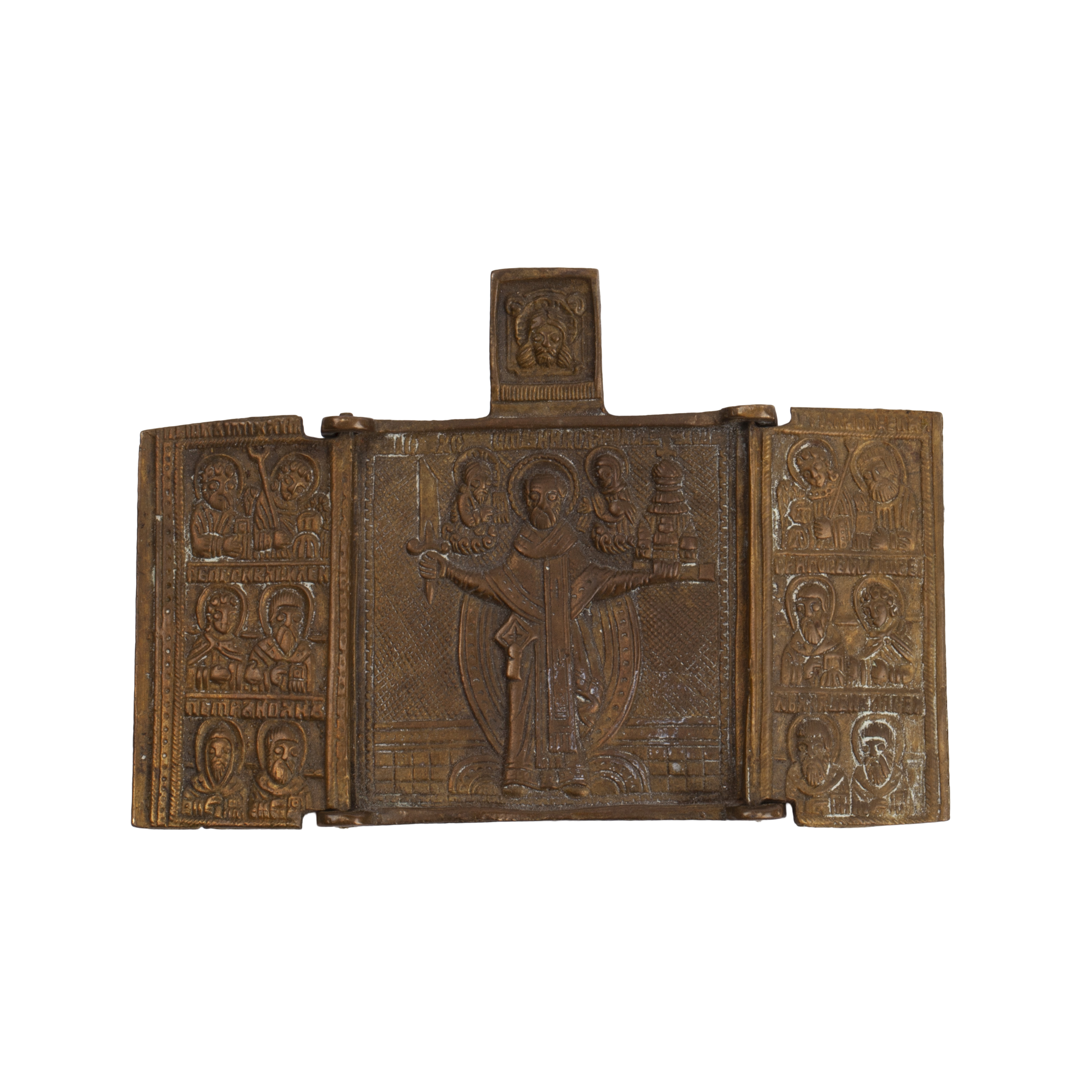
Lot 0265
Russian bronze travel icon of St. Nicholas of Mozhaisk, 19th century.
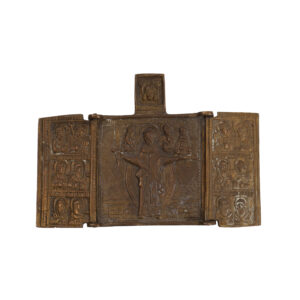
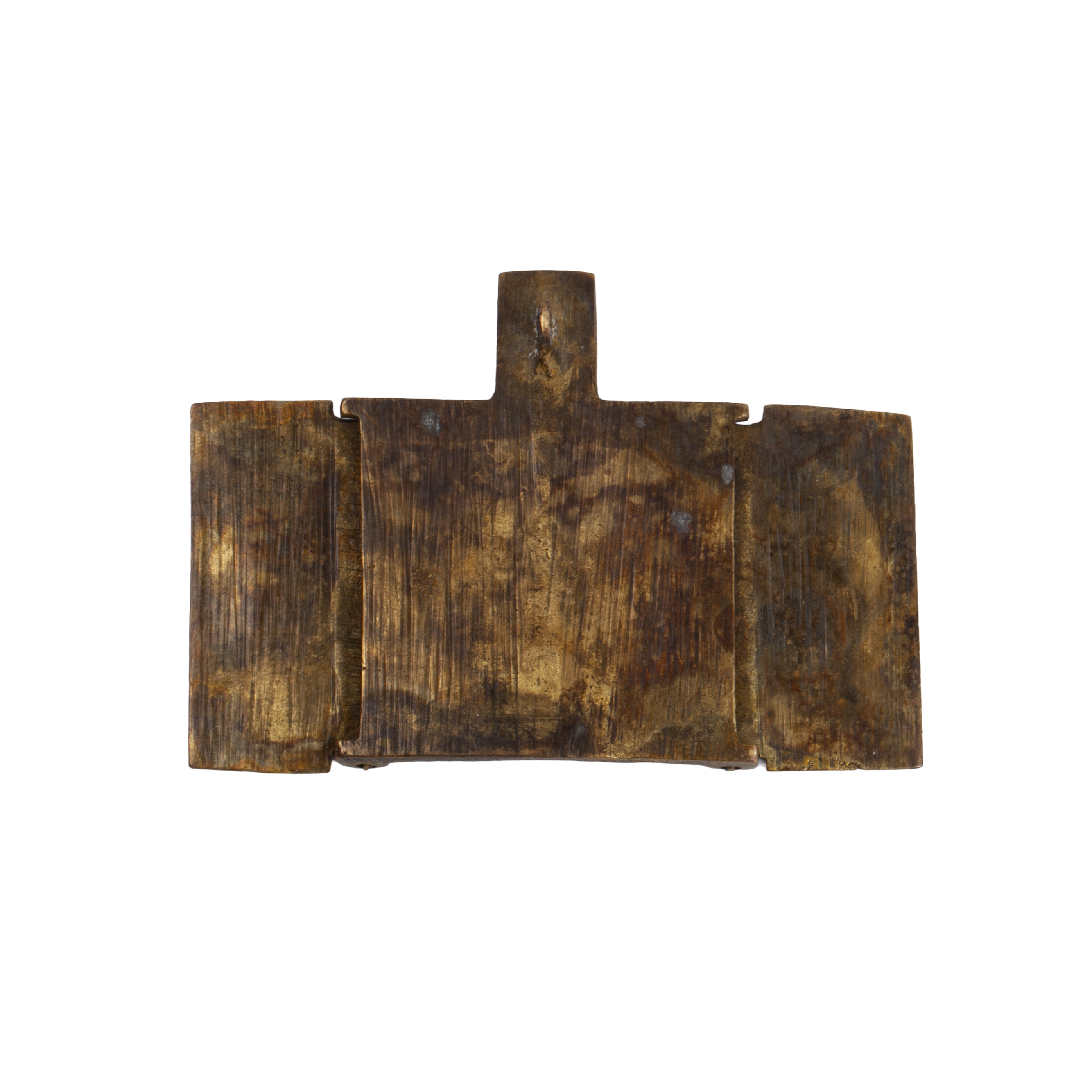
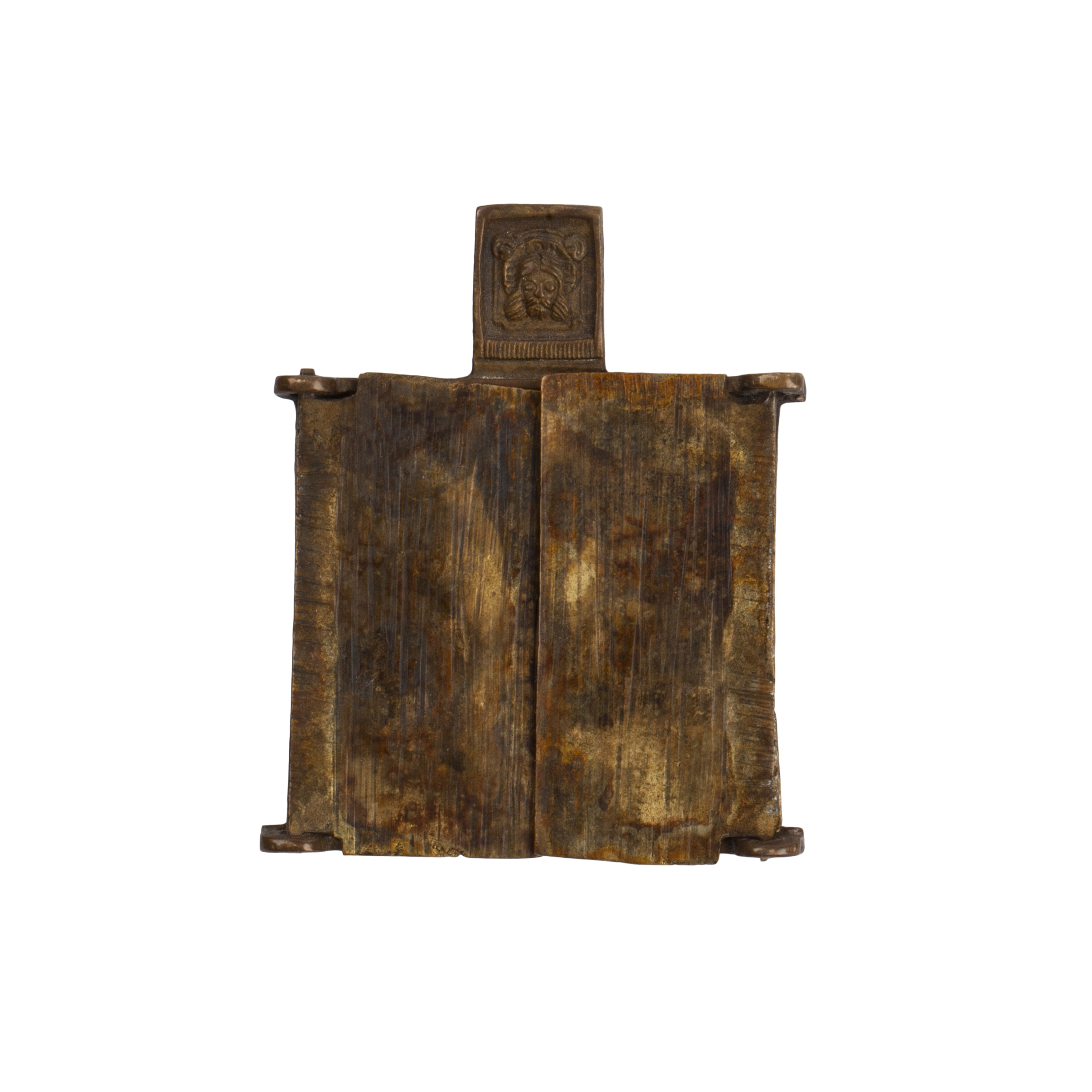
Estimate: 150-200€Russian bronze travel icon of St. Nicholas of Mozhaisk, 19th century.
Small cast bronze three-panel travel icon. The central panel depicts St. Nicholas of Mozhaisk, holding a sword and a church or fortified city — a traditional image of the saint as a heavenly protector.
Bronze travel icons of this type were used in Russia for private prayer and travel, especially among Old Believer communities.
Closed: 6.6 × 5.5 cm.
Opened: 6.6 × 9.6 cm.Starting price: 100€
Estimate: 150-200€
Hammer Price: 100 € -
Lot 0266
Russian Icon of “The Mother of God of Korsun”
Estimate: 3000-3500€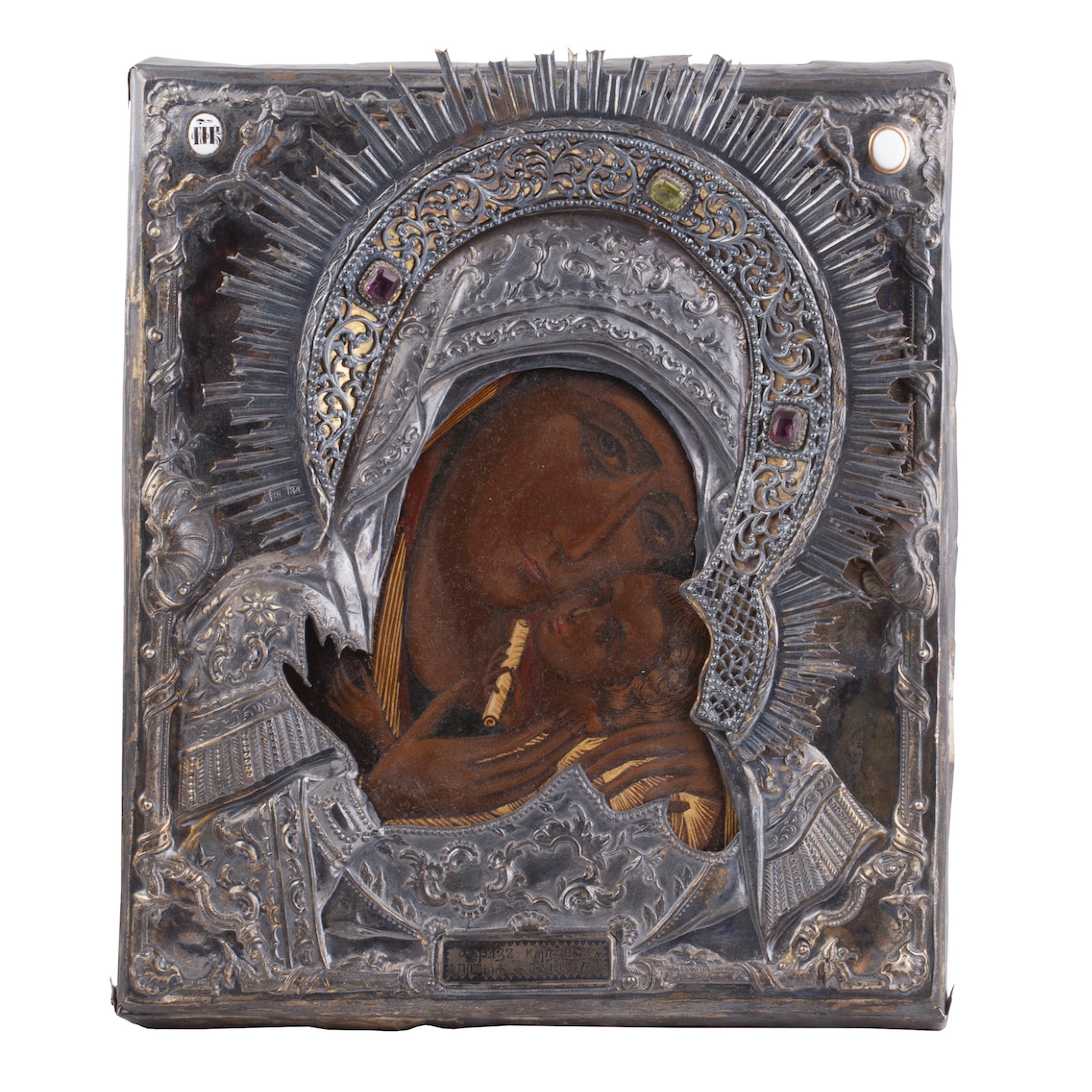
Lot 0266
Russian Icon of “The Mother of God of Korsun”
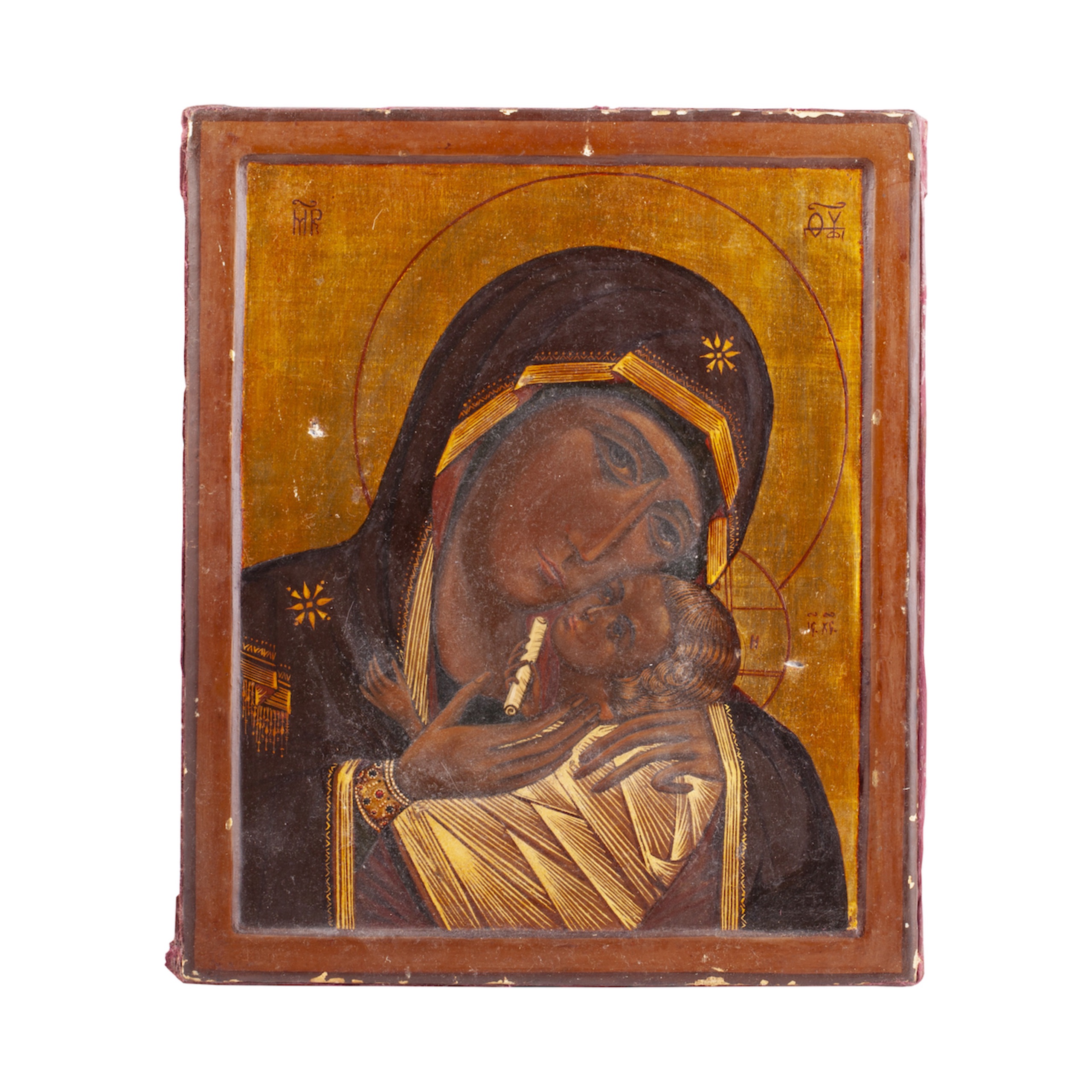
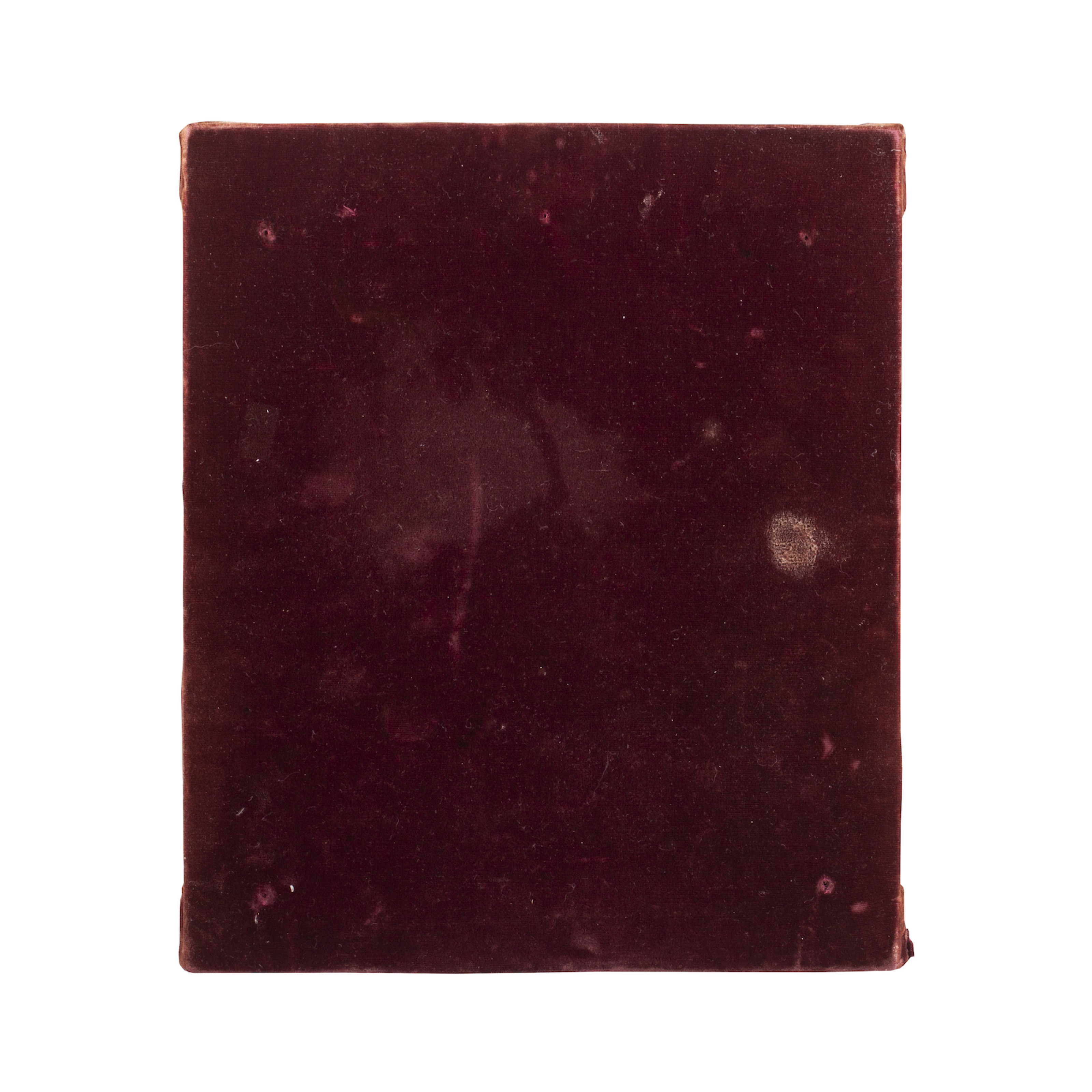
Estimate: 3000-3500€Icon “The Mother of God of Korsun”
Vladimir, 1857
Icon: wood, tempera, gold leaf
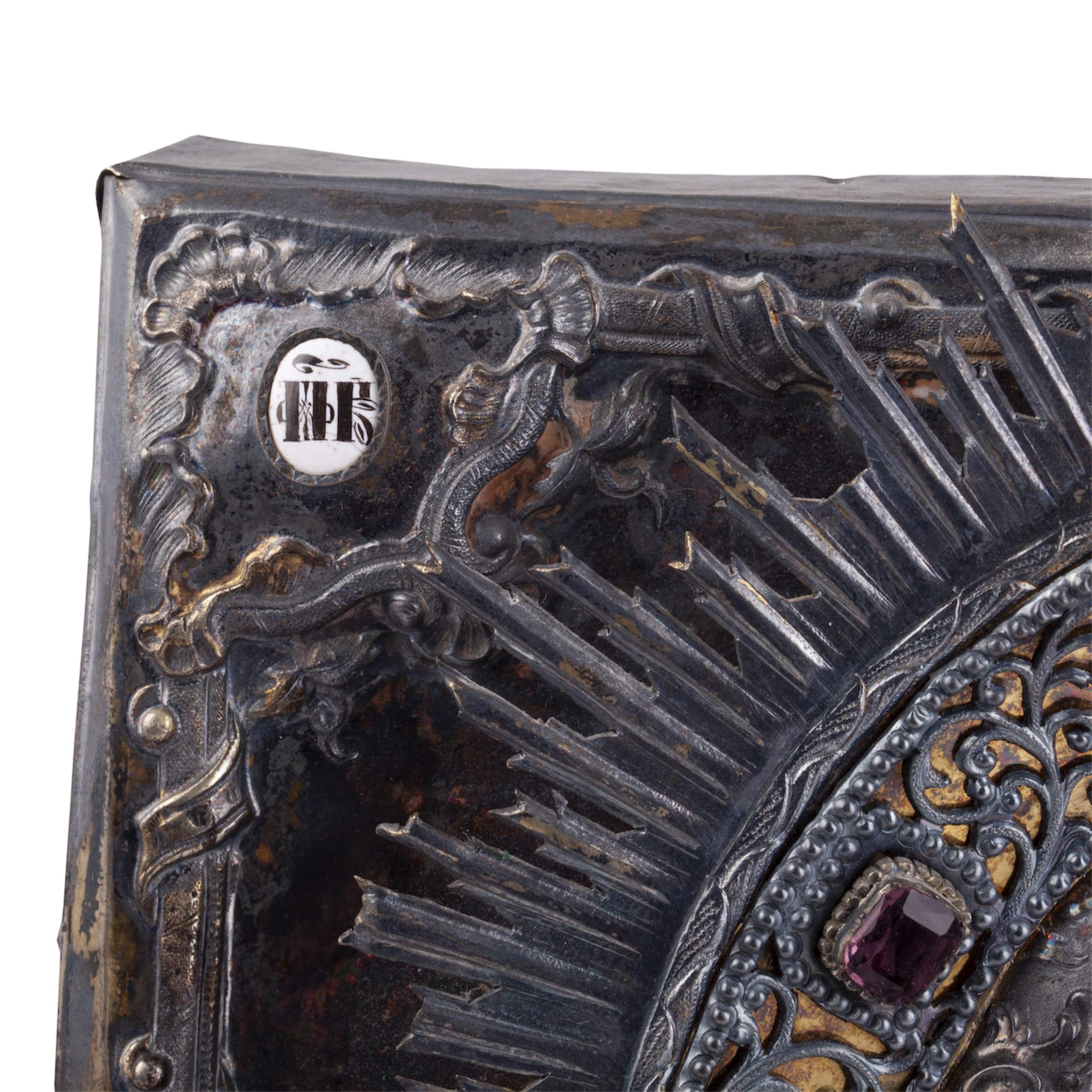
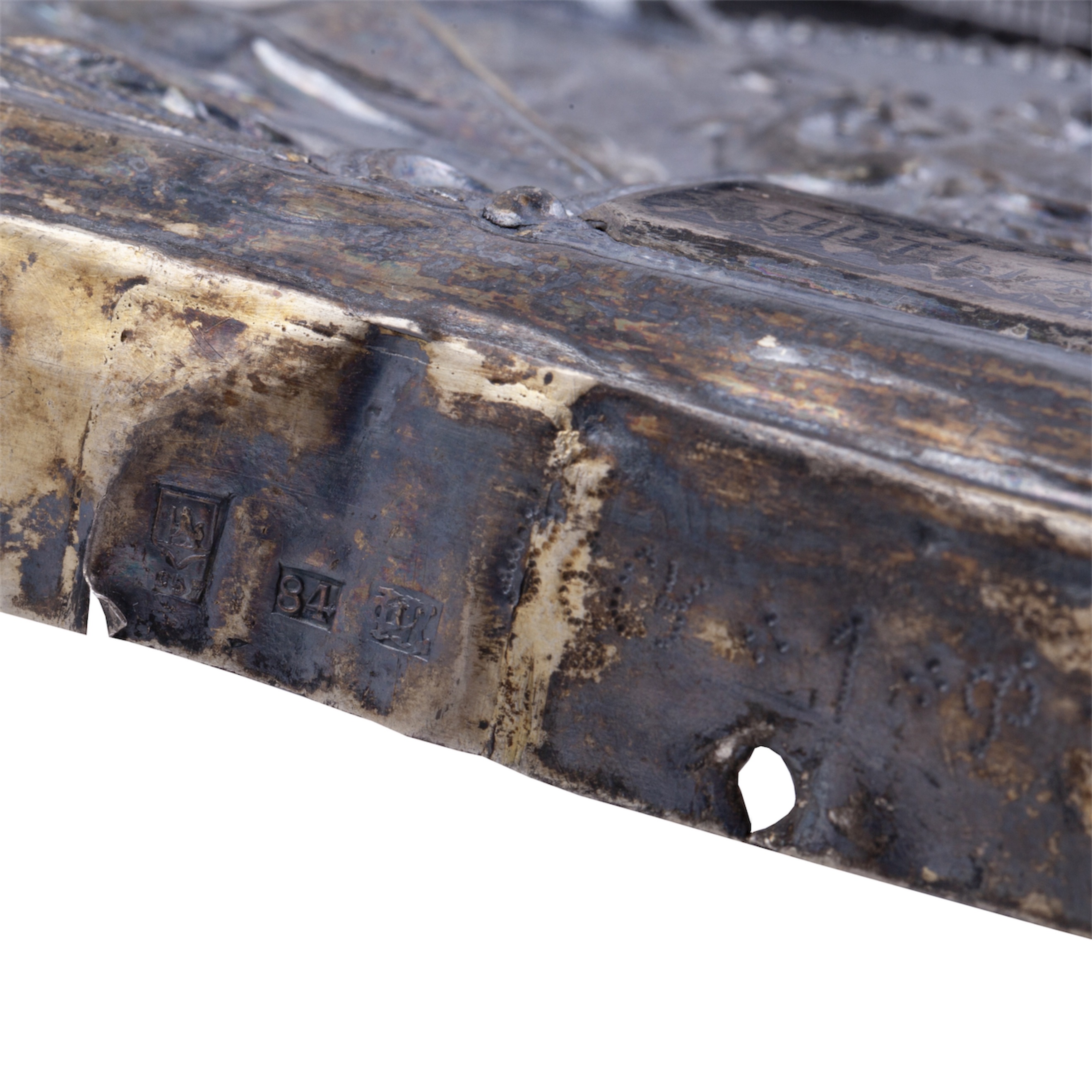
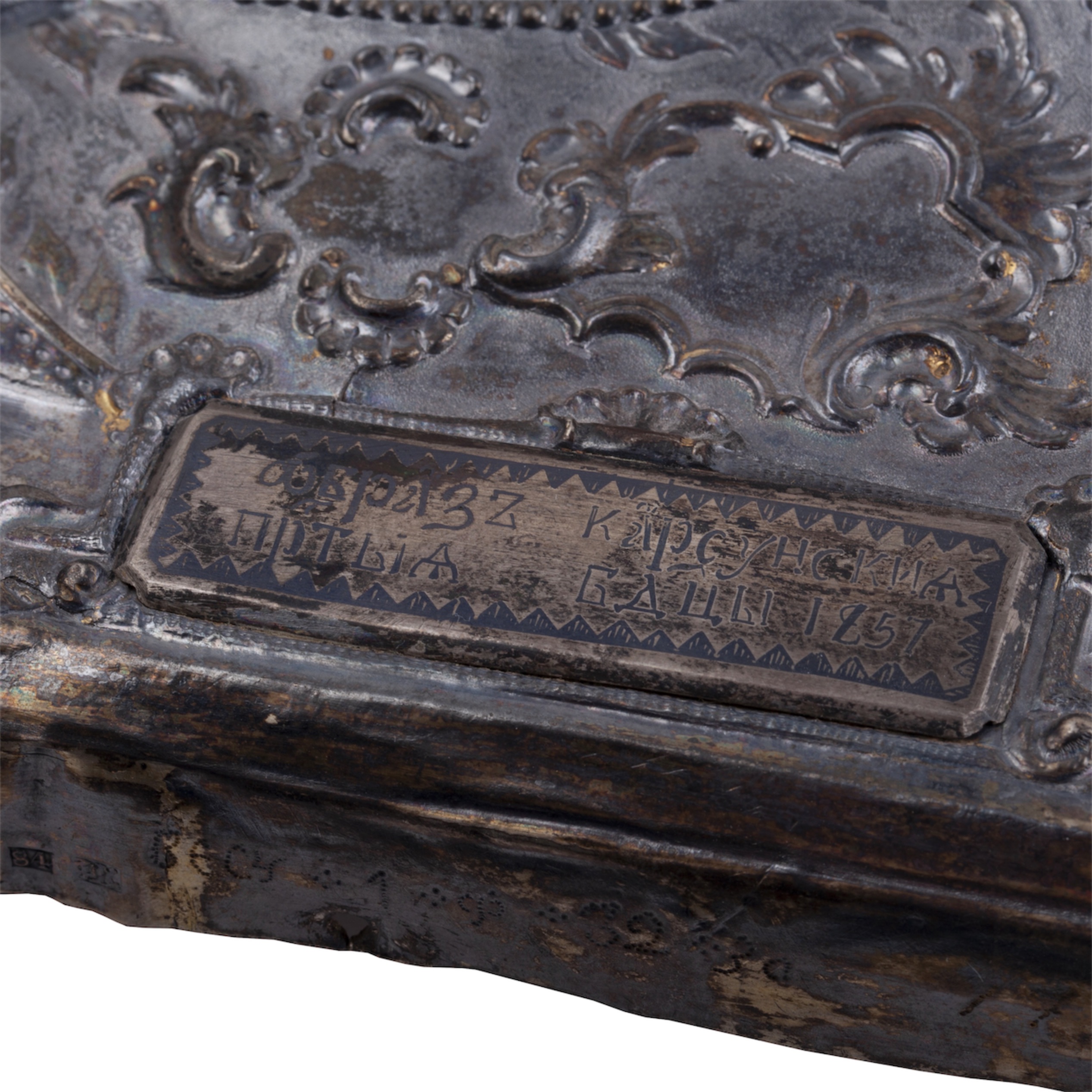
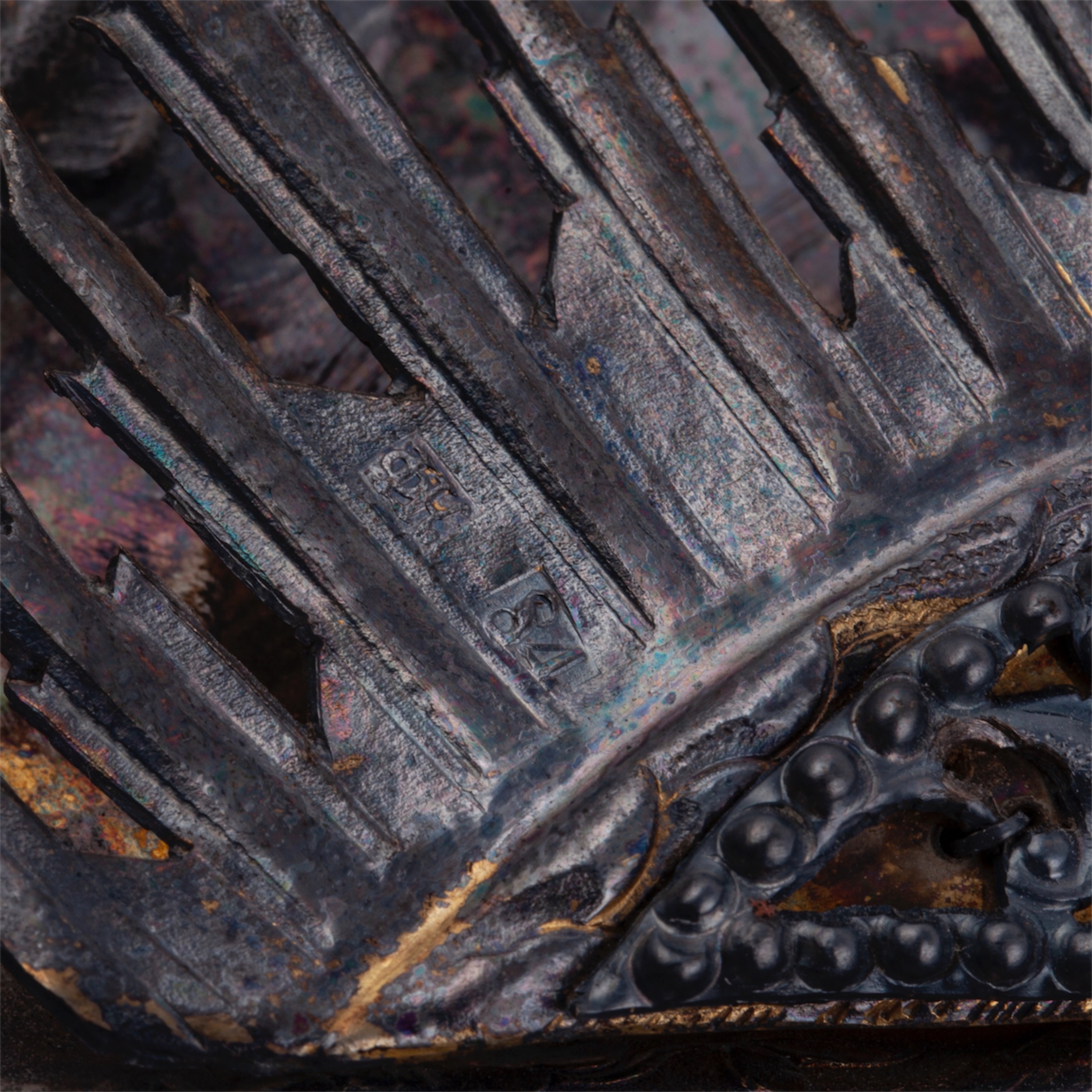
Riza: silver 84, chasing, engraving, gilding, niello, enamel, colored stones or glass
Master: F. Che
Dimensions: 33 × 27.5 × 5 cm
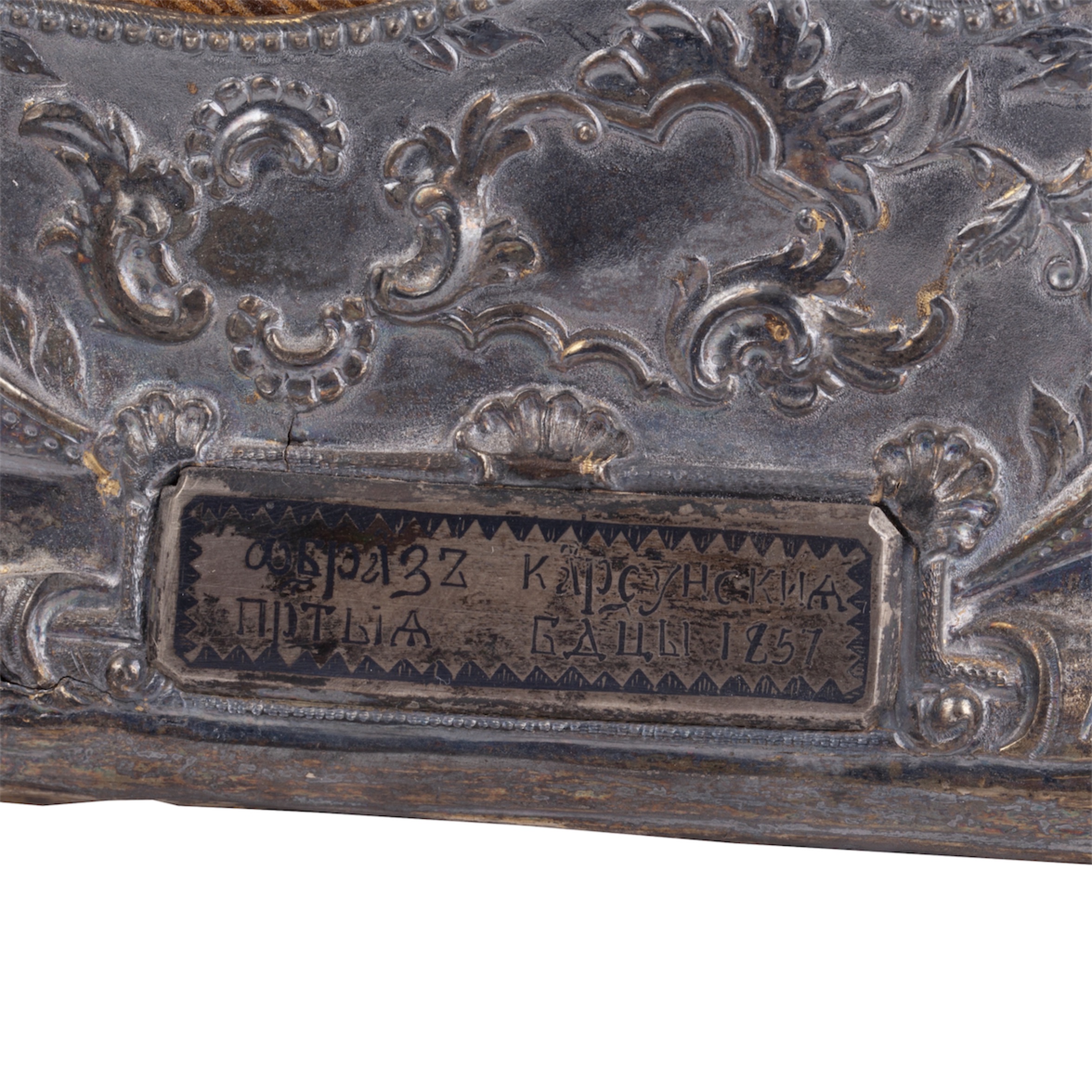
Riza weight: 558.5 gAn baroque-style 19th-century Russian icon of The Mother of God of Korsun, covered with a finely worked silver riza richly decorated with chasing, gilded details, and inset colored stones. The engraved inscription identifies the icon as “Korsun Mother of God, 1857.”
According to ancient tradition, the original Korsun icon was painted by St. Luke the Evangelist and brought from Ephesus to Kiev by Prince Vladimir after his baptism in 988. The image later resided in Novgorod and then in Moscow’s Dormition Cathedral, where it became one of Russia’s most revered relics.
Another legend connects the icon with St. Euphrosyne of Polotsk, who received it as a gift from the Byzantine Emperor and Patriarch in the 12th century. It was later brought to Toropets by Princess Paraskeva, wife of St. Alexander Nevsky, and became famous for its miracles and protection of the city.
Icons of the Korsun type belong to the “Tenderness” (Umilenie) family, symbolizing the deep spiritual and human bond between the Virgin and the Christ Child.
Starting price: 2500€
Estimate: 3000-3500€
Hammer Price: Not sold -
Lot 0267
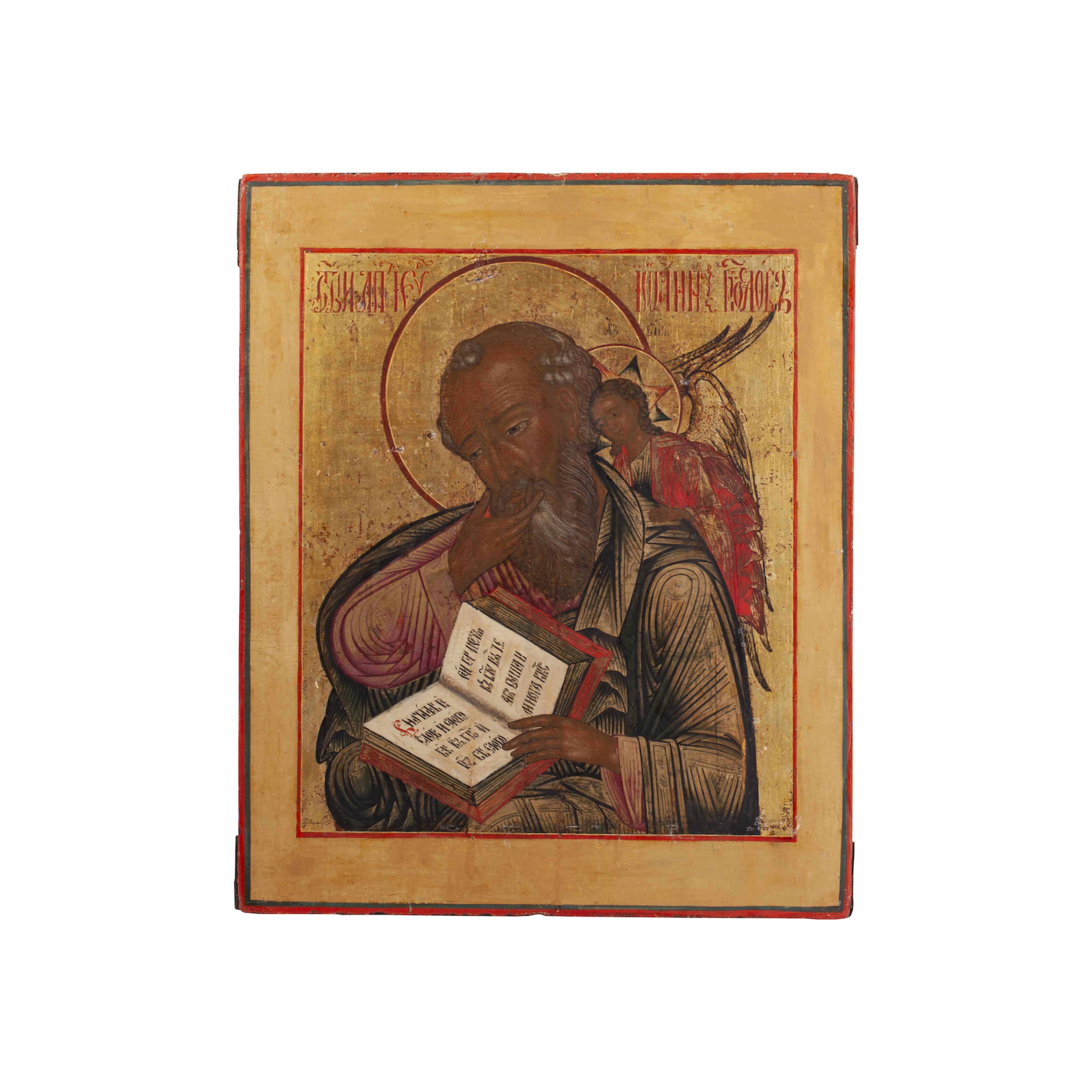
Russian Icon “John The Evangelist”
Estimate: 3000-3500€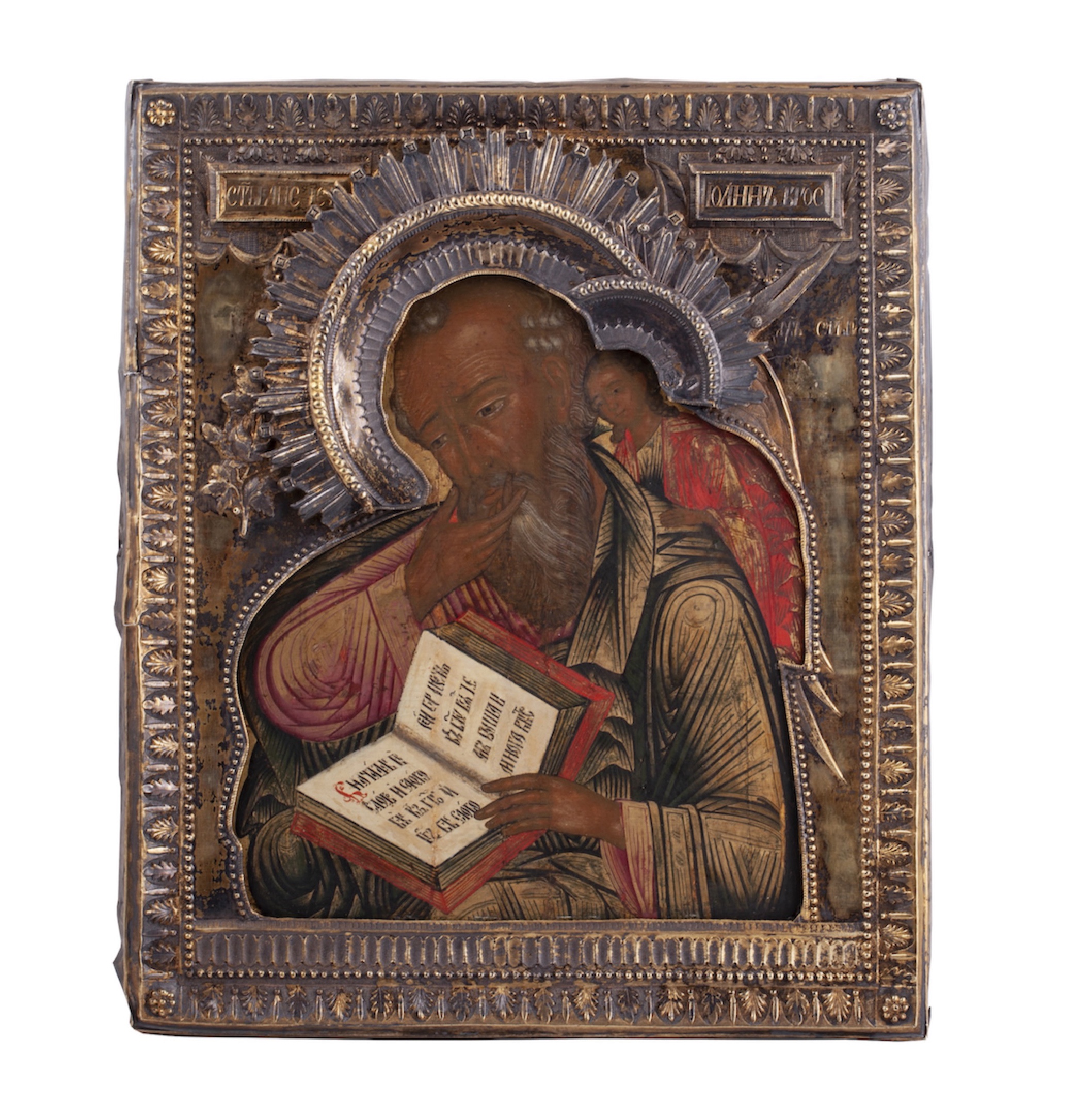
Lot 0267
Russian Icon “John The Evangelist”
Estimate: 3000-3500€Icon “John the Evangelist”
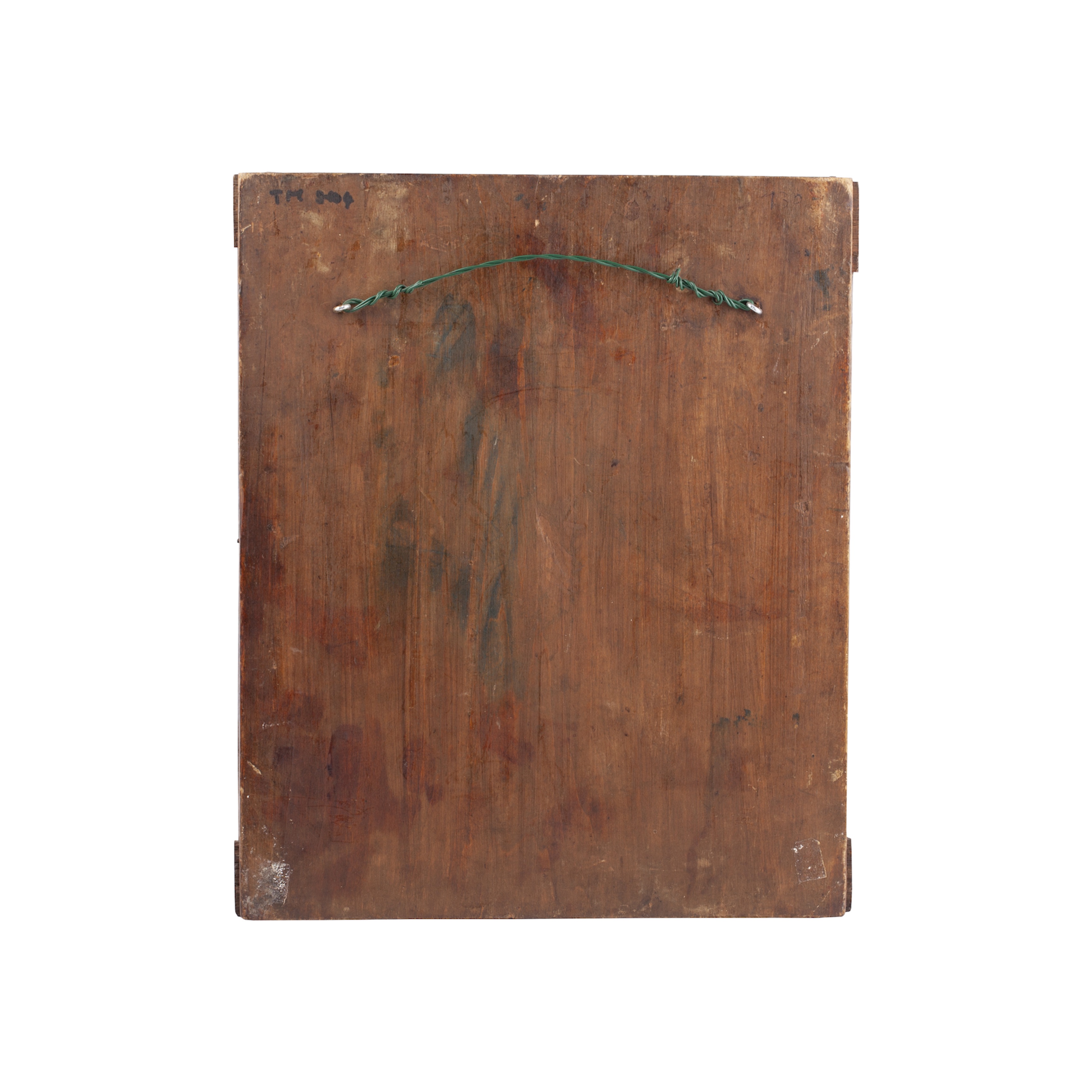
Yaroslavl, late 18th century
Tempera on wood, gesso, gold leaf and melted gold
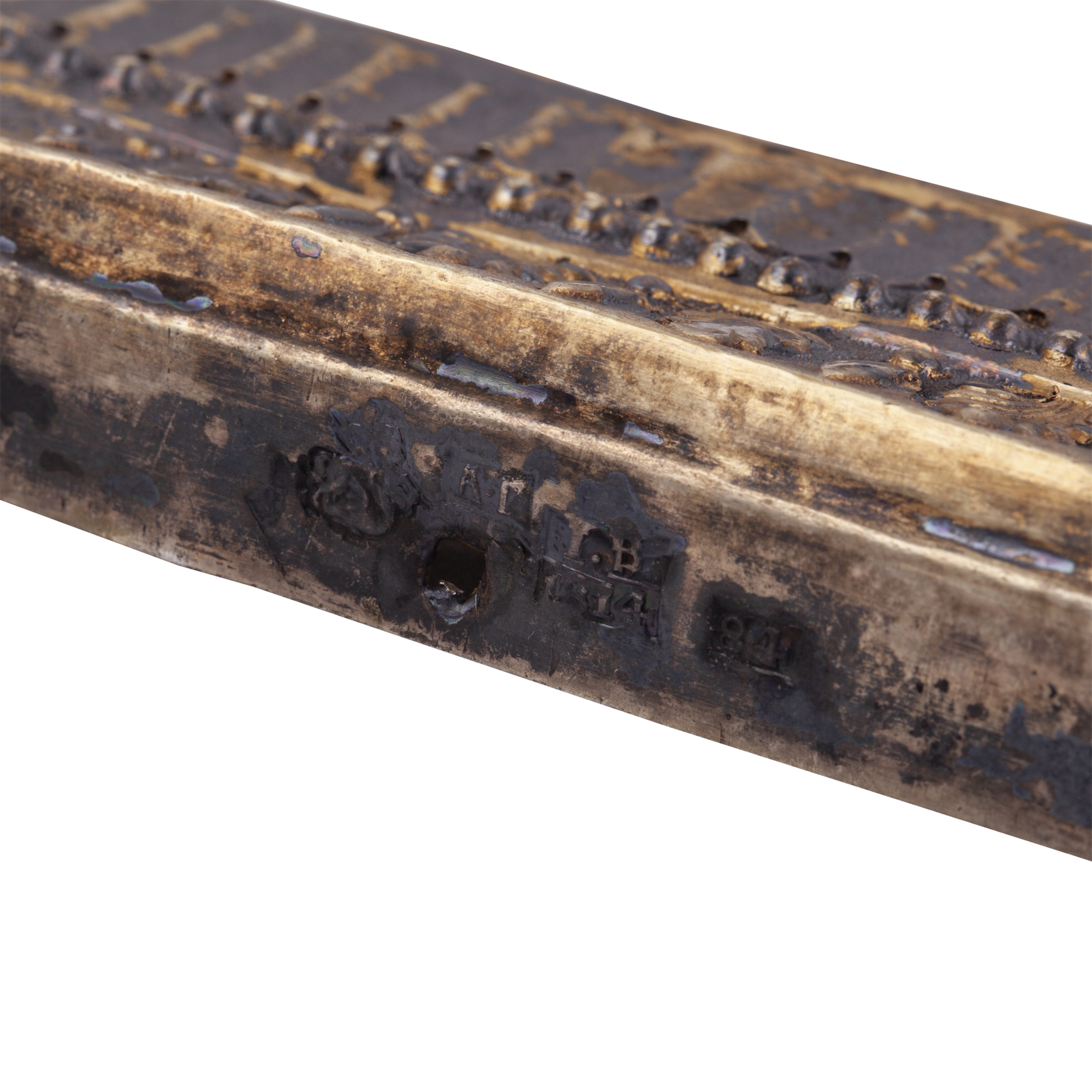
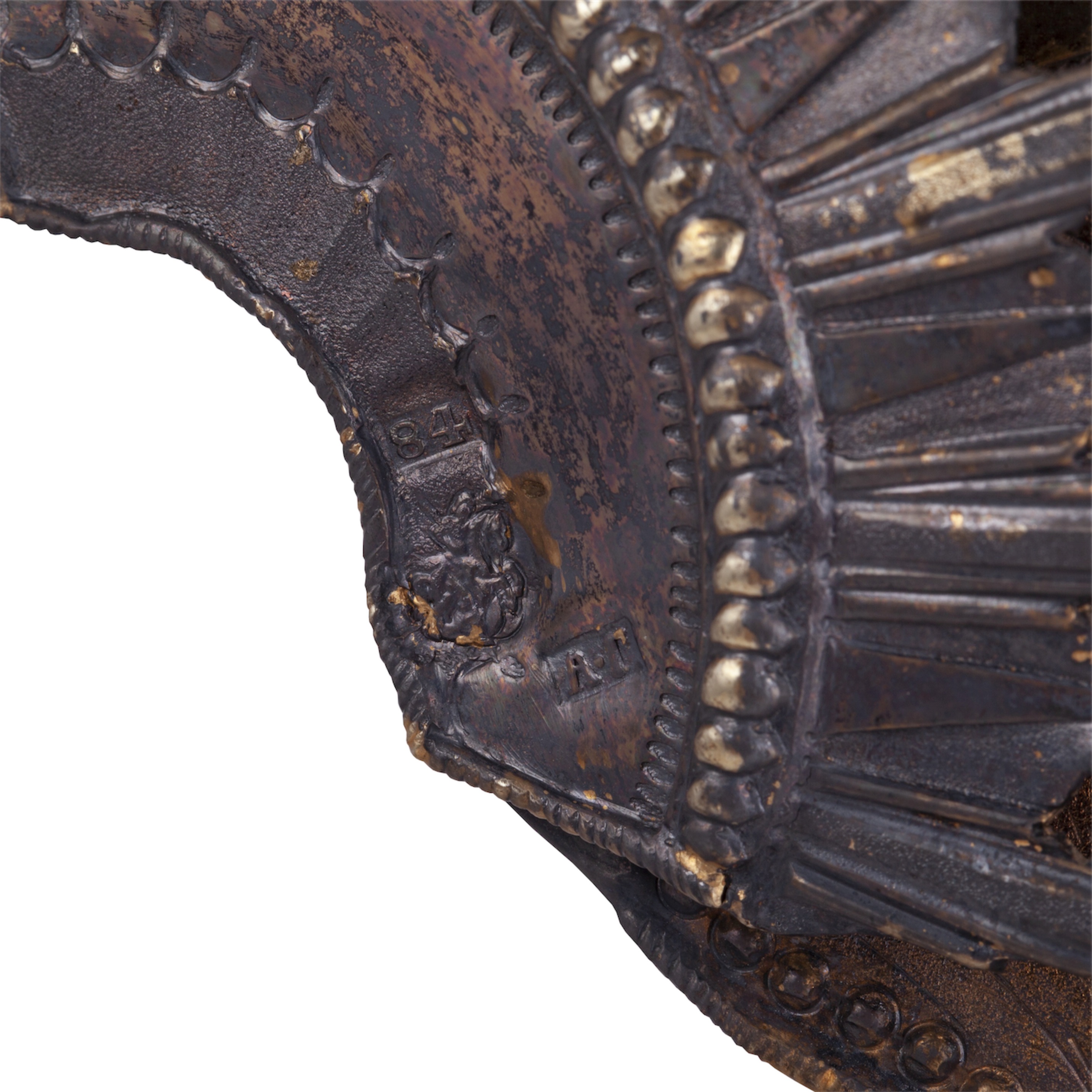
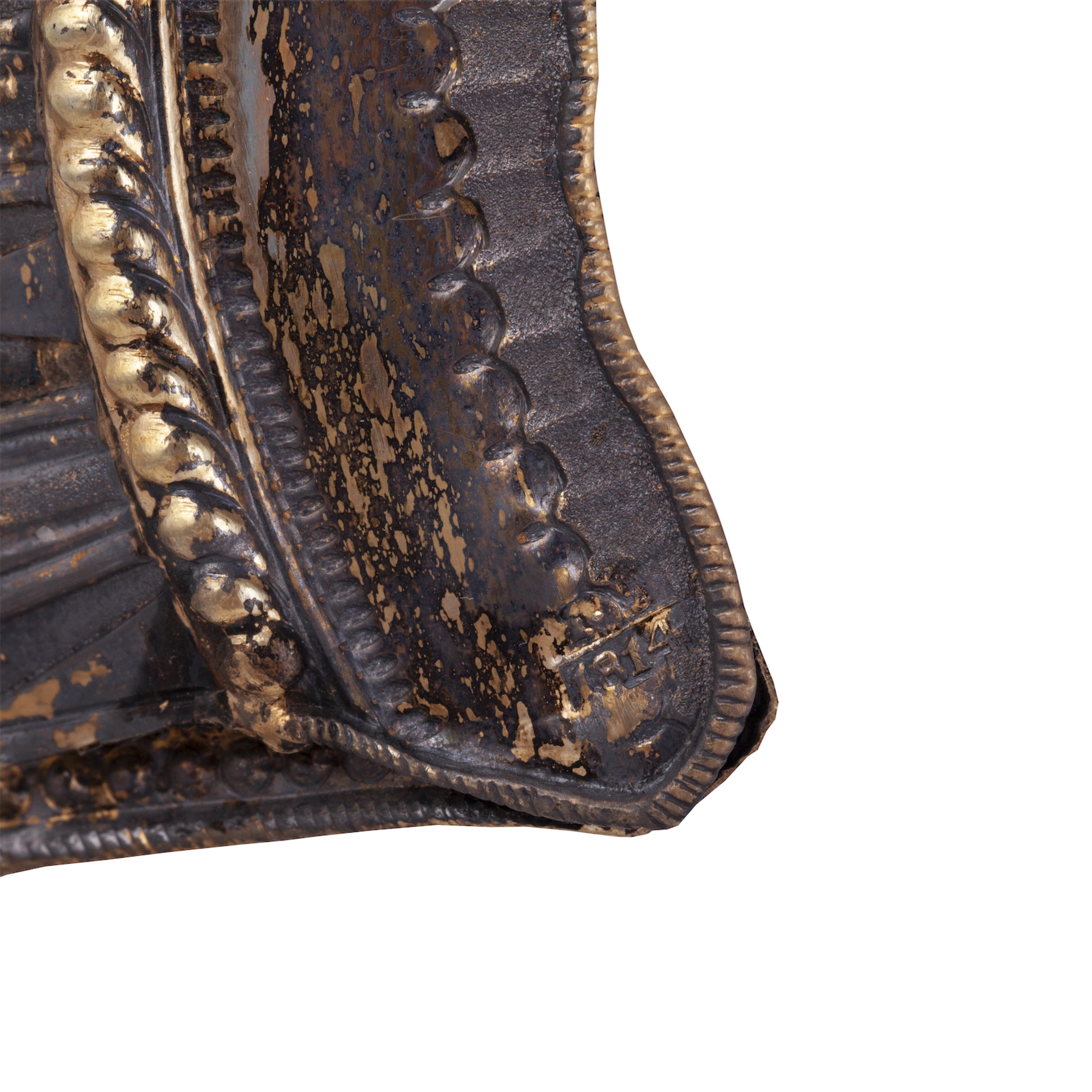
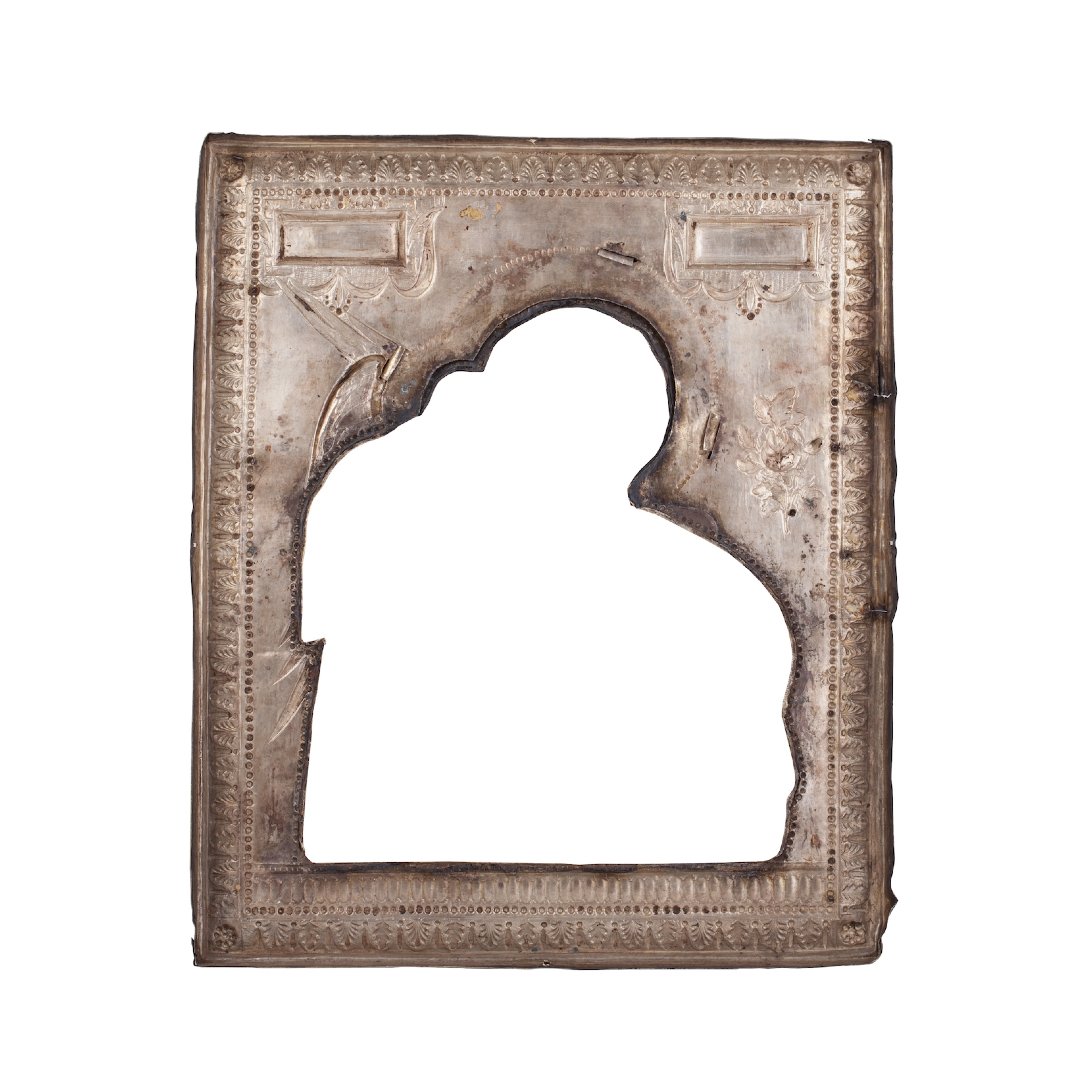
Riza: silver (84 zolotniks), gilding, chasing
Moscow, 1814, maker’s mark AG
Dimensions: 33 × 28 × 4.5 cm
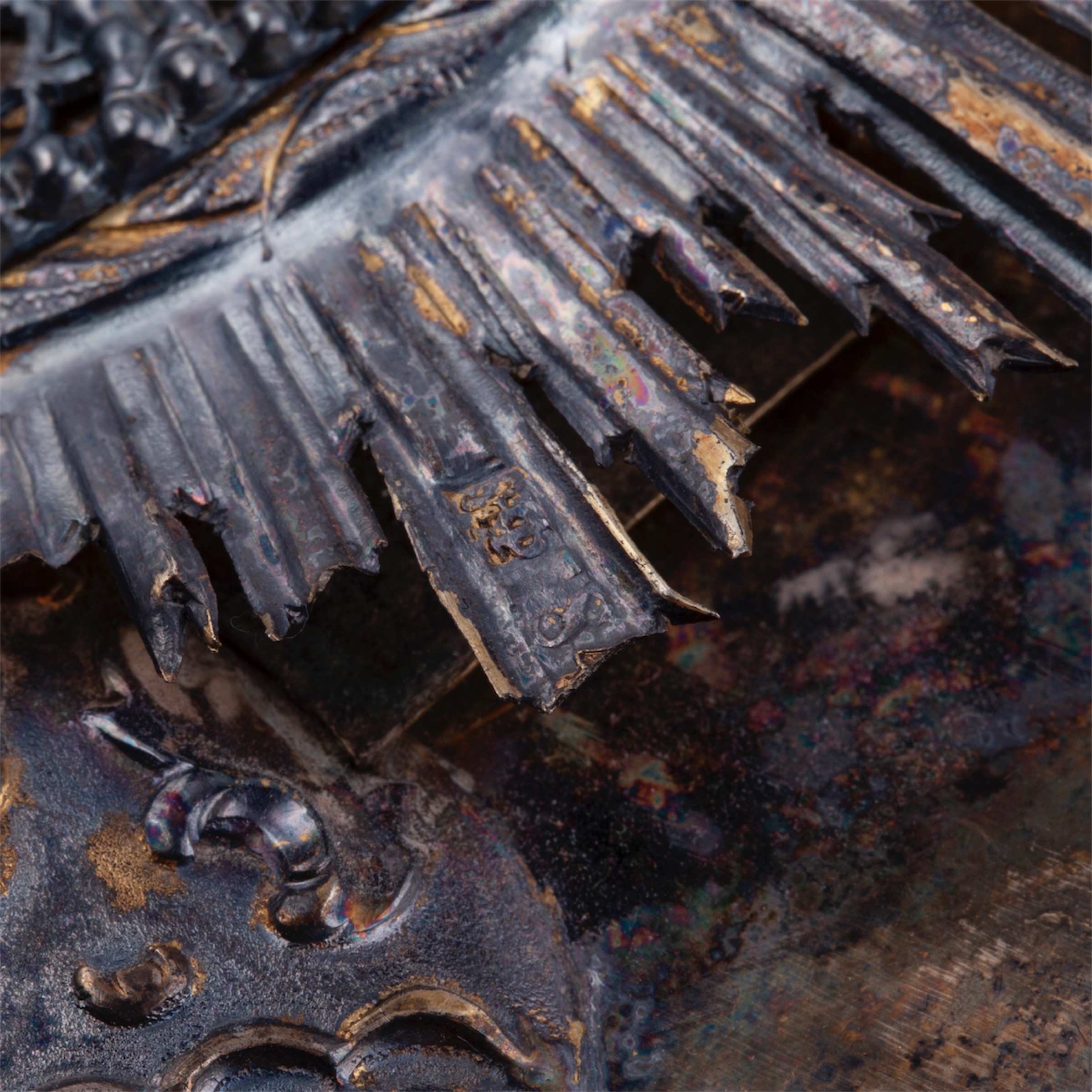
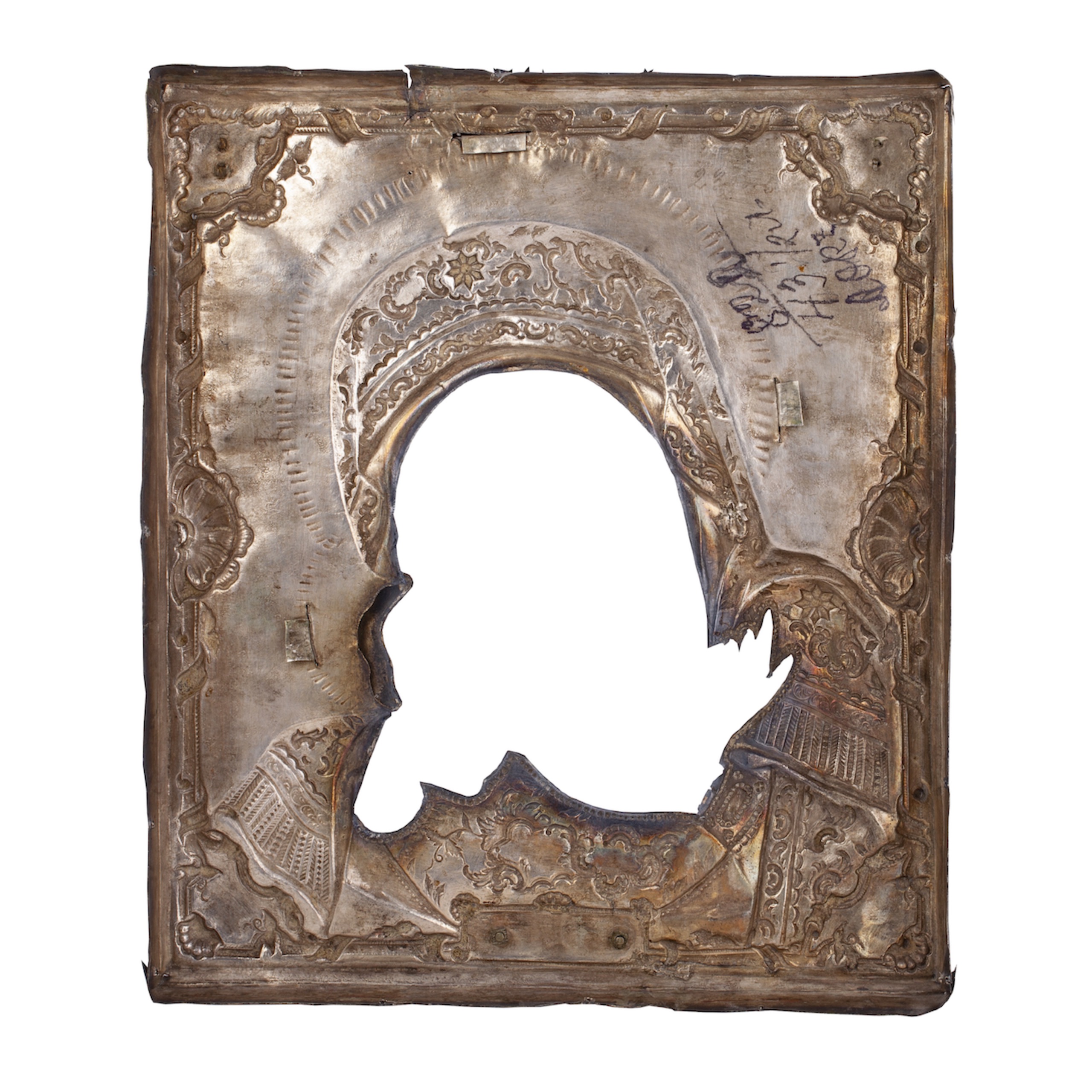
Riza weight: 349.5 gThis refined icon depicts Saint John the Evangelist, portrayed in deep reflection as he writes the Gospel under the guidance of an angel. The composition is filled with warmth and psychological depth, characteristic of the Yaroslavl School of the 18th century — one of the most expressive traditions of Russian icon painting.
The Yaroslavl school emerged in the 16th–17th centuries during a period of artistic flourishing. Many of its painters came from artisan backgrounds, which shaped their unique visual language: soft color transitions, emotional faces, and lively gestures. Unlike the austere icons of earlier centuries, Yaroslavl works combined devotion with a deeply human sensibility.
By the 17th century, Yaroslavl had become a major center of iconography. Its artists contributed to the decoration of key cathedrals, including the Assumption Cathedral of the Moscow Kremlin and the Church of Elijah the Prophet in Yaroslavl. Despite the growing influence of Western art, Yaroslavl icon painters preserved traditional techniques and aesthetics well into the 19th century.
The silver-gilt riza in classicism style, crafted in Moscow in 1814, enhances the sacred image with delicate gilding and chased ornamentation, highlighting the saint’s spiritual authority and contemplative grace.
Starting price: 2500€
Estimate: 3000-3500€
Hammer Price: Not sold -
Lot 0268
Russian Icon “St. Prince Alexander Nevsky” in Silver Riza
Estimate: 1500-2000€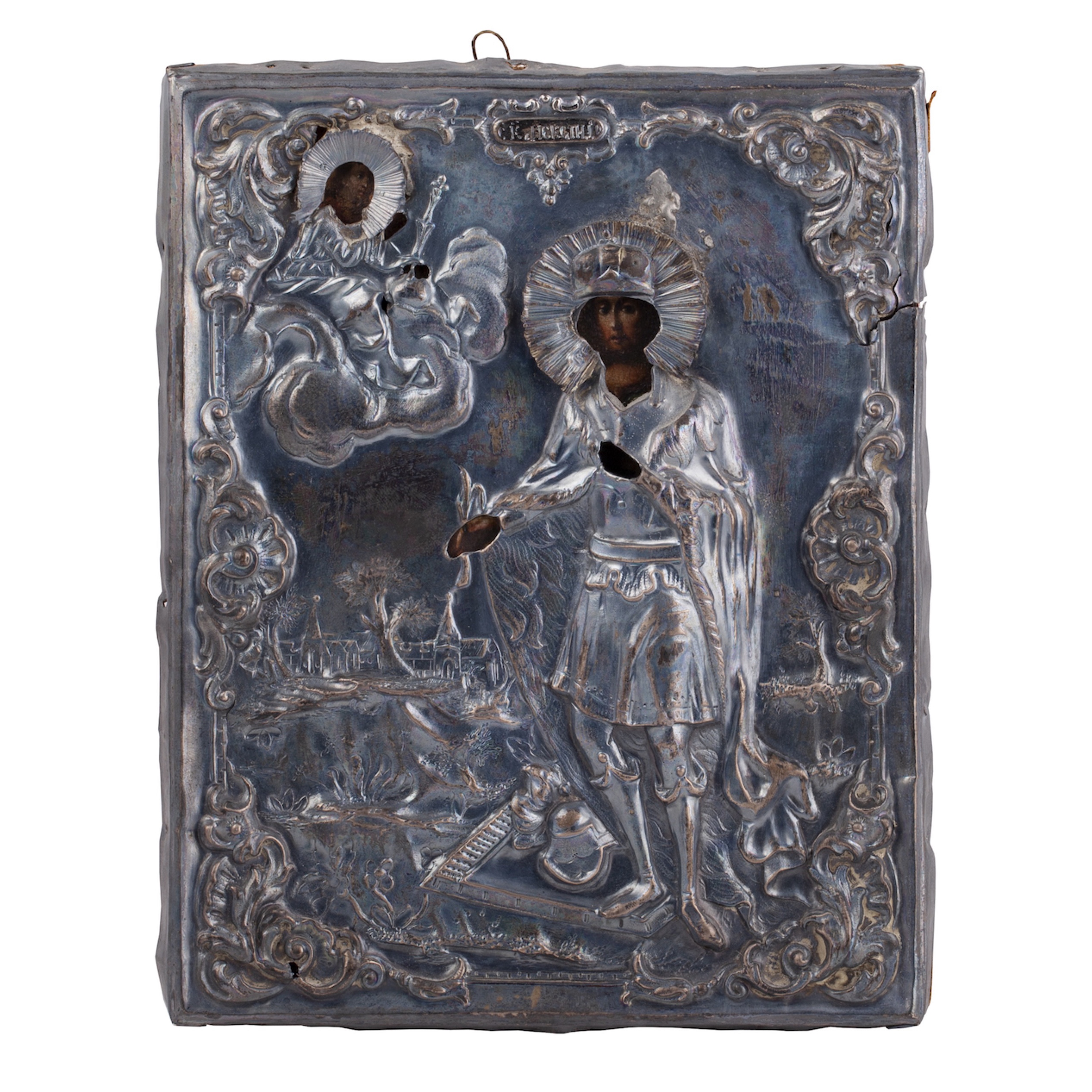
Lot 0268
Russian Icon “St. Prince Alexander Nevsky” in Silver Riza
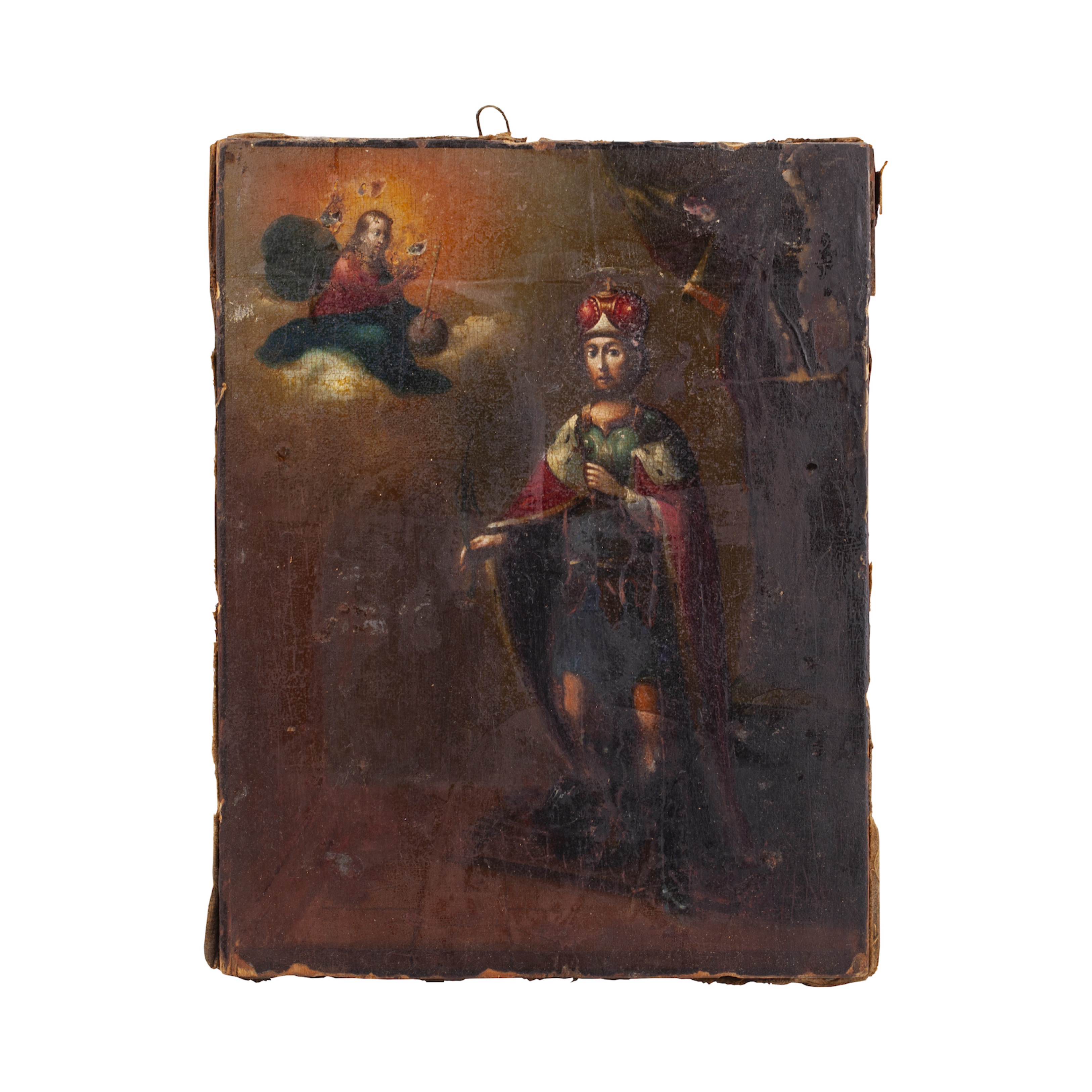
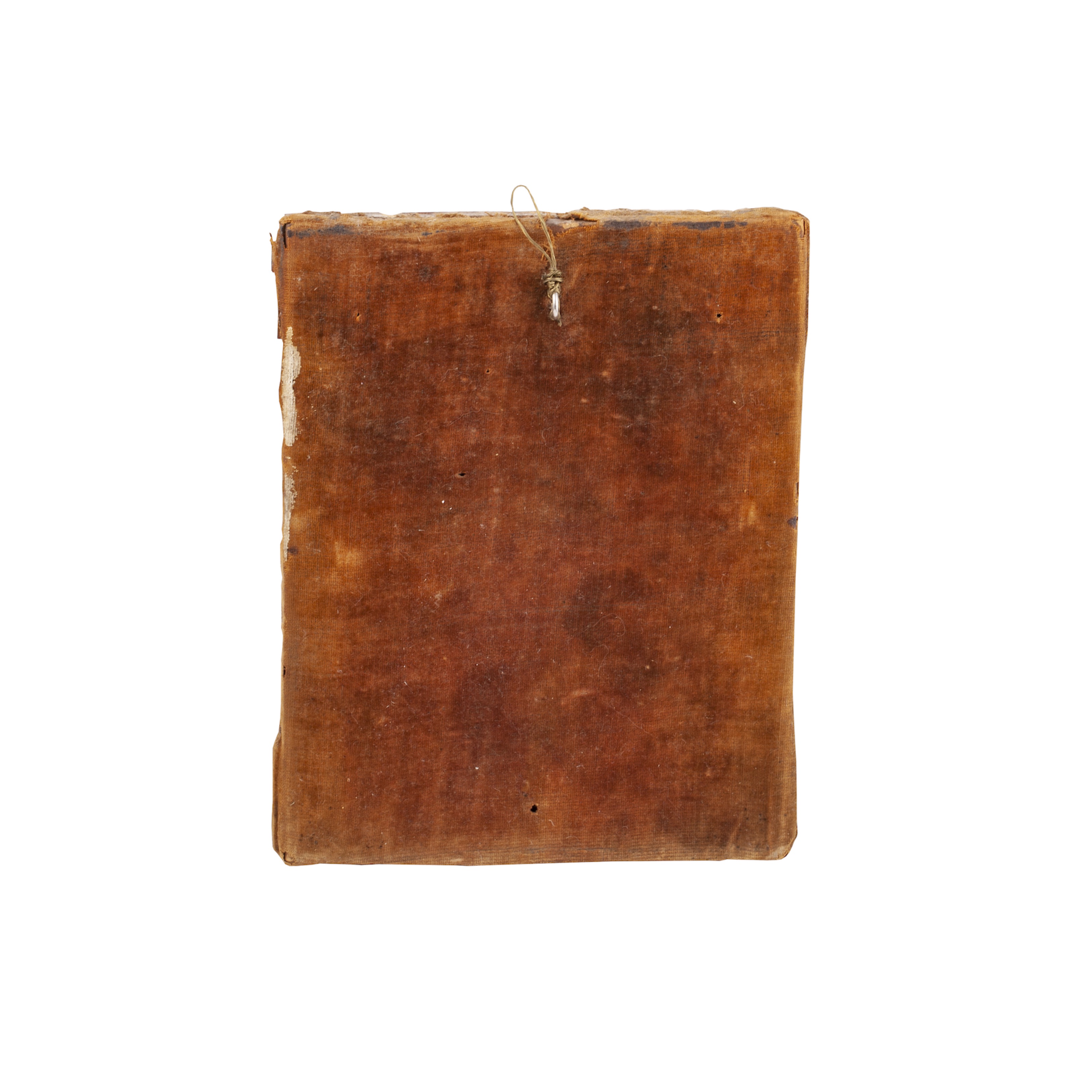
Estimate: 1500-2000€Icon of Saint Prince Alexander Nevsky in Silver Riza
Moscow, mid-19th century
Icon: wood, oil painting
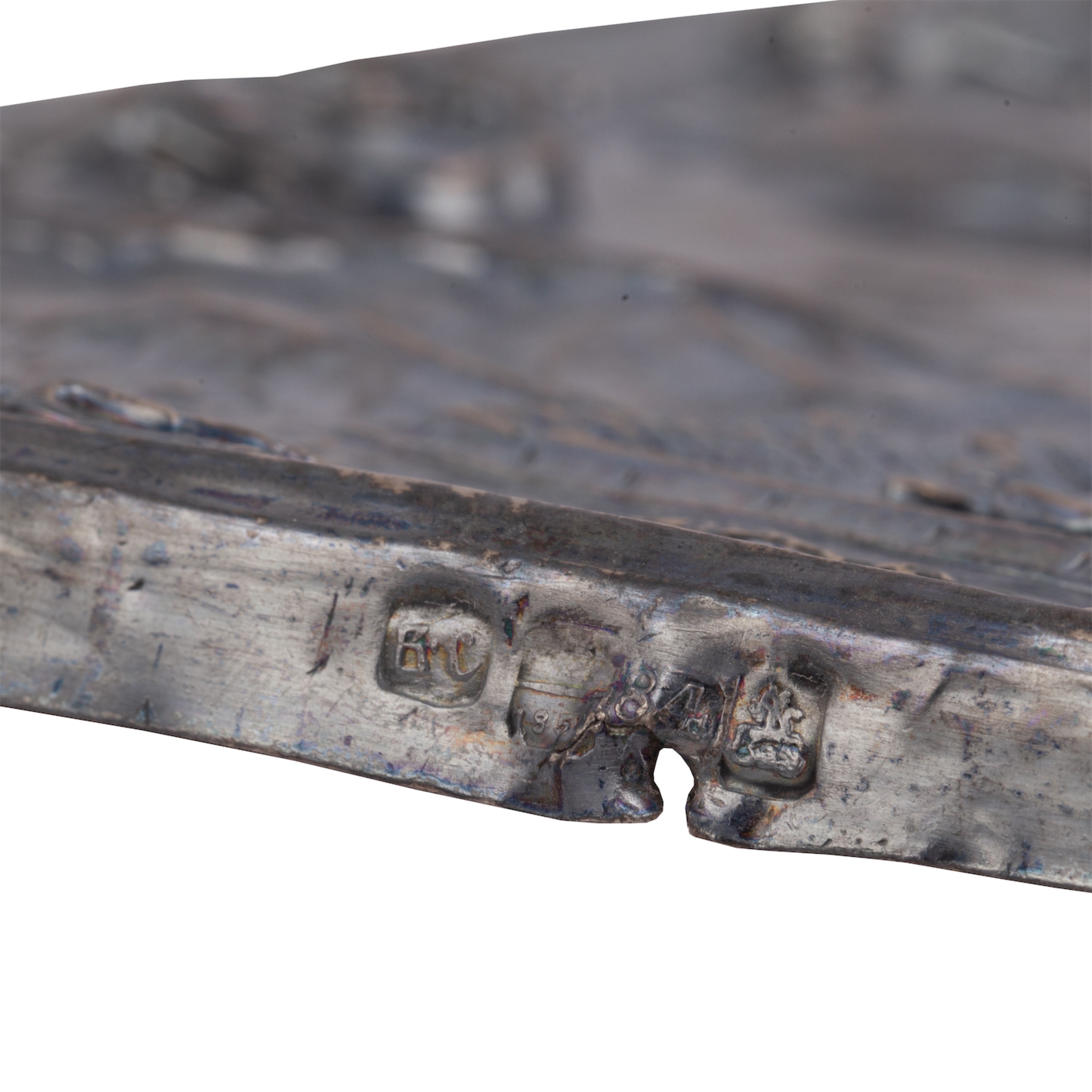
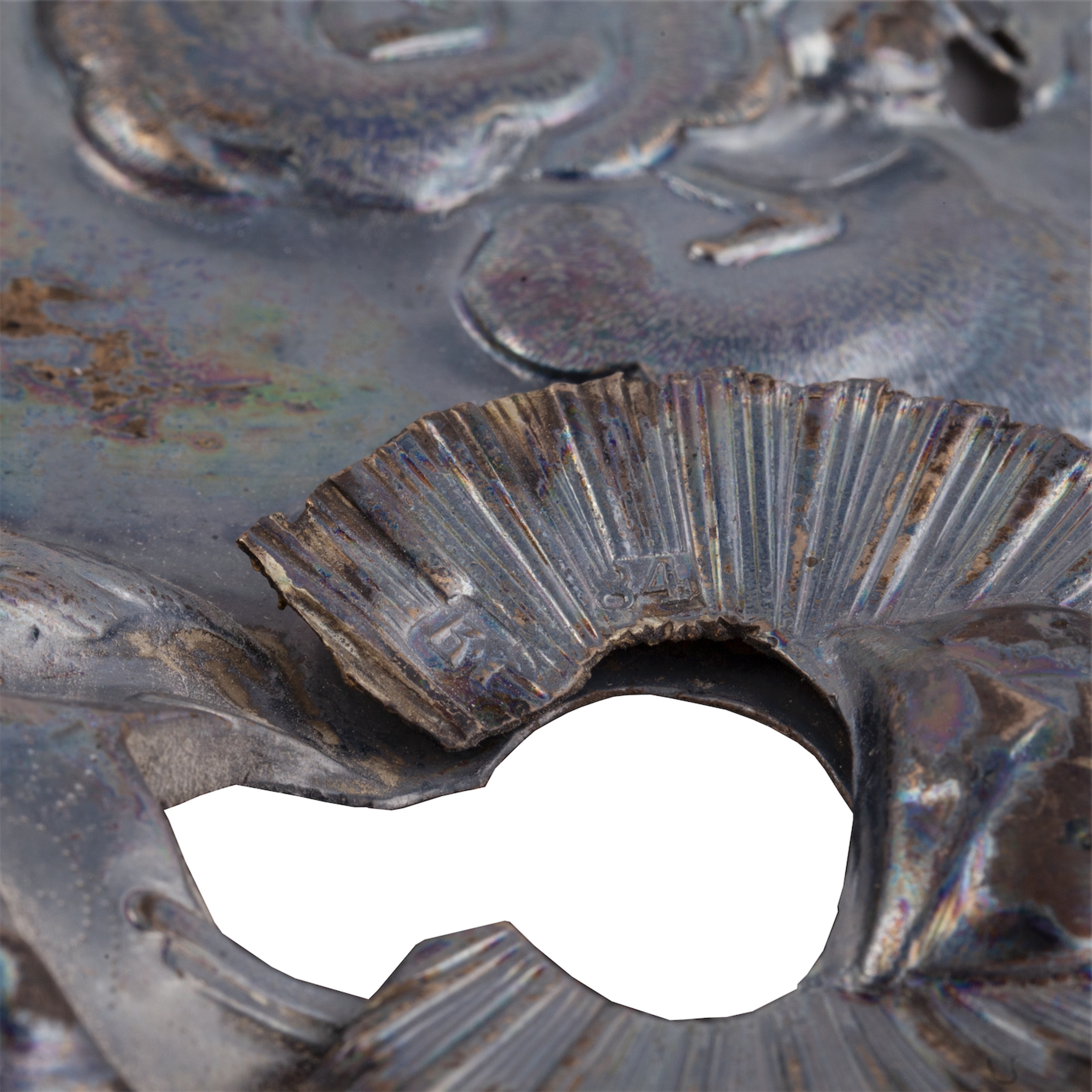
Riza: silver (84 zolotnik), chased and mounted
Maker’s mark: BC
Dimensions: 22.5 × 18 × 3 cm
Riza weight: 135.3 gThis elegant icondepicts Saint Prince Alexander Nevsky, one of the most venerated Russian military saints and a national hero. The saint is portrayed standing, dressed in princely armor and a cloak, his gaze turned heavenward toward Christ Pantocrator, who appears in the upper left blessing the prince.
The finely painted composition is overlaid with a richly ornamented massive silver riza (revetment) in the baroque style, elaborately chased with floral cartouches and architectural motifs.
Starting price: 1300€
Estimate: 1500-2000€
Hammer Price: Not sold -
Lot 0269
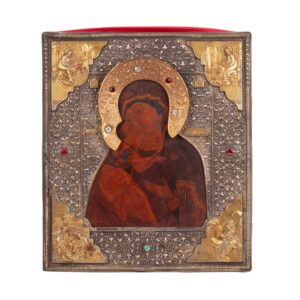
Icon of the Vladimir Mother of God with Silver-Gilt Oklad, Moscow, M. D. Shein workshop, 1867
Estimate: 2500-3500€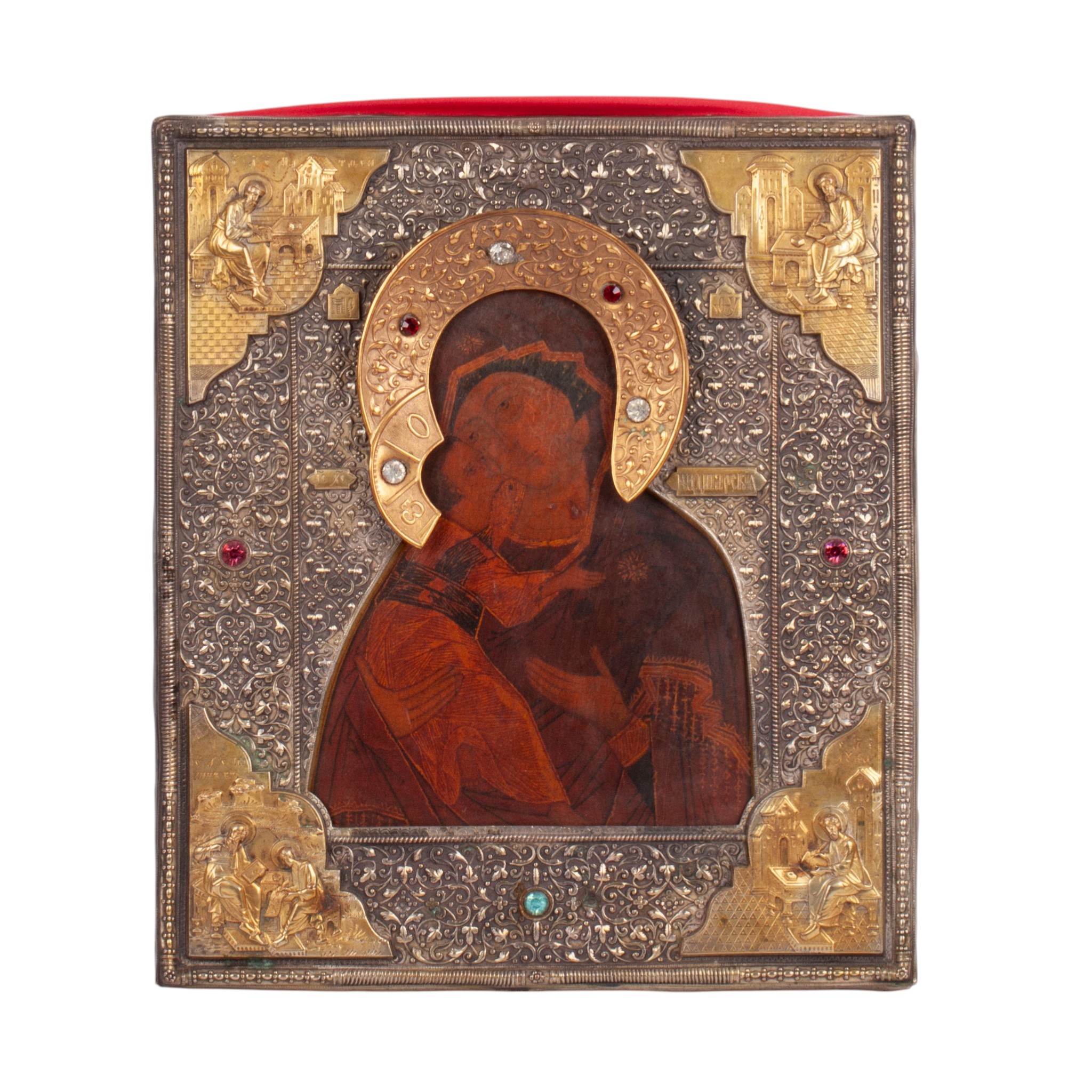
Lot 0269
Icon of the Vladimir Mother of God with Silver-Gilt Oklad, Moscow, M. D. Shein workshop, 1867
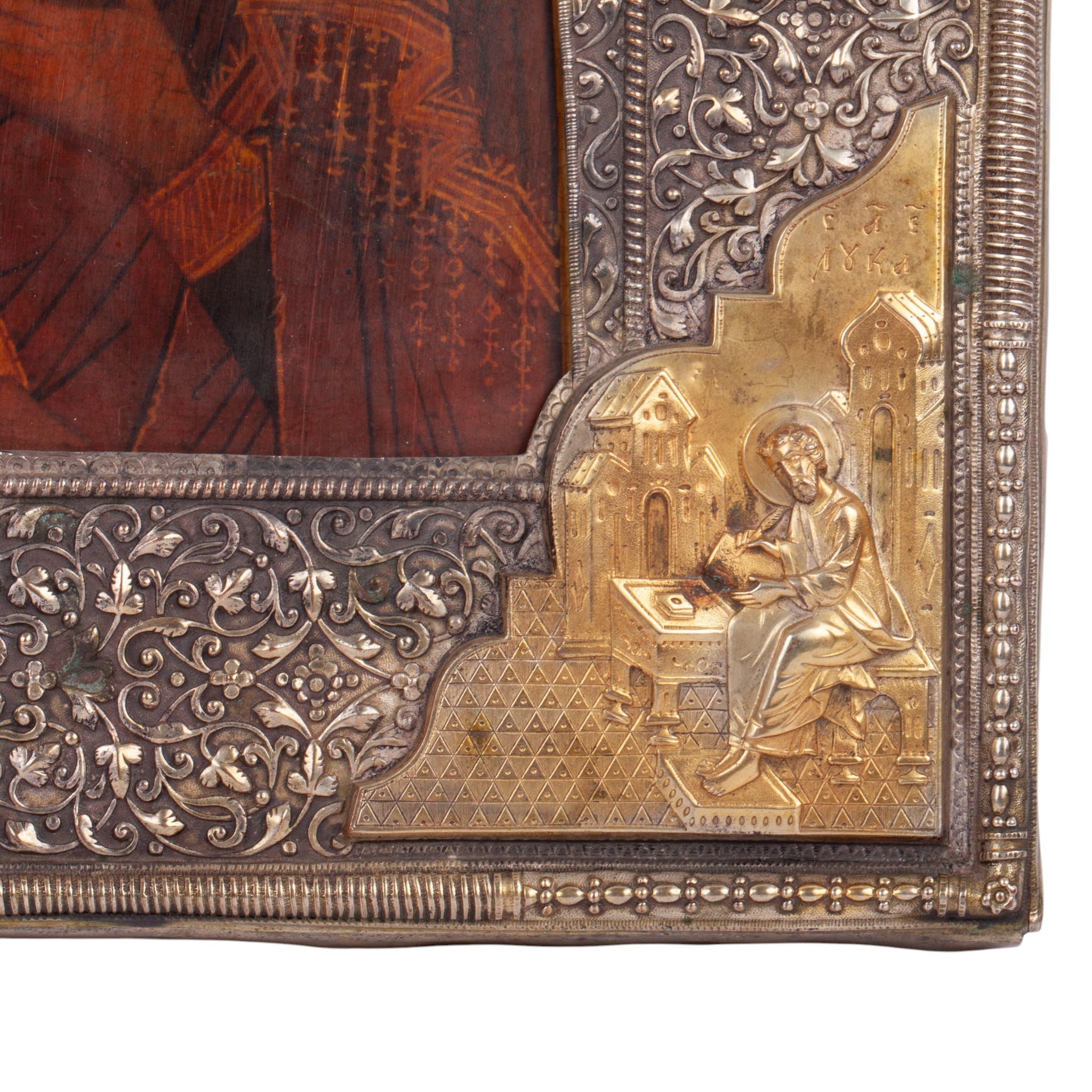
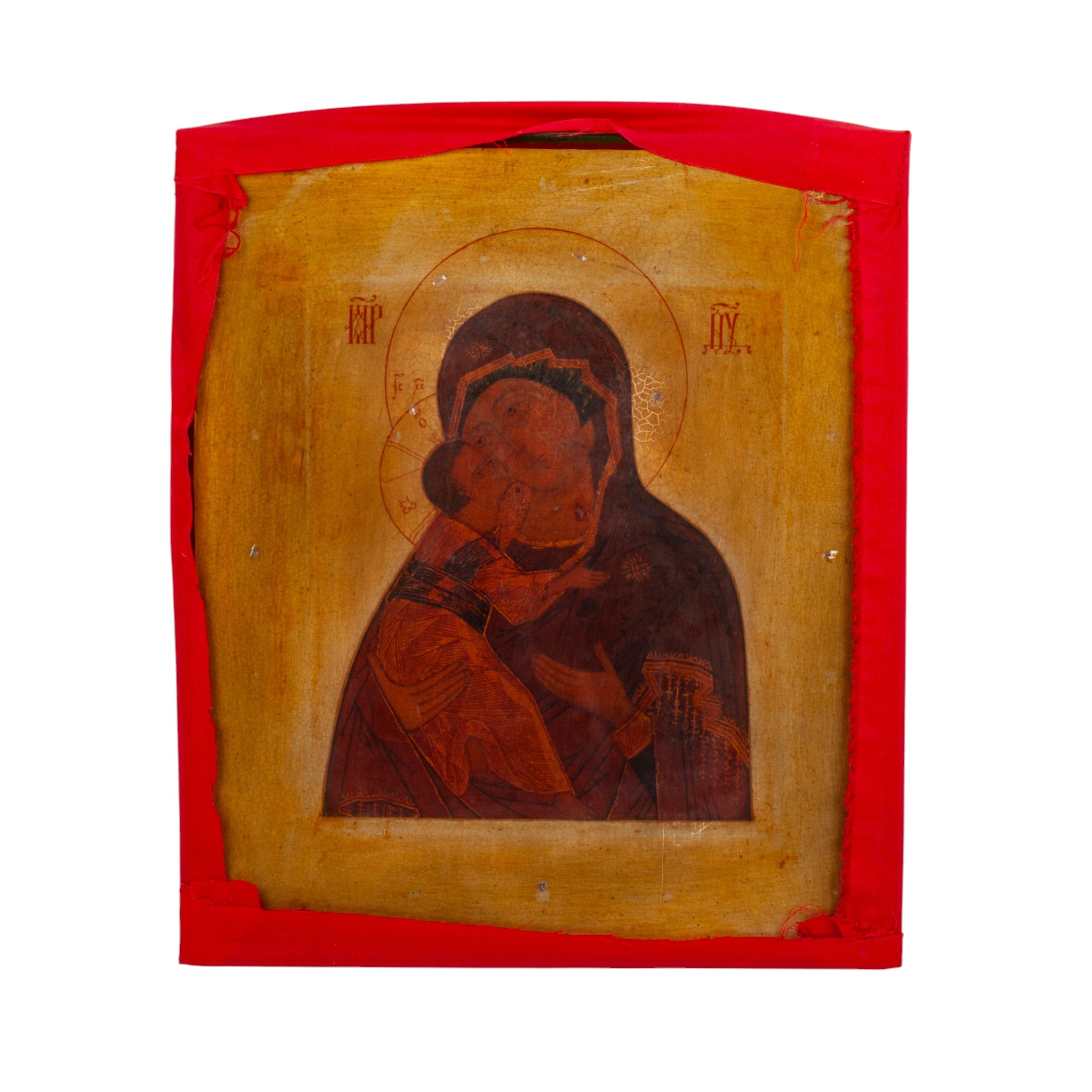
Estimate: 2500-3500€A Fine Icon of the Vladimir Mother of God in a silver-gilt oklad.
Moscow, icon mid 19th century; oklad: Moscow, workshop of Mikhail Dmitrievich Shein, 1867.
Wood, tempera; silver, parcel gilding, repoussé, chasing, engraving, applied ornament, coloured glass.
Dimensions: 31.5 x 27.5 x 3.5 cm.
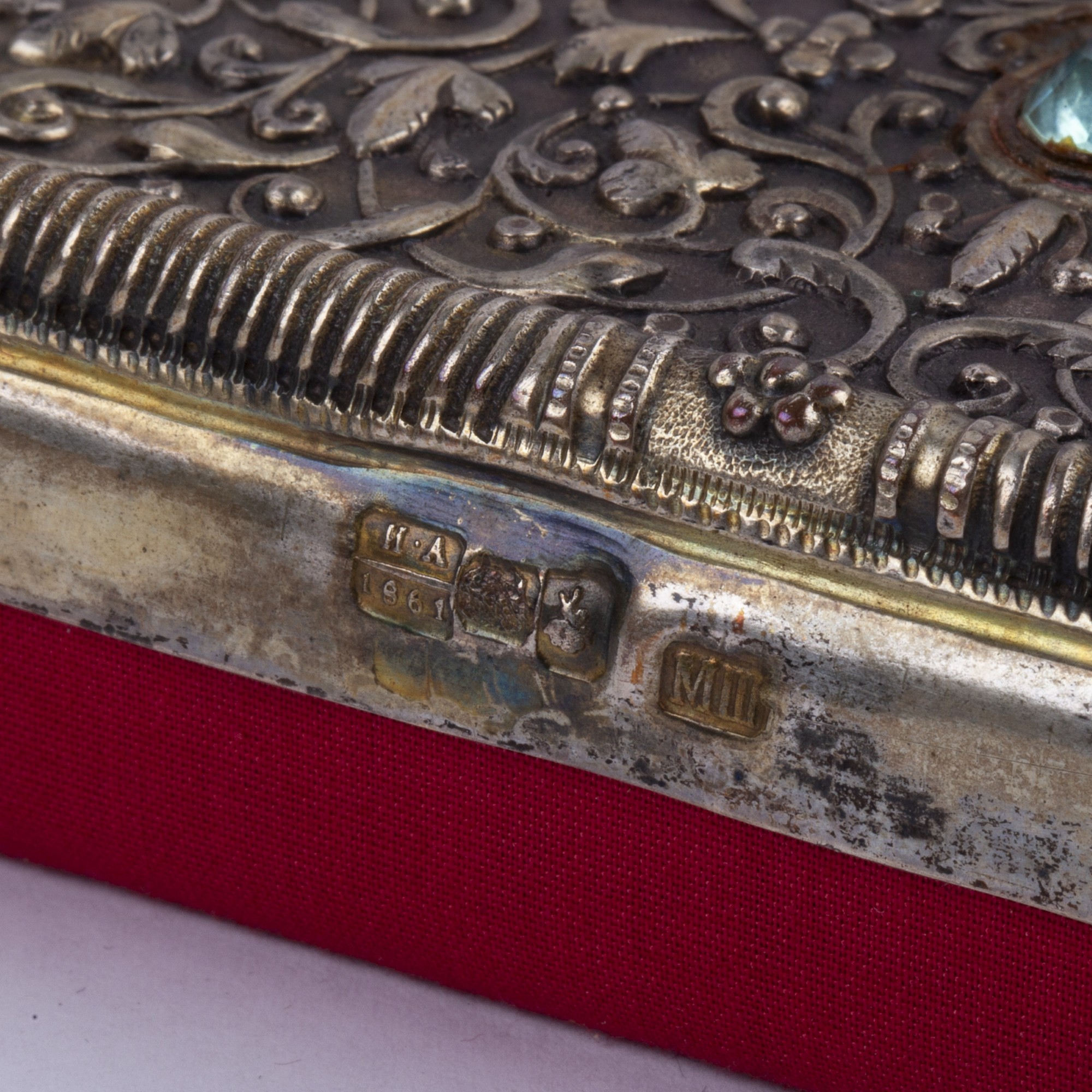
Marks: maker’s mark “МШ” for Mikhail Dmitrievich Shein; Moscow assay mark “П.А / 1867”; 84 zolotnik silver standard; Moscow city mark with St George.
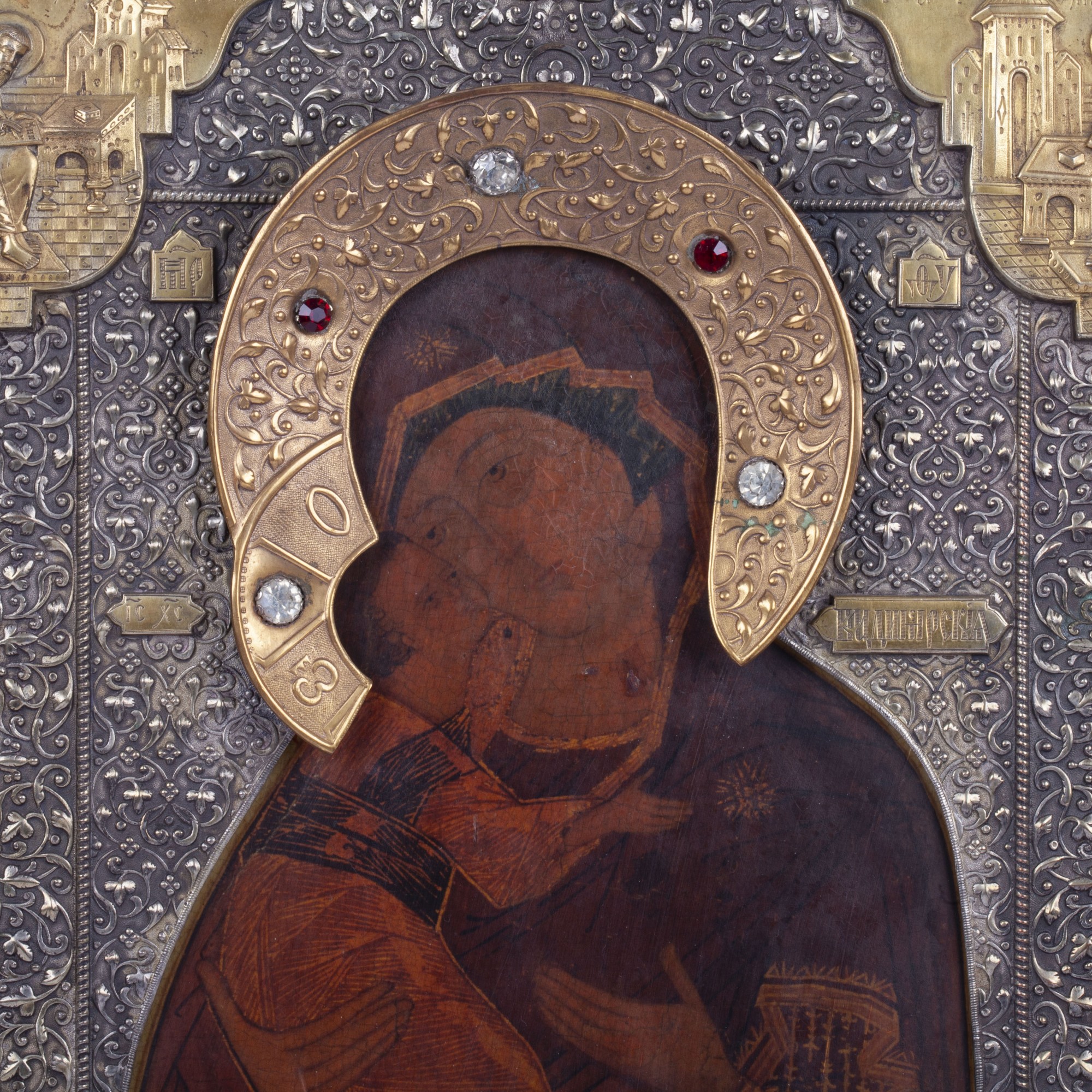
A Russian icon of the Vladimir Mother of God, one of the most revered Byzantine-derived iconographic types in Orthodox art. The Virgin is shown in the tender Eleusa type, inclining her head toward the Christ Child, whose cheek is pressed against hers.
The icon is set in a richly worked silver-gilt oklad. The ground is densely chased with scrolling floral ornament, small blossoms and foliate tendrils. The halo of the Mother of God is separately applied and gilded, with engraved vegetal decoration and inset red and colourless glass pastes. The gilded collar of the Christ Child bears the sacred abbreviation “ОѾ””, while small name plaques identify the figures with the inscriptions “IC XC” and “ВЛАДИМИРСКАЯ”.
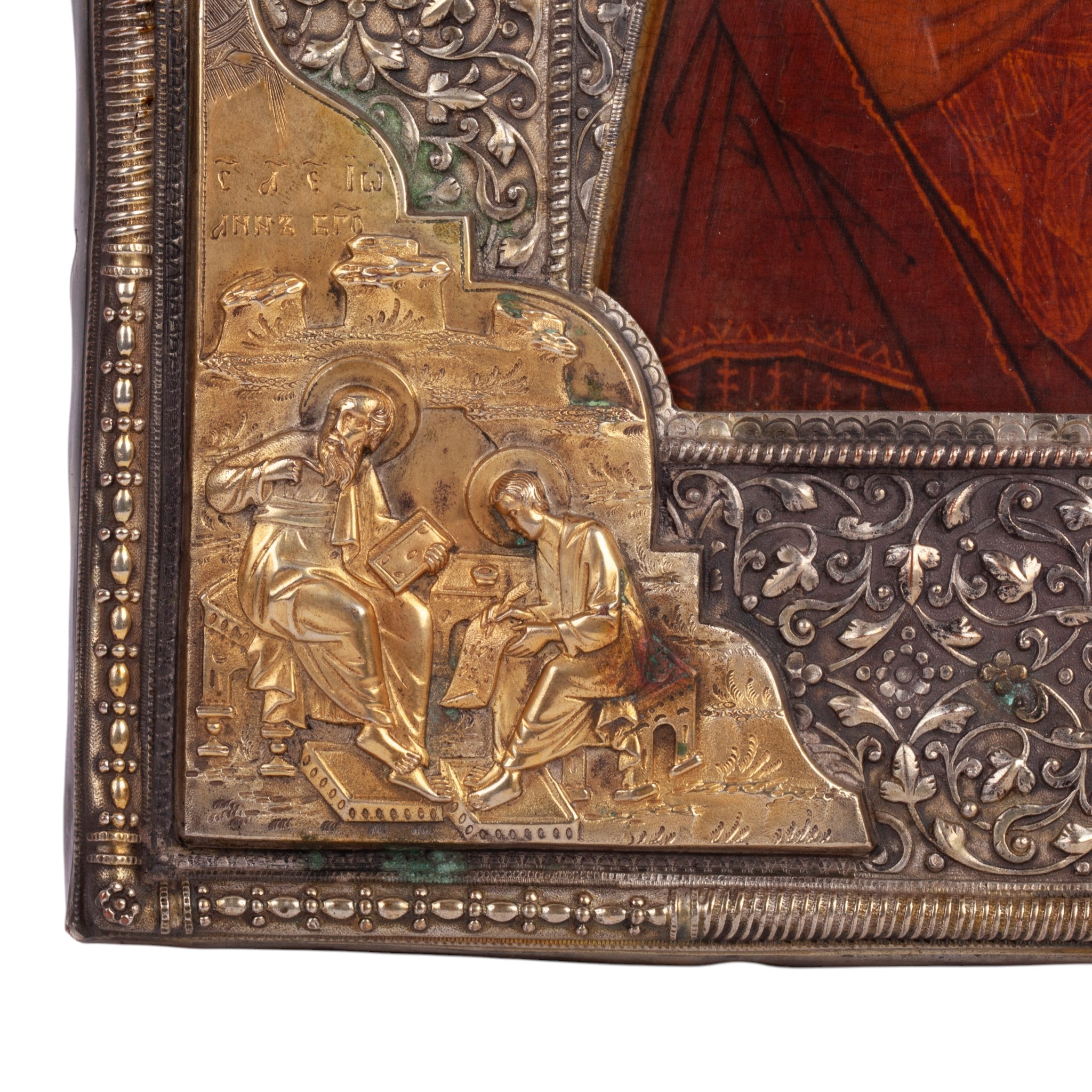
The four corners of the oklad are decorated with gilded relief images of the Evangelists seated at writing desks within architectural settings. The border is finished with beaded and ribbed bands, typical of mid-19th-century Moscow silverwork.
Mikhail Dmitrievich Shein was a Moscow silversmith and owner of a silver workshop, whose mark consists of the initials “МШ”. Works by Shein, including an icon oklad and a cream jug, are known in the collection of the State Historical Museum. (https://catalog.shm.ru/entity/OBJECT/1713520?index=1&paginator=entity-set&entityType=OBJECT&entityId=1713522&attribute=like_predm&ysclid=moh447zzvk36607535)Starting price: 2000€
Estimate: 2500-3500€
Hammer Price: Not sold -
Lot 0270
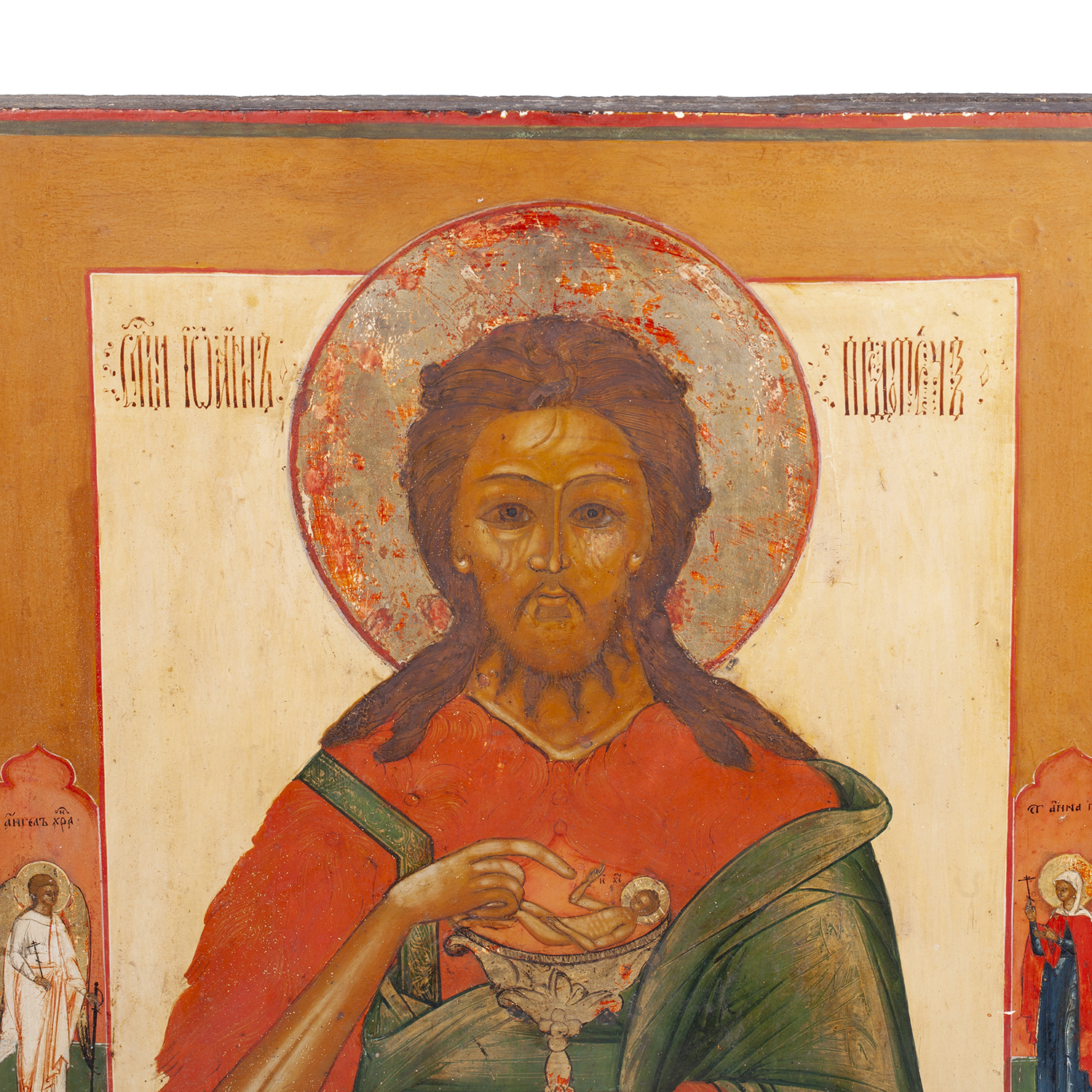
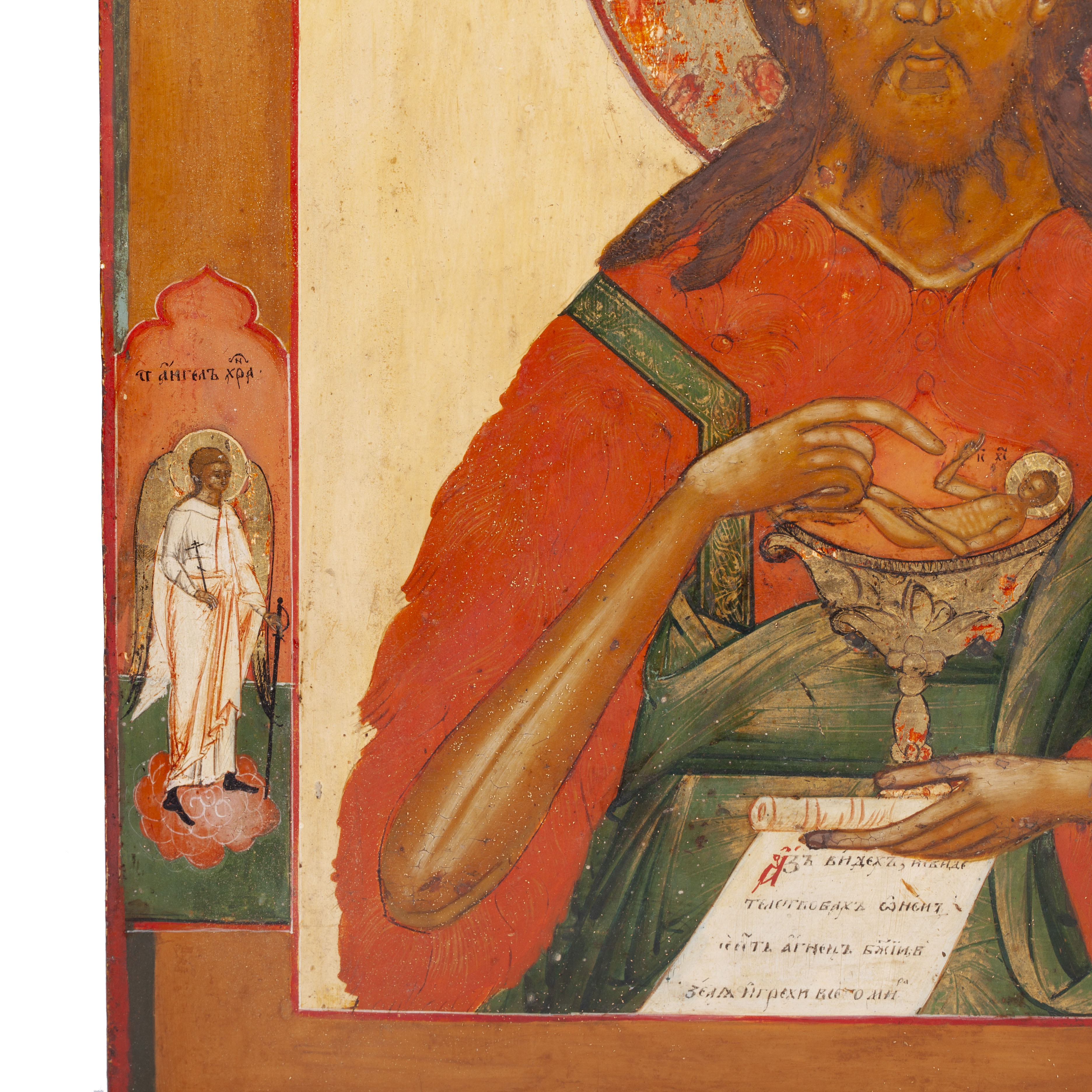
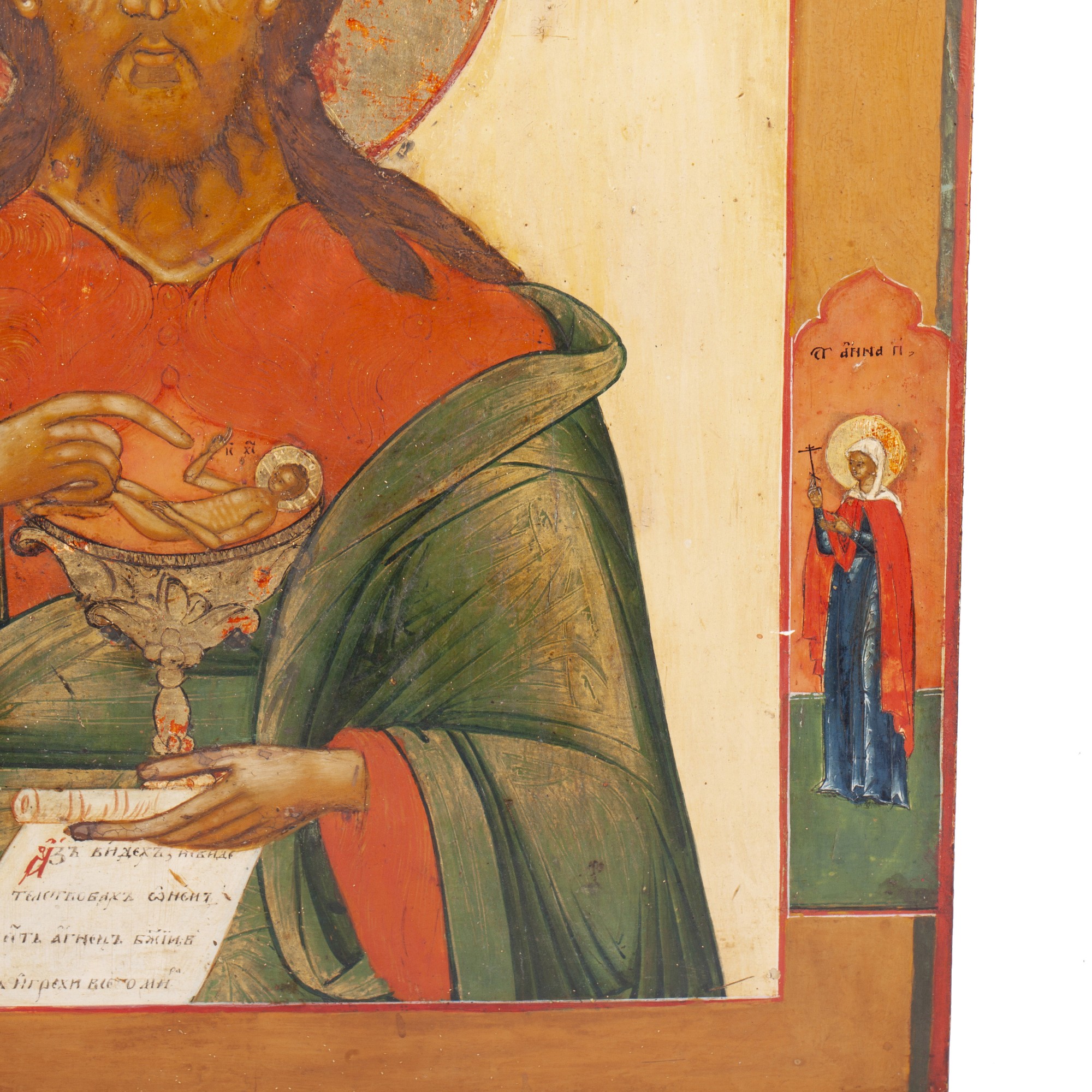
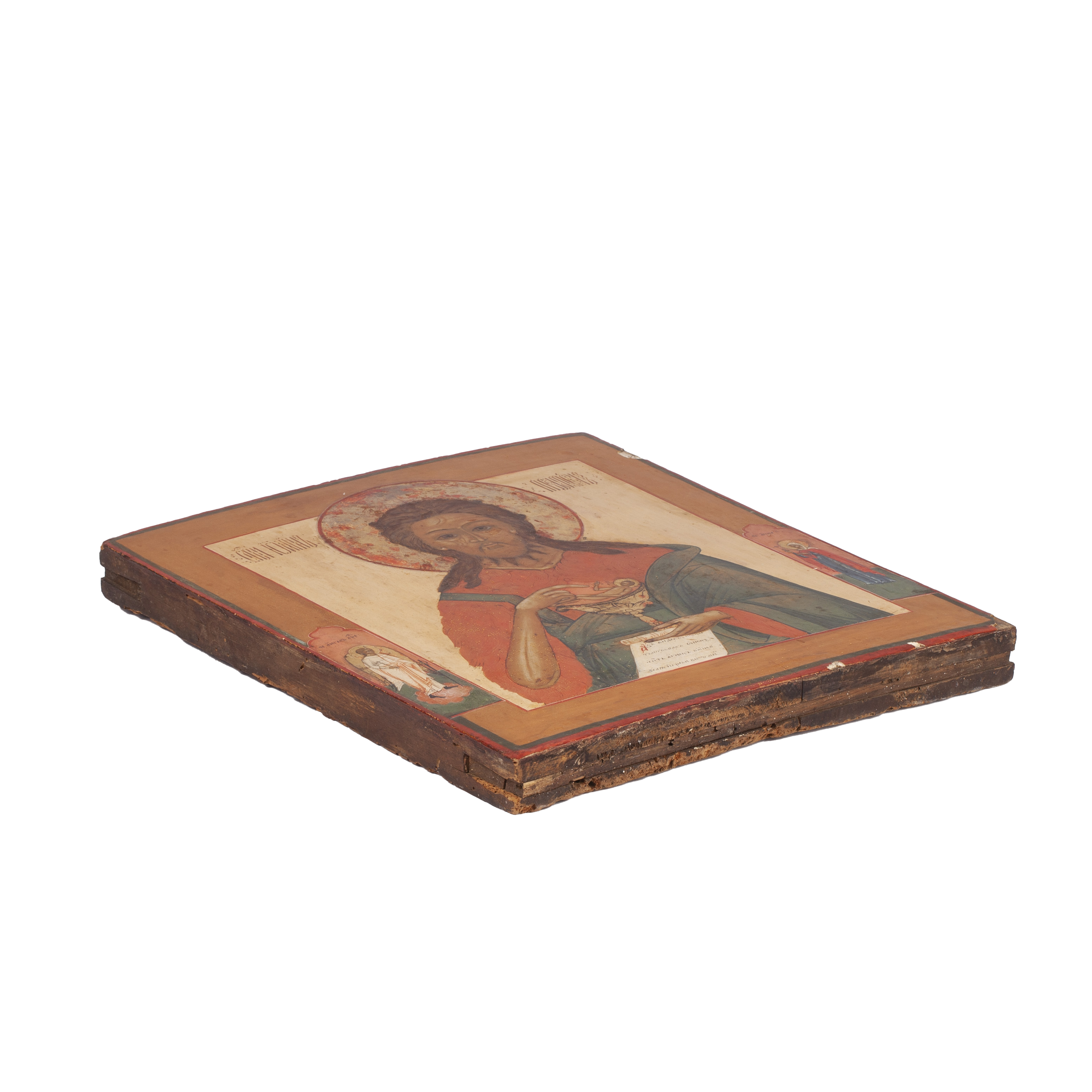
Finely Painted Russian Icon of St. John the Baptist with St. Anna and Guardian Angel
Estimate: 500-600€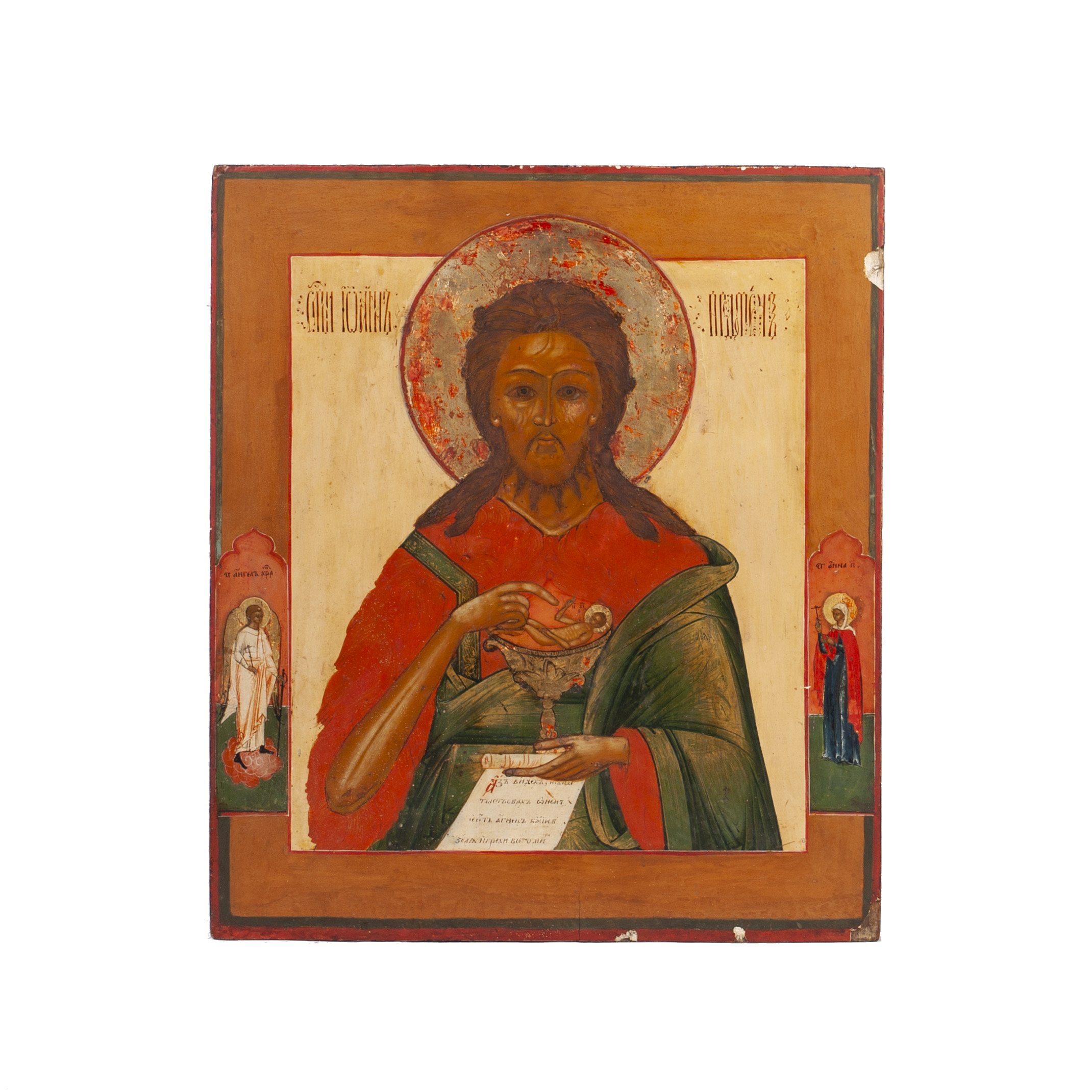
Lot 0270
Finely Painted Russian Icon of St. John the Baptist with St. Anna and Guardian Angel
Estimate: 500-600€Icon of Saint John the Baptist
Central Russia, second half of the 19th century
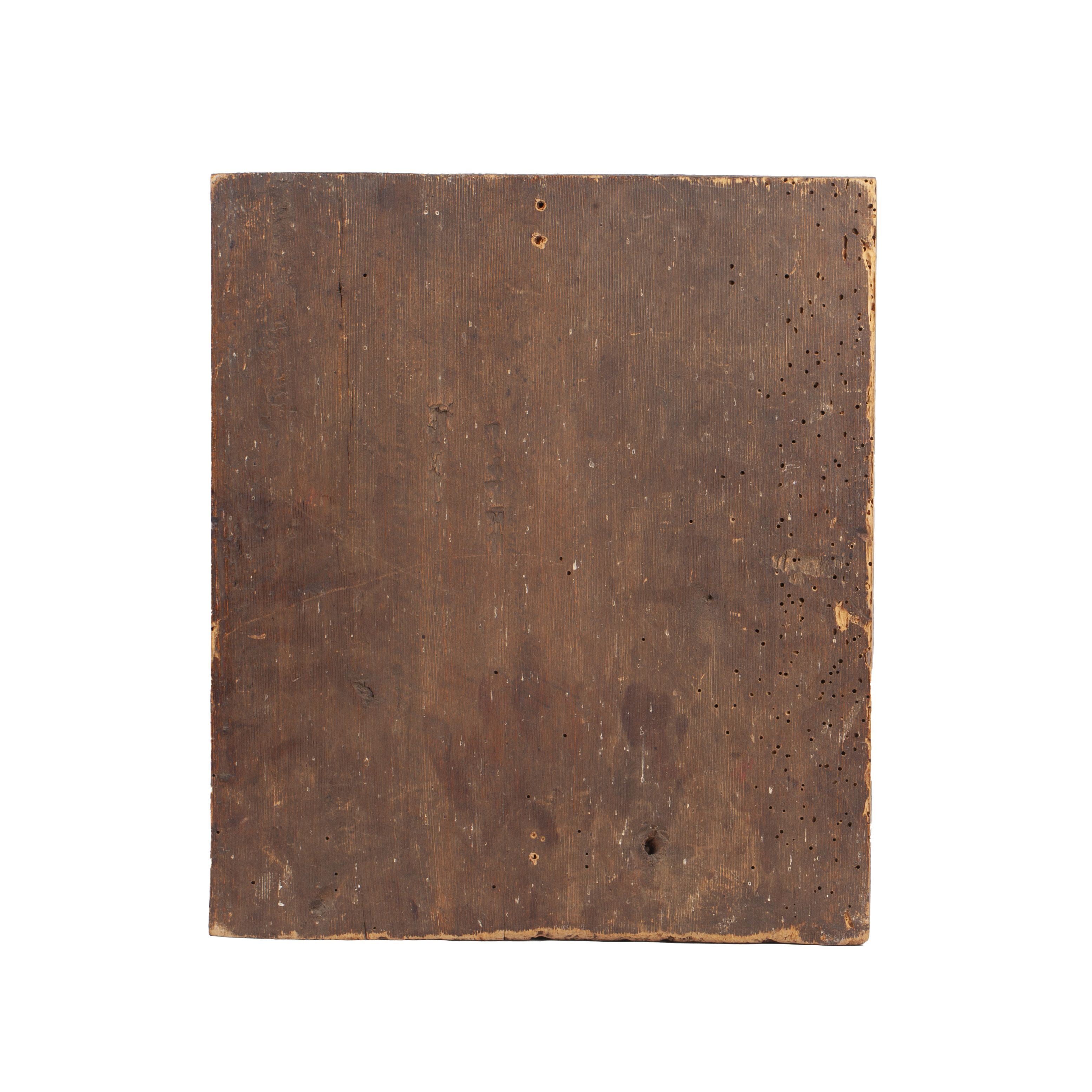
Tempera on wood
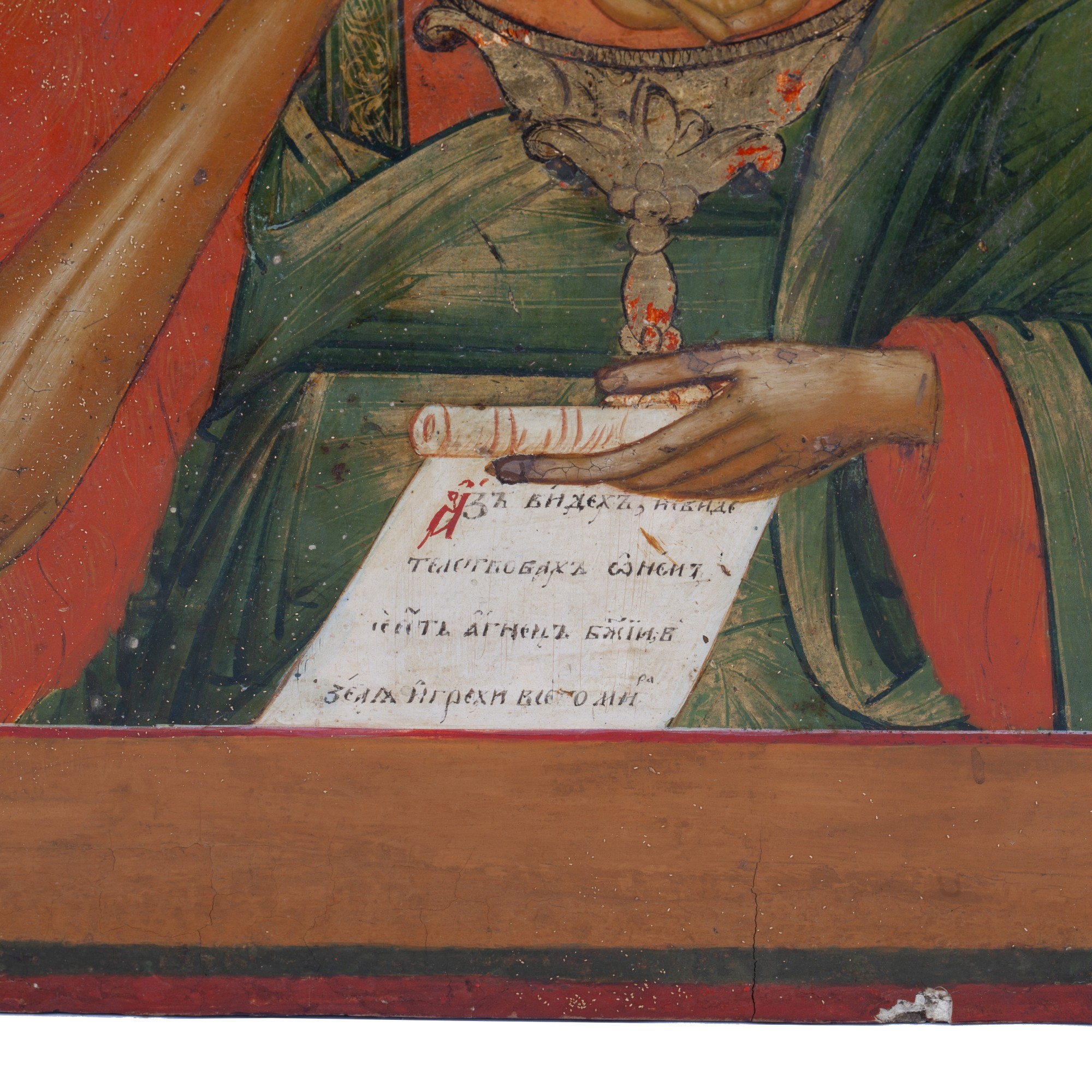
Dimensions: 35.5 × 30.5 cmA finely painted Russian icon depicting Saint John the Baptist, portrayed half-length and holding a chalice containing the image of the infant Christ — a symbolic reference to his prophecy of the coming of the Savior and his role as the Forerunner. In his left hand, the saint holds a scroll with a passage from the Gospel.
The borders feature Saint Anna on the left and a Guardian Angel on the right, painted within small decorative panels.
Starting price: 400€
Estimate: 500-600€
Hammer Price: Not sold -
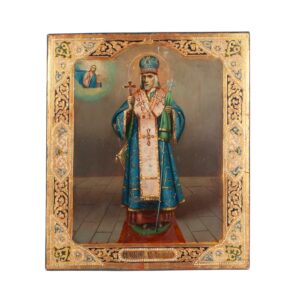
Lot 0271
Russian Icon of Saint Joasaph of Belgorod, After 1911
Estimate: 1000-1200€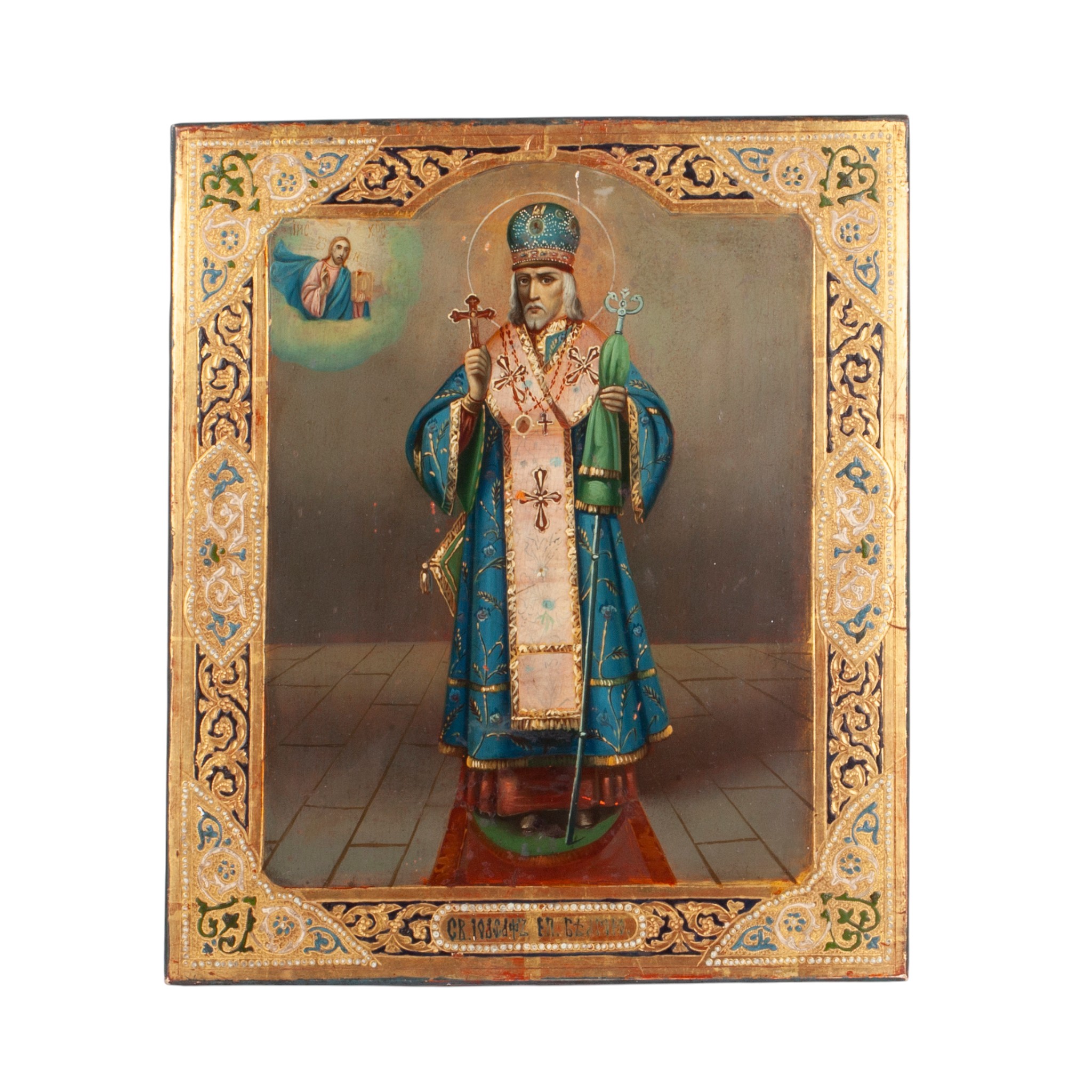
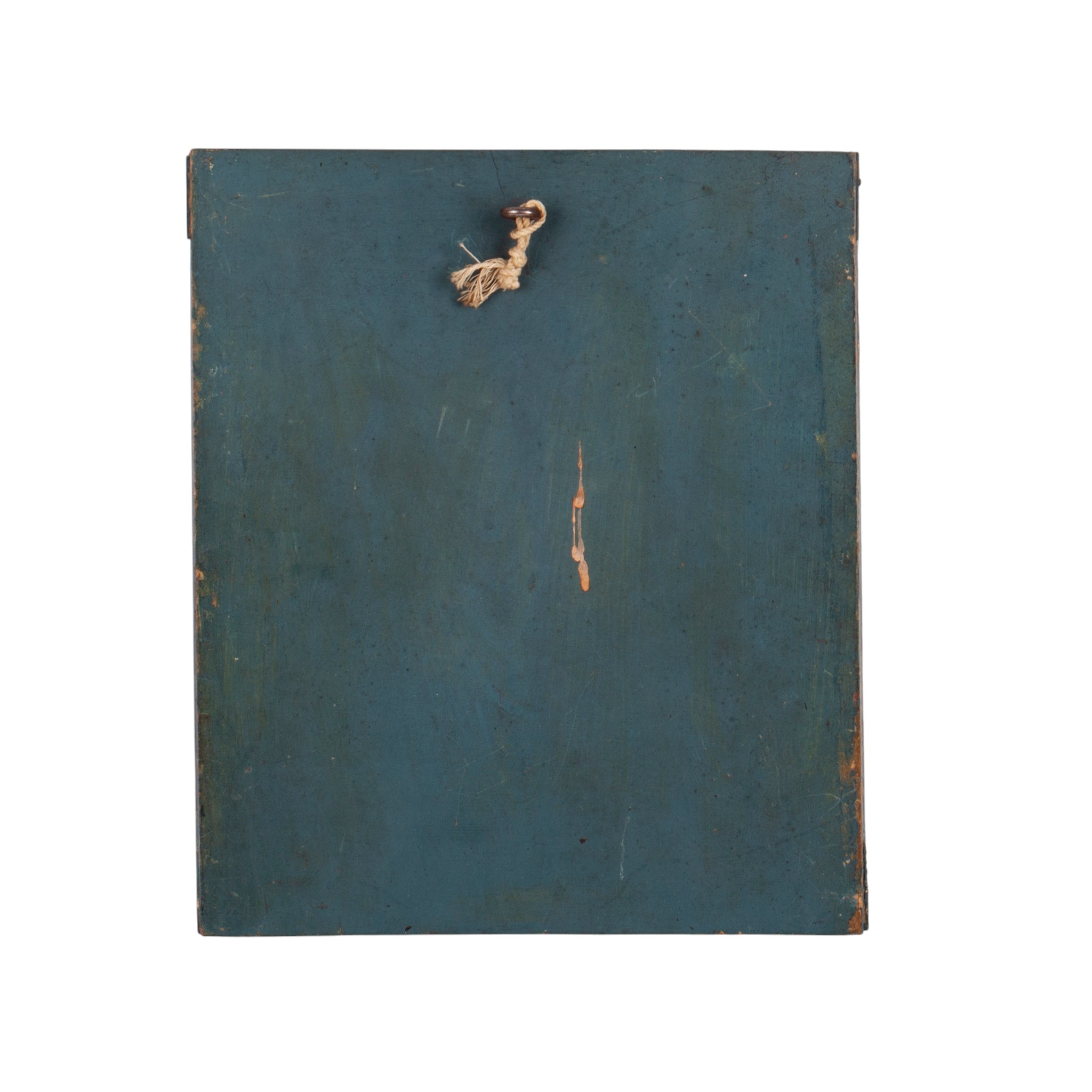
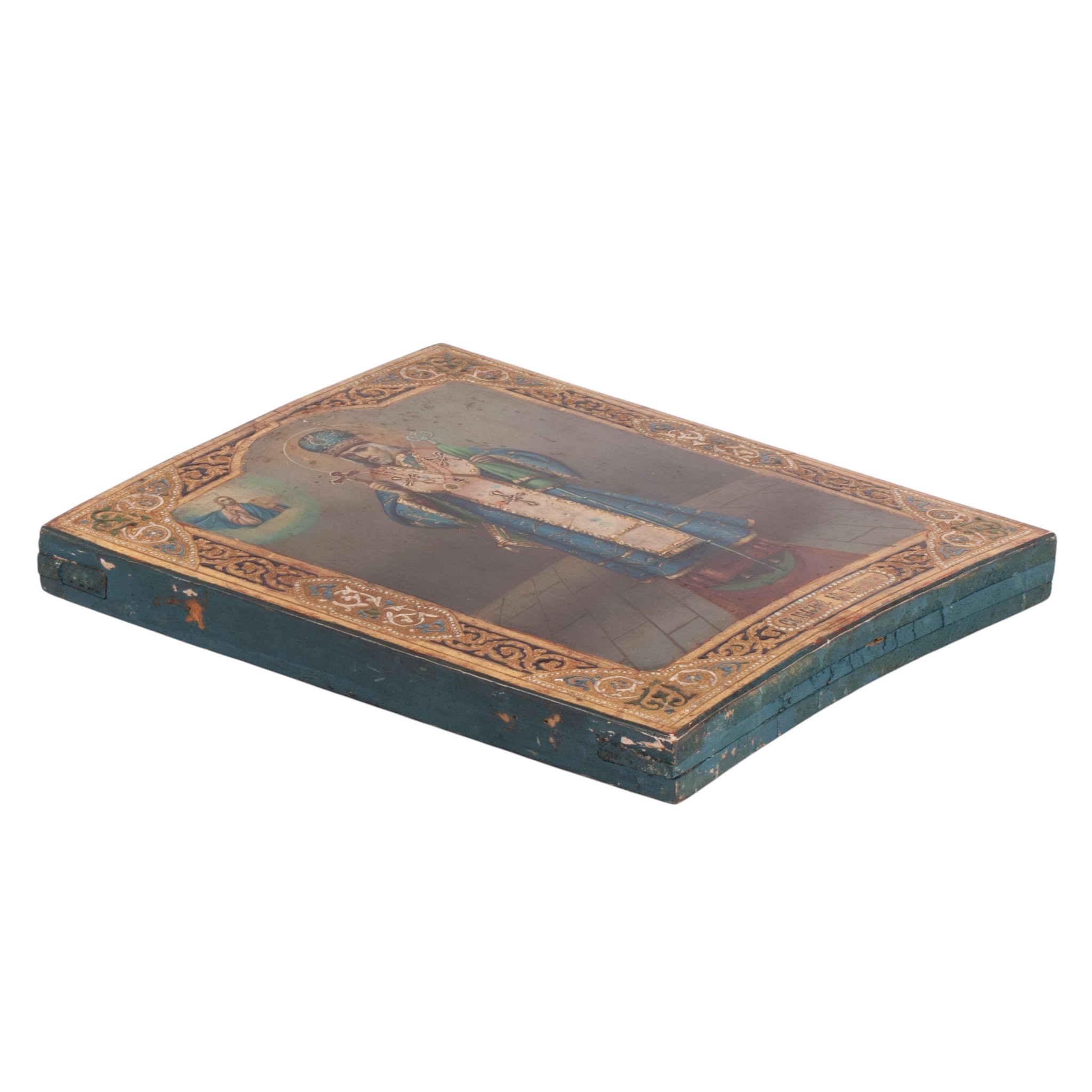
Lot 0271
Russian Icon of Saint Joasaph of Belgorod, After 1911
Estimate: 1000-1200€Russian icon of Saint Joasaph, Bishop of Belgorod.
Central Russia, after 1911.
Wood, gesso, oil; gilding, painted ornament, applied decorative pastiglia.
Dimensions: 31.2 x 27 x 3 cm.
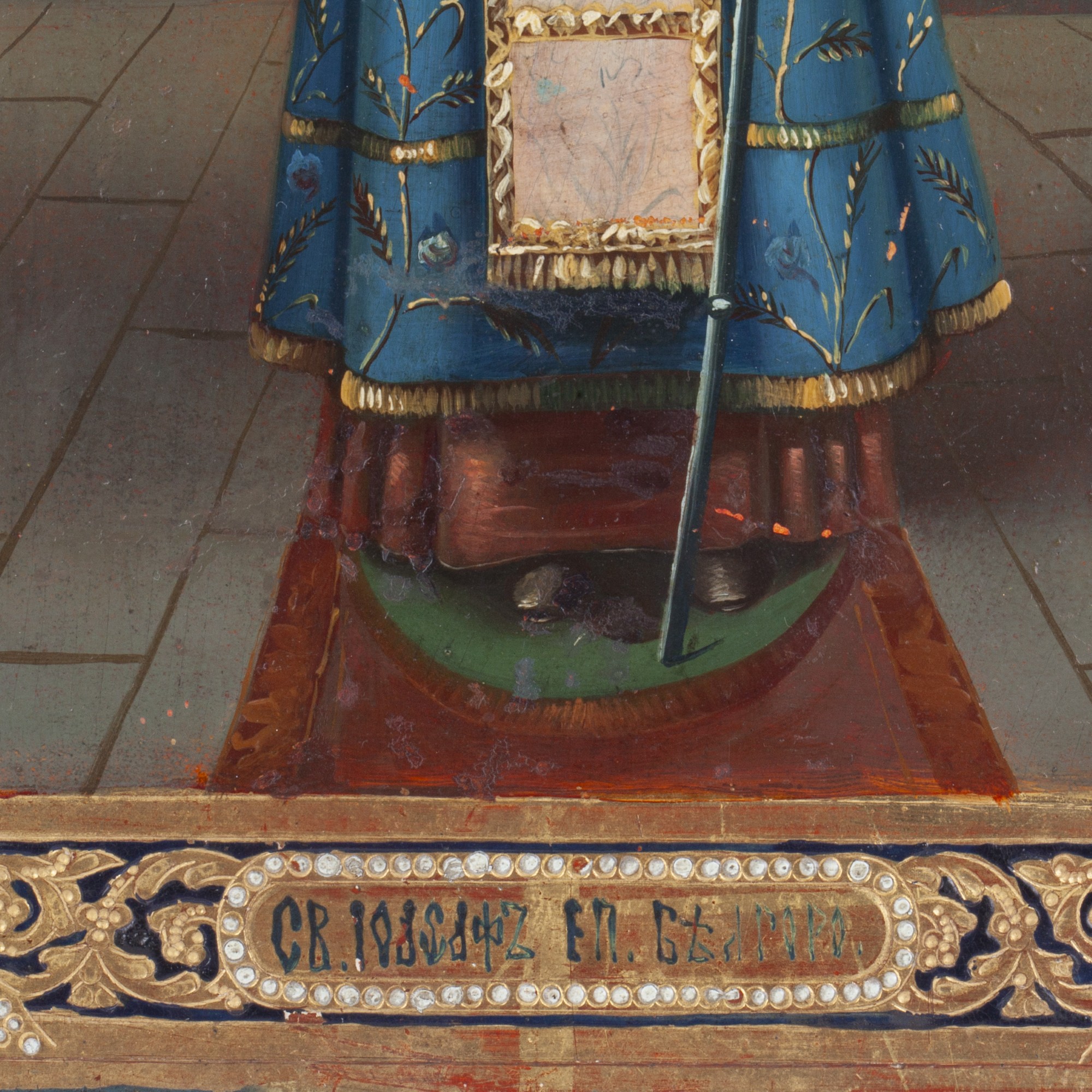
Inscription: along the lower cartouche: “Св. Iоасафъ Еп. Белгород…”
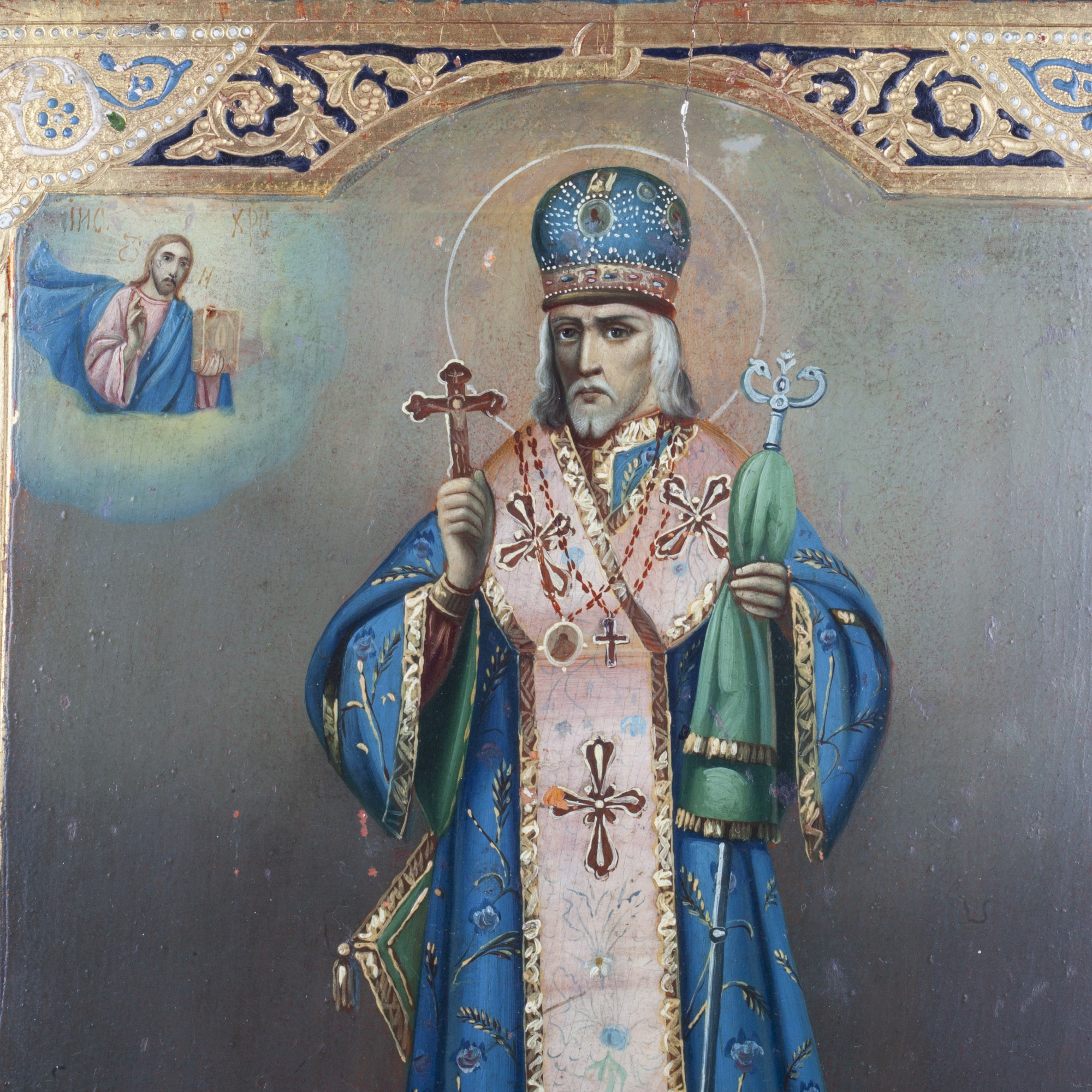
Saint Joasaph, Bishop of Belgorod.
An icon depicting Saint Joasaph of Belgorod in full episcopal vestments, standing frontally within an architectural interior. The saint is shown as a hierarch: in a blue sakkos with floral ornament, omophorion, episcopal mitre and medallion panagia. In his right hand he holds a blessing cross; in his left, a staff with a green veil. In the upper left corner appears Christ Pantocrator in a cloud mandorla, blessing the saint and holding the Gospel.
The border is richly decorated with gilded relief ornament imitating the effect of an enamelled or jewelled frame. Scrolling foliage, dark blue reserves, green and turquoise accents, and rows of small pearl-like beads create a festive ornamental setting.
Saint Joasaph of Belgorod, who died in 1754, was one of the most venerated Russian hierarchs of the eighteenth century. His incorrupt relics and reported miracles formed the basis of a powerful local and national cult, and his official glorification by the Russian Orthodox Church in 1911 led to a broad dissemination of his icons. The present image should therefore be understood in the context of this renewed veneration on the eve of the First World War.Starting price: 800€
Estimate: 1000-1200€
Hammer Price: Not sold -
Lot 0272
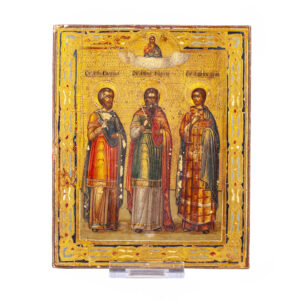
Russian Icon Depicting the Holy Martyrs Gurias, Samonas, and Aviv, 2nd Half 19th Century
Estimate: 300-400€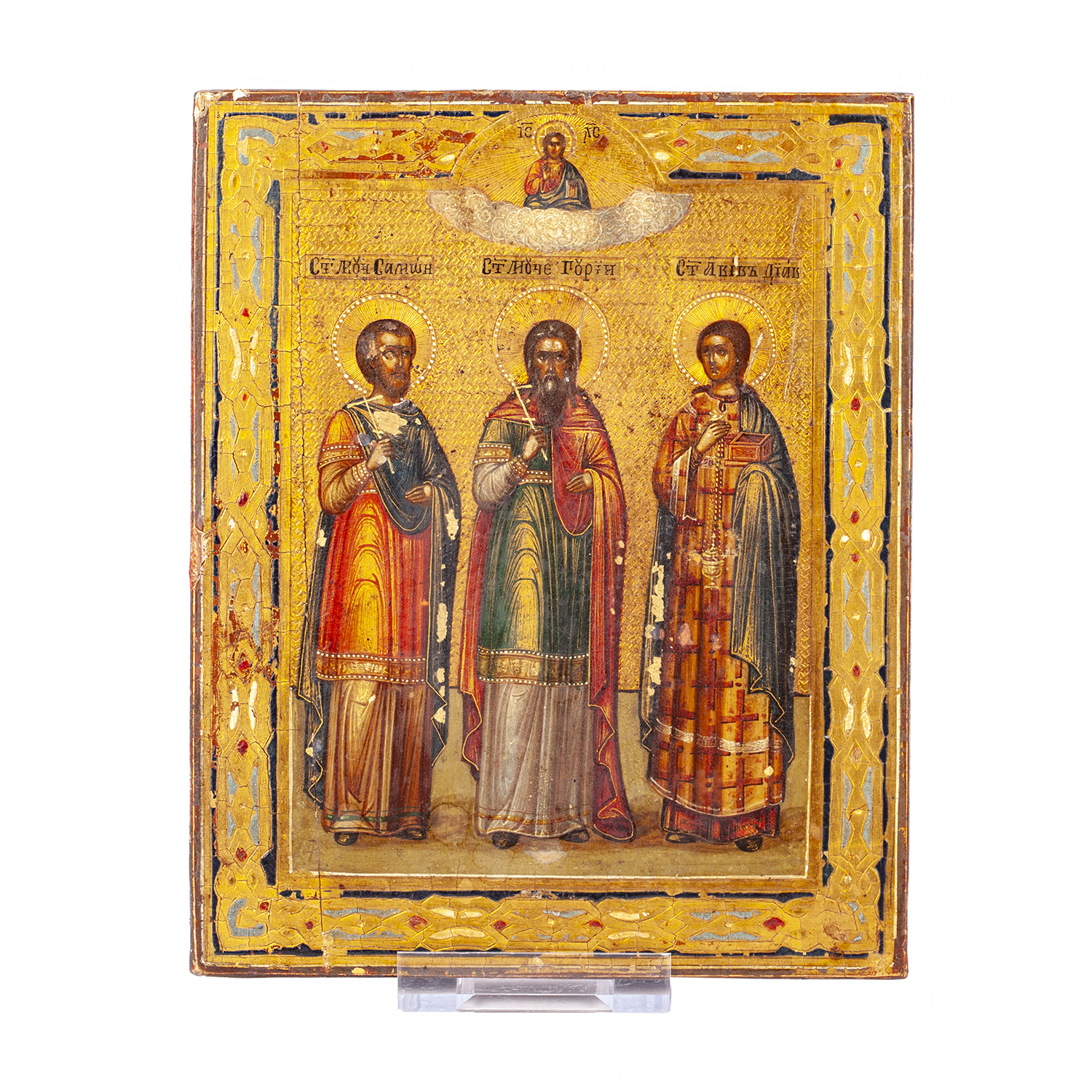
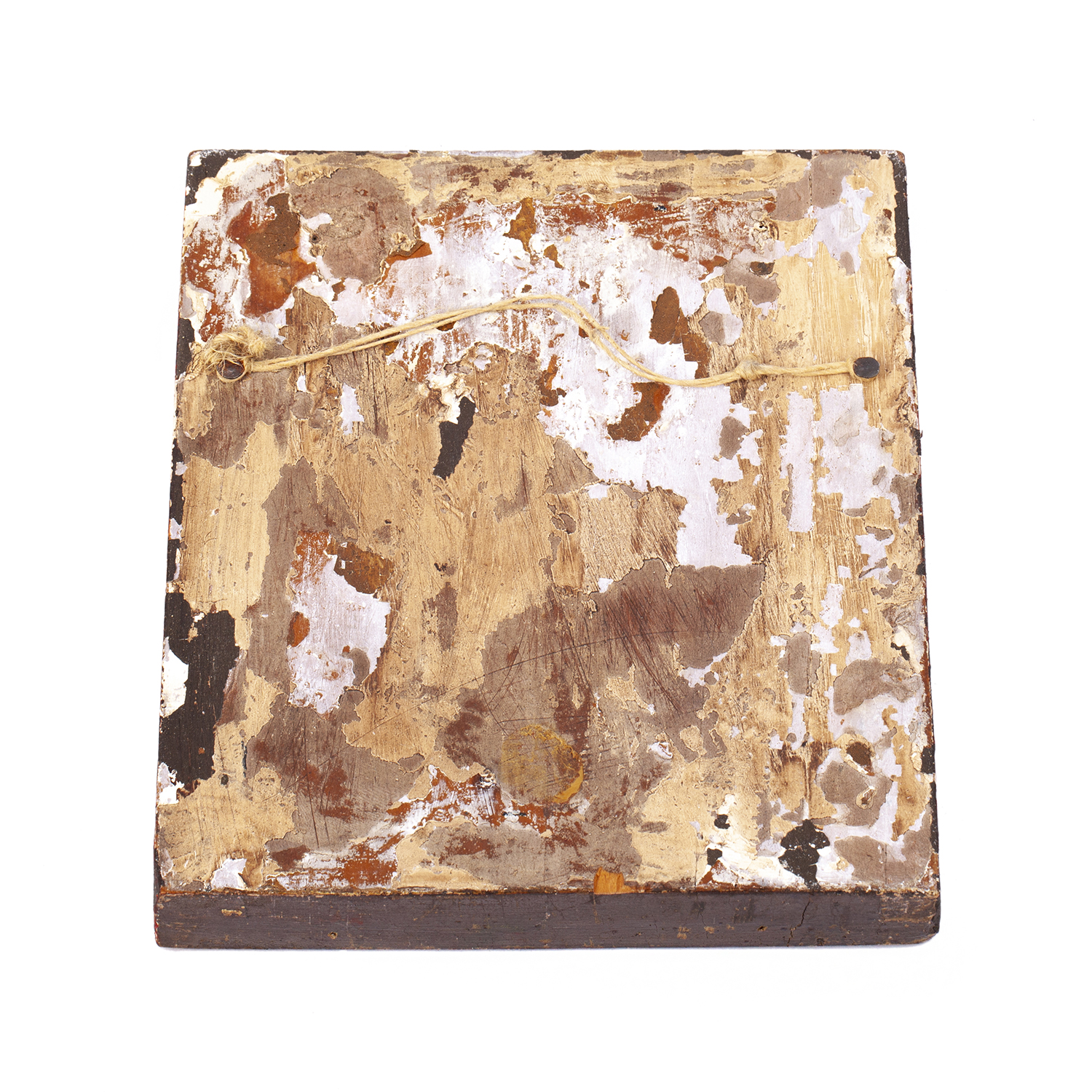
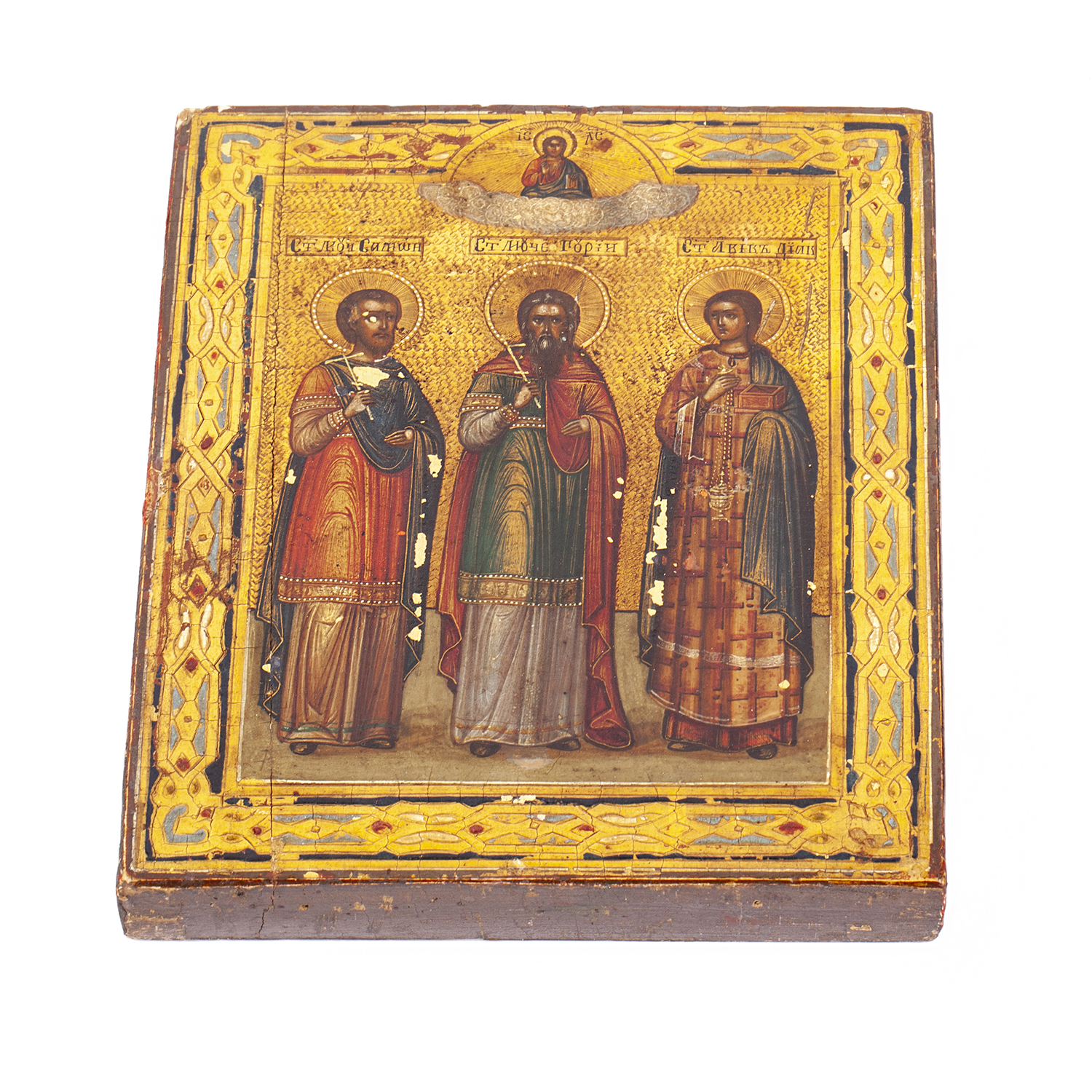
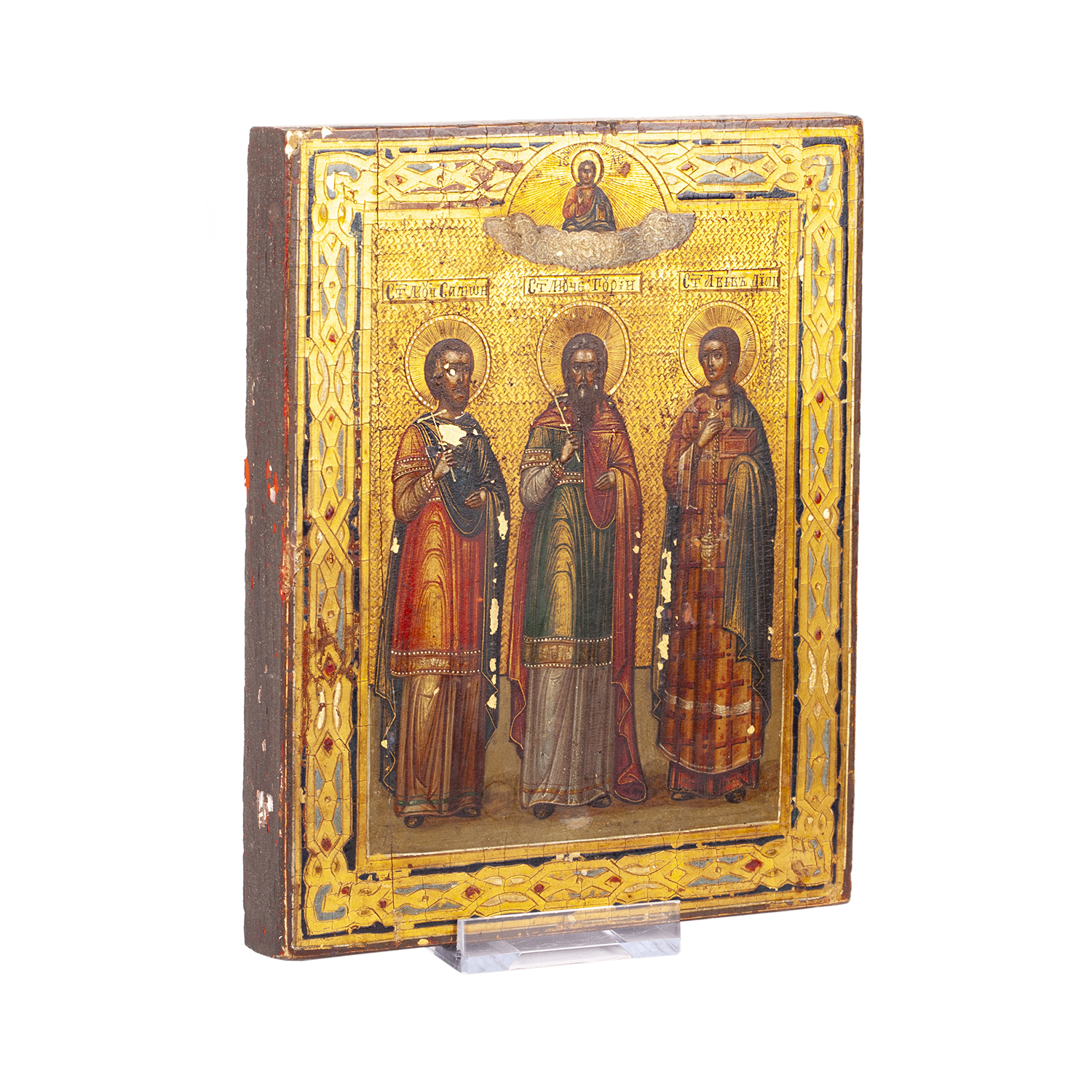
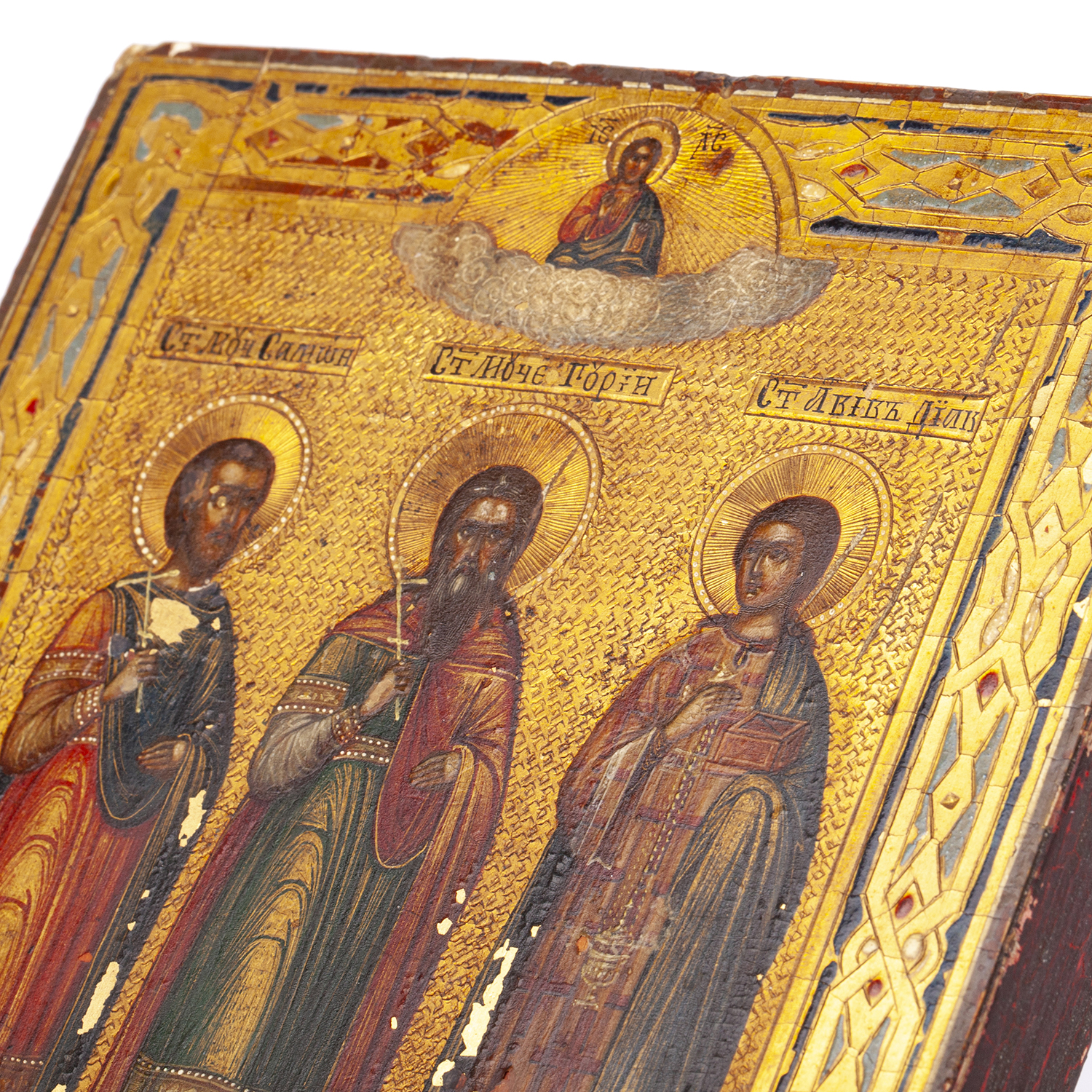
Lot 0272
Russian Icon Depicting the Holy Martyrs Gurias, Samonas, and Aviv, 2nd Half 19th Century
Estimate: 300-400€Icon of the Holy Martyrs Gurias, Samonas, and Aviv
Russia, second half of the 19th century
Tempera on wood
Dimensions: 18 × 14.8 × 2 cm.A finely painted Russian icon depicting the Holy Martyrs Gurias, Samonas, and Aviv, known as early Christian saints and patrons of faithful marriage. At the top, Christ Emmanuel appears in blessing, emphasizing the heavenly approval of the martyrs’ steadfast faith. Executed in the precise and elegant style typical of Russian provincial iconography of the late 19th century.
Starting price: 250€
Estimate: 300-400€
Hammer Price: Not sold -
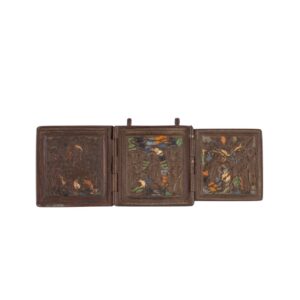
Lot 0273
Russian Enamelled Travel Triptych Icon, Late 19th Century
Estimate: 150-200€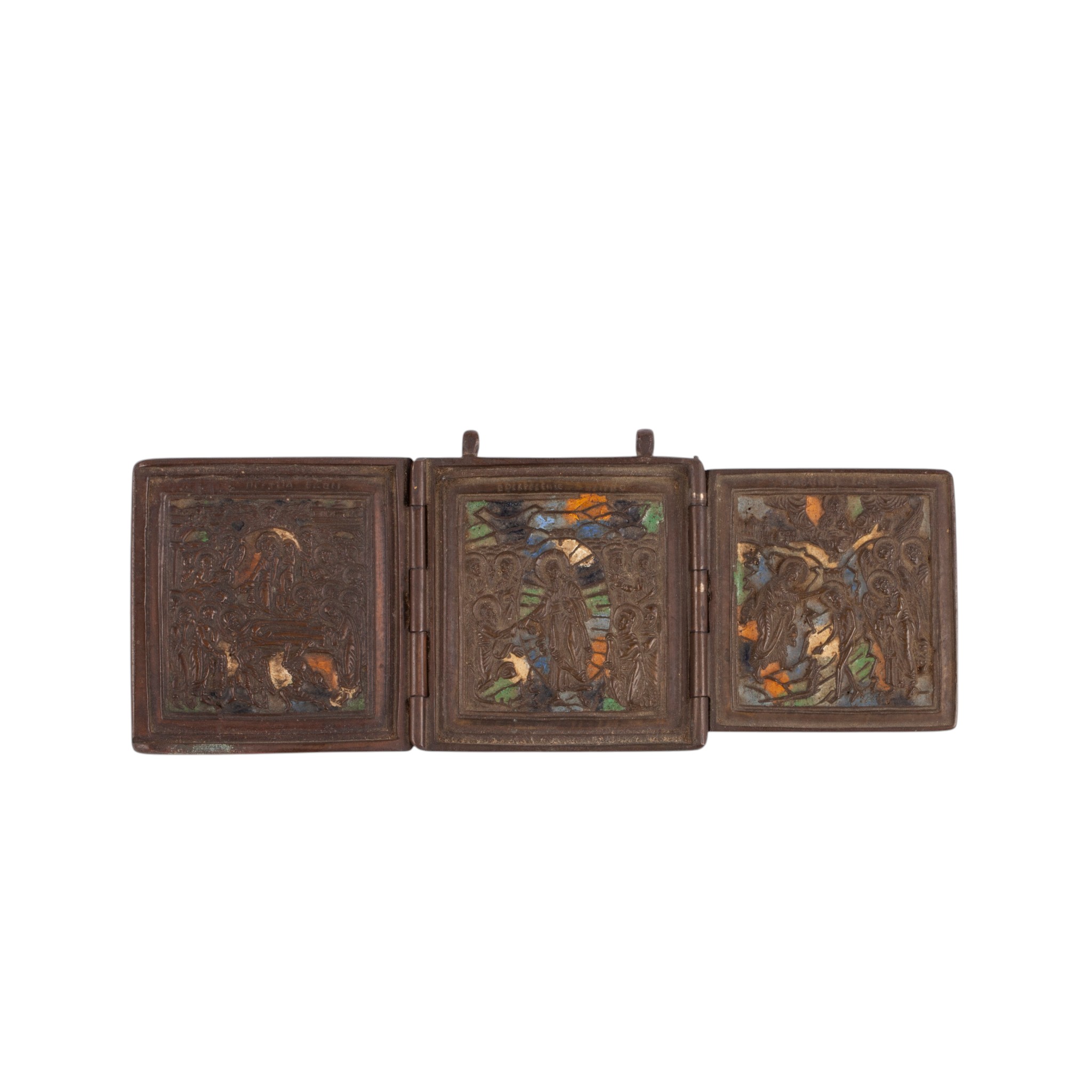
Lot 0273
Russian Enamelled Travel Triptych Icon, Late 19th Century
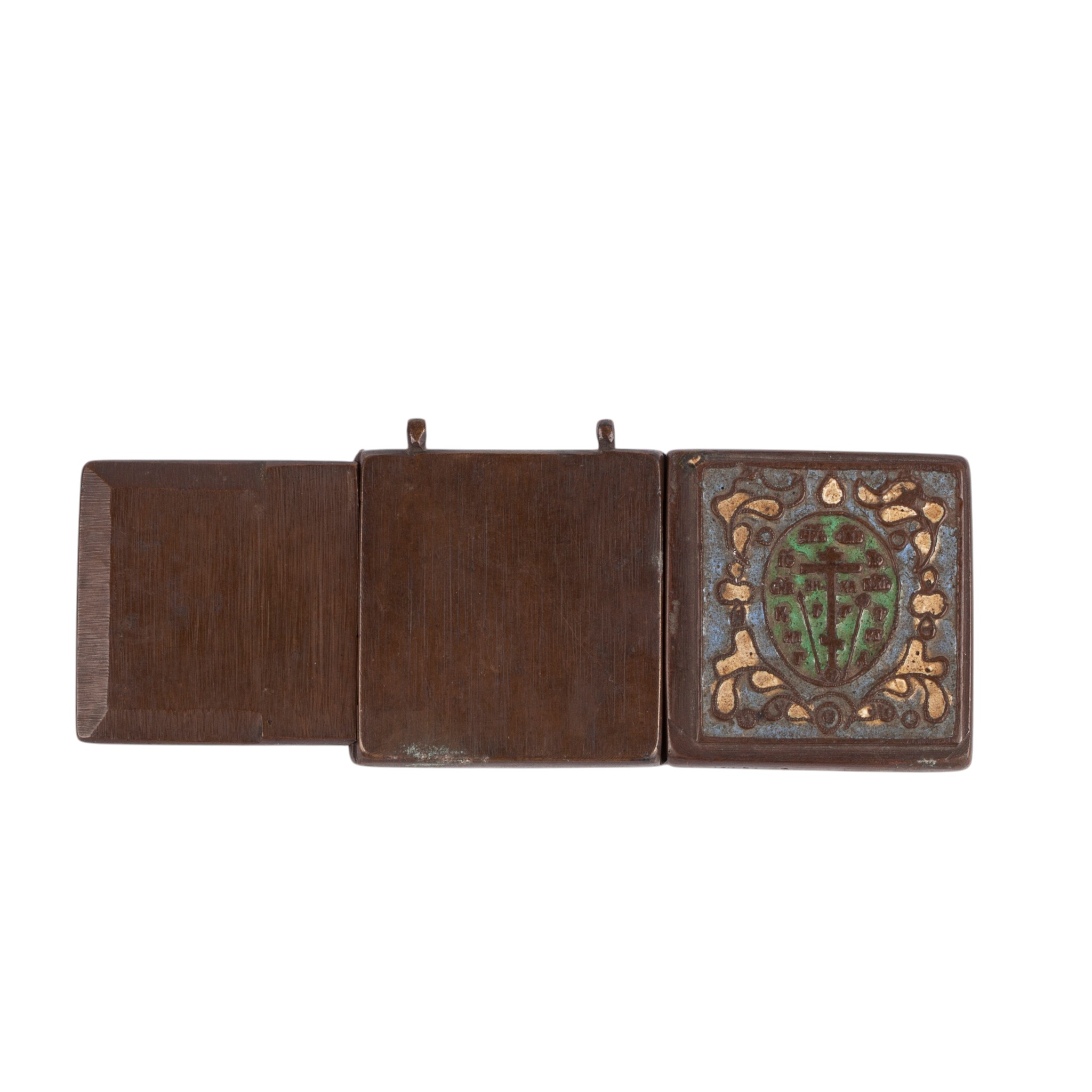
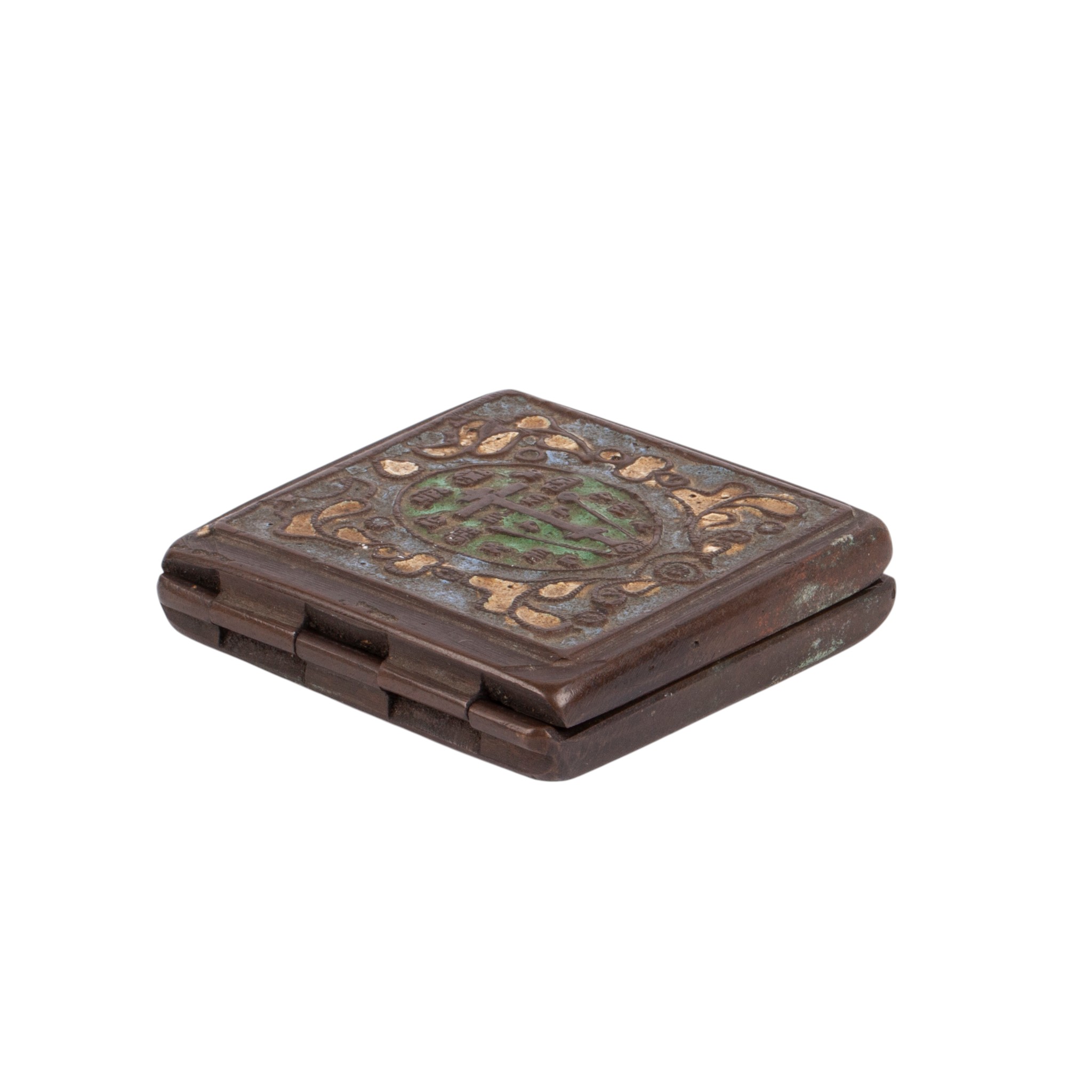
Estimate: 150-200€Russian travelling triptych icon with the Dormition of the Mother of God, the Resurrection of Christ and the Baptism of Christ.
Russian Empire, late 19th century.
Copper alloy, three-colour enamel; casting, chasing, enamelling.
Dimensions closed: 6.5 x 6 x 1.5 cm.
Dimensions opened: 6.5 x 16.4 x 0.7 cm.
A small folding travelling icon, or skladen, composed of three hinged panels. The central panel depicts the Resurrection of Christ, with the figure of the Saviour shown frontally in a mandorla-like radiance, surrounded by attendant figures. The left wing represents the Dormition of the Most Holy Mother of God, with the Virgin laid upon her bier and Christ appearing above to receive her soul. The right wing shows the Baptism of Christ, or Theophany, with Christ standing in the waters of the Jordan and flanked by sacred figures.
The cast relief is enriched with remains of silvering and translucent three-colour enamel, in blue, green and amber-orange tones.Starting price: 100€
Estimate: 150-200€
Hammer Price: 160 € -
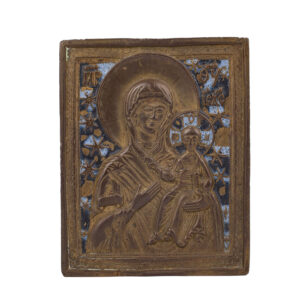
Lot 0274
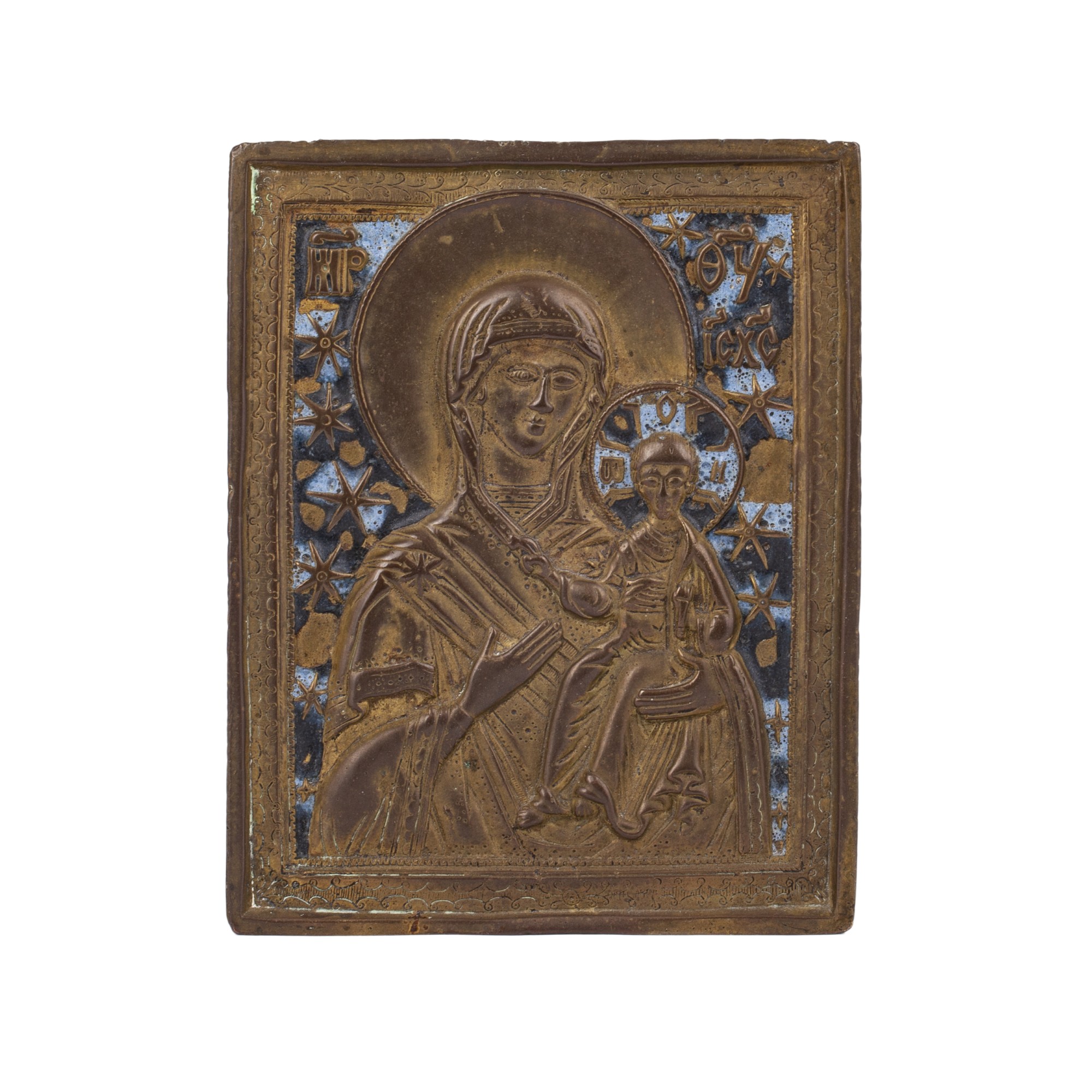
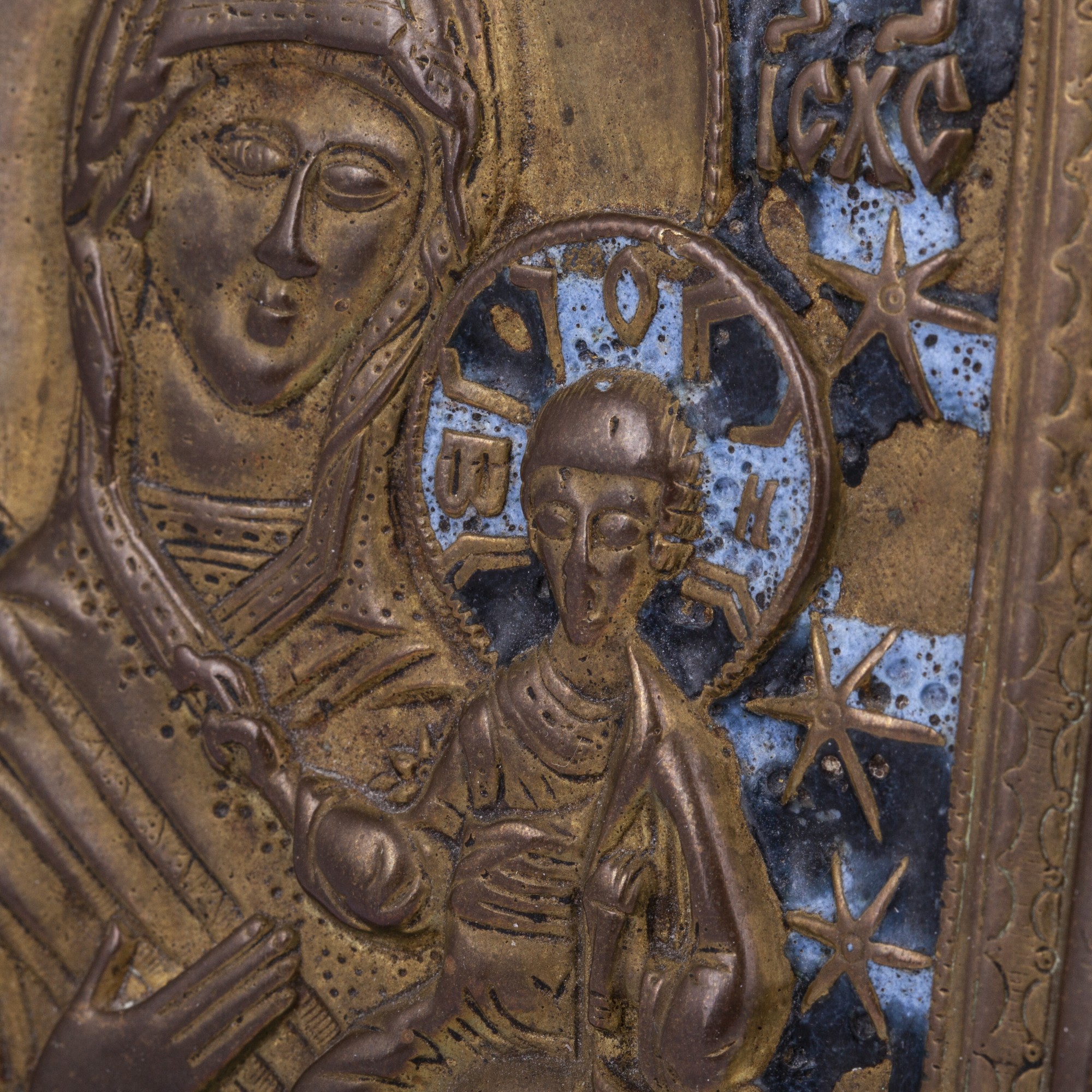
A Russian brass and enamel icon of “Mother of God of Smolensk”
Estimate: 200-250€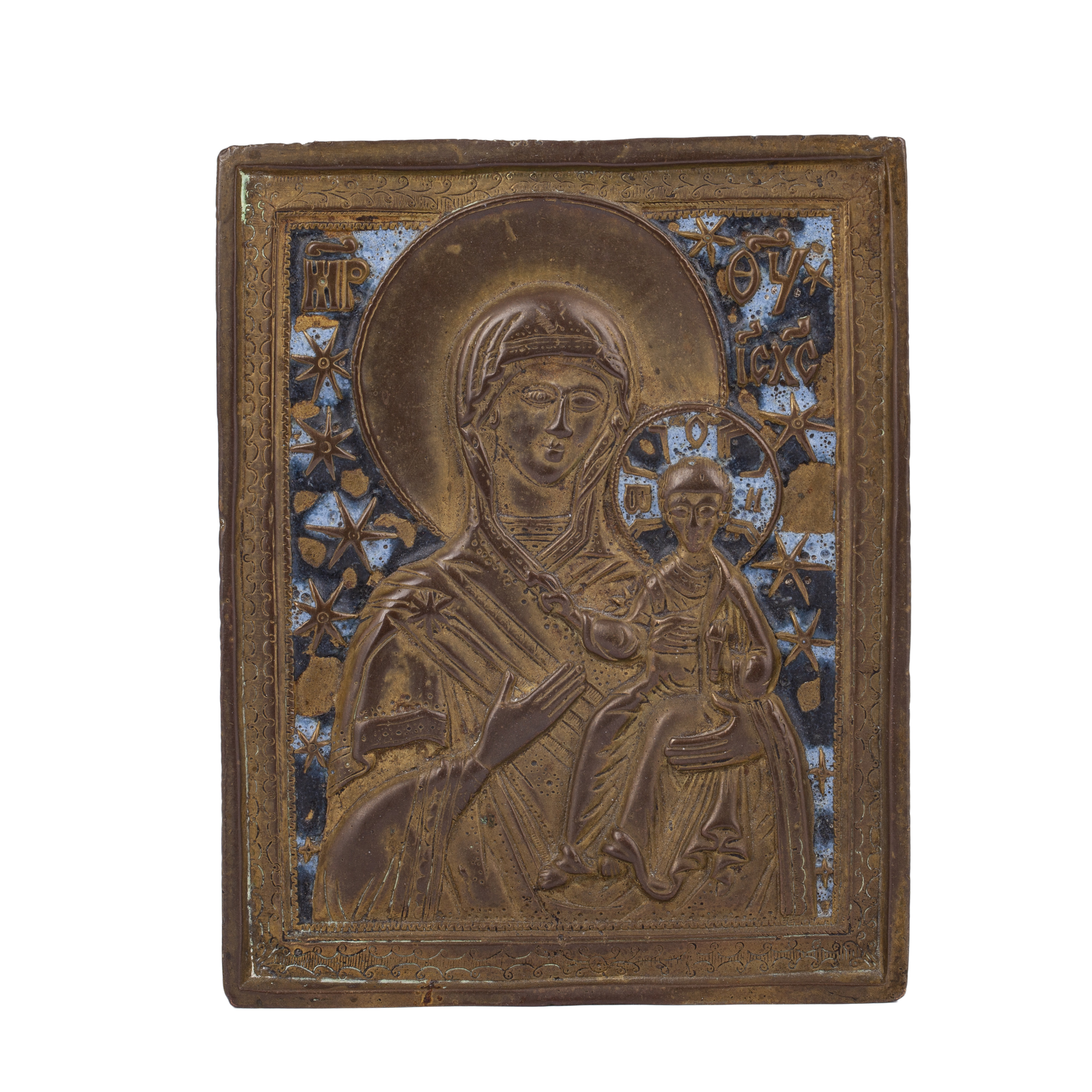
Lot 0274
A Russian brass and enamel icon of “Mother of God of Smolensk”
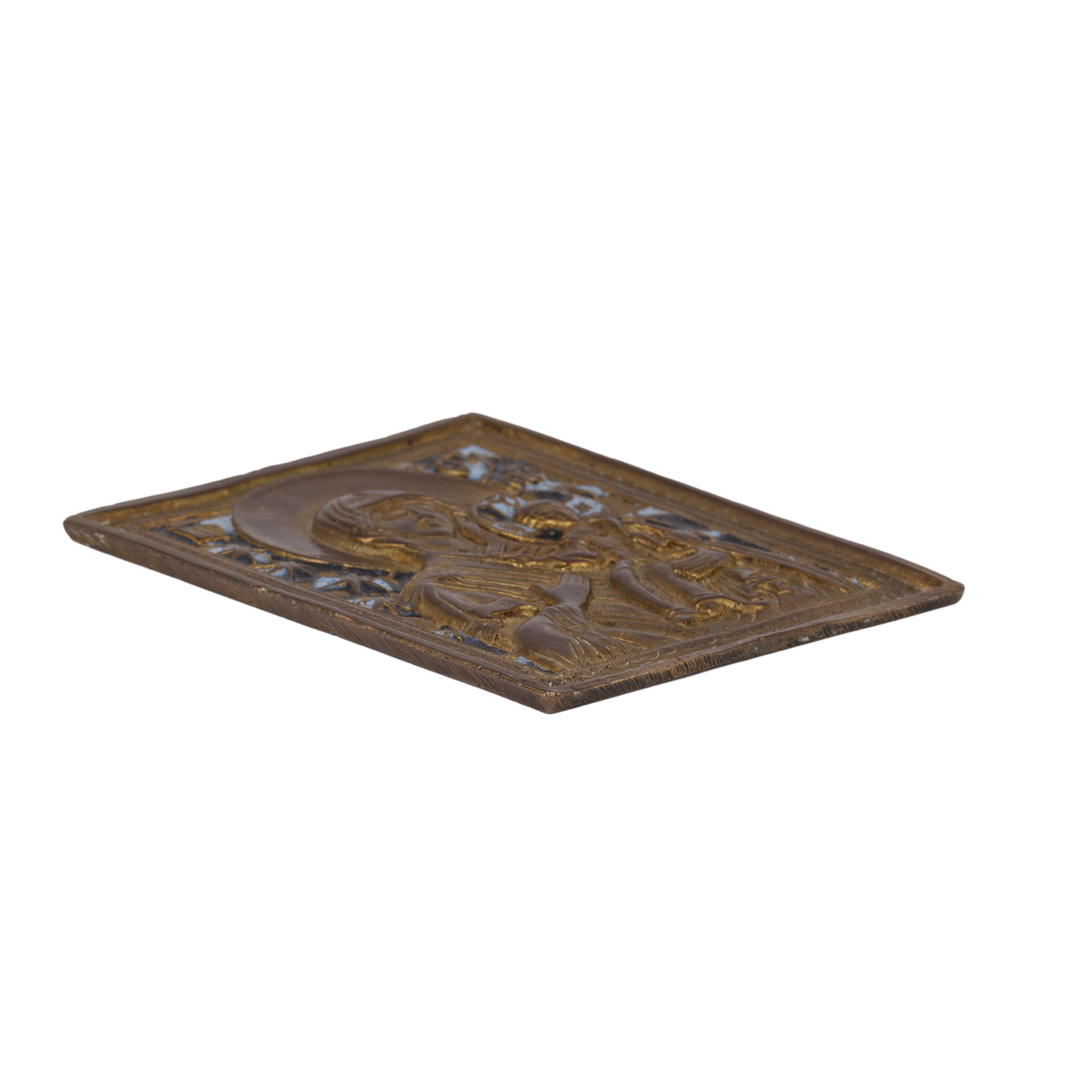
Estimate: 200-250€A Russian brass and enamel icon of “Mother of God of Smolensk”. The mid of the 19th century.
Dimensions: 12.5 x 10 cm.Starting price: 150€
Estimate: 200-250€
Hammer Price: Not sold -
Lot 0275
Ovchinnikov. Exceptopnal Icon of Saint Martyr Panteleimon
Estimate: 10000-15000€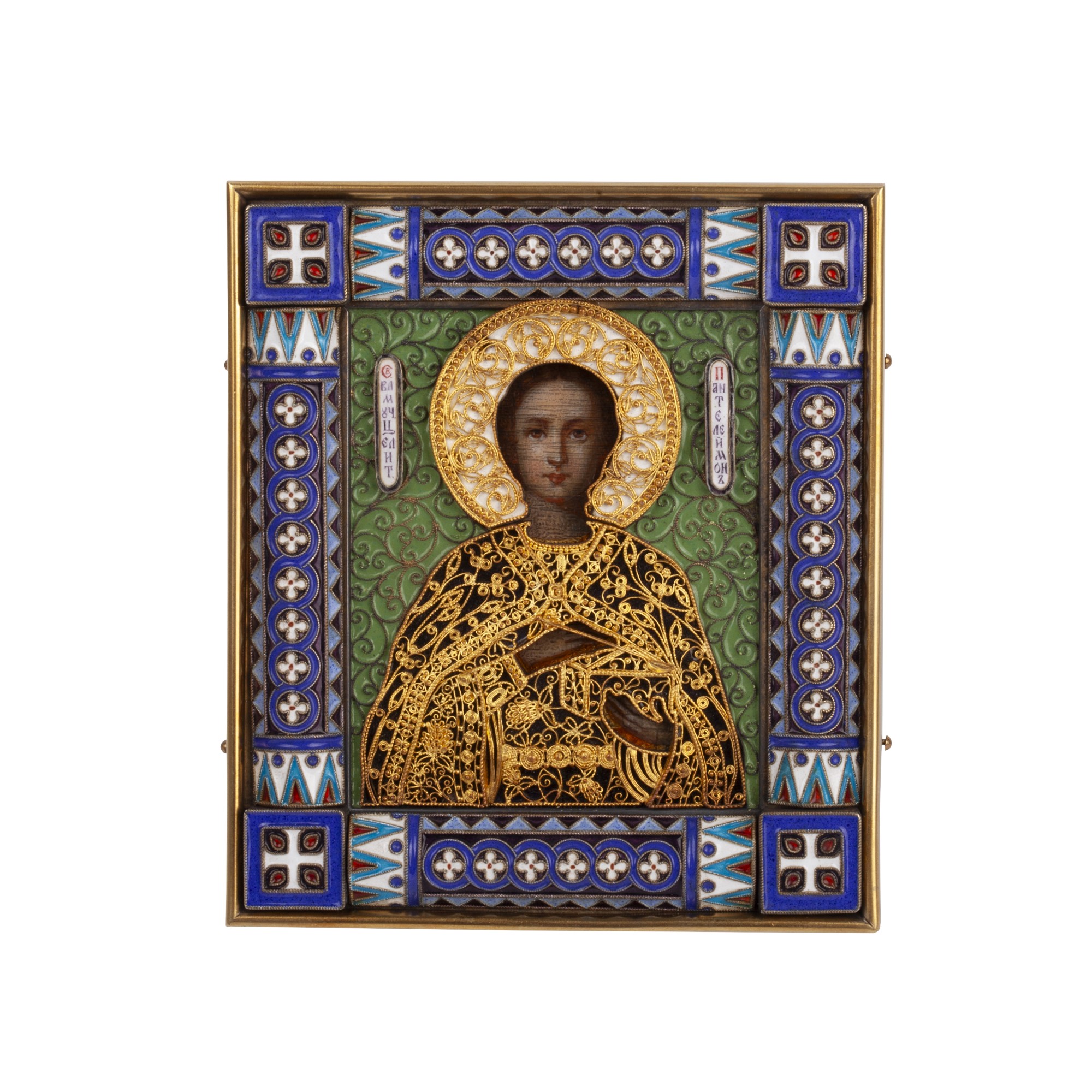
Lot 0275
Ovchinnikov. Exceptopnal Icon of Saint Martyr Panteleimon
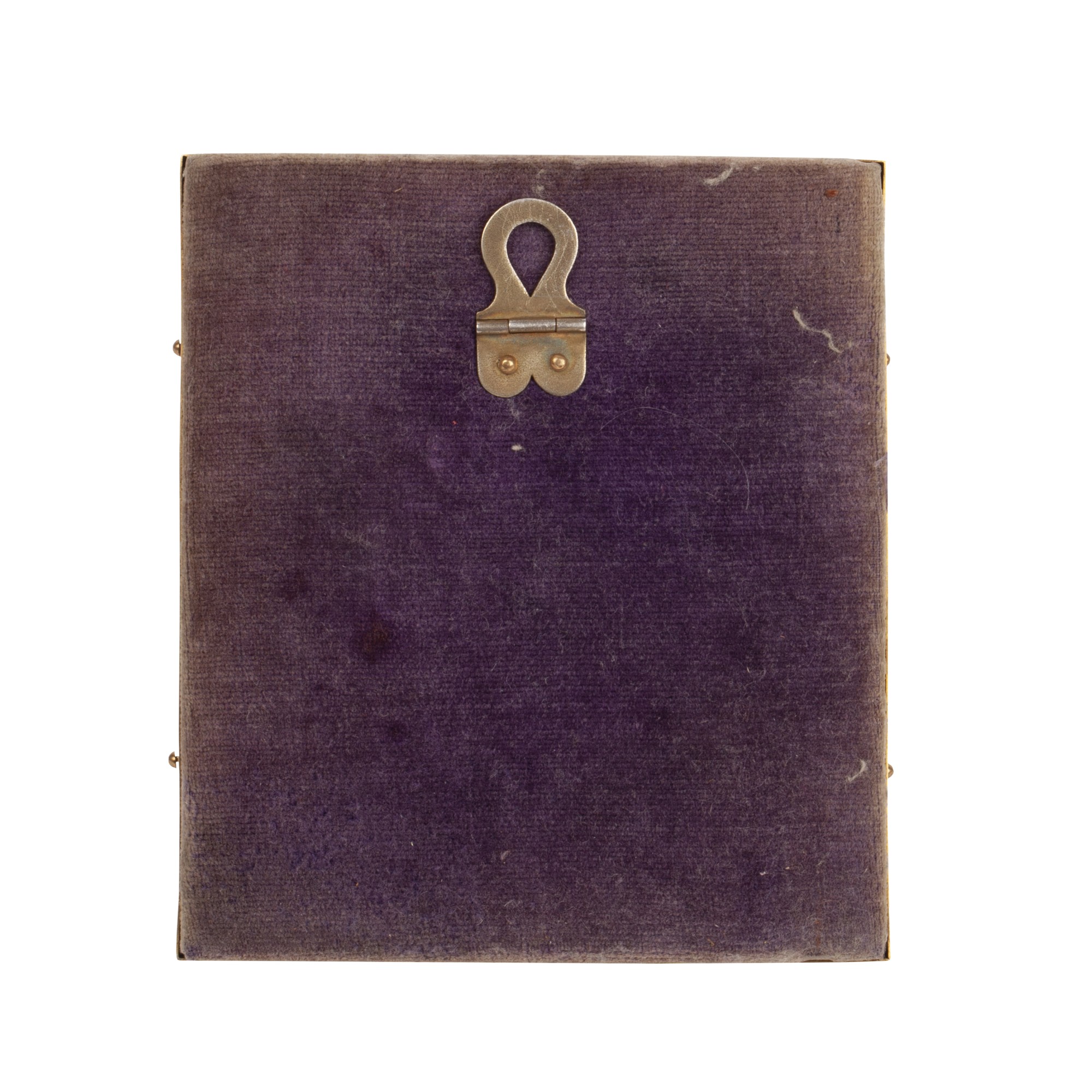
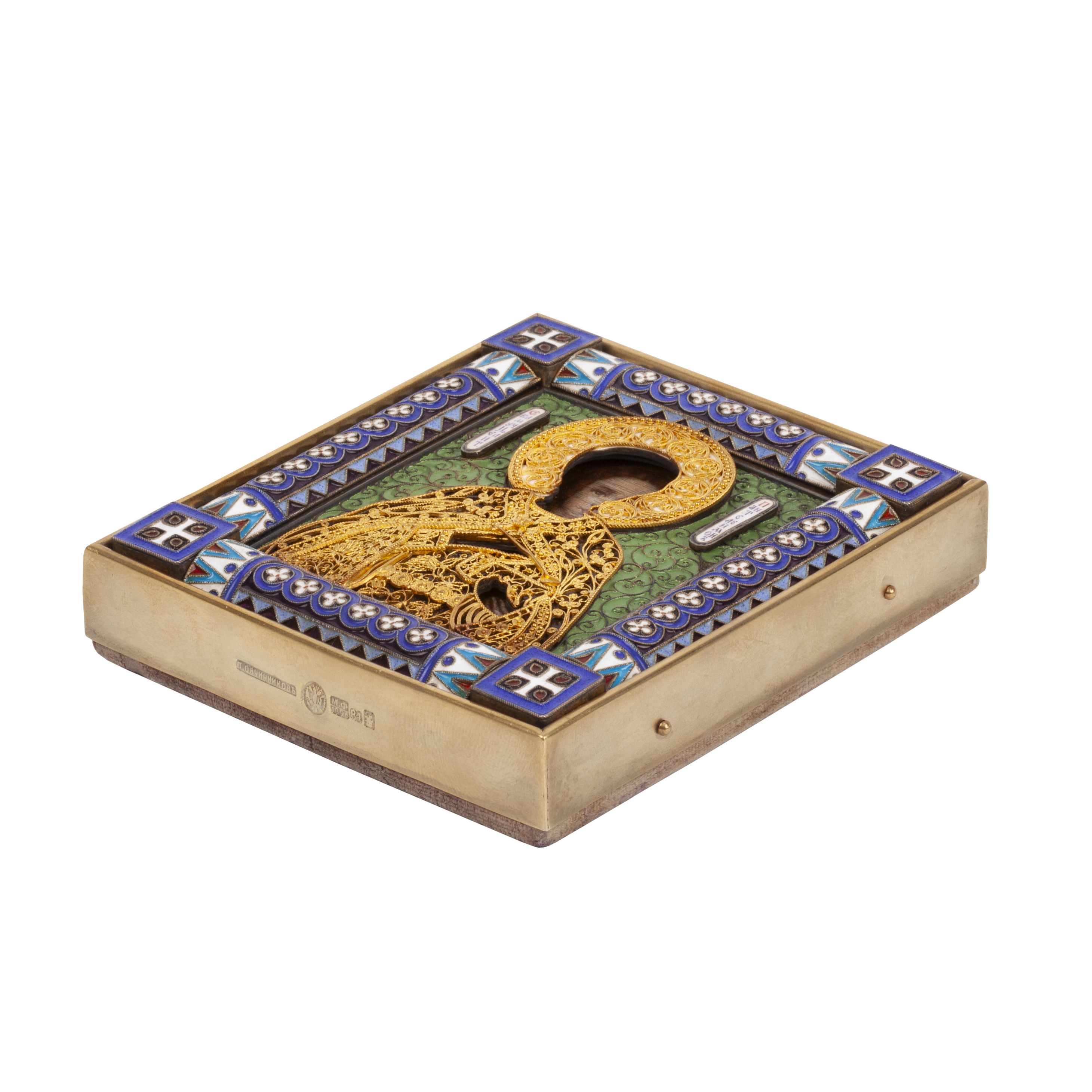
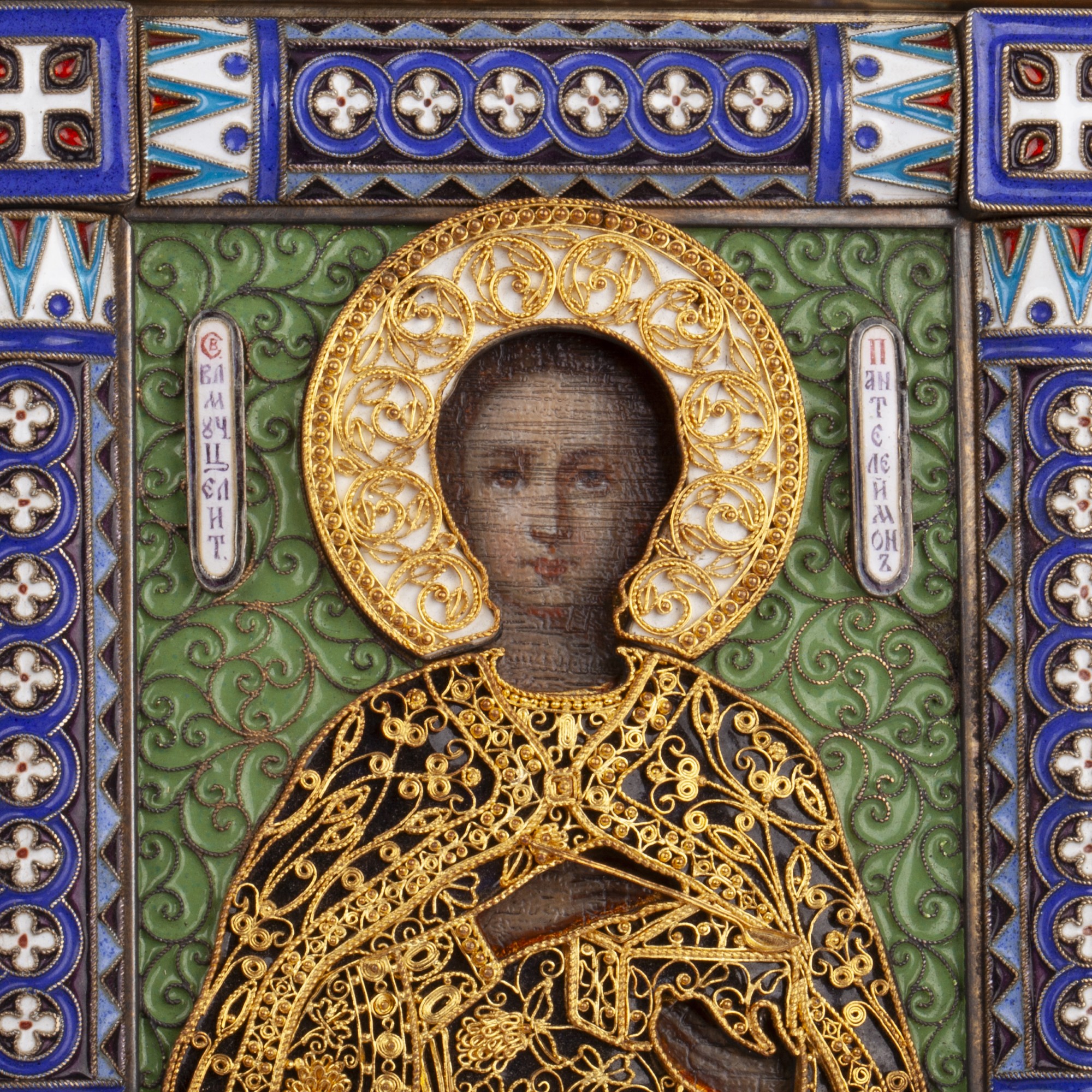
Estimate: 10000-15000€Ovchinnikov. Icon of Saint Martyr Panteleimon.
Silver, gold, filigree, gliding, cloisonné enamel, oil painting on wood.
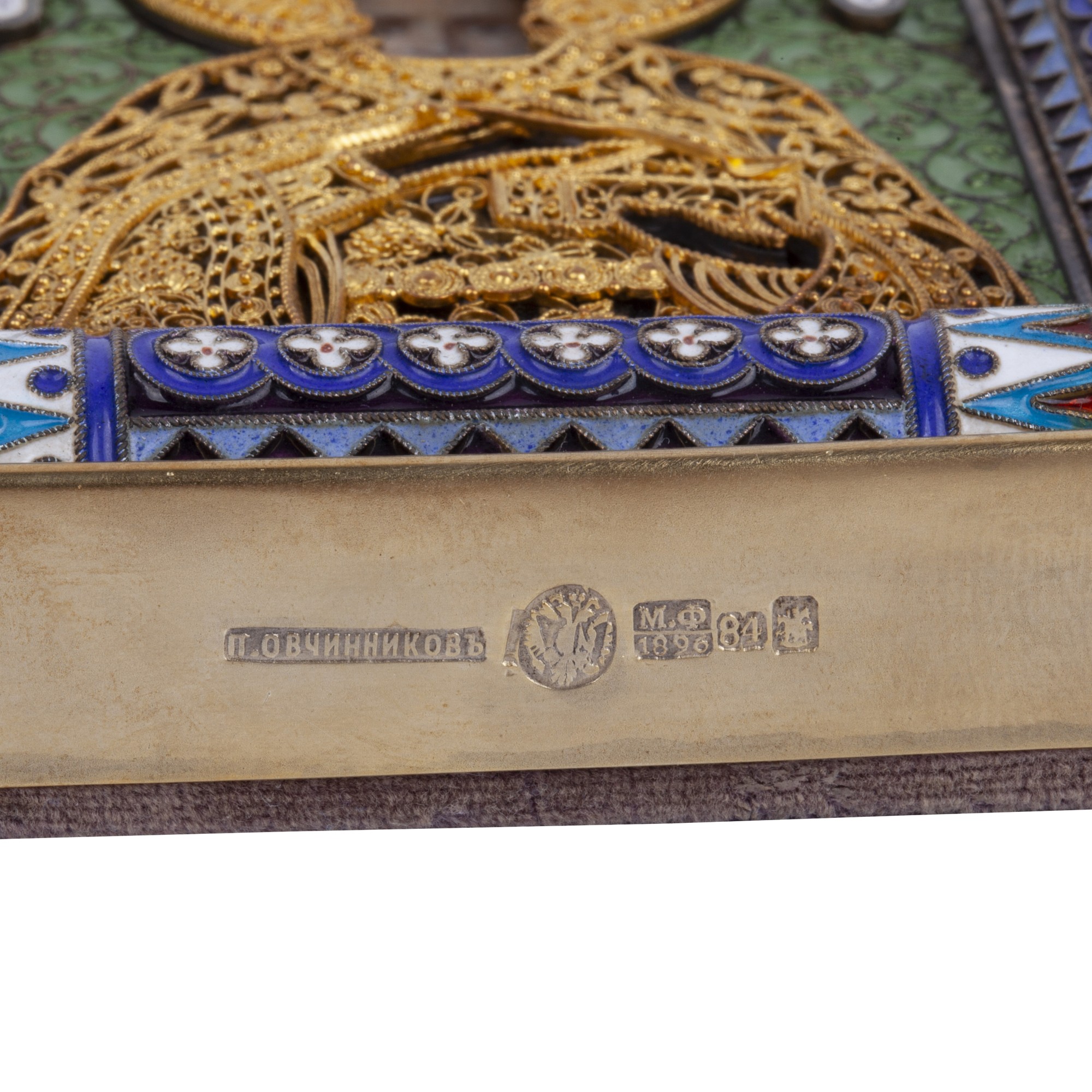
Makers mark of «P. Ovchinnikov» with Imperial warrant. Moscow, 1896.Dimensions: 10.3 x 9 x 2.2 cm.
Total weight: 290.2 g
Icon of Saint Panteleimon in a silver-gilt oklad by the Ovchinnikov firm. The central is painted in oil on wood; the saint’s nimbus and garments are overlaid and made with 24k gold. The cover is decorated with cloisonné enamel in blue, white, and red, arranged in geometric and floral patterns referring to traditional Russian wooden architecture.
Saint Panteleimon, patron of physicians, was a popular subject in 19th-century Russia. The Ovchinnikov workshop, Imperial Court supplier, was renowned for enamel and silverwork of the highest quality, celebrated at international exhibitions.
See similar:
https://www.sothebys.com/en/auctions/ecatalogue/2011/russian-works-of-art-faberg-and-icons-l11113/lot.634.html
https://www.christies.com/en/lot/lot-5091302Starting price: 8000€
Estimate: 10000-15000€
Hammer Price: Not sold -
Lot 0276
Icon “Mother of God of Kazan” Solvychegodsk (Usolye)
Estimate: 2500-3500€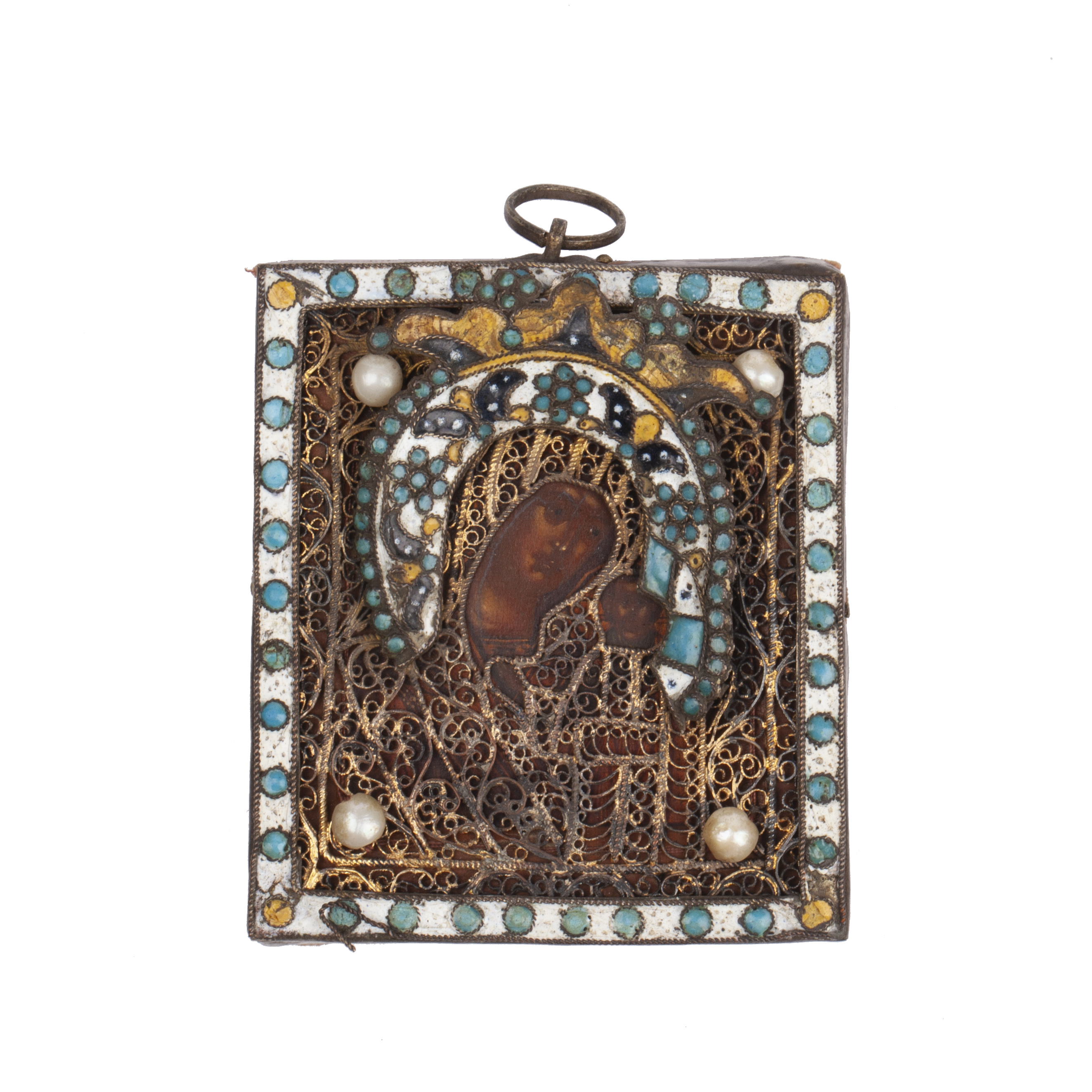
Lot 0276
Icon “Mother of God of Kazan” Solvychegodsk (Usolye)
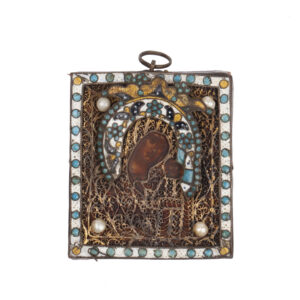
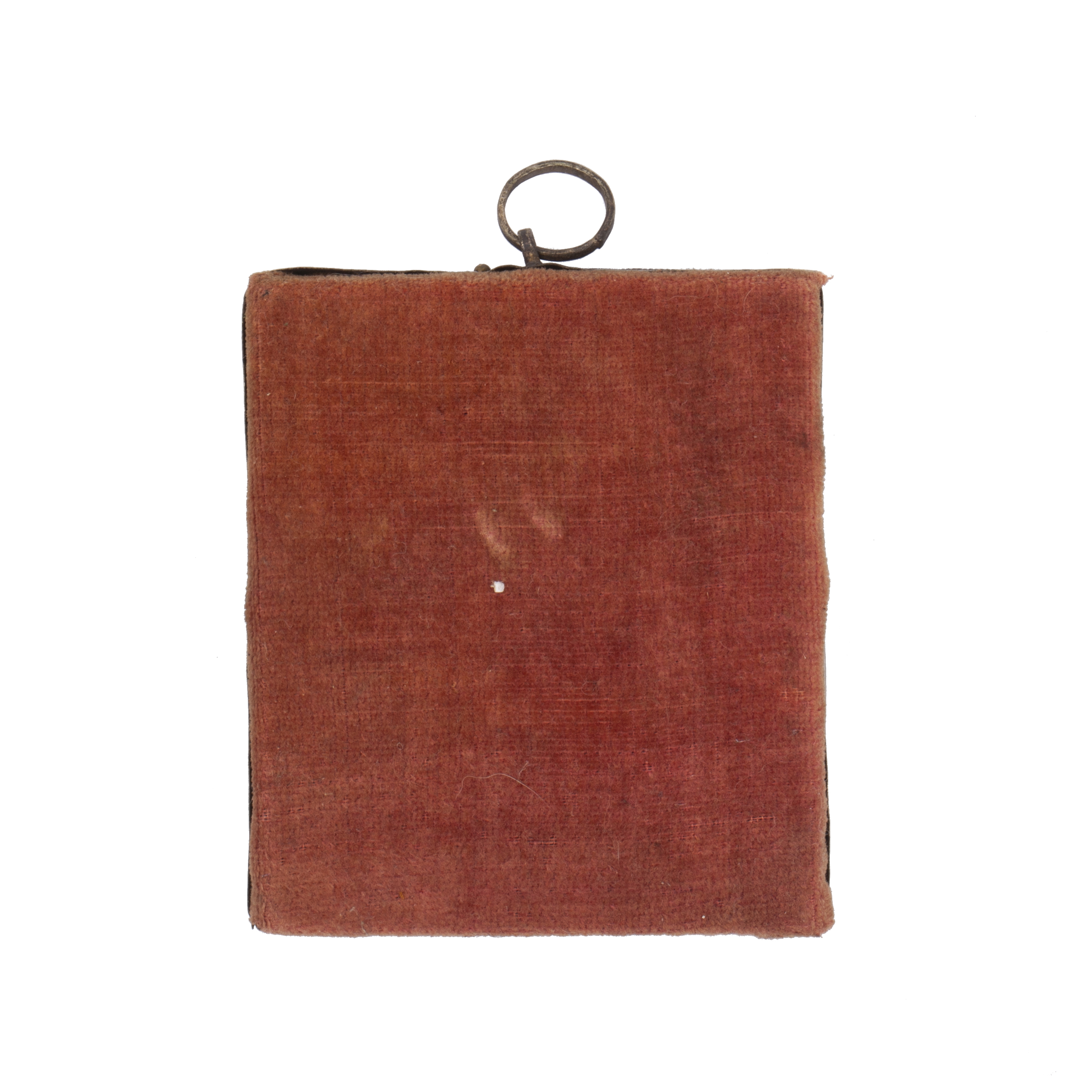
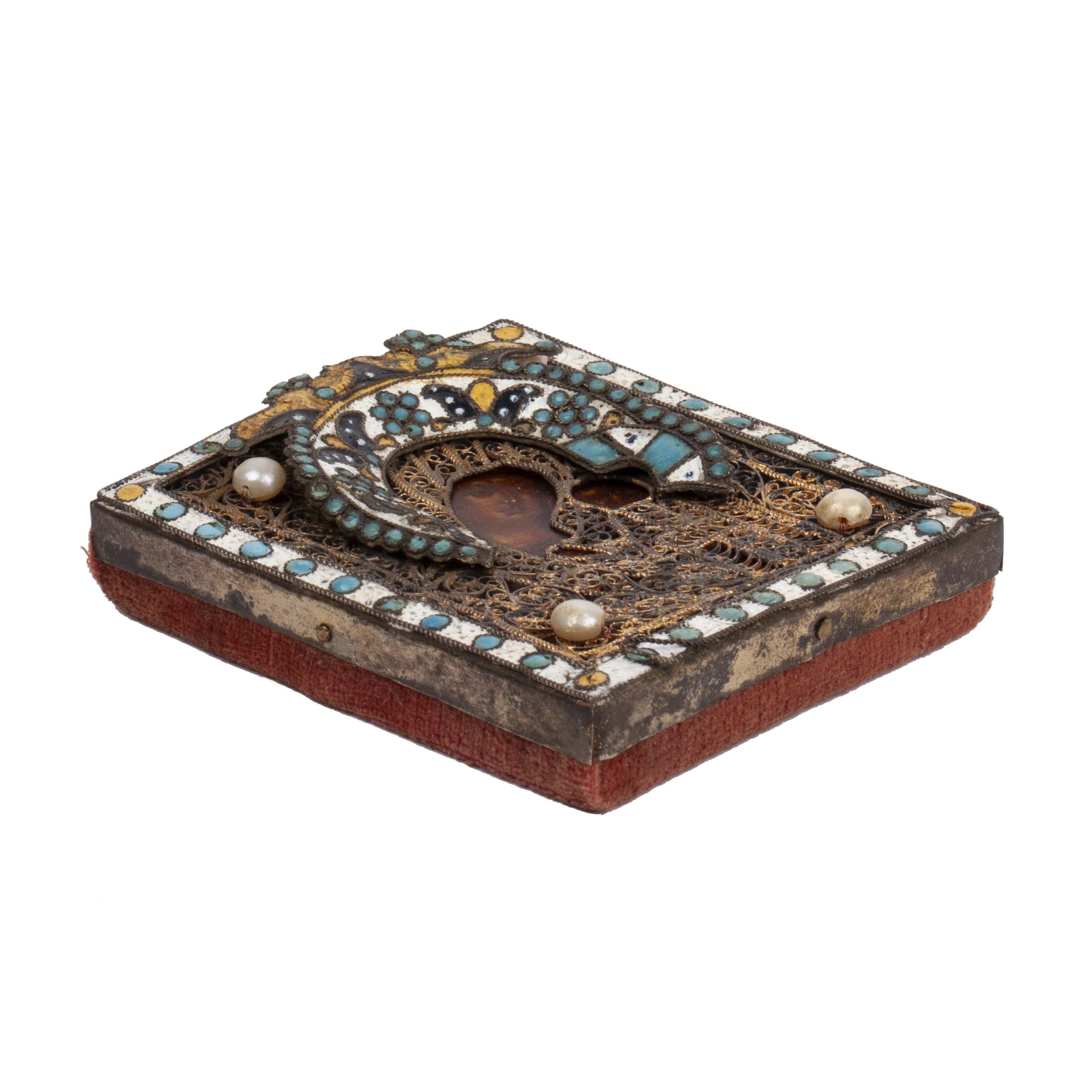
Estimate: 2500-3500€Icon “Mother of God of Kazan”
Solvychegodsk (Usolye), Northern Russia, 18th century (?).
Wood, tempera, enamel, silver filigree, pearls.
Dimensions: 8 × 7 cmThis small icon of the Mother of God of Kazan reflects the rich enamel and filigree tradition of Solvychegodsk (Usolye), a renowned center of northern Russian craftsmanship. The image of the Virgin and Child is framed by delicate silver filigree ornamentation, accented with turquoise and white enamel and pearls at the corners.
The Usolye enameling school, which flourished from the sixteenth through the eighteenth centuries, was founded by Novgorod craftsmen under the patronage of the powerful Stroganov family. Its masters perfected the art of painted enamel on copper, applying vibrant colors and intricate floral or geometric patterns that merged folk motifs with Western Baroque influences. Comaprable icon of Mother of god of Kazan (XVII century) in State Hermitage collection (Russian Enamel from the 12th to the Early 20th Century from the Collection of the State Hermitage Museum. Leningrad, 1987. P.47)
Starting price: 2000€
Estimate: 2500-3500€
Hammer Price: Not sold -
Lot 0277
Russian Icon of Christ Pantokrator
Estimate: 6000-8000€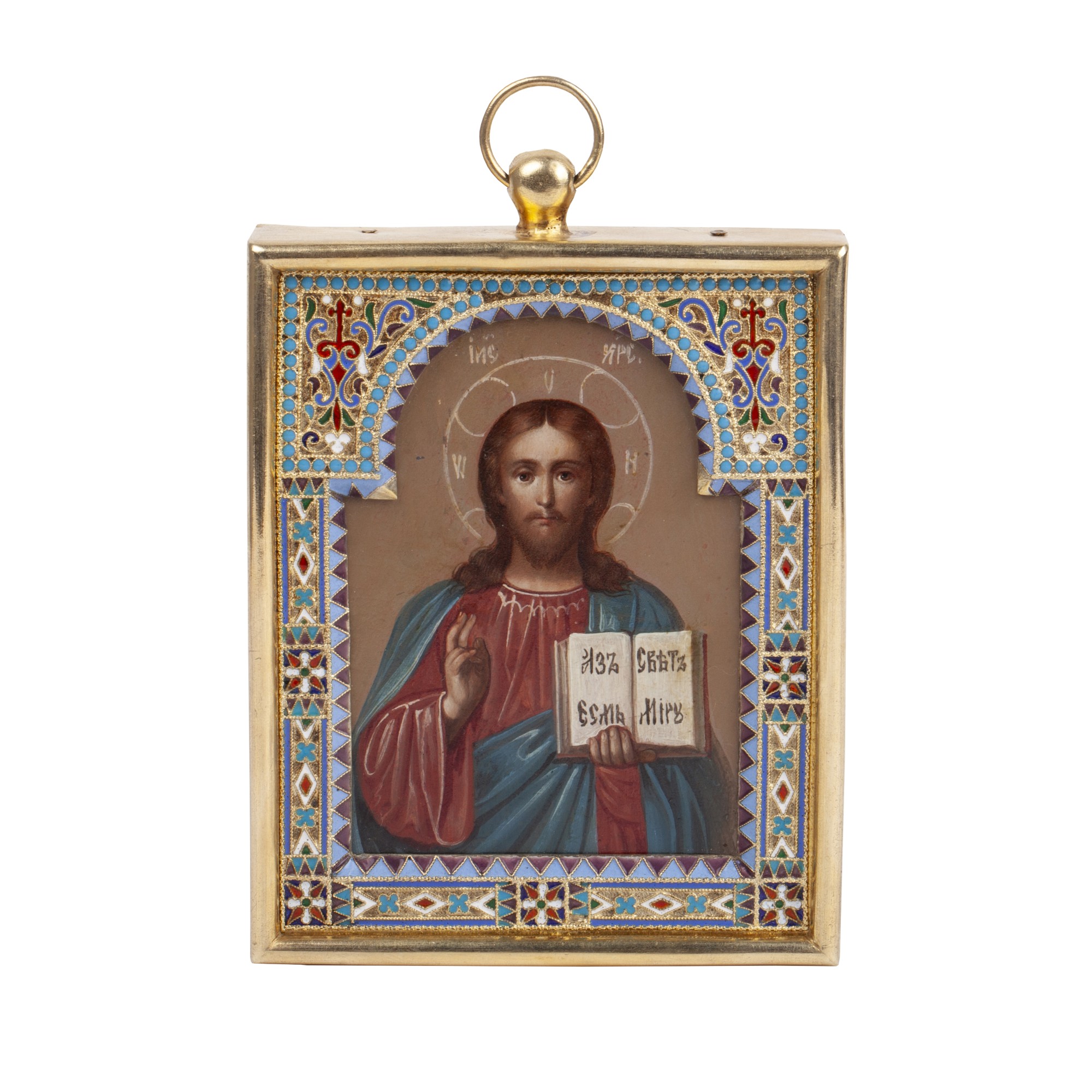
Lot 0277
Russian Icon of Christ Pantokrator
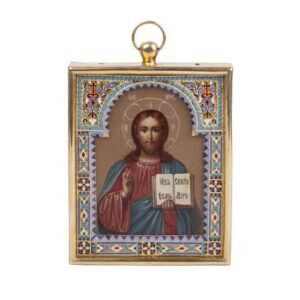
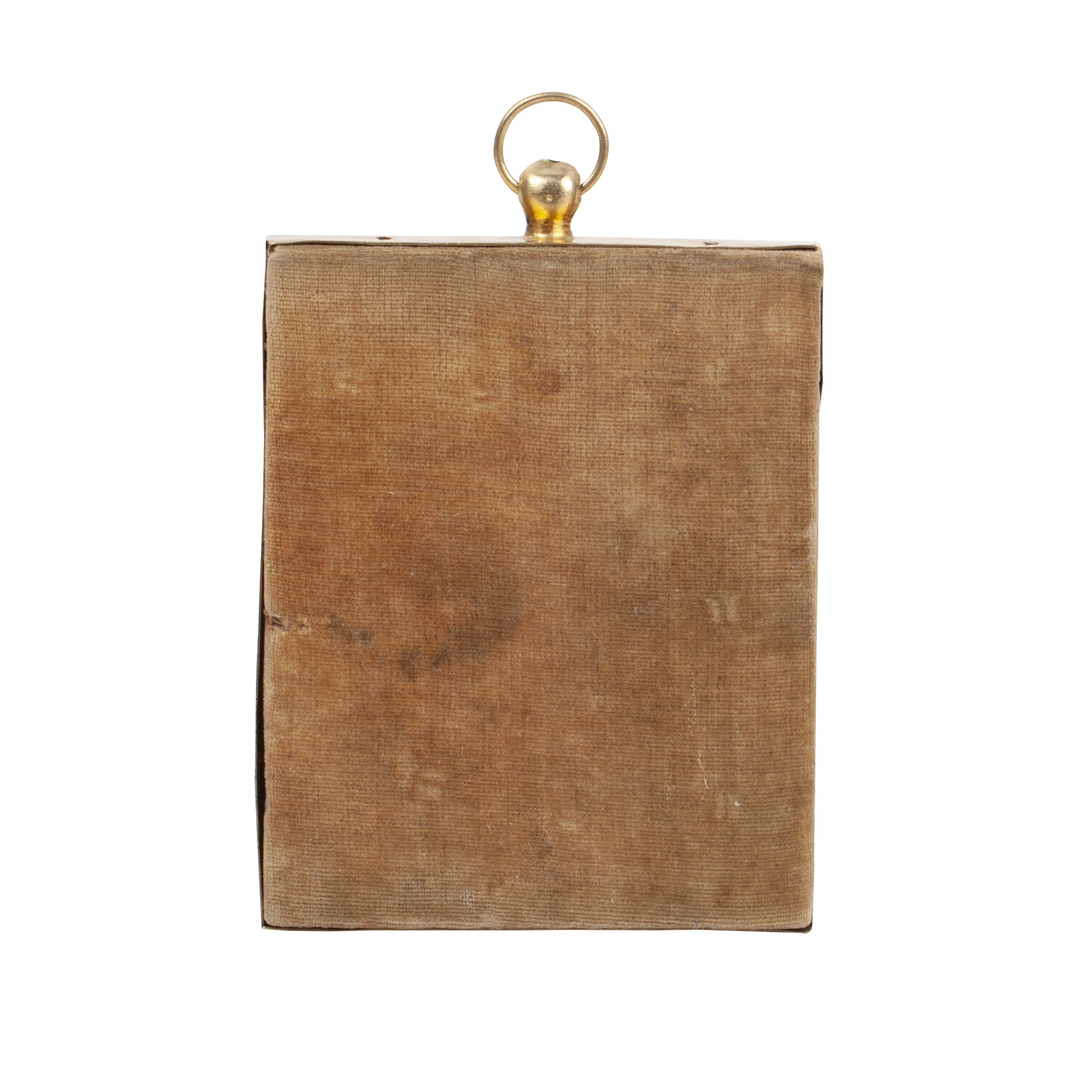
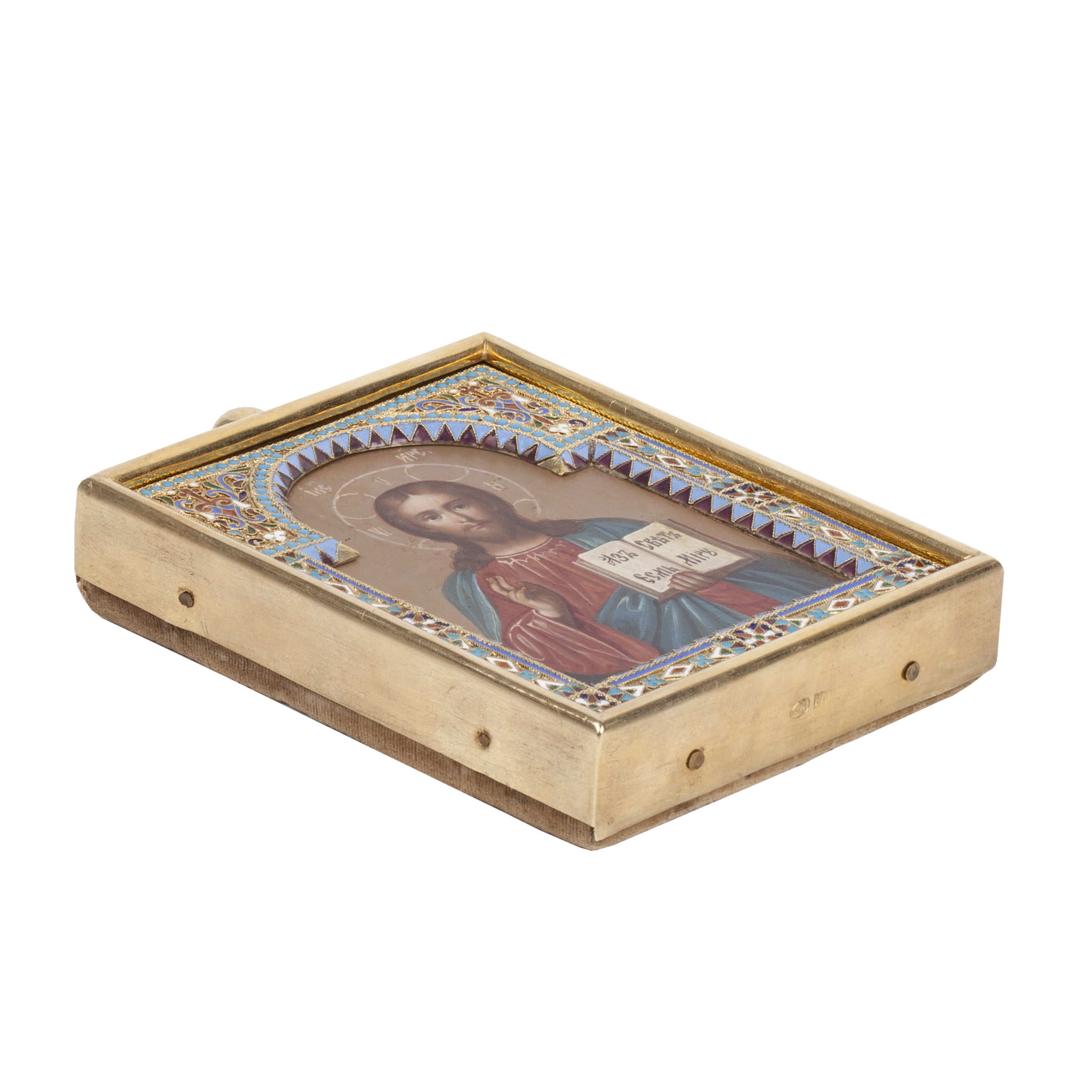
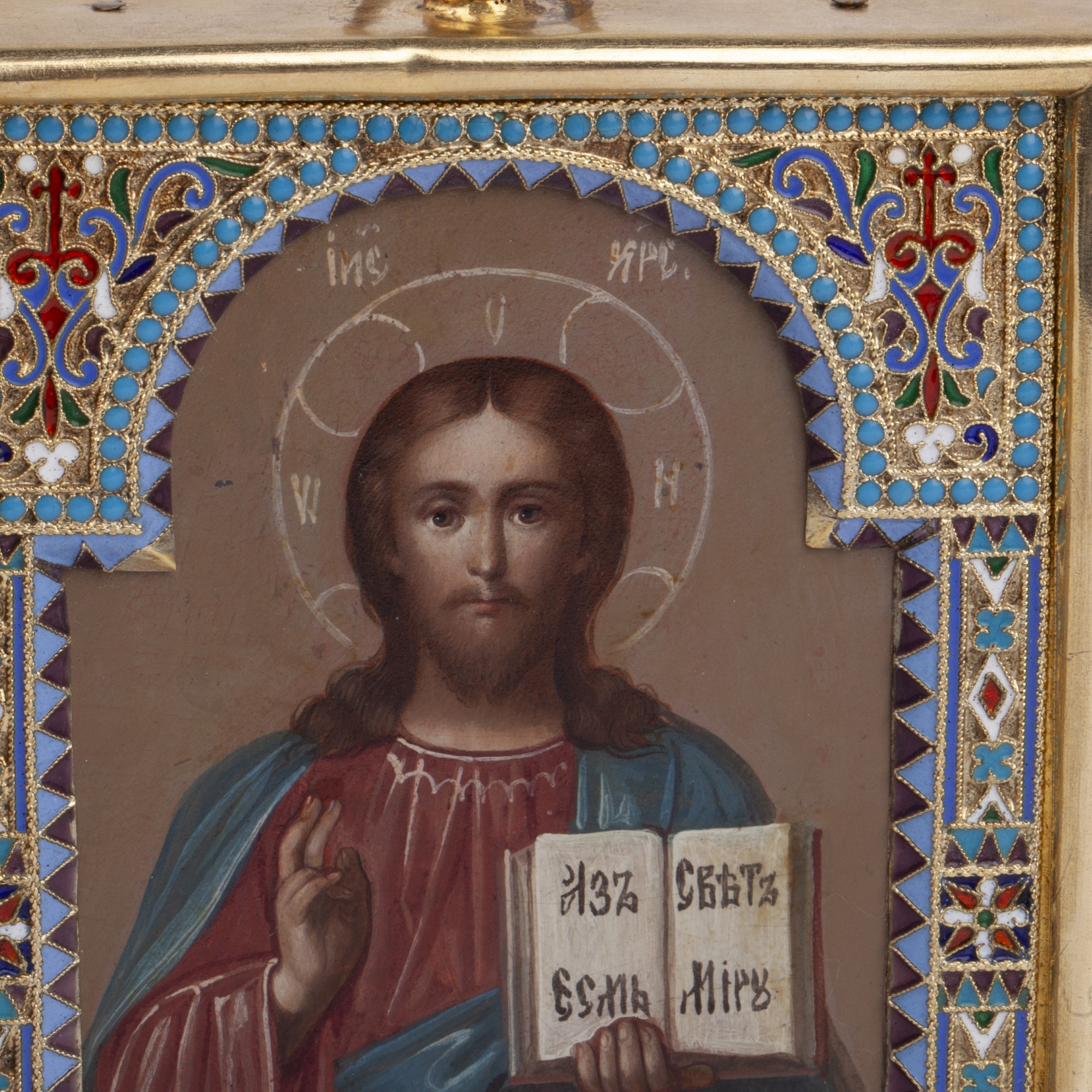
Estimate: 6000-8000€Icon of Christ Pantokrator. Silver, gilding, cloisonné enamel, oil painting on wood.
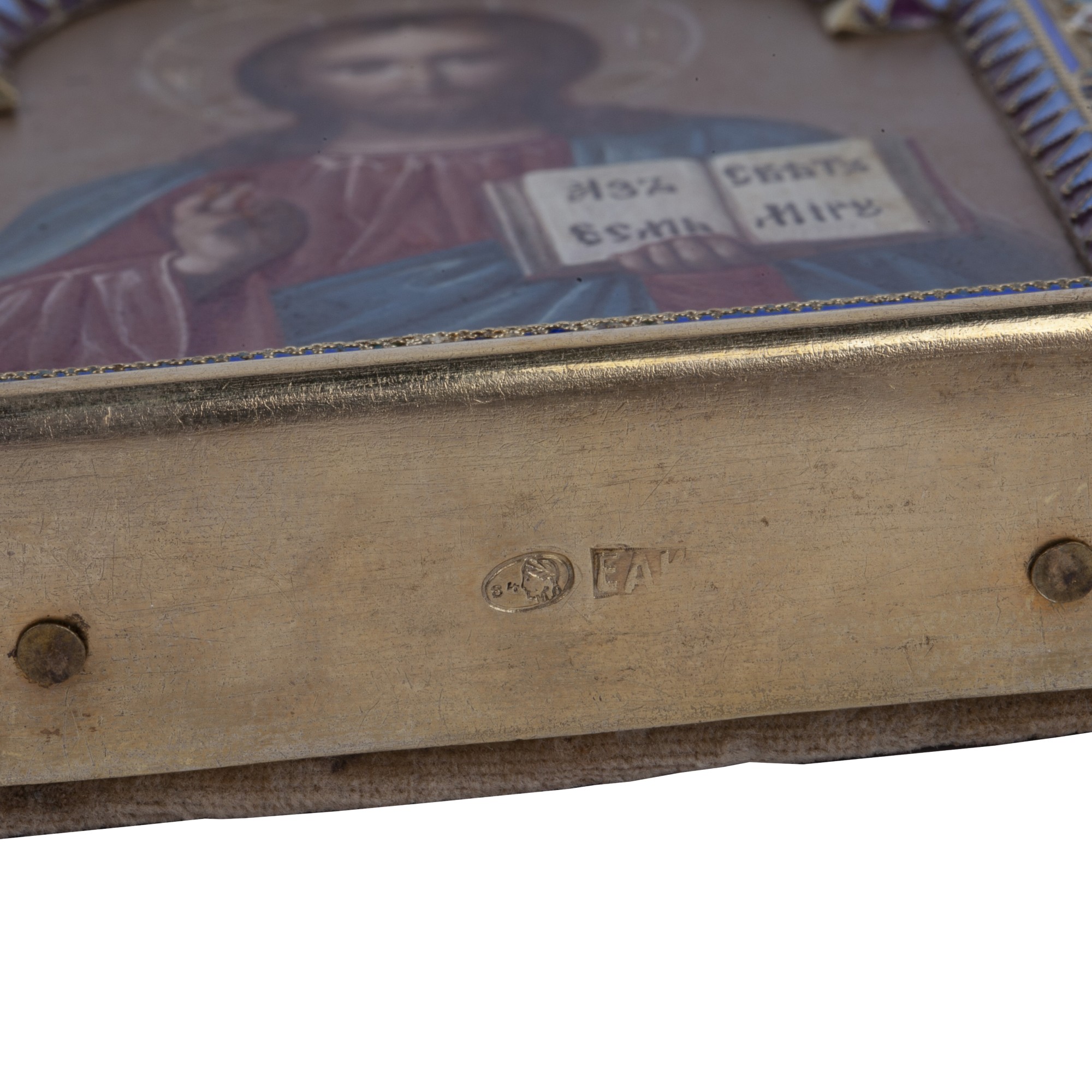
Maker mark of «EAK». Moscow, 1898-1908.
Dimensions: 13.5 x 9 x 2.3 cm.
Total weight: 222.2 gIcon of Christ Pantokrator in a silver-gilt oklad decorated with cloisonné enamel. The central panel depicts Christ painted in oil on wood: His right hand raised in blessing, His left holding an open Gospel with the inscription “I am the Light of the World.” The enamel cover is richly ornamented with an arch of floral motifs and a border of geometric patterns in red and blue, enhancing the solemnity of the image.
The hallmark [EAK] refers to Emelyan Alekseevich Kuznetsov, owner of a silver workshop founded in 1886. According to records from 1897, the workshop produced silver icon covers valued at 5,000 rubles. At that time, it employed 13 men, 6 adolescents, and 6 boys (silver, chased icon oklad, State Historical Museum). In 1898, the workshop is listed at Pereyaslavskaya Street, in Kuznetsov’s own house, Moscow.Starting price: 5000€
Estimate: 6000-8000€
Hammer Price: Not sold -
Lot 0278
Ovchinnikov. Fine Russian Silver-Gilt and Cloissone Enamel Travel Icon of St. Vladimir
Estimate: 7000-9000€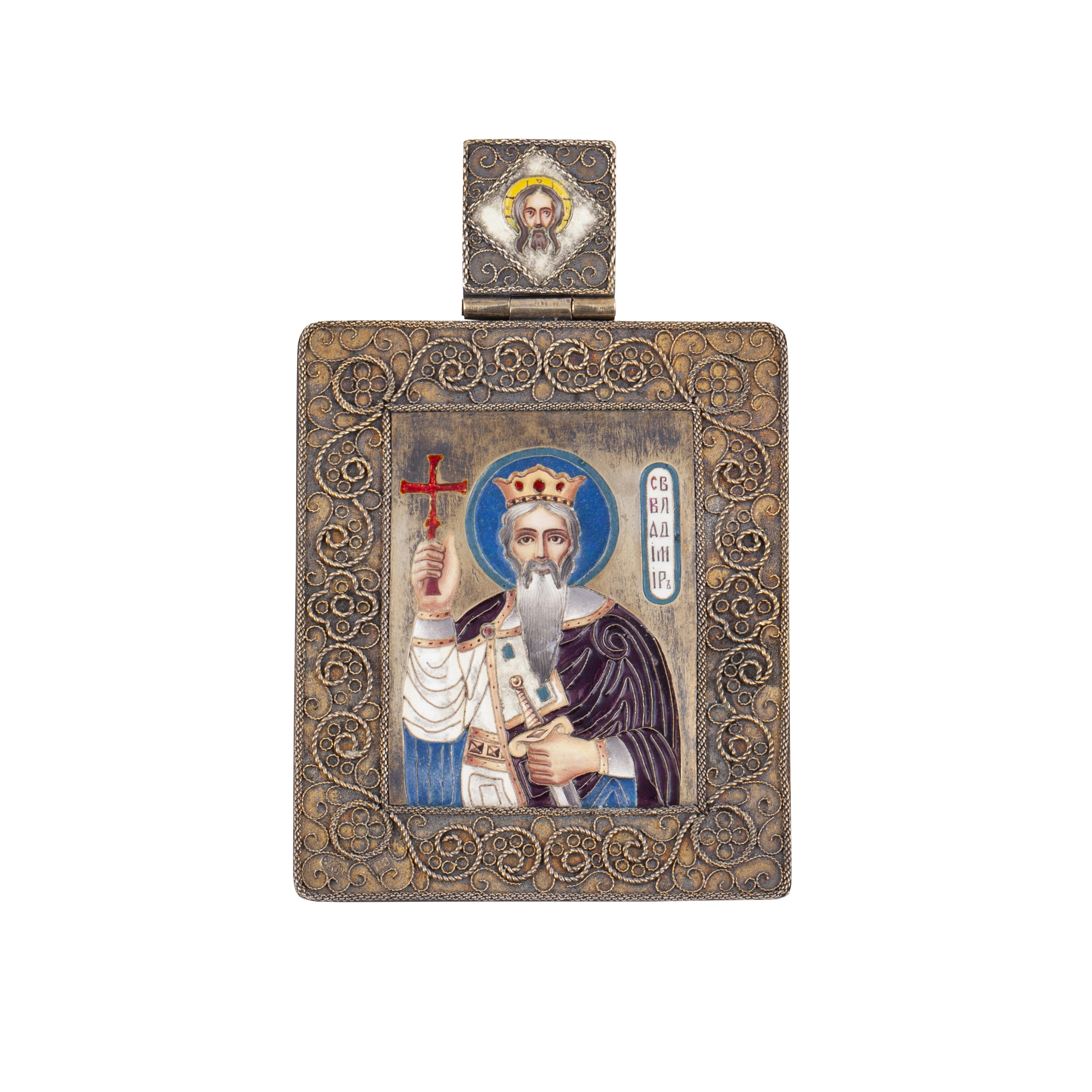
Lot 0278
Ovchinnikov. Fine Russian Silver-Gilt and Cloissone Enamel Travel Icon of St. Vladimir
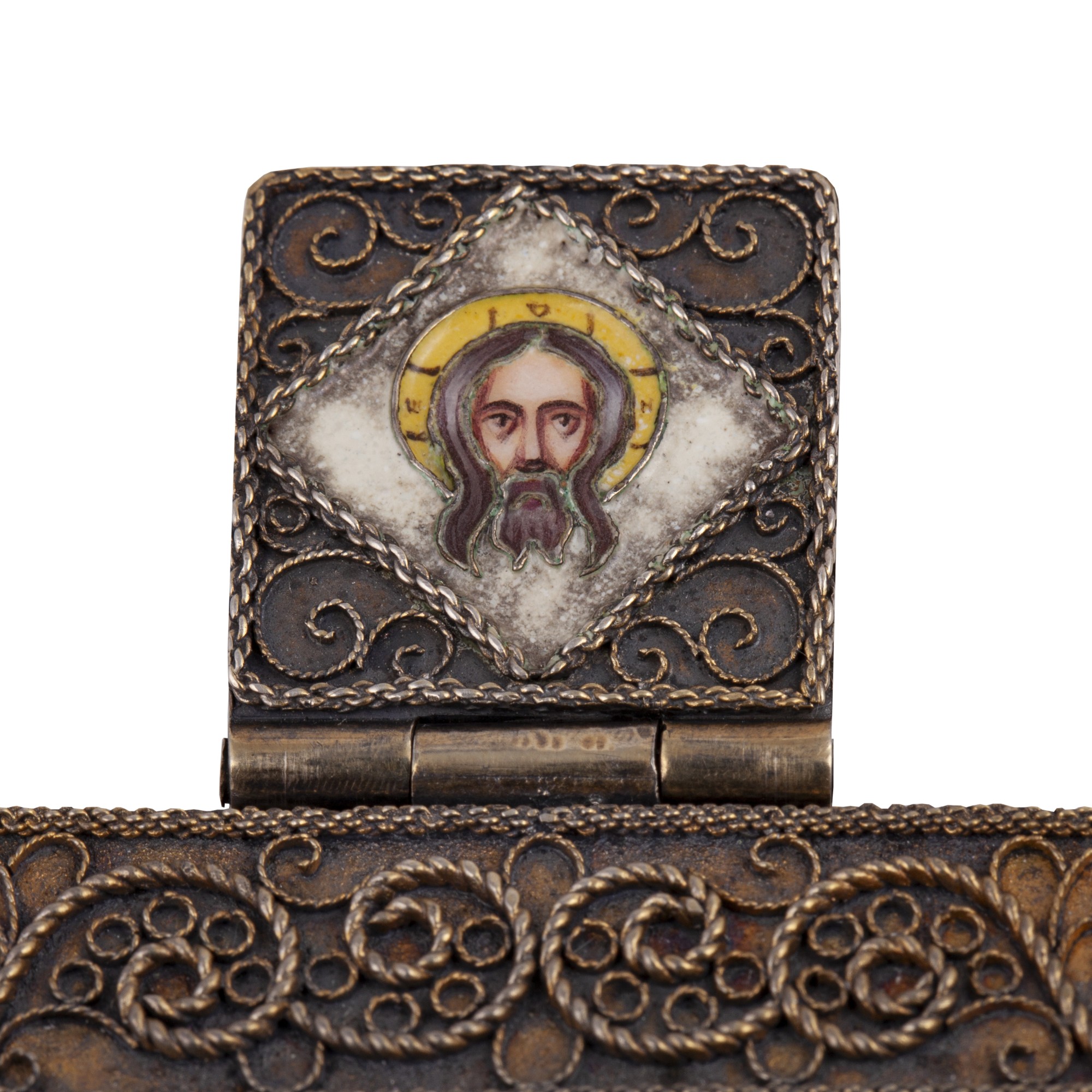
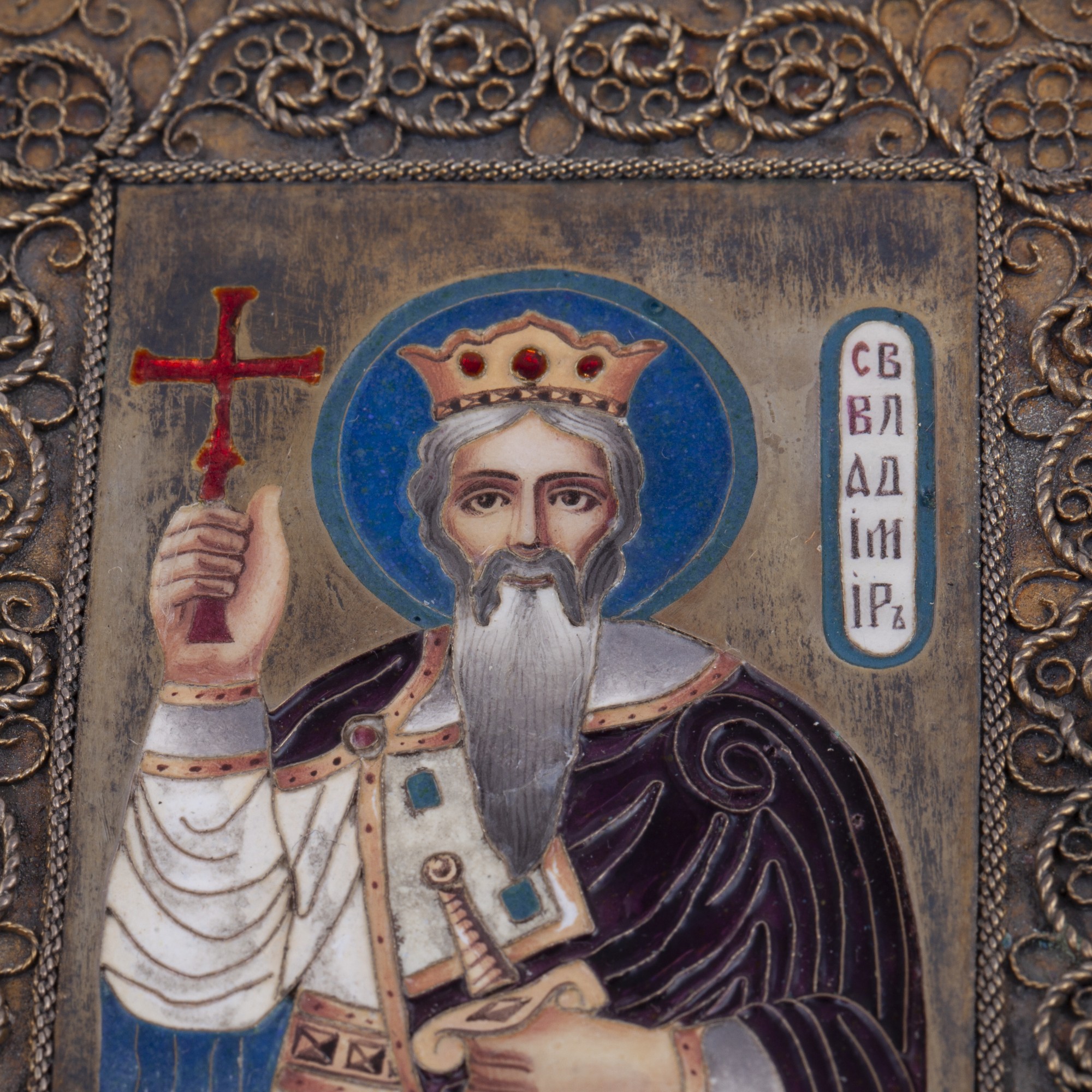
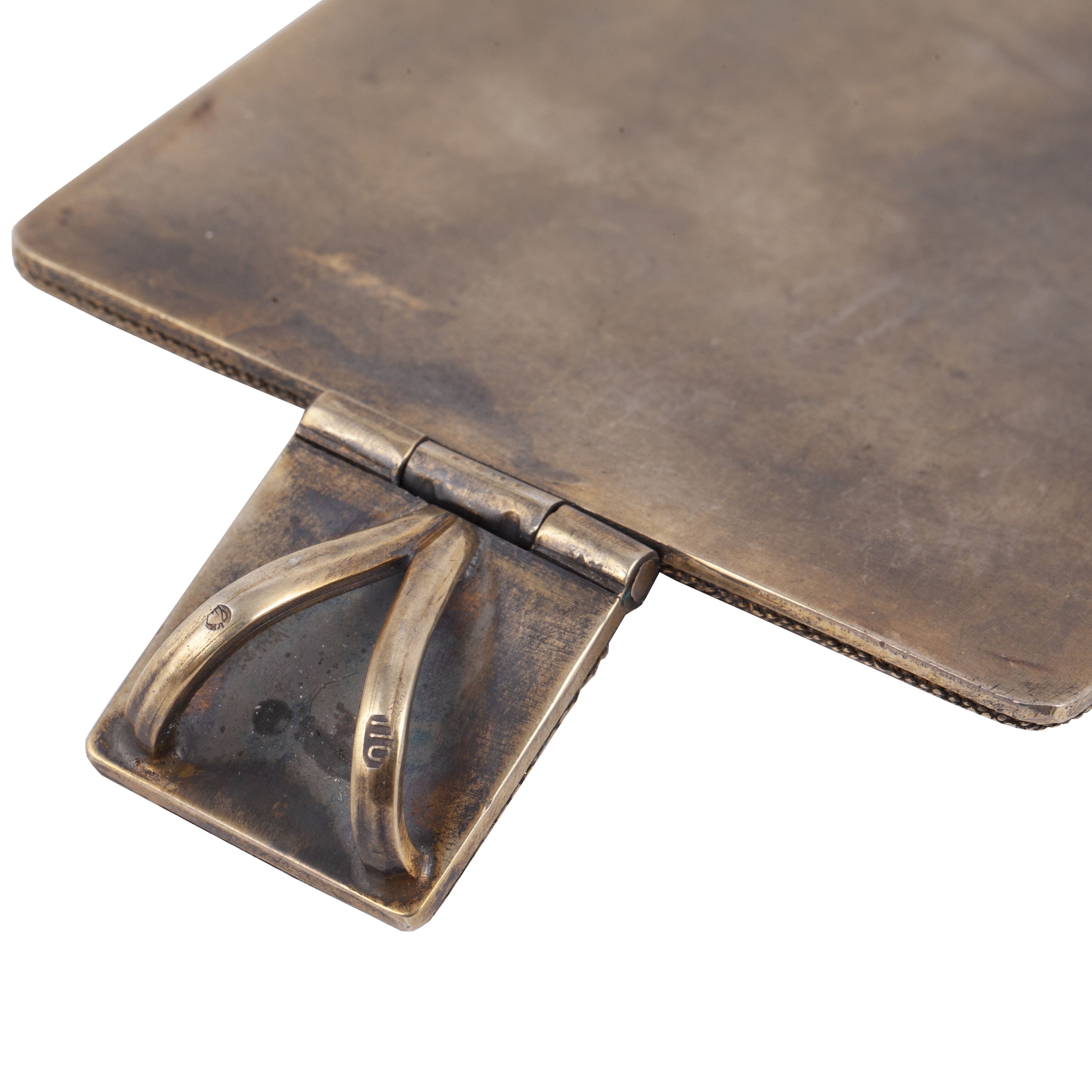
Estimate: 7000-9000€Ovchinnikov. A Russian Silver-Gilt and Cloisonné Enamel Travel Icon of St. Vladimir
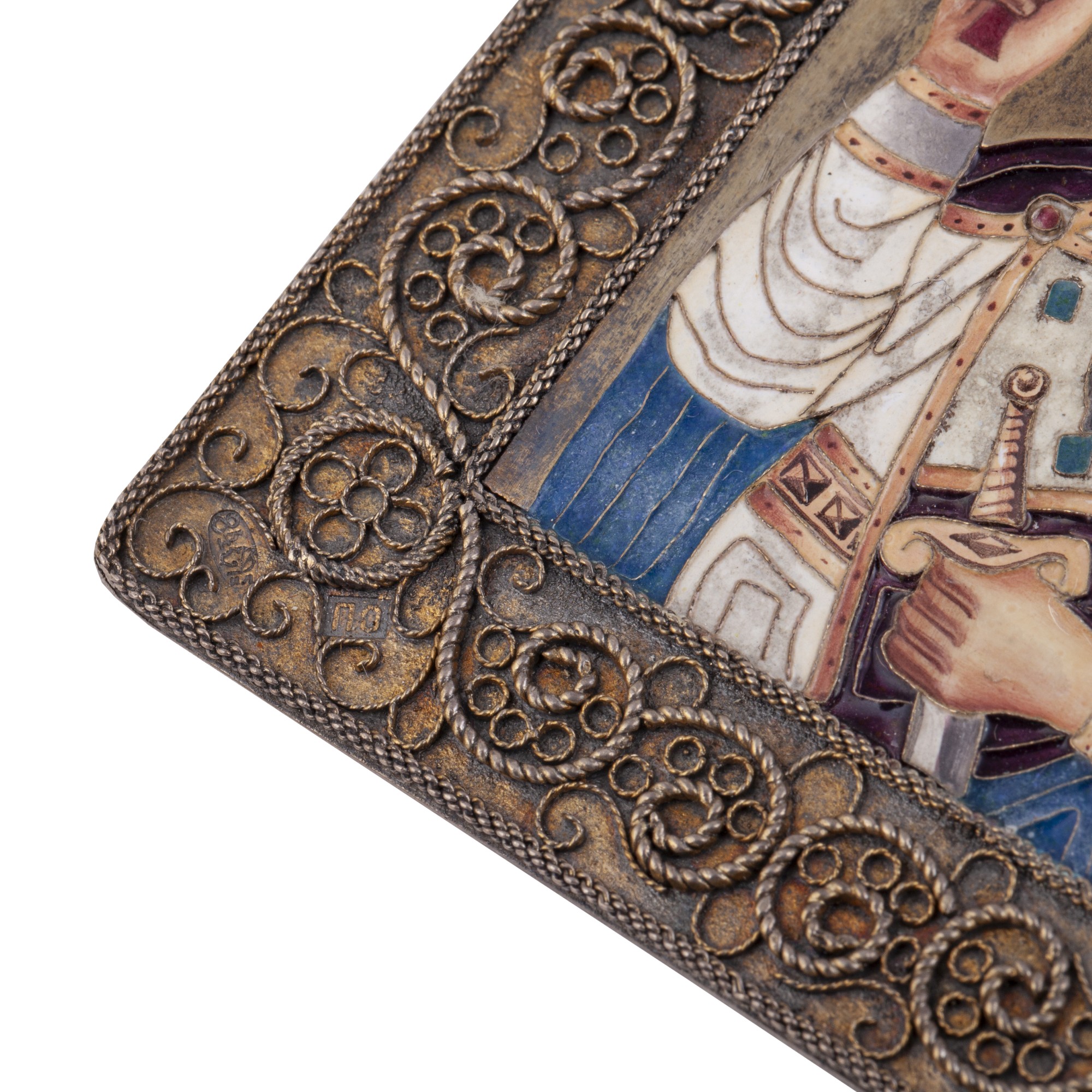
Maker’s mark “PO”. Moscow, 1899–1908
Silver (84 zolotniks), gilt, cloisonné enamel, polychrome en-plein enamel
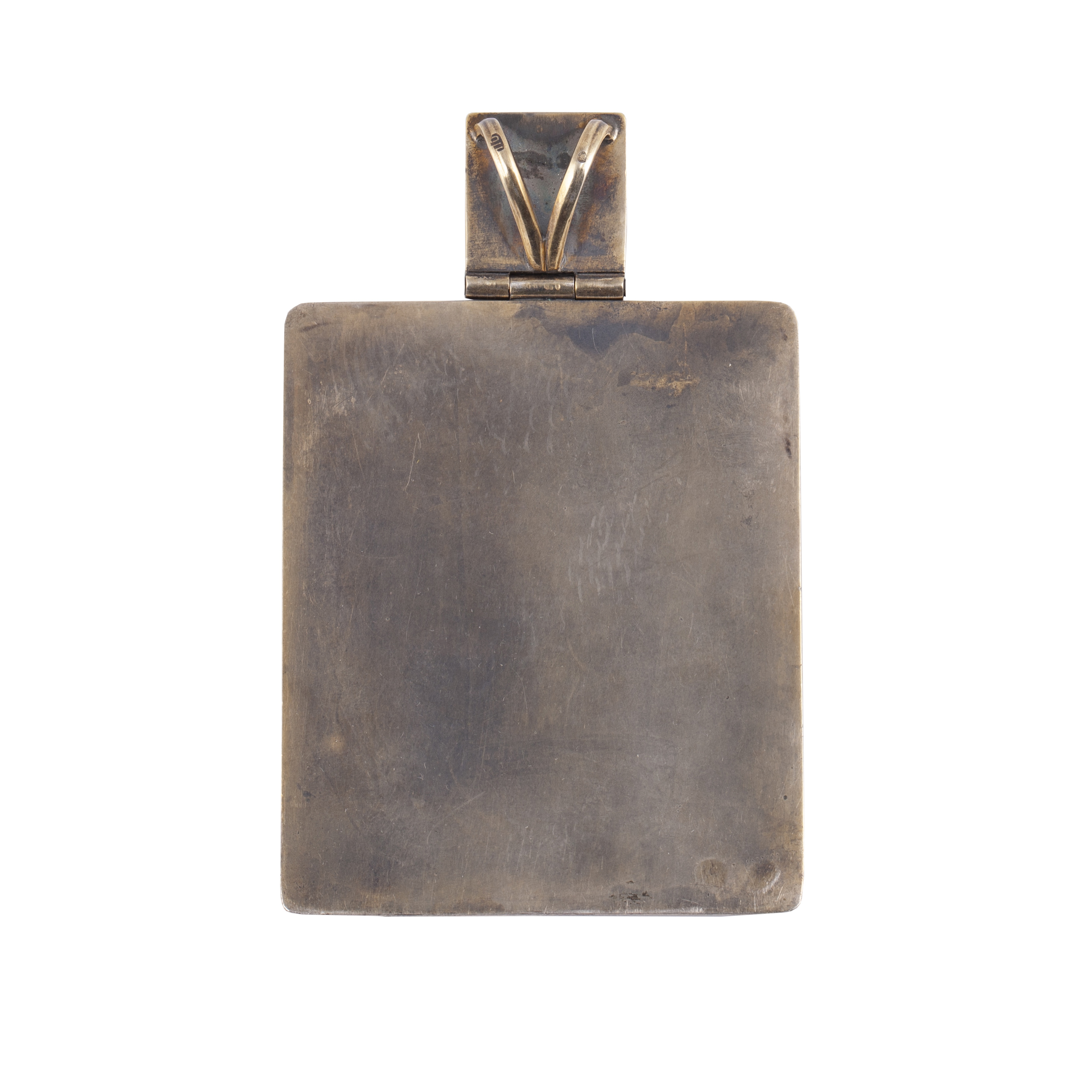
Dimensions (with hanger): 10 × 6.3 cm
Weight: 84 gThis finely crafted travel icon depicts St. Vladimir, the Baptizer of Rus’, rendered in enoplein polychrome enamels within an ornate silver-gilt frame. The saint is shown crowned, holding a red cross in his right hand and a sword in his left, symbolizing both his royal authority and his spiritual mission. Above, on the suspension loop, appears the Mandylion—the image of Christ.
The piece was made by the celebrated Moscow workshop of Pavel Akimovich Ovchinnikov, one of the leading jewelers of the Russian Empire. Founded in 1853, Ovchinnikov’s firm was the first in Russia to produce works in the Old Russian style, reviving medieval decorative traditions through cloisonné enamel and filigree.
Renowned for its exceptional craftsmanship and artistry, the Ovchinnikov factory collaborated with prominent Russian artists and architects such as Ippolit Monighetti, Alexander Opekushin, Eugene Lanceray, and Viktor Vasnetsov. The firm supplied the Imperial Court and the Orthodox Church with liturgical items, including altar Gospels, processional crosses, icon covers, chalices, and censers, achieving the highest artistic standards of its time.
Comparable examples:
Sotheby’s, Russian Works of Art, Fabergé & Icons, London, June 2014, lot 507 https://www.sothebys.com/en/auctions/ecatalogue/2014/russian-works-art-faberge-icons-l14116/lot.507.html
Christie’s, Russian Works of Art, Fabergé and Icons, London, November 2014, lot 38 https://www.christies.com/en/lot/lot-5896351Starting price: 6000€
Estimate: 7000-9000€
Hammer Price: Not sold -
Lot 0279
Khlebnikov. Russian Icon of the Guardian Angel in Cloisonné Enamel, Moscow, late 19th century
Estimate: 1000-1200€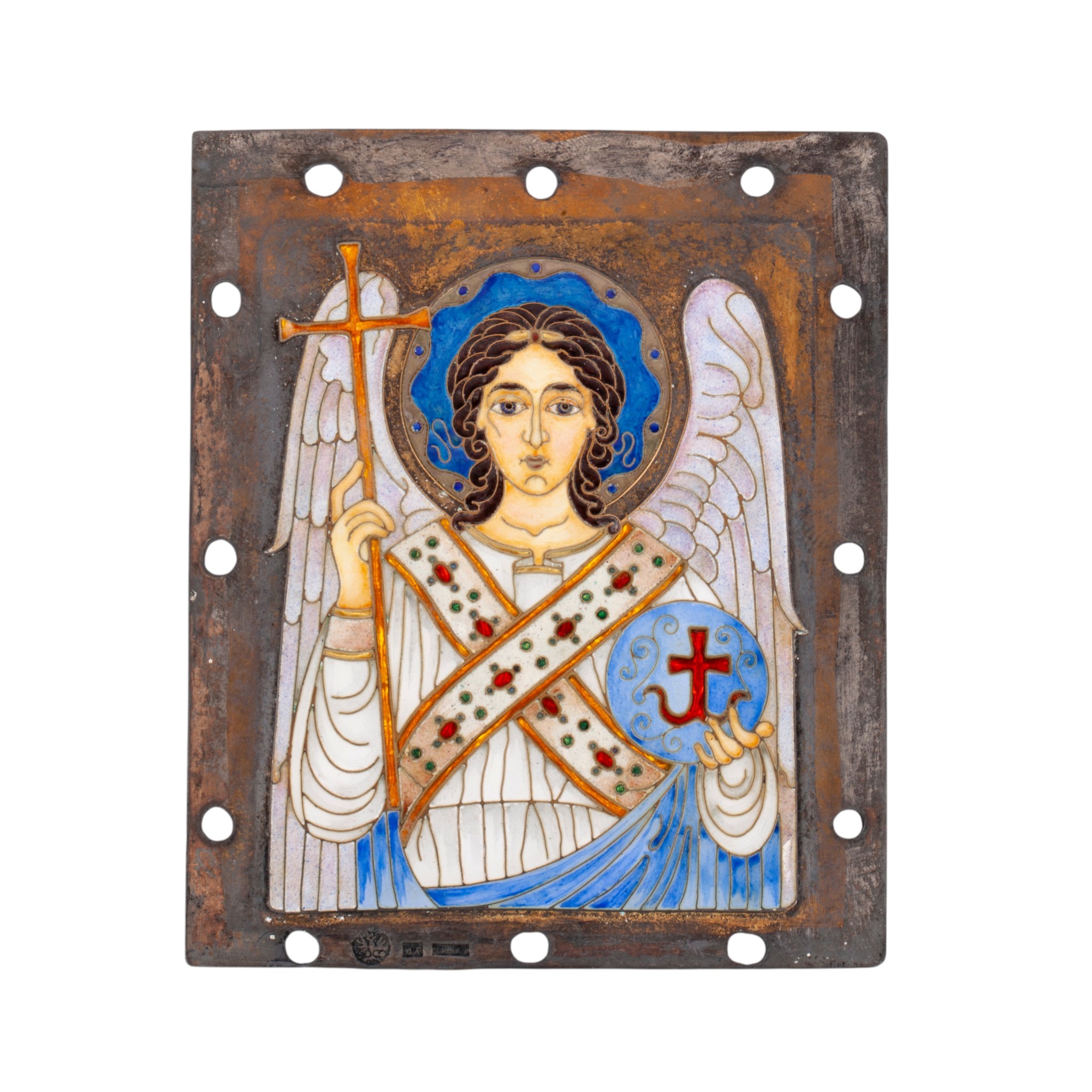
Lot 0279
Khlebnikov. Russian Icon of the Guardian Angel in Cloisonné Enamel, Moscow, late 19th century
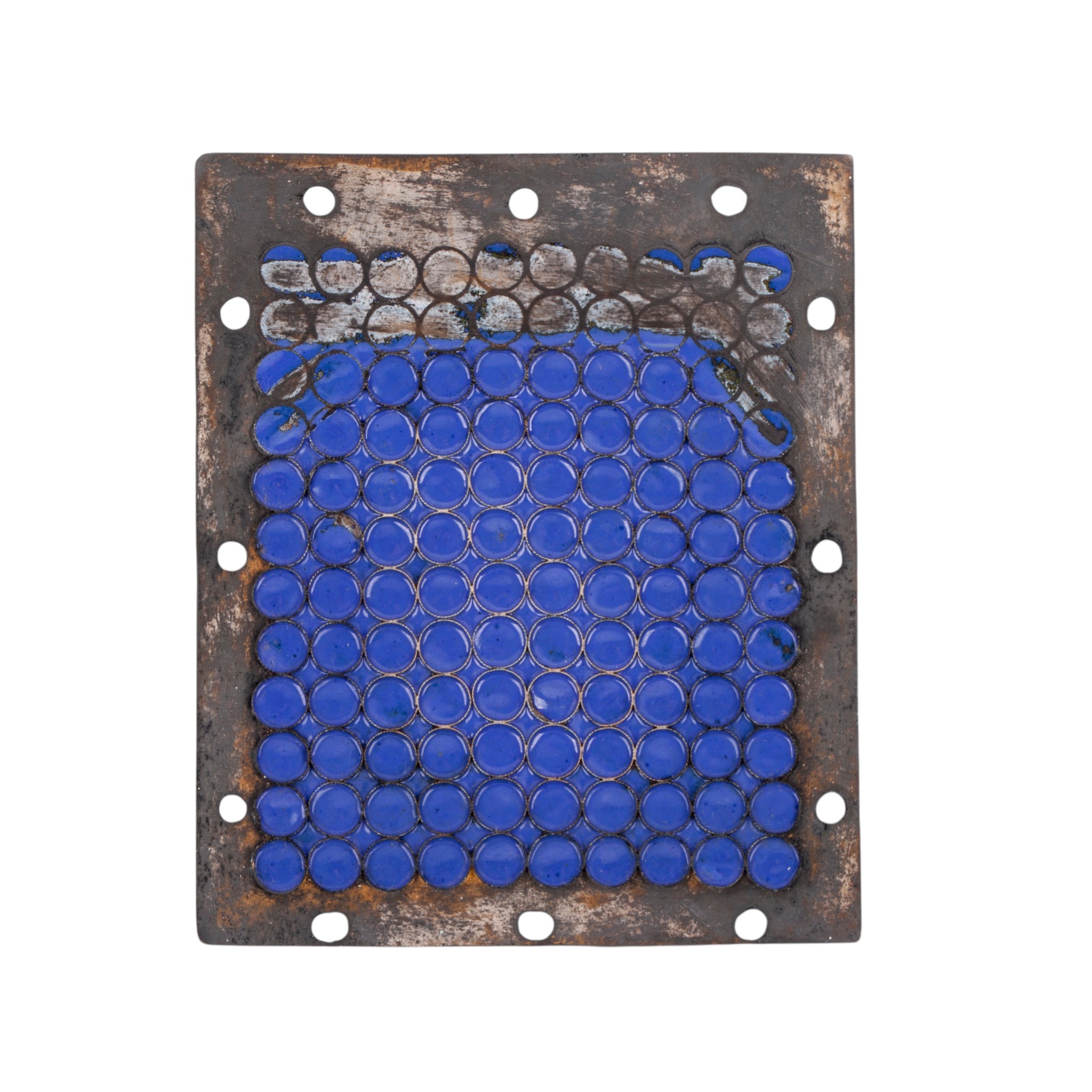
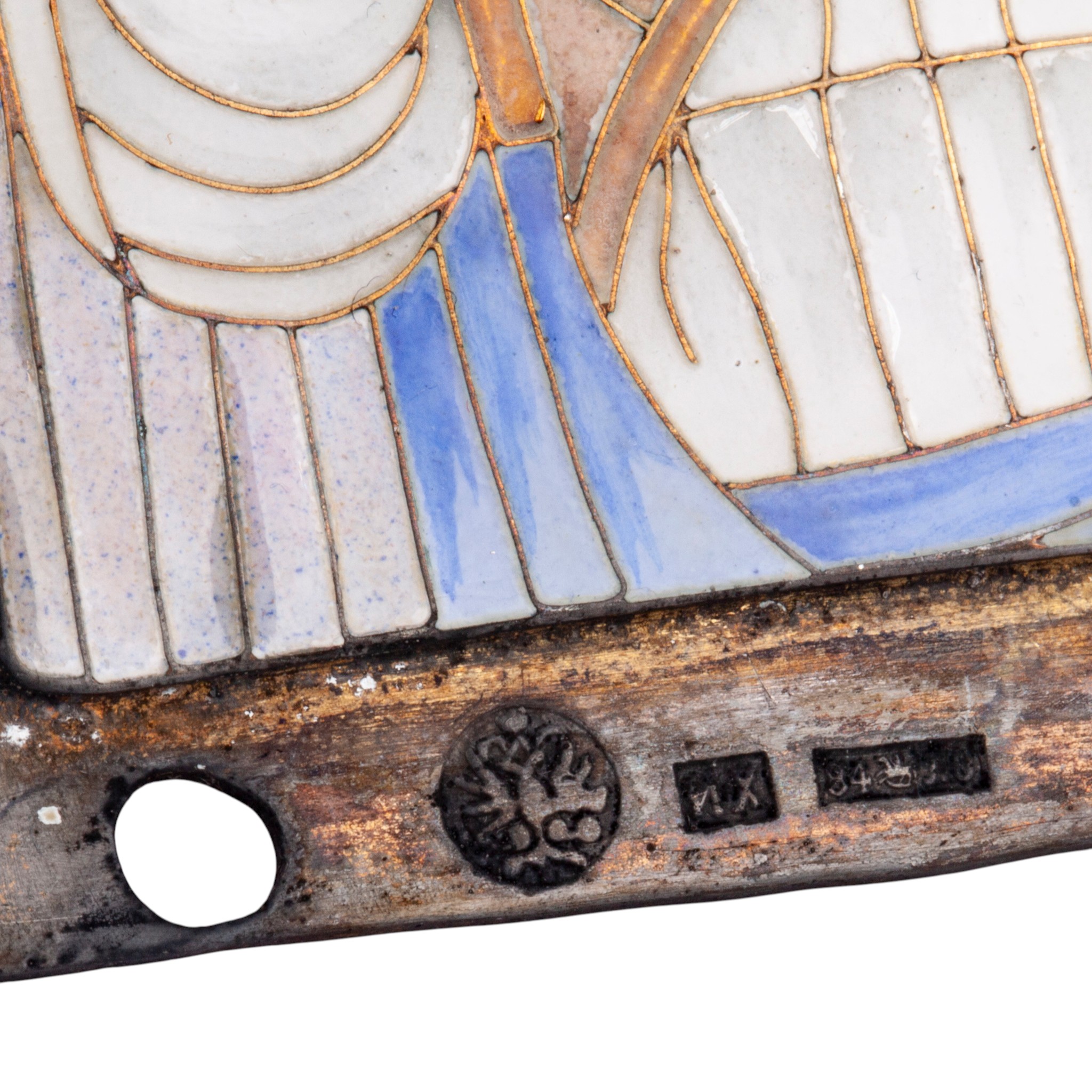
Estimate: 1000-1200€Khlebnikov. Russian Icon of Saint Guardian Angel in Neo-byzantine style Silver, cloisonné enamel. Makers mark of «I.KH» with Imperial warrant. Moscow, the end of the 19th century. Silver, cloisonné enamel (Byzantine technique)
This icon is executed in the Byzantine enamel technique, distinguished by bright polychrome en plein surfaces, deep translucence, and precise detail. The Saint Angle is depicted frontally, holding in the left hand sphere and the cross in the right one. The figure is adorned in richly coloured vestments with enamel in palette of white, blue, yellow and red, framed by a finely worked nimbus with stylised spiral ornament. The Khlebnikov firm, founded in Moscow in 1867, was one of the foremost Russian producers of silver and enamelware in the late Imperial period. Known as Supplier to the Imperial Court, the workshop gained renown for reviving and modernising ancient Russian and Byzantine decorative traditions. Its masters excelled in cloisonné enamel, producing icons, liturgical objects, tableware, and presentation pieces, many of which were exhibited at international exhibitions and awarded highest prizes. This plaque exemplifies Khlebnikov’s interpretation of Byzantine heritage, combining medieval artistic vocabulary with the technical perfection and luxurious materials typical of Russian decorative arts at the turn of the century.
Dimensions: 10,1 x 8,3 cm. Total weight: 101 g.Starting price: 800€
Estimate: 1000-1200€
Hammer Price: Not sold -
Lot 0280
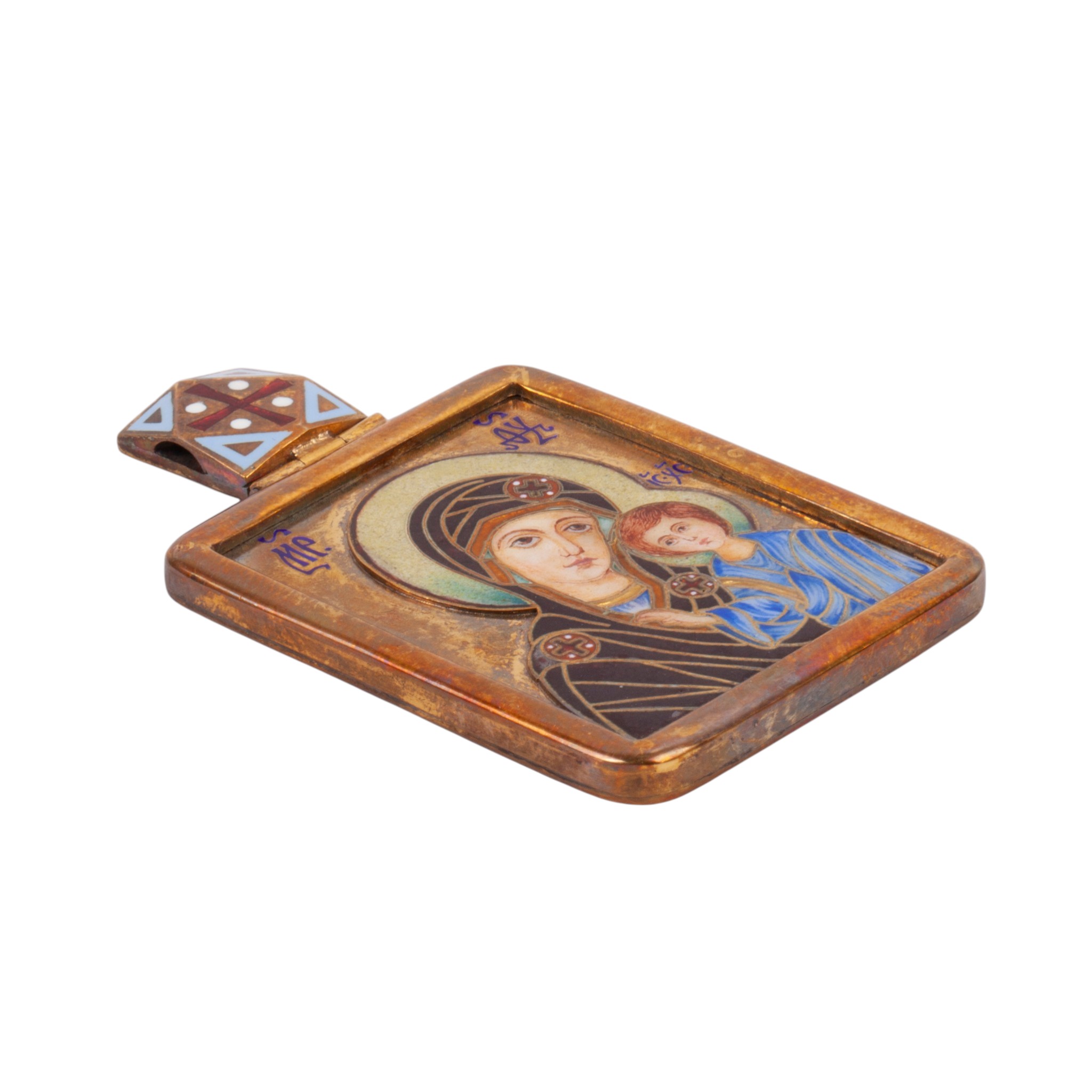
Ovchinnikov. Travel Icon of the Kazan Mother of God in Cloisonné Enamel, Moscow, 1899–1908
Estimate: 5000-7000€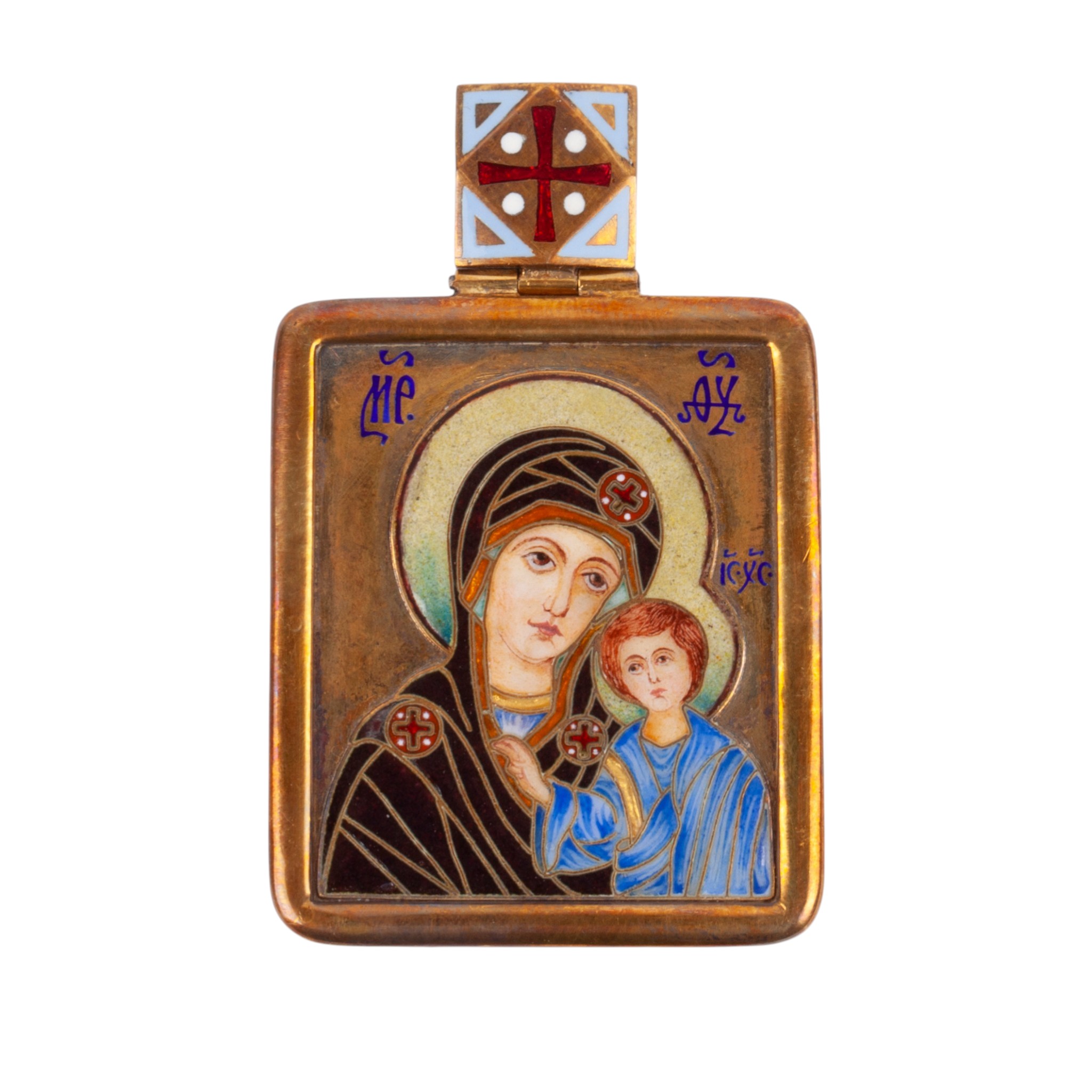
Lot 0280
Ovchinnikov. Travel Icon of the Kazan Mother of God in Cloisonné Enamel, Moscow, 1899–1908
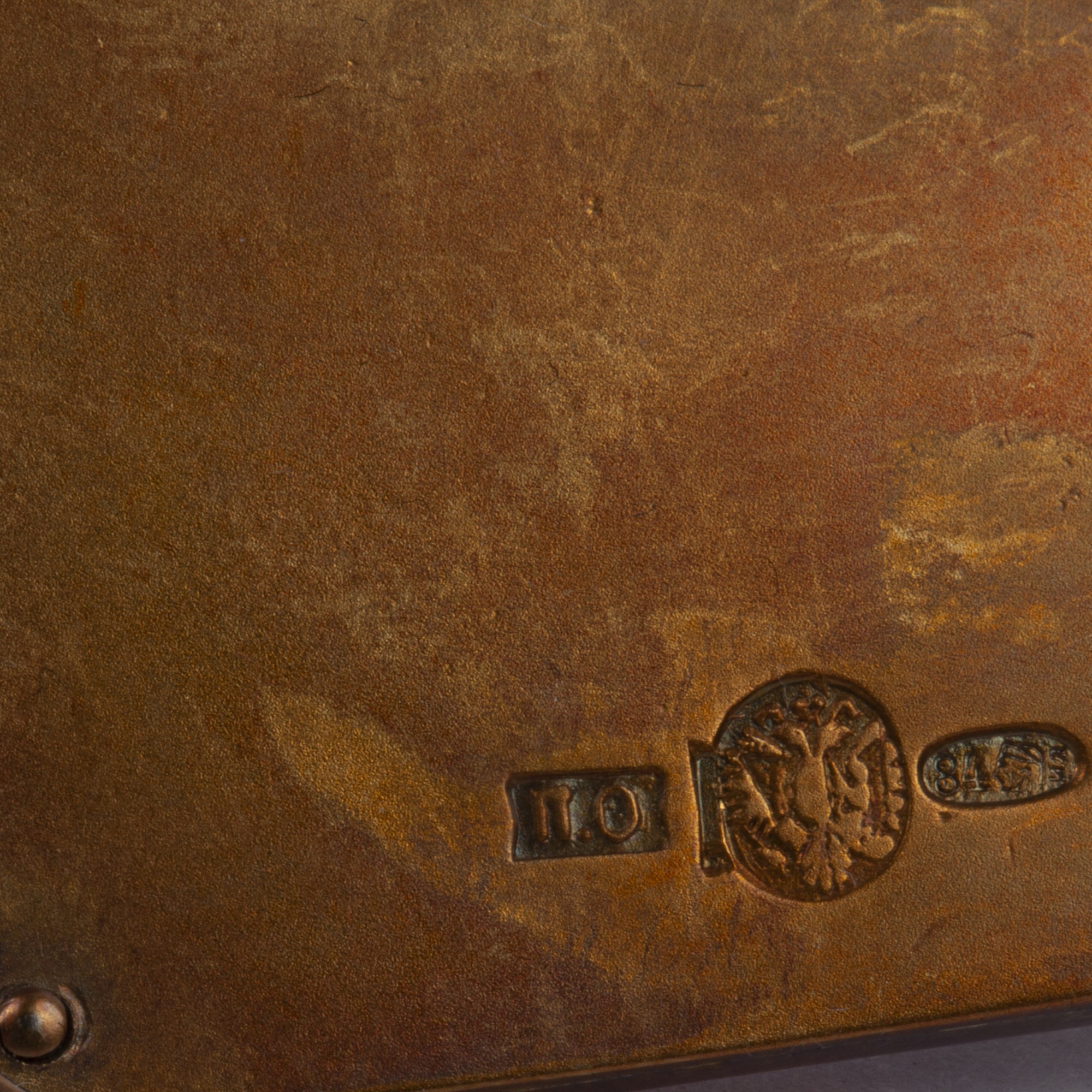
Estimate: 5000-7000€Ovchinnikov. Travel Icon of the Mother of God Kazan
Moscow, firm of Pavel Akimovich Ovchinnikov, 1899-1908.
Silver-gilt, cloisonné enamel, polychrome enamel on guilloché ground.
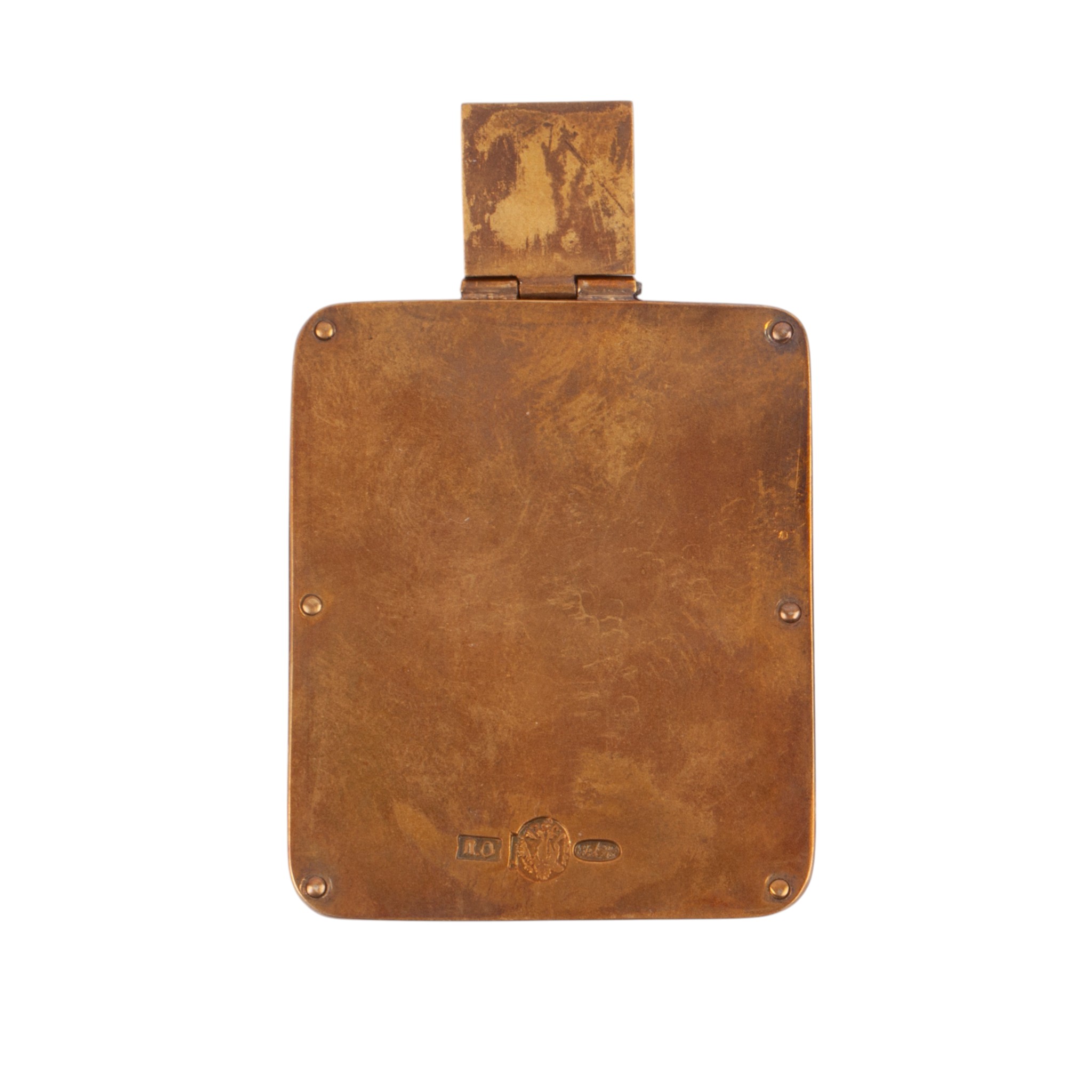
Marked: maker’s mark “ПО”, Moscow assay mark, 84 zolotnik silver standard.
A finely executed Russian travel icon in Neo-Bysantine style depicting the Mother of God with the Christ Child in a compact rectangular silver-gilt frame. The sacred image is rendered in delicate polychrome en-plein enamels, with the Virgin shown in a dark maphorion accented by red enamel crosses, and the Christ Child draped in luminous blue robes. The suspension loop is enriched with cloisonné enamel ornament in white and red, lending the object both a liturgical and jewel-like character.
The icon was produced by the celebrated Moscow firm of Pavel Akimovich Ovchinnikov, one of the most distinguished jewellery and silver workshops of the Russian Empire. Founded in 1853, the firm played a leading role in the revival of the Old Russian style, drawing upon medieval models while bringing them to a high level of technical and artistic finish. Ovchinnikov’s workshop was especially renowned for cloisonné enamel, filigree, and ecclesiastical silver, and supplied both the Imperial Court and the Orthodox Church.
Comparable examples:Sotheby’s, Russian Works of Art, Fabergé & Icons, London, June 2014, lot 507
https://www.sothebys.com/en/auctions/ecatalogue/2014/russian-works-art-faberge-icons-l14116/lot.507.html
Christie’s, Russian Works of Art, Fabergé and Icons, London, November 2014, lot 38 https://www.christies.com/en/lot/lot-5896351Starting price: 4000€
Estimate: 5000-7000€
Hammer Price: Not sold -
Lot 0281
Russian Icon of Christ Pantokrator with Silver-Gilt Riza, Moscow, circa 1880
Estimate: 150-200€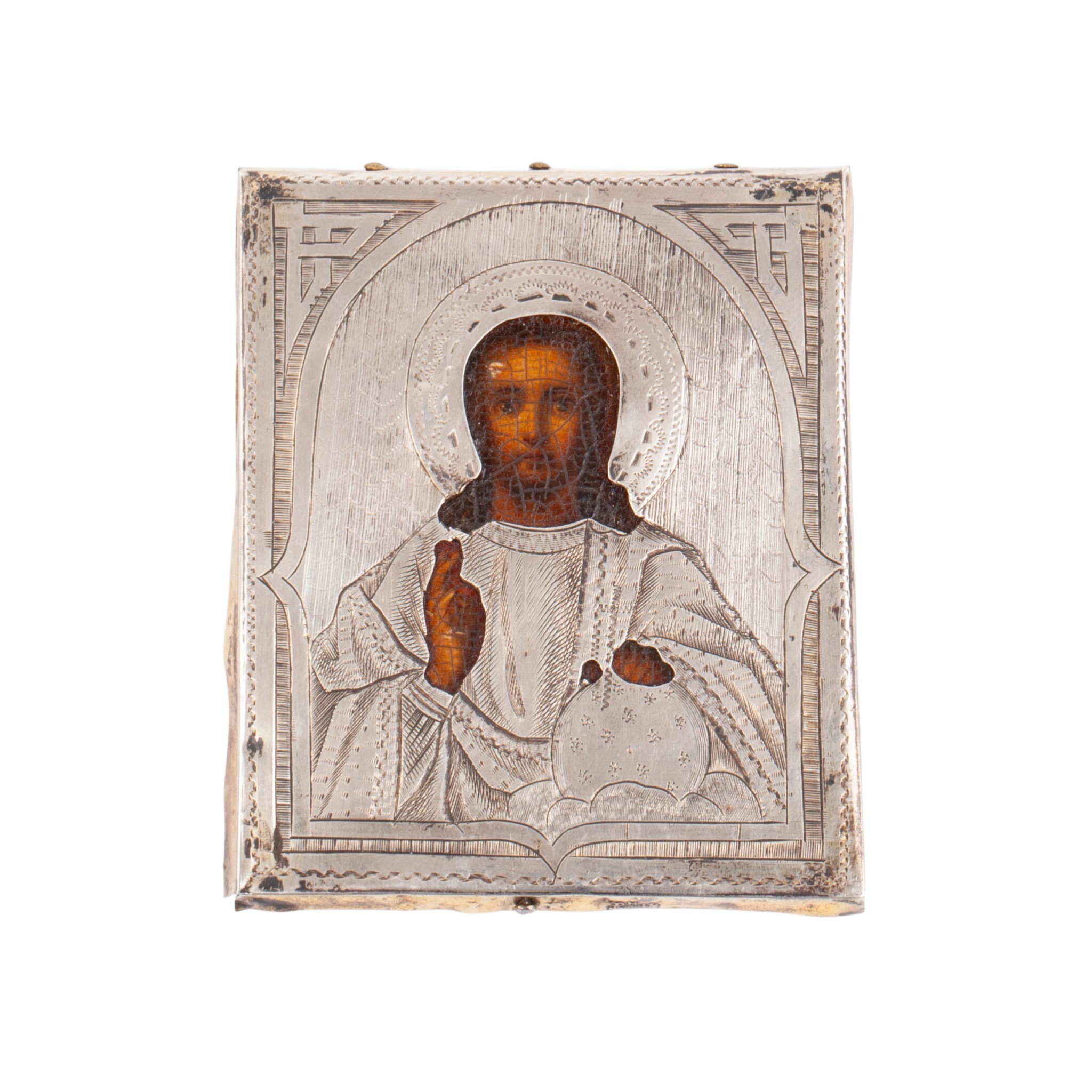
Lot 0281
Russian Icon of Christ Pantokrator with Silver-Gilt Riza, Moscow, circa 1880
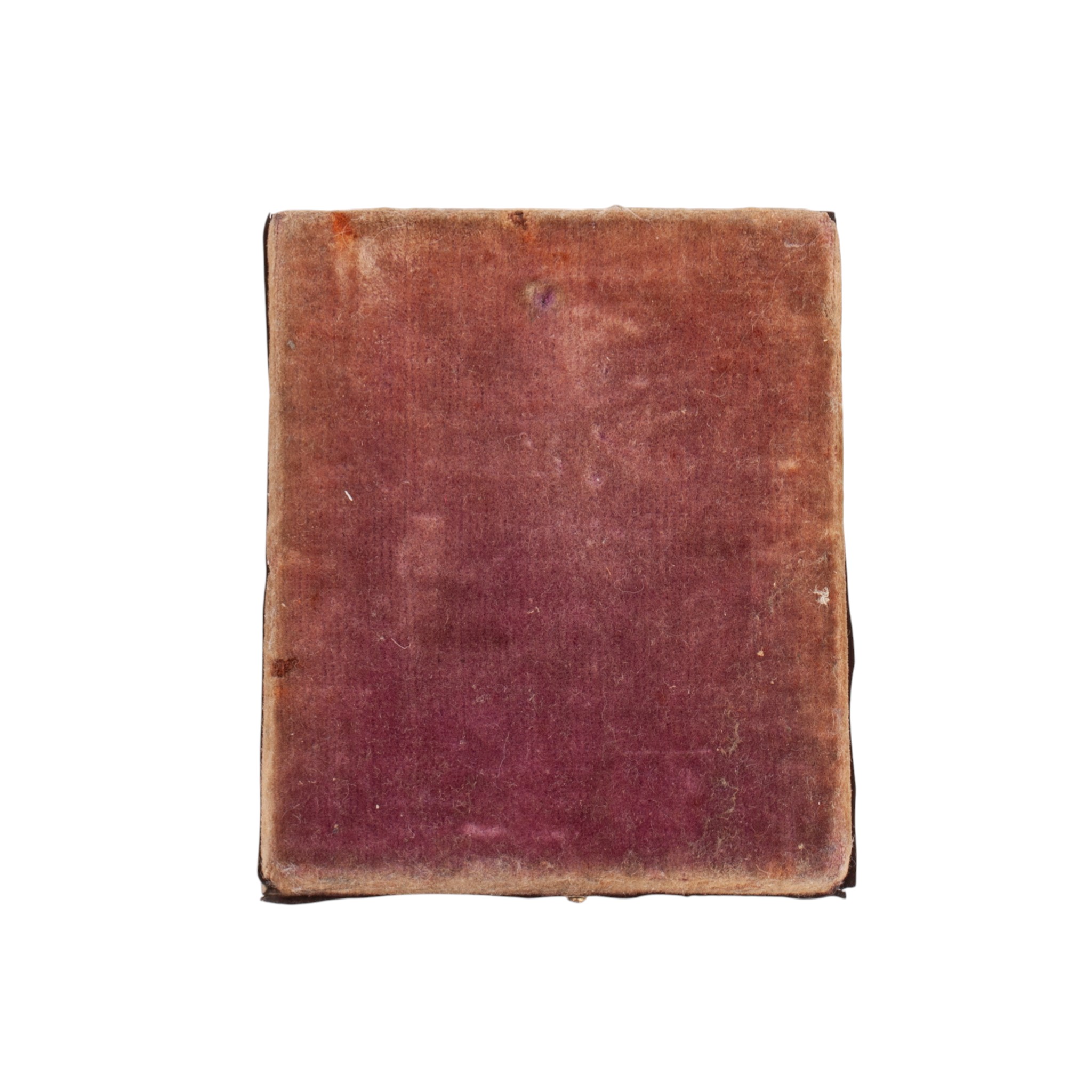
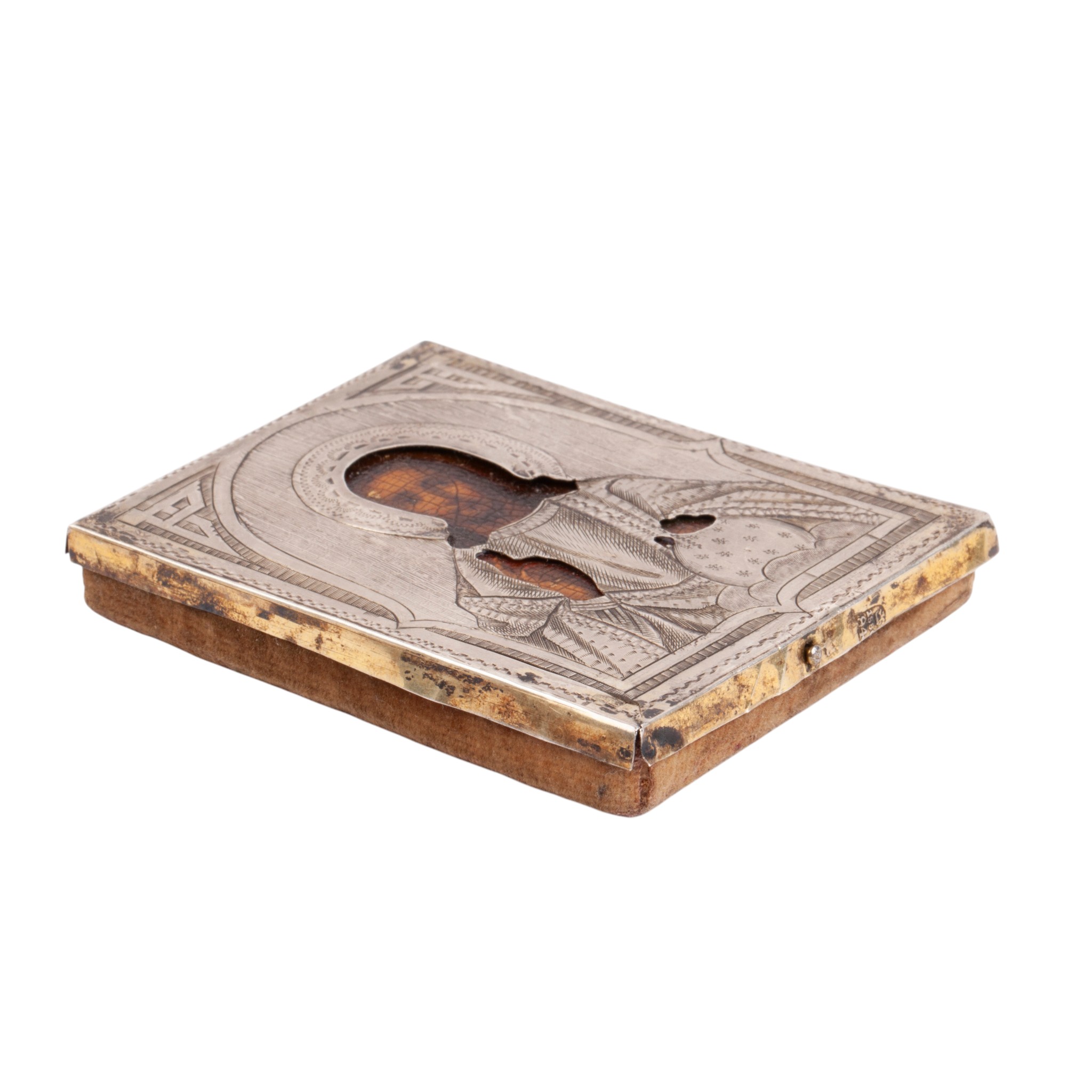
Estimate: 150-200€A Russian Icon of Christ Pantokrator
Mosocw, circa 1880.
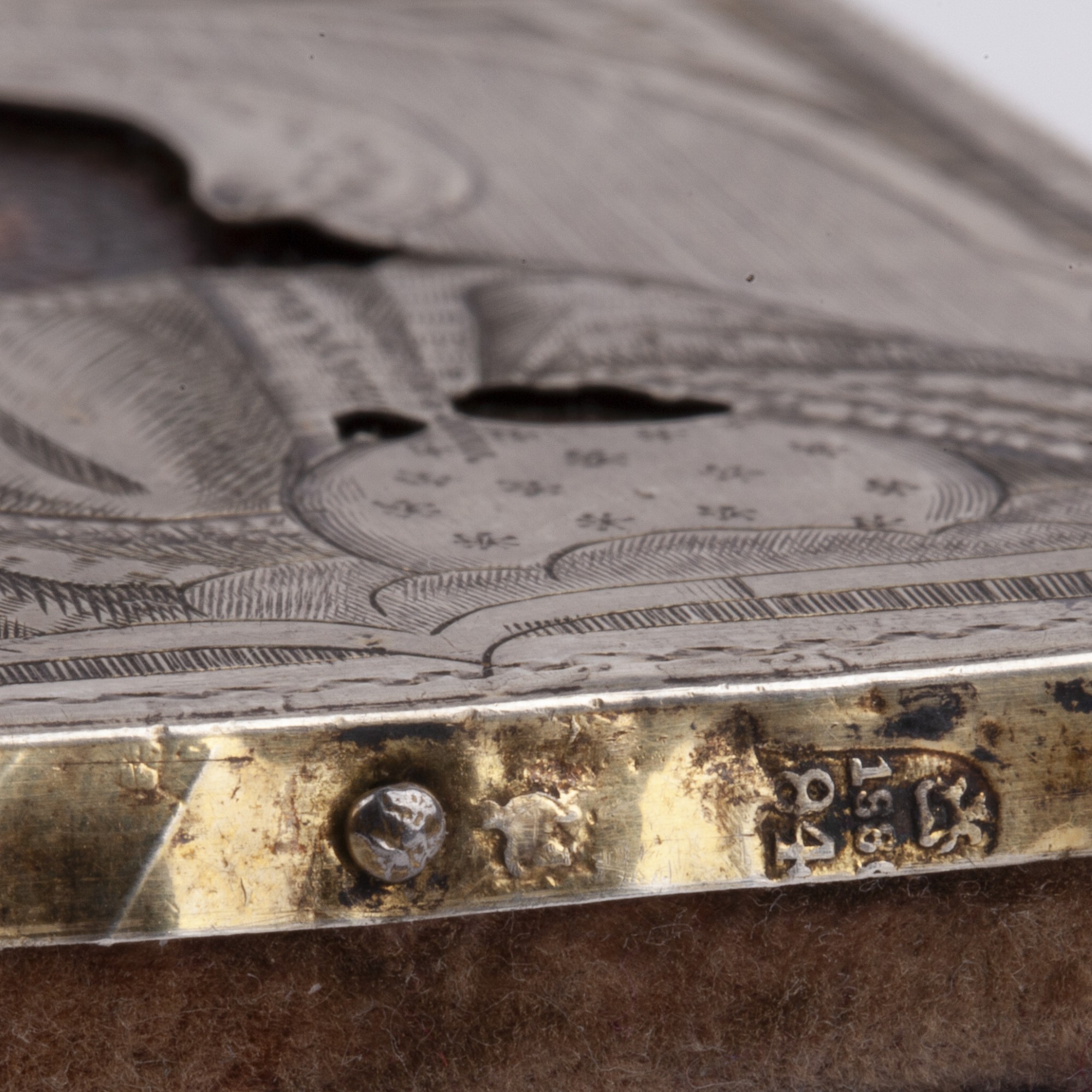
Silver, partially gilded, engraved; oil painted. Marks: stamped on the side with 84 zolotnik silver standard and Moscow assay mark.
Dimensions: 6.7 × 5.5 × 1 cm.
A small rectangular traditional icon representing Christ Pantokrator in half-length, shown raising His right hand in blessing and holding the orb in His left. The image is covered with a finely engraved silver riza, the face and hands left visible through shaped apertures in the traditional manner. The surface is enriched with delicate linear work defining the folds of the robes, the cross-halo, and the architectural frame, while the spandrels are accented with restrained geometric ornament.Starting price: 100€
Estimate: 150-200€
Hammer Price: Not sold -
Lot 0282
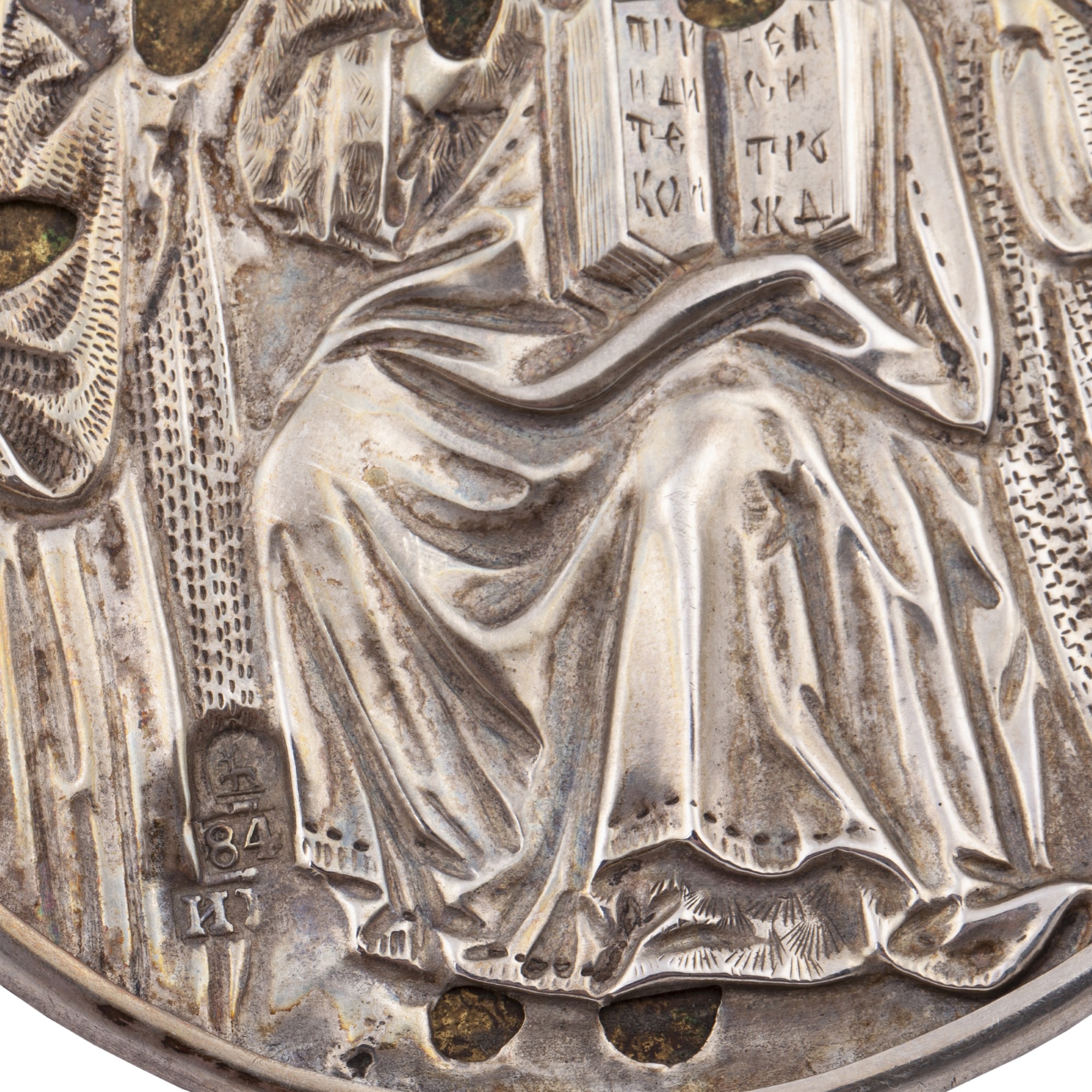
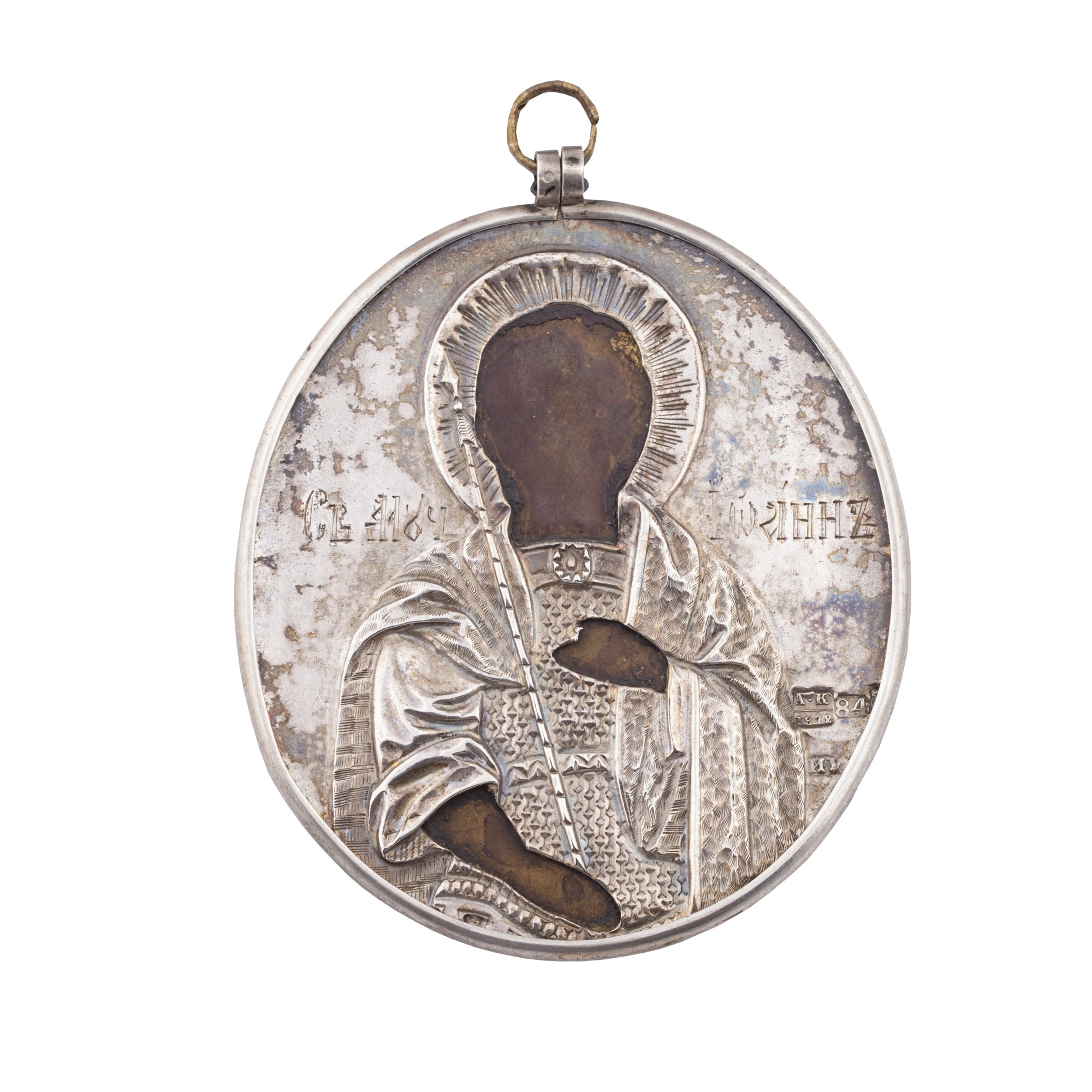
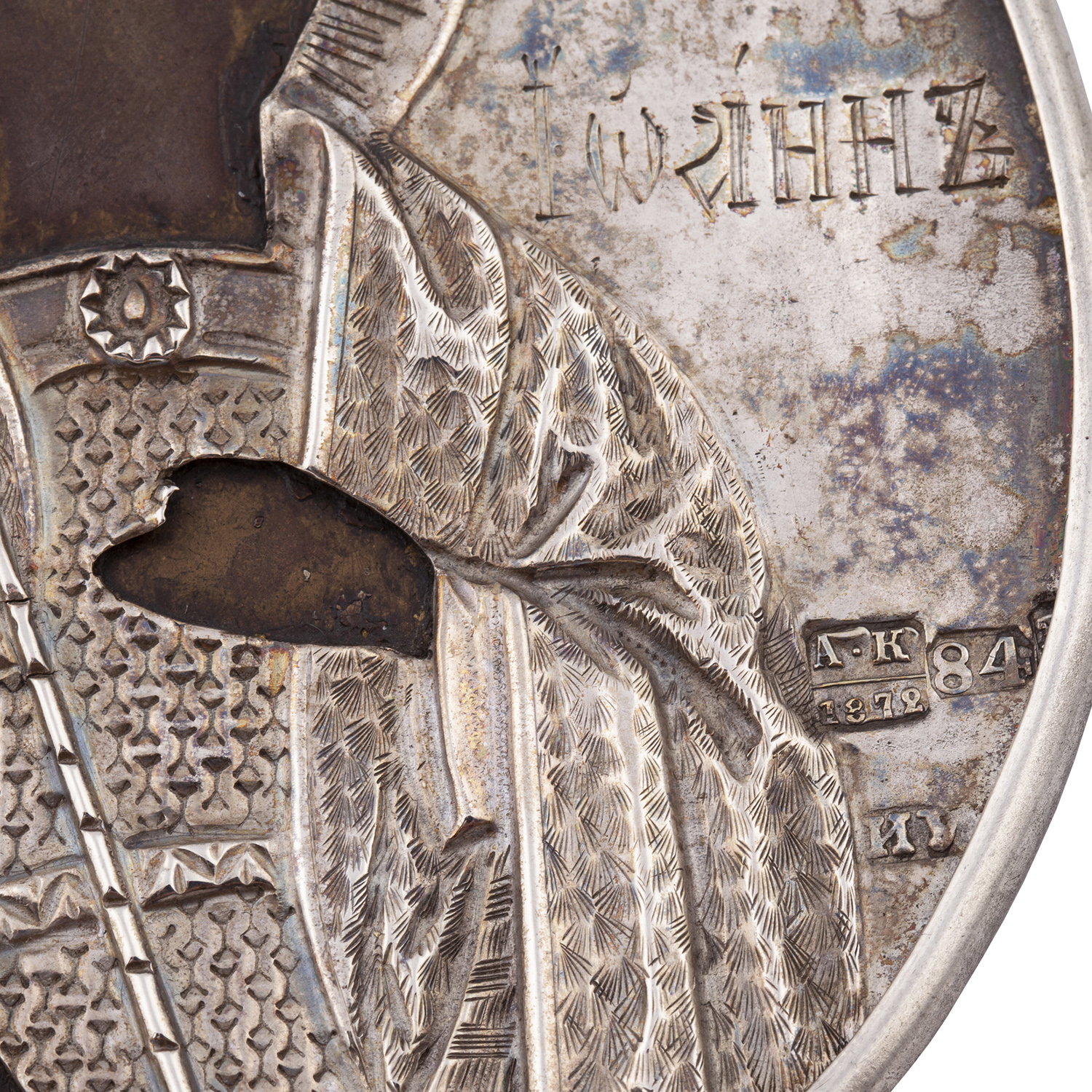
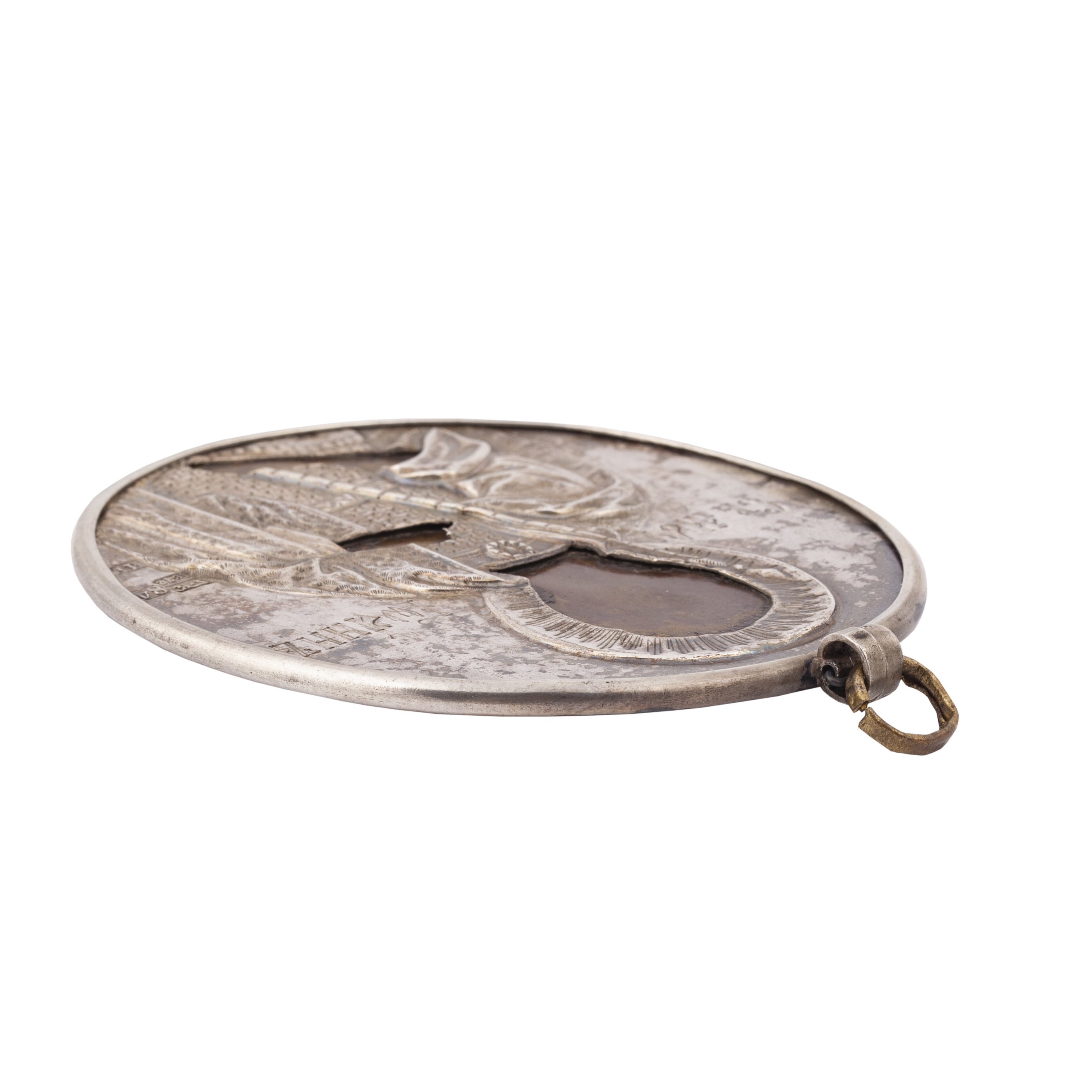
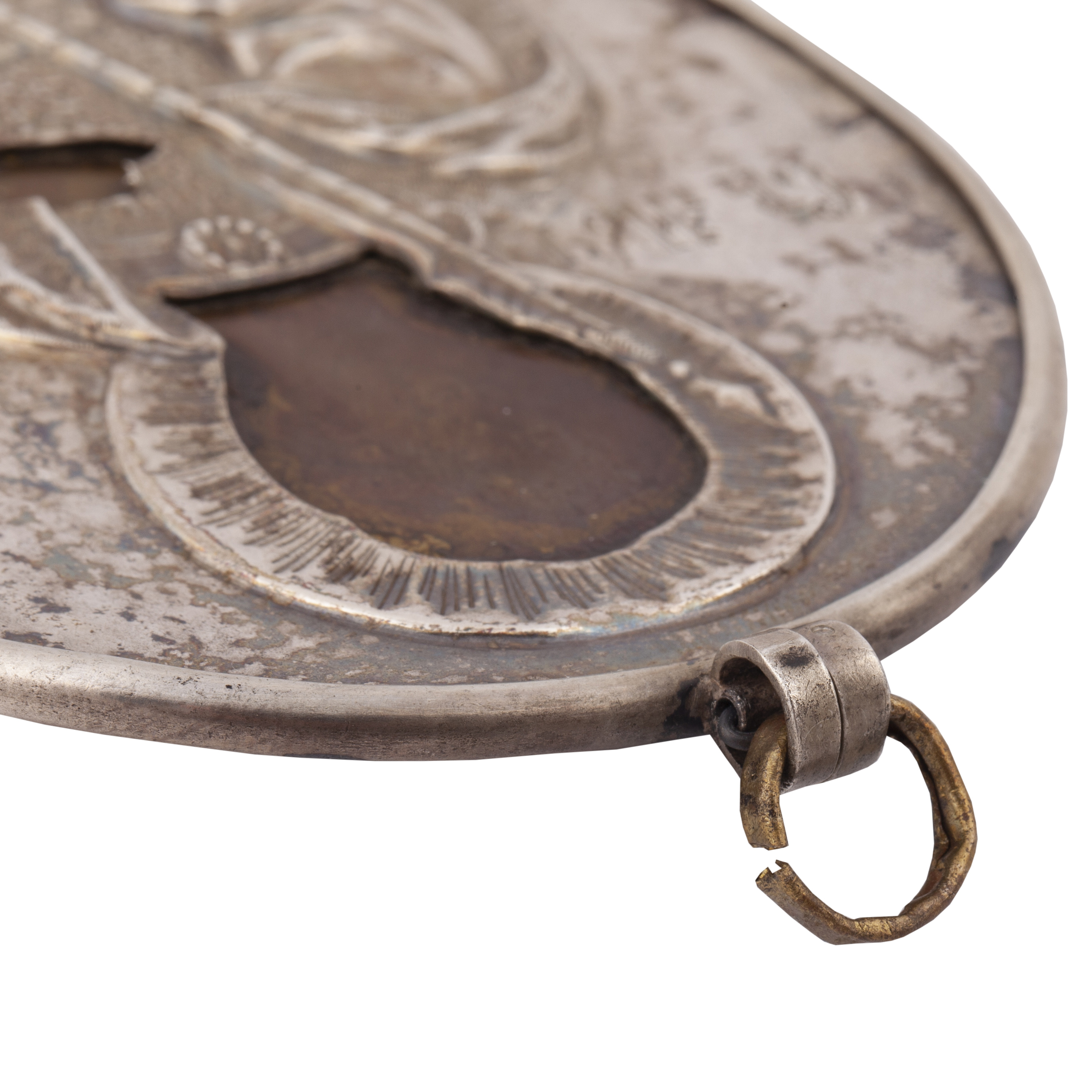
Russian Travel Icon in a Silver Riza with Deesis and Saint Martyr John
Estimate: 500-600€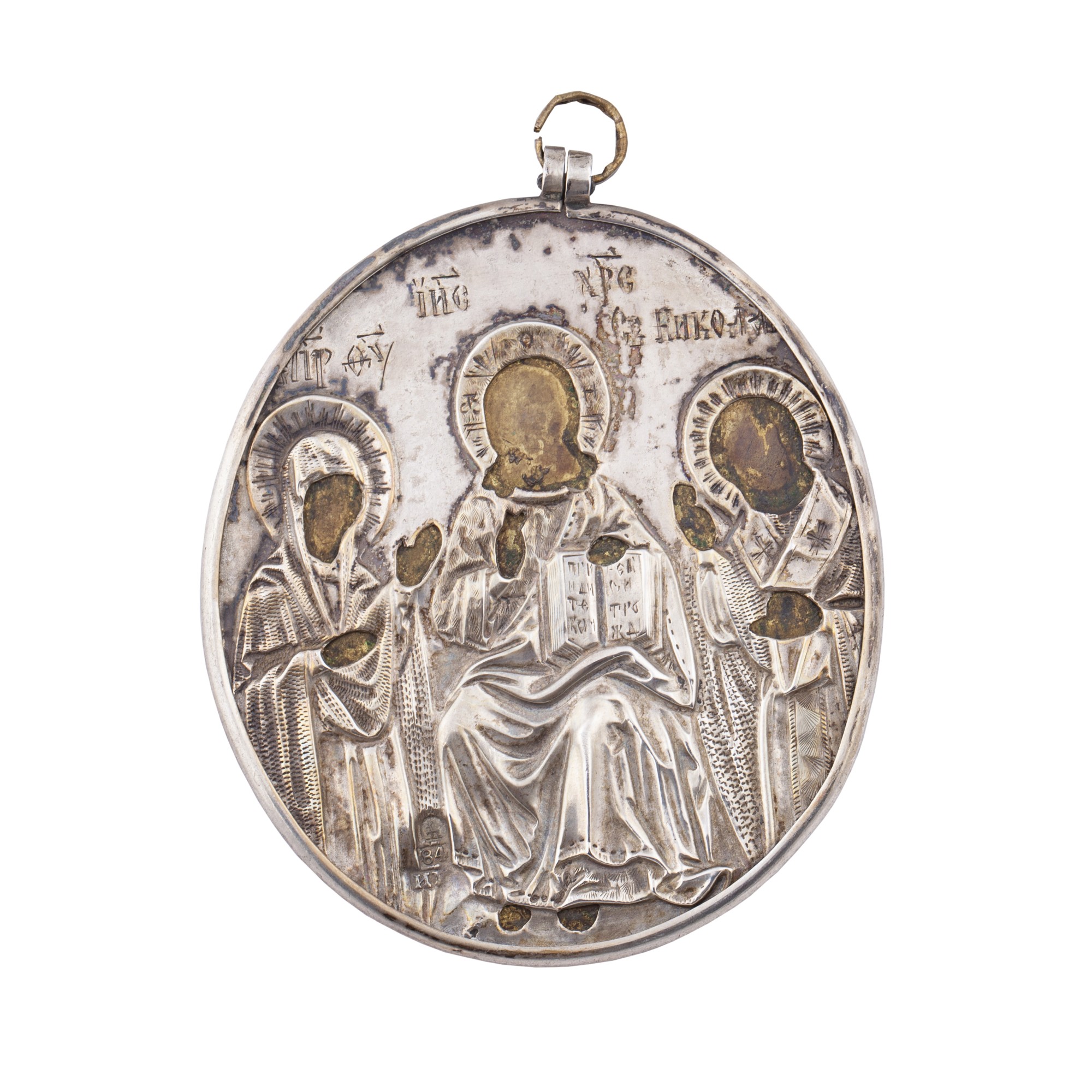
Lot 0282
Russian Travel Icon in a Silver Riza with Deesis and Saint Martyr John
Estimate: 500-600€Travel Icon with Deesis and Saint Martyr John
Russia, Nizhniy Novgorod, 1872
Painting on zinc, silver riza (oklad).
Dimensions: 10 × 7.2 cm
Maker’s mark of I. Udalov.This small double-sided travel icon is an exquisite example of provincial Russian metalwork from the late 19th century. The obverse depicts Saint Martyr John, framed by a finely chased silver riza that leaves the face and hands visible, their darkened tones showing the passage of time. The reverse presents the Deesis composition — Christ enthroned in the center, flanked by the Virgin Mary and St. John the Baptist in prayerful intercession.
The icon’s base is made of zinc — a practical, lightweight metal often used for travel icons. Its chased and engraved silver oklad demonstrates the restrained elegance typical of Nizhniy Novgorod silversmithing.
The maker’s mark belongs to Ivan Ivanovich Udalov (1859–1909), a master silversmith from Nizhniy Novgorod. His hallmark consisted of the initials “ИУ”. Udalov employed one master craftsman, five journeymen, and three apprentices. His workshop produced repoussé and engraved objects in silver and copper, often gilded or silvered. Known works include a reliquary (kovcheg) and an icon cover (oklad) now held in the State Historical Museum, Moscow.
Starting price: 400€
Estimate: 500-600€
Hammer Price: Not sold -
Lot 0283
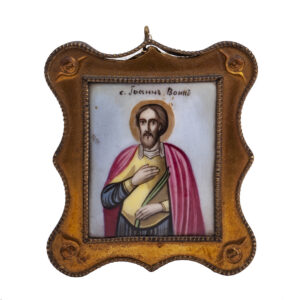
A Russian pendant travel icon of “The Holy Warrior John”
Estimate: 300-400€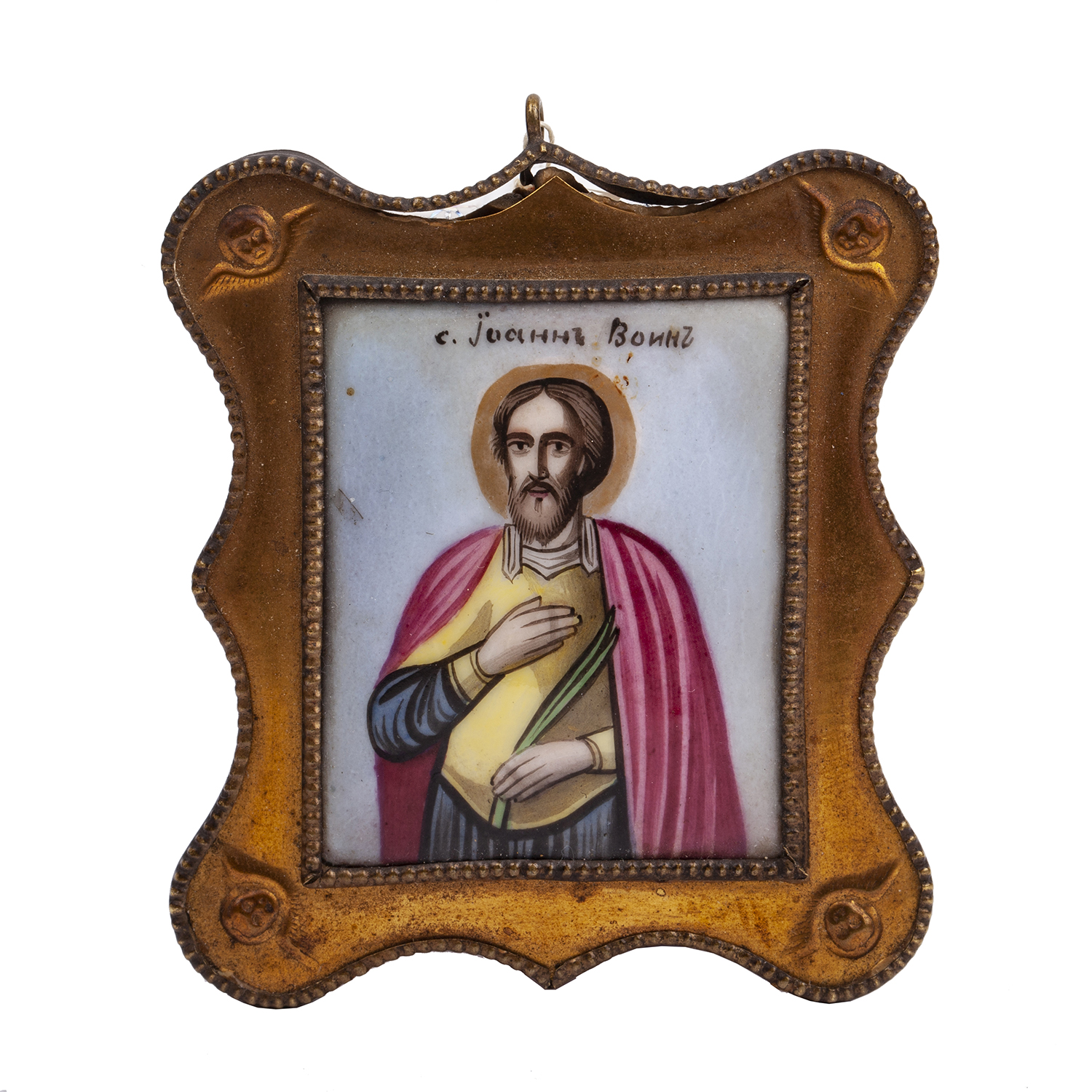
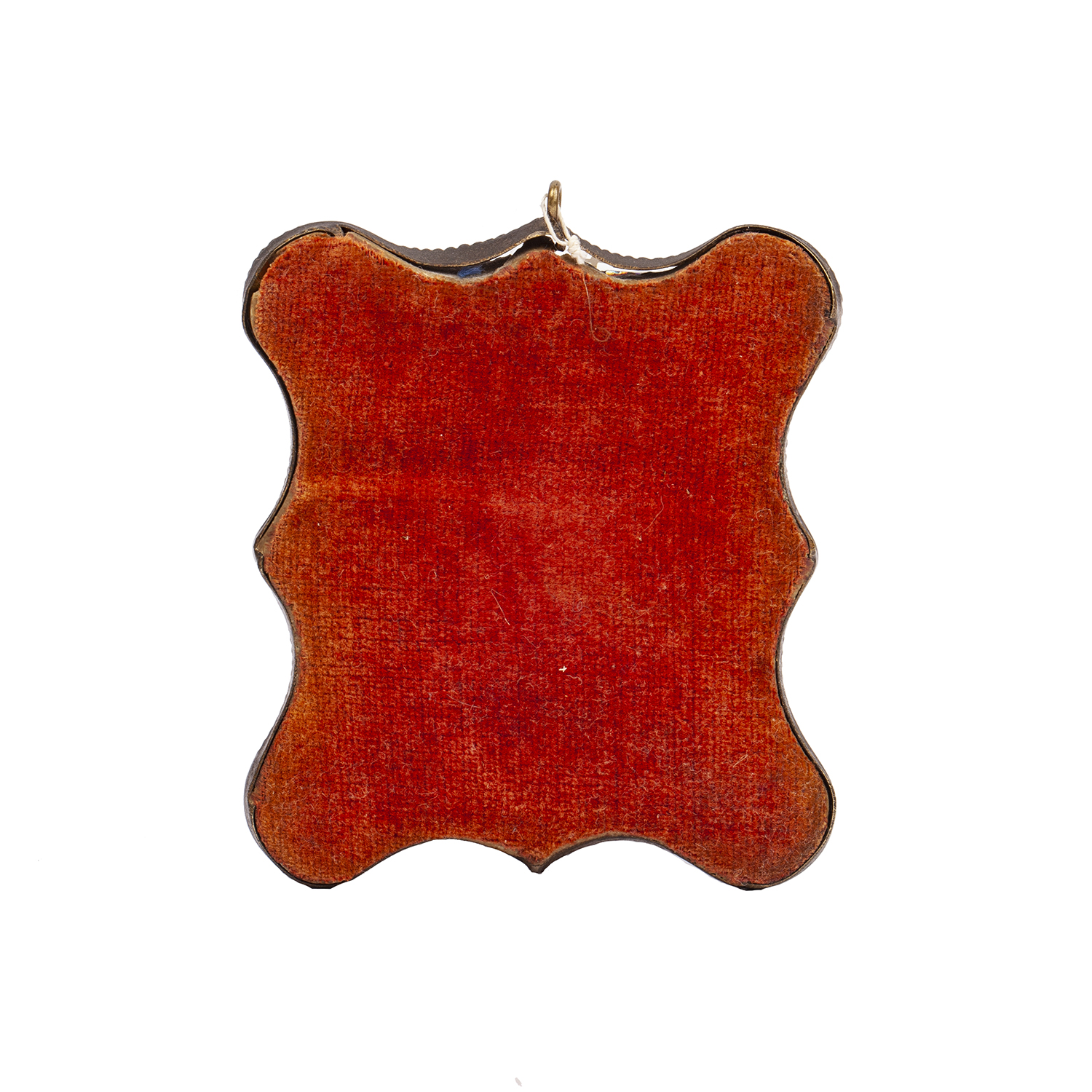
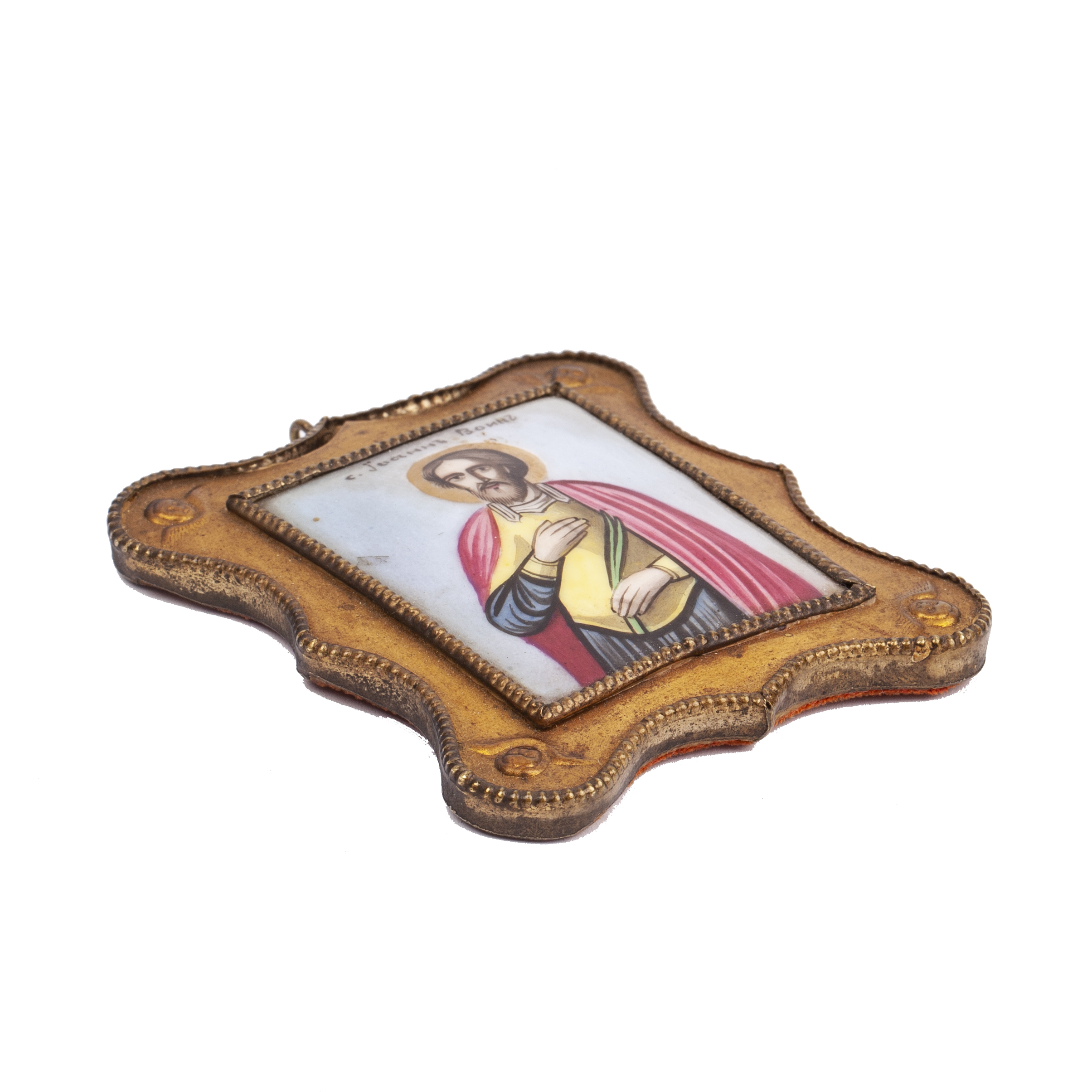
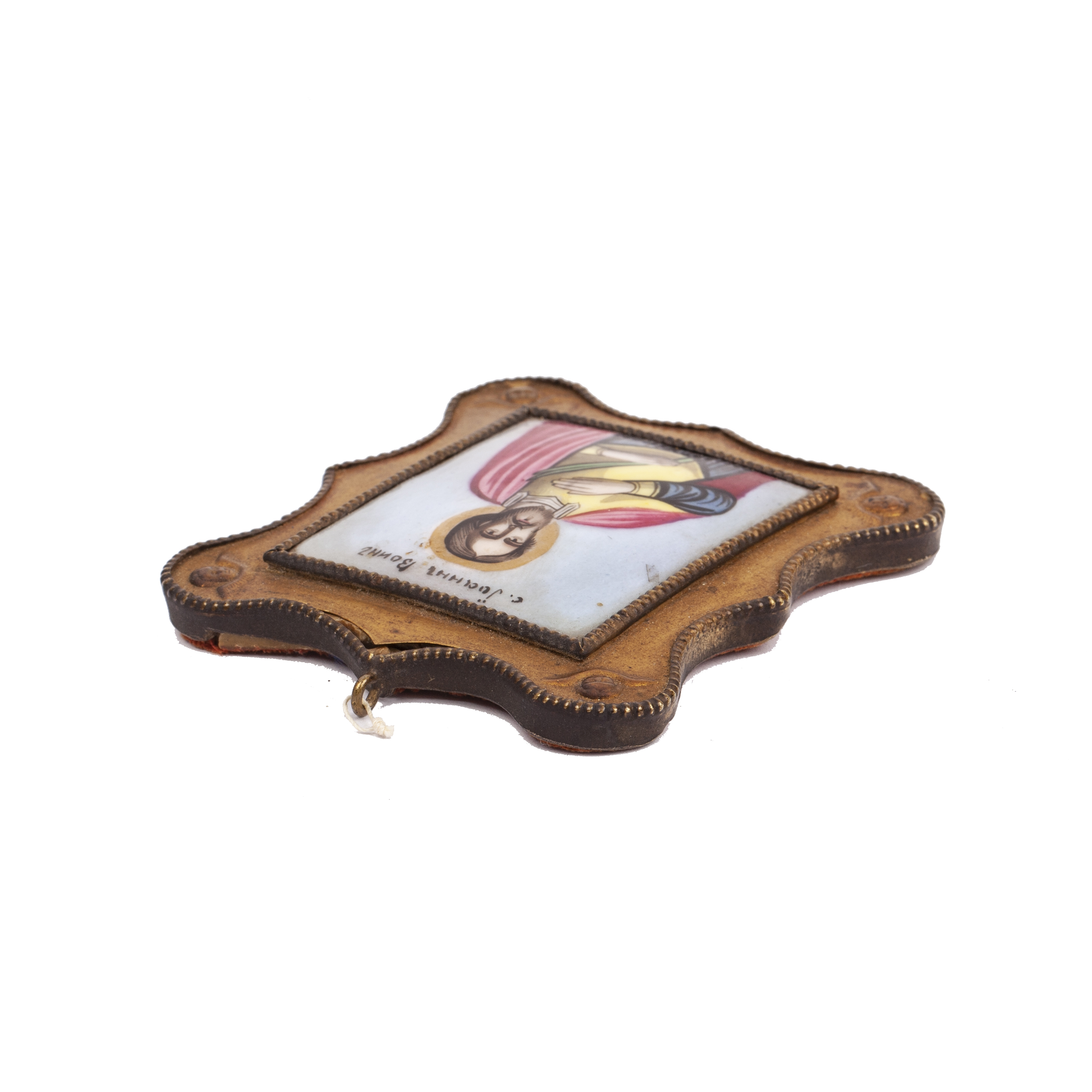
Lot 0283
A Russian pendant travel icon of “The Holy Warrior John”
Estimate: 300-400€A Russian pendant travel icon of “The Holy Warrior John”, painting on porcelain.
Dimensions with the frame: 7.3 x 6.4 x 1 cmStarting price: 250€
Estimate: 300-400€
Hammer Price: Not sold

Providing Antique Auctions