-
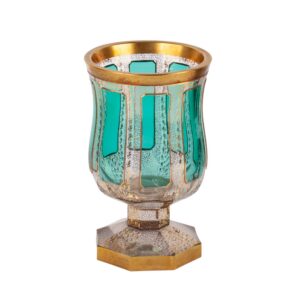
Lot 0121
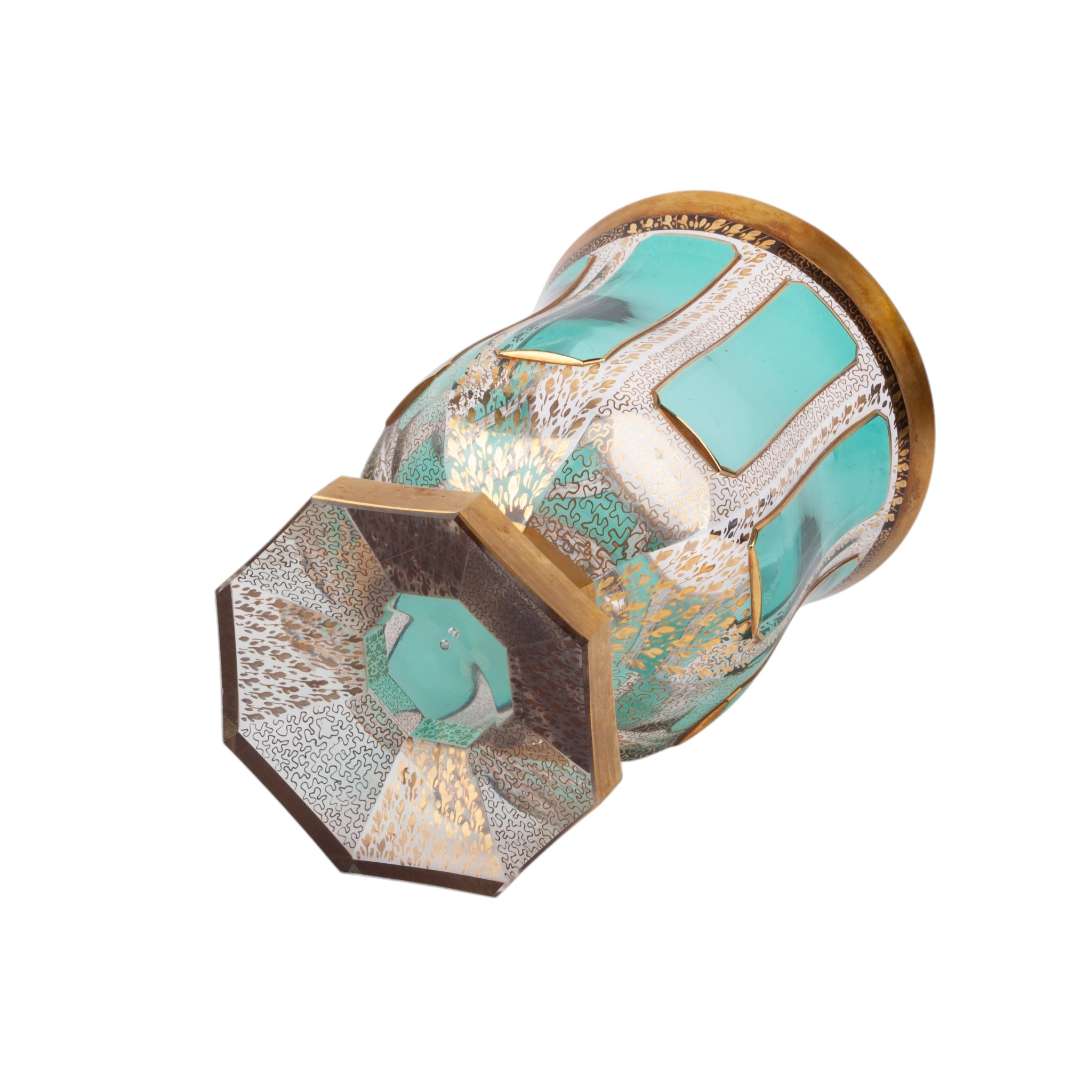
Massive Turquoise and Gilt Glass Goblet, Late 19th–Early 20th Century
Estimate: 90-100€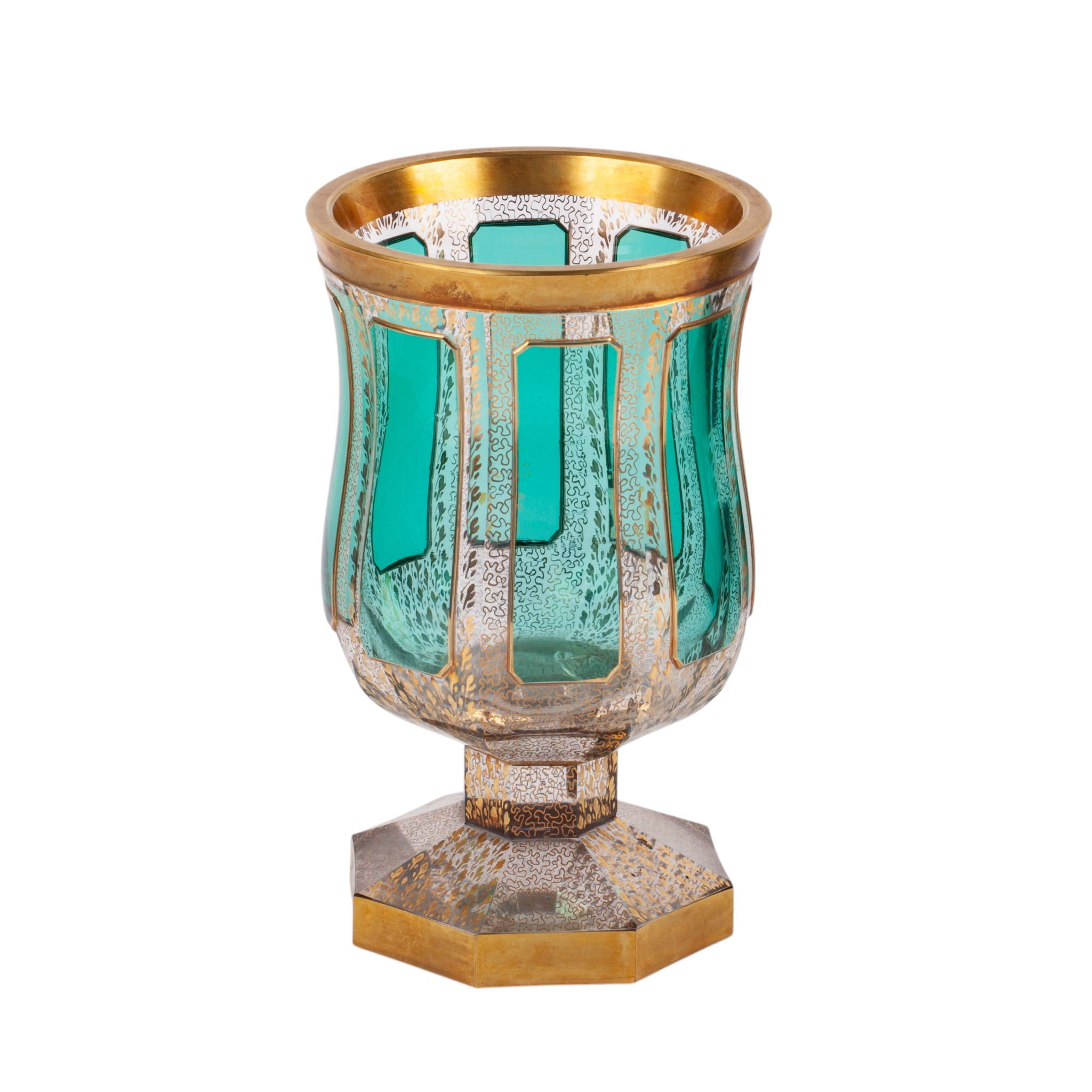
Lot 0121
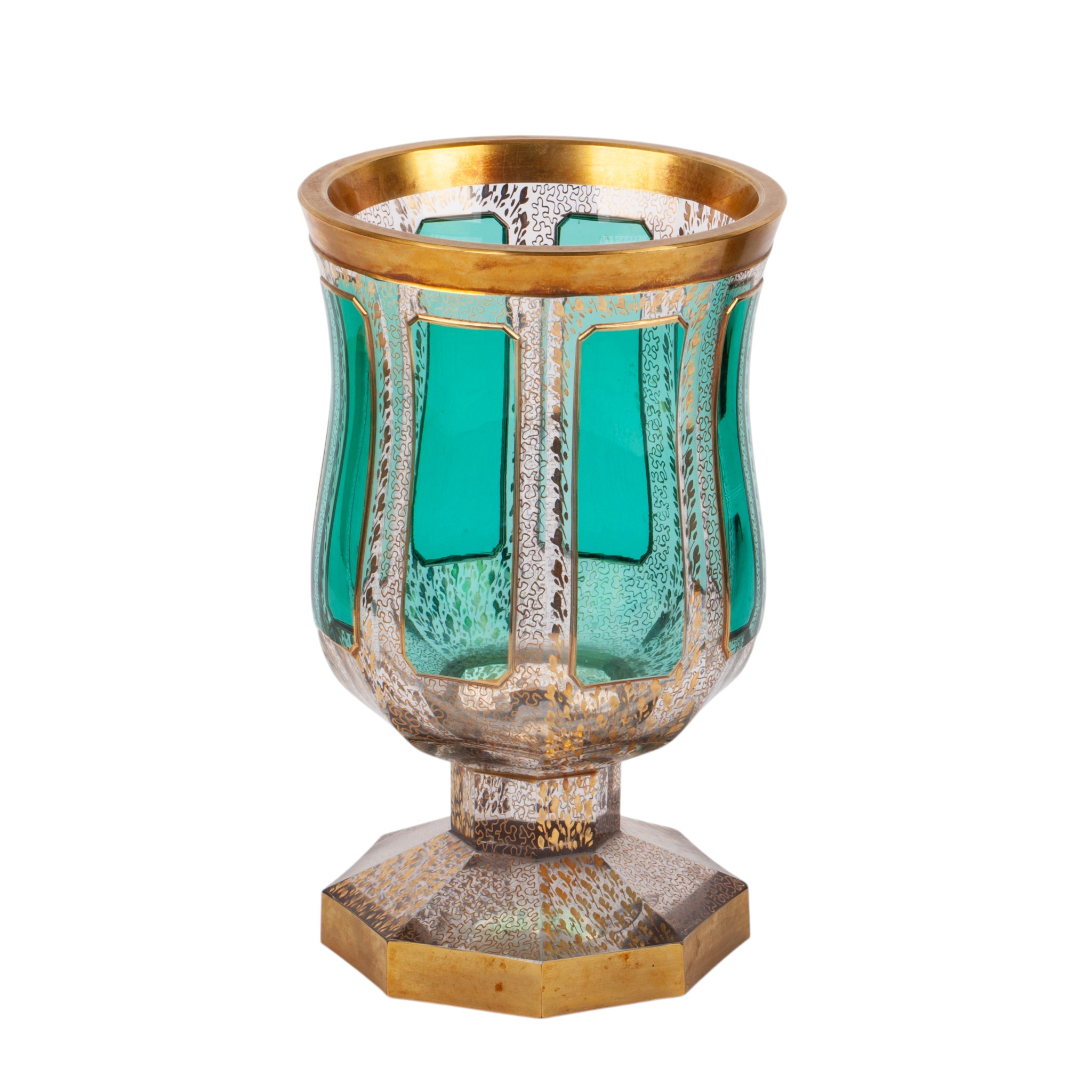
Massive Turquoise and Gilt Glass Goblet, Late 19th–Early 20th Century
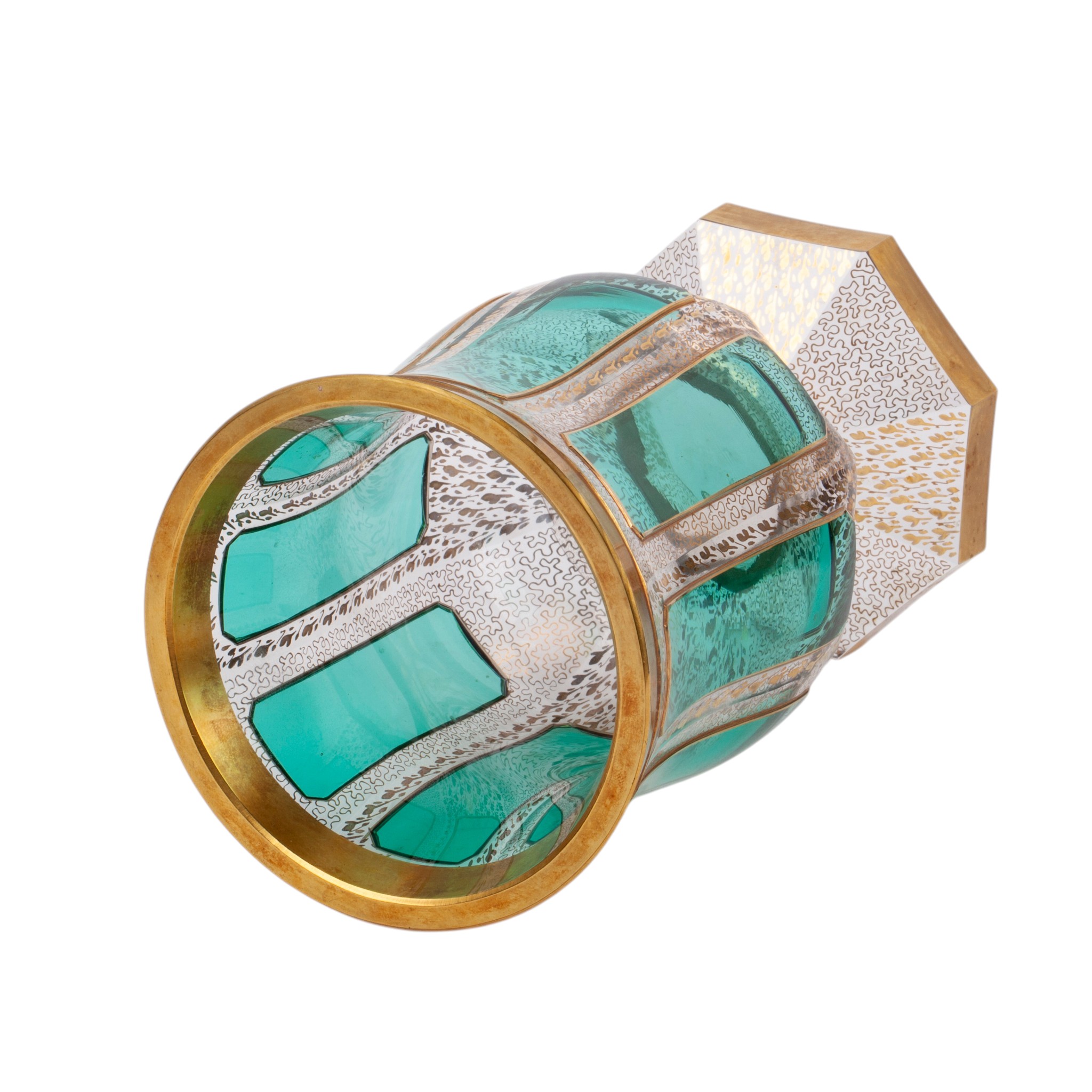
Estimate: 90-100€Massive turquoise and gilt glass goblet, late 19th to early 20th century
Elegant goblet with turquoise glass panels, richly heightened with gilt decoration and raised on a faceted geometric foot. A decorative example of Central European glass in the Bohemian taste. Height: 15.5 cm.
Starting price: 80€
Estimate: 90-100€
Hammer Price: Not sold -
Lot 0122
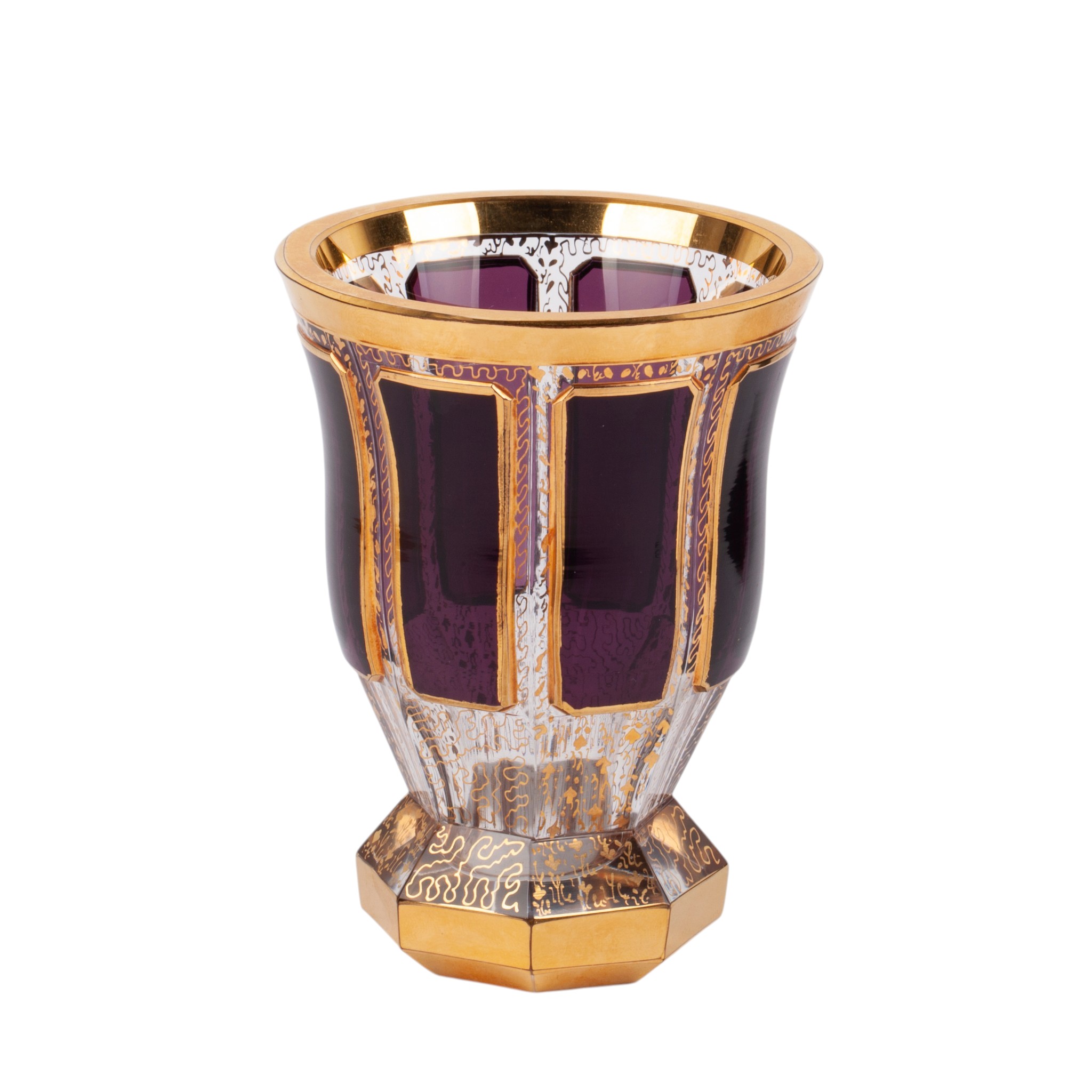
Cut Clear Glass Goblet with Gilt Bands, Late 19th–Early 20th Century
Estimate: 120-150€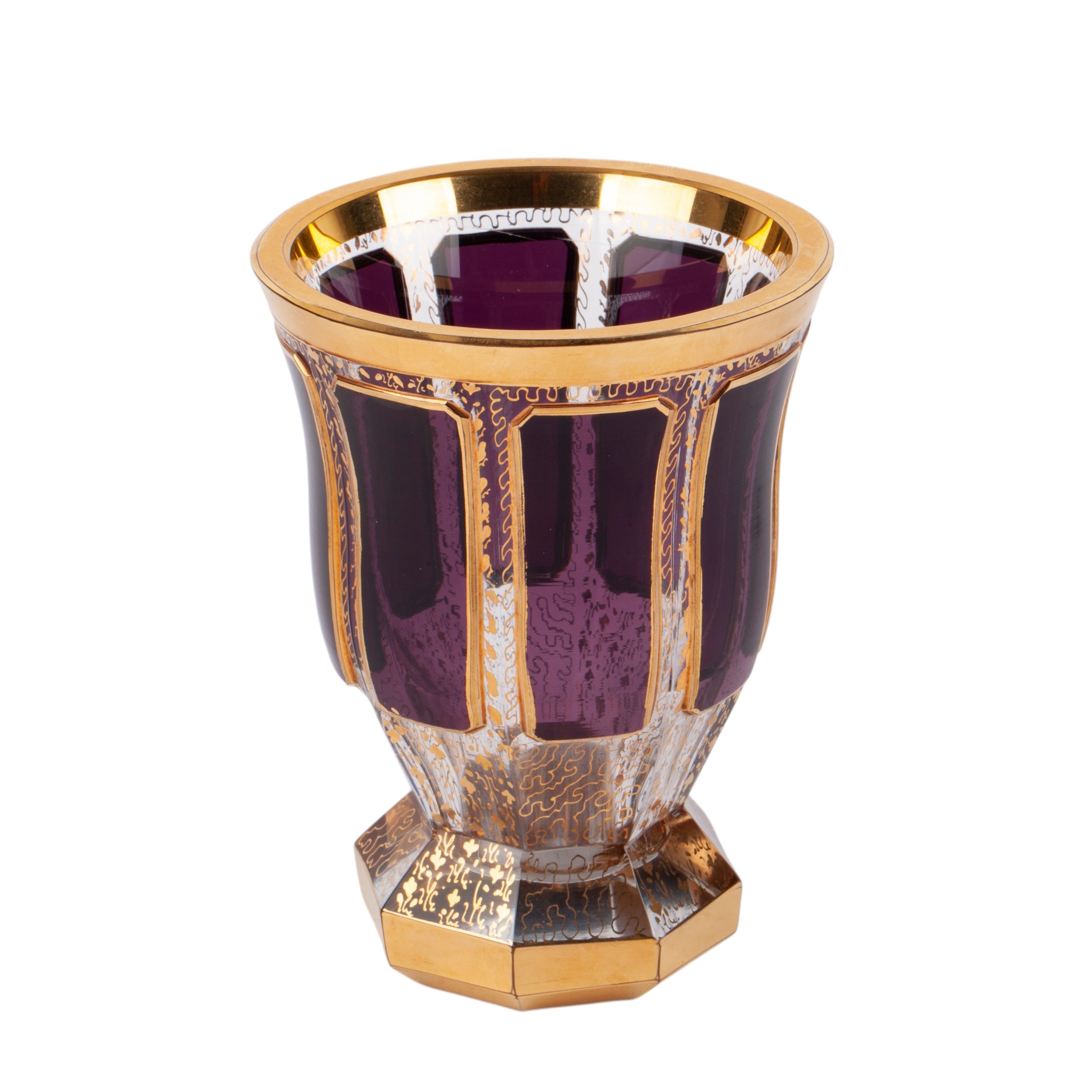
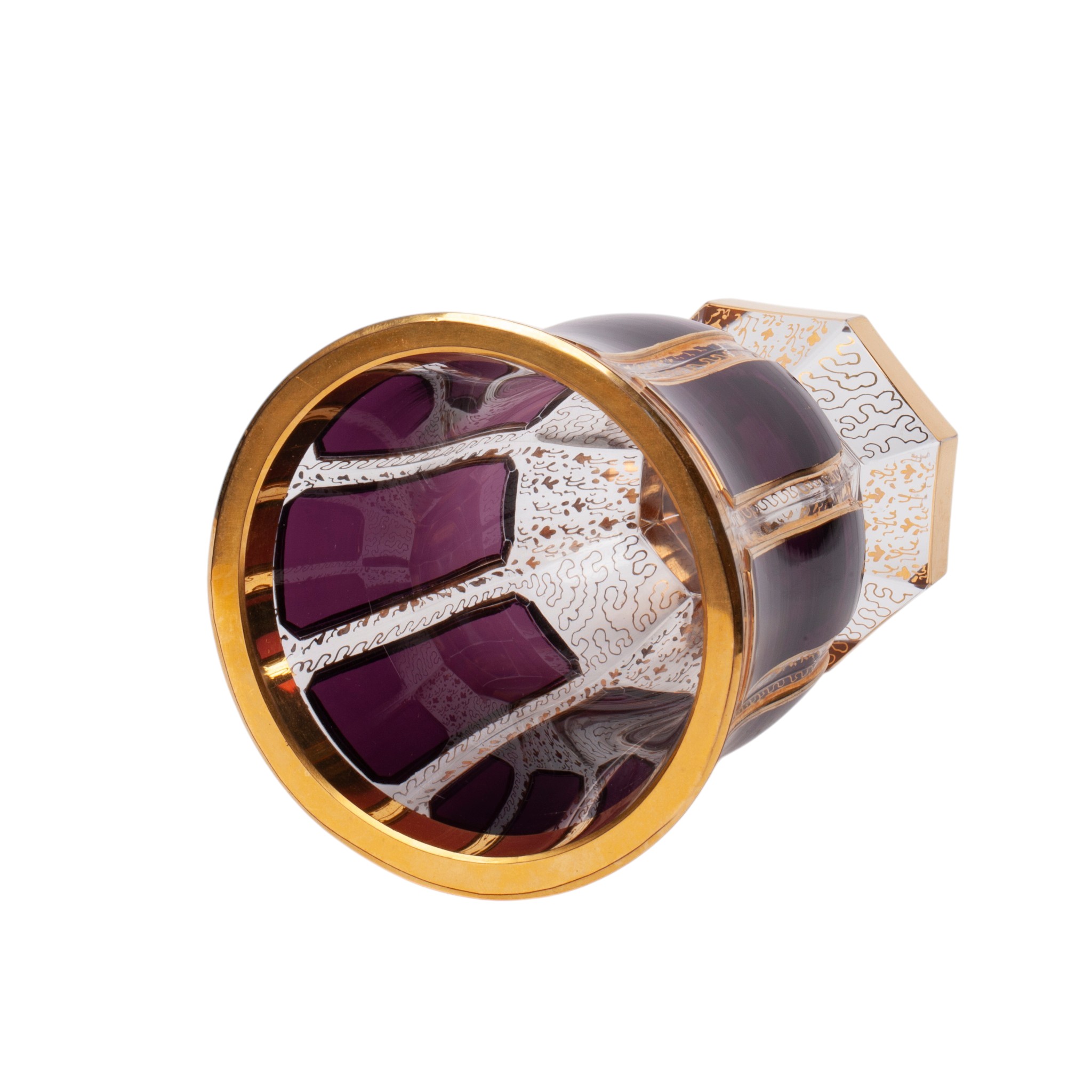
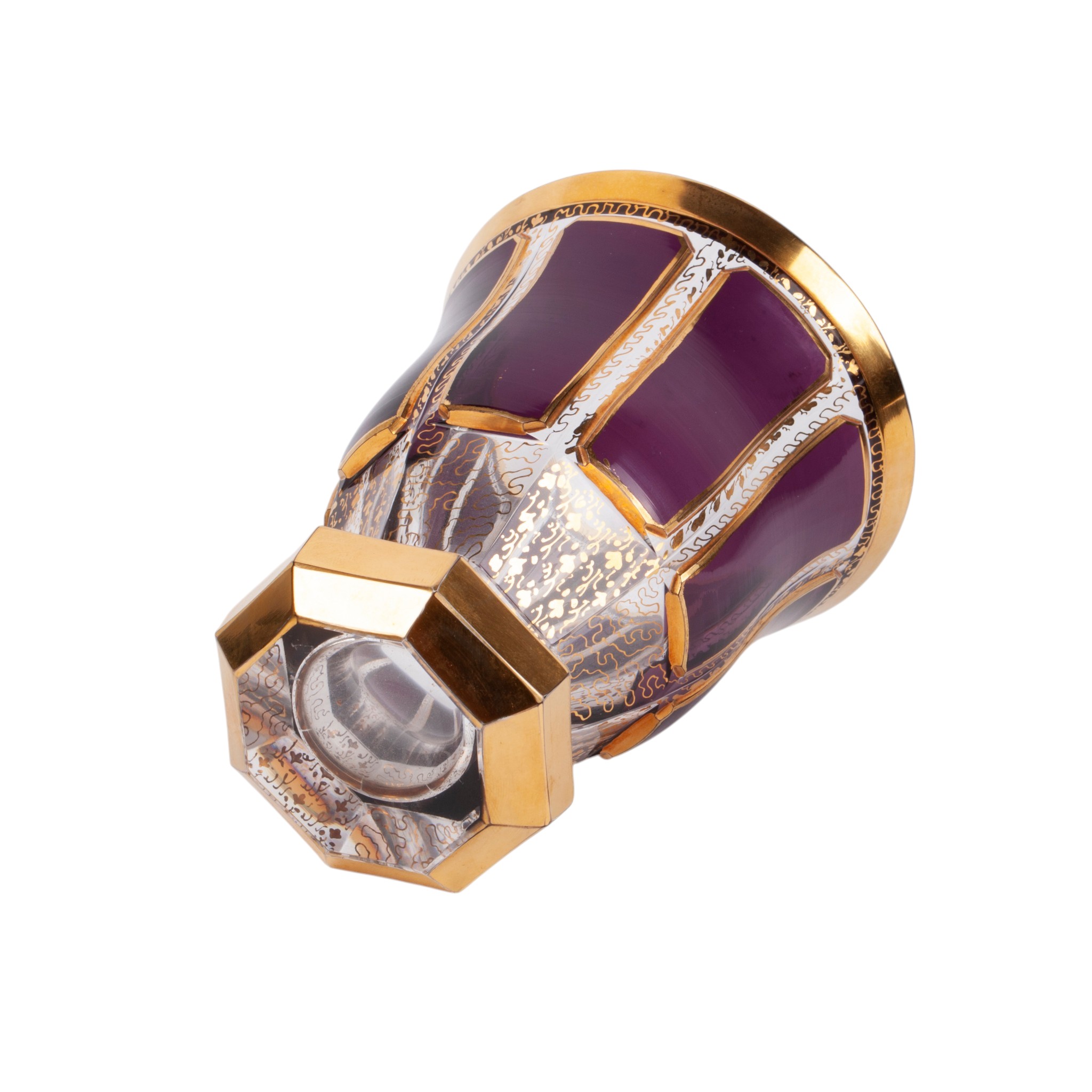
Lot 0122
Cut Clear Glass Goblet with Gilt Bands, Late 19th–Early 20th Century
Estimate: 120-150€Cut clear glass goblet with gilt bands, late 19th to early 20th century
Clear glass goblet with finely cut geometric ornament, a baluster stem and a shaped foot, accented with gilt bands. A decorative example of Central European glass in the Bohemian taste. Height: 12 cm.
Starting price: 100€
Estimate: 120-150€
Hammer Price: Not sold -
Lot 0123
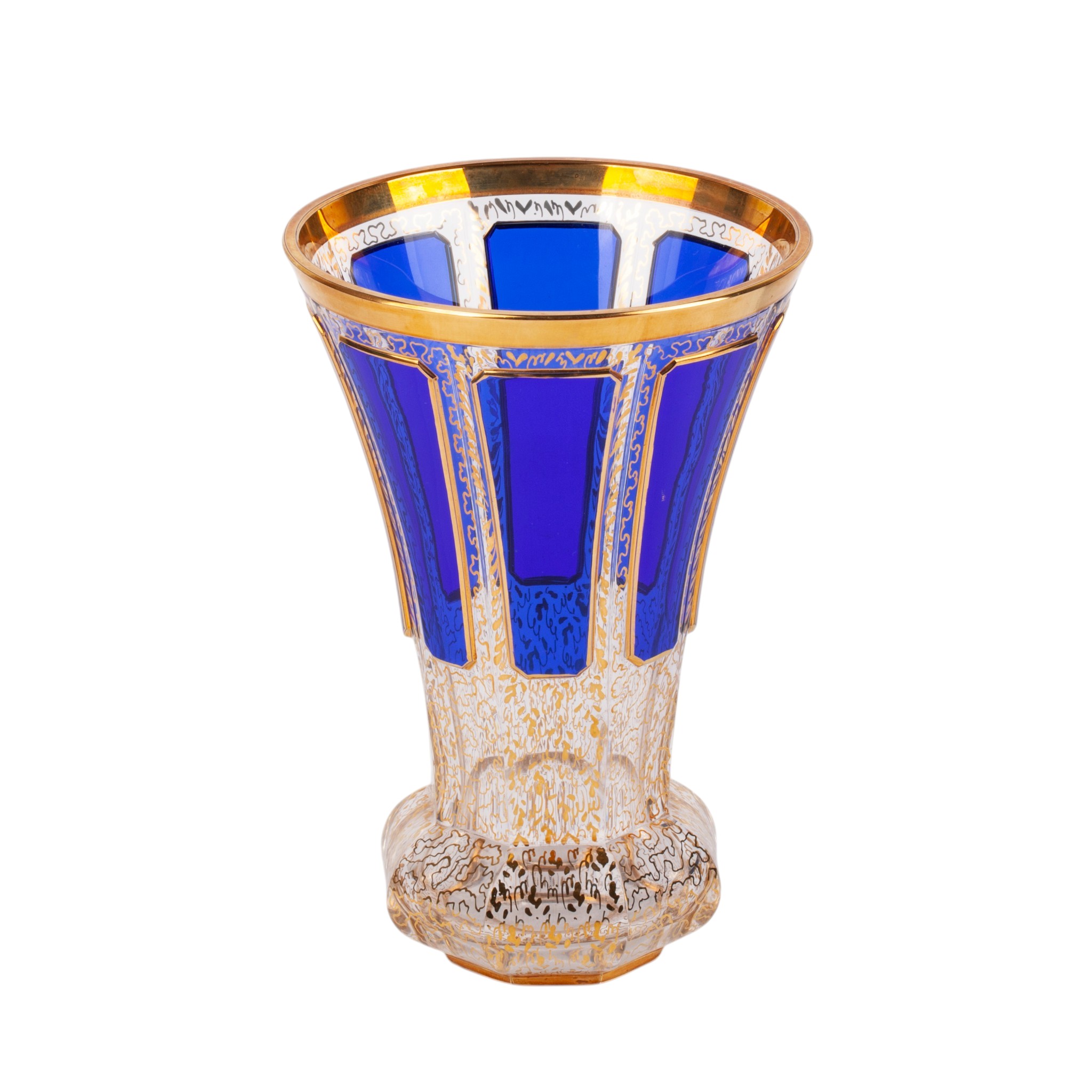
Cobalt Blue and Gilt Glass Vase, Late 19th–Early 20th Century
Estimate: 100-110€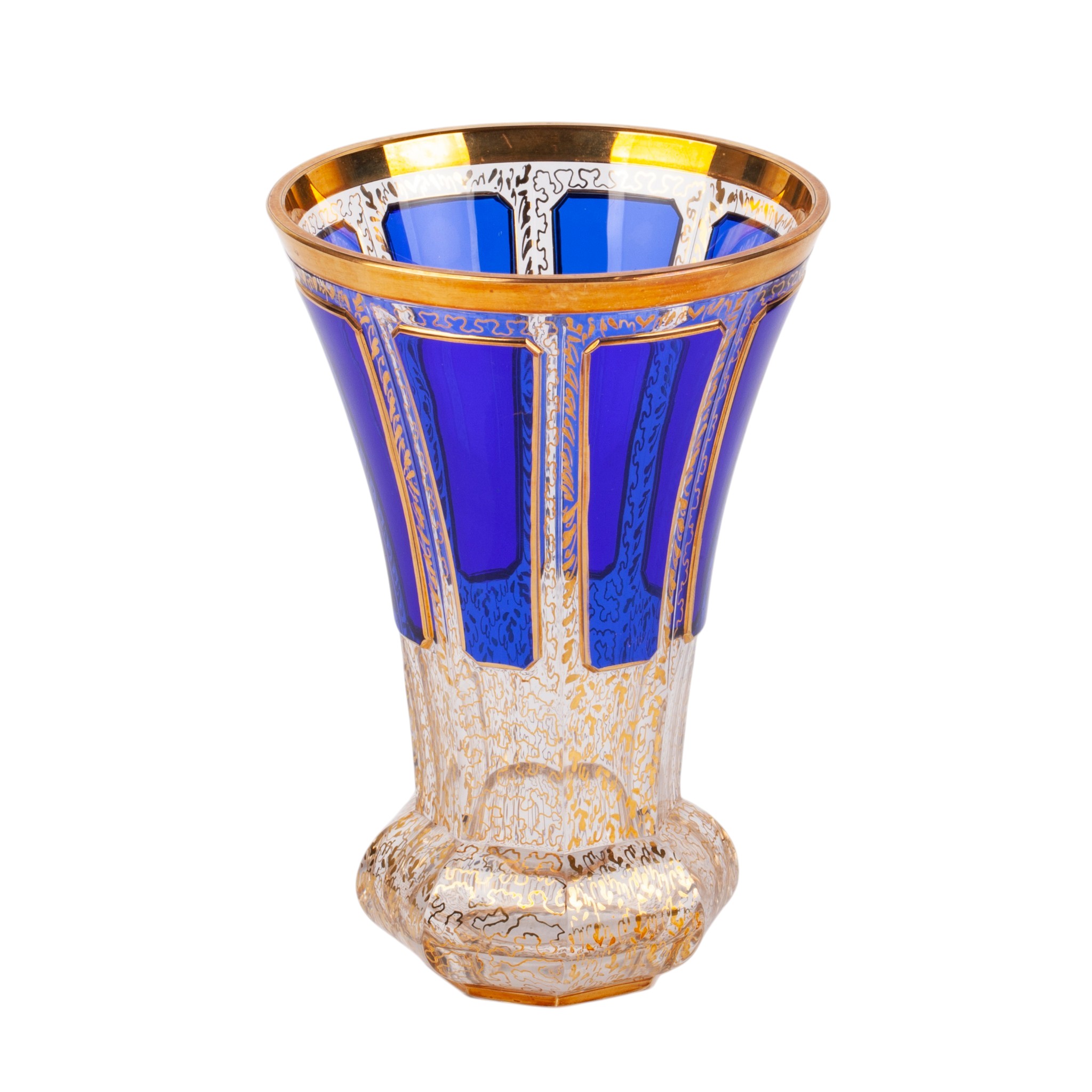
Lot 0123
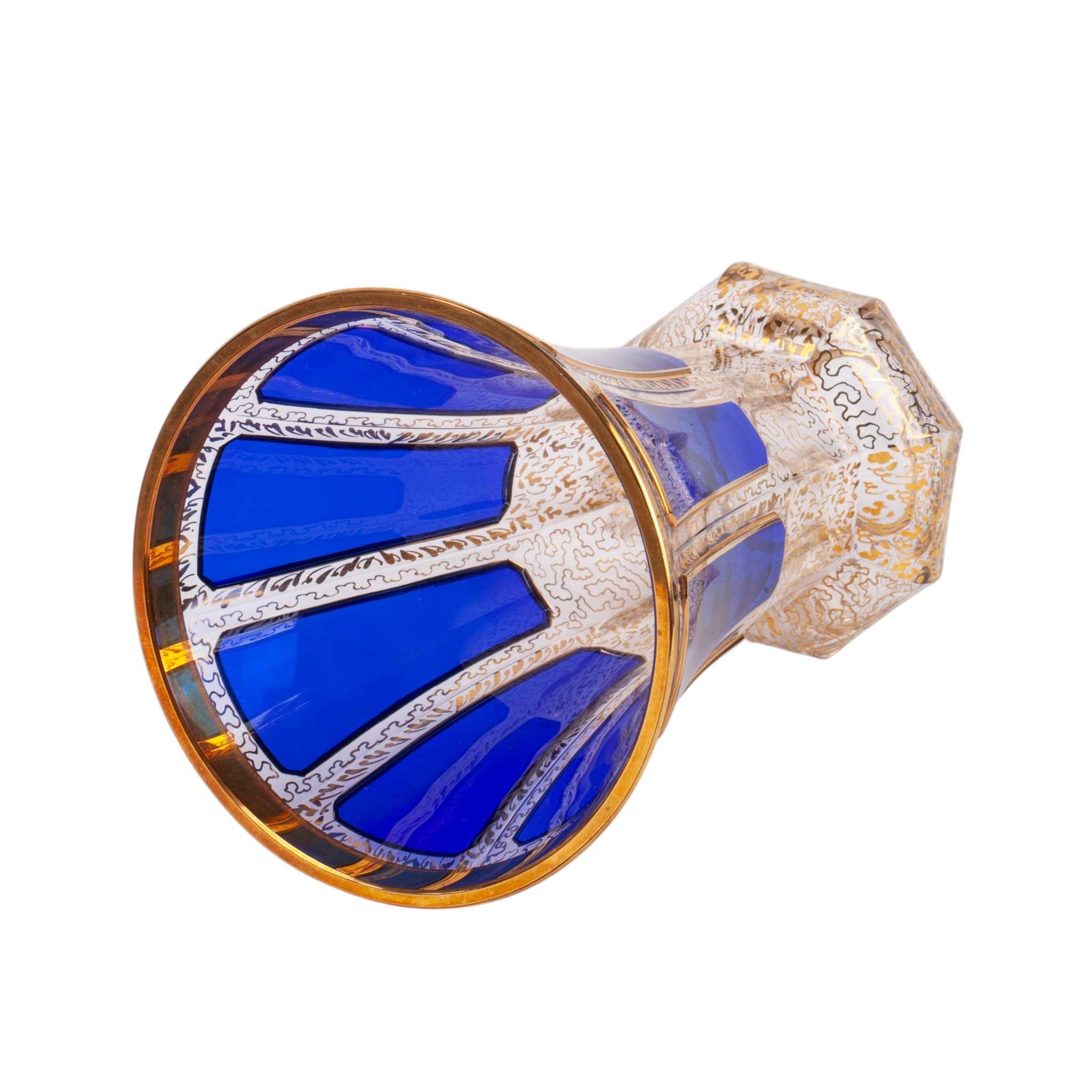
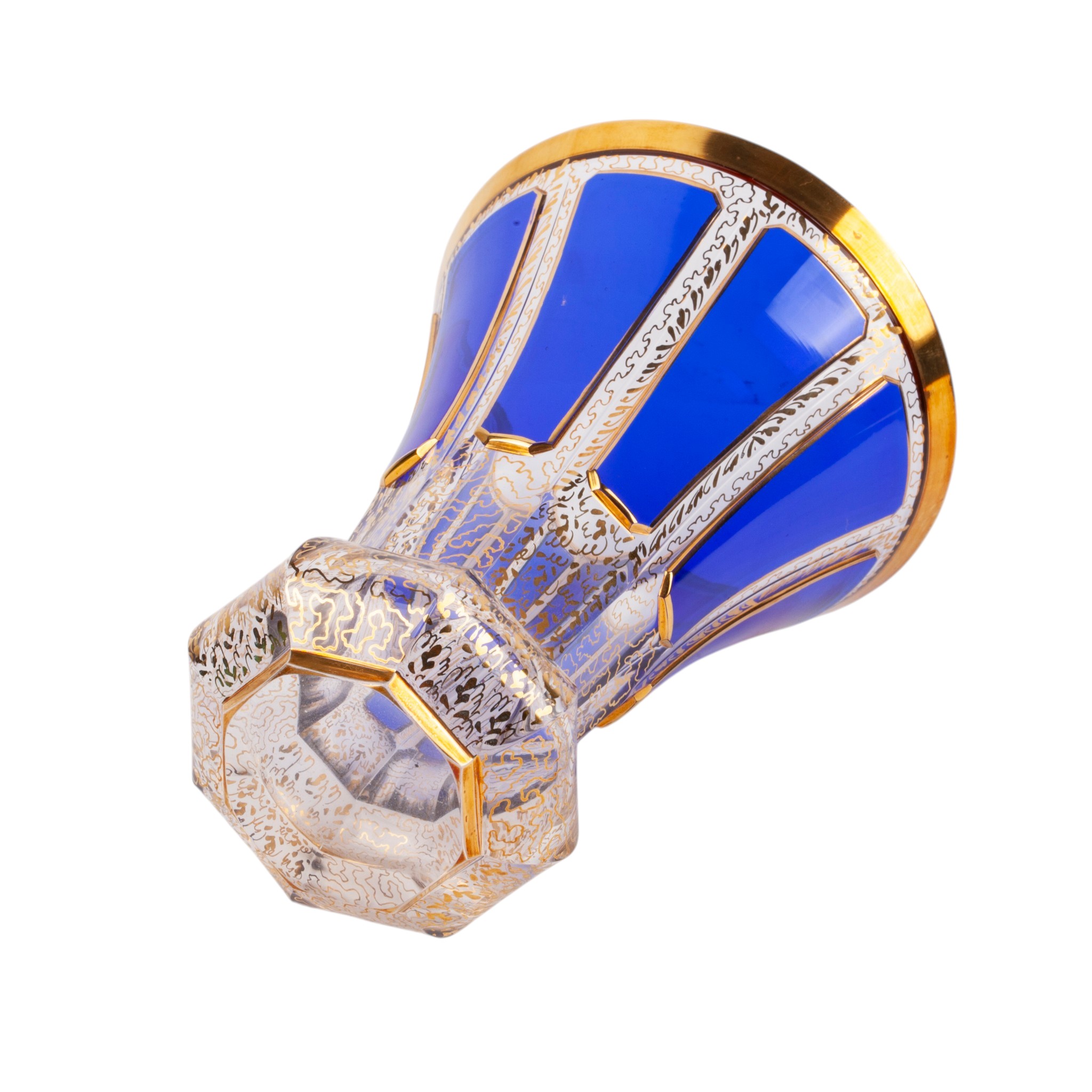
Cobalt Blue and Gilt Glass Vase, Late 19th–Early 20th Century
Estimate: 100-110€Cobalt blue and gilt glass vase, late 19th to early 20th century
Elegant vase with deep cobalt-blue panels, richly heightened with gilt decoration and raised on a shaped foot. A decorative example of Central European glass in the Bohemian taste. Height: 14 cm.
Starting price: 90€
Estimate: 100-110€
Hammer Price: Not sold -
Lot 0124
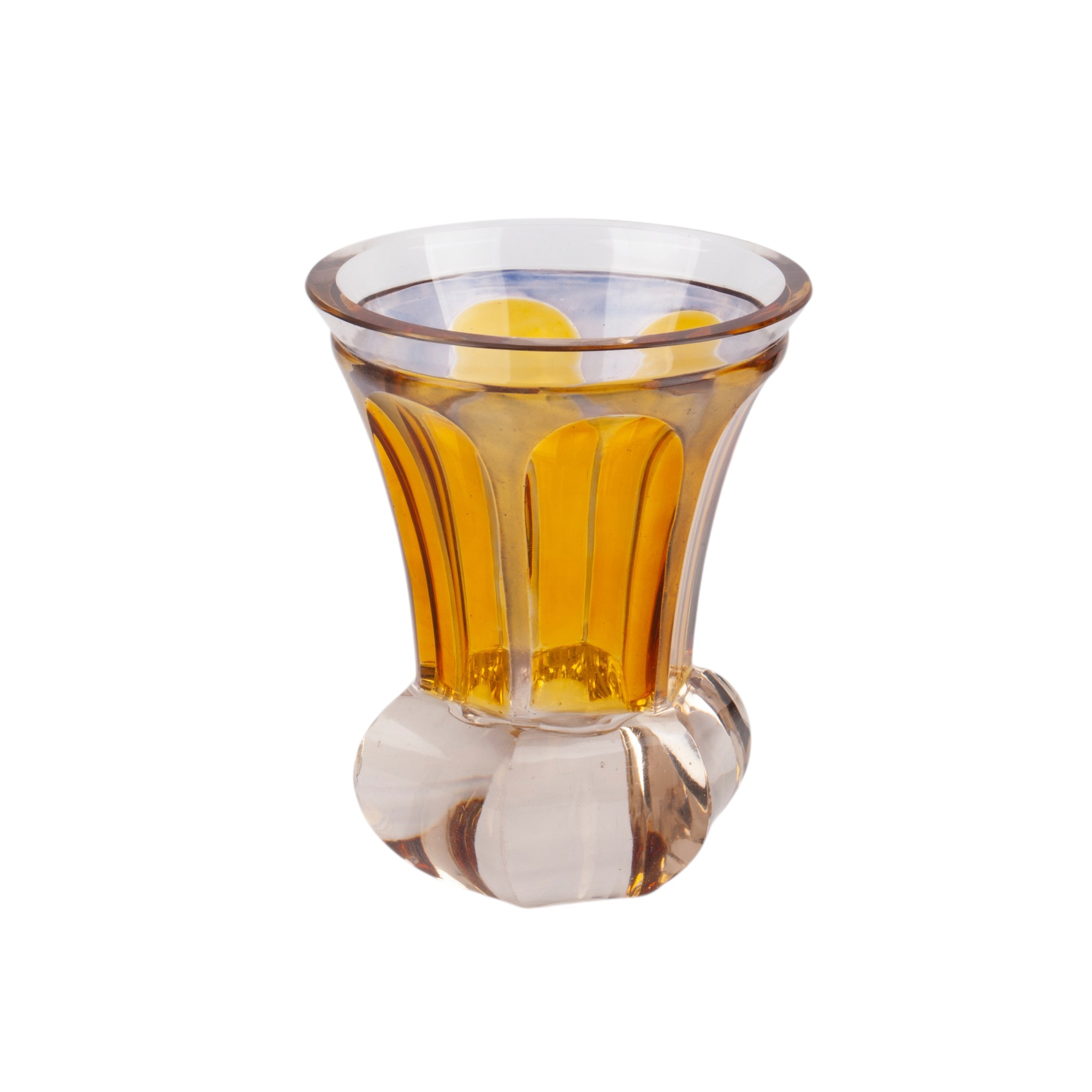
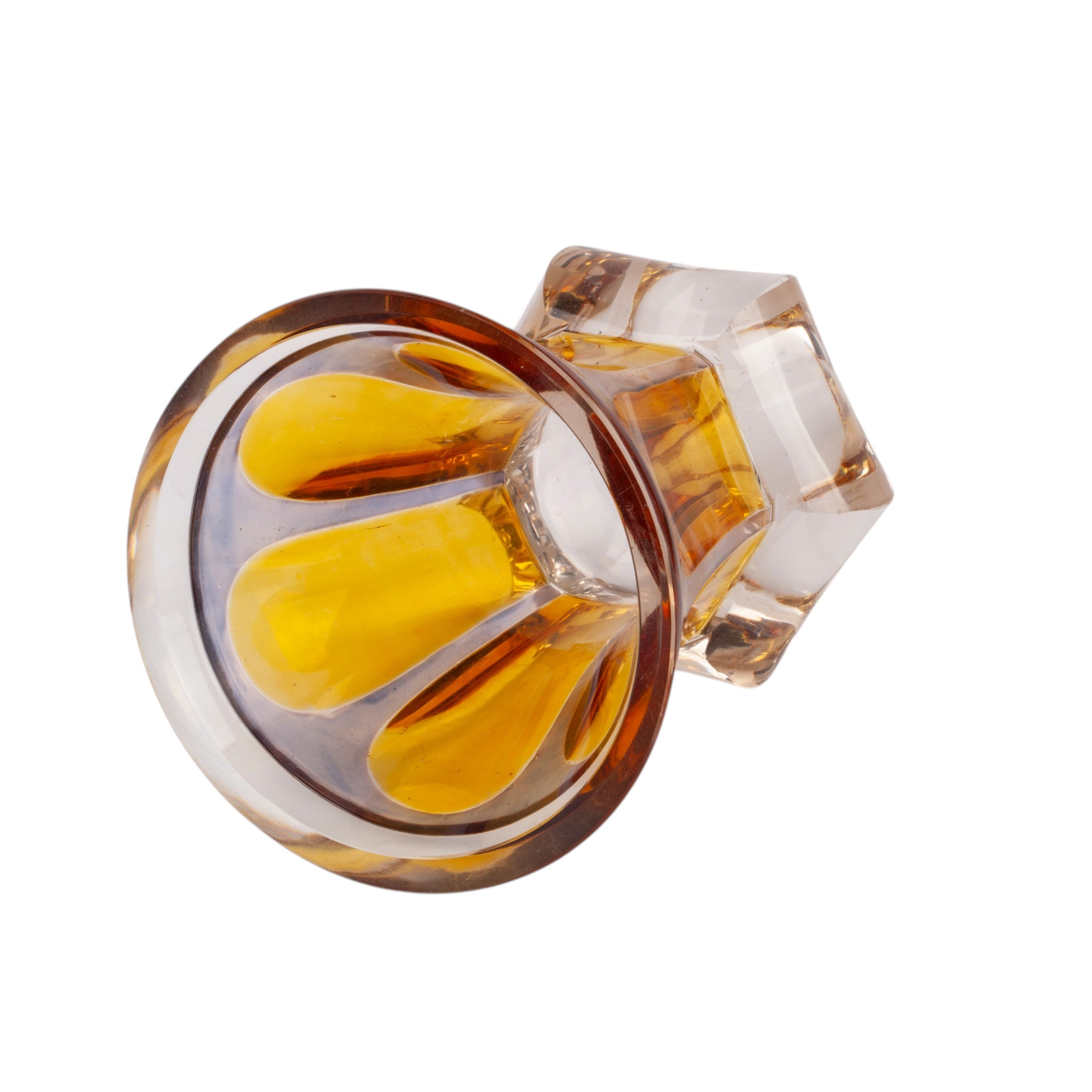
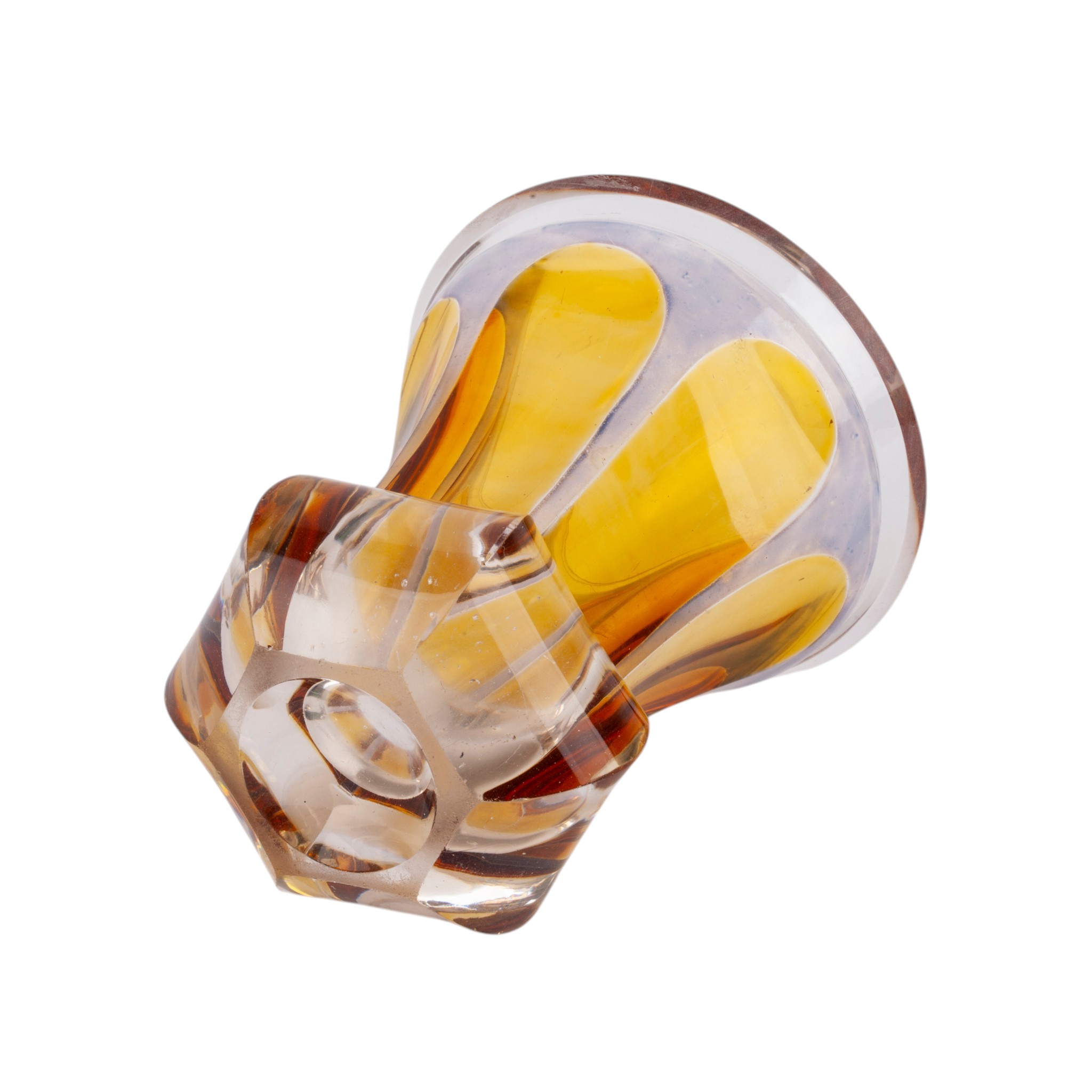
Amber-Coloured and Clear Glass Vase, Late 19th–Early 20th Century
Estimate: 60-70€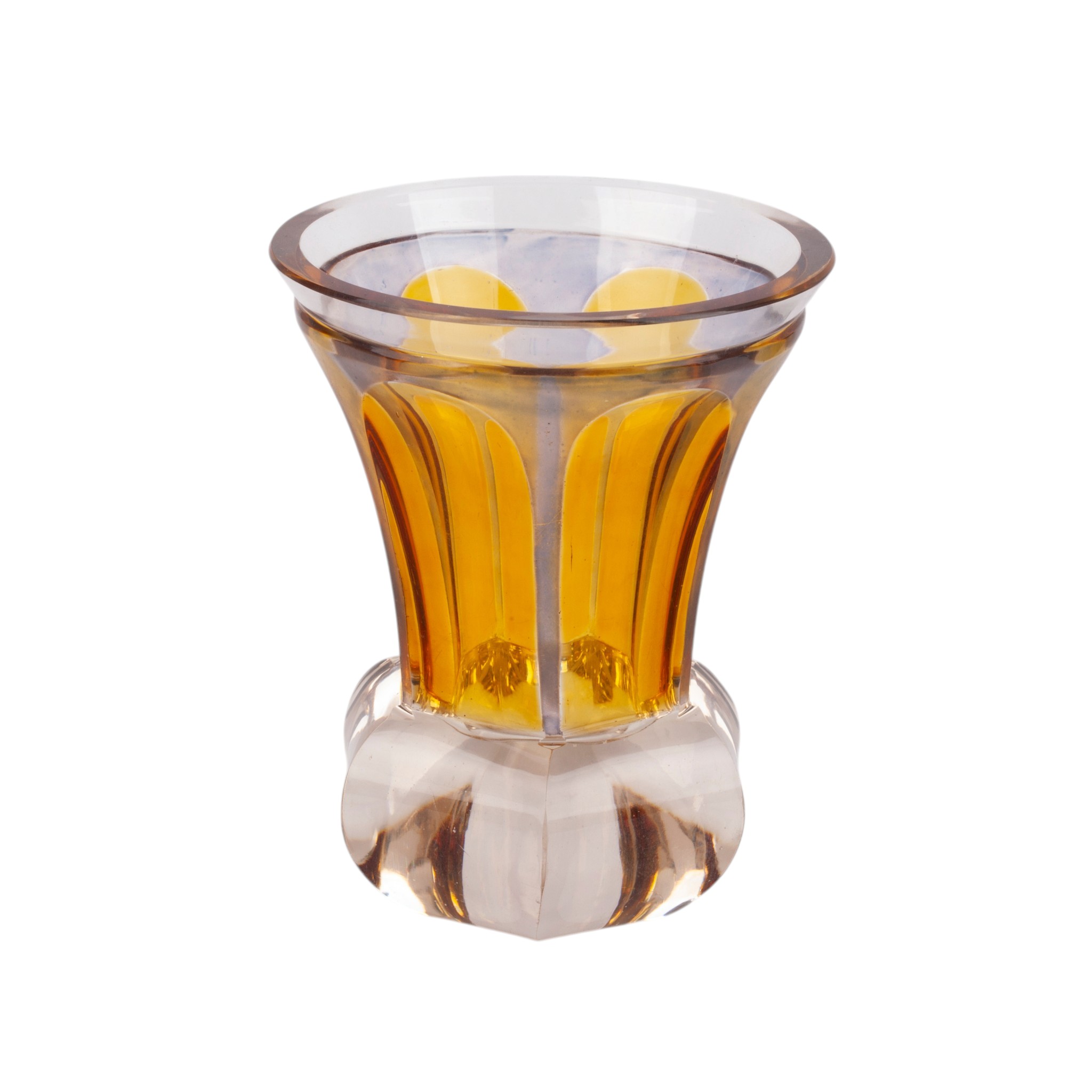
Lot 0124
Amber-Coloured and Clear Glass Vase, Late 19th–Early 20th Century
Estimate: 60-70€Amber-coloured and clear glass vase, late 19th to early 20th century
Elegant vase with amber-coloured panels and a clear shaped foot. A decorative example of Central European glass in the Bohemian taste. Height: 12.5 cm.
Starting price: 50€
Estimate: 60-70€
Hammer Price: Not sold -
Lot 0125
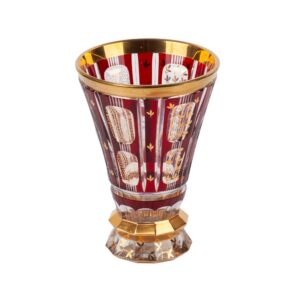
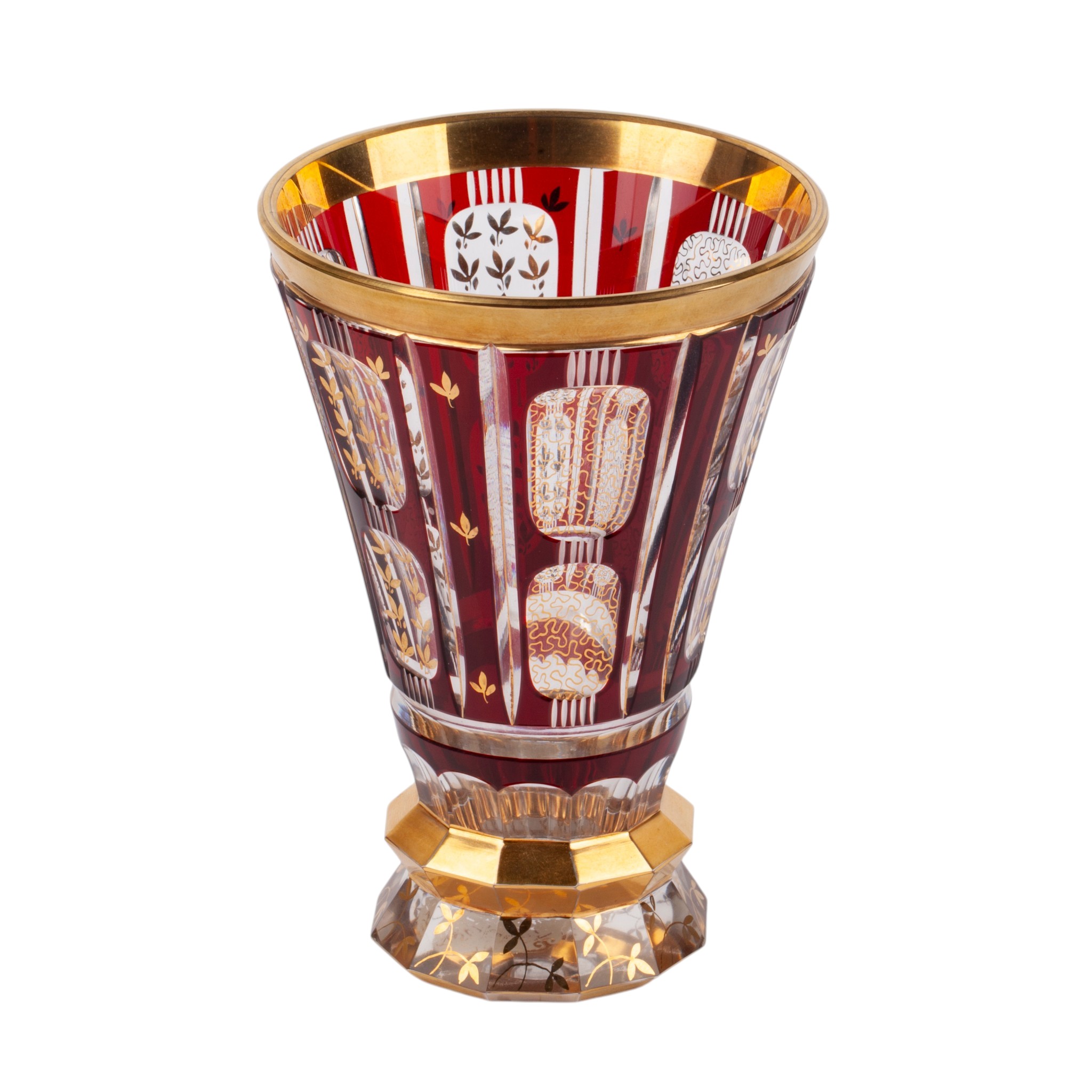
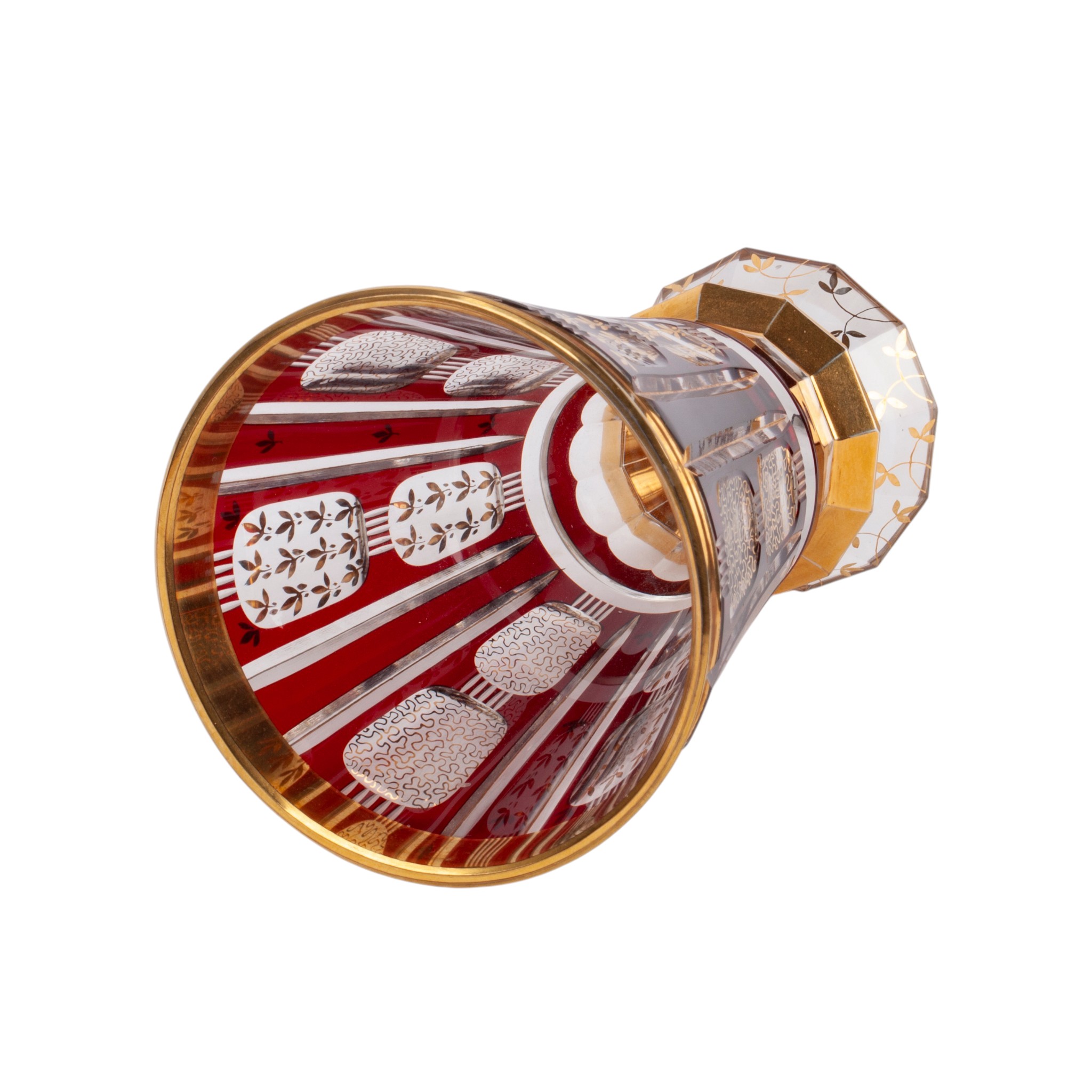
Ruby and Gilt Glass Goblet, Late 19th–Early 20th Century
Estimate: 120-150€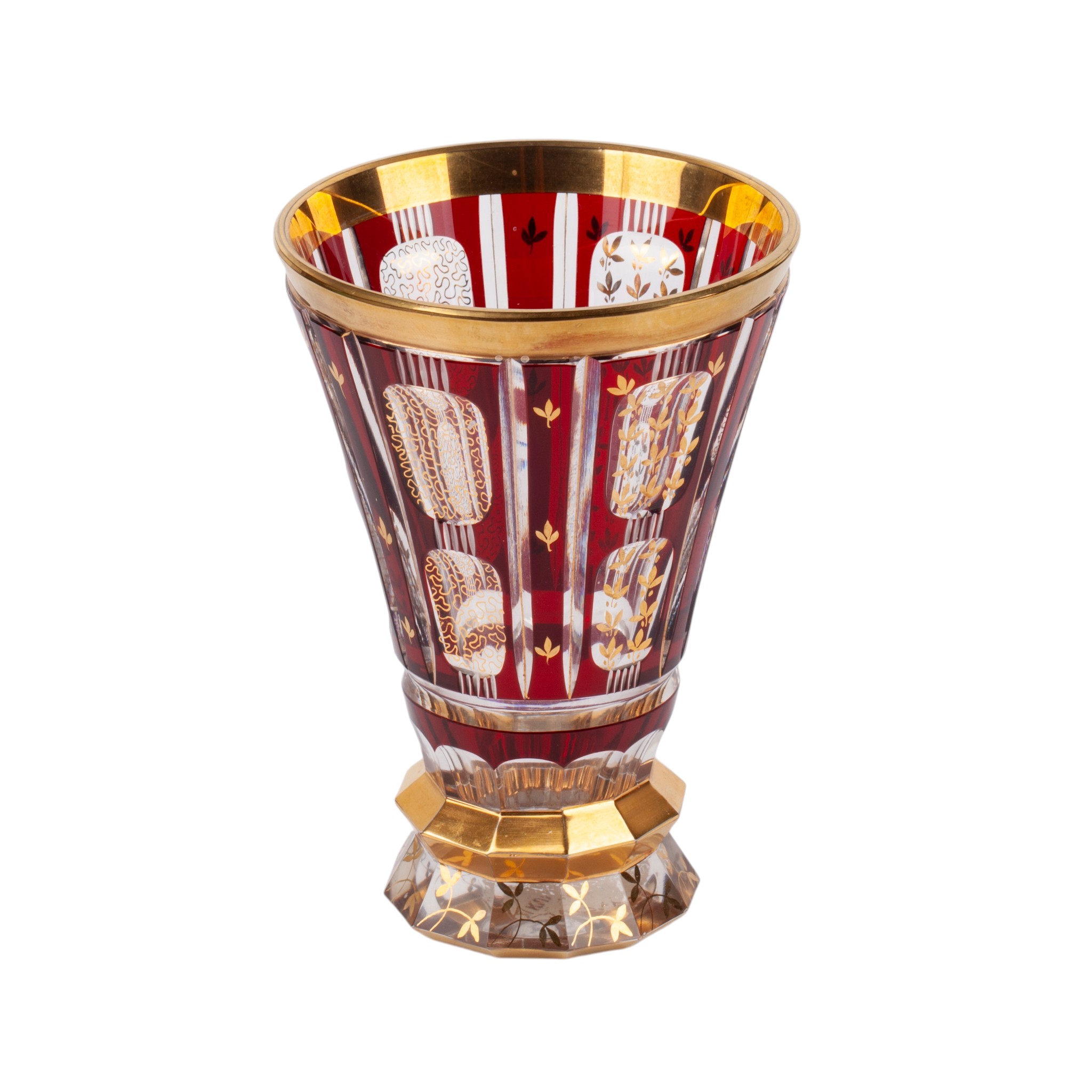
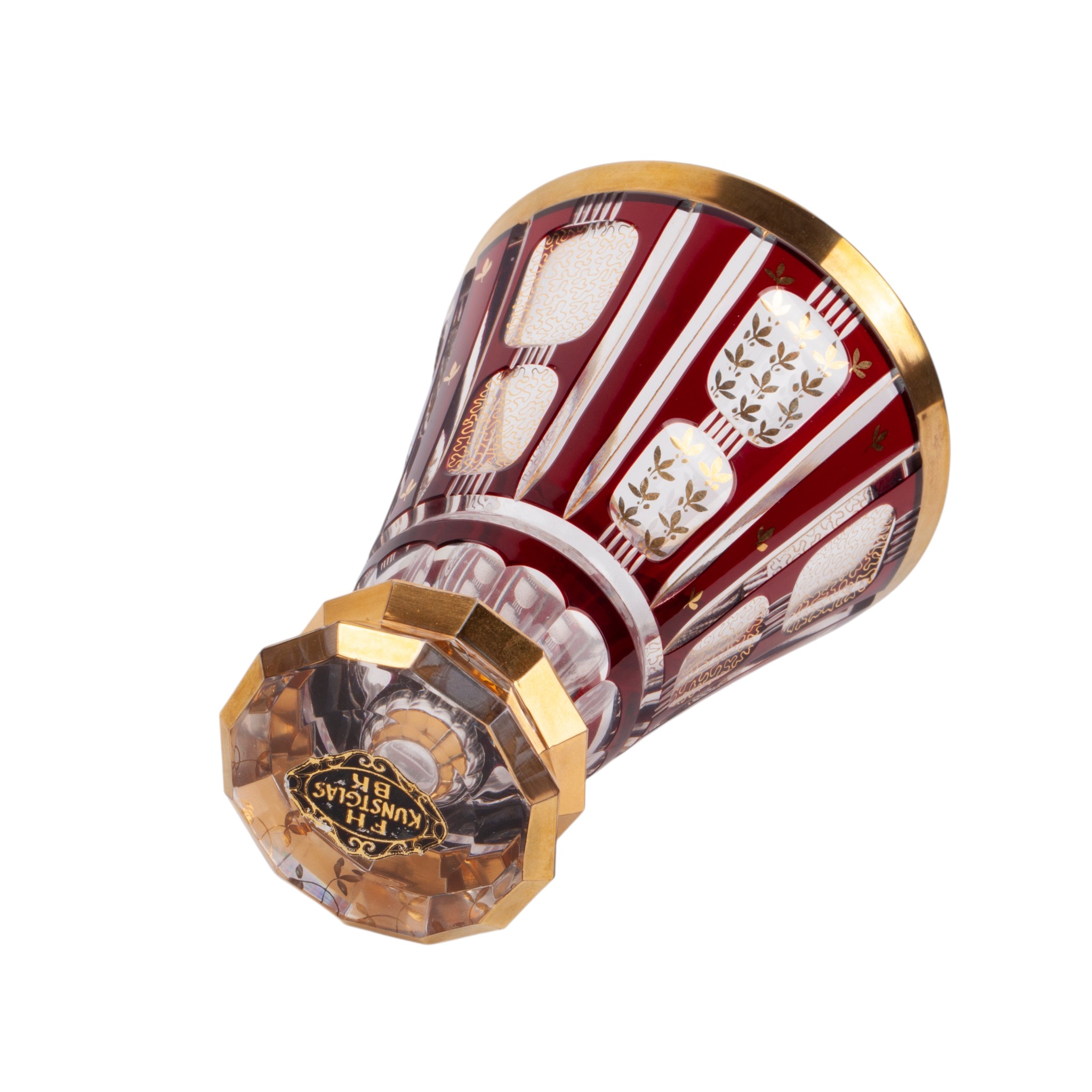
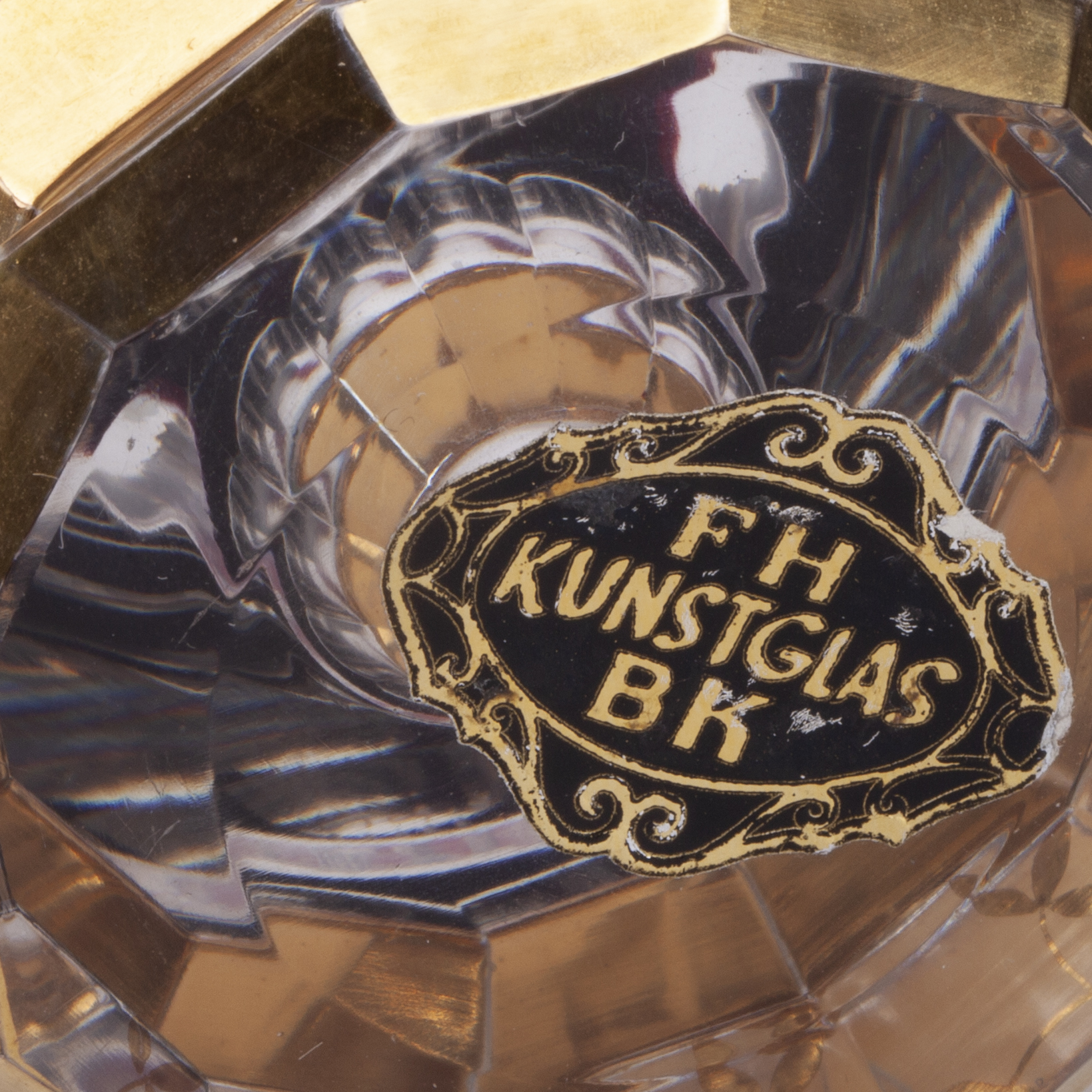
Lot 0125
Ruby and Gilt Glass Goblet, Late 19th–Early 20th Century
Estimate: 120-150€Ruby and gilt glass goblet, late 19th to early 20th century
Elegant ruby glass goblet with gilt and white ornament, flared body and faceted foot. A decorative example of Central European glass in the Bohemian taste. Height: 12 cm.
Starting price: 100€
Estimate: 120-150€
Hammer Price: Not sold -
Lot 0126
Small Ruby and Gilt Glass Vase / Beaker, Late 19th–Early 20th Century
Estimate: 60-70€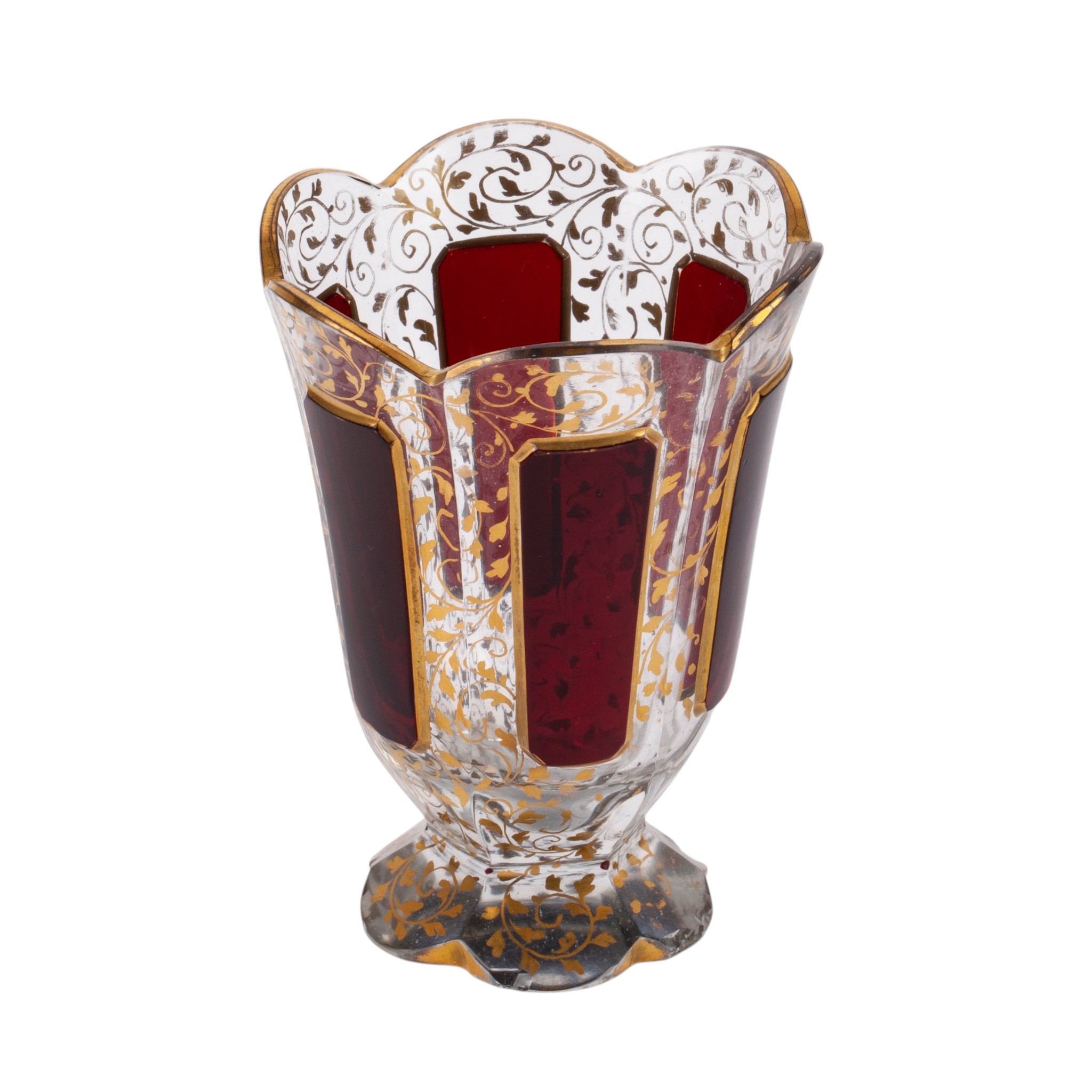
Lot 0126
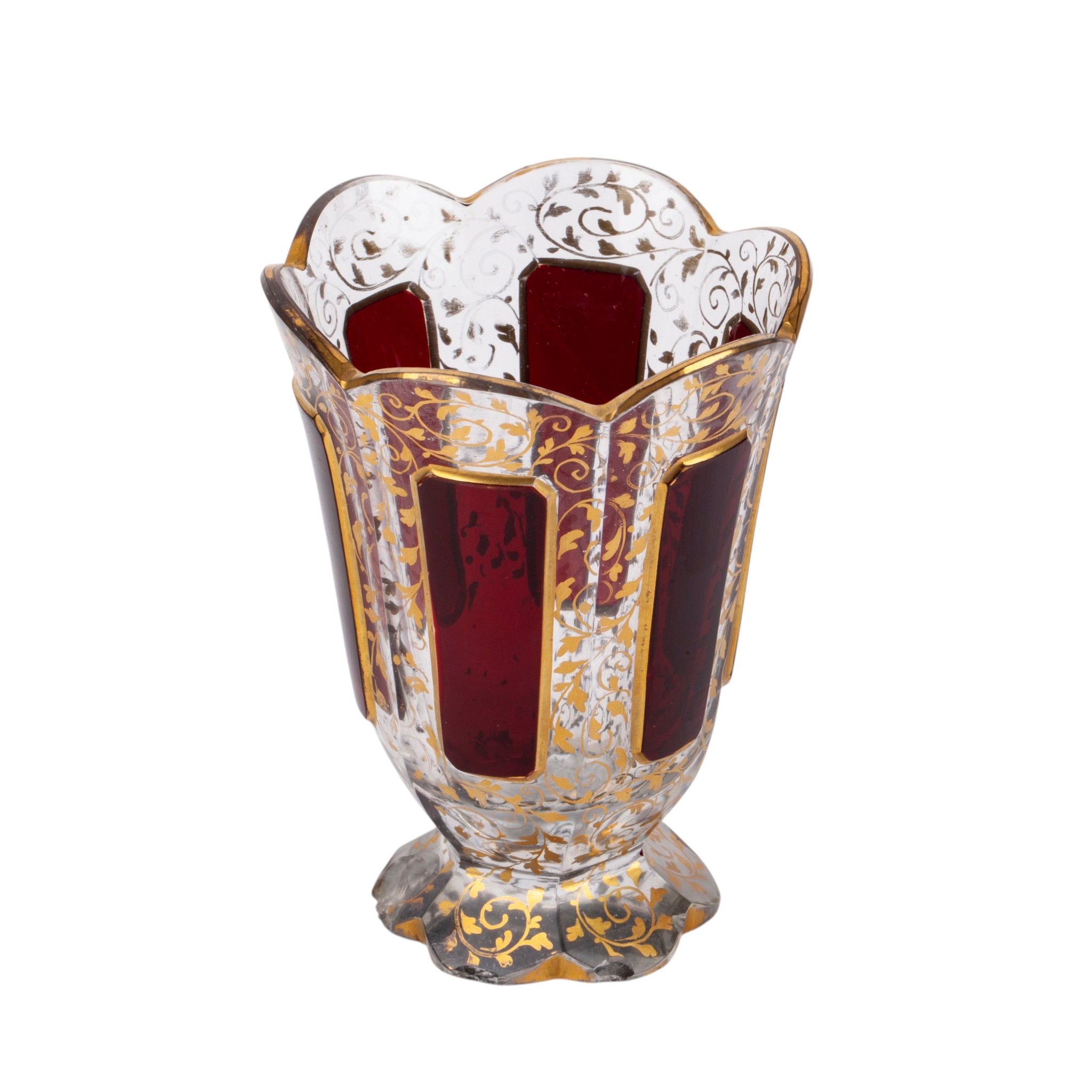
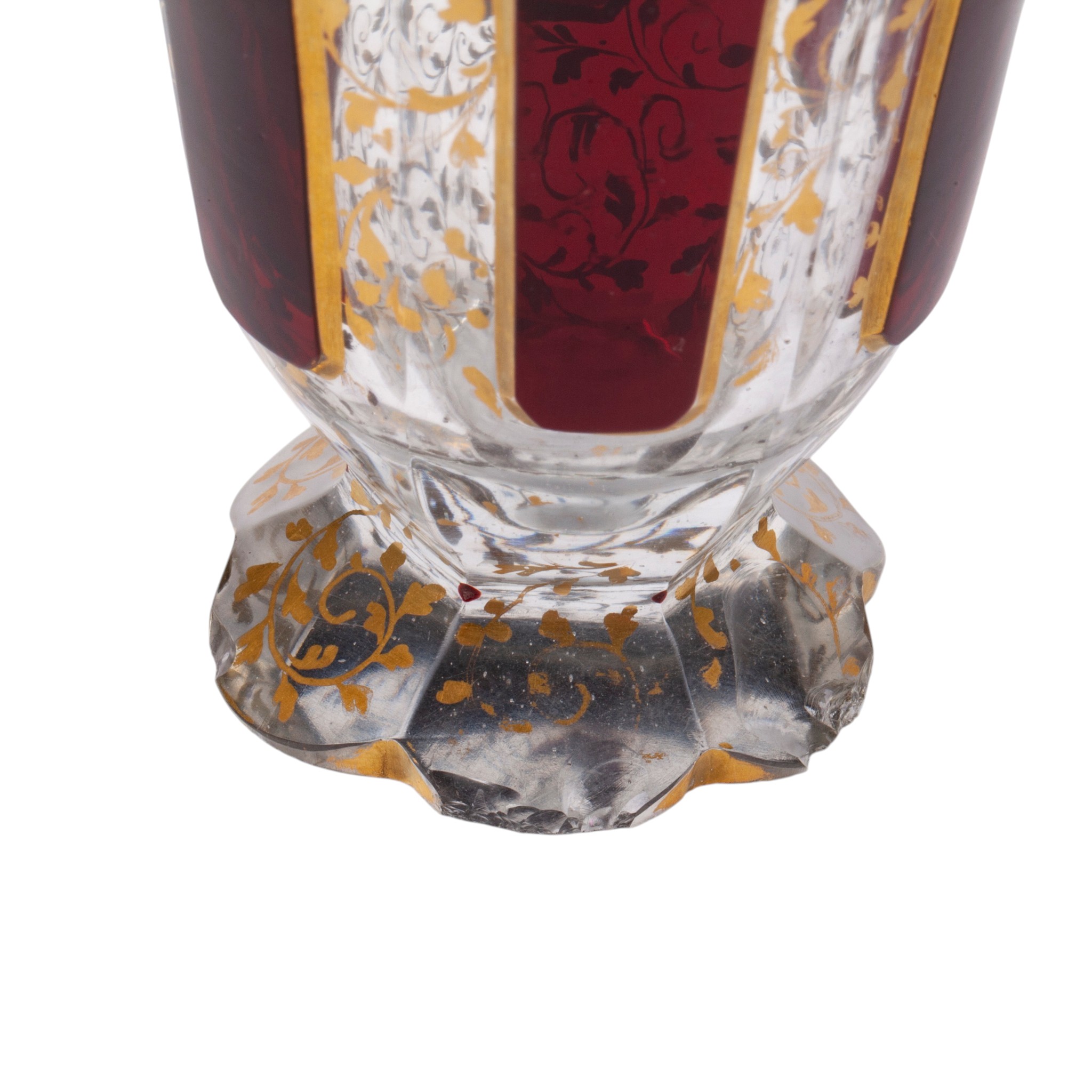
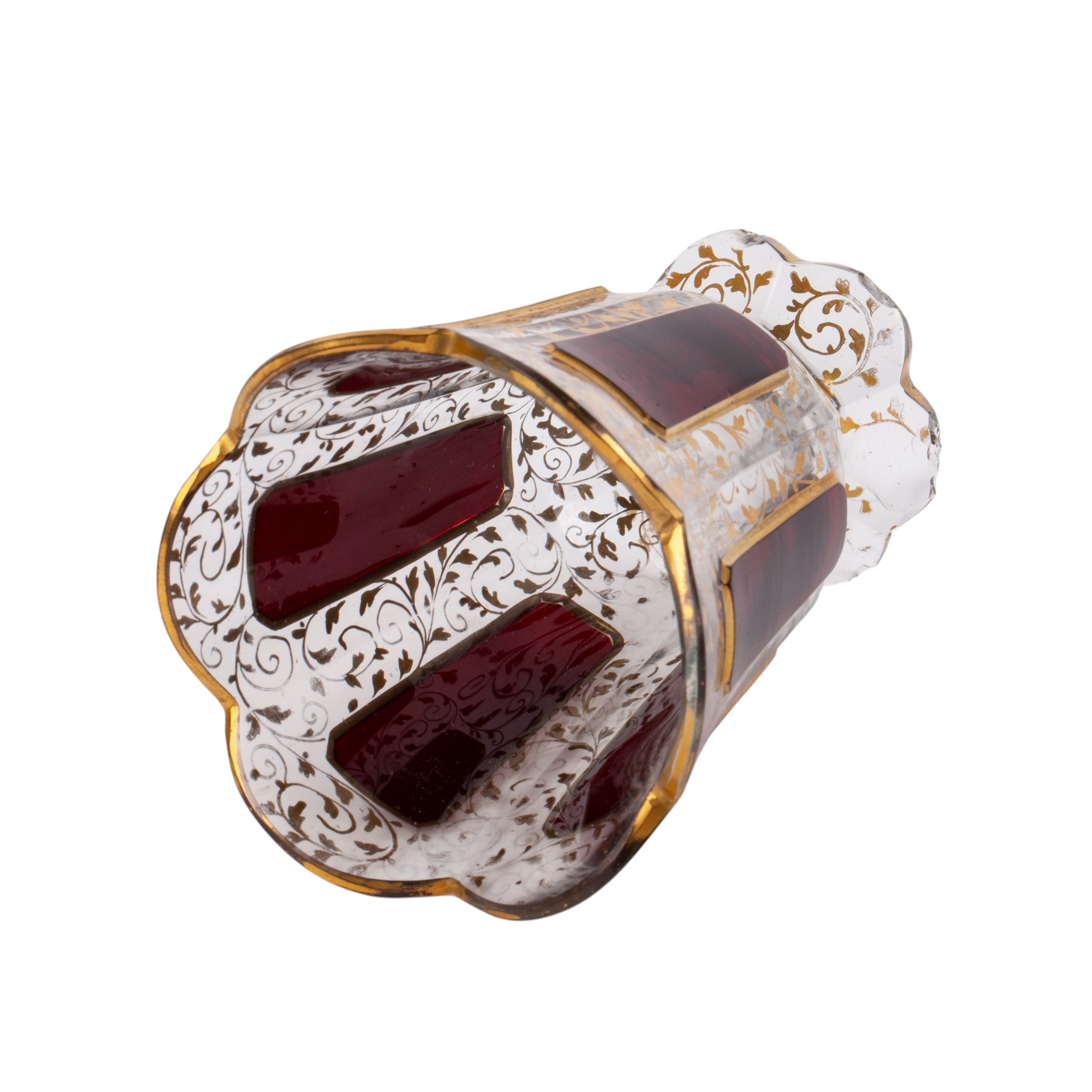
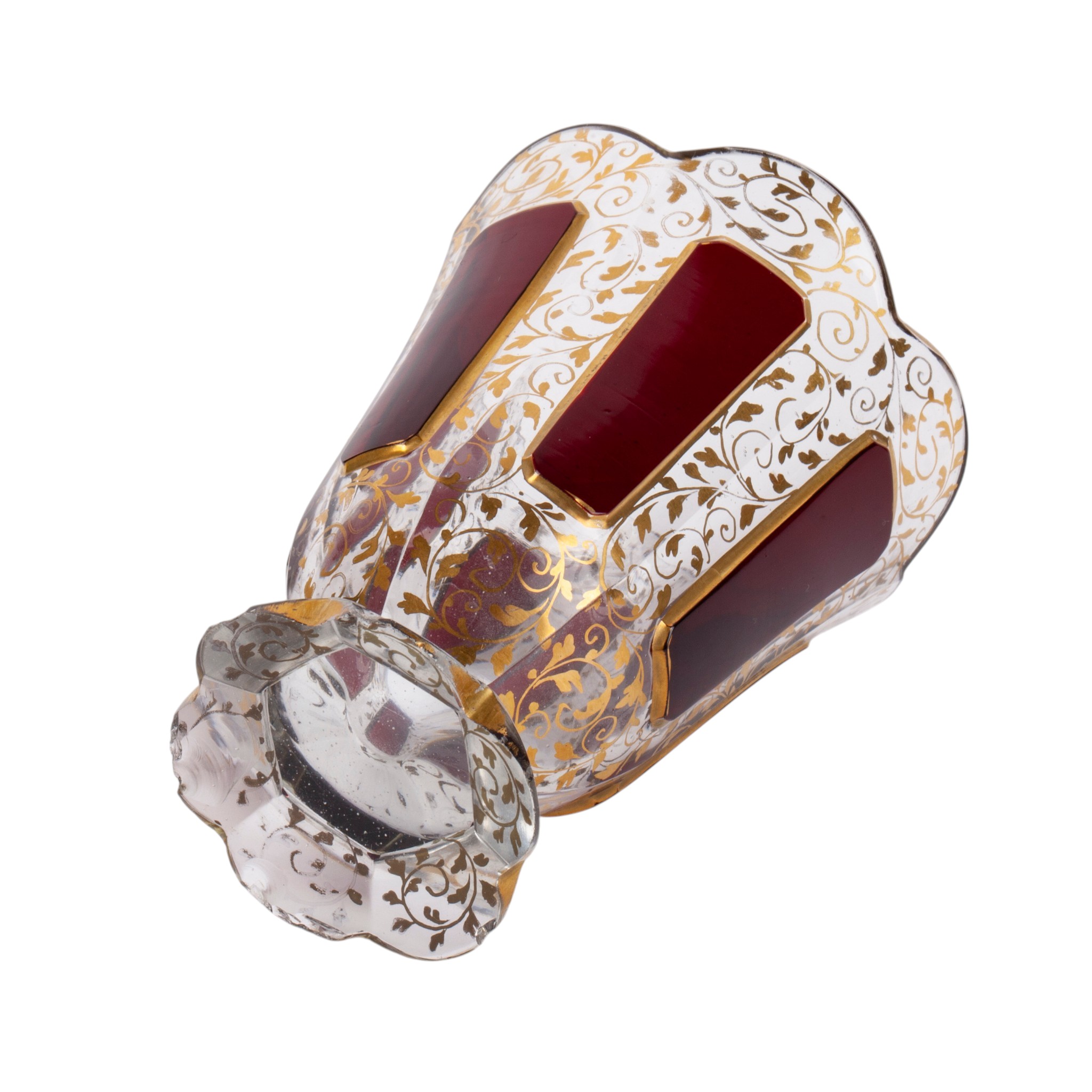
Small Ruby and Gilt Glass Vase / Beaker, Late 19th–Early 20th Century
Estimate: 60-70€Small ruby and gilt glass vase / beaker, late 19th to early 20th century
Small ruby glass vessel with gilt scrolling ornament and a shaped foot. A decorative example of Central European glass in the Bohemian taste. Small chip on stand. Height: 8.5 cm.
Starting price: 50€
Estimate: 60-70€
Hammer Price: Not sold -
Lot 0127
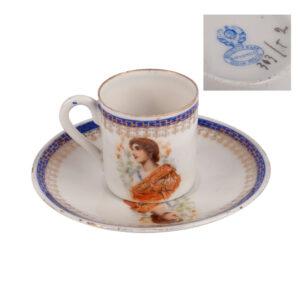
Rare Early Soviet Porcelain Cup and Saucer, Dulevo “Pravda” Factory, circa 1925–1930
Estimate: 300-400€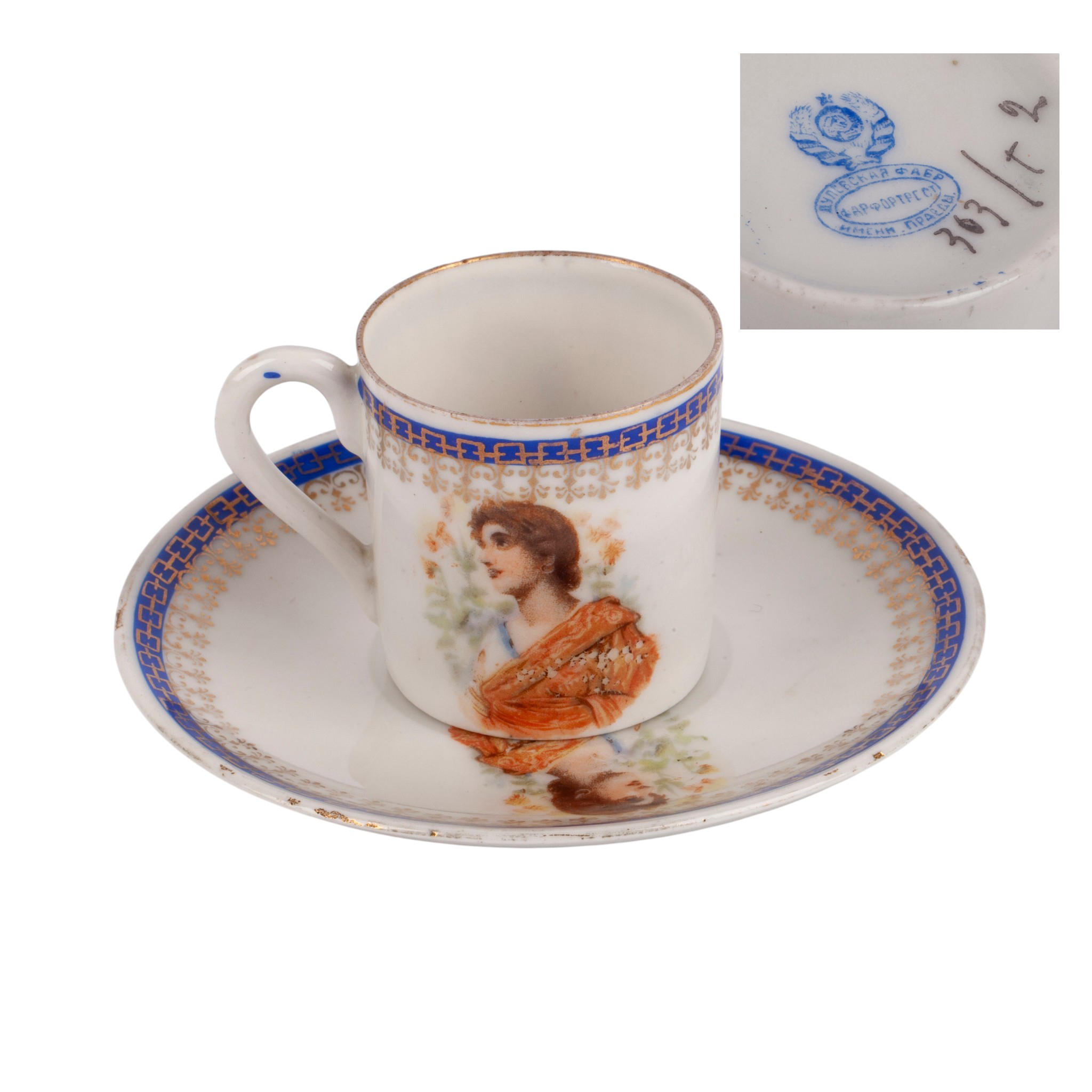
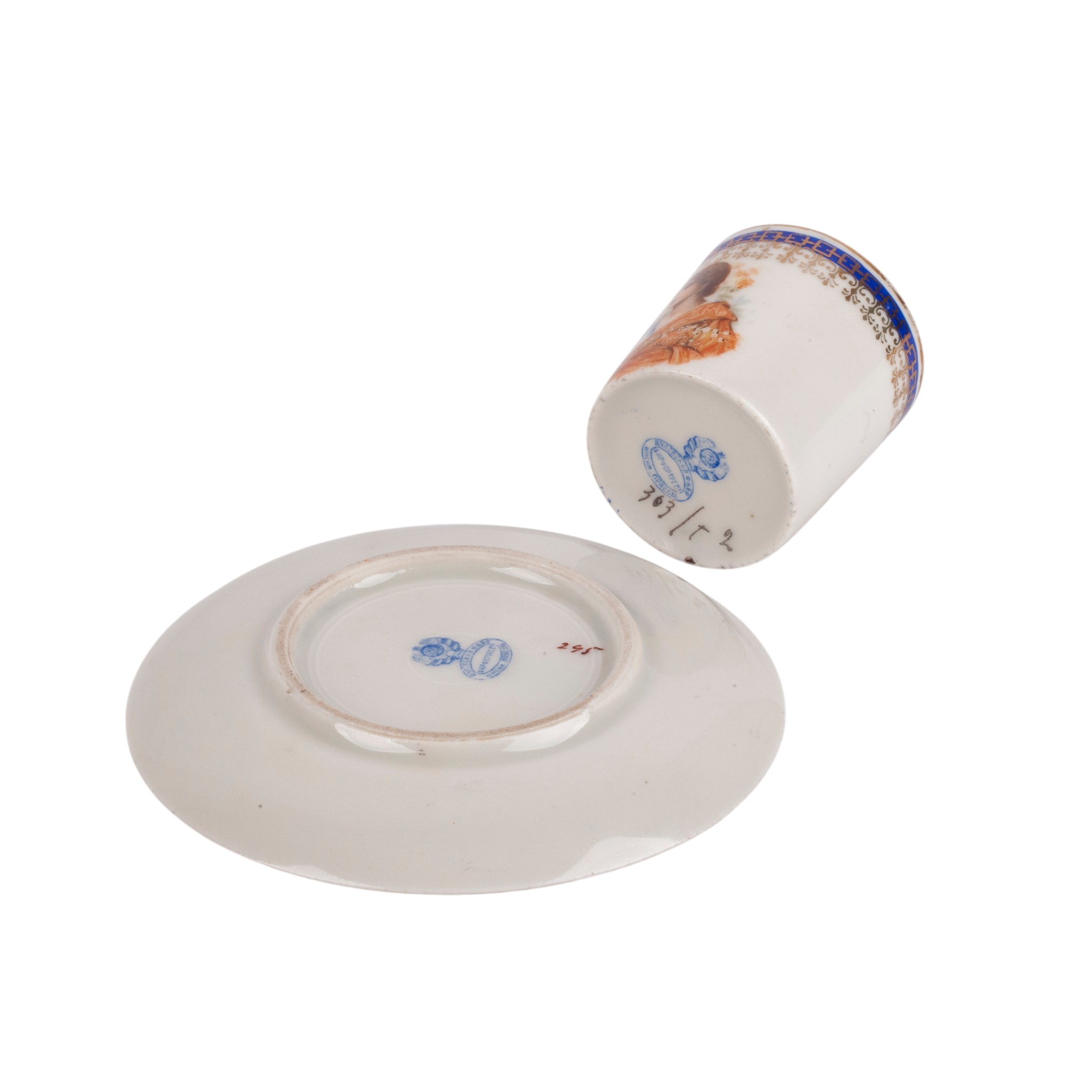
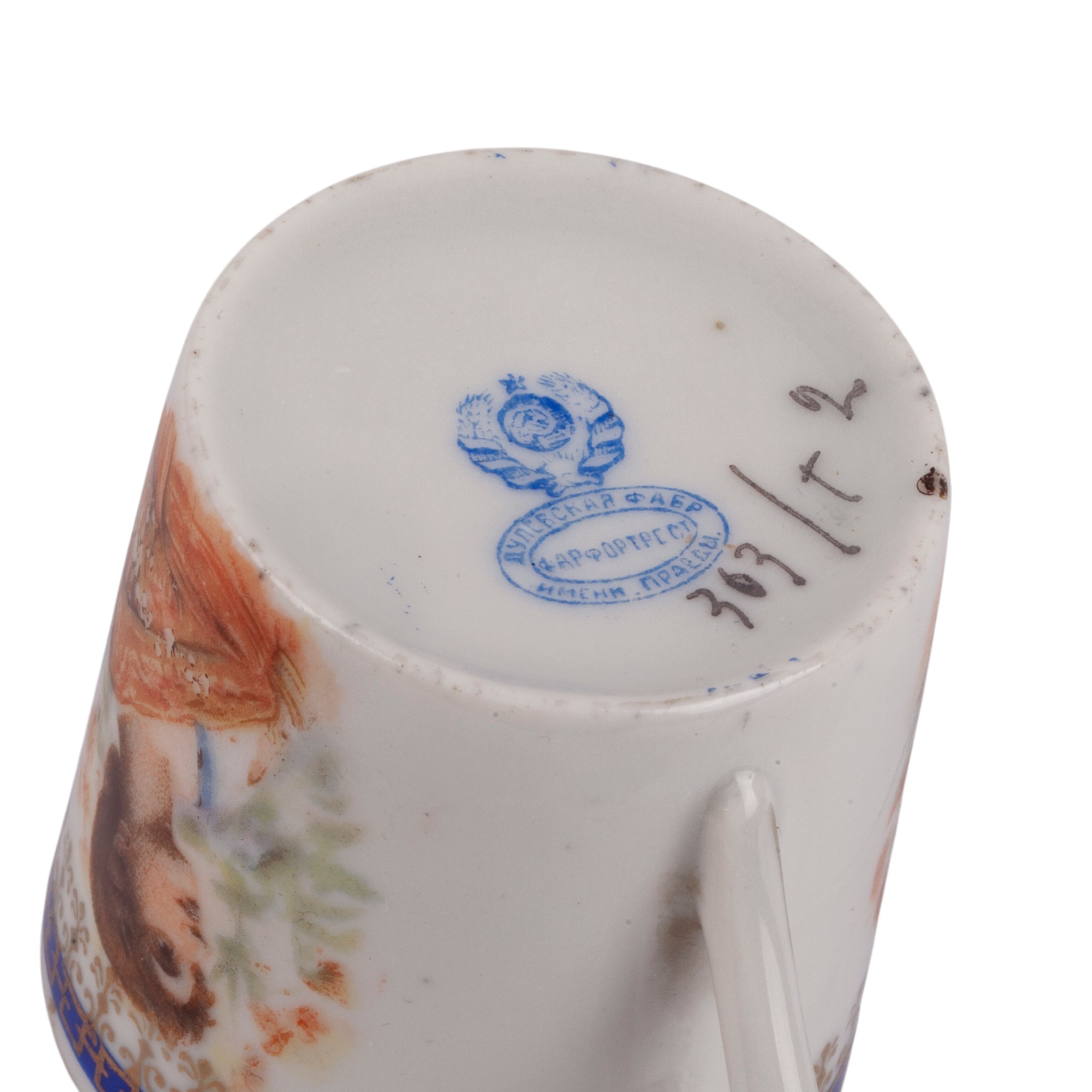
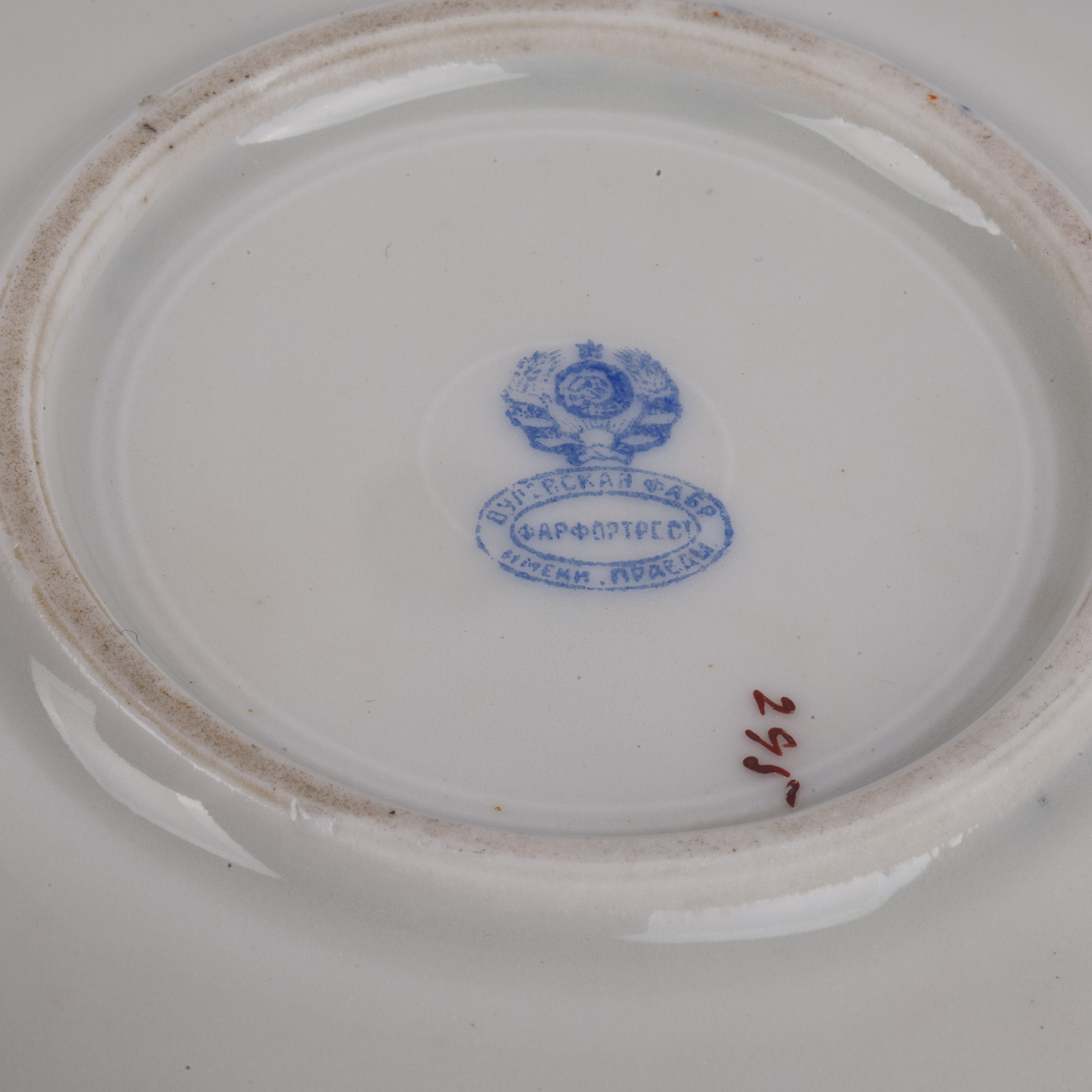
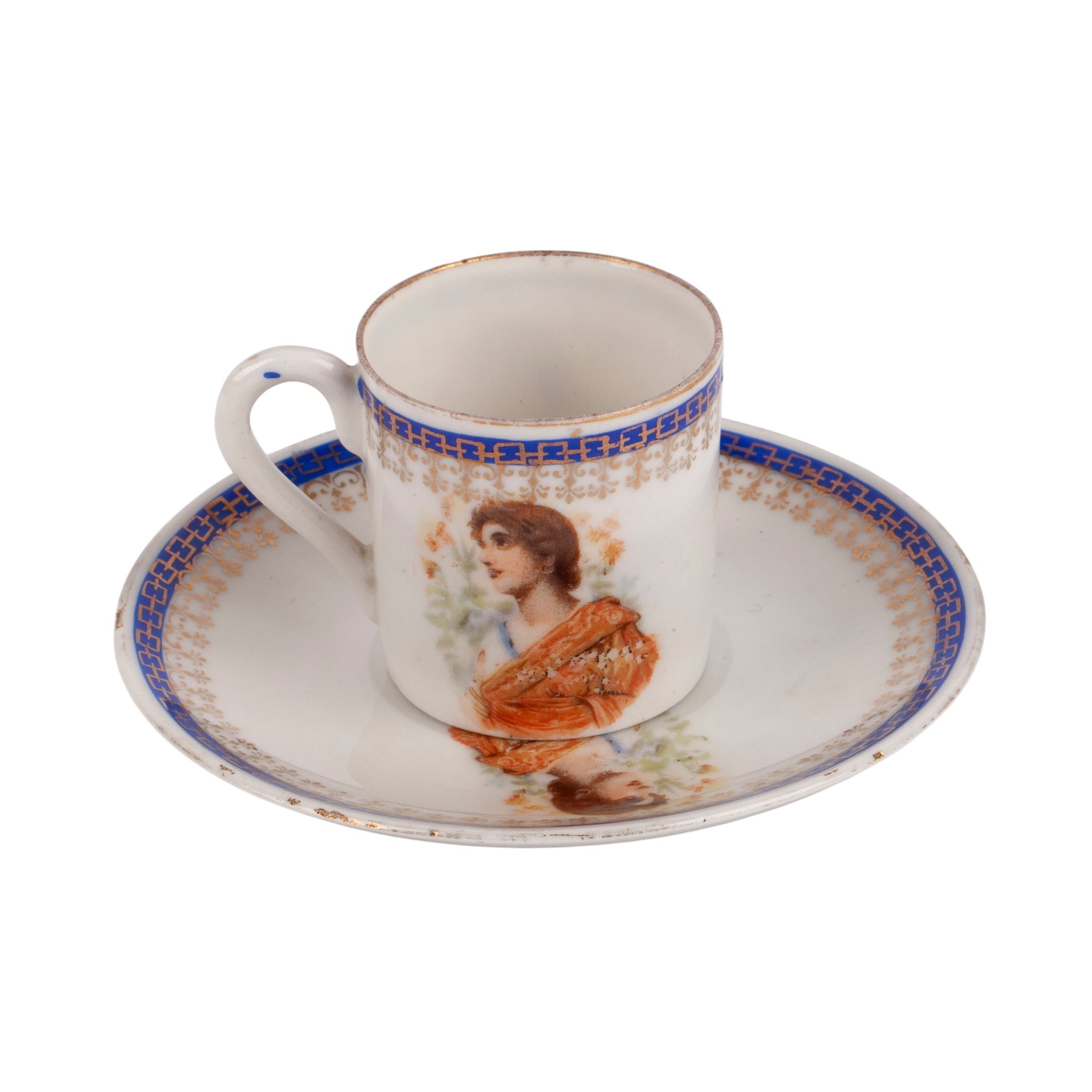
Lot 0127
Rare Early Soviet Porcelain Cup and Saucer, Dulevo “Pravda” Factory, circa 1925–1930
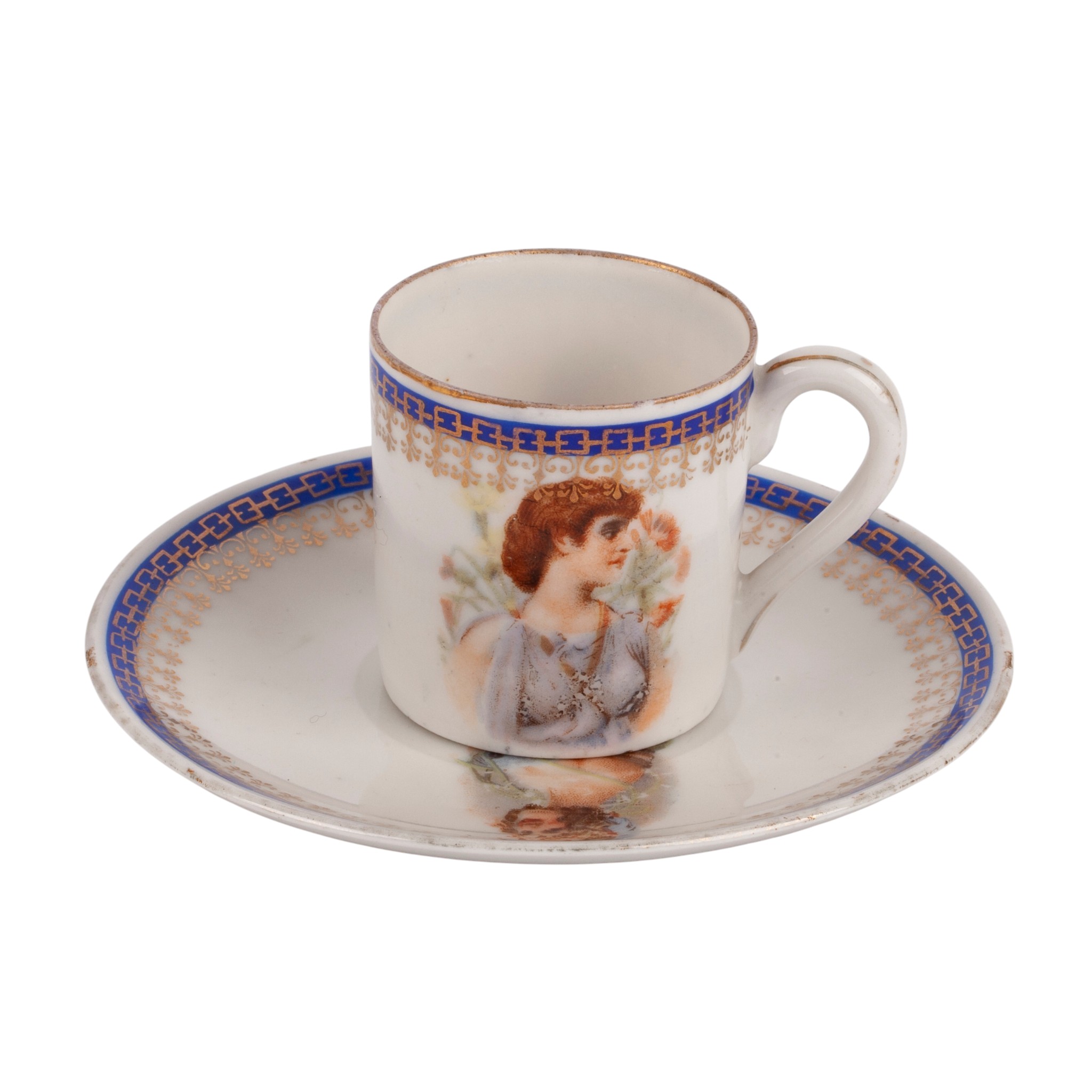
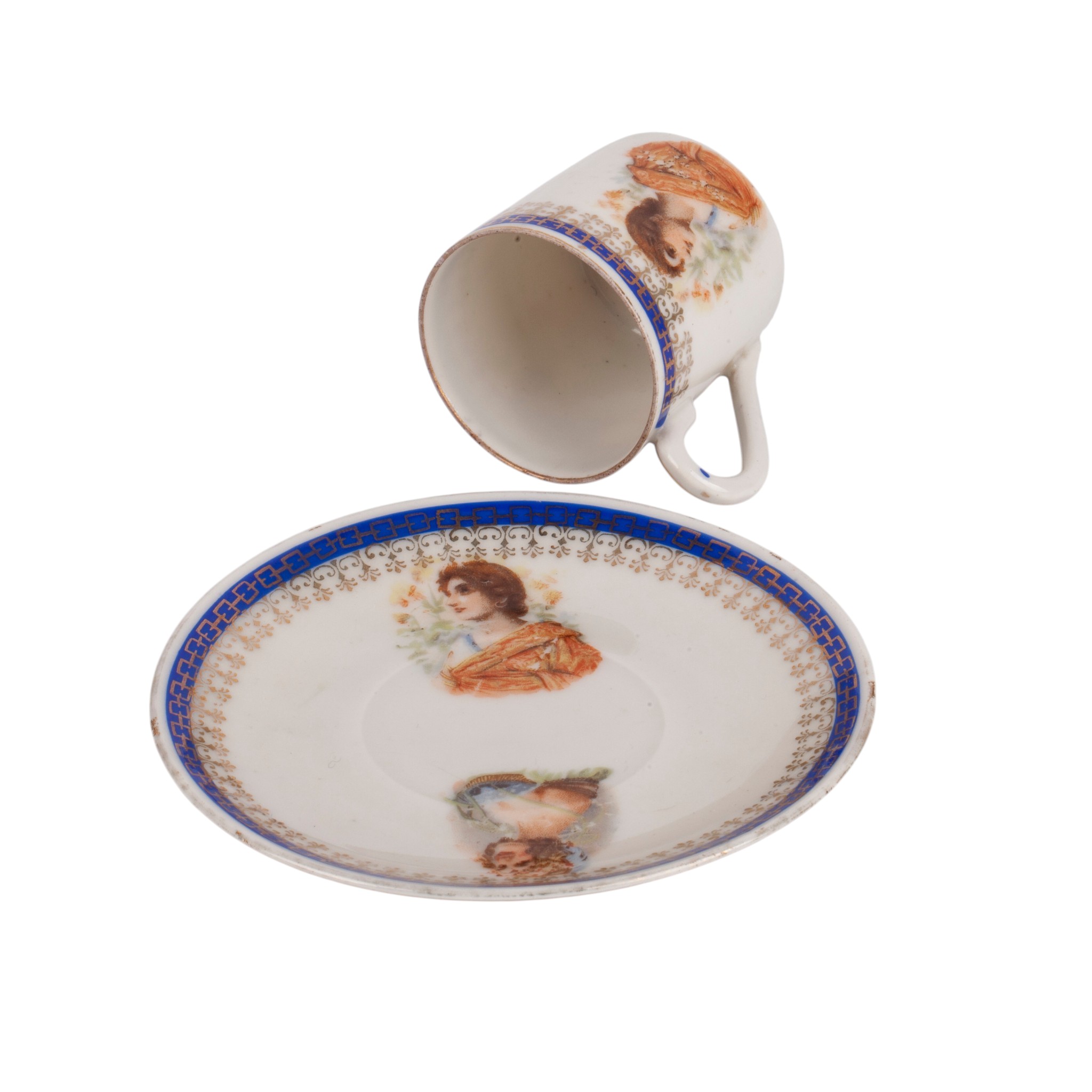
Estimate: 300-400€Rare Early Soviet Porcelain Cup & Saucer – Dulevo “Pravda” Factory (c. 1925–1930)
Description: A historically significant porcelain set from the early Soviet “Farfortrest” (Porcelain Trust) era. Produced at the former Kuznetsov factory, then renamed “Imeni Pravdy,” this piece showcases the transition between Imperial-style aesthetics and early Soviet production.Decoration: Features a vibrant overglaze portrait of a lady in a red wrap, framed by a classic cobalt blue “Greek Key” border and hand-applied gilding.
Markings: Blue factory stamp featuring the Soviet Coat of Arms (used 1925–1930) and handwritten pattern numbers (303/1).
Dimensions: Saucer diameter 11.4 cm; Cup height 4.9 cm.
Condition: Excellent vintage condition with no chips, cracks, or repairs. Minor age-appropriate wear to the gilding.
Starting price: 200€
Estimate: 300-400€
Hammer Price: Not sold -
Lot 0128
Antique Russian Gardner Porcelain Cup and Saucer, Eastern Market, Late 19th Century
Estimate: 300-400€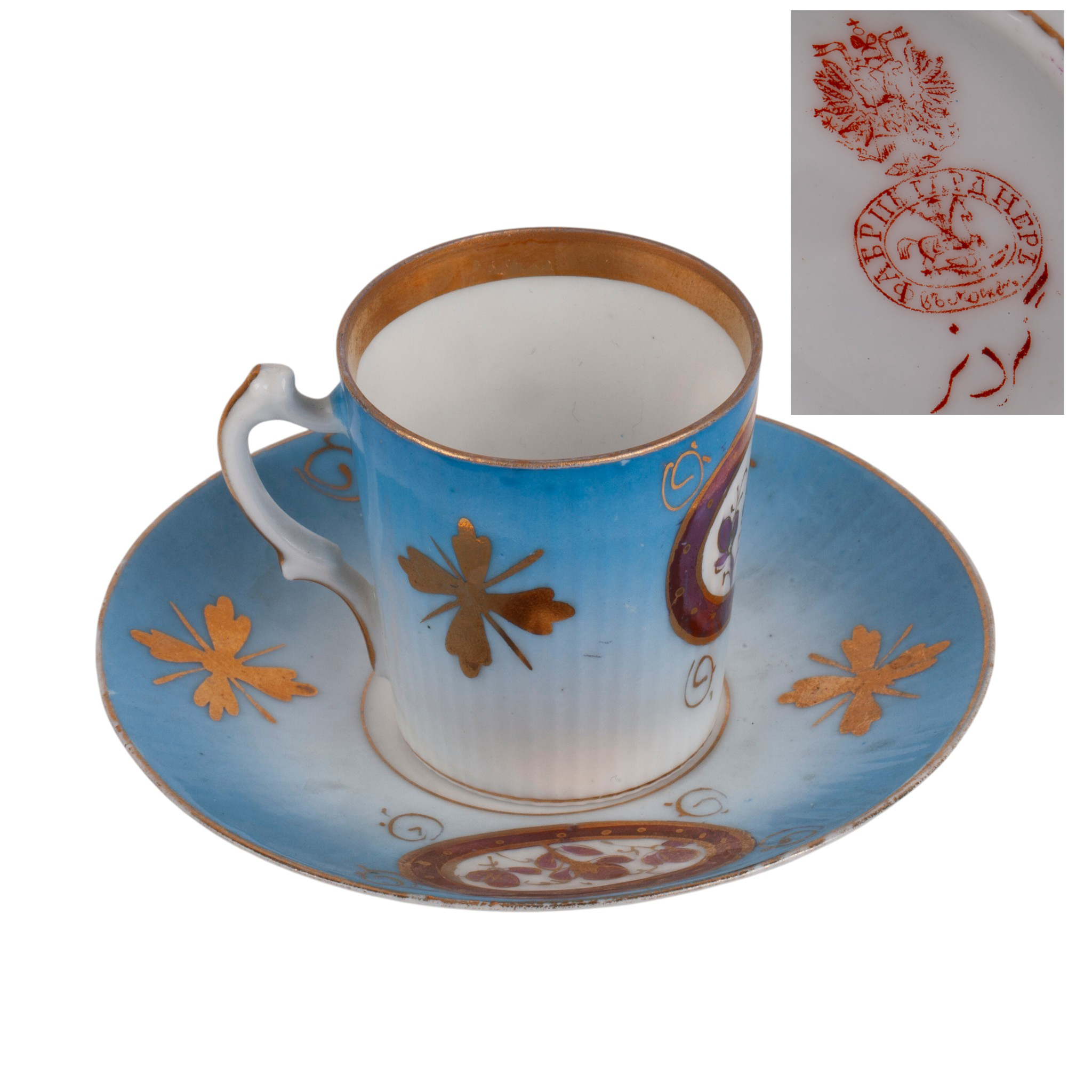
Lot 0128
Antique Russian Gardner Porcelain Cup and Saucer, Eastern Market, Late 19th Century
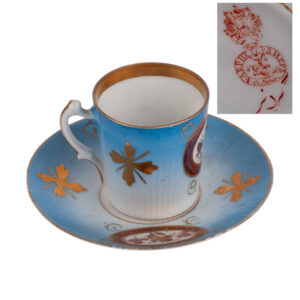
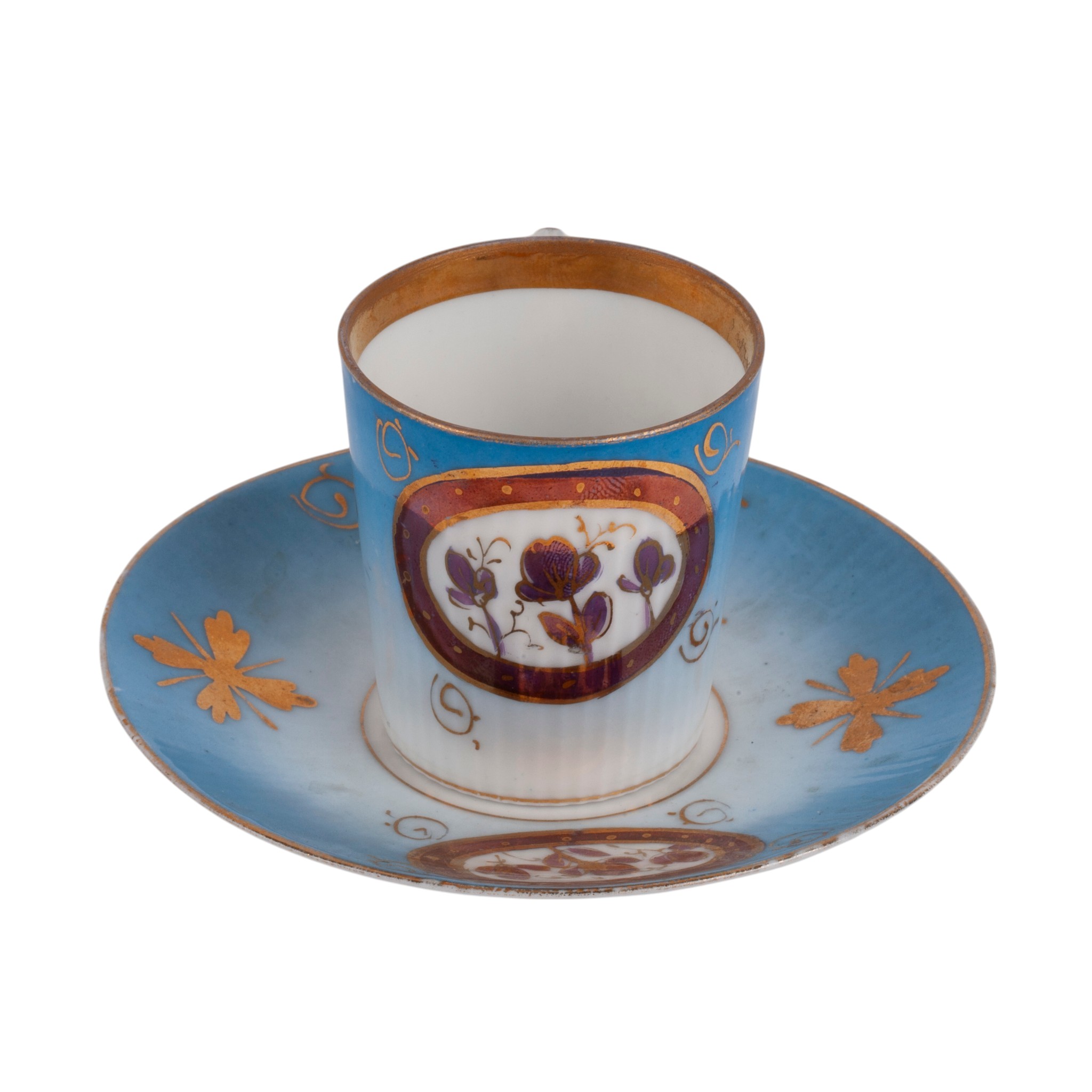
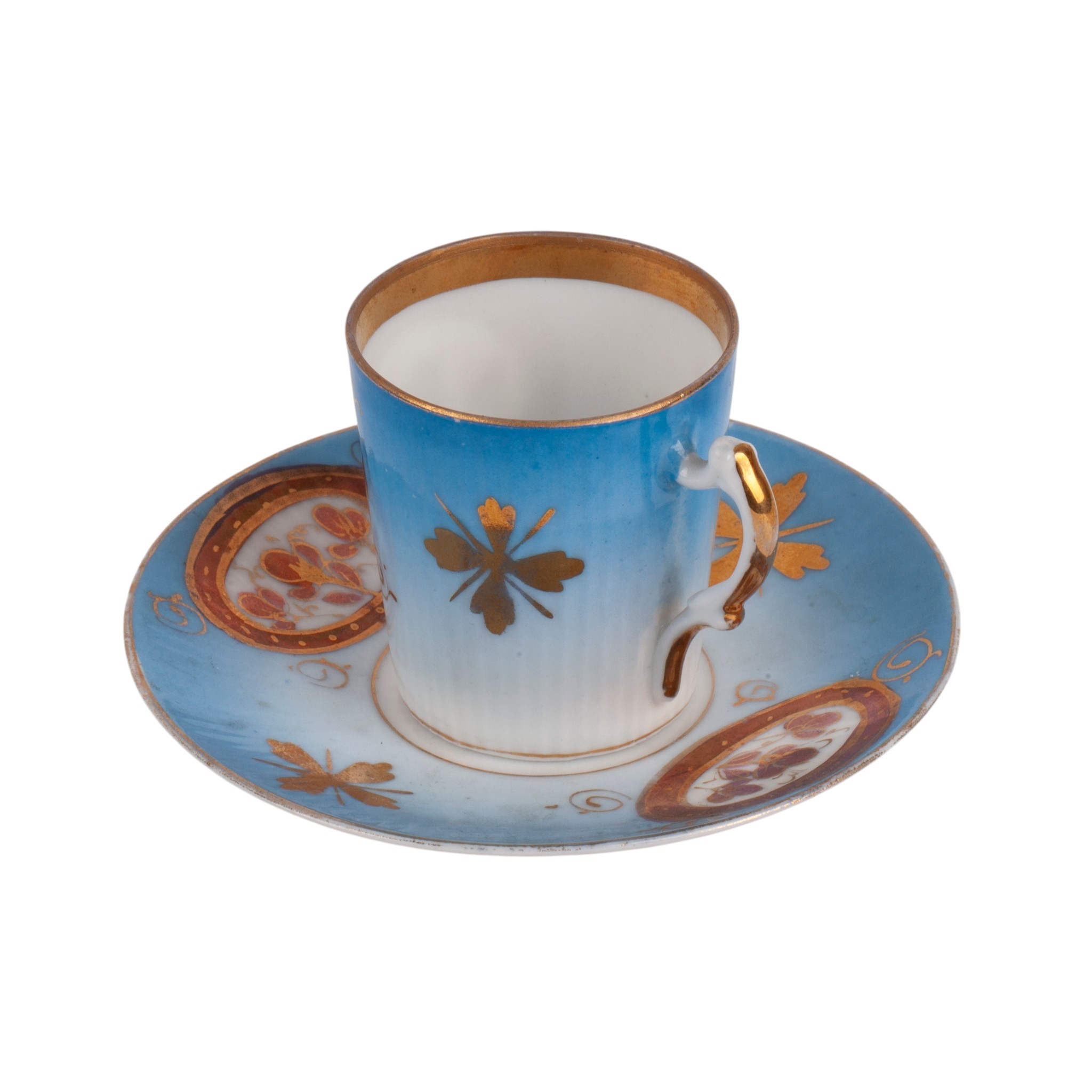
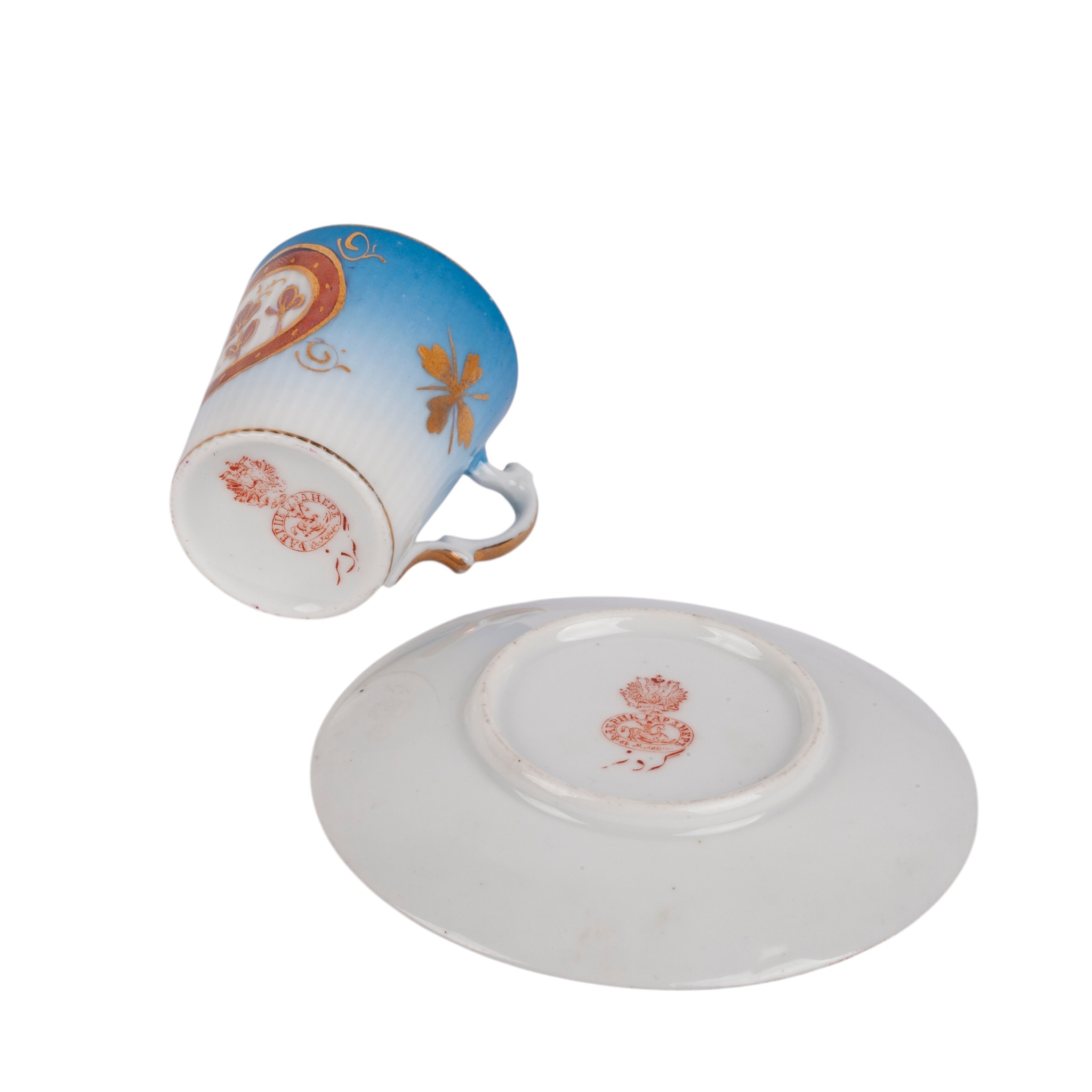
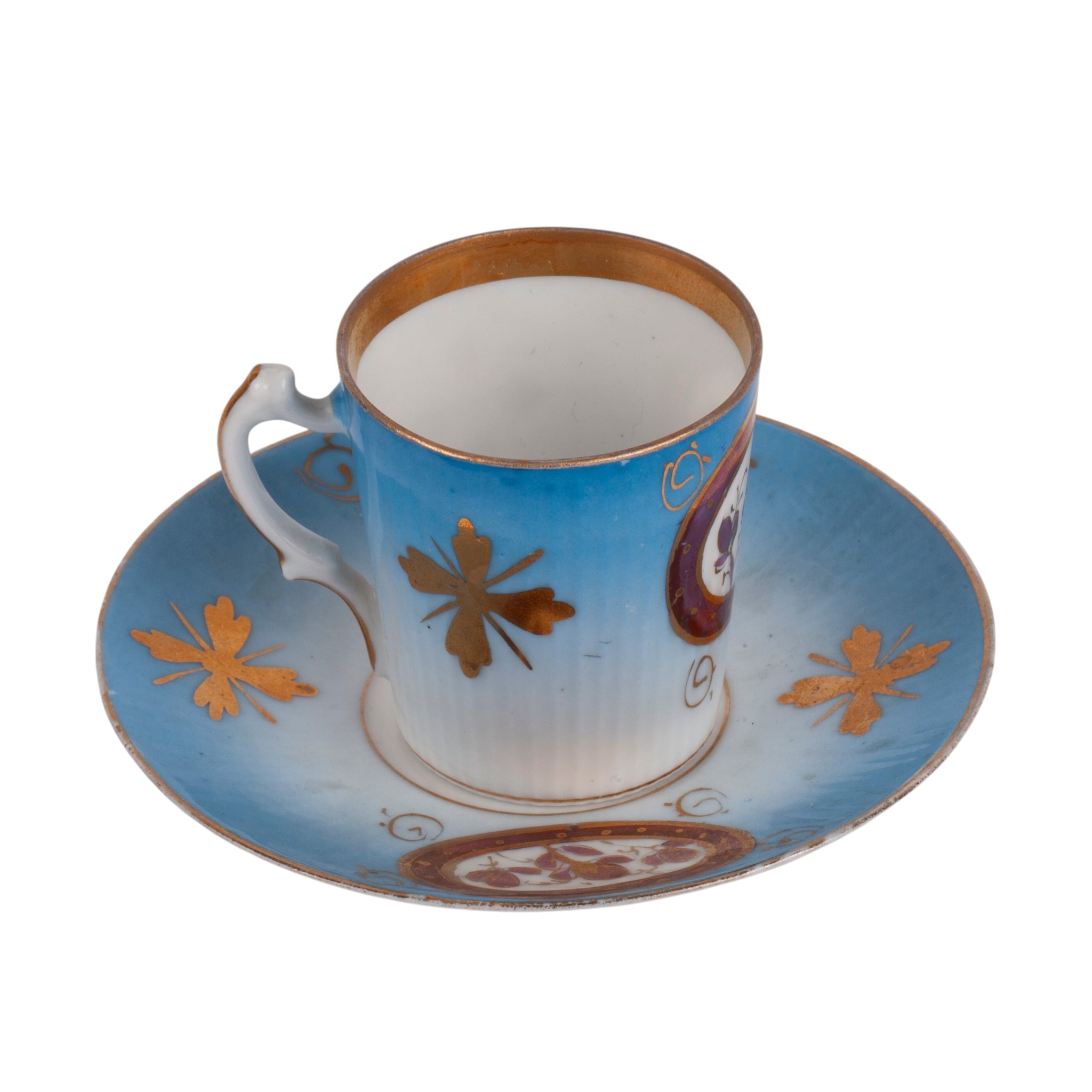
Estimate: 300-400€Antique Russian Gardner Porcelain Cup & Saucer – Eastern Market (Late 19th Century)
Description: An exquisite example of 19th-century Russian porcelain from the world-renowned Gardner Factory (Verbilki). This set was specifically produced for the “Eastern Market” (Persia and Central Asia), a prestigious segment of Gardner’s production known for its vibrant colors and specific motifs.Design: Features a striking sky-blue gradient (ombré) background. The body is decorated with elegant gilded butterflies and hand-painted polychrome floral cartouches. The cup has a delicate ribbed (fluted) texture and a classical scroll handle.
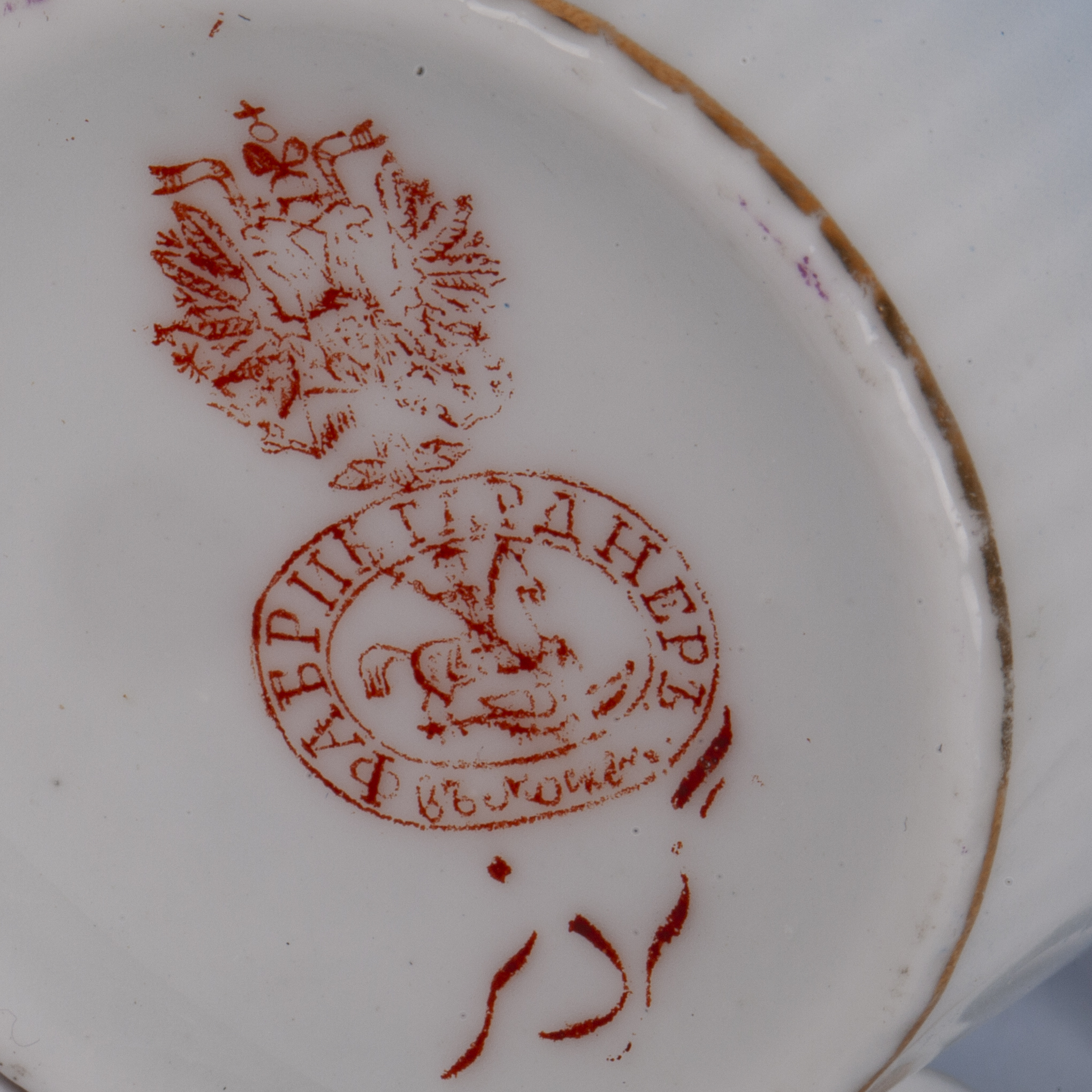
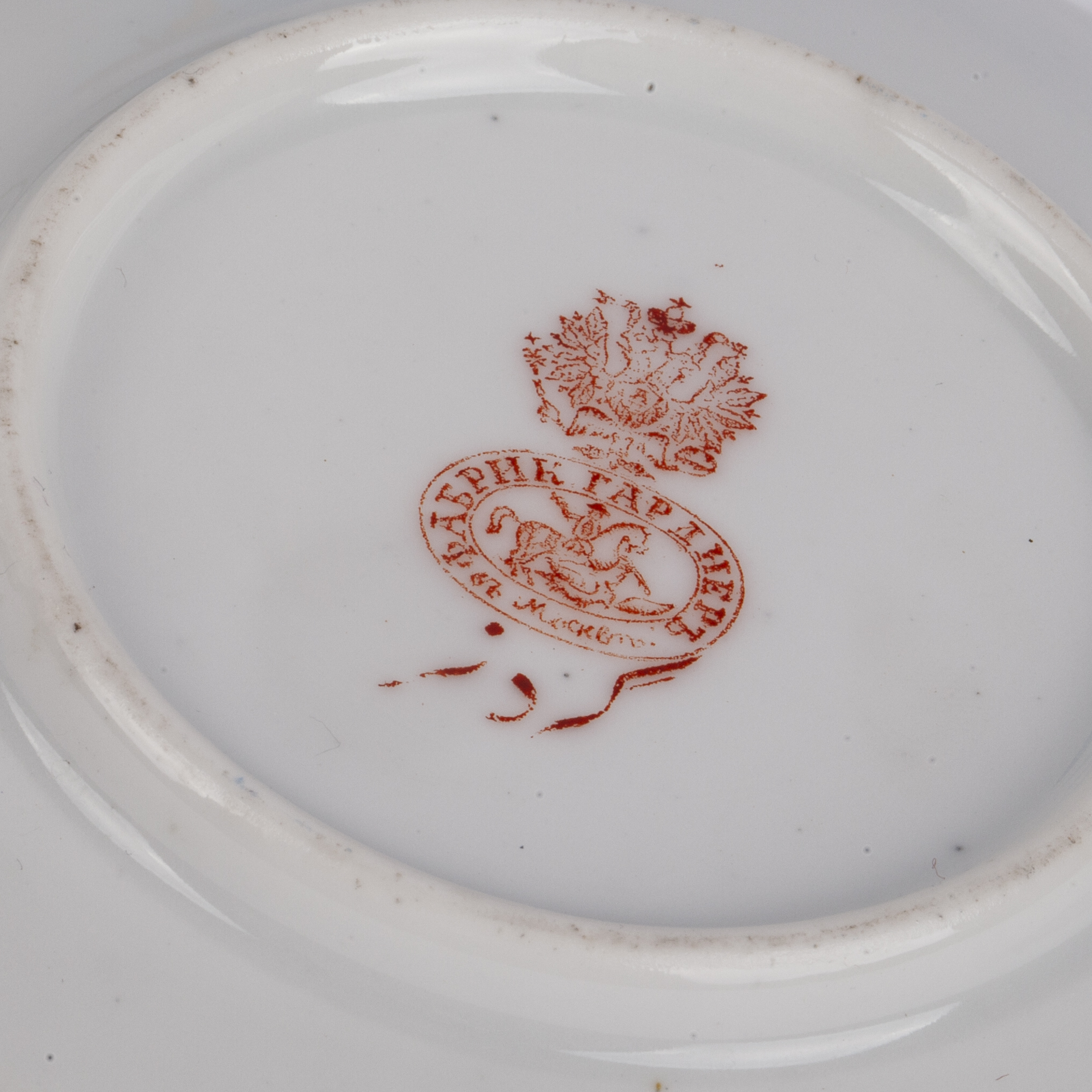
Markings: The underside bears the authentic red Gardner Factory stamp featuring the Imperial Double-Headed Eagle and St. George the Victorious. It also includes the specific Persian/Arabic script markings used for export to the Eastern provinces.
Dimensions: Saucer diameter 11.3 cm; Cup height 5.6 cm.
Condition: Remarkable antique condition. The porcelain is intact with no chips or cracks. The gilding remains bright with only very light, age-appropriate thinning on the rims.
Starting price: 200€
Estimate: 300-400€
Hammer Price: 200 € -
Lot 0129
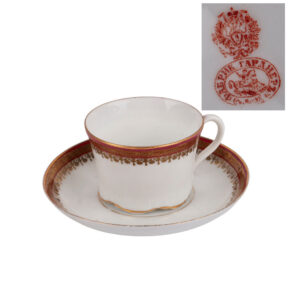
Antique Russian Gardner Porcelain Cup and Saucer, Imperial Period, Late 19th Century
Estimate: 300-400€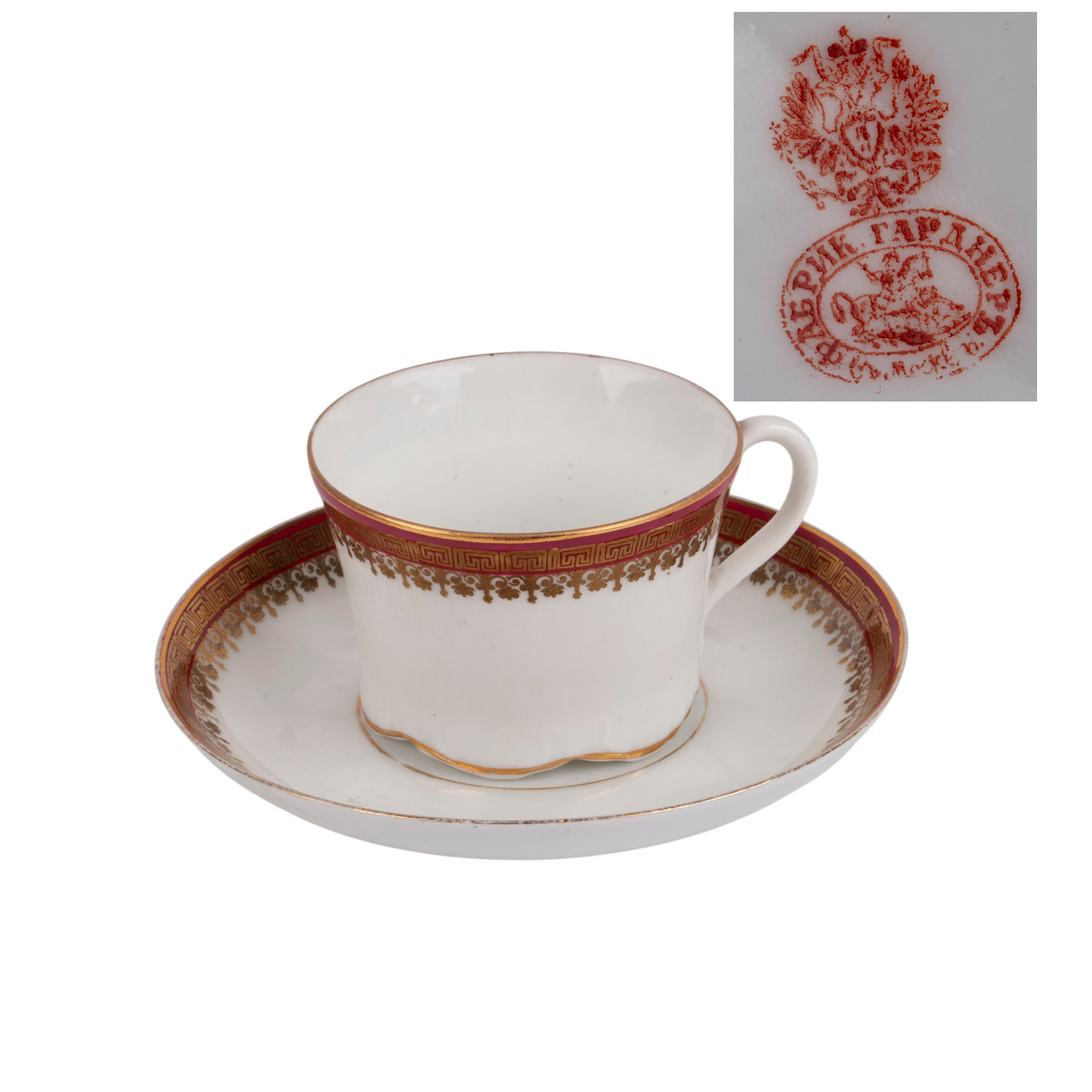
Lot 0129
Antique Russian Gardner Porcelain Cup and Saucer, Imperial Period, Late 19th Century
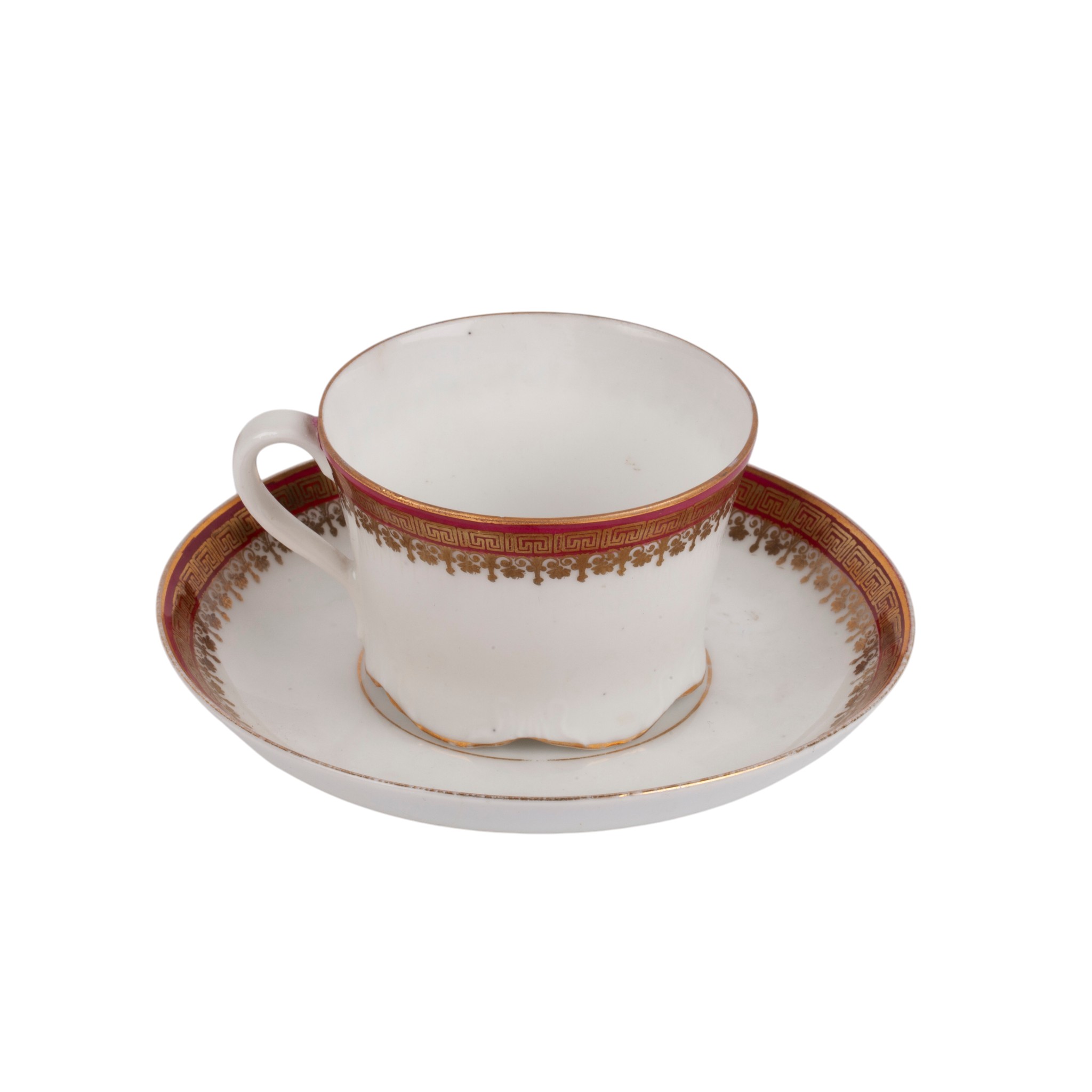
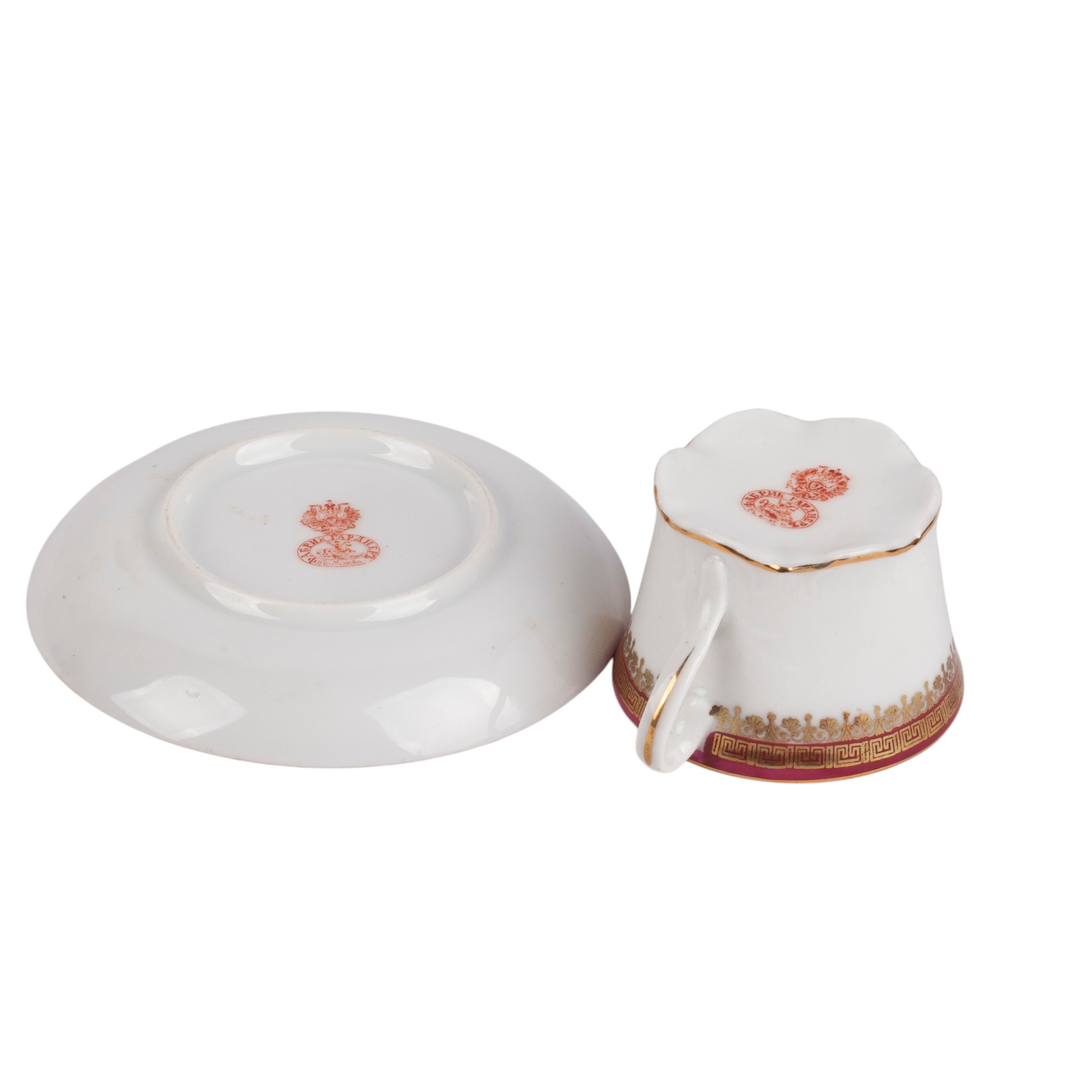
Estimate: 300-400€Antique Russian Gardner Porcelain Cup & Saucer – Imperial Period (Late 19th Century)
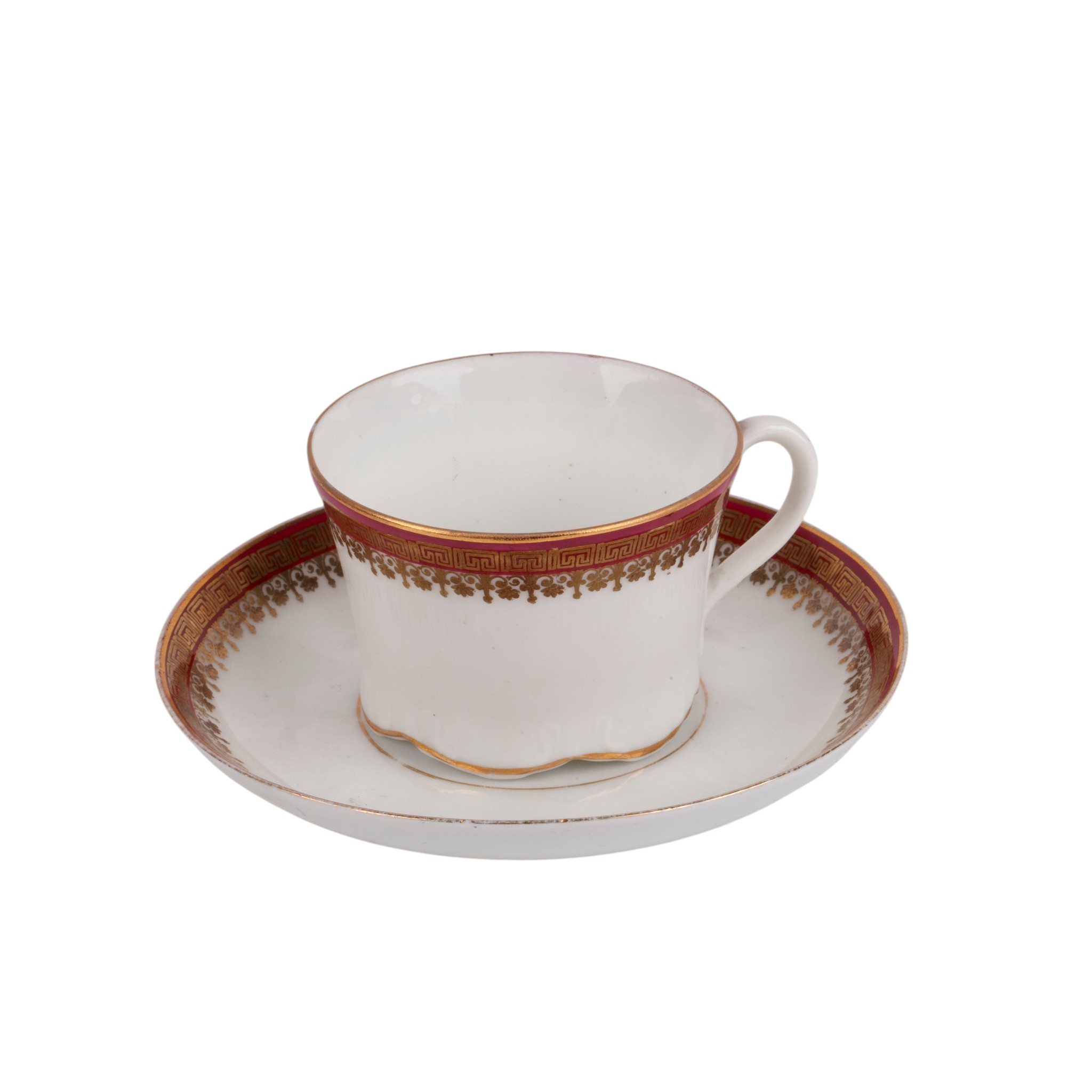
Description: A classic and elegant porcelain cabinet set from the prestigious Gardner Factory (Verbilki), Russia’s first private porcelain manufactory. This set features a sophisticated neoclassical design typical of the late Imperial era.Design: Decorated with a rich burgundy-red (maroon) band featuring a continuous gilded “Greek Key” (meander) pattern. Below the band is a delicate lace-like gold filigree border. The cup has a slightly waisted shape with a refined scroll handle and gold-rimmed edges.
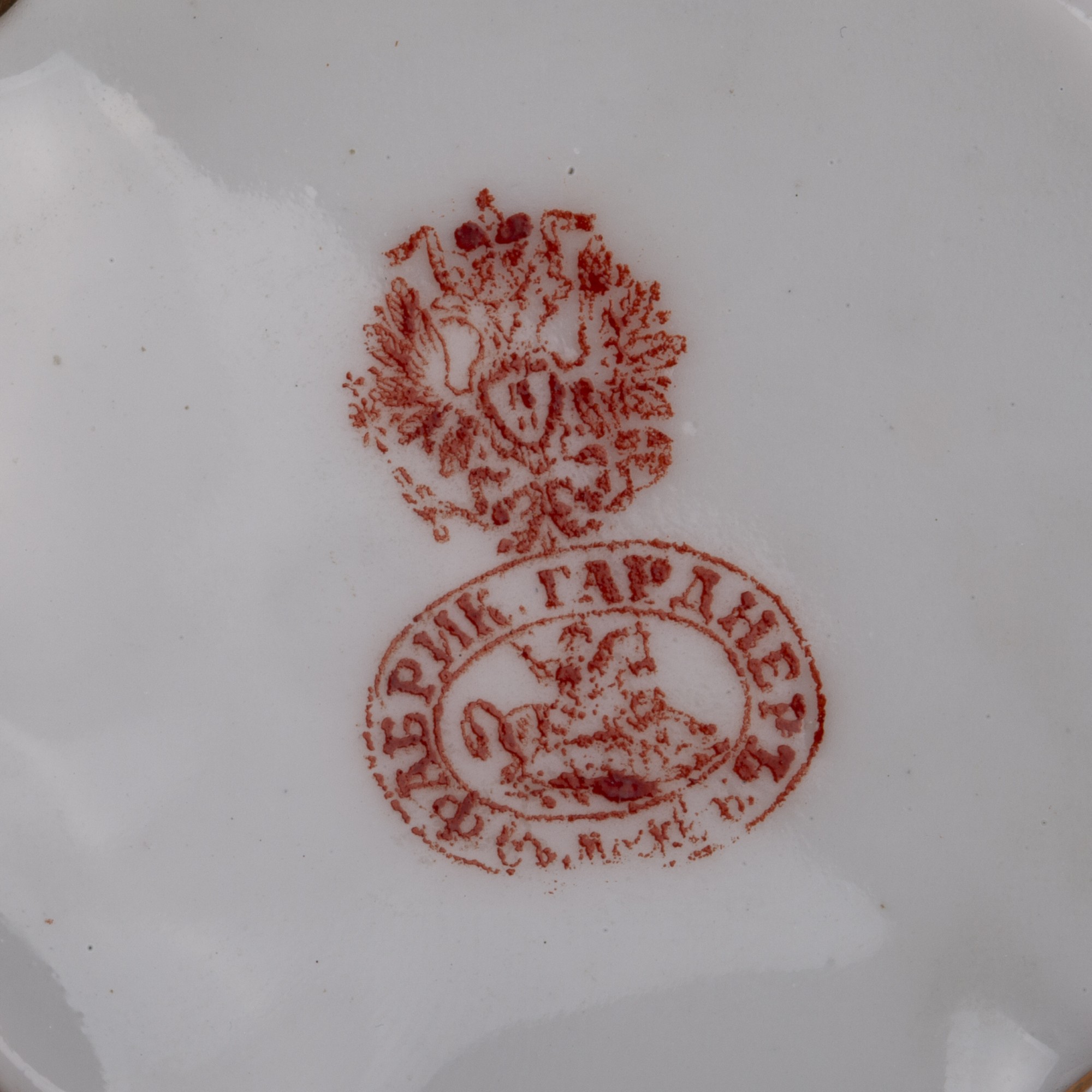
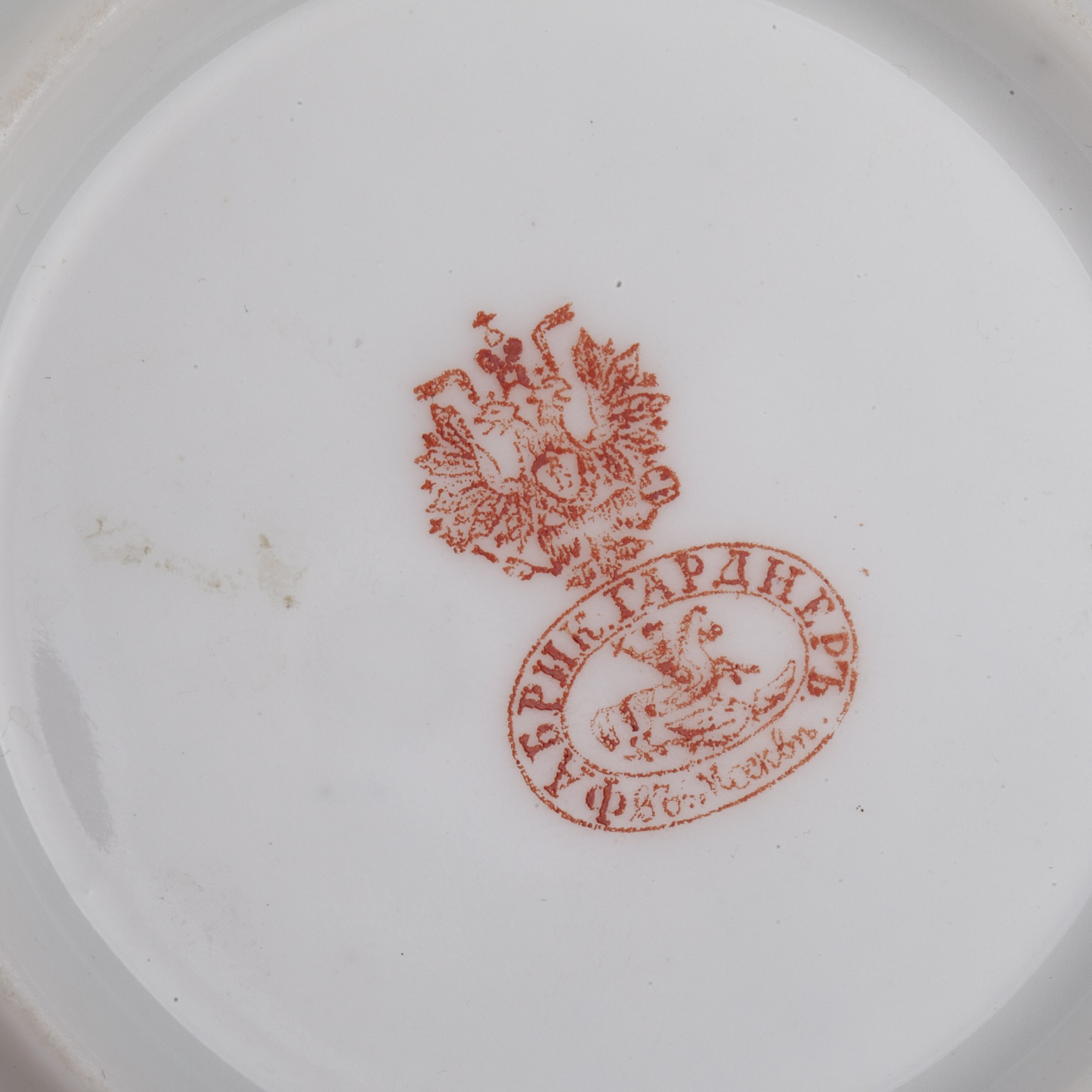
Markings: The underside of both pieces bears the authentic red Gardner factory stamp featuring the Imperial Double-Headed Eagle and St. George the Victorious (signifying the factory’s status as a Purveyor to the Imperial Court).
Dimensions: Saucer diameter 11.5 cm; Cup height 4.5 cm.
Starting price: 200€
Estimate: 300-400€
Hammer Price: Not sold -
Lot 0130
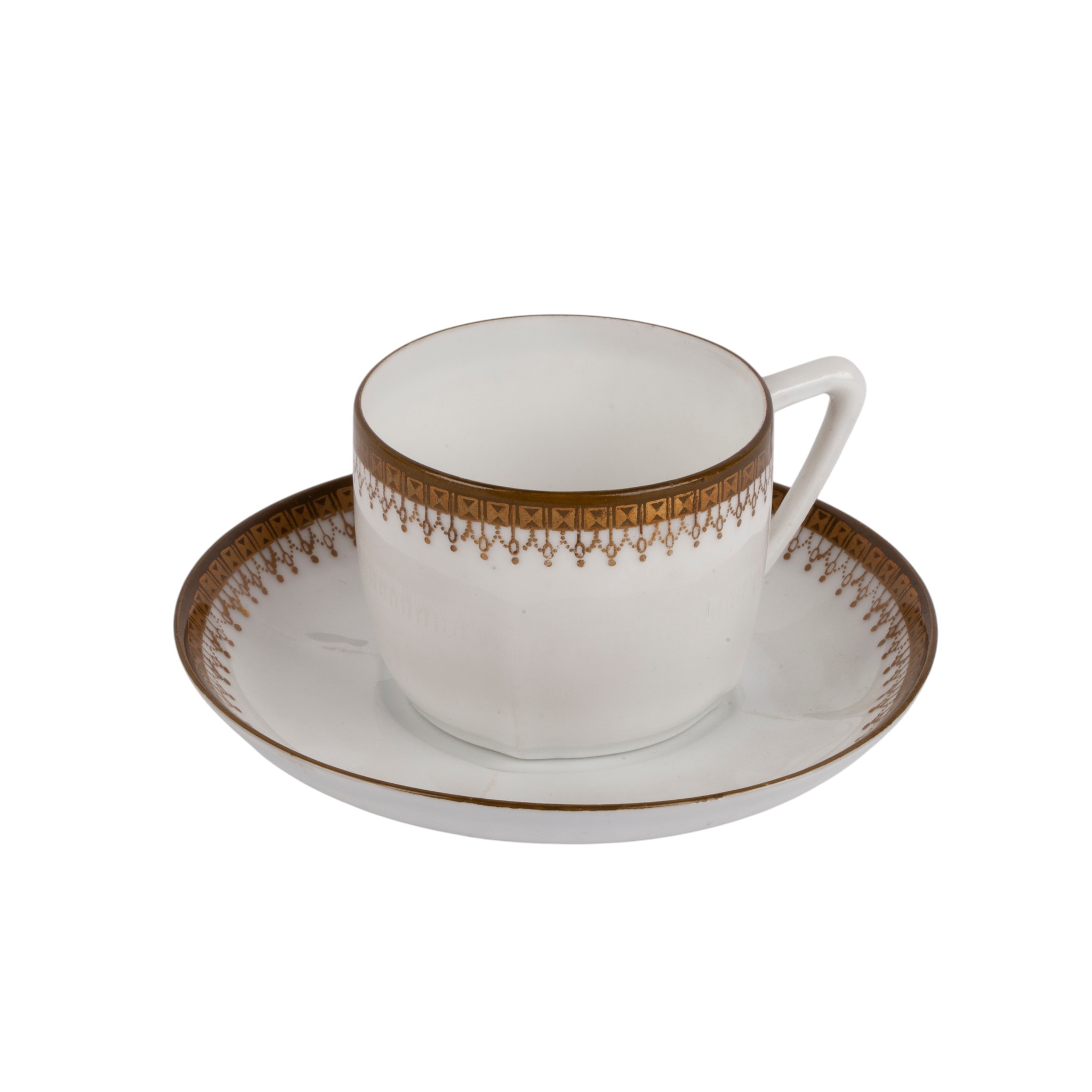
Antique Russian Gardner Porcelain Cup and Saucer “Olive & Gold”, Late 19th Century
Estimate: 300-400€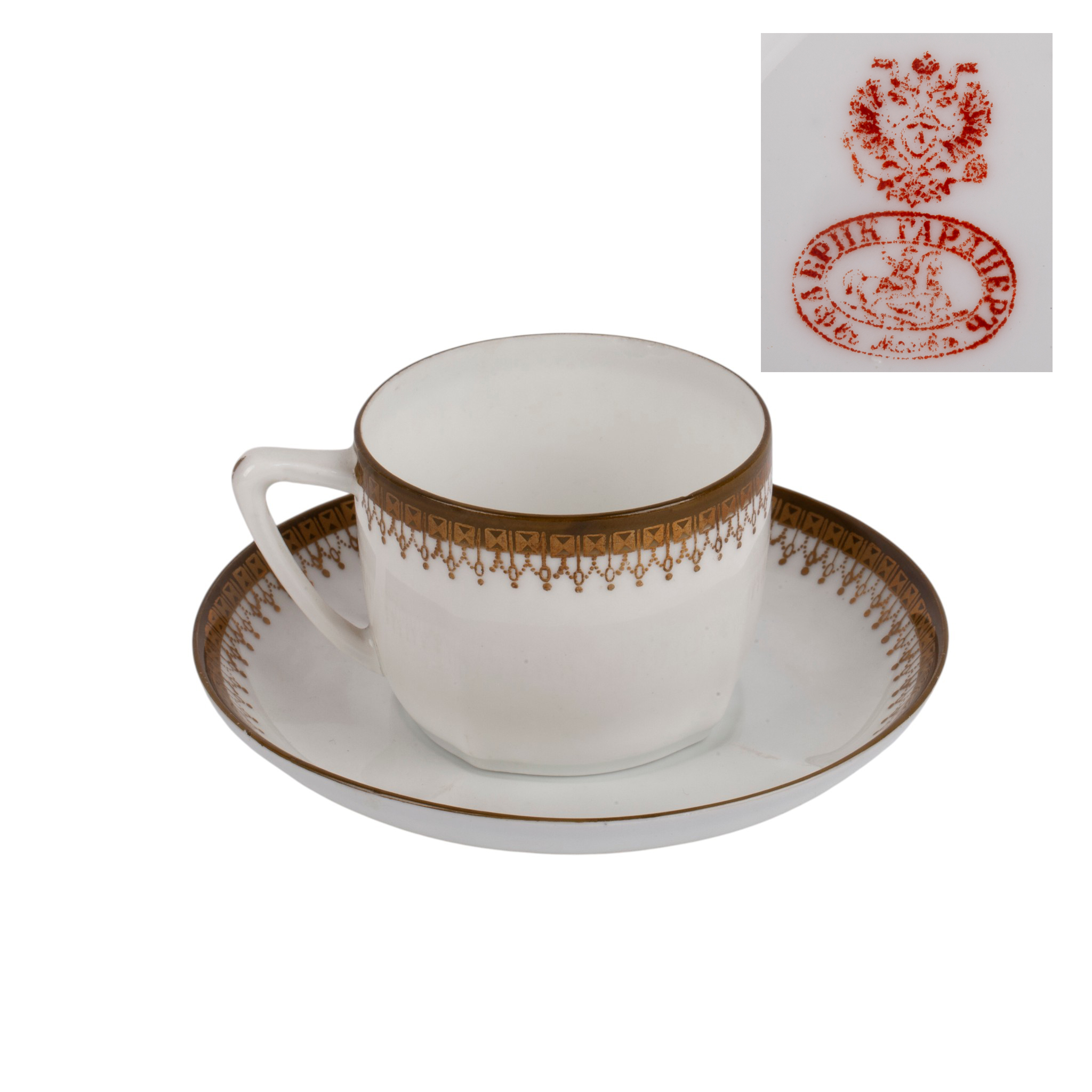
Lot 0130
Antique Russian Gardner Porcelain Cup and Saucer “Olive & Gold”, Late 19th Century
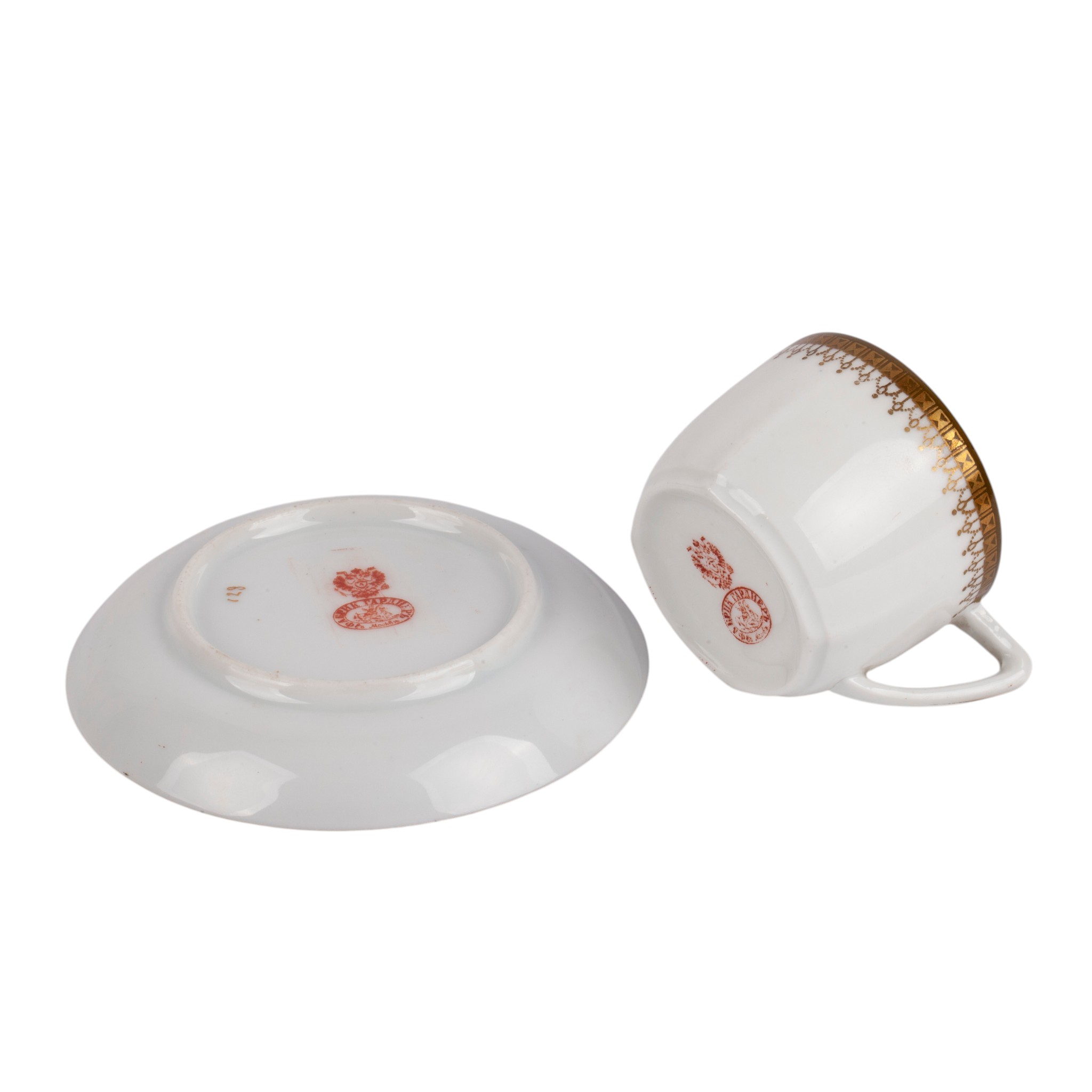
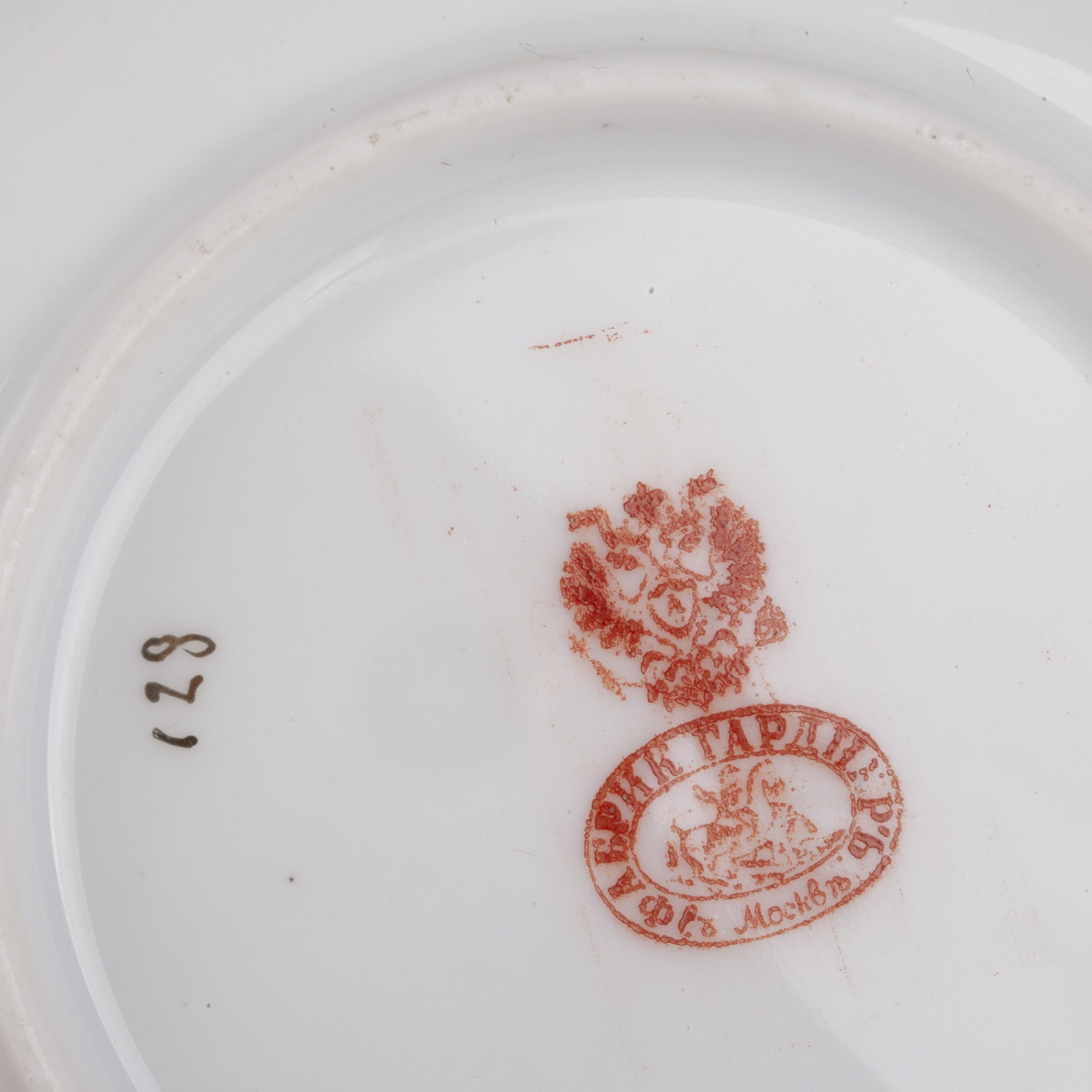
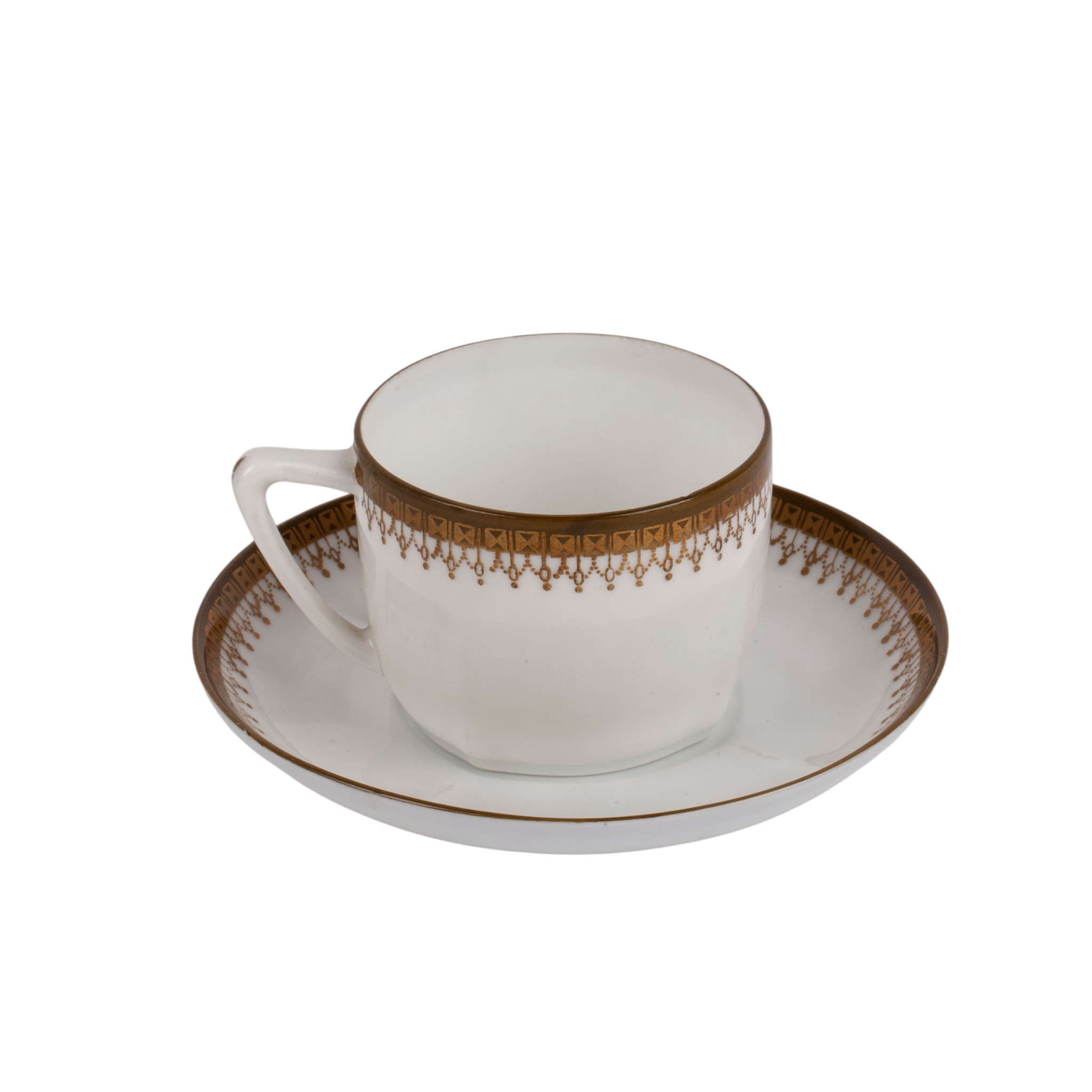
Estimate: 300-400€Antique Russian Gardner Porcelain Cup & Saucer – “Olive & Gold” (Late 19th Century)
Description: A refined and understated example of Imperial-era porcelain from the Gardner Factory (Verbilki). This set features a sophisticated “Green Gardner” design, utilizing a dark olive-toned band that provides a striking contrast to the fine white porcelain.Design: The primary decoration consists of a deep olive-green border overlaid with a continuous gilded geometric pattern. Below the band is a delicate, hanging gold-filigree “lace” motif. The cup features a clean, slightly flared silhouette and a graceful handle.
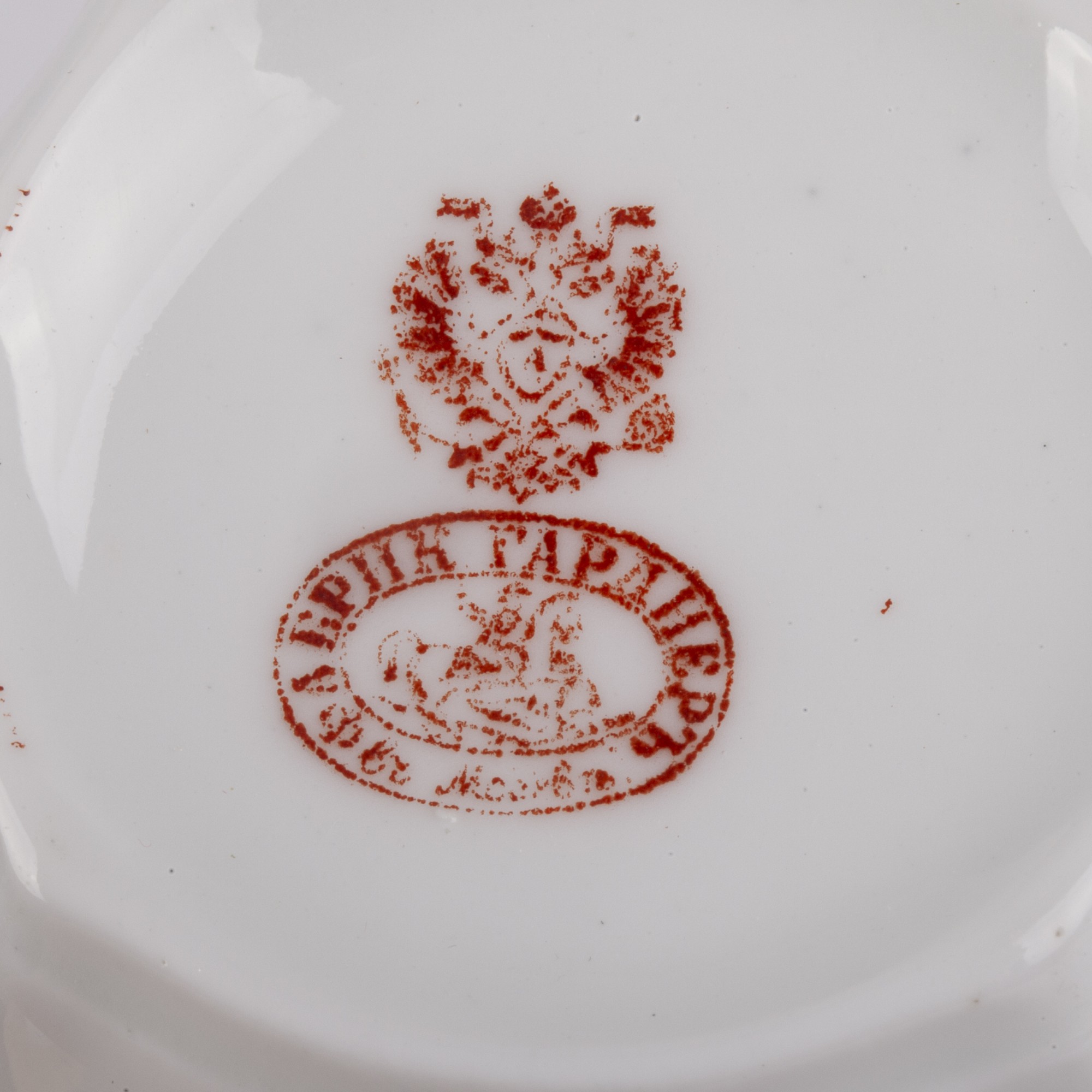
Markings: The base of both pieces features the authentic red Gardner factory stamp, complete with the Imperial Double-Headed Eagle and St. George the Victorious.
Dimensions: Saucer diameter 11.5 cm; Cup height 4.8 cm.
Starting price: 200€
Estimate: 300-400€
Hammer Price: Not sold -
Lot 0131
Tea Cup from the Cobalt Caillouté Service, Imperial Porcelain Factory, St Petersburg, 1881–1894
Estimate: 500-600€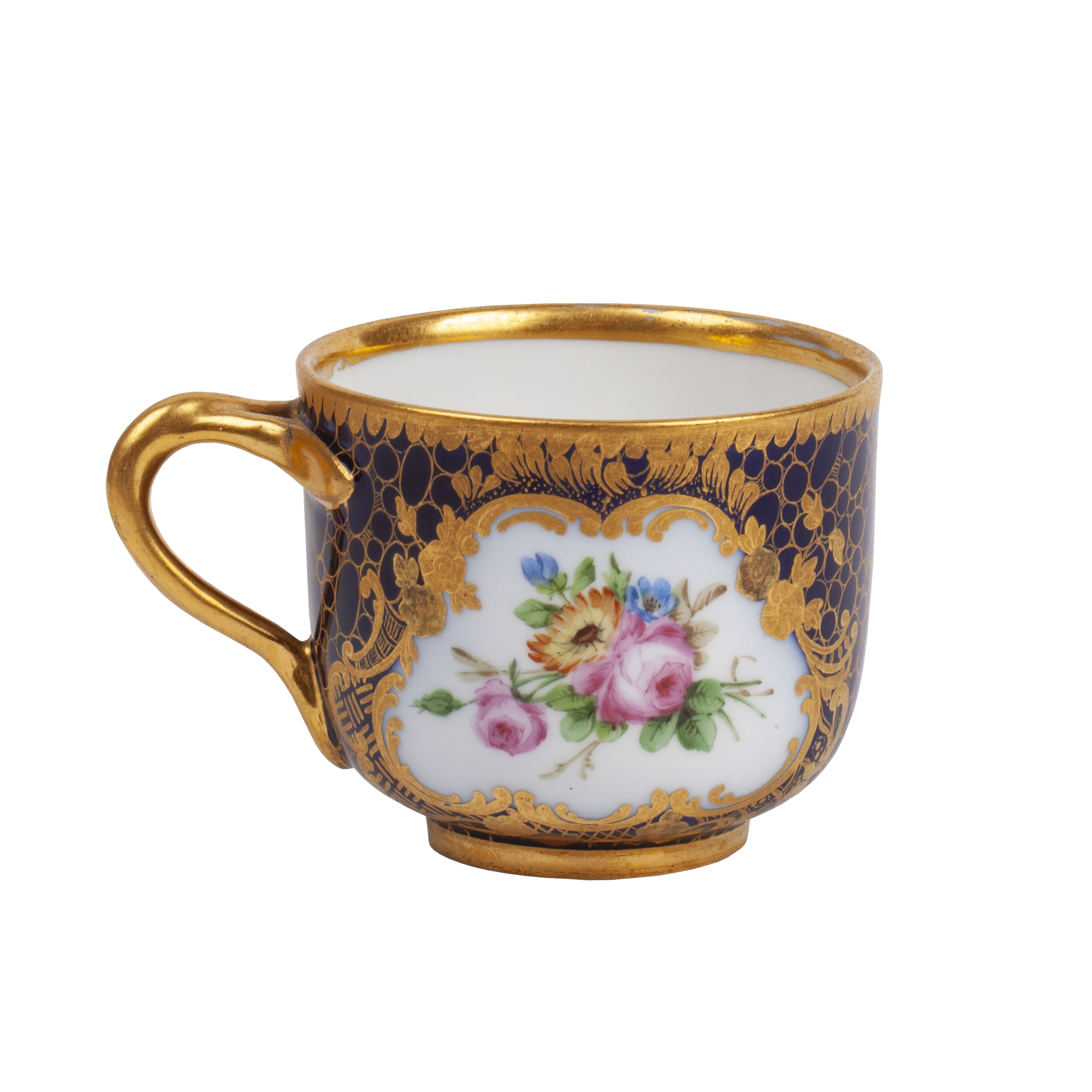
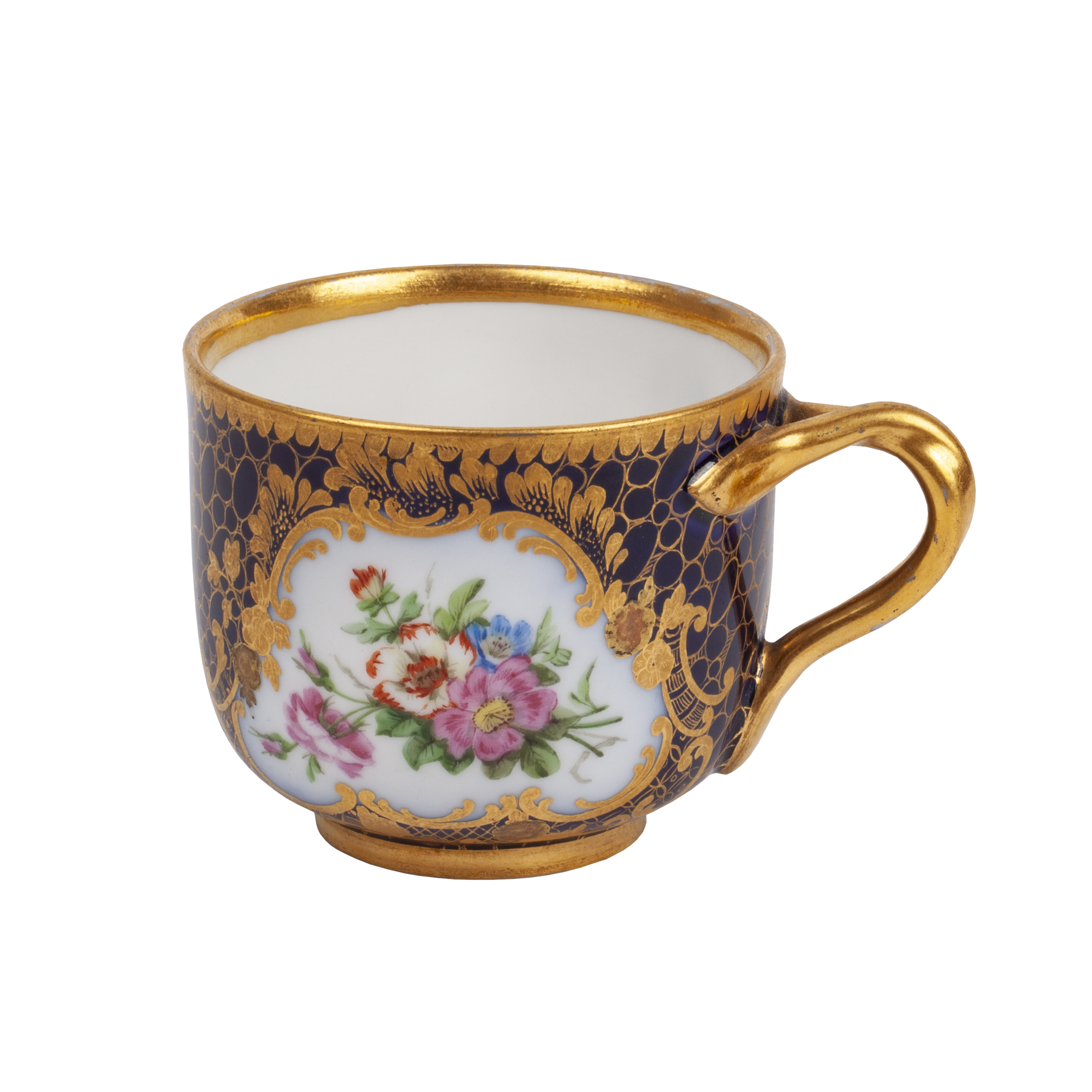
Lot 0131
Tea Cup from the Cobalt Caillouté Service, Imperial Porcelain Factory, St Petersburg, 1881–1894
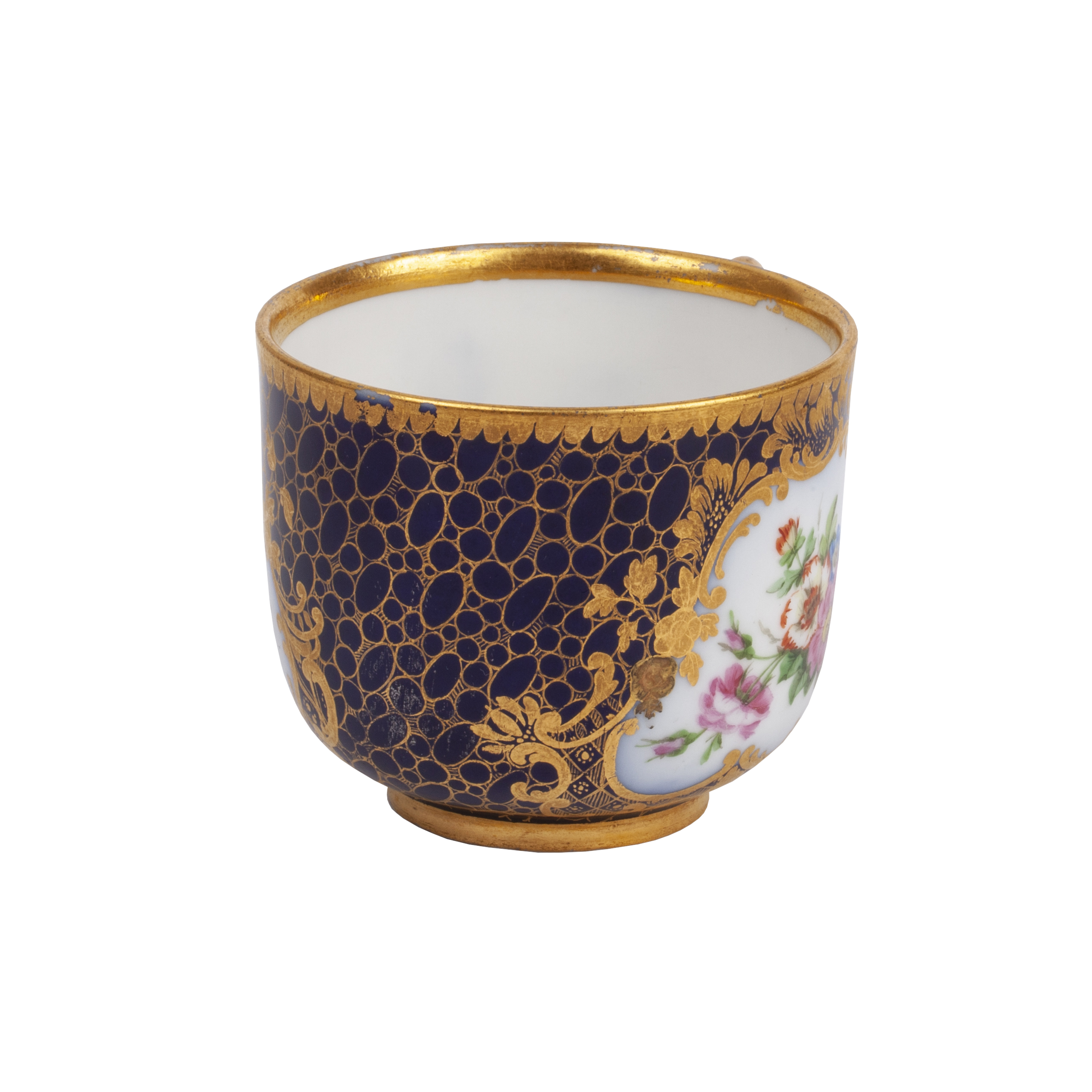
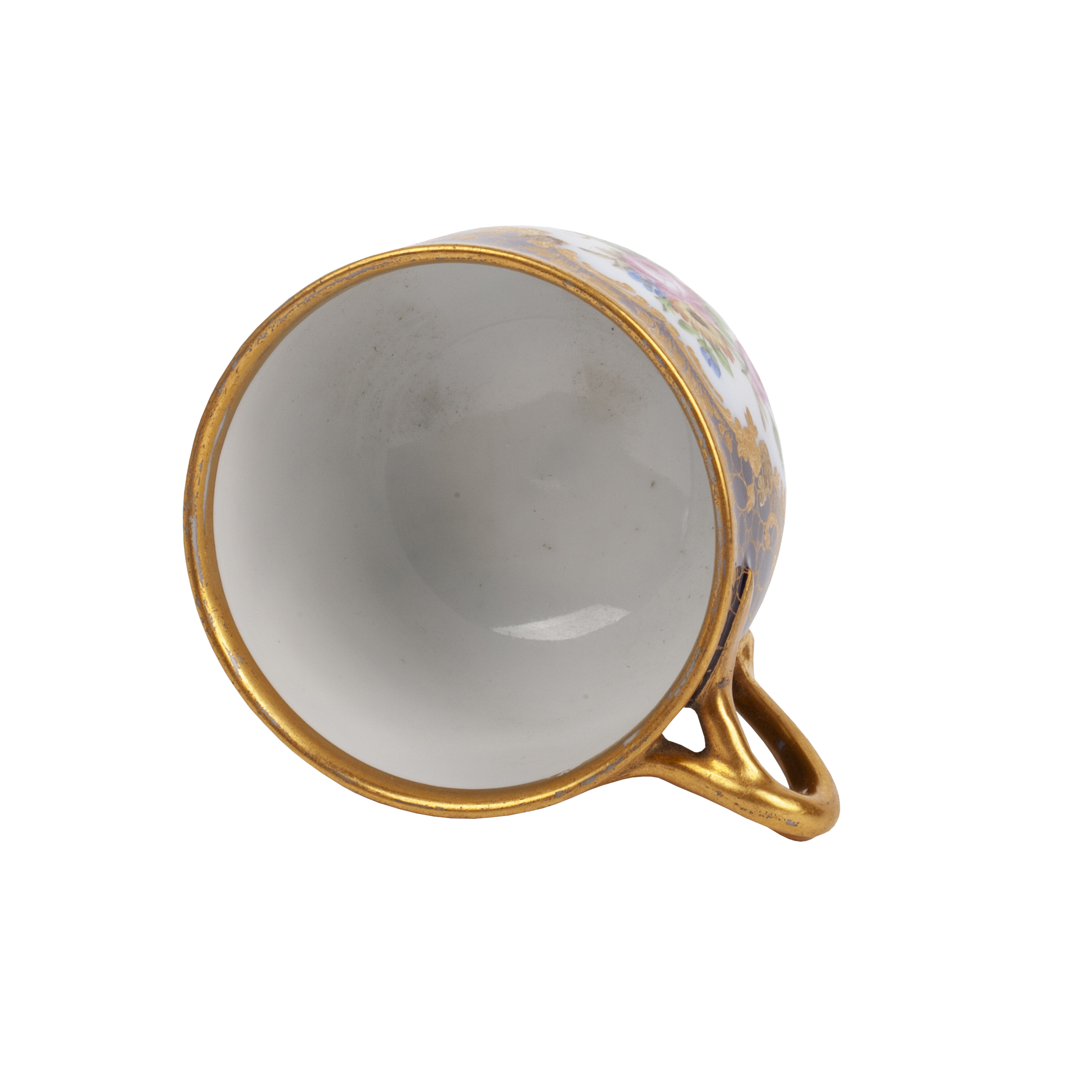
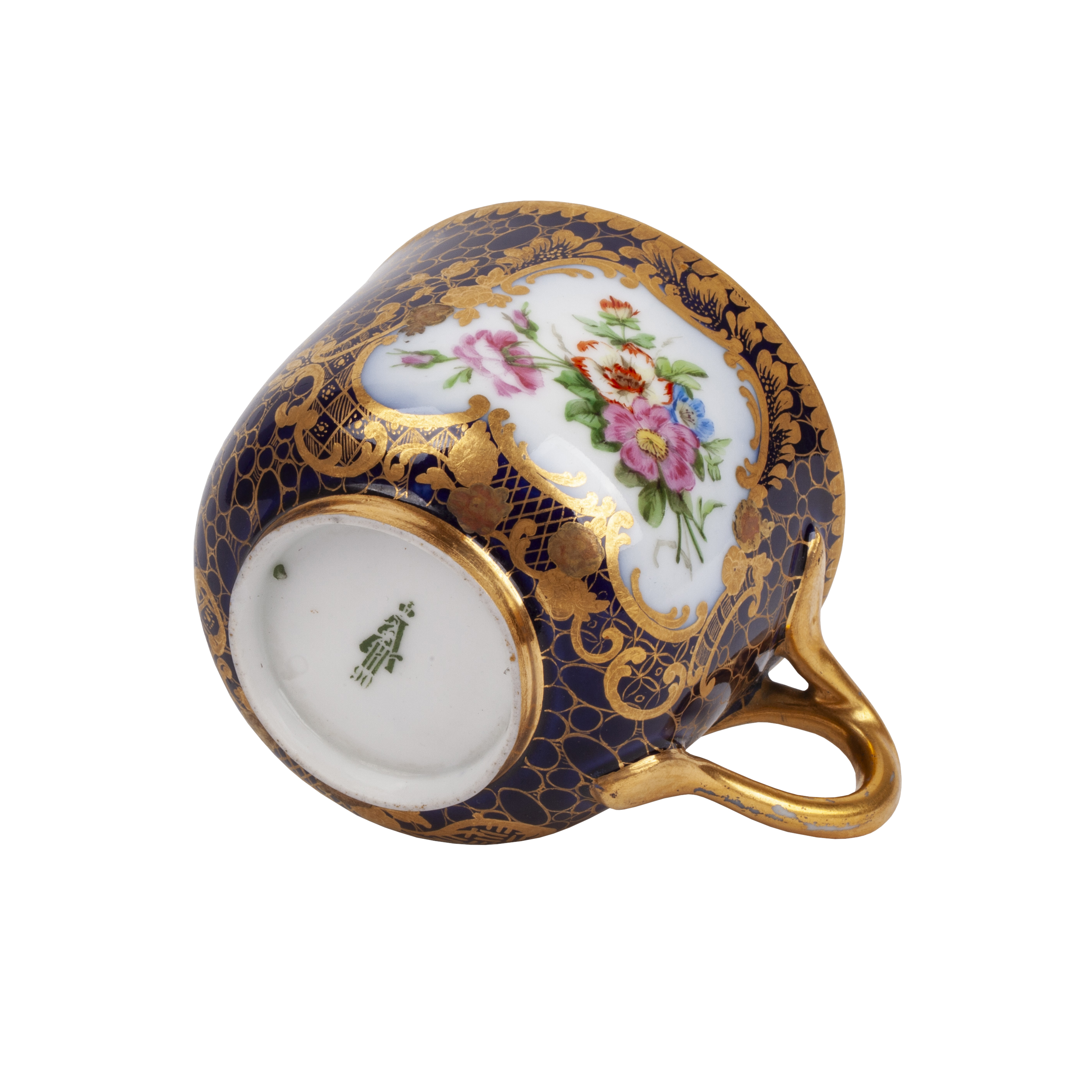
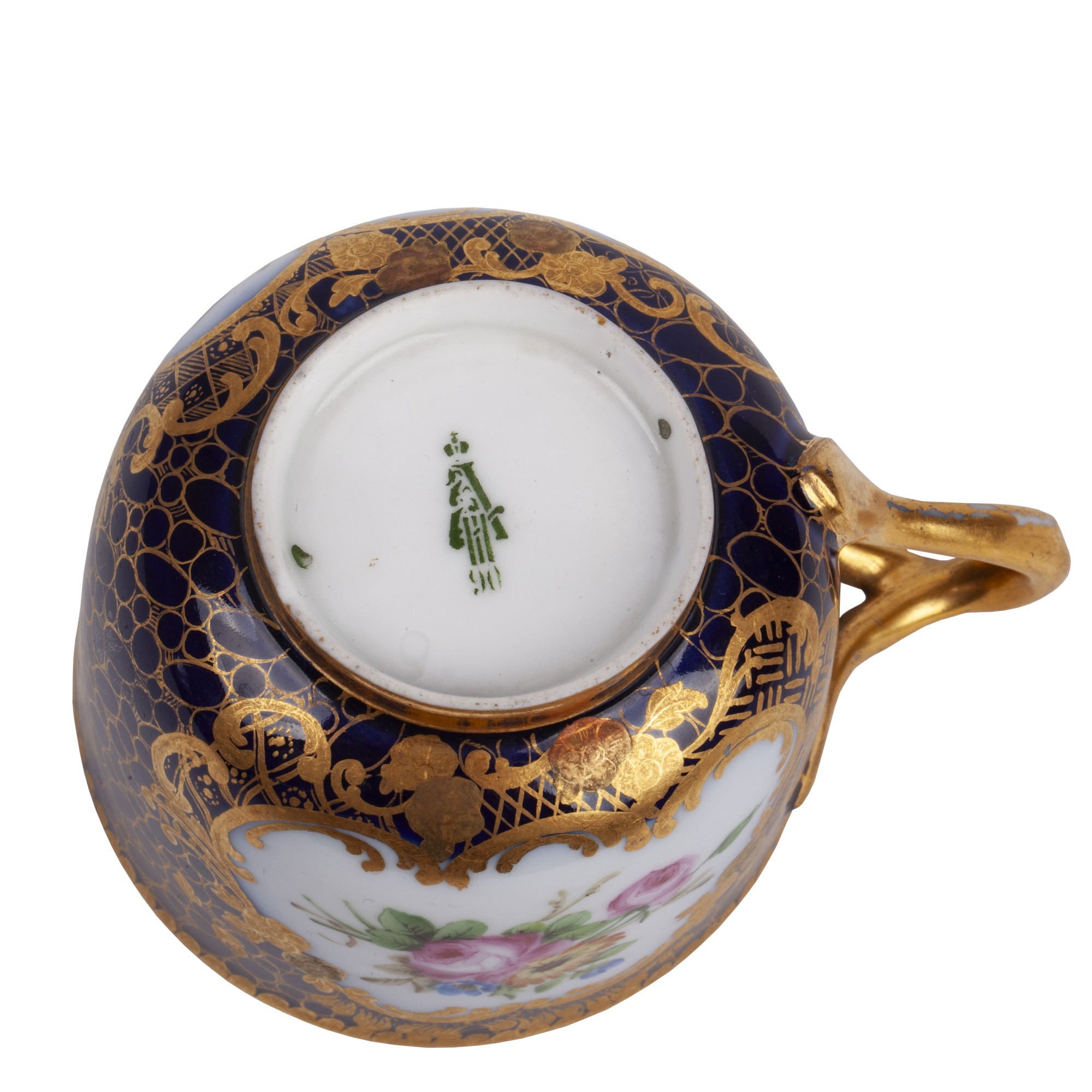
Estimate: 500-600€Tea Cup from the Cobalt Caillouté Service
Imperial Porcelain Factory, St. Petersburg, 1881–1894
Porcelain, cobalt ground, gilding, painting, and burnishing
Mark: green underglaze “A III” beneath the Imperial crow.
Dimensions: 6.5 х 10 х 7.5 cm.
A porcelain tea cup from the celebrated Caillouté cobalt service, richly decorated with gilded lattice ornament, floral cartouches, and cobalt-blue ground. The intricate gilding pattern — imitating cobblestone paving — gave the service its French name caillouté.The design originated from a service produced by the Vienna Manufactory in 1786, gifted to Grand Duke Paul Petrovich by Archduke Joseph II of Austria. Closely following Sèvres forms and style, the lavish gilding and deep cobalt tone made it one of the most distinguished ceremonial services of the Russian court.
Similar pieces are published in Imperial Porcelain Factory 1744–1904, ed. V. V. Znamenov, Global View & St. Petersburg Orchestra, St. Petersburg–Moscow, 2008, pp. 492–493.
Starting price: 400€
Estimate: 500-600€
Hammer Price: Not sold -
Lot 0132
Plate by the Kornilov Brothers Manufactory, St Petersburg, Second Half of the 19th Century
Estimate: 150-200€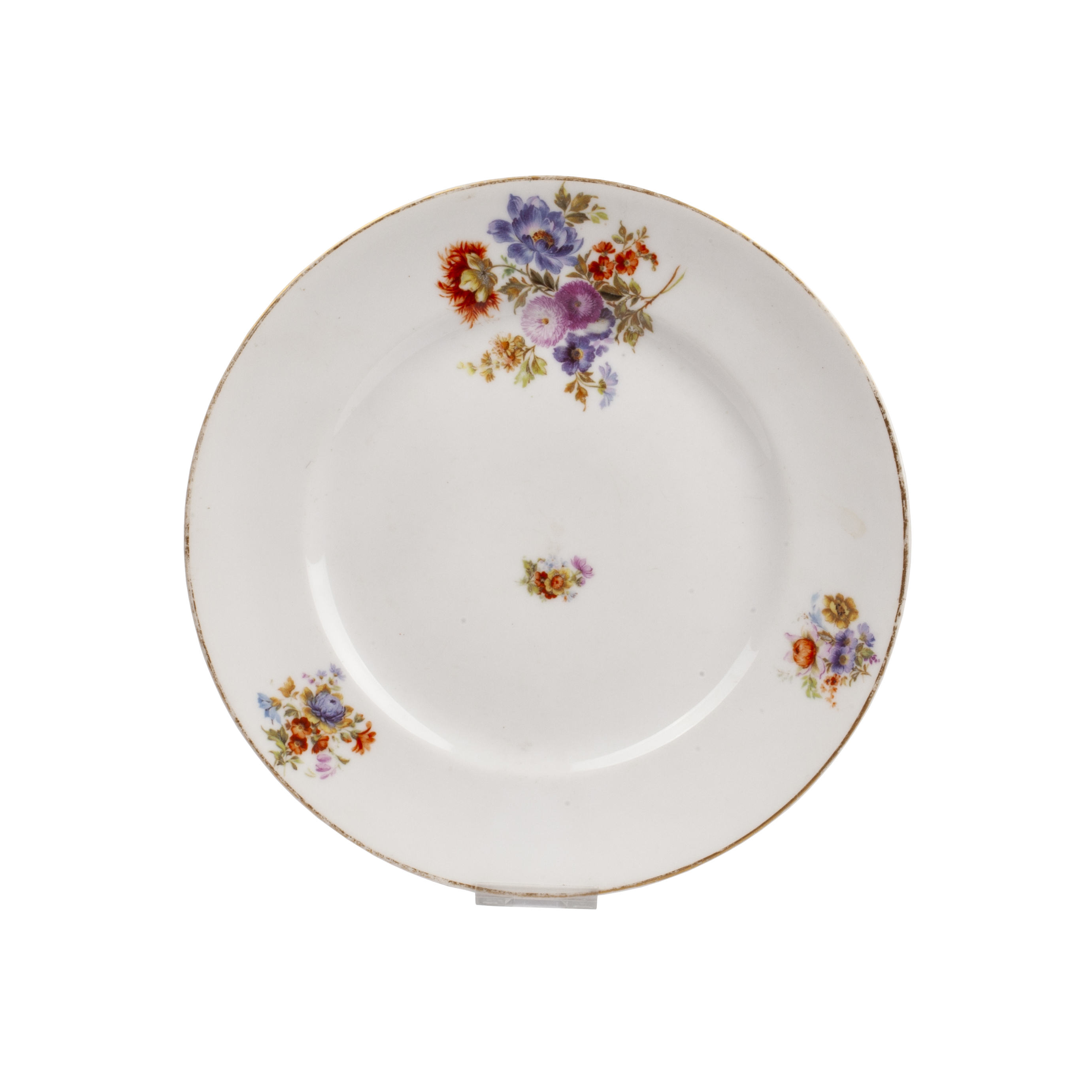
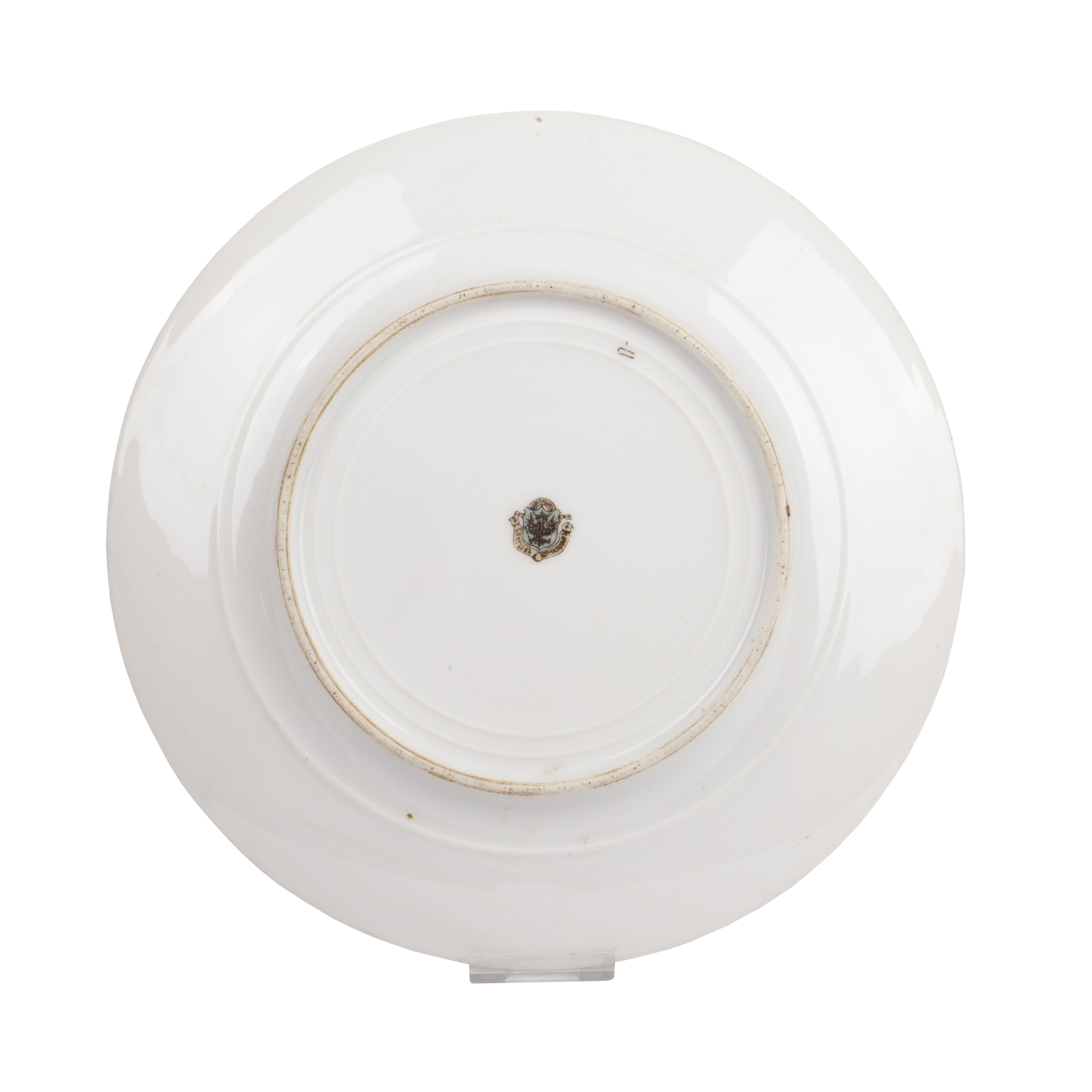
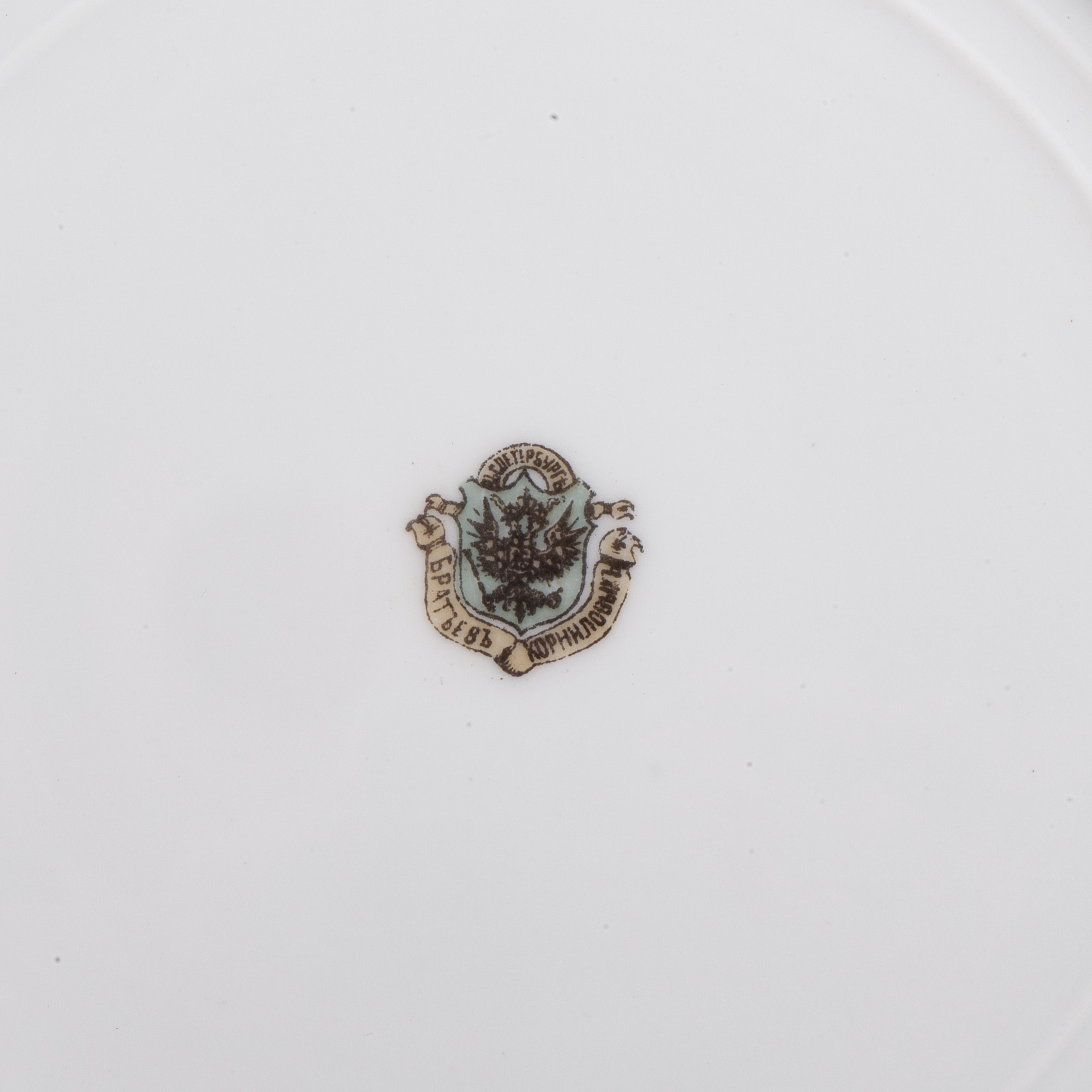
Lot 0132
Plate by the Kornilov Brothers Manufactory, St Petersburg, Second Half of the 19th Century
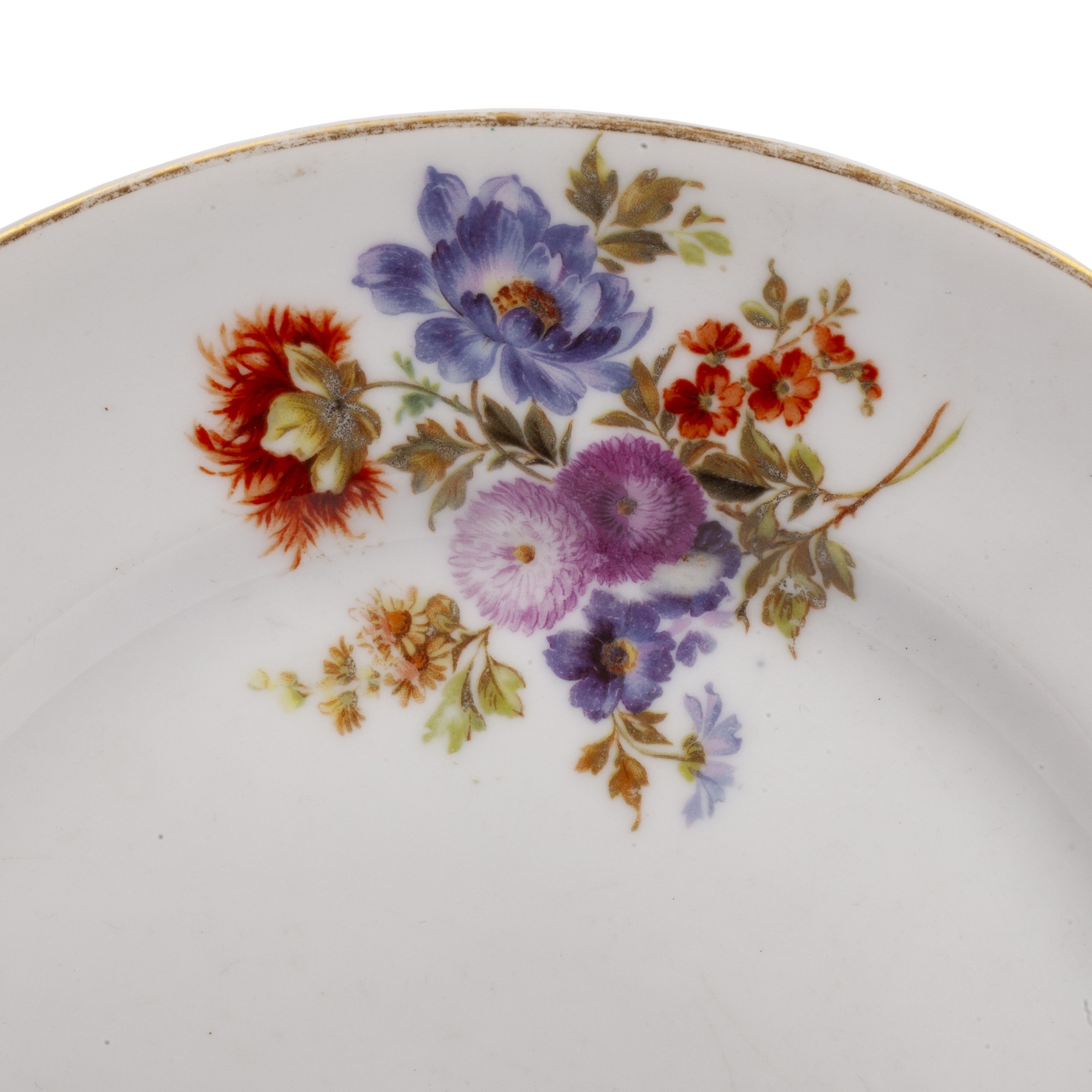
Estimate: 150-200€Plate by the Kornilov Brothers Manufactory
Russia, St. Petersburg, second half of the 19th century
Porcelain, overglaze polychrome painting, gilding
Diameter: 24.3 cmAn elegant round porcelain plate decorated with hand-painted bouquets of garden flowers — violets, dahlias, and roses — rendered in the refined painterly style characteristic of the Kornilov Brothers factory. A small floral wreath adorns the center, while the rim is highlighted with a delicate gold border, partially preserved.
The Kornilov Brothers porcelain was admired for its fine white body and meticulous decorative work. Their pieces were highly sought after among the St. Petersburg elite and were often commissioned for private households and noble estates. In the late 19th century, Kornilov’s production competed with that of Kuznetsov and Gardner, maintaining a distinctive sense of grace and artistry rooted in hand craftsmanship.
The factory mark of the Kornilov Brothers on the underside confirms the authenticity of the piece.
Starting price: 120€
Estimate: 150-200€
Hammer Price: Not sold -
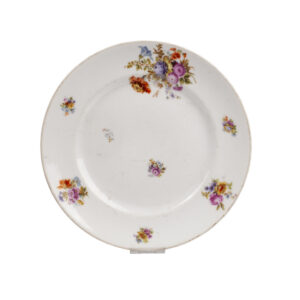
Lot 0133
Plate by the Kornilov Brothers Manufactory, St Petersburg, Second Half of the 19th Century
Estimate: 150-200€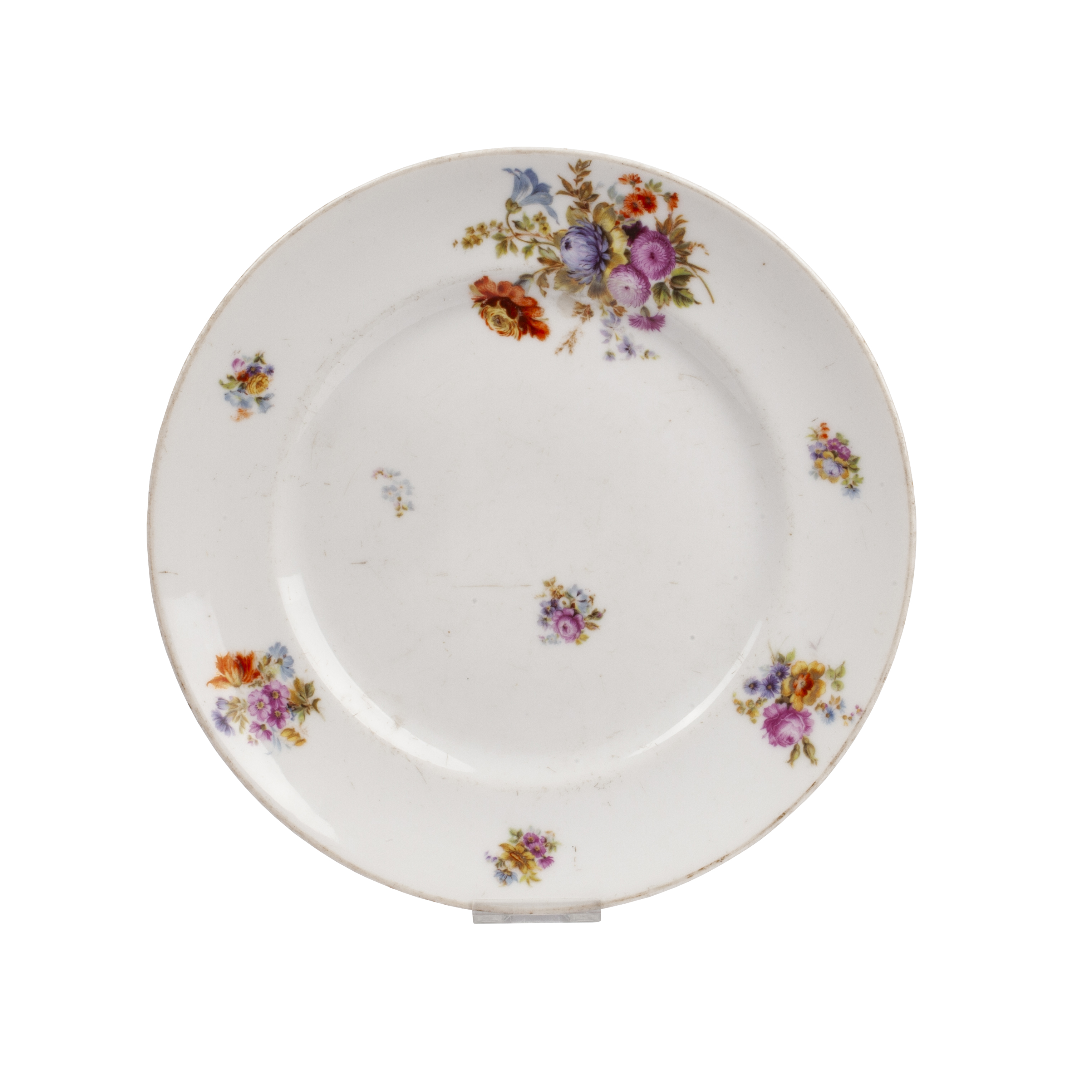
Lot 0133
Plate by the Kornilov Brothers Manufactory, St Petersburg, Second Half of the 19th Century
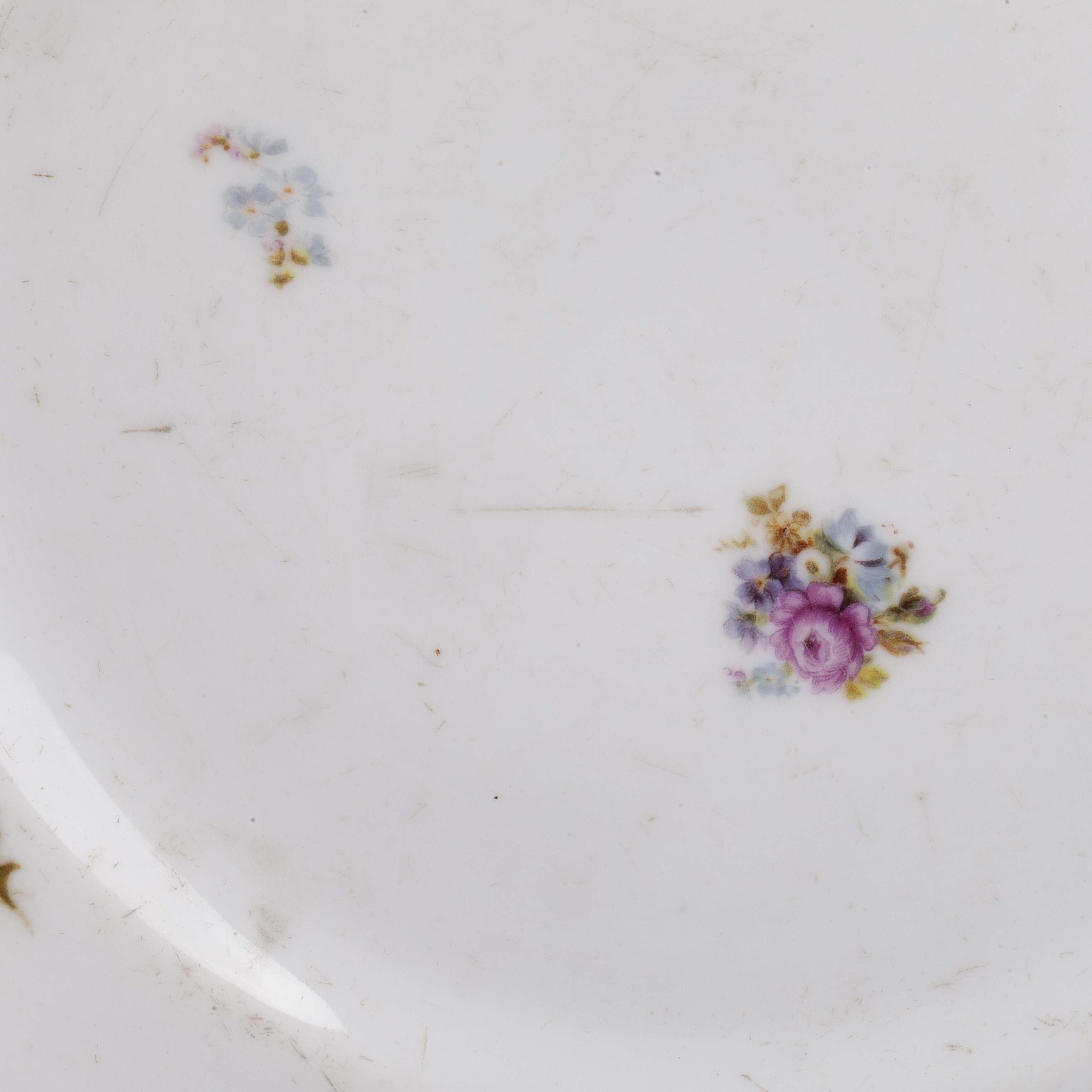
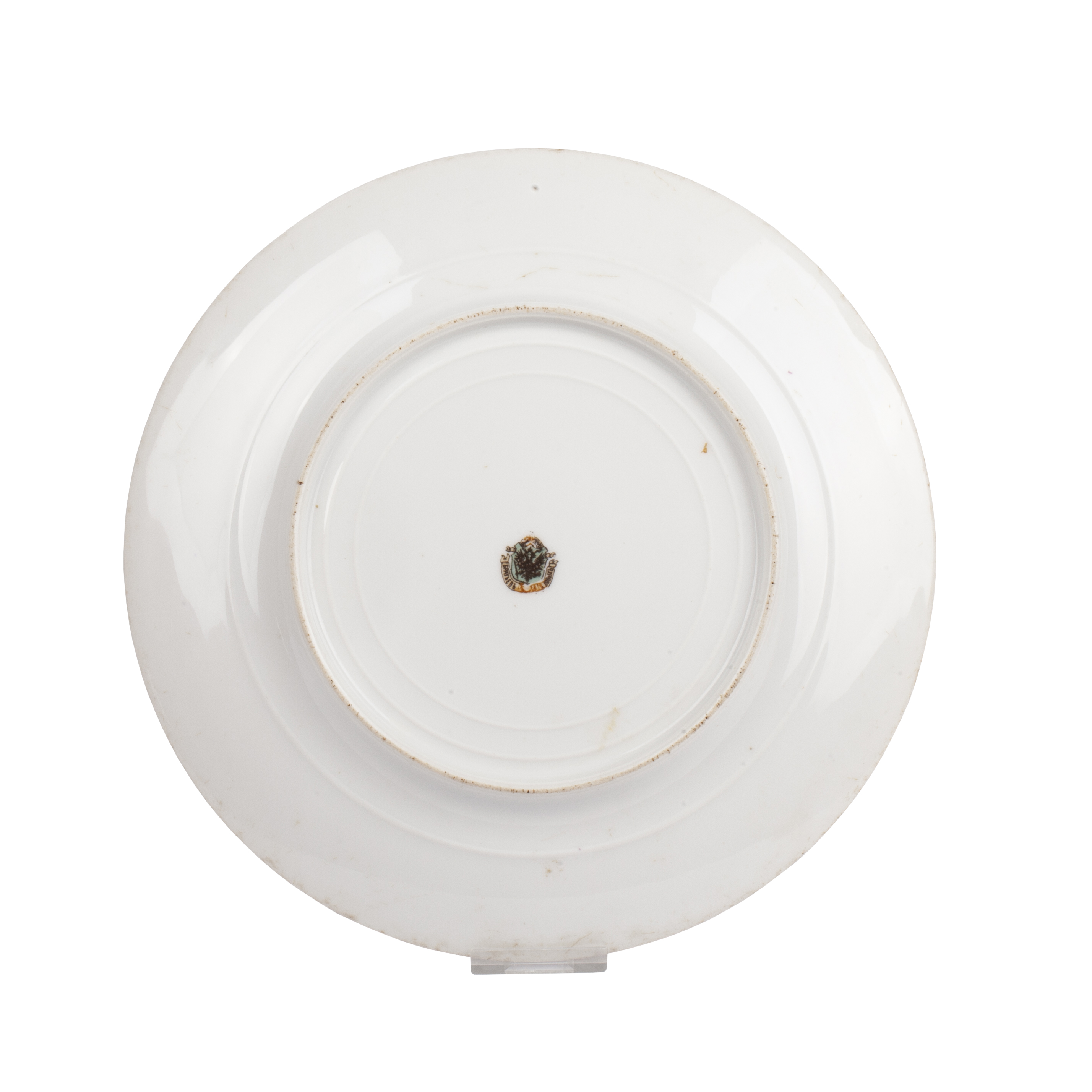
Estimate: 150-200€Plate by the Kornilov Brothers Manufactory
Russia, St. Petersburg, second half of the 19th century
Porcelain, overglaze polychrome painting, gilding
Diameter: 24.3 cmAn elegant round porcelain plate decorated with hand-painted bouquets of garden flowers — violets, dahlias, and roses — rendered in the refined painterly style characteristic of the Kornilov Brothers factory. A small floral wreath adorns the center, while the rim is highlighted with a delicate gold border, partially preserved.
The Kornilov Brothers porcelain was admired for its fine white body and meticulous decorative work. Their pieces were highly sought after among the St. Petersburg elite and were often commissioned for private households and noble estates. In the late 19th century, Kornilov’s production competed with that of Kuznetsov and Gardner, maintaining a distinctive sense of grace and artistry rooted in hand craftsmanship.
The factory mark of the Kornilov Brothers on the underside confirms the authenticity of the piece.
Starting price: 120€
Estimate: 150-200€
Hammer Price: Not sold -
Lot 0134
Russian Imperial Porcelain Factory Plate from the Gatchina Palace Service, St Petersburg, 1909
Estimate: 300-400€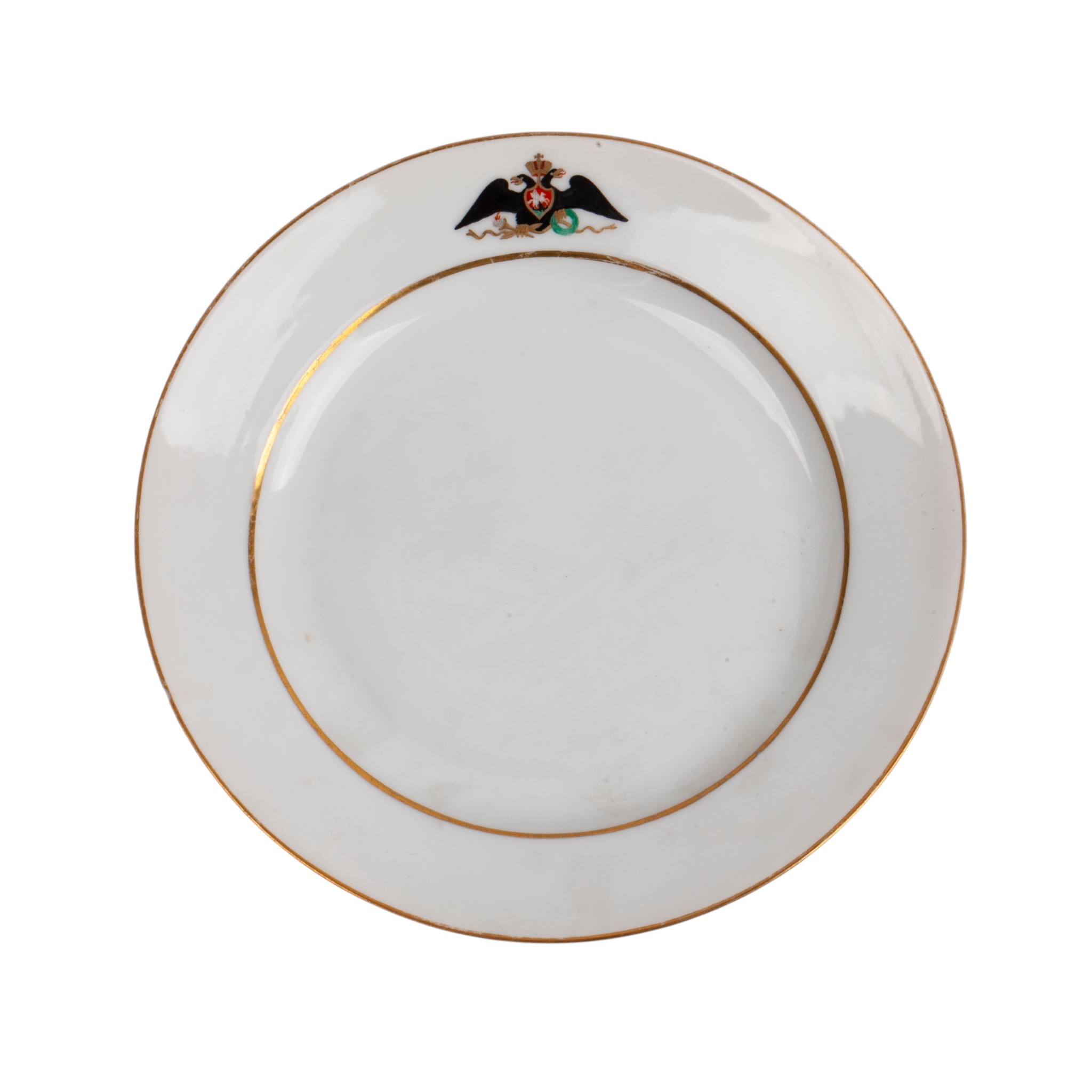
Lot 0134
Russian Imperial Porcelain Factory Plate from the Gatchina Palace Service, St Petersburg, 1909
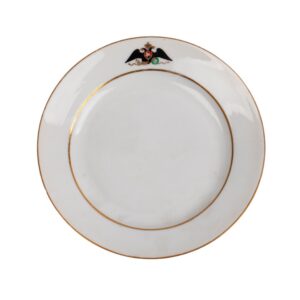
Estimate: 300-400€A Russian Imperial Porcelain Factory Plate from the Gatchina Palace Service
St Petersburg, Imperial Porcelain Factory, reign of Nicholas II, dated 1909.
Porcelain; overglaze painting, gilding.
Diameter: 23.8 cm.
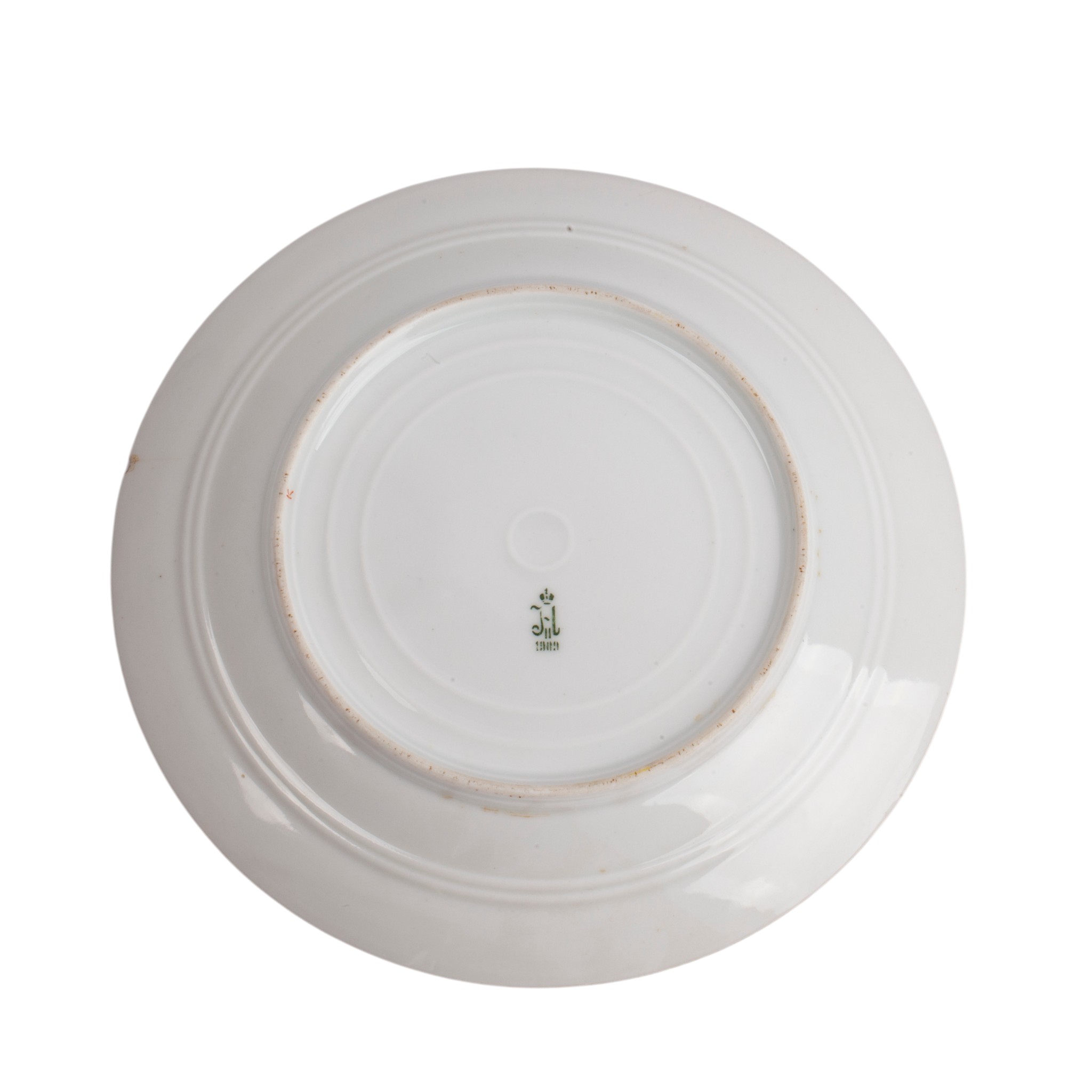
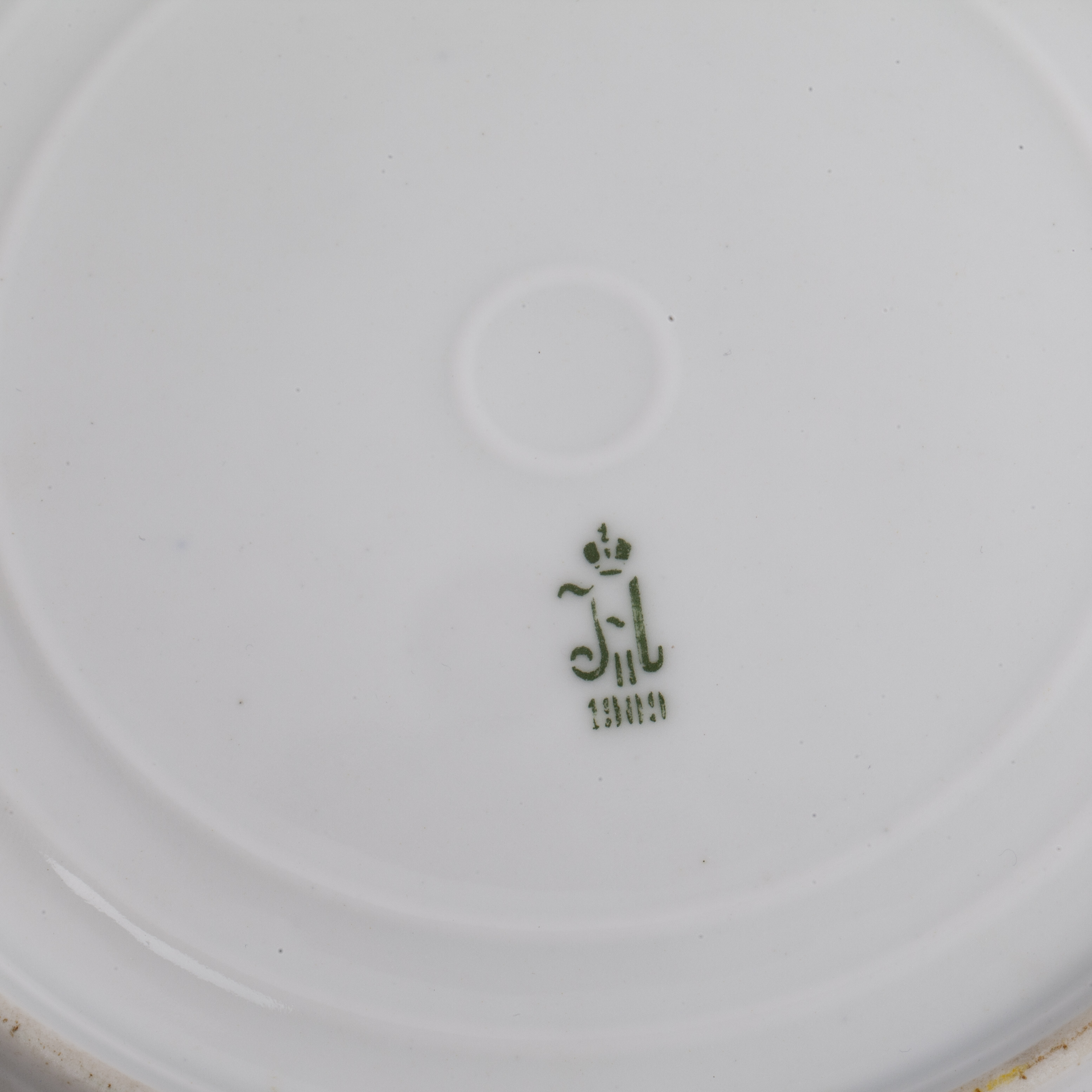
Mark: green of Emperor Nicholas II beneath the Imperial crown, dated 1909.
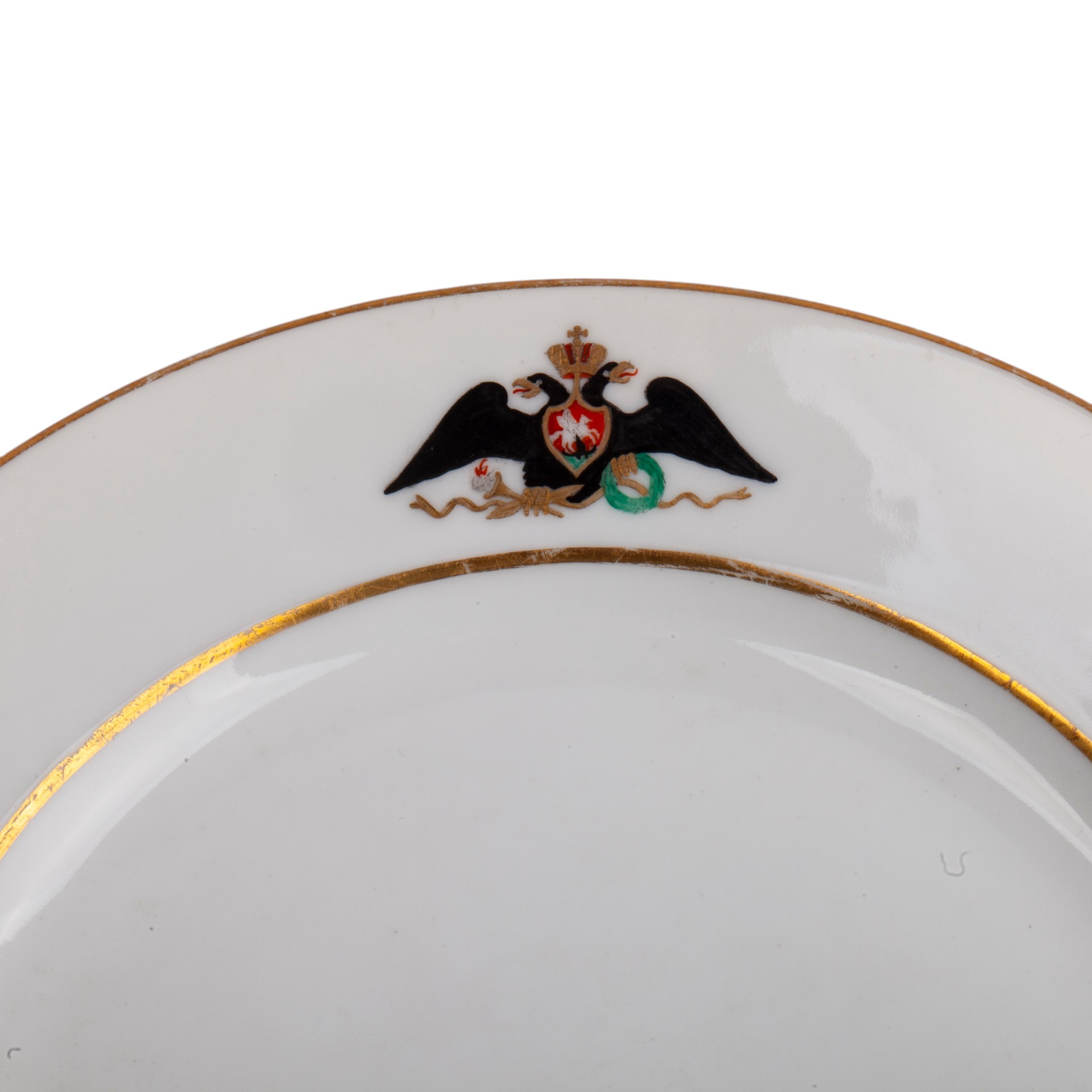
A porcelain dinner plate from the Ordinary Service of the Gatchina Palace, known as the service “with the coat of arms and gilt rim” or the “Service with Large Eagles.” The plate is of circular form, with a broad white border and a gilt line to the rim and well. The upper part of the border is decorated with the Russian Imperial double-headed eagle, finely painted in black, red, green and gold.
The Imperial eagle forms the principal decorative motif of the Gatchina service. In its talons it holds a flaming torch, wreath and thunderbolts, emblems traditionally associated with sovereign authority, victory and dynastic power.
The mark on the reverse, the green cipher of Nicholas II with the date 1909, identifies the plate as a product of the Imperial Porcelain Factory in St Petersburg during the last reign of the Romanov dynasty. The service was connected with the table appointments of the Great Gatchina Palace, one of the principal suburban residences of the Imperial family. Built in 1766-1781 to the design of Antonio Rinaldi for Count Grigory Orlov, the palace later became closely associated with the Romanovs and was among the favoured residences of the court.
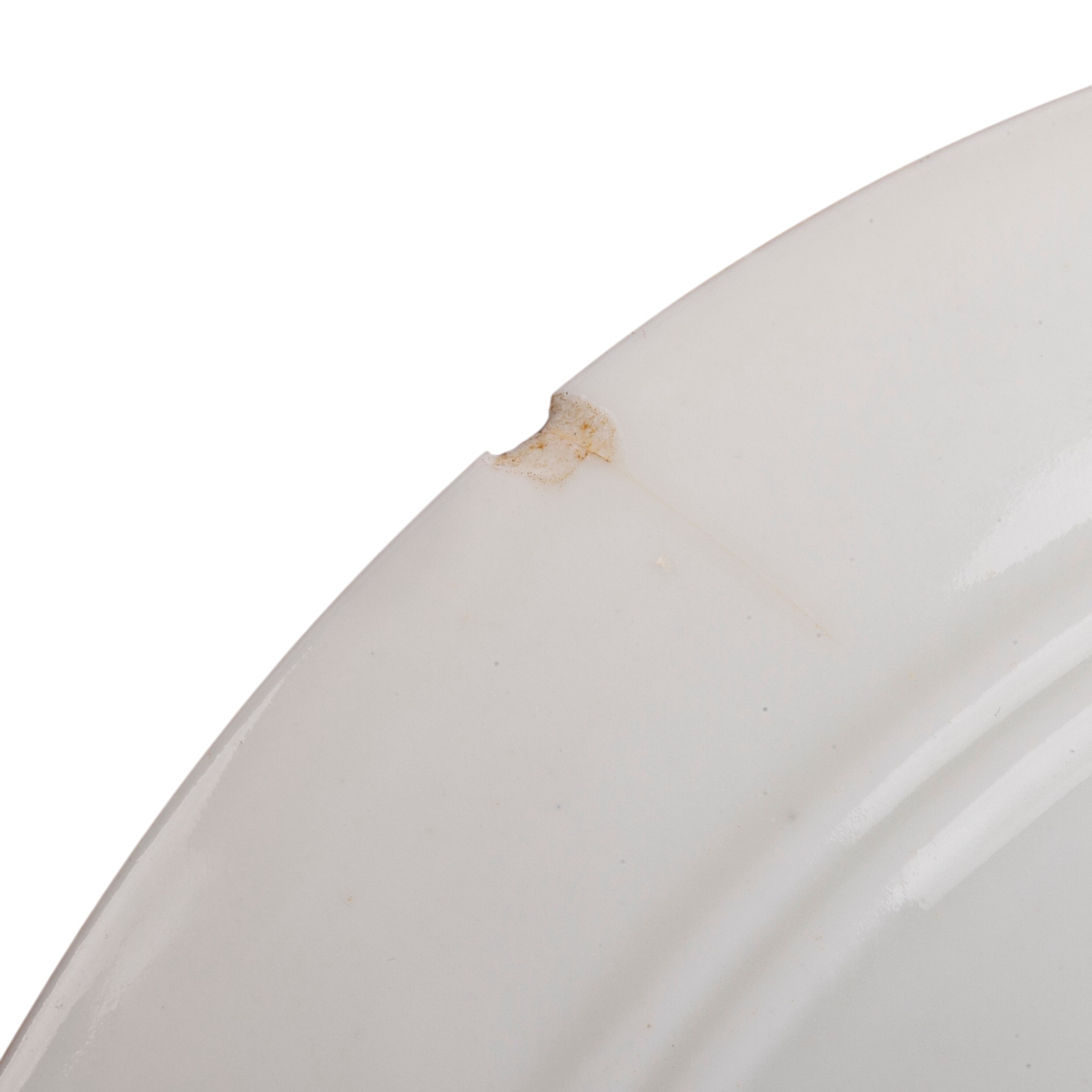
Condition: small chip to the rim.Starting price: 240€
Estimate: 300-400€
Hammer Price: Not sold -
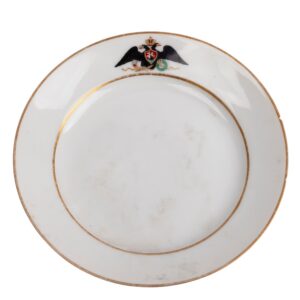
Lot 0135
Russian Imperial Porcelain Factory Plate from the Gatchina Palace Service, St Petersburg, 1909
Estimate: 250-300€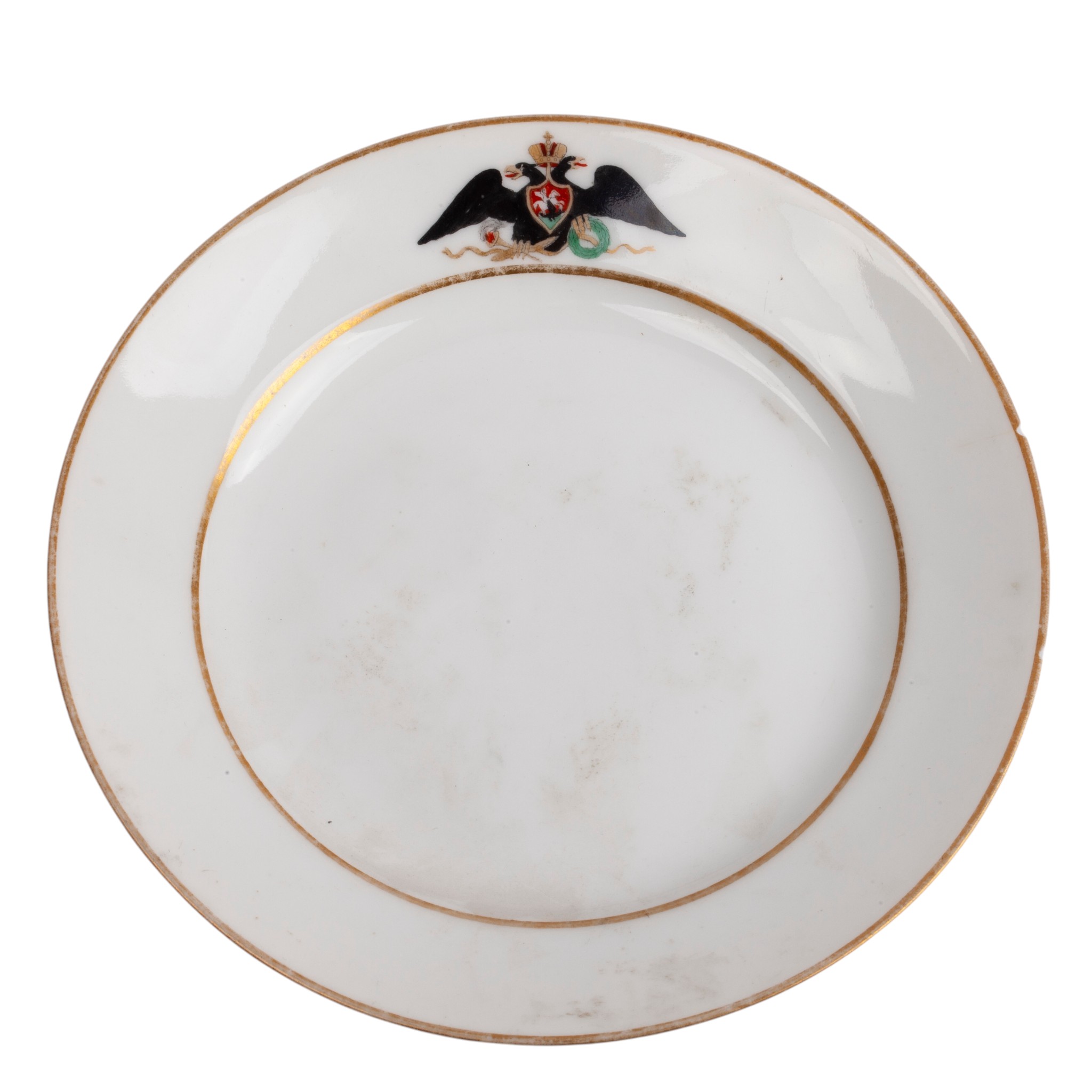
Lot 0135
Russian Imperial Porcelain Factory Plate from the Gatchina Palace Service, St Petersburg, 1909
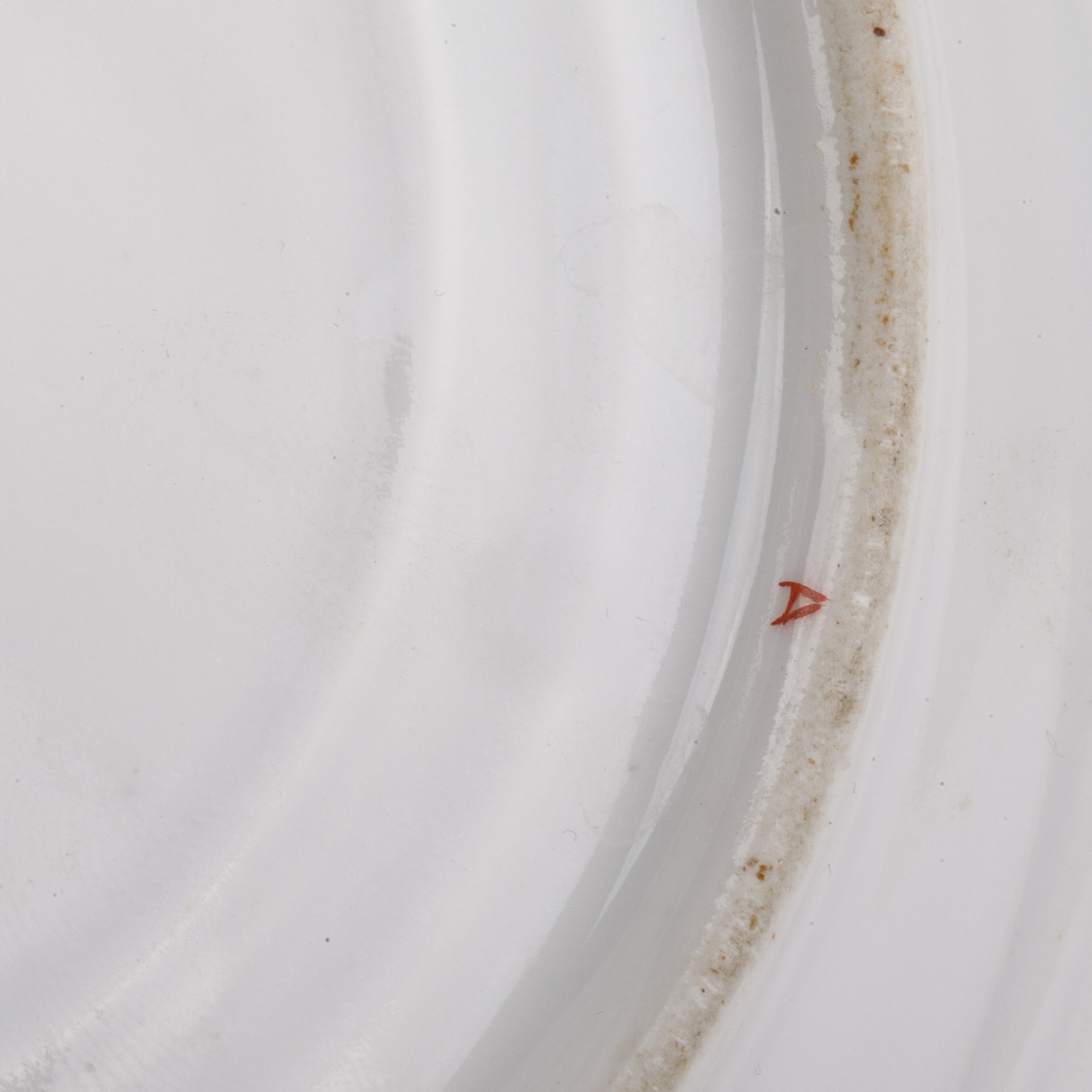
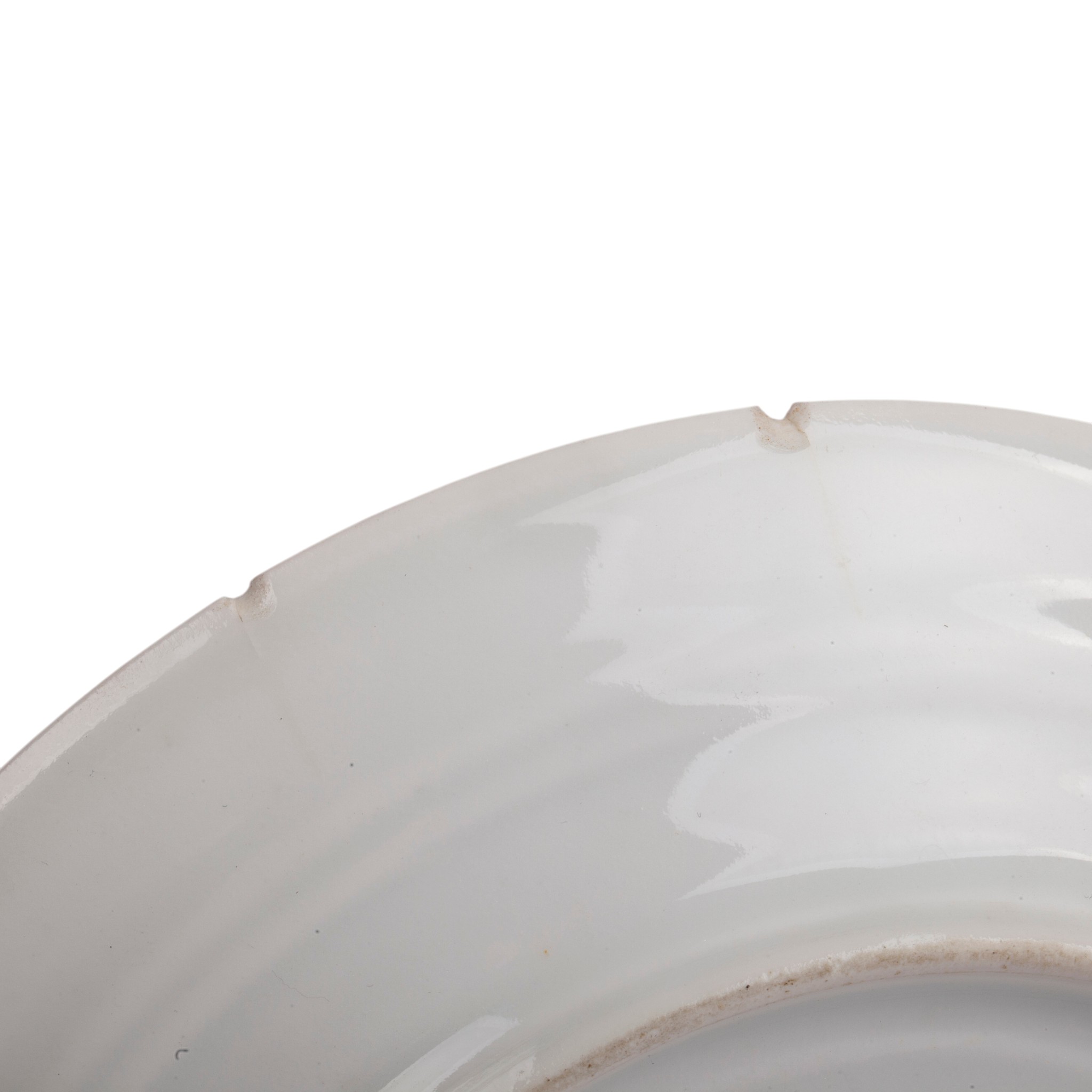
Estimate: 250-300€A Russian Imperial Porcelain Factory Plate from the Gatchina Palace Service
St Petersburg, Imperial Porcelain Factory, reign of Nicholas II, dated 1909.
Porcelain; overglaze painting, gilding.
Diameter: 18,5 cm.
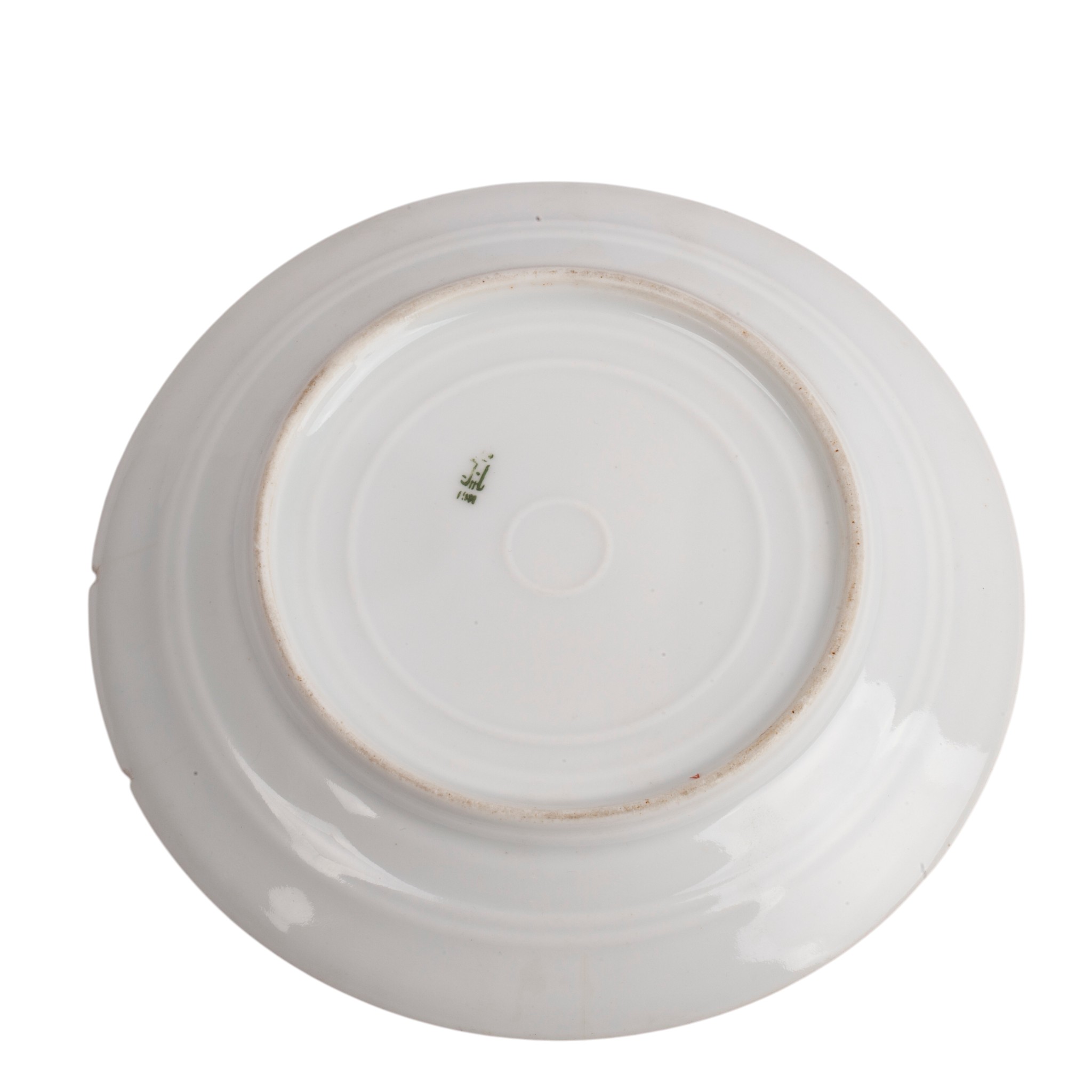
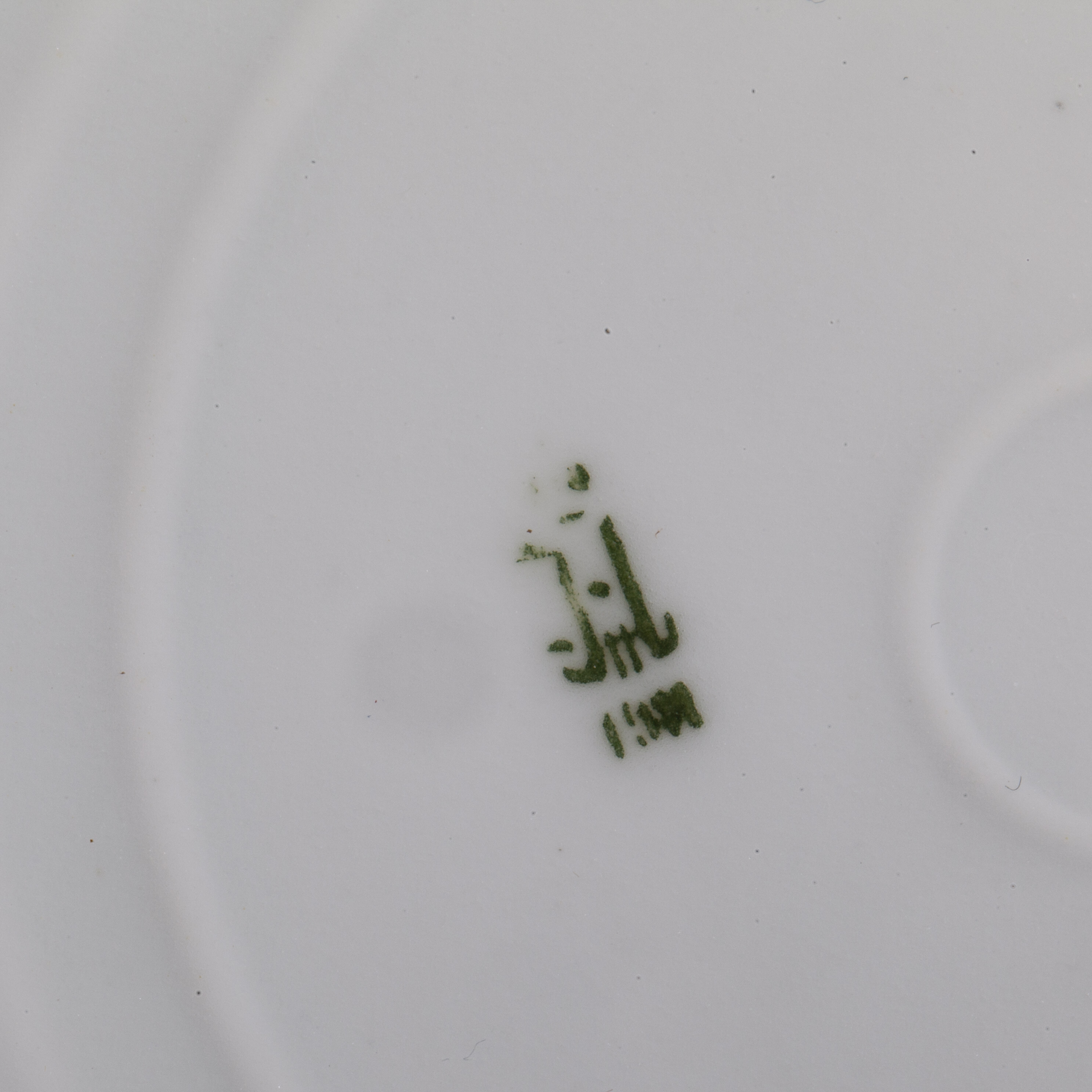
Mark: green cipher of Emperor Nicholas II beneath the Imperial crown, dated 1909.
A porcelain dinner plate from the Ordinary Service of the Gatchina Palace, known as the service “with the coat of arms and gilt rim” or the “Service with Large Eagles.” The plate is of circular form, with a broad white border and a gilt line to the rim and well. The upper part of the border is decorated with the Russian Imperial double-headed eagle, finely painted in black, red, green and gold.
The Imperial eagle forms the principal decorative motif of the Gatchina service. In its talons it holds a flaming torch, wreath and thunderbolts, emblems traditionally associated with sovereign authority, victory and dynastic power. The restrained composition, with the heraldic device set against the white porcelain ground and framed by narrow gilt bands, reflects the formal character of palace table services made for official use at the Russian Imperial residences.
The mark on the reverse, the green cipher of Nicholas II with the date 1909, identifies the plate as a product of the Imperial Porcelain Factory in St Petersburg during the last reign of the Romanov dynasty. The service was connected with the table appointments of the Great Gatchina Palace, one of the principal suburban residences of the Imperial family. Built in 1766-1781 to the design of Antonio Rinaldi for Count Grigory Orlov, the palace later became closely associated with the Romanovs and was among the favoured residences of the court.Starting price: 220€
Estimate: 250-300€
Hammer Price: Not sold -
Lot 0136
Russian Faience Figurine of a Sbiten Seller, from the Series “Traders and Craftsmen”, Late 19th Century
Estimate: 350-450€
Lot 0136
Russian Faience Figurine of a Sbiten Seller, from the Series “Traders and Craftsmen”, Late 19th Century
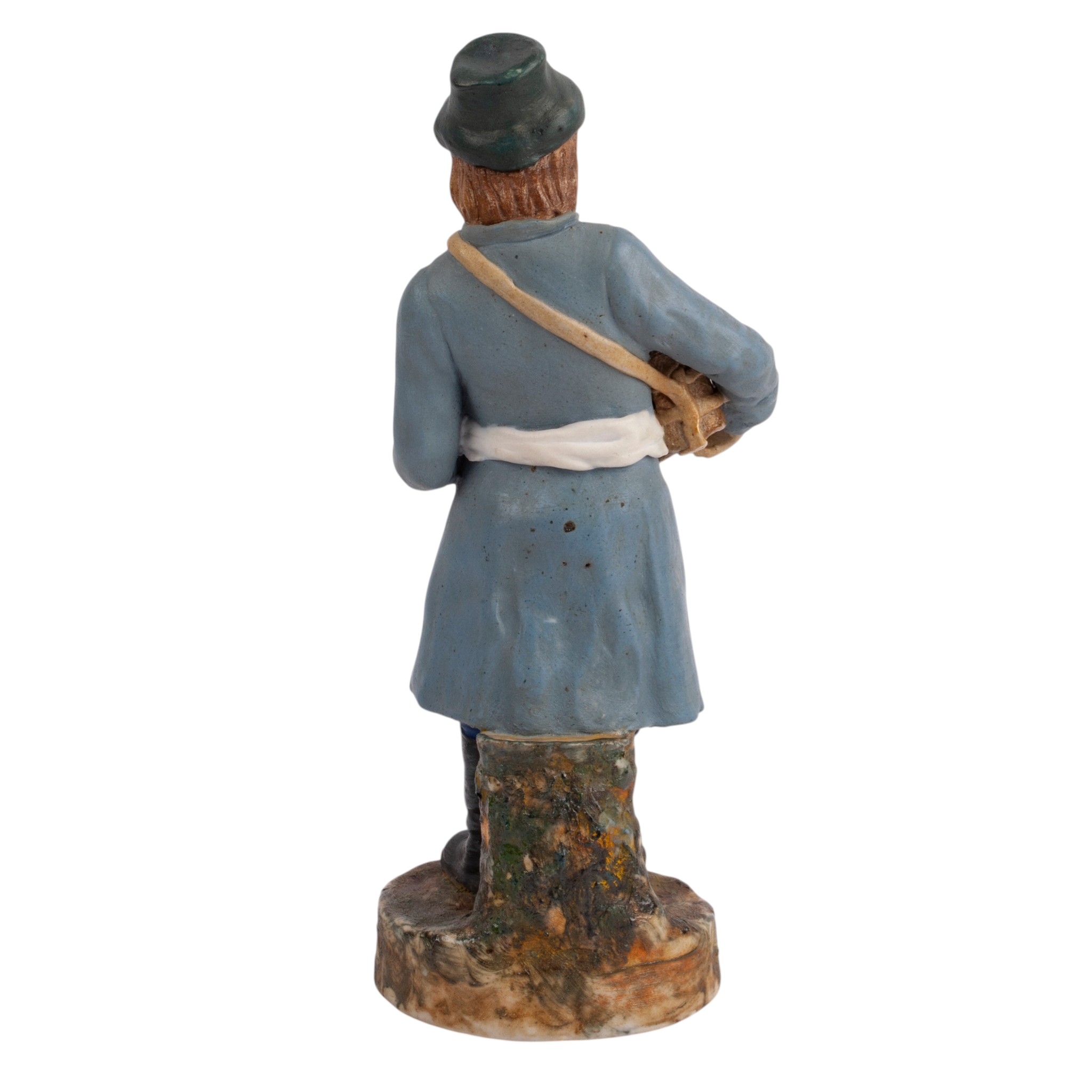
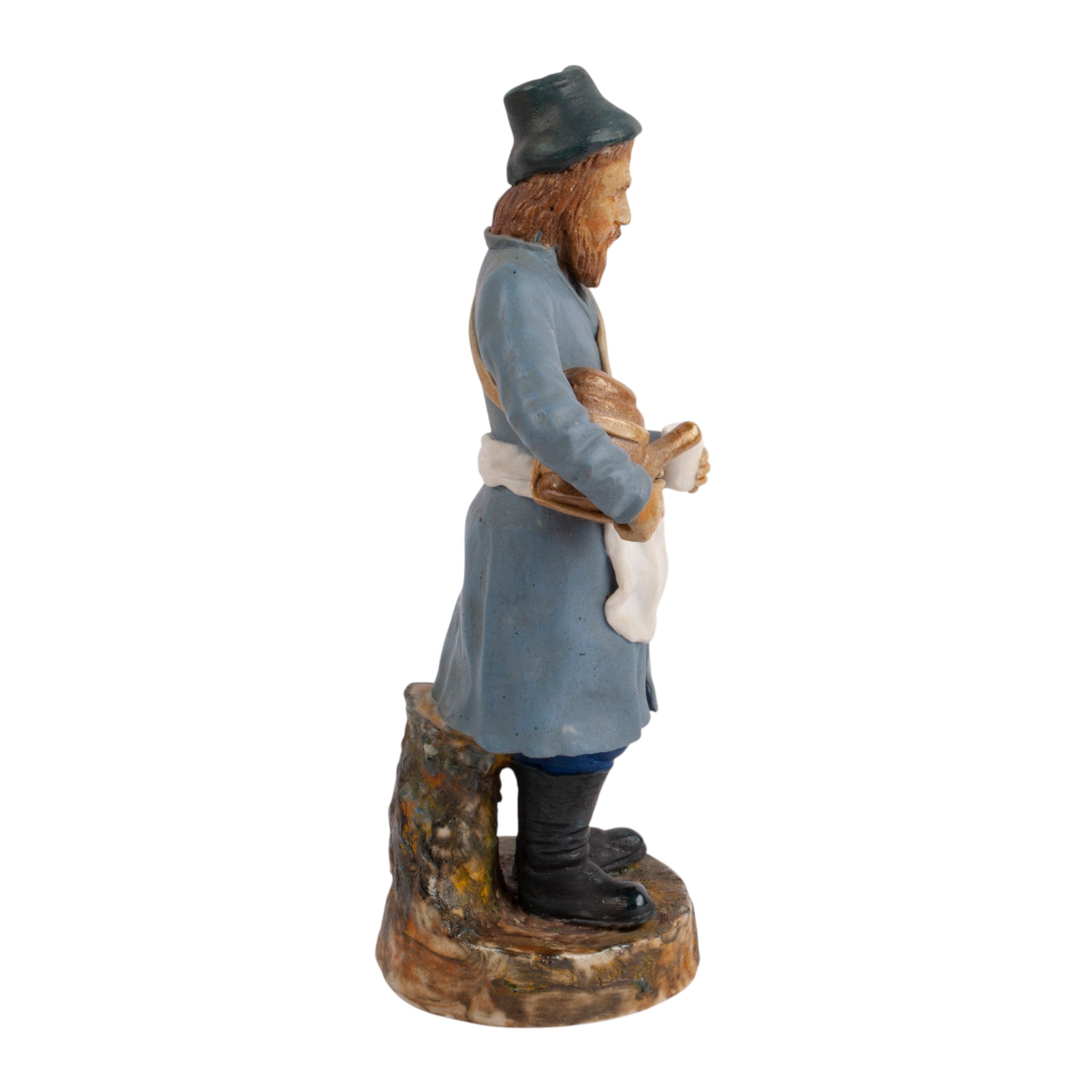
Estimate: 350-450€A RUSSIAN FIGURINE OF SBITEN SELLER
from the series Traders and Craftsmen
Faience, polychrome painting.
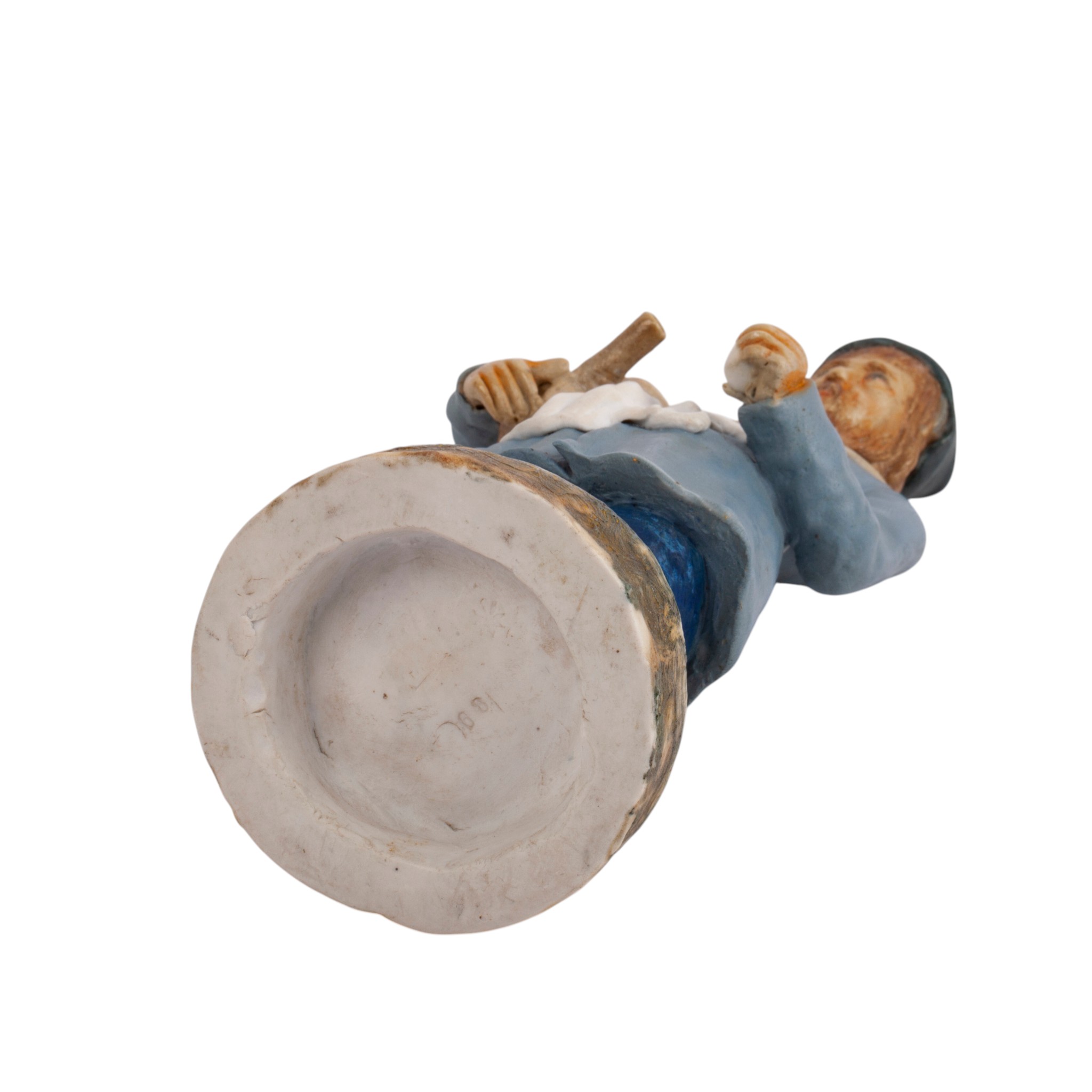
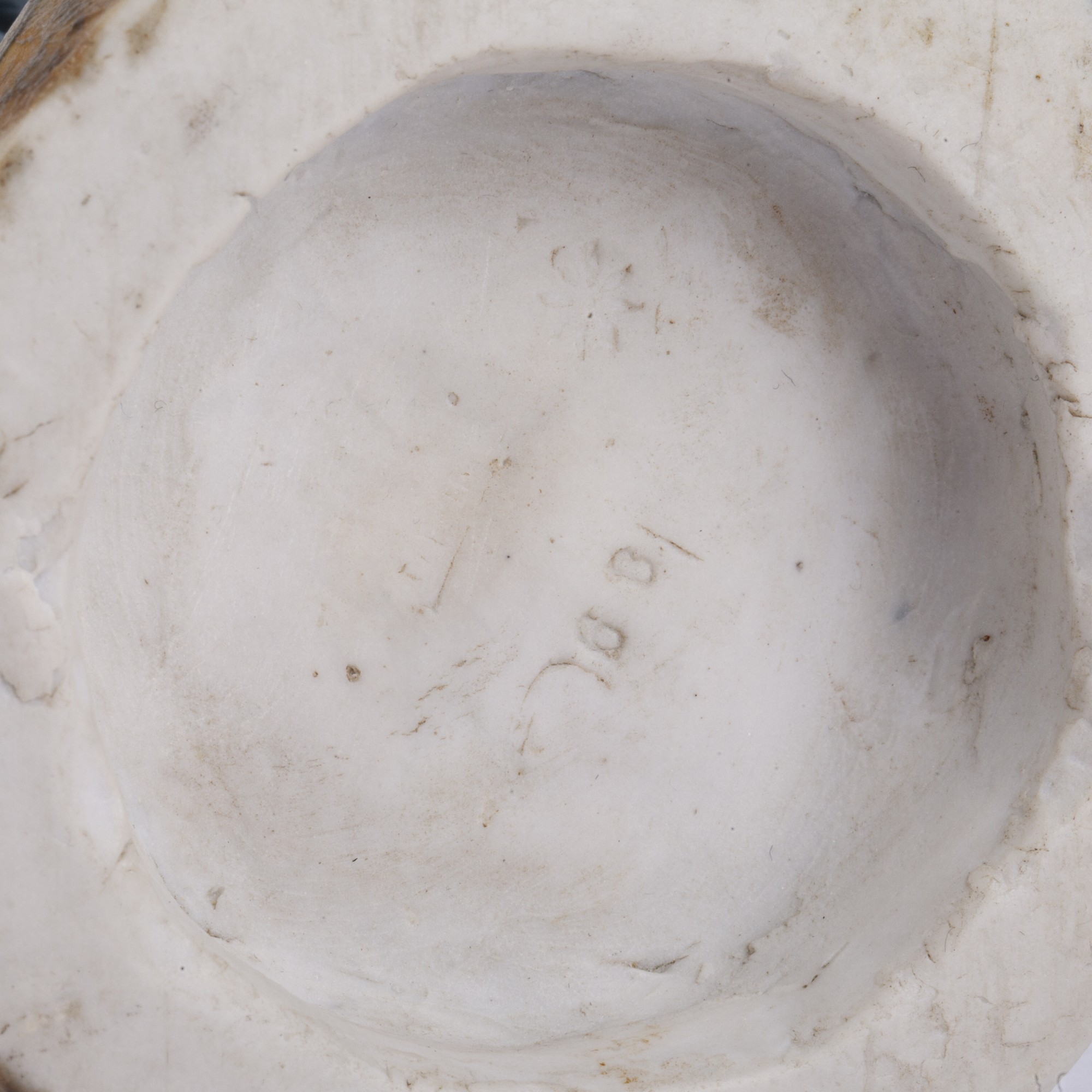
Russia, private porcelain factory, late 19th century.
Height: 21.3 cm.
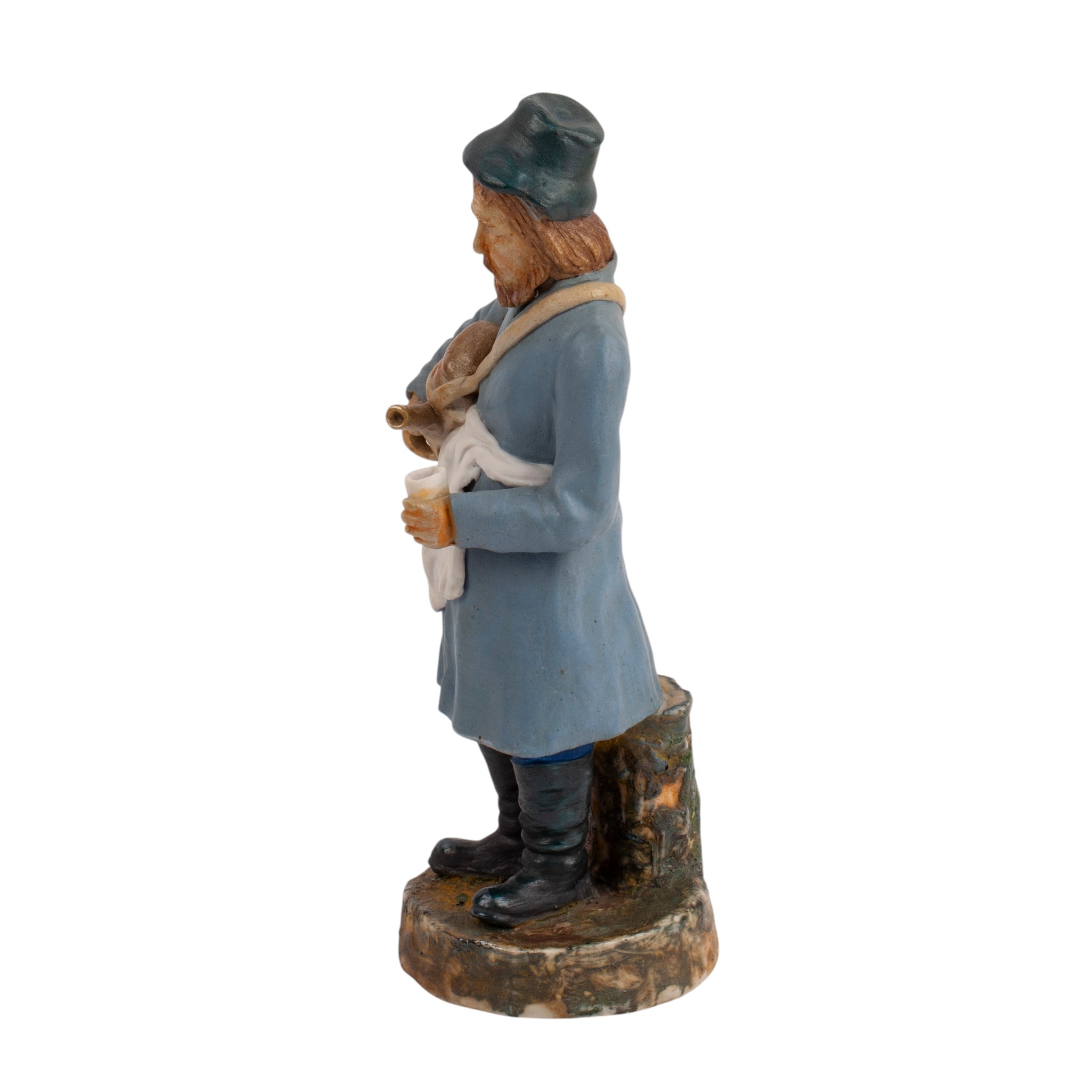
A polychrome faience figure of a sbiten seller, shown standing in a long pale blue caftan, black boots, and a dark cap, with a white towel tied at the waist. Slung across his shoulder is a strap supporting a rounded vessel for the hot honey drink, while in his hands he holds a small cup and ladle-like spout, ready to serve. The bearded face, slightly inclined forward, lends the figure an air of quiet concentration, while the compact stance and carefully observed costume preserve the vivid character of a familiar type from old urban life.
The iconography belongs to the long-lived Russian tradition of representing street vendors and artisans, a theme rooted in popular printed imagery of the early 19th century, including widely circulated city lithographs of itinerant sellers. The figure of the sbiten vendor was especially resonant in this visual culture, perceived as an instantly recognizable emblem of everyday life in old Moscow and St Petersburg.
The subject ultimately relates to the celebrated series Traders and Craftsmen, first modeled at the Imperial Porcelain Factory in the late 18th century after designs by Jacques-Dominique Rachette. That series, created during the reign of Catherine II, marked one of the earliest and most influential Russian attempts to translate popular graphic representations of common people and their occupations into three-dimensional porcelain form. By the 19th century the theme had become enormously popular and was widely adopted by private factories, which continued to reinterpret these familiar urban and folk types for a broader market.
The present figure preserves that tradition in a late 19th-century faience version, combining lively genre observation with decorative appeal. As Vladimir Gilyarovsky later recalled, sbiten sellers dispensed, for a kopeck a cup, the hot honey drink that warmed coachmen and shop assistants freezing in unheated stalls. This small sculpture thus evokes not only a picturesque occupational type, but also a distinctly Russian world of street trade, winter cold, and everyday sustenance.Starting price: 300€
Estimate: 350-450€
Hammer Price: Not sold -
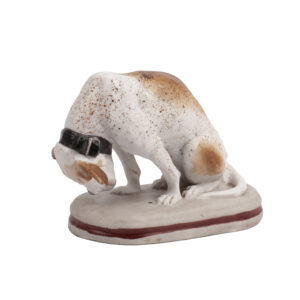
Lot 0137
Gardner Figurine “Seated Pointer”, Porcelain, Moscow, 19th Century
Estimate: 1000-1200€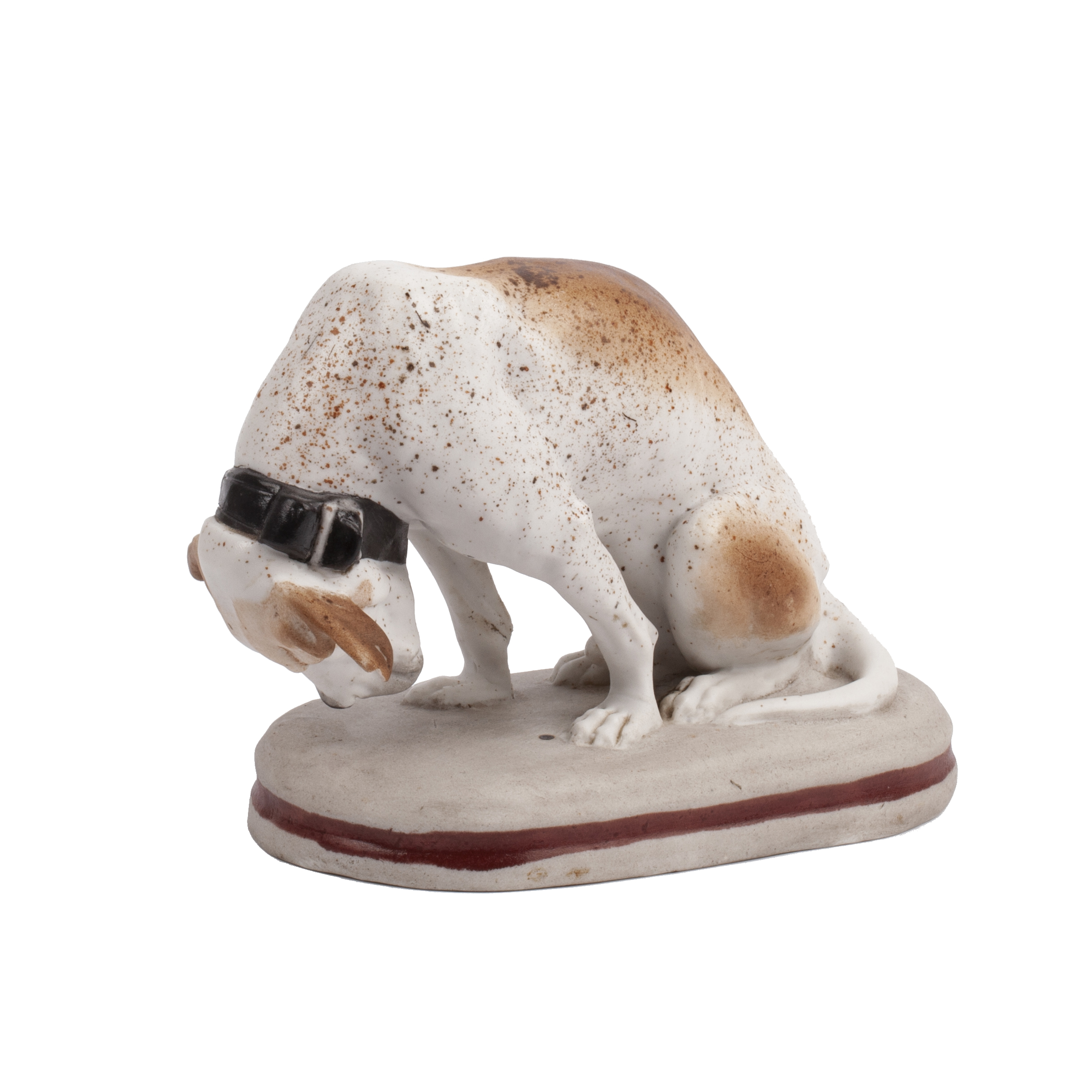
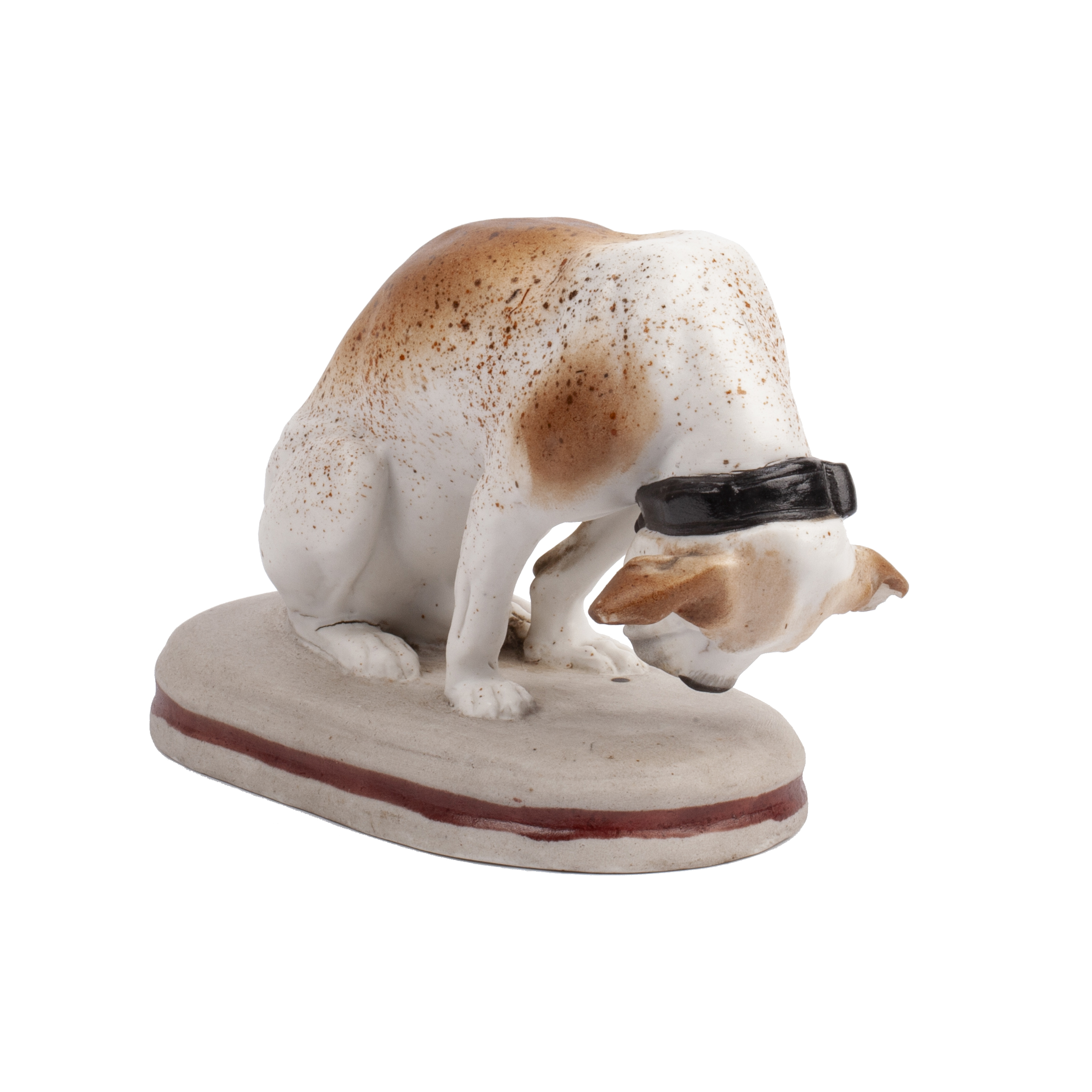
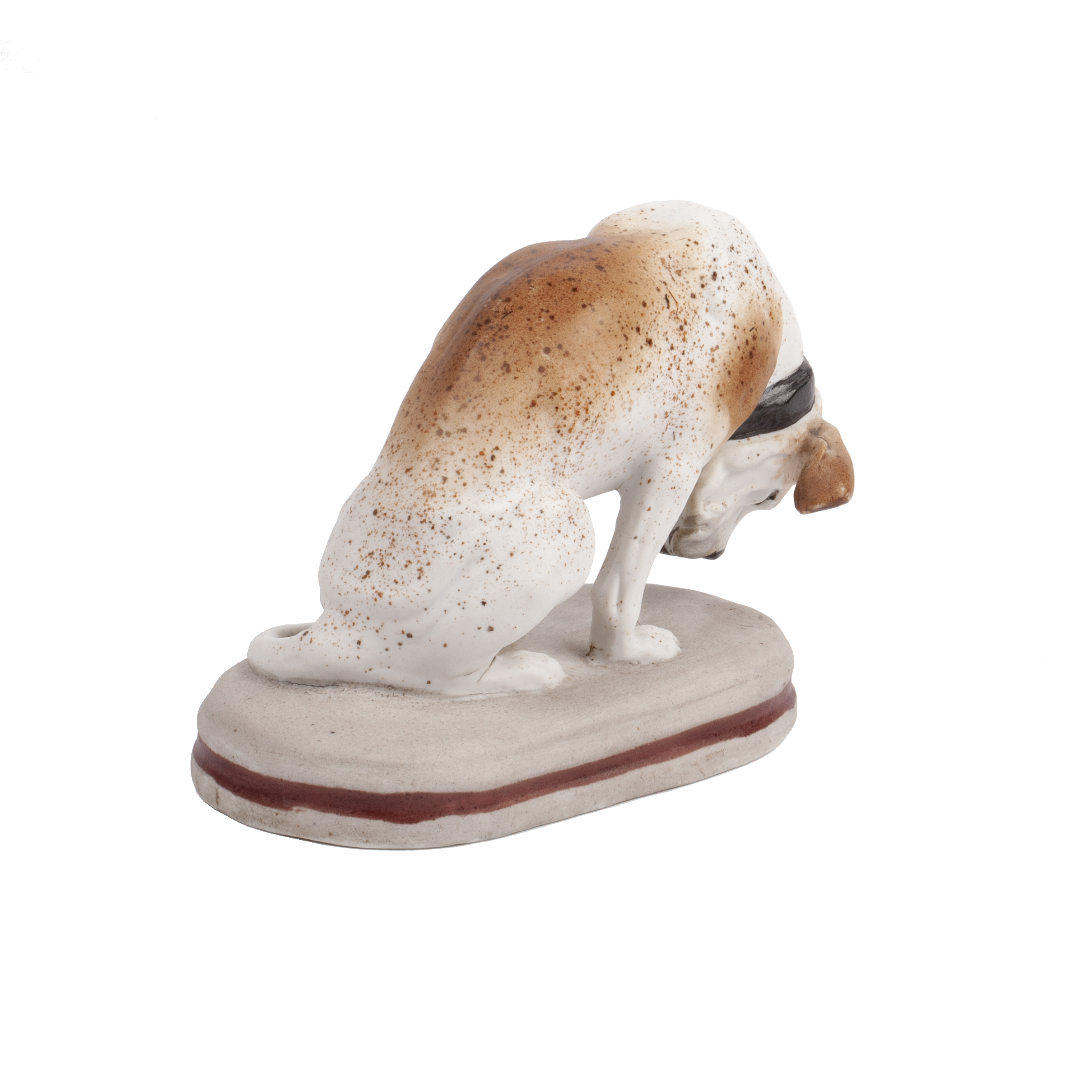

Lot 0137
Gardner Figurine “Seated Pointer”, Porcelain, Moscow, 19th Century
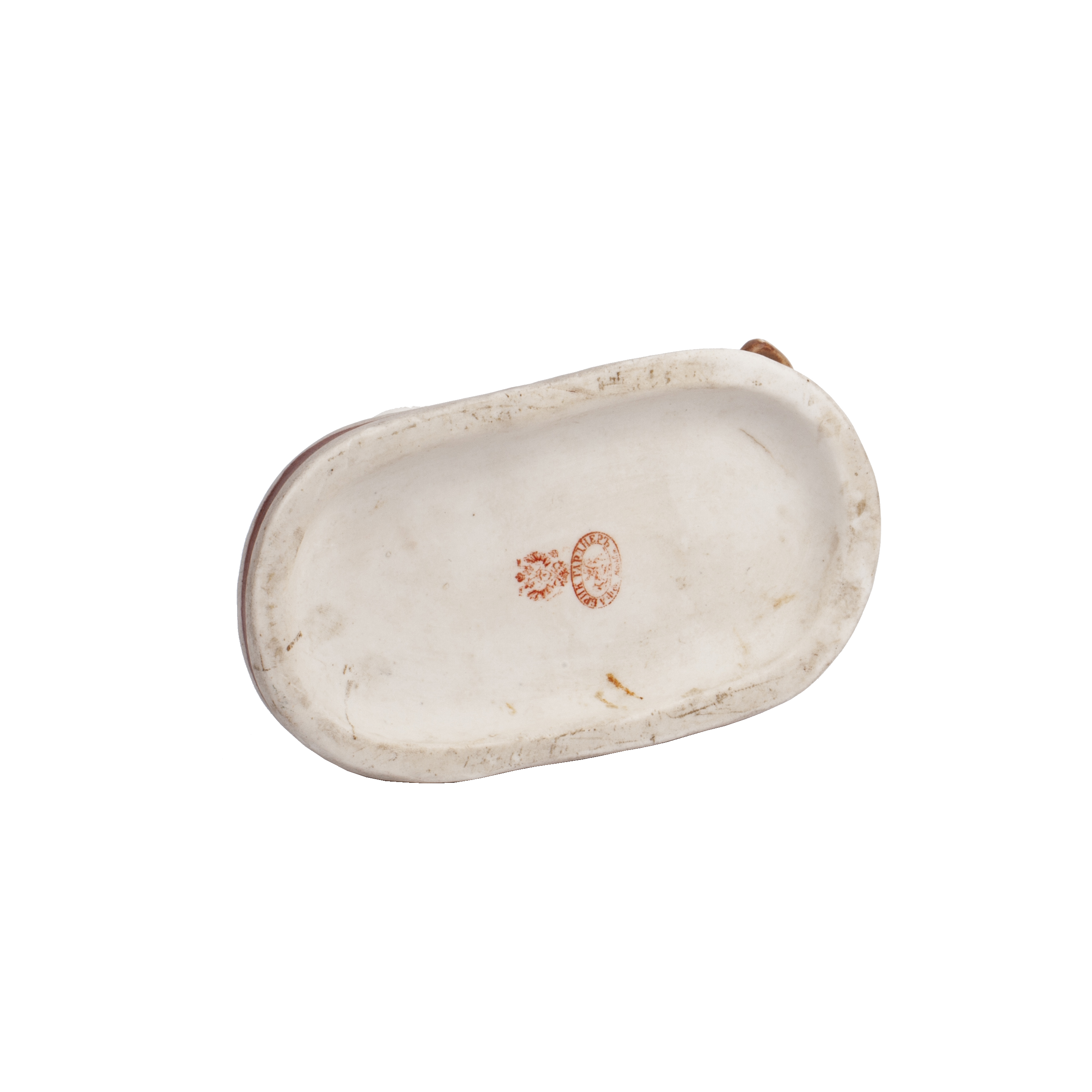
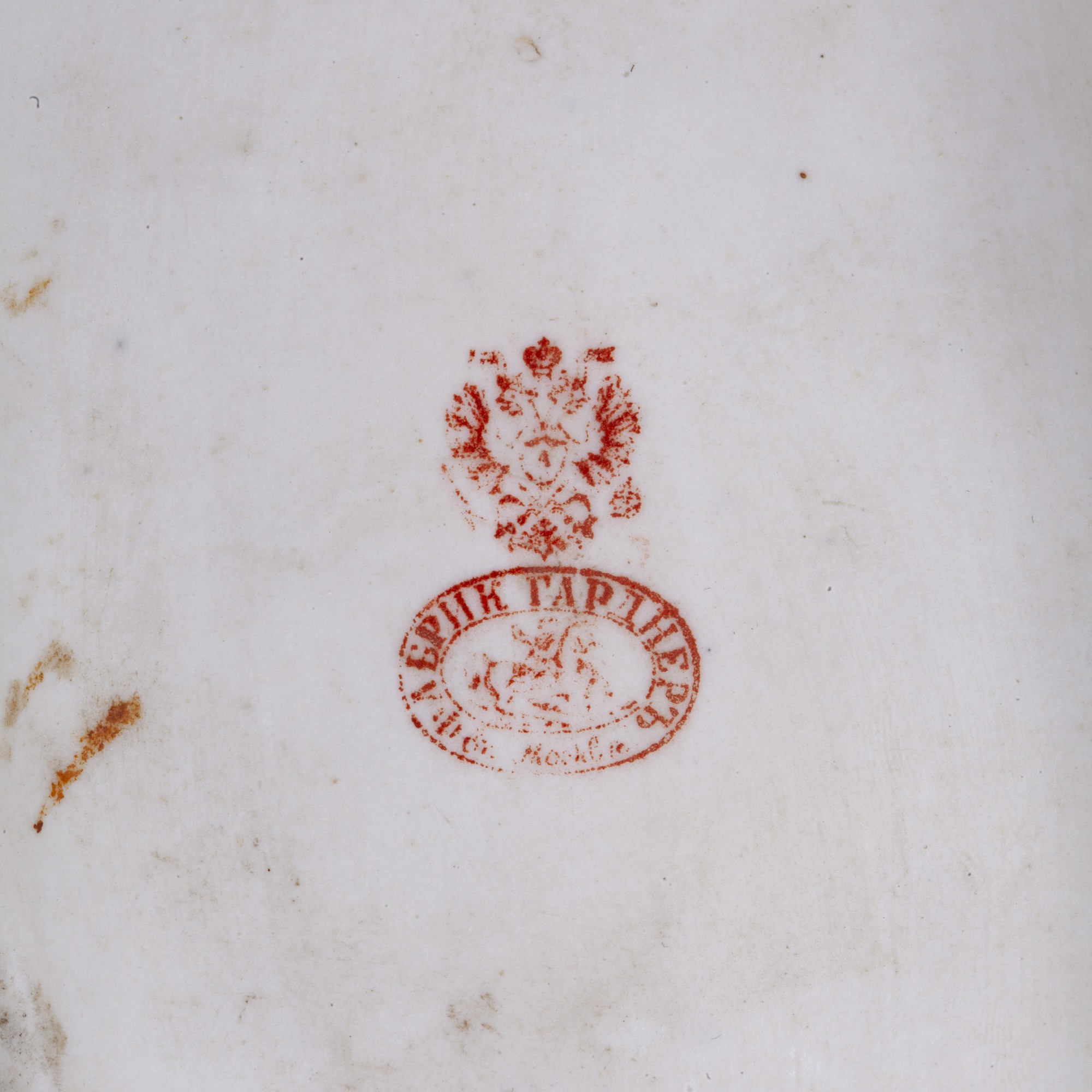
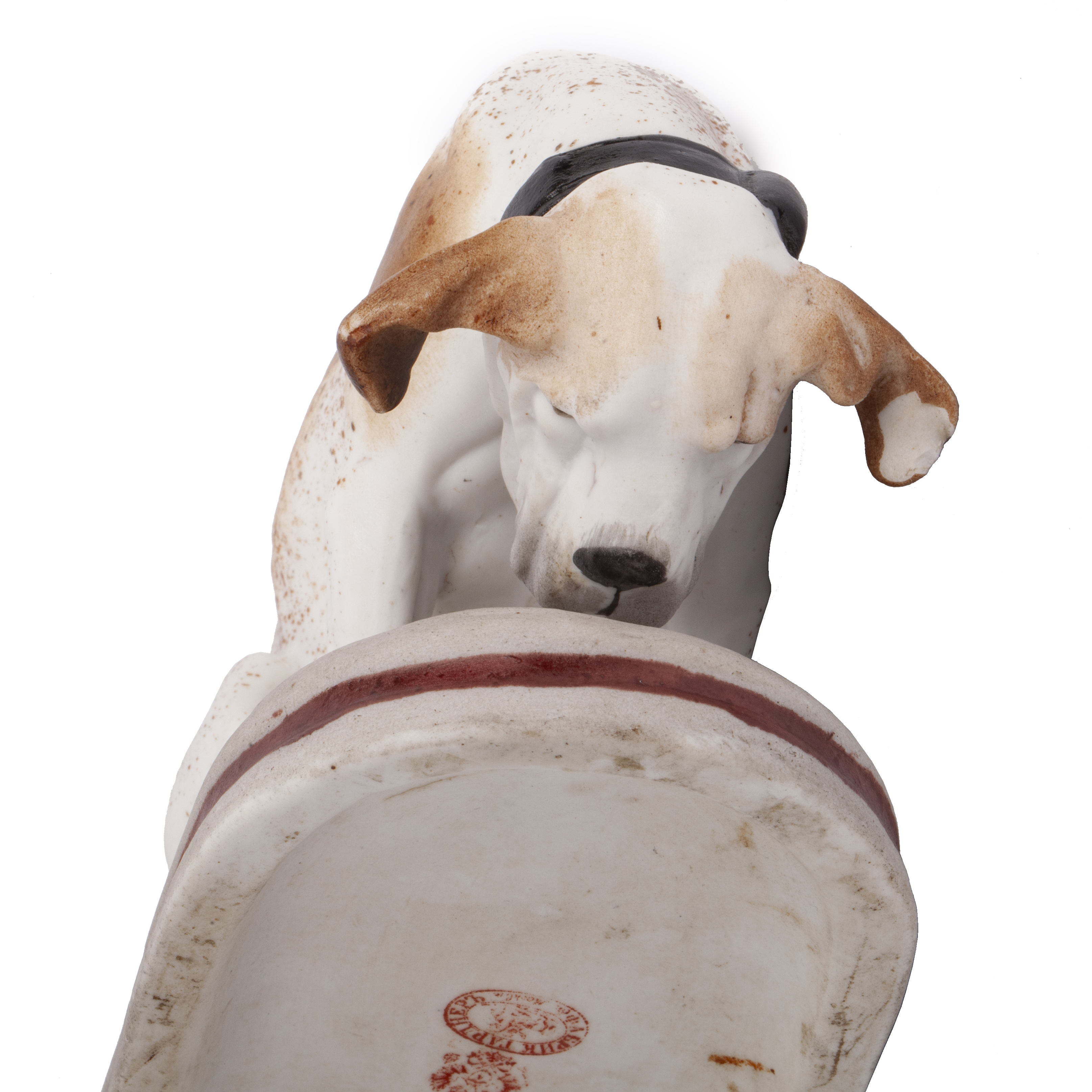
Estimate: 1000-1200€Gardner Figurine “Seated Pointer”
Porcelain
Maker’s mark of Fabrika Gardner in Moscow with Imperial warrant
Height: 10.7 cmA finely modeled porcelain figure of a pointer dog, naturalistically painted with brown and white markings. Produced at the renowned Gardner Factory, founded in the 18th century and celebrated for its lifelike animal figures, which were highly prized in 19th-century Russia.
Condition: small chip on the ear.
Starting price: 700€
Estimate: 1000-1200€
Hammer Price: Not sold -
Lot 0138
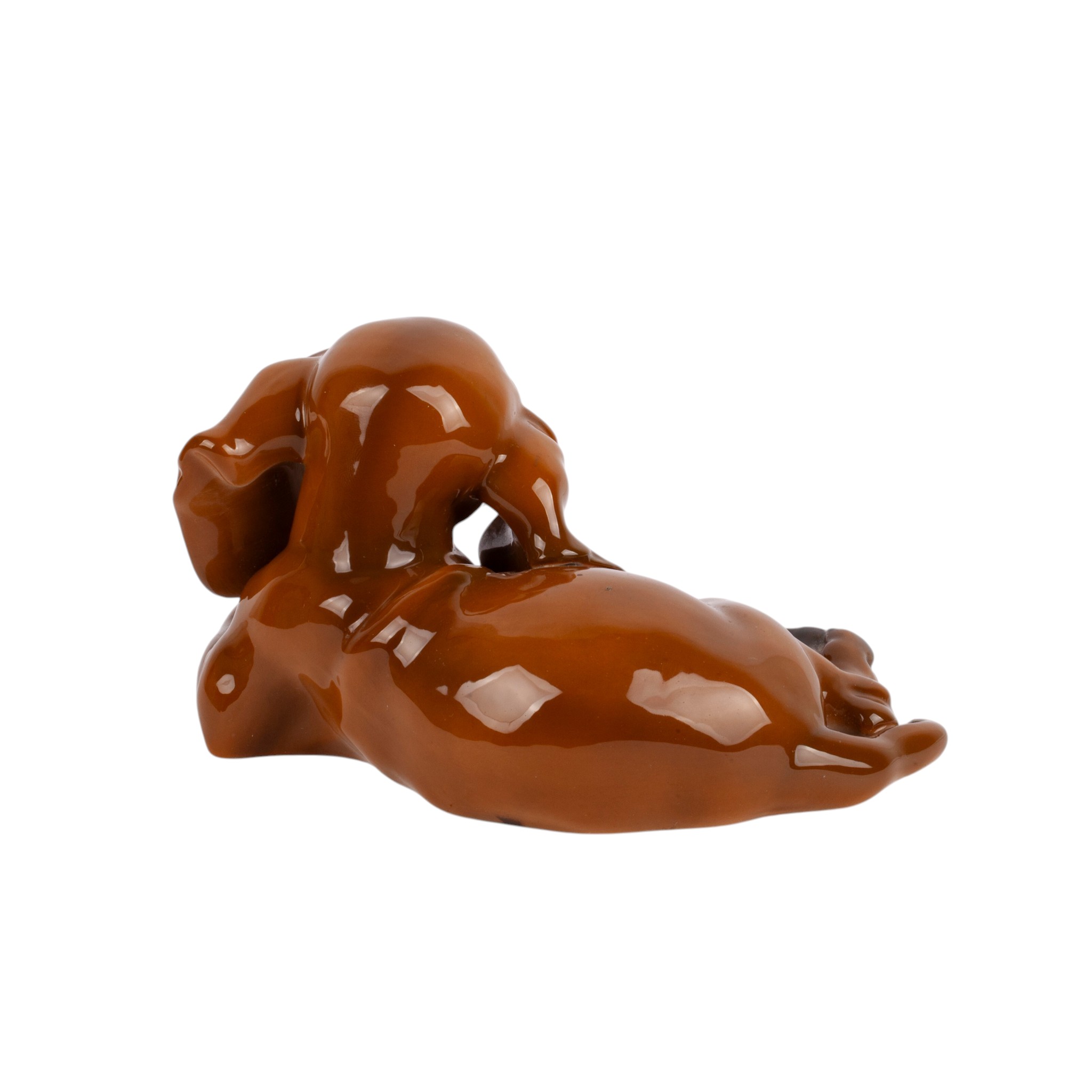
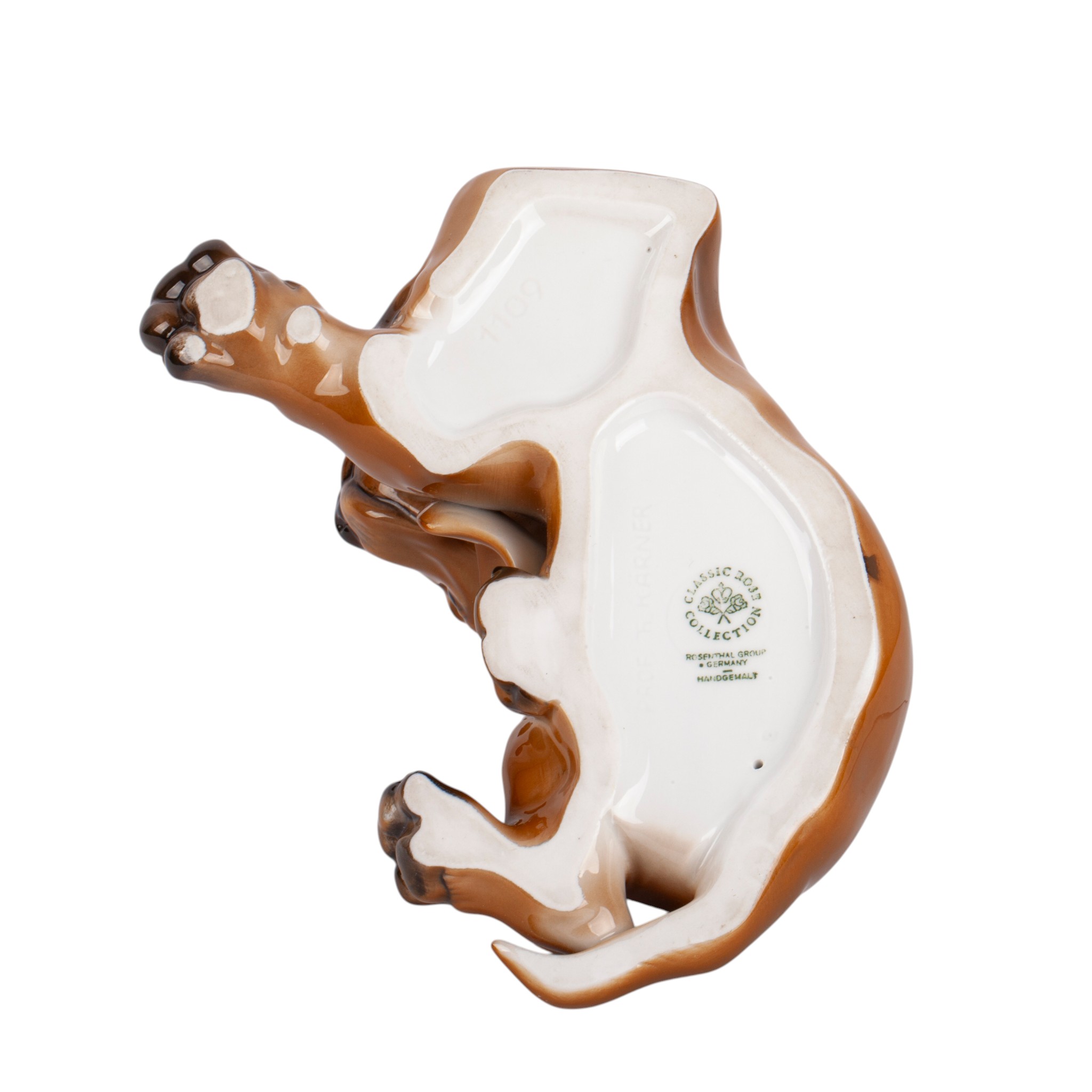
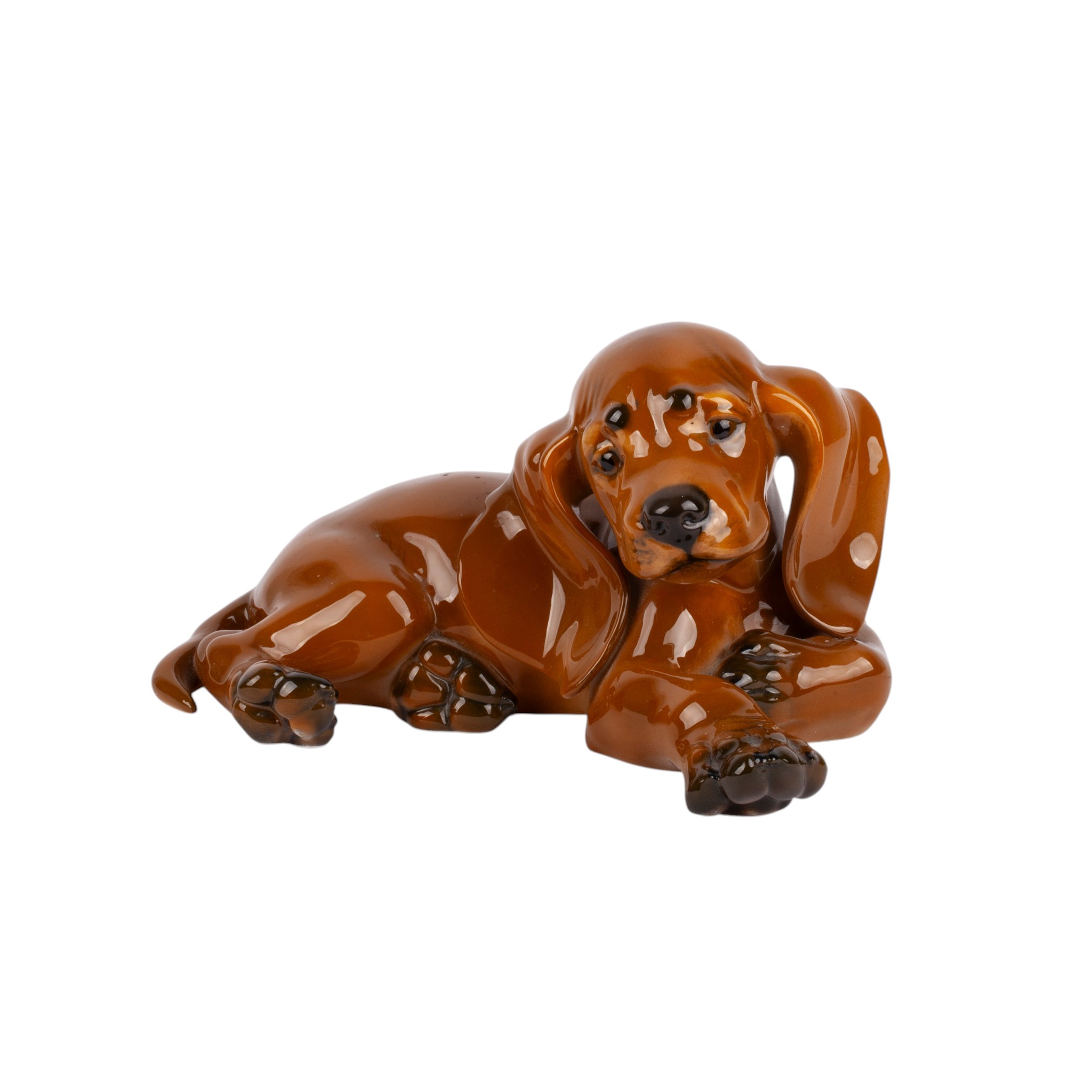
Rosenthal Porcelain Figure of a Seated Dachshund, Germany, Hand-Painted
Estimate: 150-200€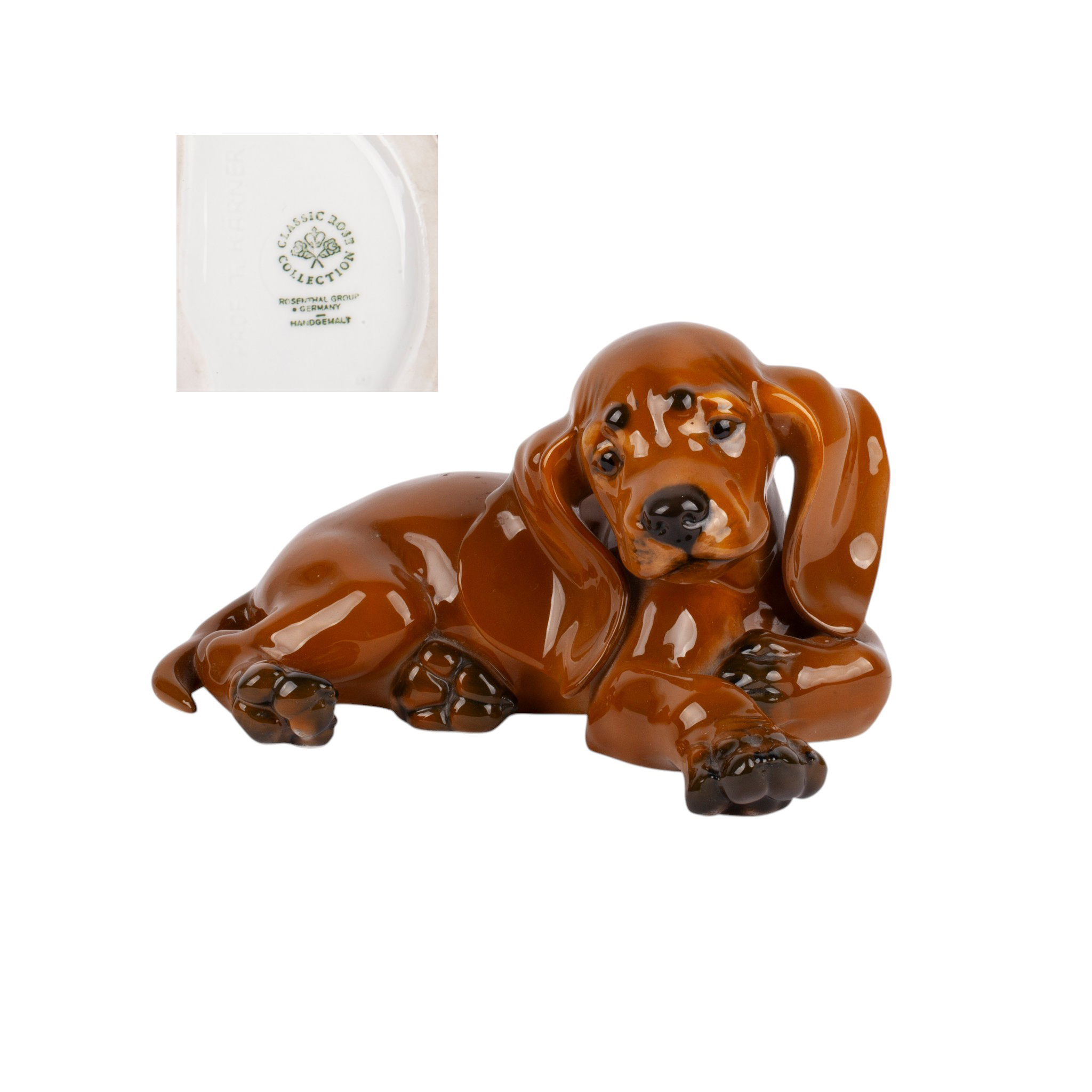
Lot 0138
Rosenthal Porcelain Figure of a Seated Dachshund, Germany, Hand-Painted
Estimate: 150-200€Rosenthal porcelain figure of a lying dachshund, from the Classic Rose Collection, Germany. Modelled with naturalistic detail and finished in a rich brown glaze.
Dimensions: 10 × 17.6 × 11.2 cm
Starting price: 100€
Estimate: 150-200€
Hammer Price: Not sold -
Lot 0139
Rosenthal Porcelain Figure of a Seated Dachshund, Germany, Hand-Painted
Estimate: 150-200€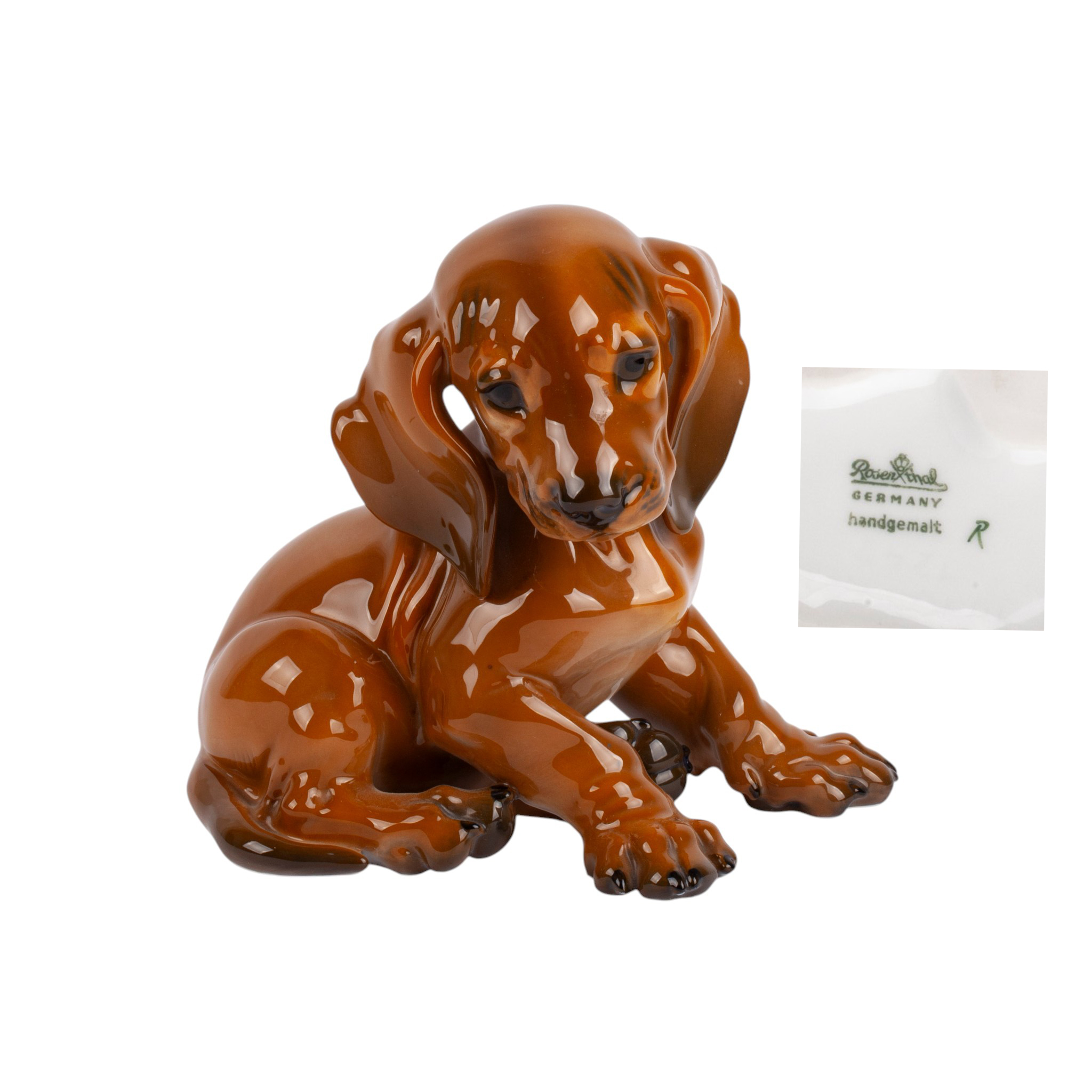
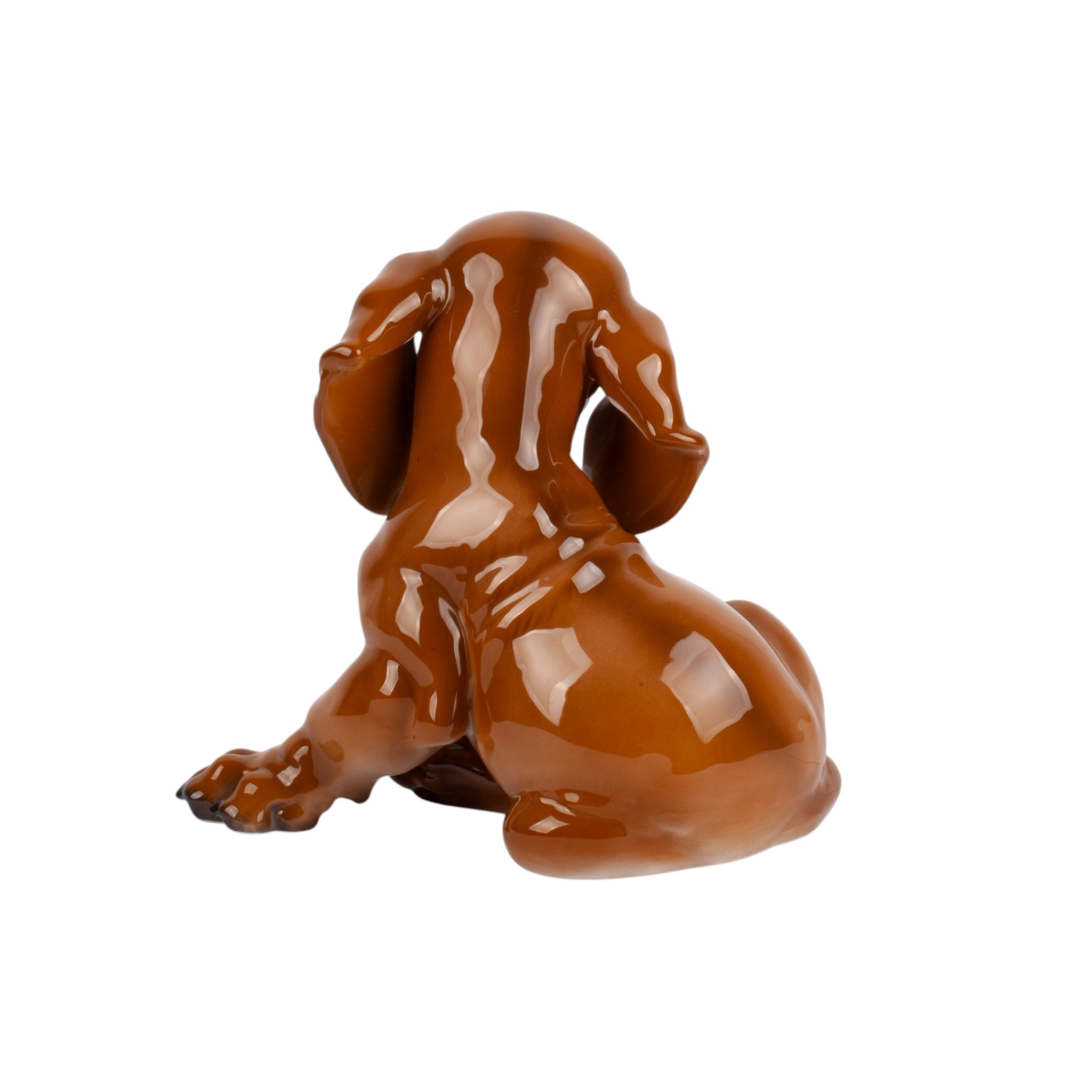
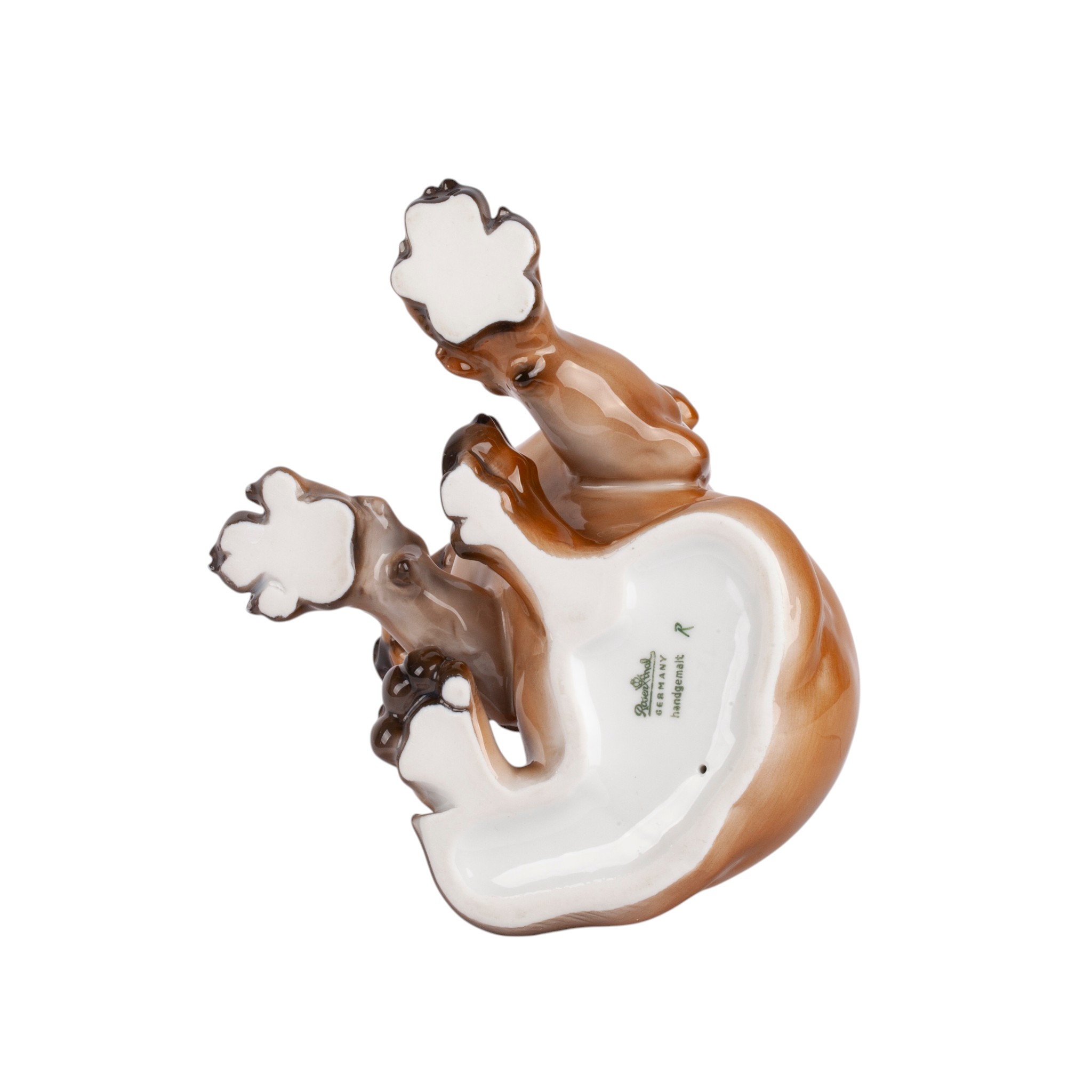
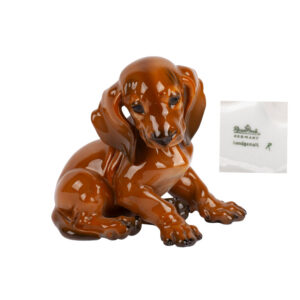
Lot 0139
Rosenthal Porcelain Figure of a Seated Dachshund, Germany, Hand-Painted
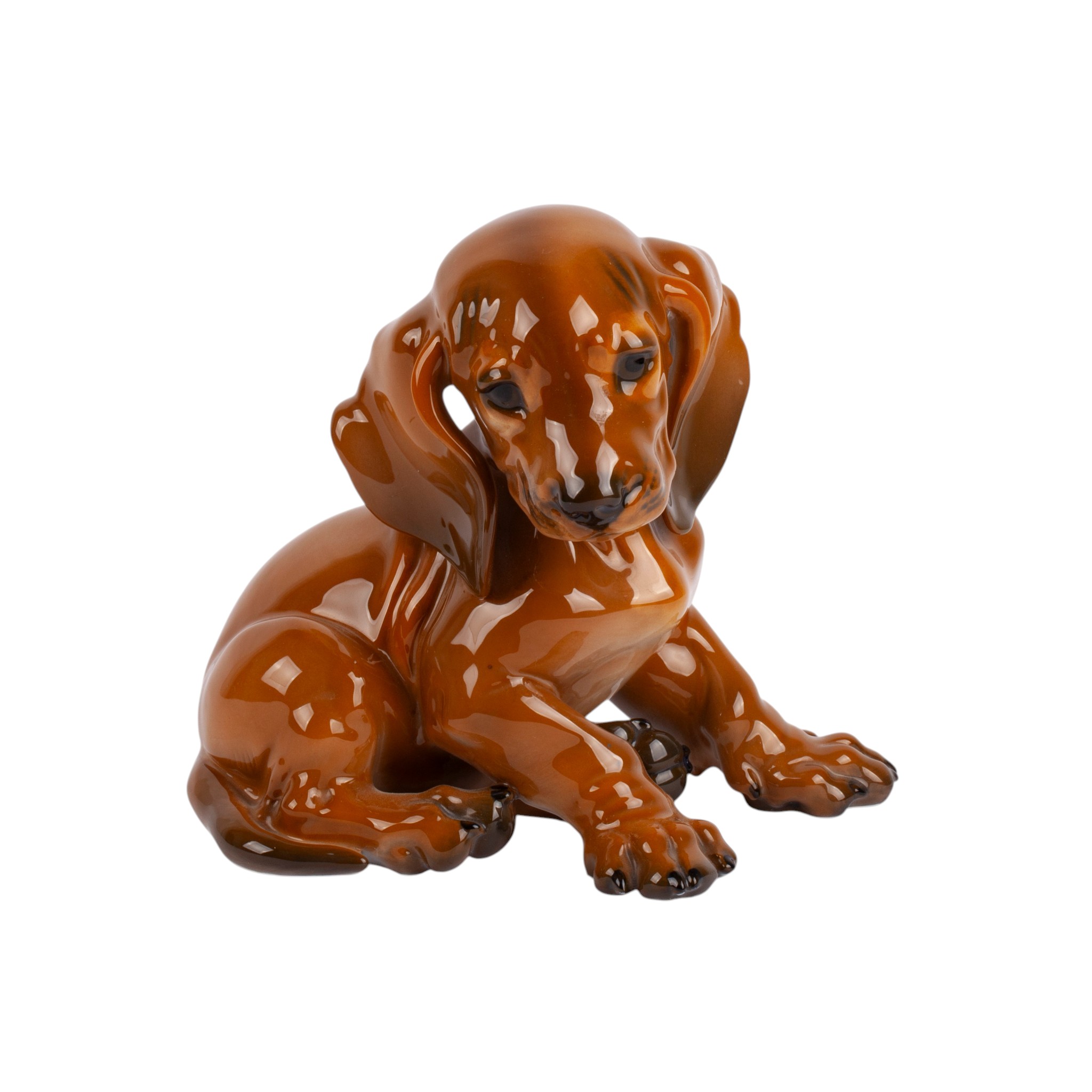
Estimate: 150-200€Rosenthal porcelain figure of a seated dachshund, Germany, hand-painted. Modelled with expressive naturalistic detail and finished in a rich brown glaze.
Height: 14.8 cm
Starting price: 100€
Estimate: 150-200€
Hammer Price: Not sold -
Lot 0140
Rosenthal Porcelain Figure of a Fox Terrier, Germany, Hand-Painted
Estimate: 150-200€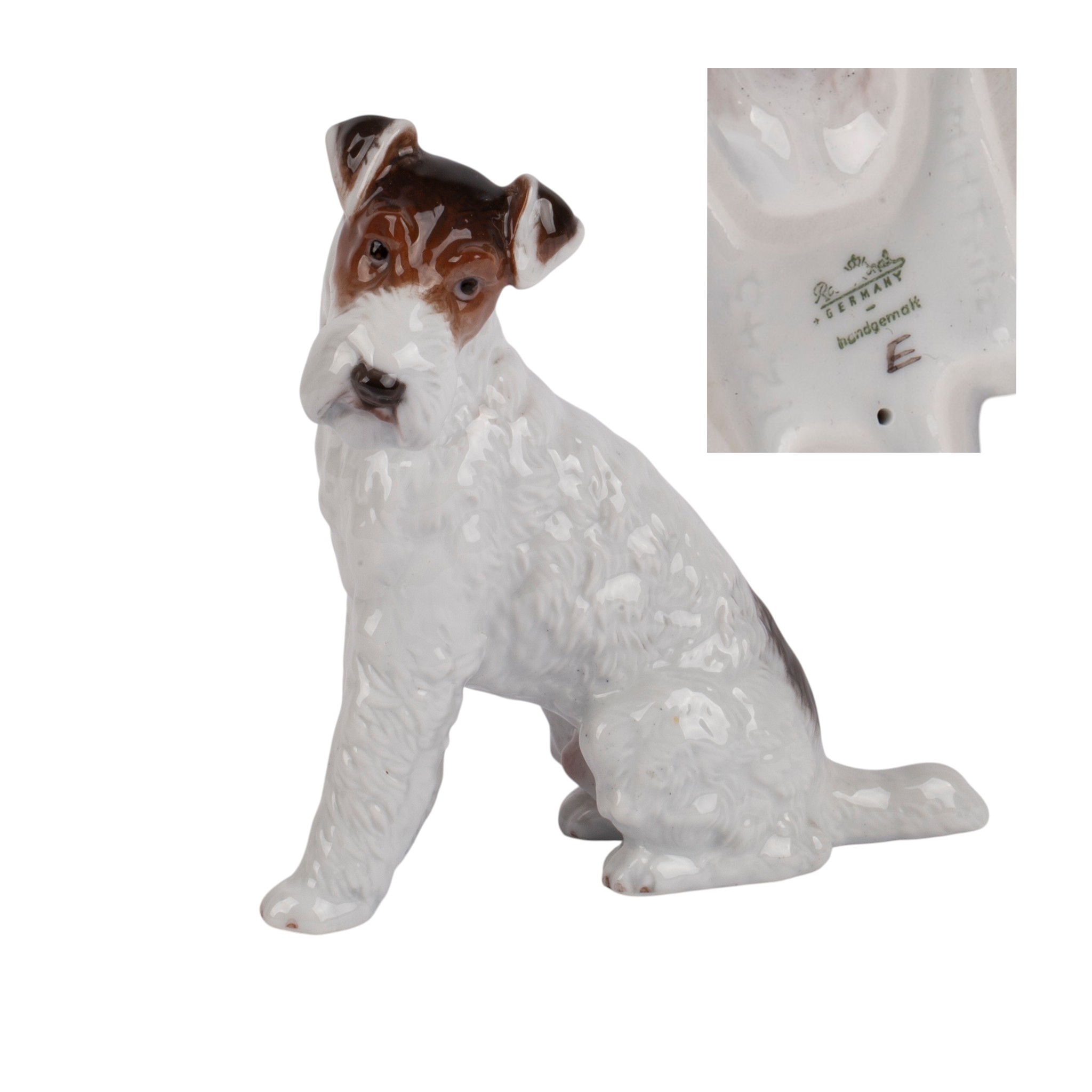
Lot 0140
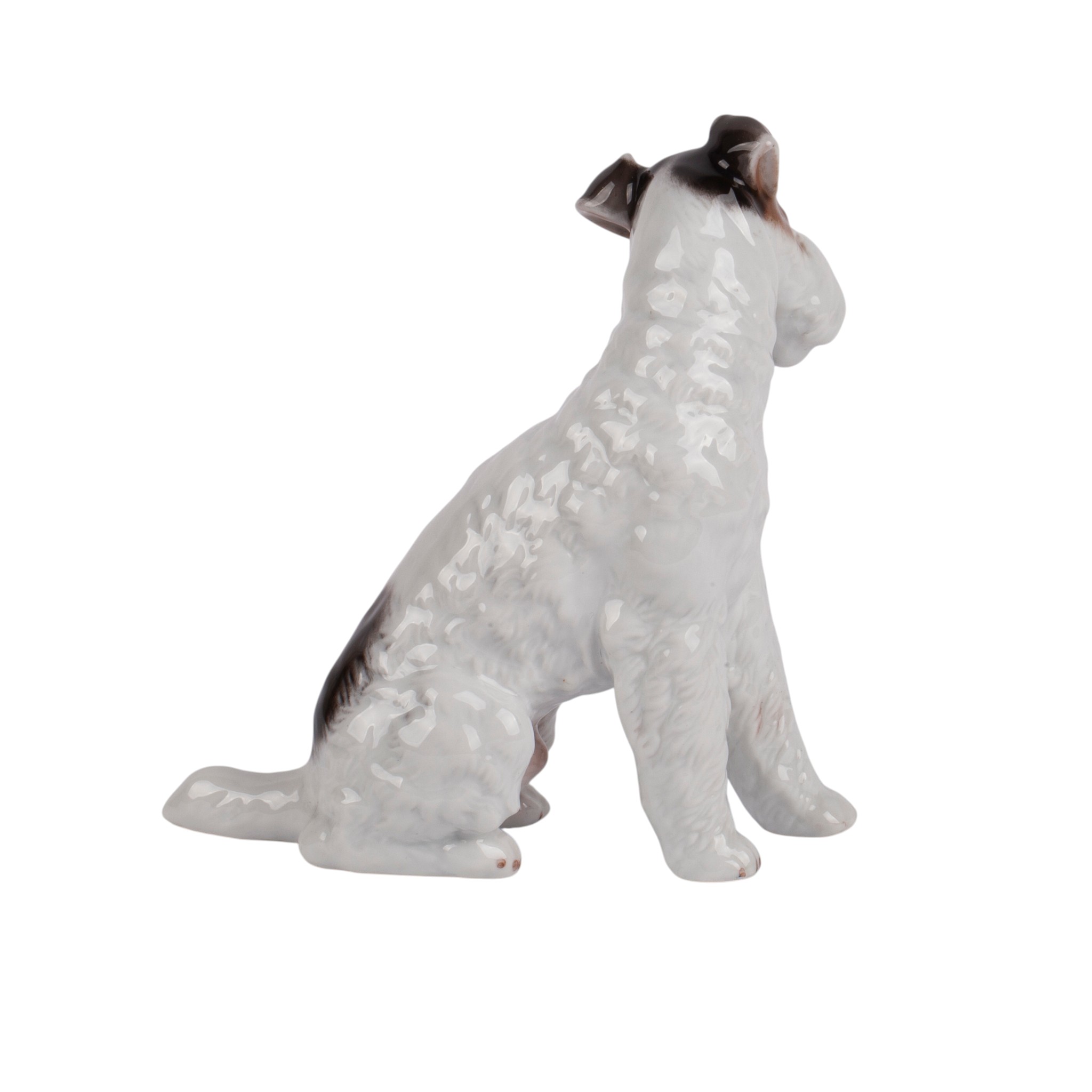
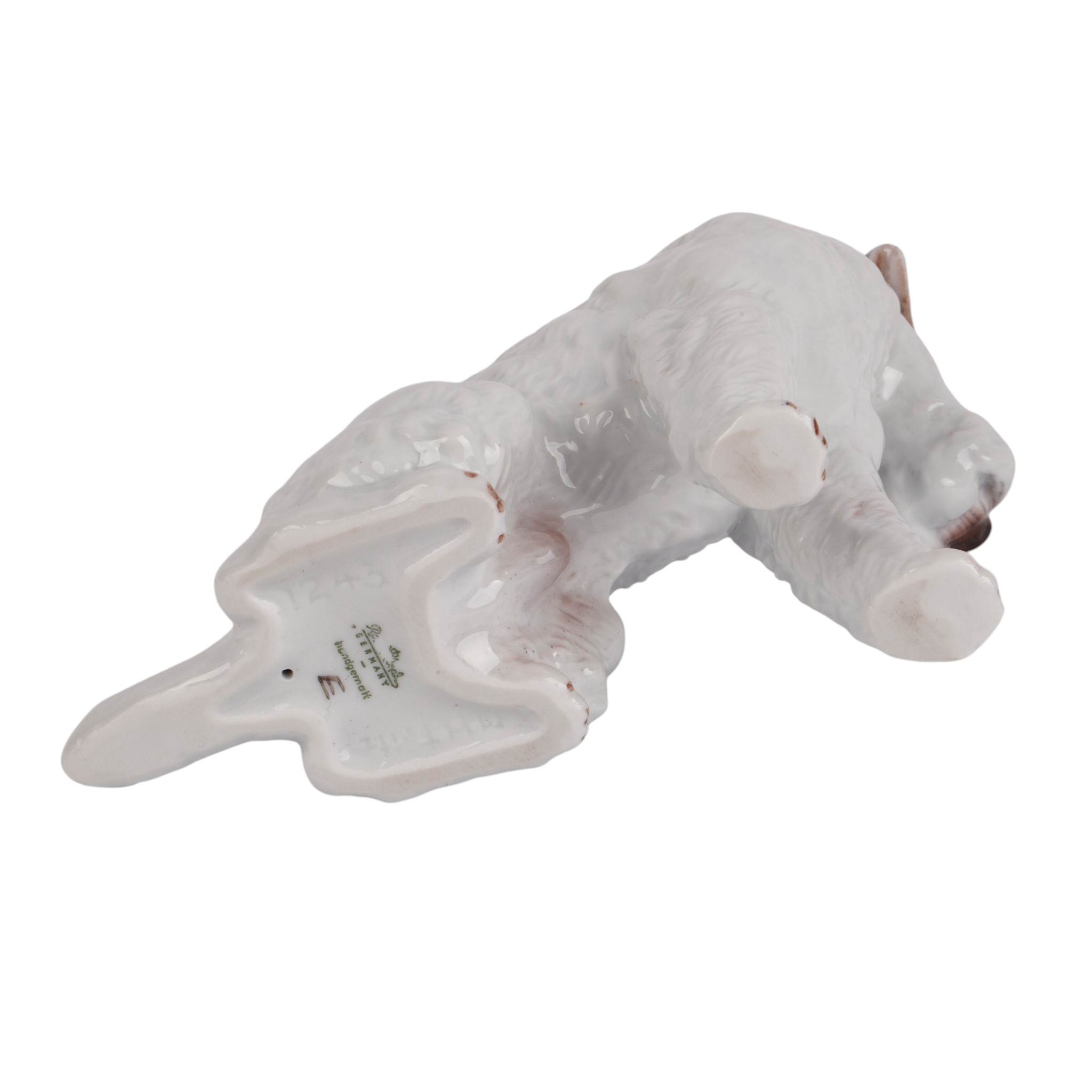
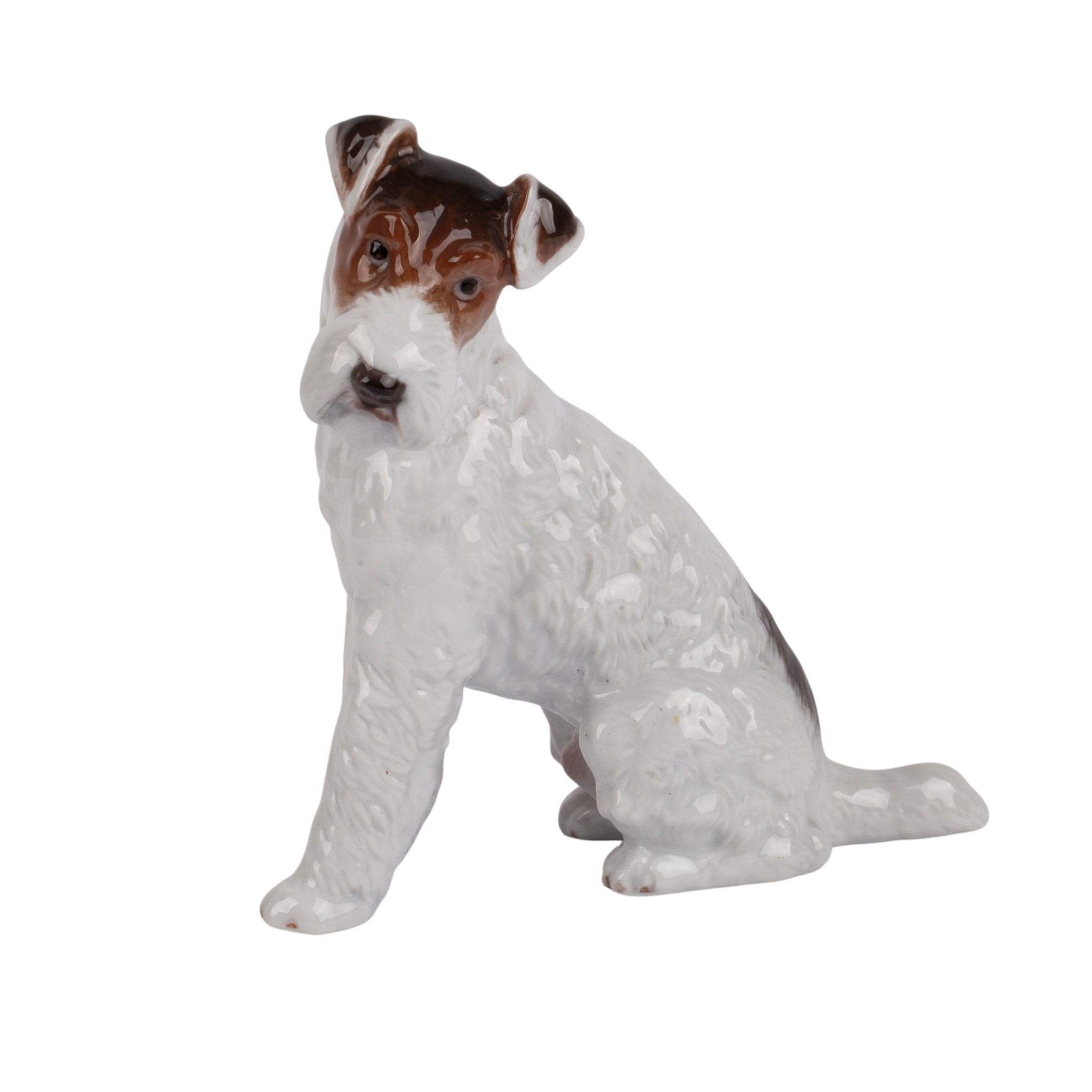
Rosenthal Porcelain Figure of a Fox Terrier, Germany, Hand-Painted
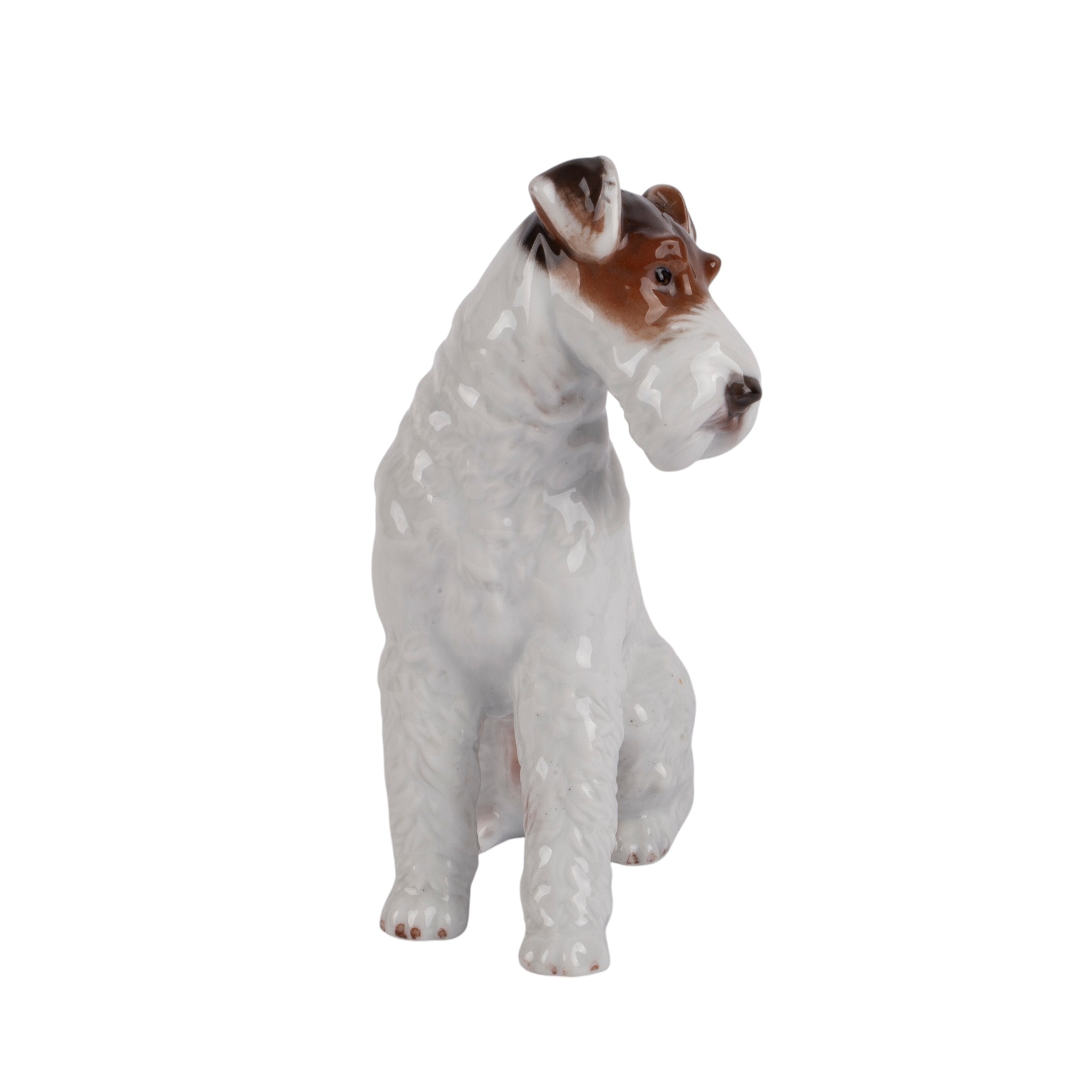
Estimate: 150-200€Rosenthal porcelain figure of a fox terrier, Germany, hand-painted. Finely modelled in a seated pose, with naturalistic treatment of the coat and expressive head.
Height: 15.2 cm
Starting price: 100€
Estimate: 150-200€
Hammer Price: Not sold -
Lot 0141
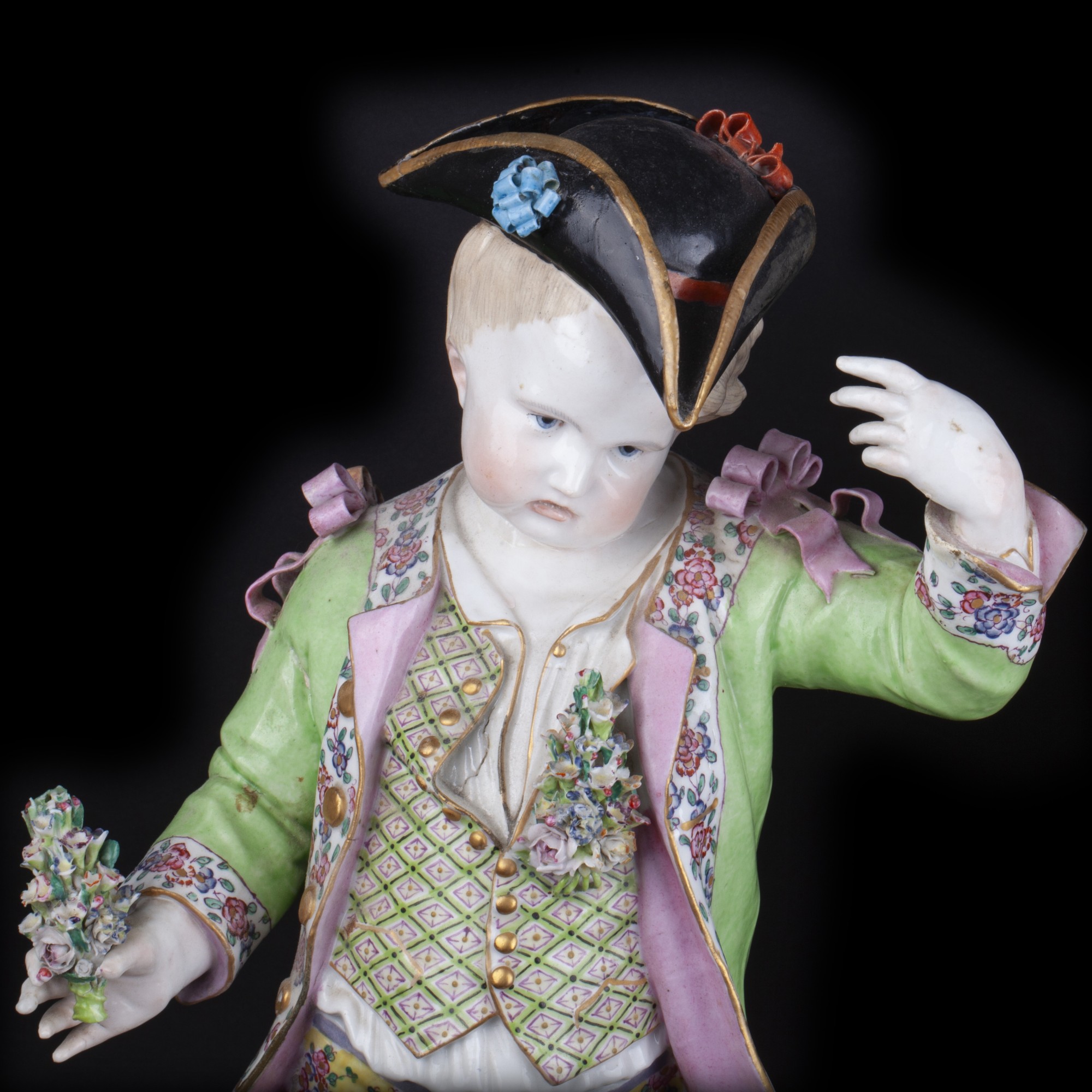
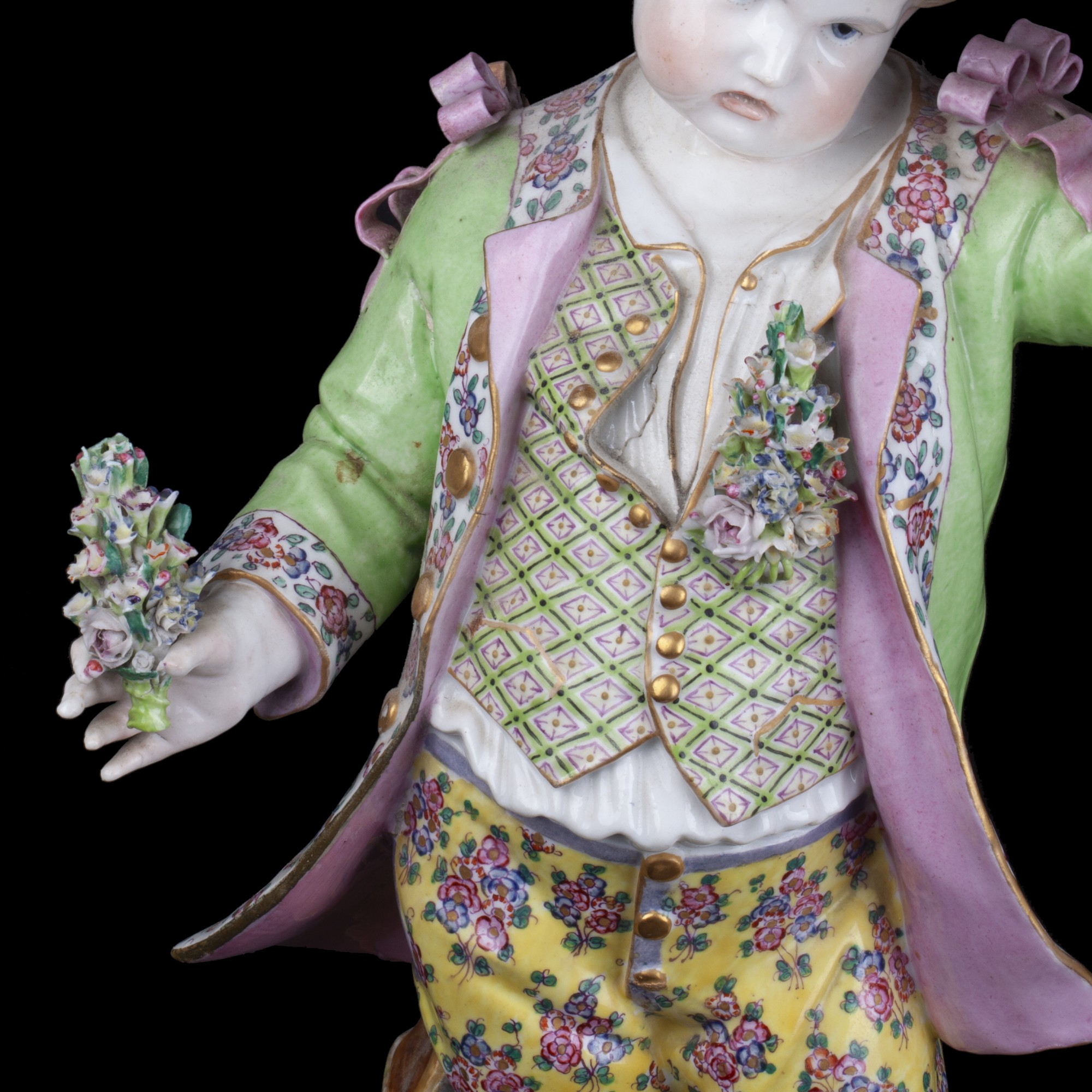
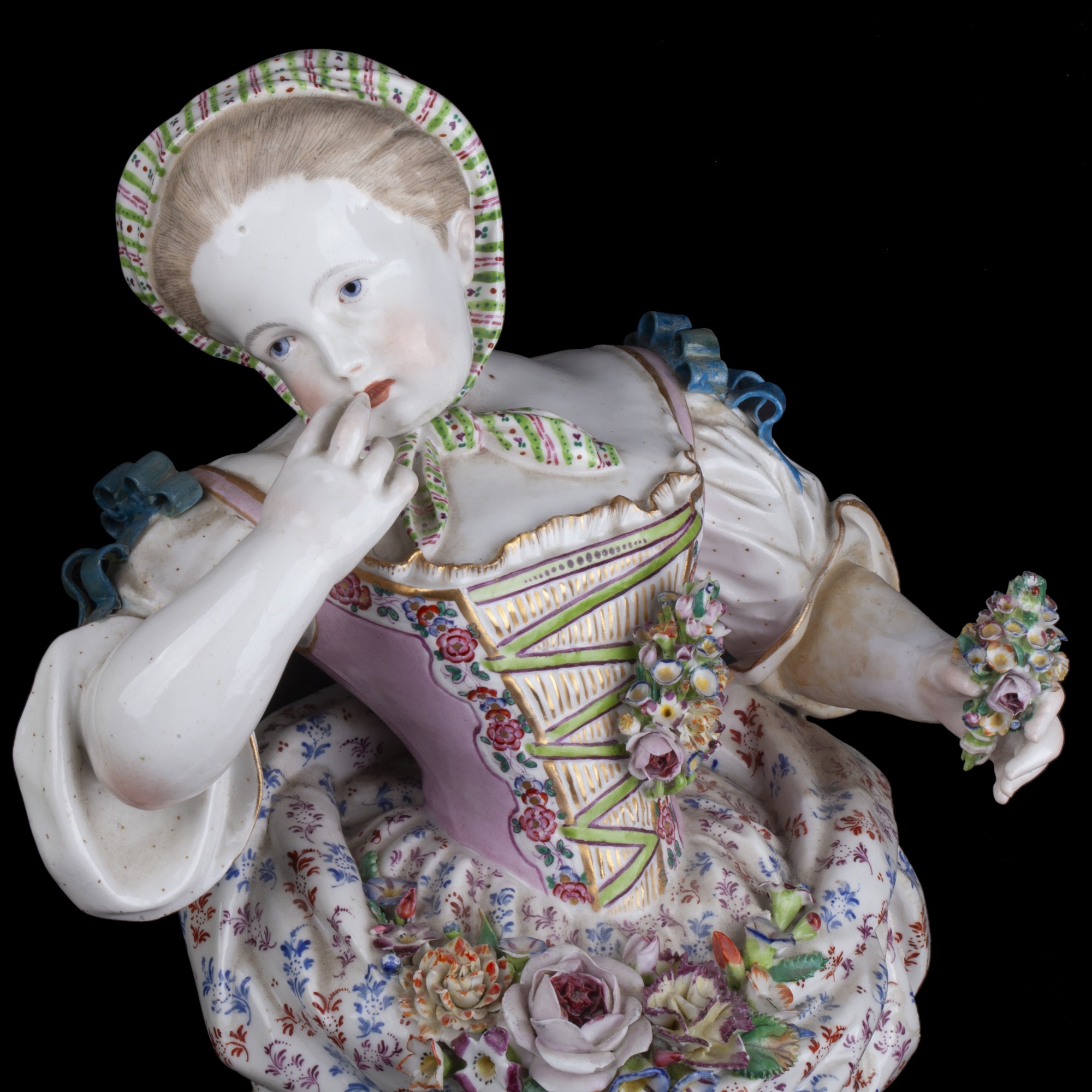
Pair of Meissen-Style Porcelain Figurines, Rococo Boy and Girl, Hand-Painted
Estimate: 4500-5000€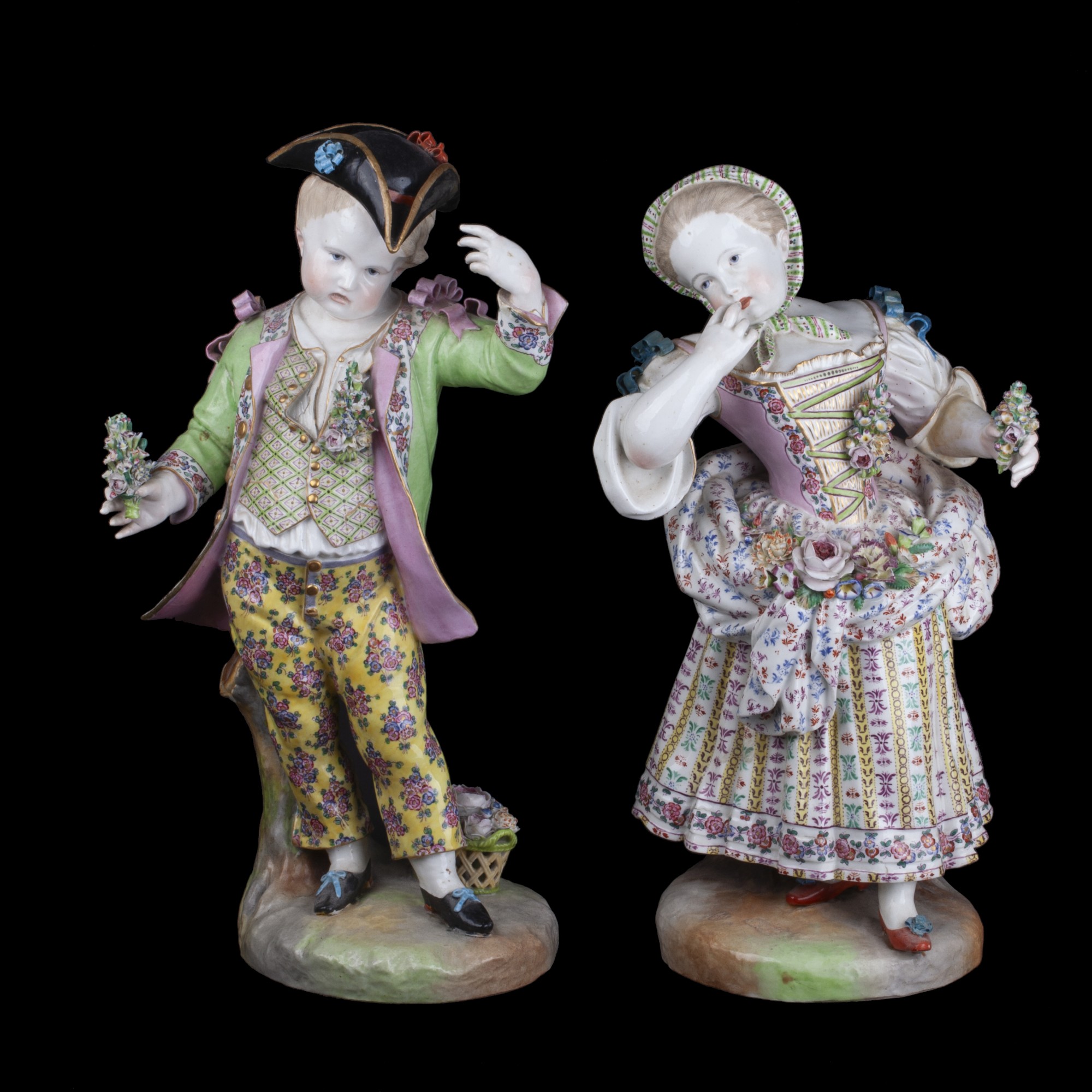
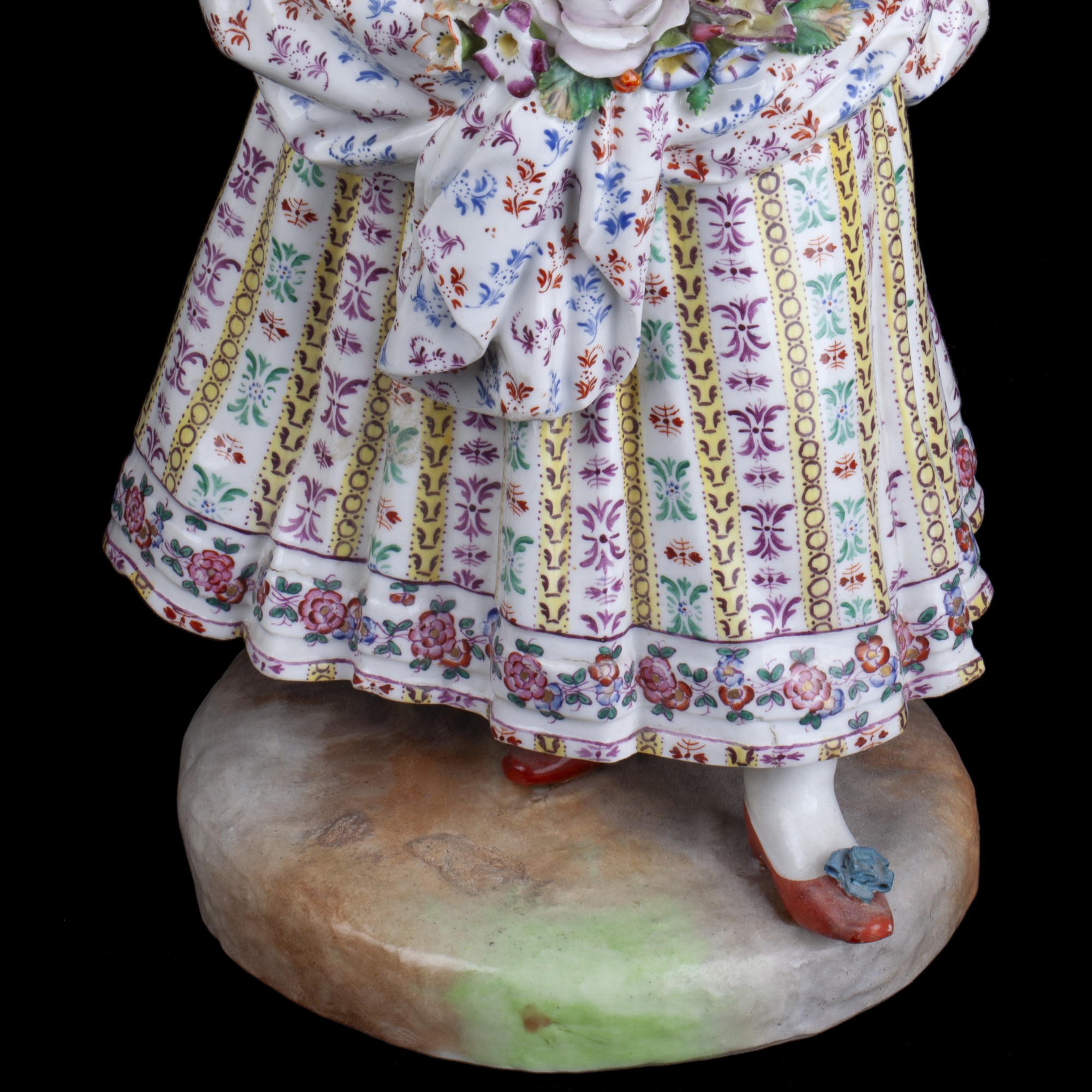
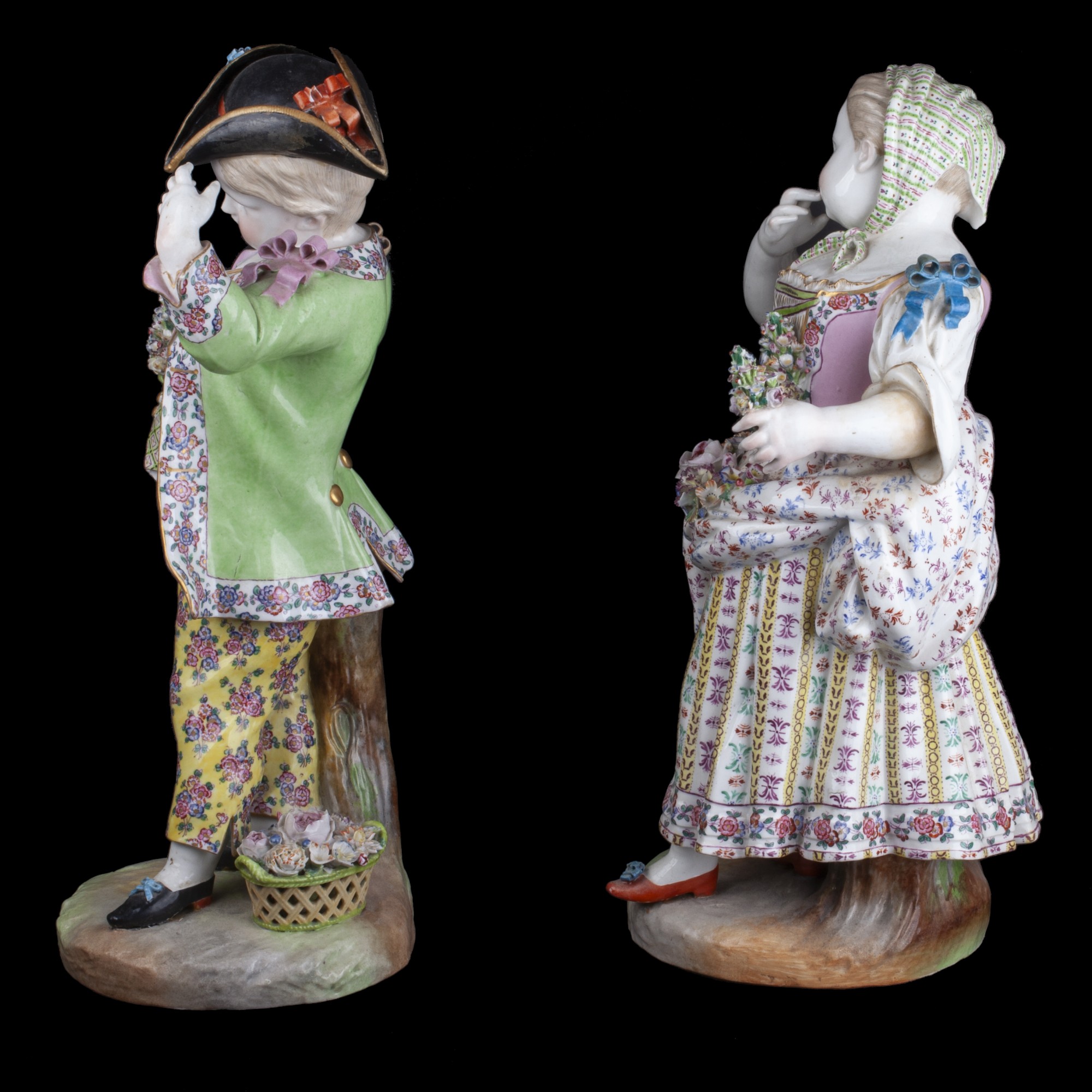
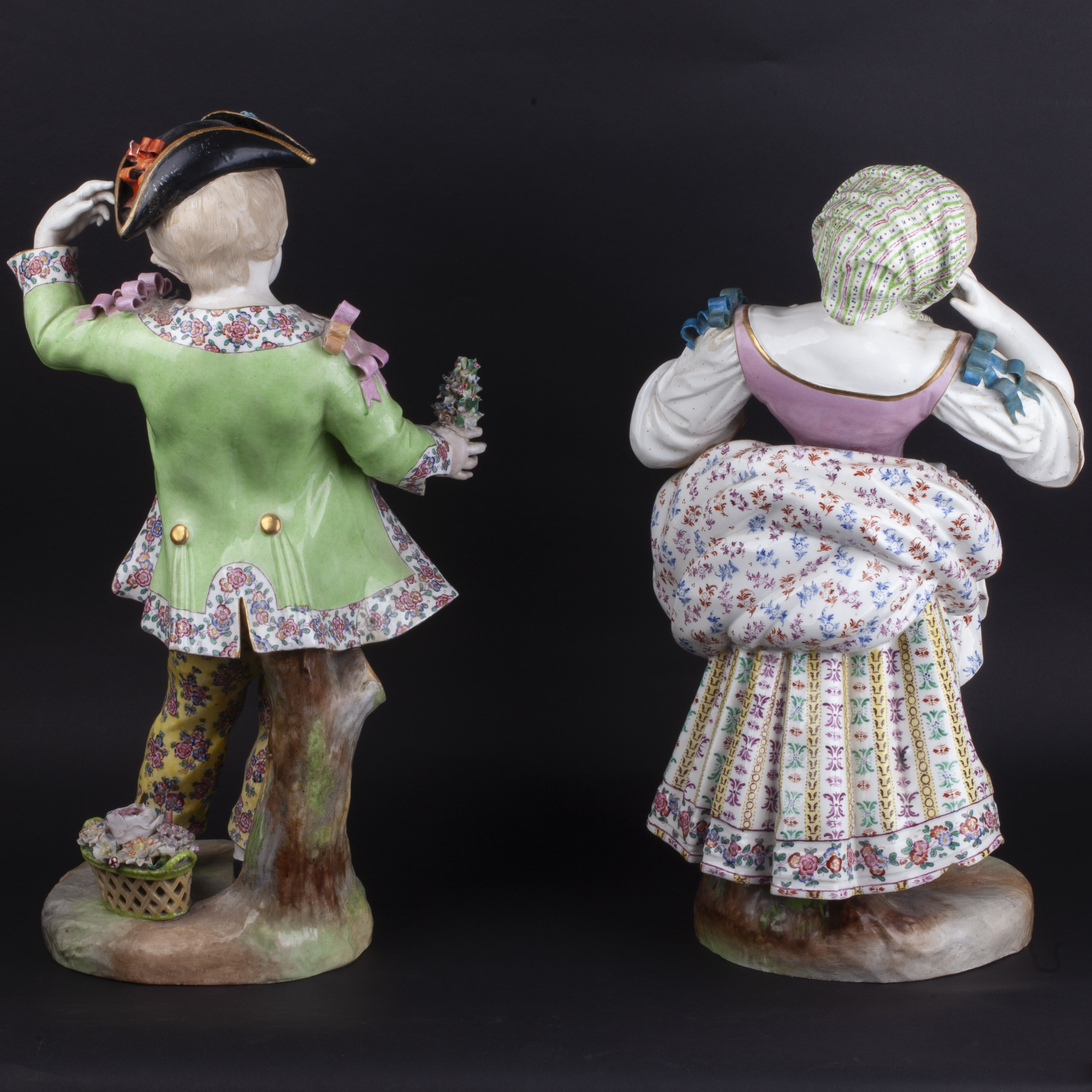
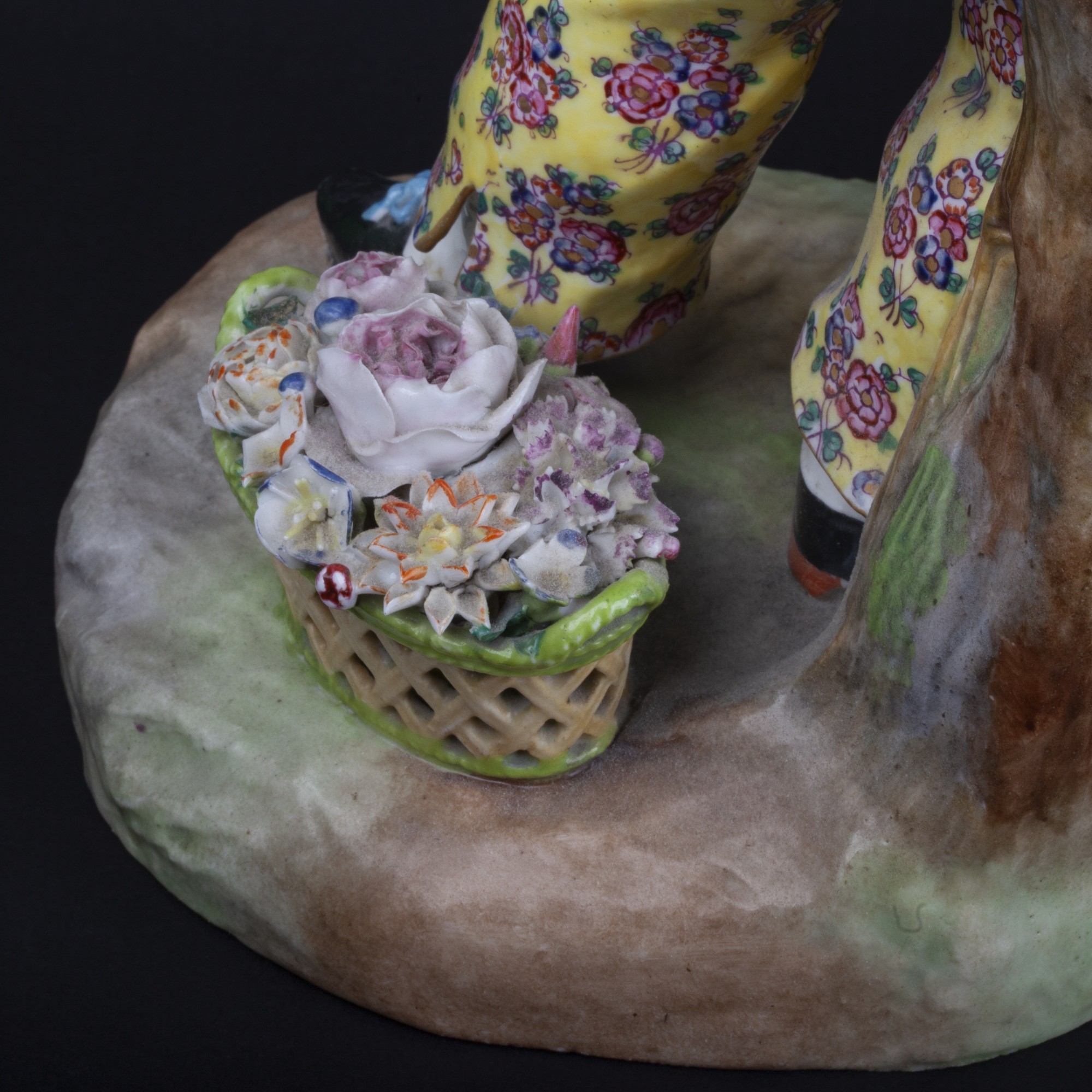
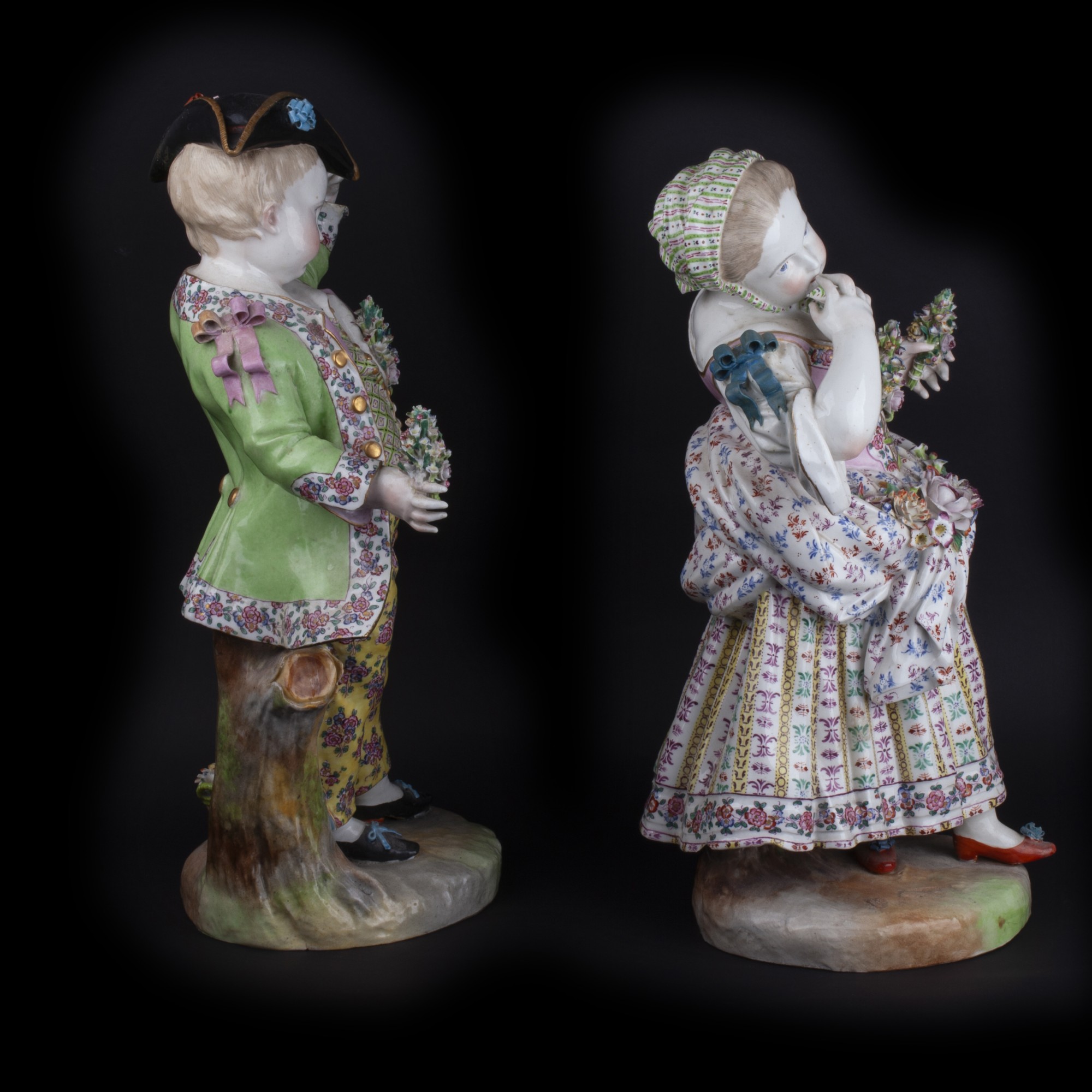
Lot 0141
Pair of Meissen-Style Porcelain Figurines, Rococo Boy and Girl, Hand-Painted
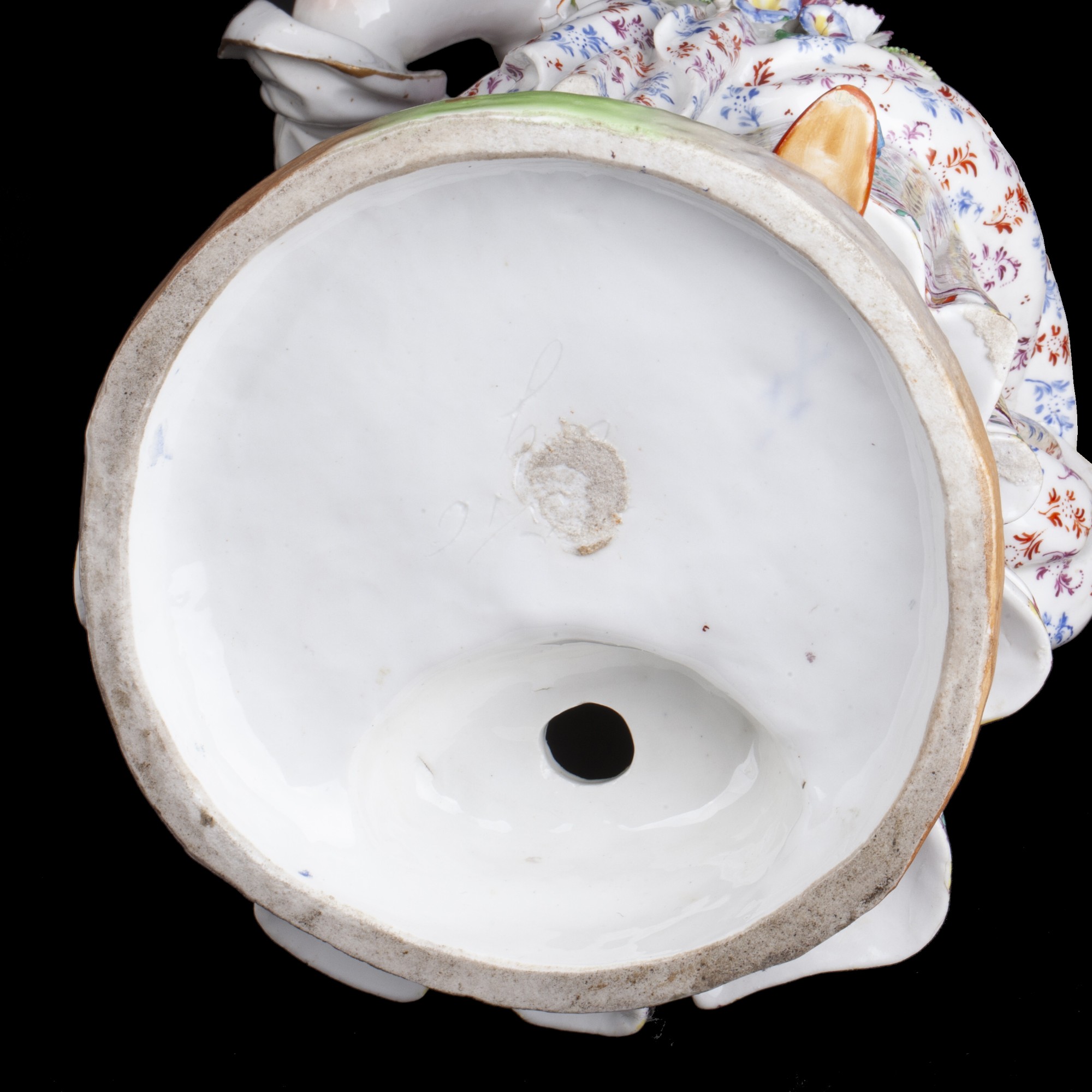
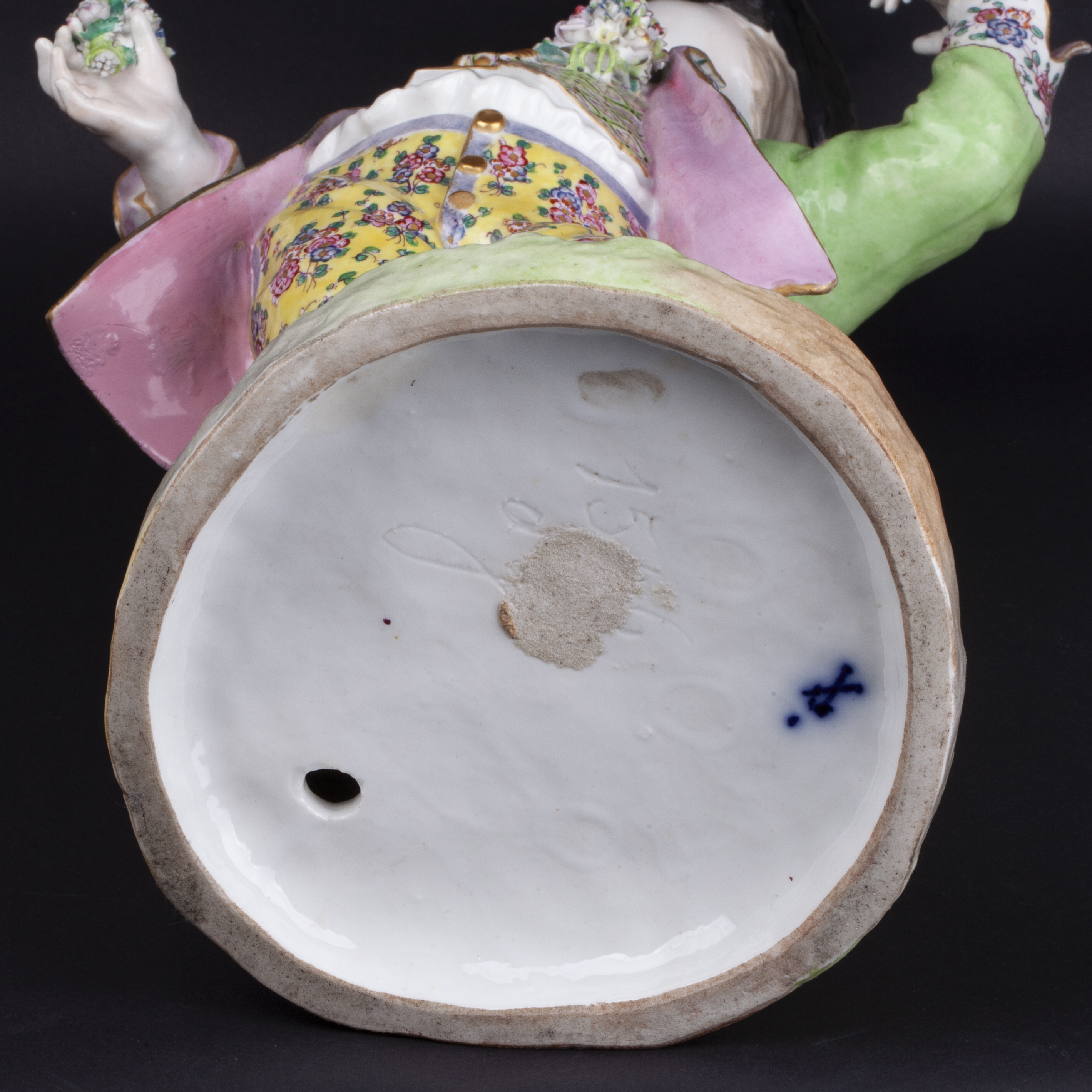
Estimate: 4500-5000€Colossal and graceful pair of Meissen-style porcelain figurines, each 40 cm tall and standing on a 17 cm diameter base. Hand-painted in the classic 18-century palette, the boy and girl are captured in elegant Rococo poses, their lace-trimmed costumes, floral bouquets and gilded highlights modelled with museum-grade detail.
Starting price: 4000€
Estimate: 4500-5000€
Hammer Price: Not sold -
Lot 0142
Interesting Desk Set in the Memory of French Russian Alliance
Estimate: 500-700€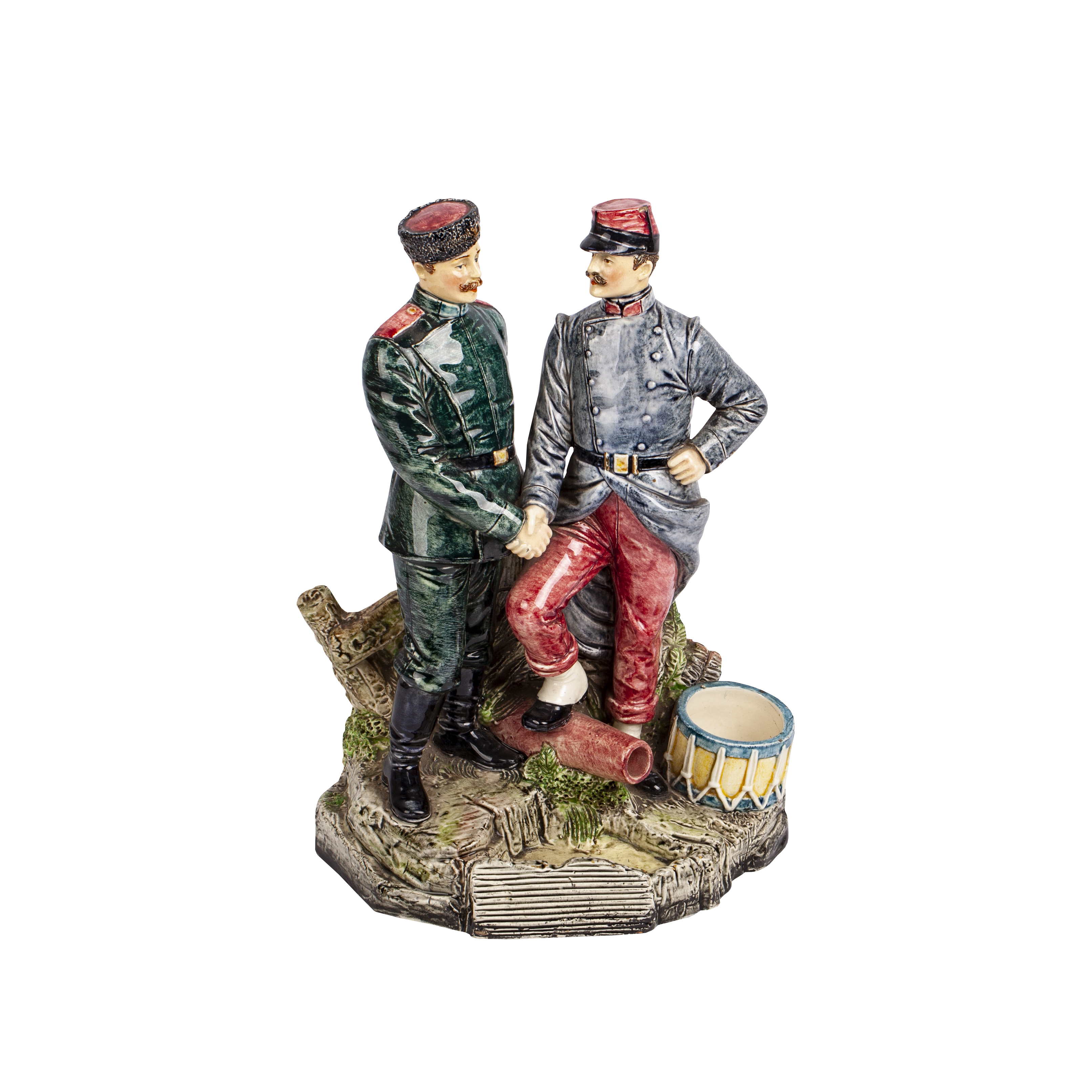
Lot 0142
Interesting Desk Set in the Memory of French Russian Alliance
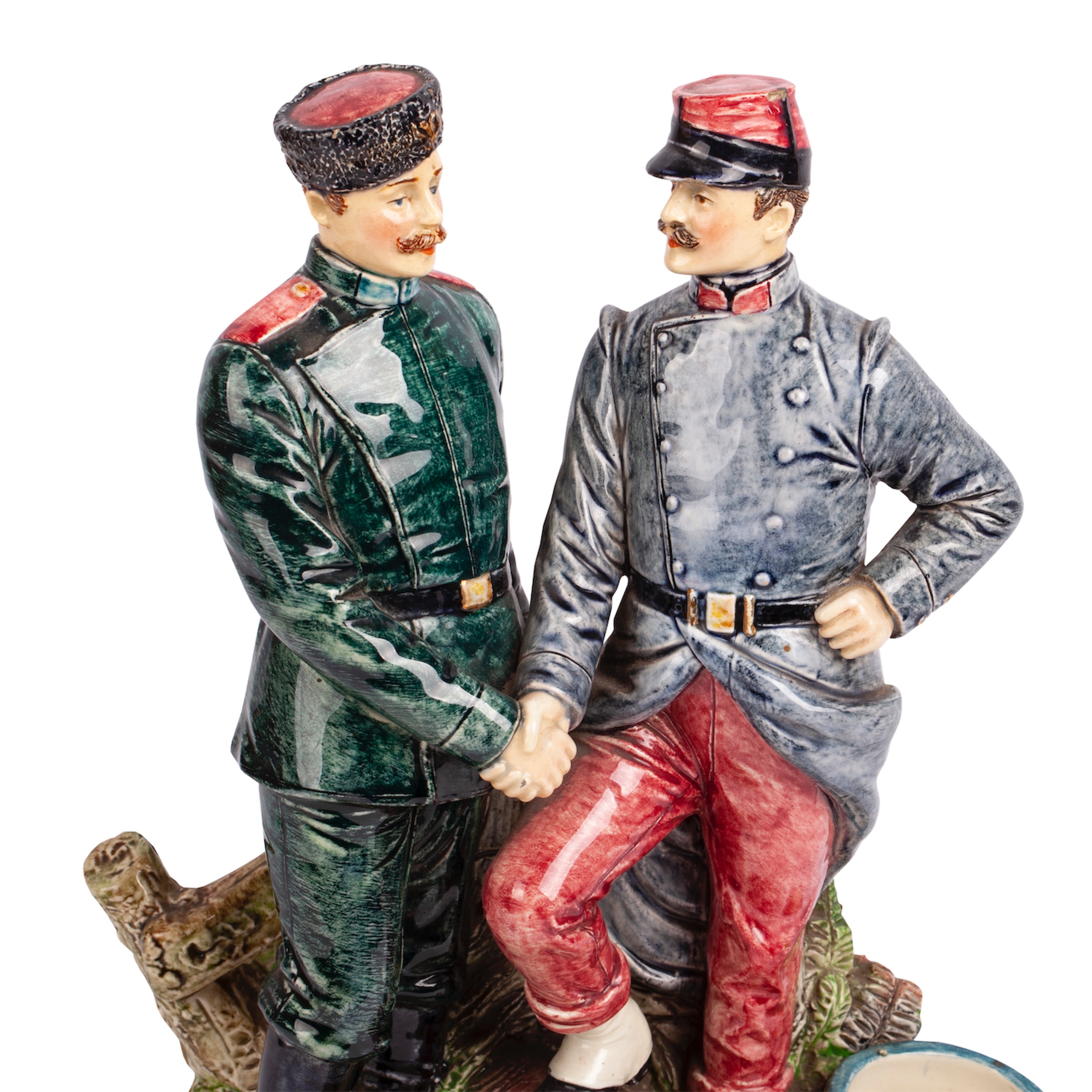
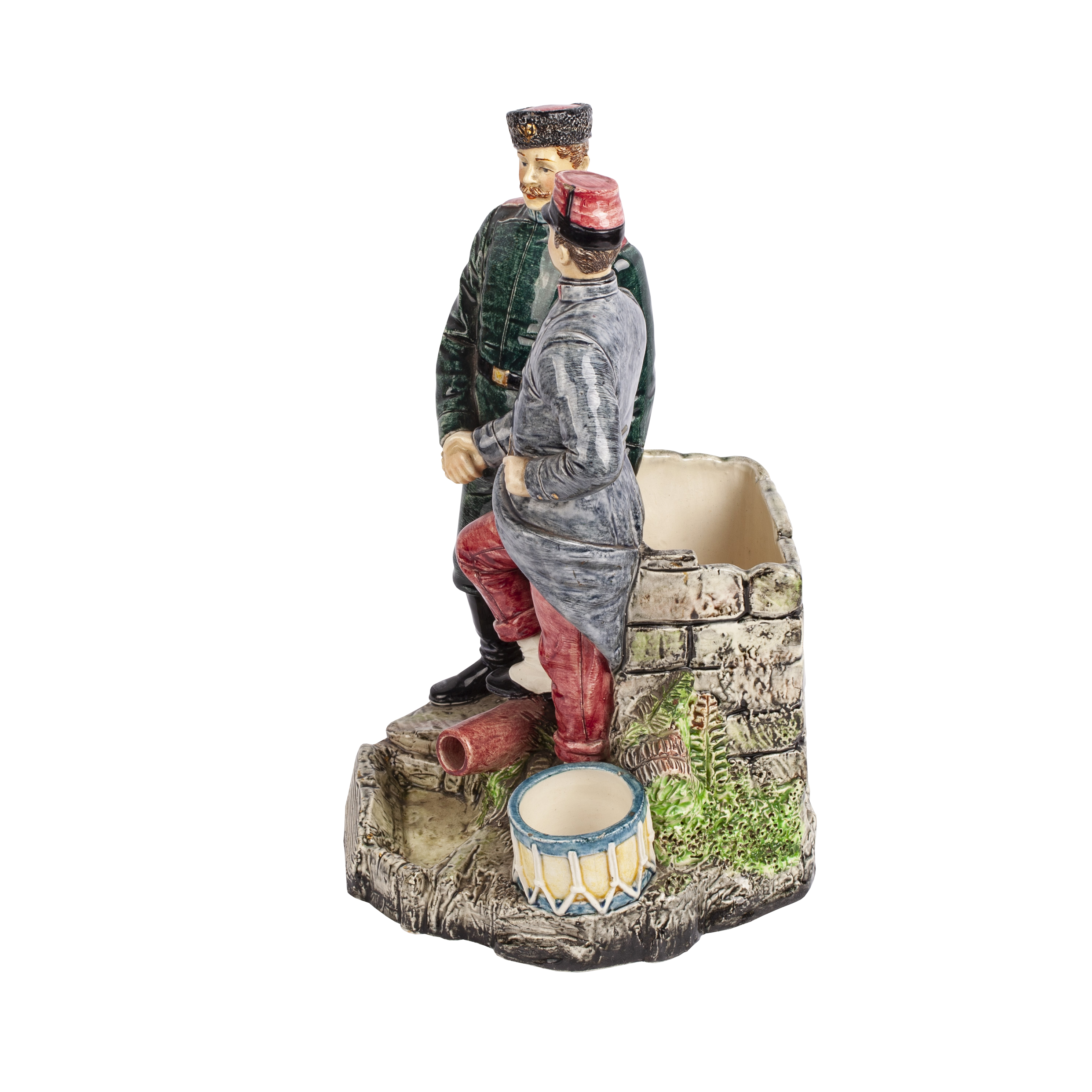
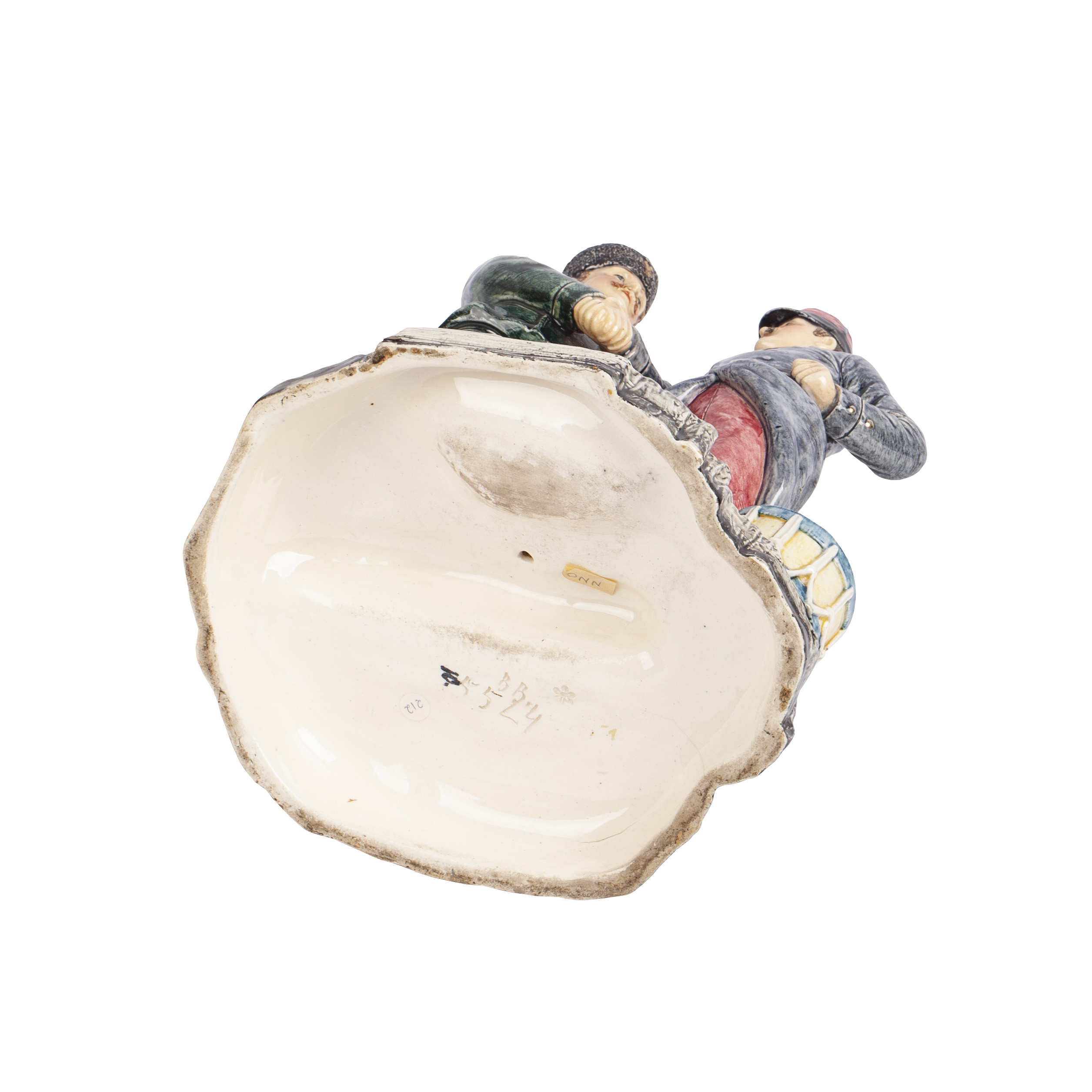
Estimate: 500-700€An interesting Russian desk set commemorating the Franco-Russian Alliance (1891–1894).
Porcelain, polychrome painting.
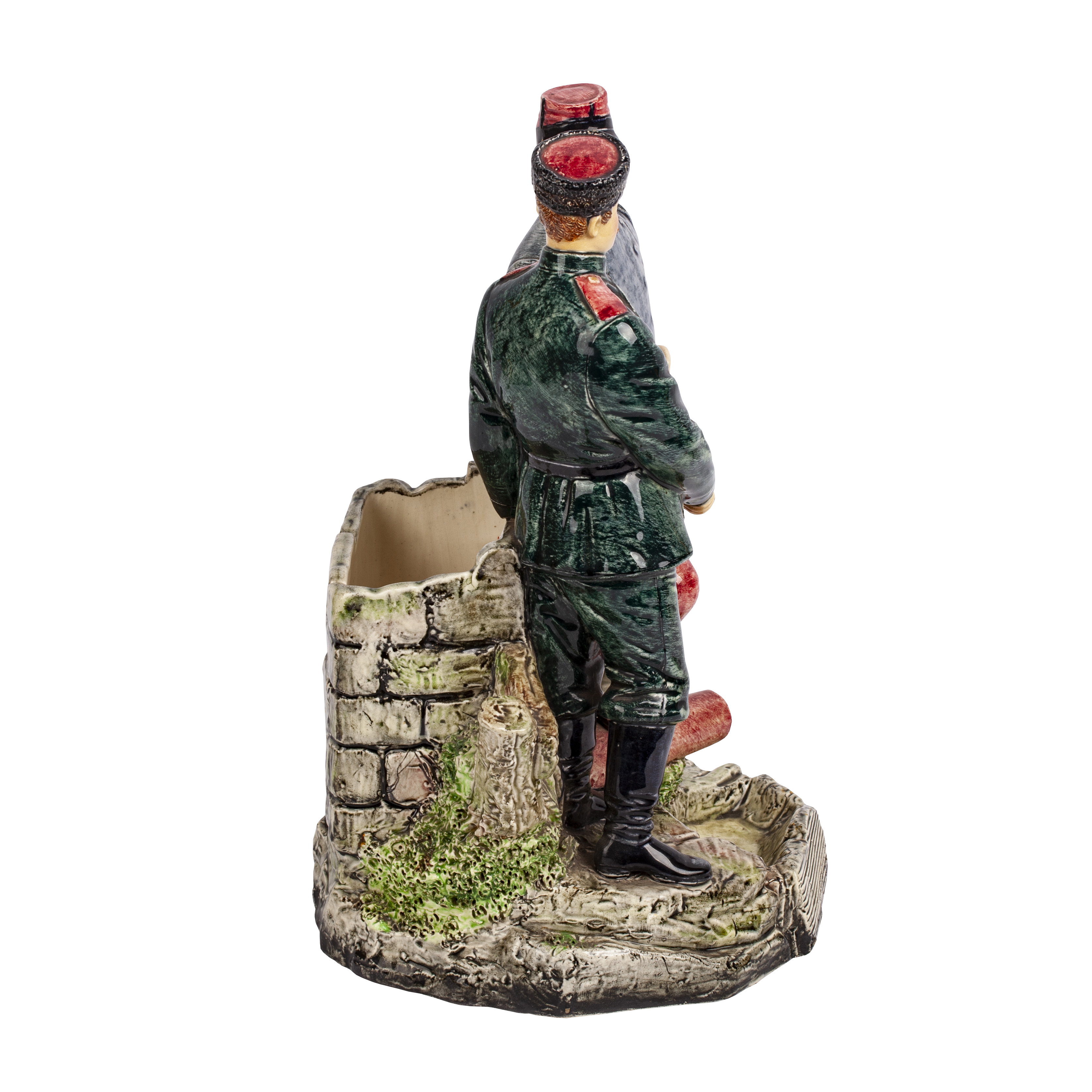
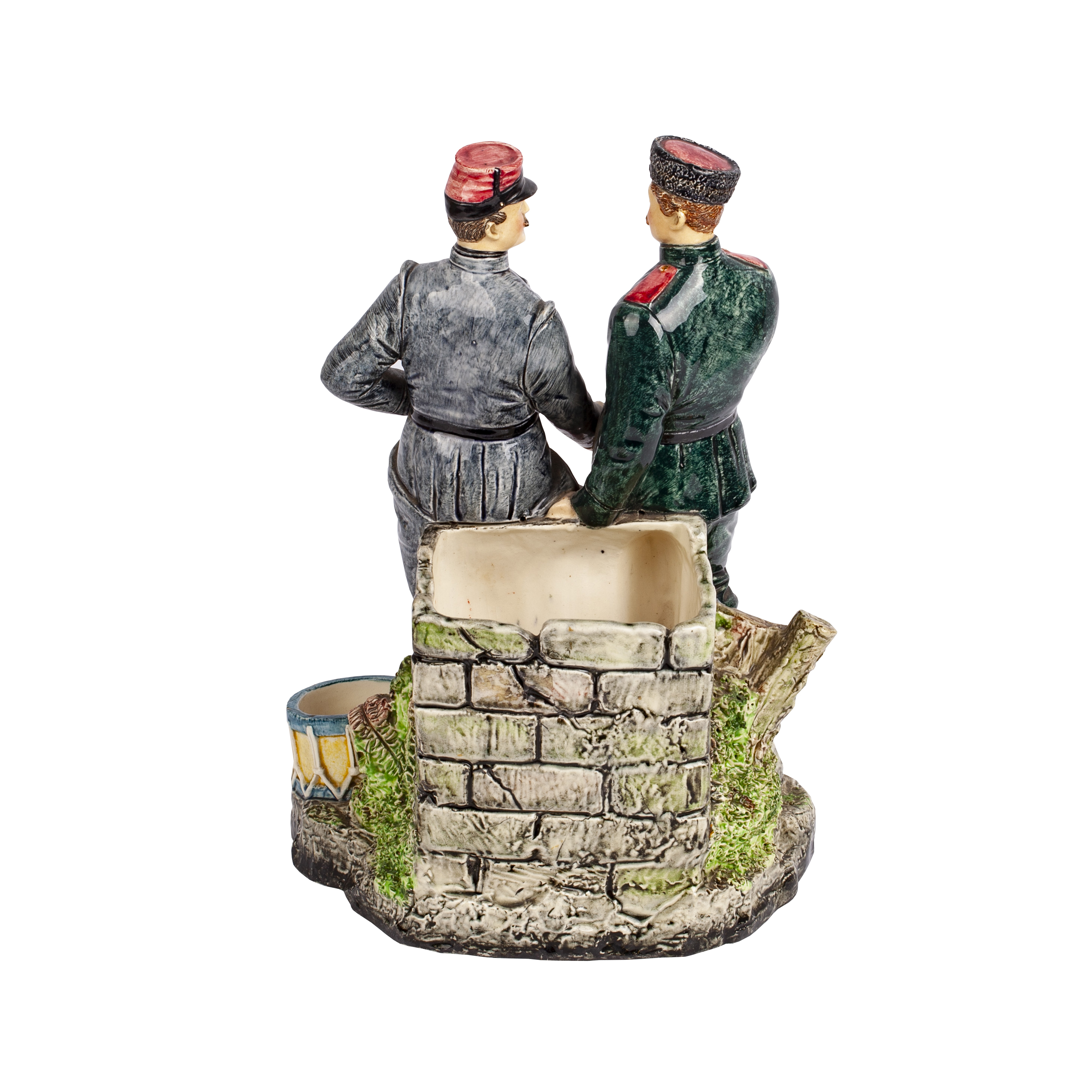
Height: 26.5 cm.The composition depicts two soldiers — one French, the other Russian — standing together in a friendly handshake, symbolizing the military and political union between the two nations at the end of the 19th century. The French soldier is dressed in a grey-blue tunic and red trousers, while the Russian wears a dark green uniform with red shoulder boards and a fur cap. At their feet lie a drum and a cannon barrel, linking the scene to a martial setting.
The piece likely served as a desk accessory, combining decorative and symbolic purposes. Such objects were produced in Russia around the time of the Franco-Russian Alliance, a pivotal event that reshaped the European balance of power before World War I.
The alliance, formalized between 1891 and 1894, united Republican France and Imperial Russia in mutual defense against the growing threat of Germany and Austria-Hungary. It marked the beginning of the diplomatic configuration later known as the Triple Entente.
This porcelain figure embodies the spirit of solidarity and goodwill between the two nations and stands as a vivid example of late 19th-century commemorative art, blending political symbolism with the charm of genre porcelain sculpture.
Starting price: 400€
Estimate: 500-700€
Hammer Price: 400 € -
Lot 0143
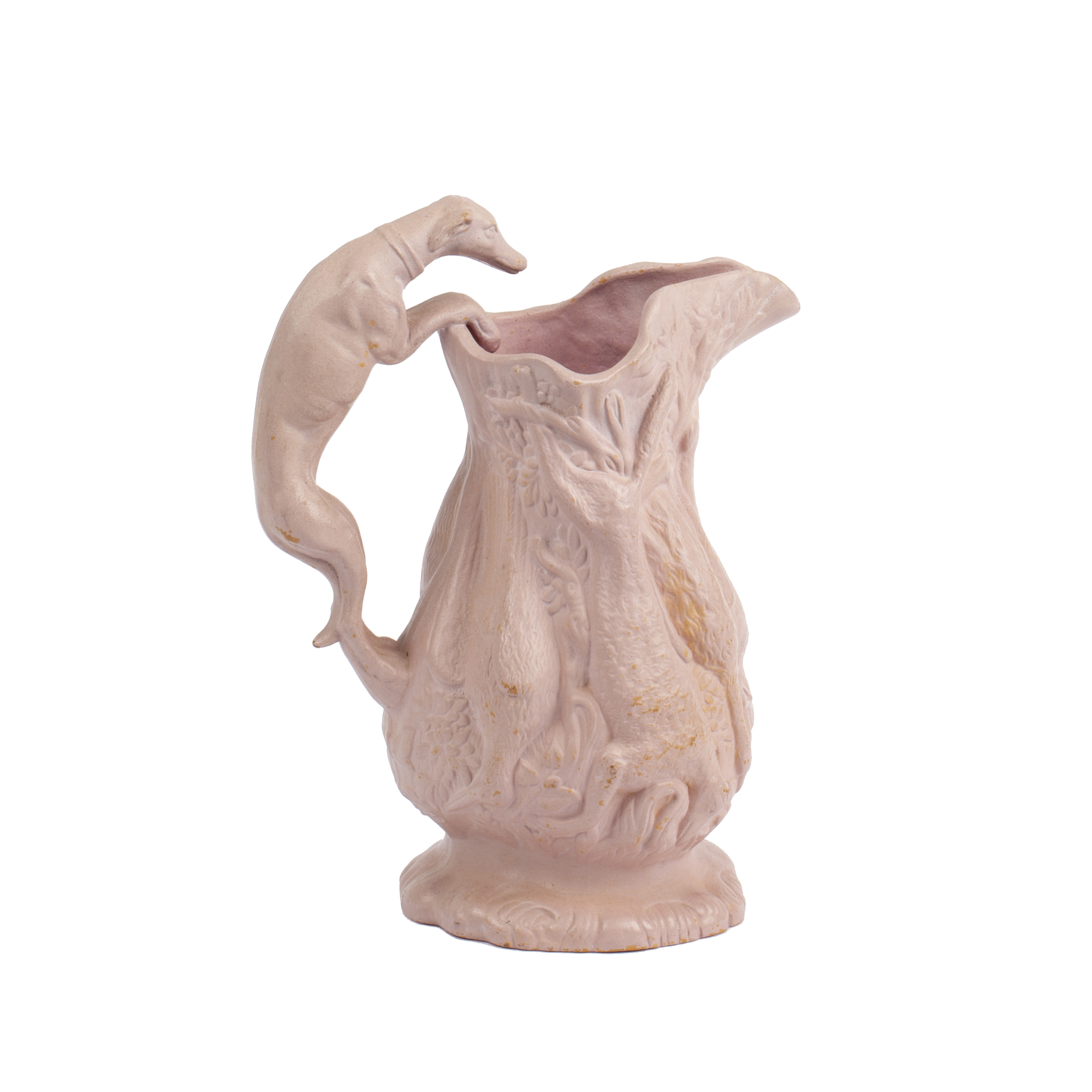
Russian Pitcher with Hunting Trophy Reliefs
Estimate: 1000-1500€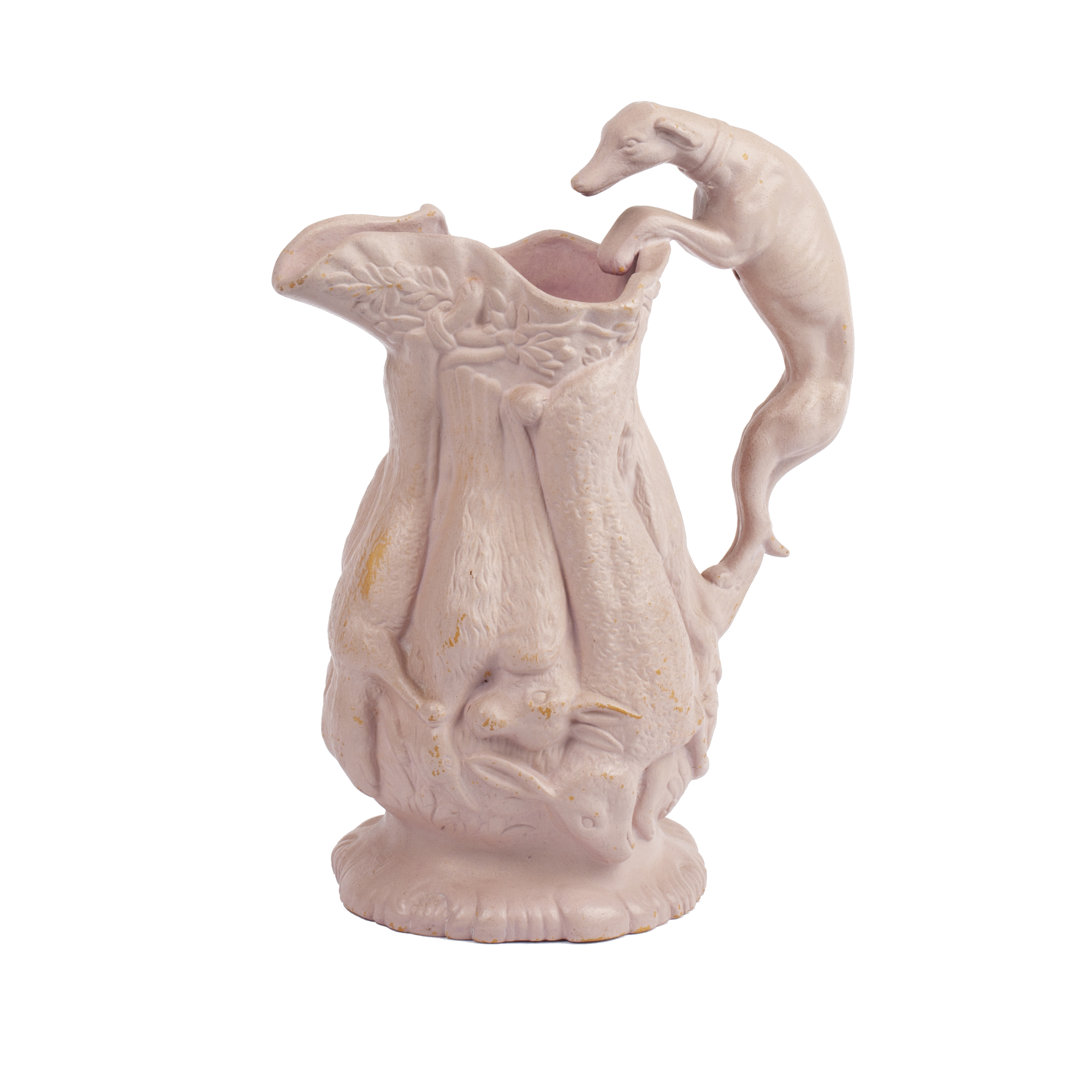
Lot 0143
Russian Pitcher with Hunting Trophy Reliefs
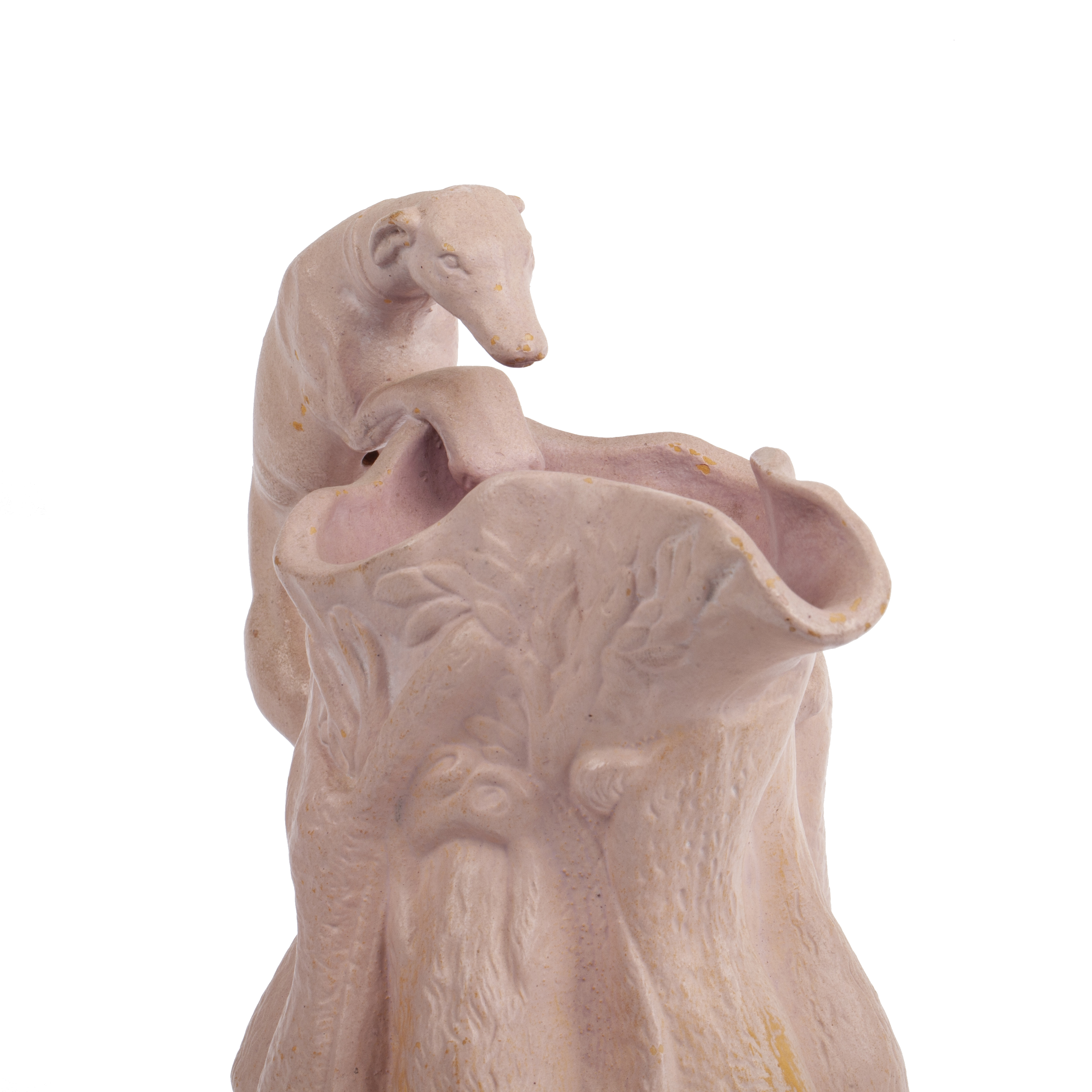
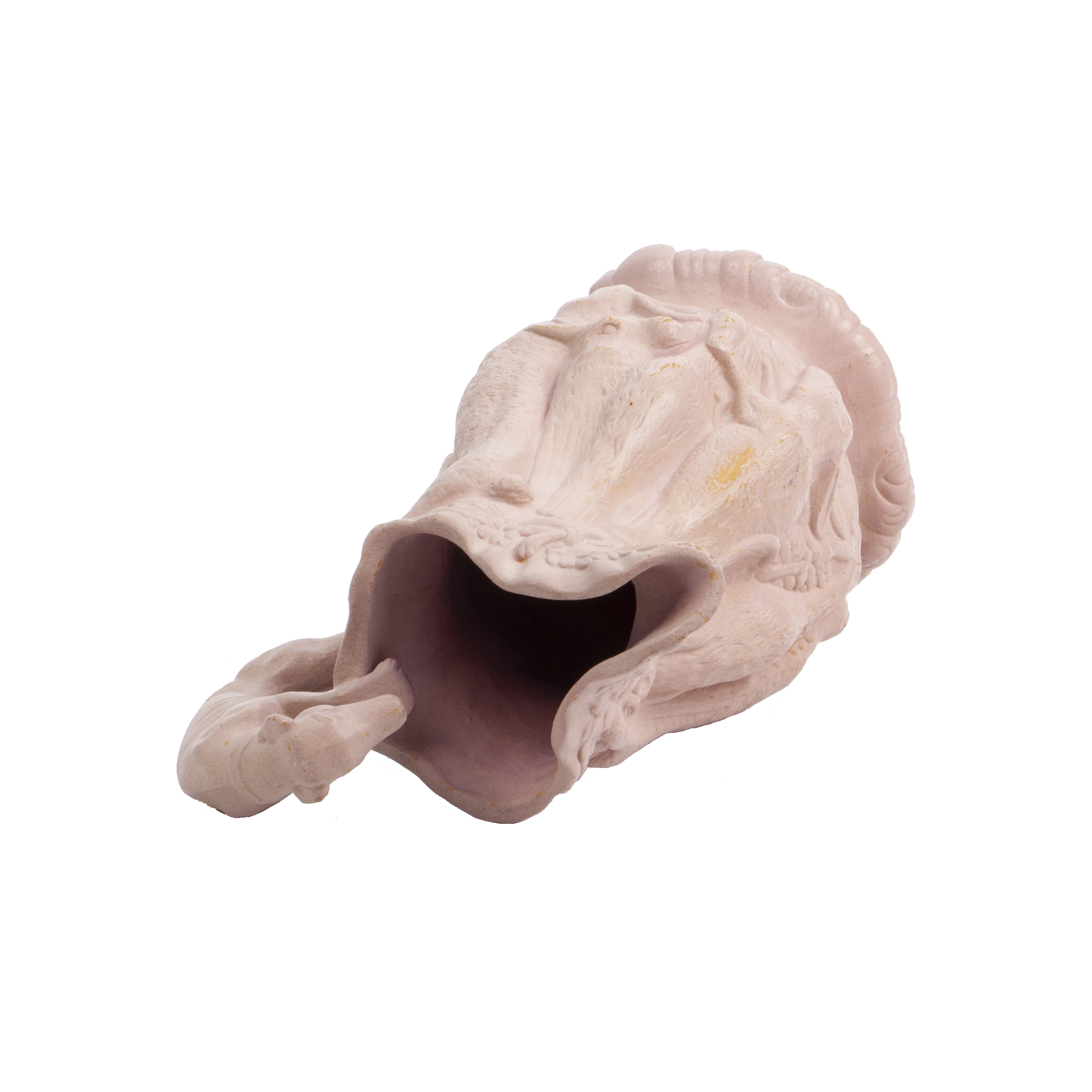
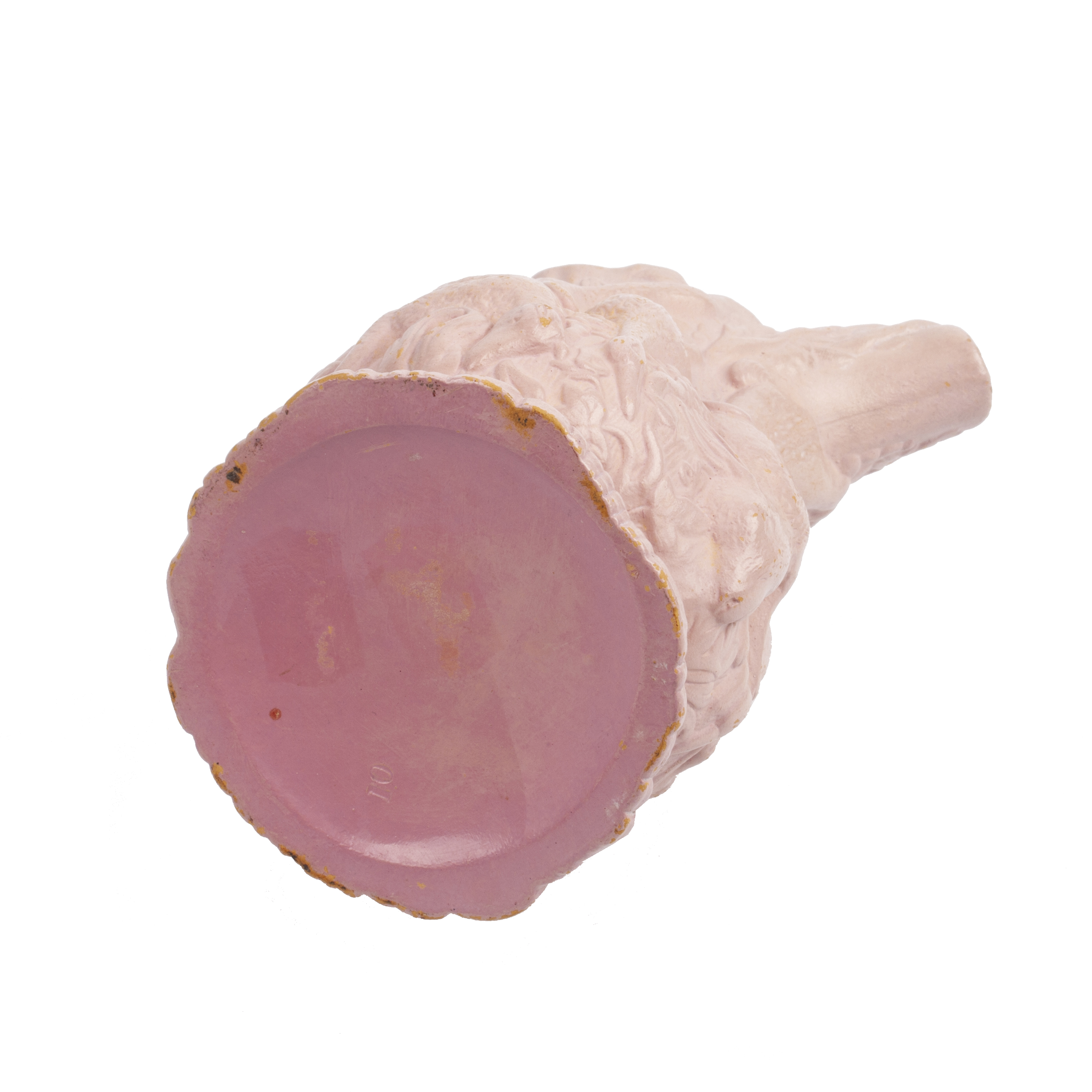
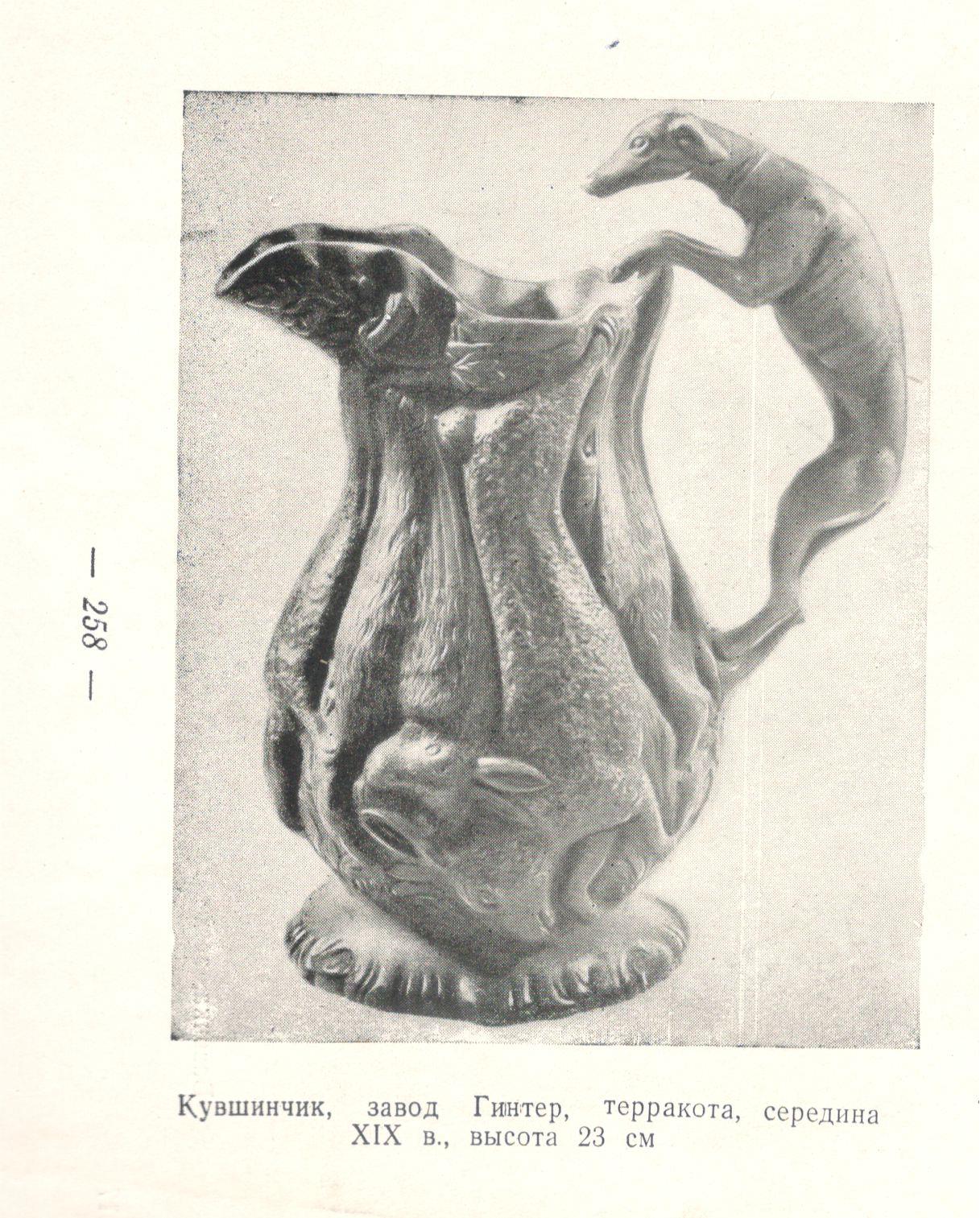
Estimate: 1000-1500€Russian pitcher with Hunting Trophy Reliefs
Günther Factory, St. Petersburg, mid-19th century
Faience
Height: 17.7 см.A rare faience pitcher decorated with reliefs of hunting trophies—small game animals—and a handle in the form of a fox peering into the vessel. The design recalls the rustic wares of Bernard Palissy (ca. 1510–1589), the French Renaissance ceramicist celebrated for his naturalistic reliefs of plants and animals.
The Günther factory near St. Petersburg, founded by merchant Fyodor Khristoforovich Günther around 1818, produced a wide range of faience wares, some inspired by Wedgwood. Its pieces were noted for their durability, strong glazes, and ability to withstand heat. The factory remained active under members of the Günther family until the 1860s, after which production ceased.
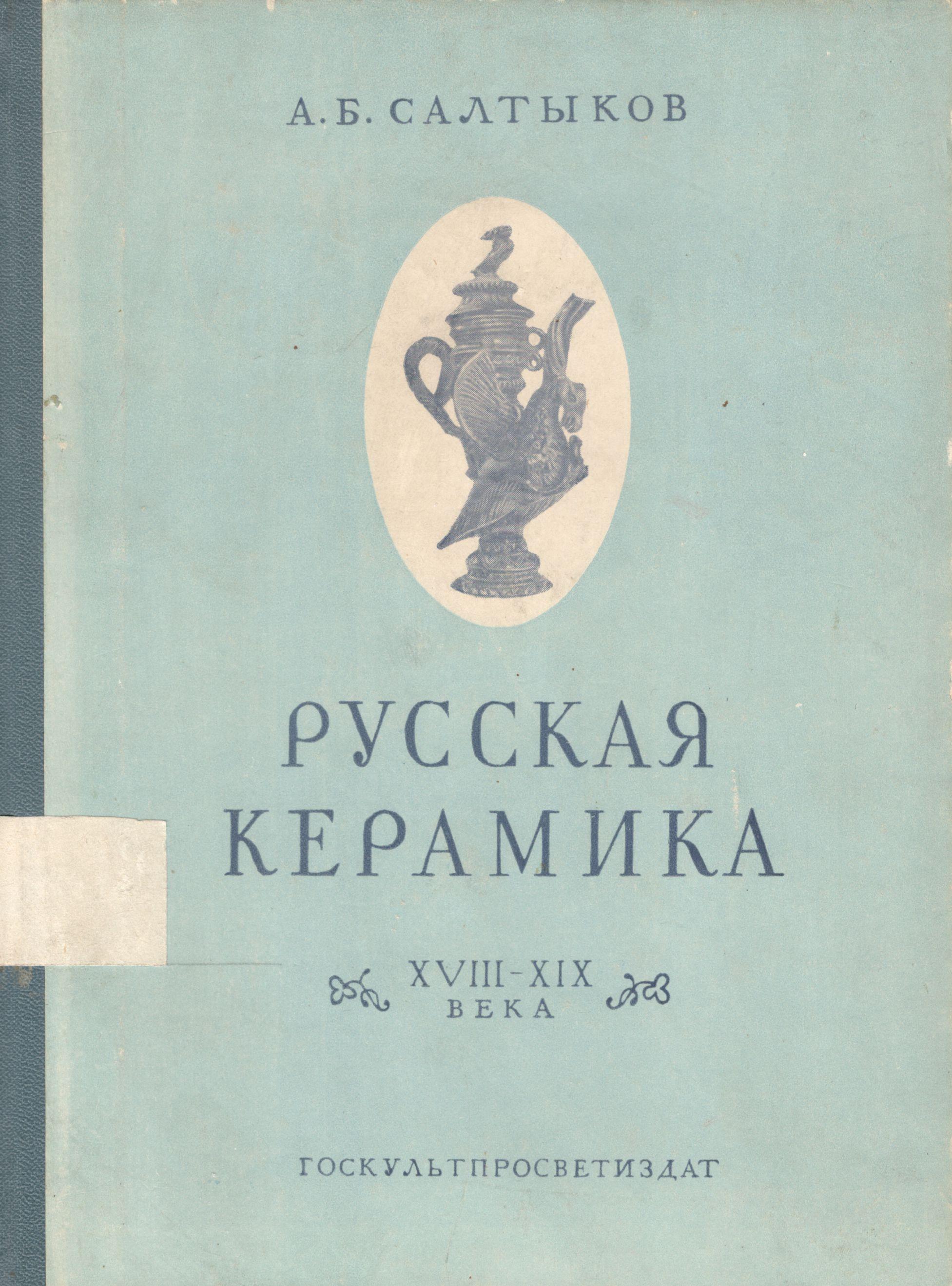
See similar: A. Saltikov. Russian ceramics of 18-19 centuries. P. 258.Starting price: 900€
Estimate: 1000-1500€
Hammer Price: Not sold -
Lot 0144
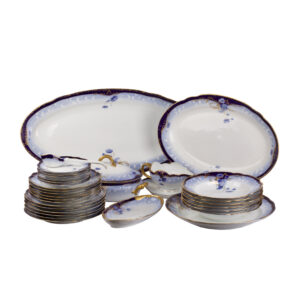
Russian Porcelain Gold and Cobalt Painted Service
Estimate: 3000-3500€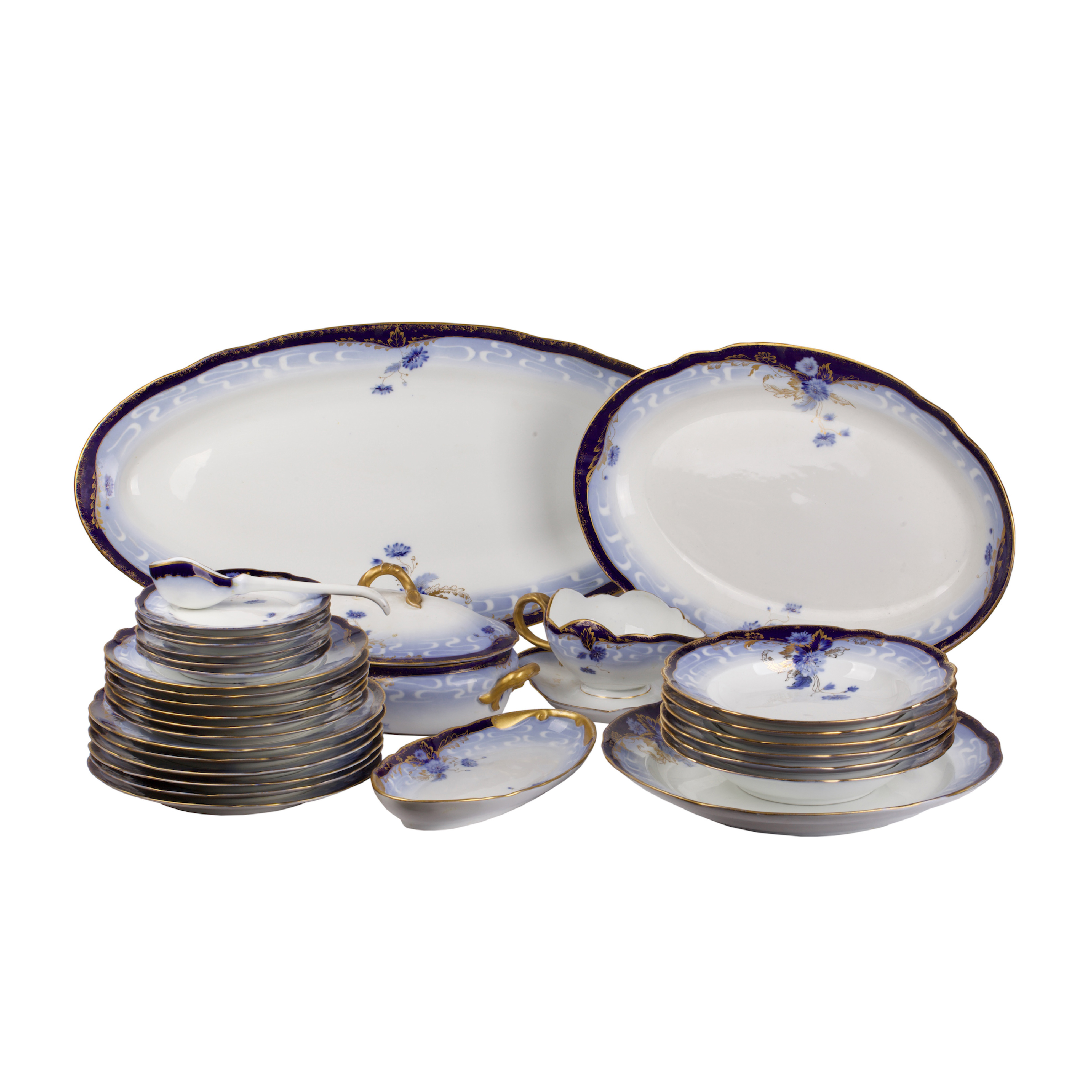
Lot 0144
Russian Porcelain Gold and Cobalt Painted Service
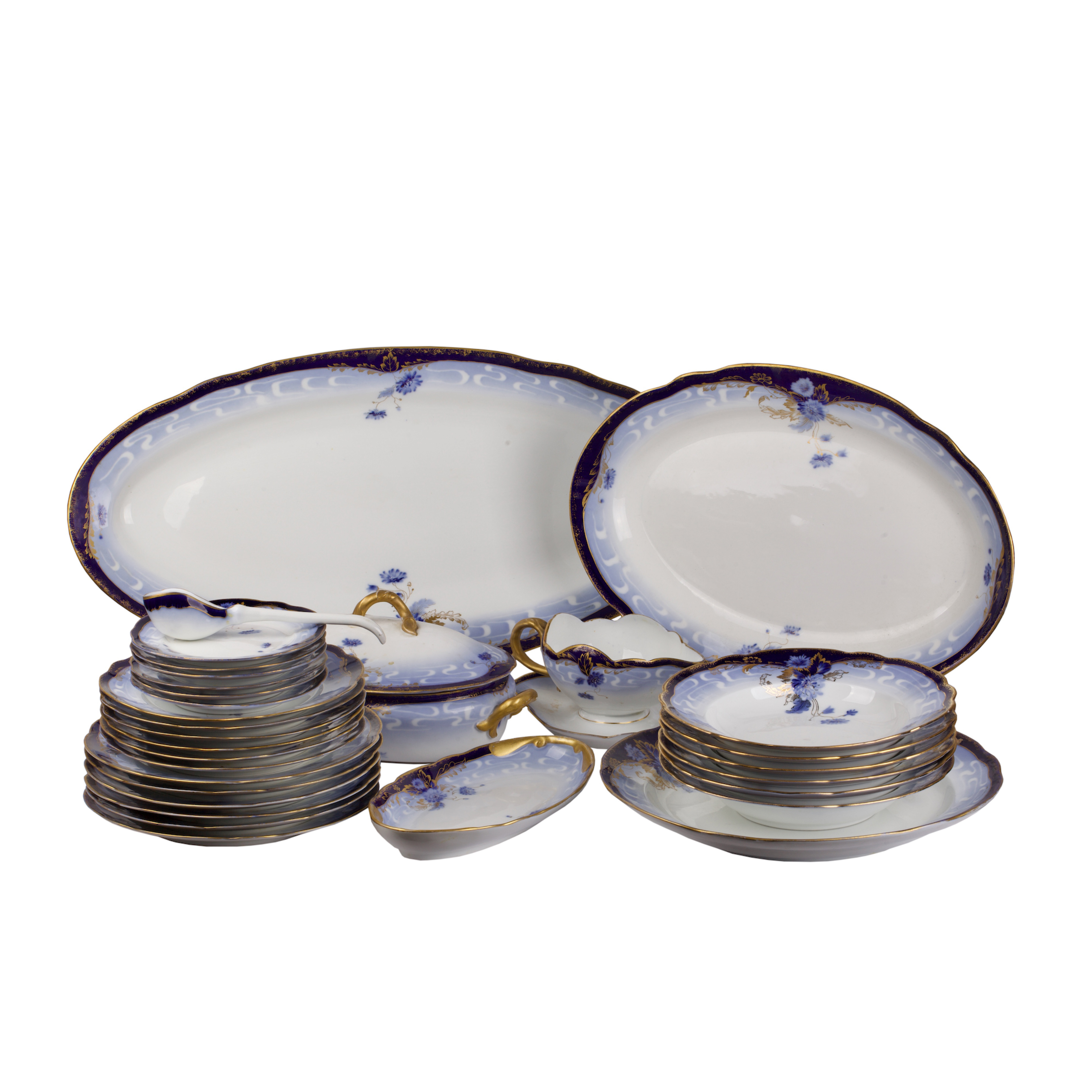
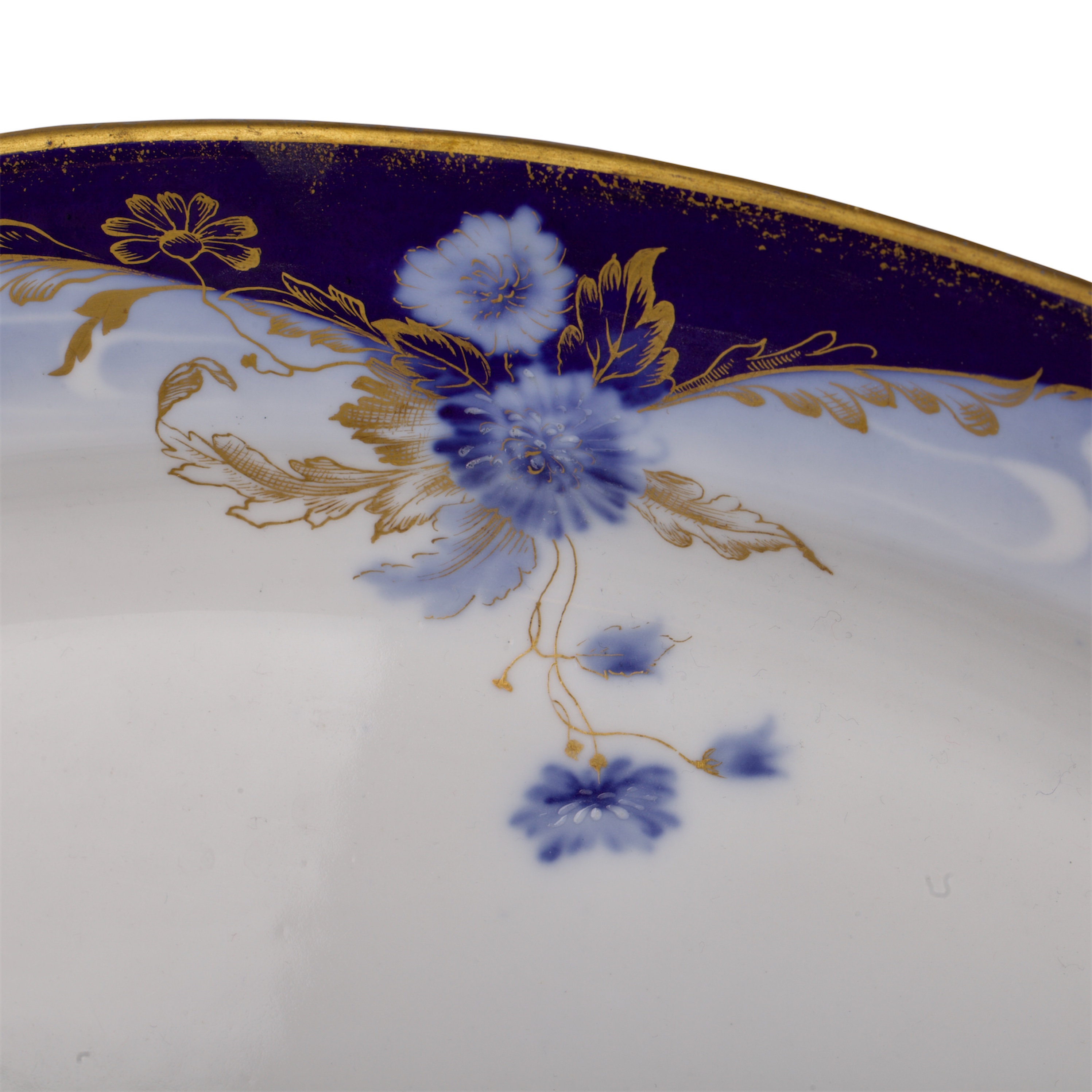
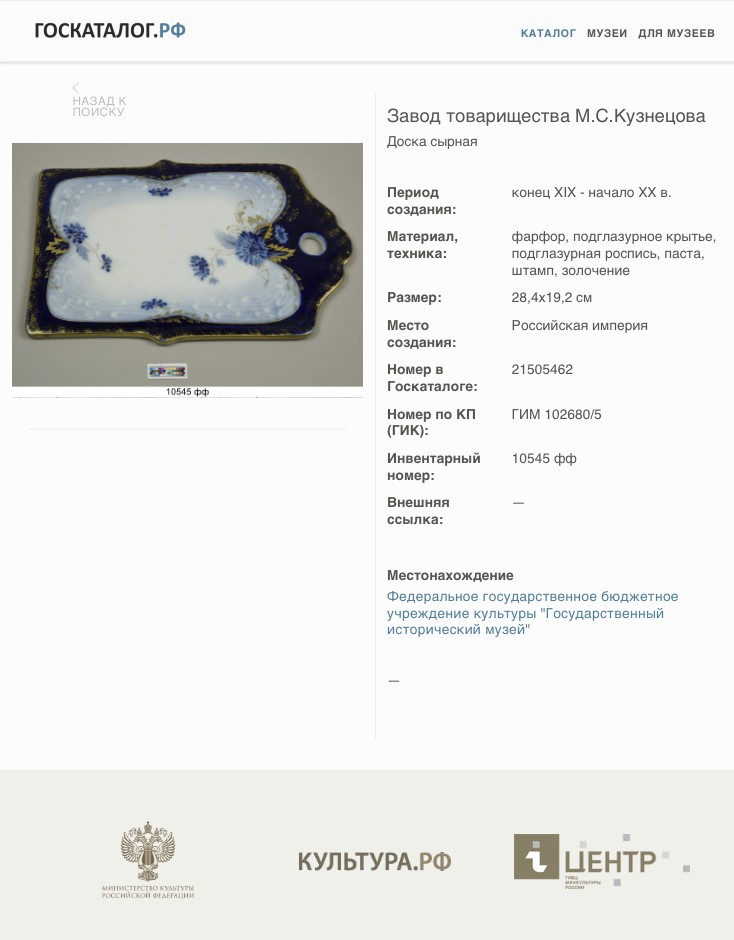
Estimate: 3000-3500€A Russian porcelain dining service of 30 pieces, richly decorated with cobalt-blue and gold floral painting.
Attributed to the Kuznetsov Manufactory, late 19th century.
Dimensions of the pot: 14 x 31 x 19.5 cm.
Diameter of the saucer plate: 16.5 cm.The service includes plates of various sizes, serving platters, sauce boats, and bowls, all unified by a refined design featuring delicate hand-painted blue flowers and gilded foliage on a white ground. The rims are bordered with a deep cobalt band, enhanced by gold scrolls and accents, creating a striking contrast and sense of depth.
Starting price: 2500€
Estimate: 3000-3500€
Hammer Price: Not sold -
Lot 0145
Interesting Russian Porcelain Coffee Set Featuring Views of Feodosia
Estimate: 2500-3000€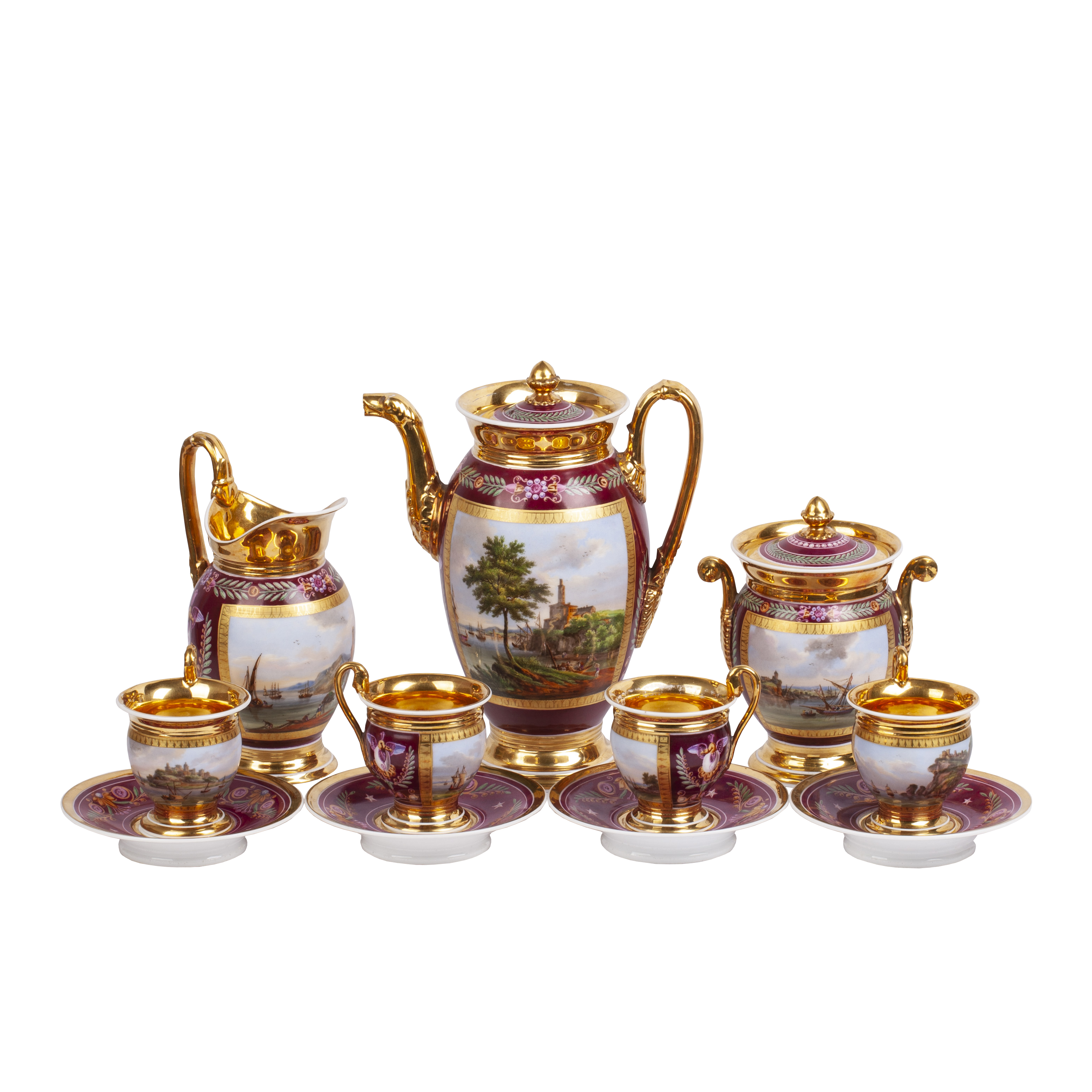
Lot 0145
Interesting Russian Porcelain Coffee Set Featuring Views of Feodosia
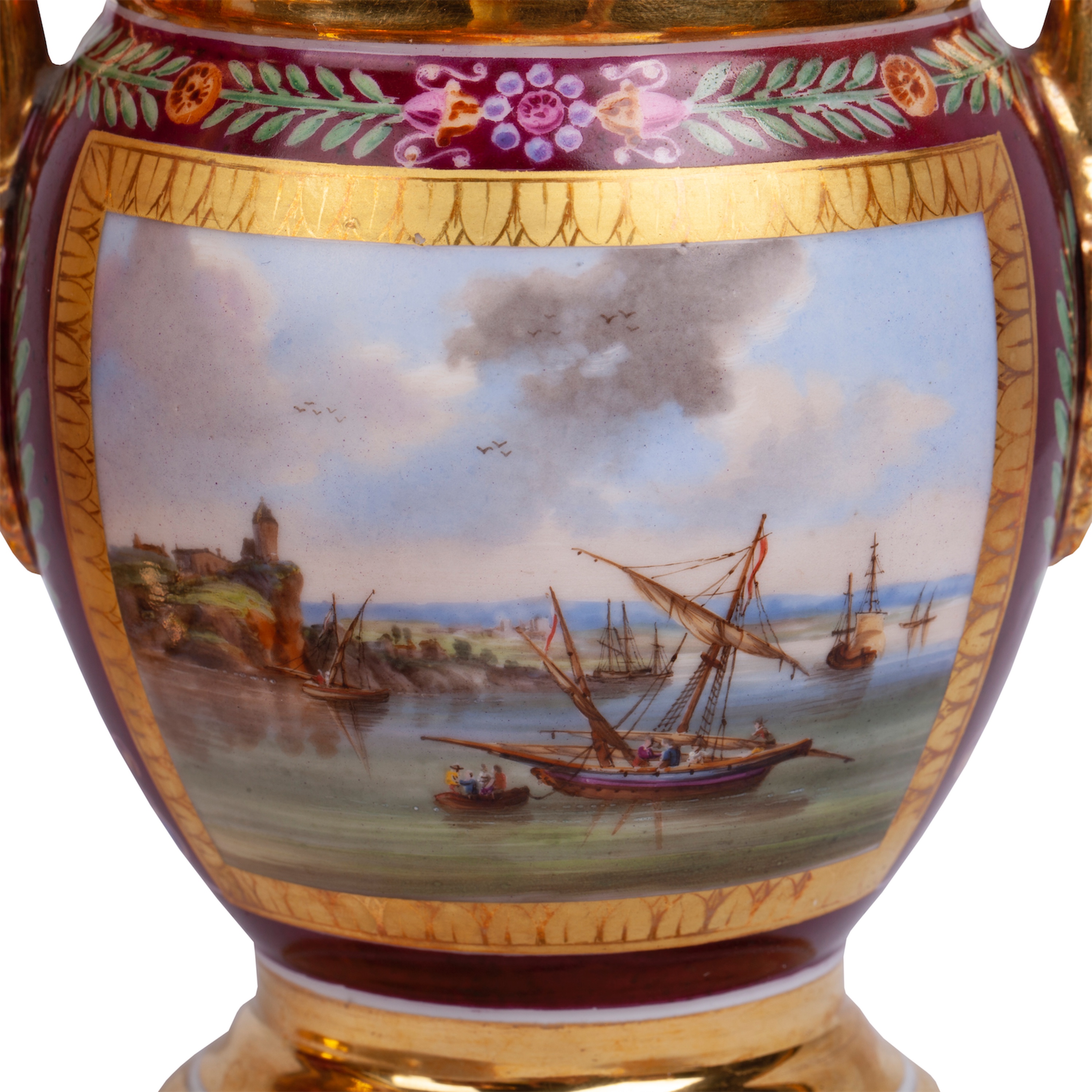
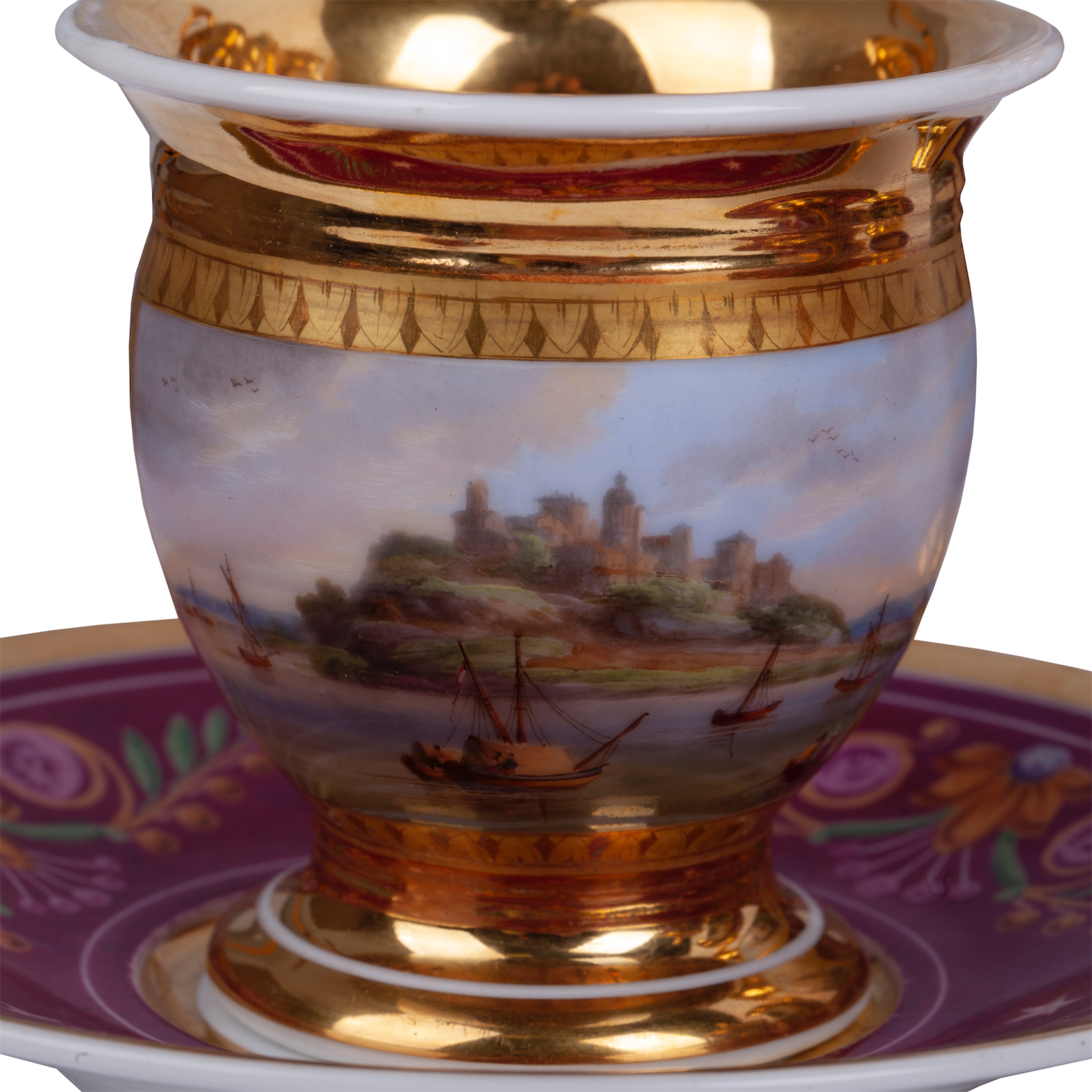
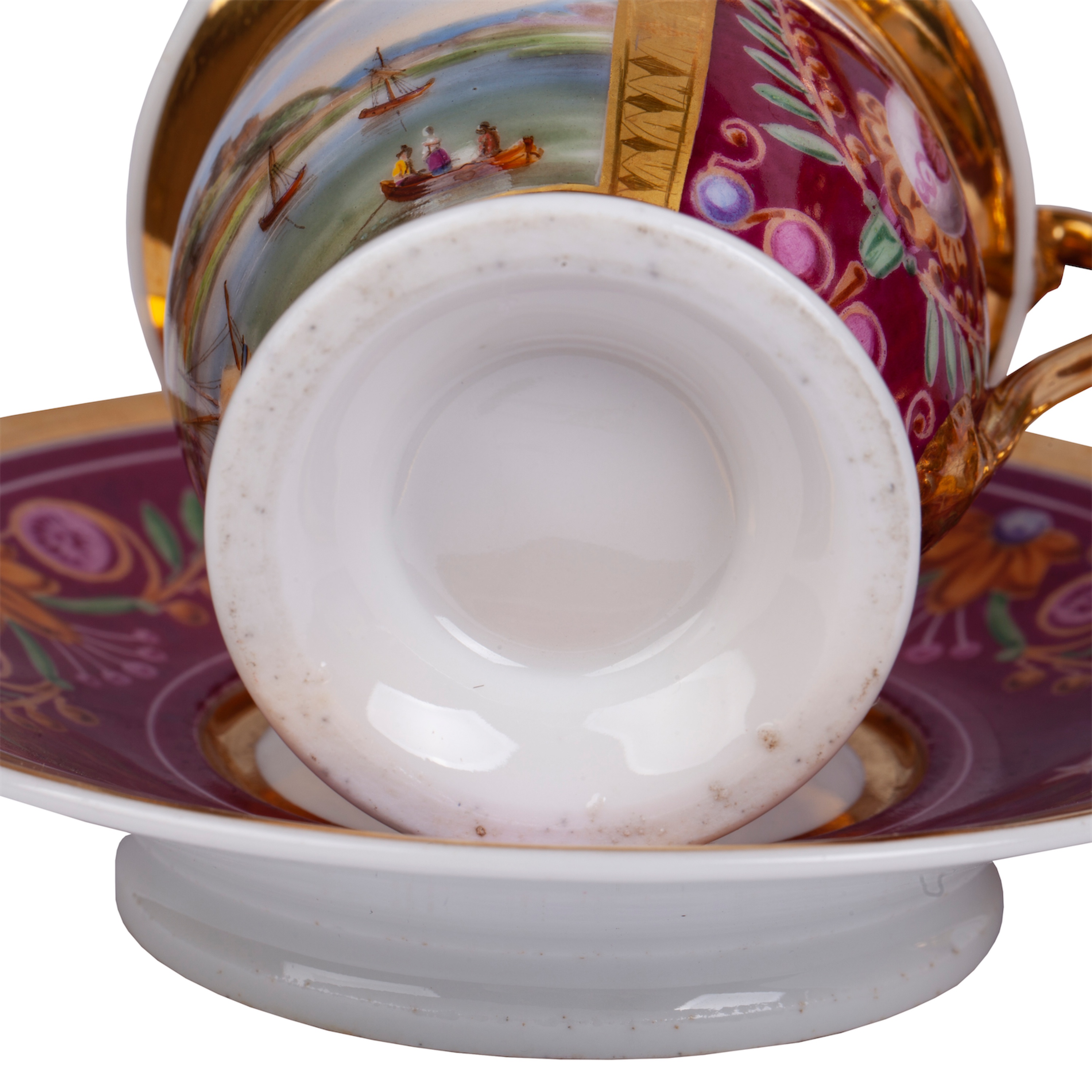
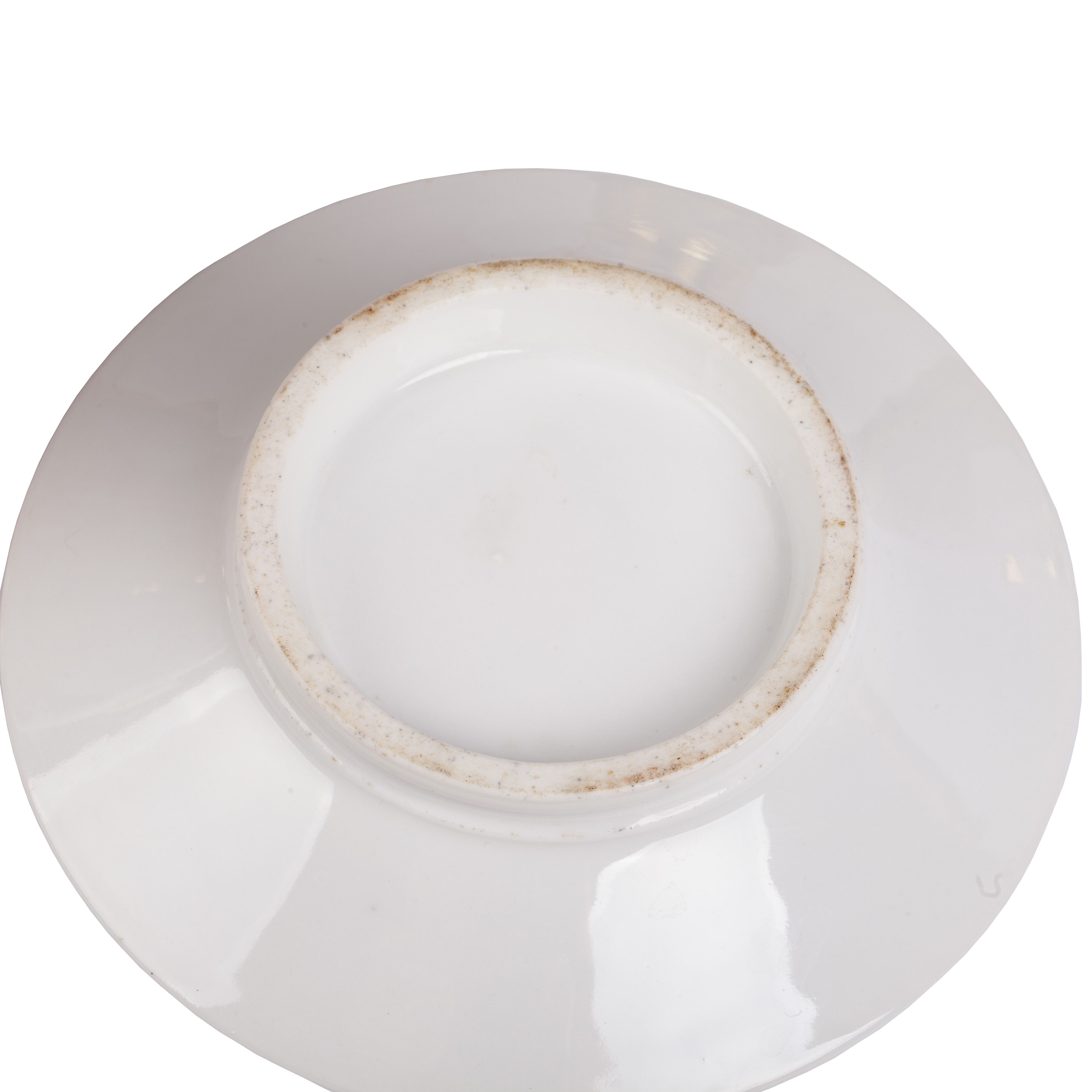
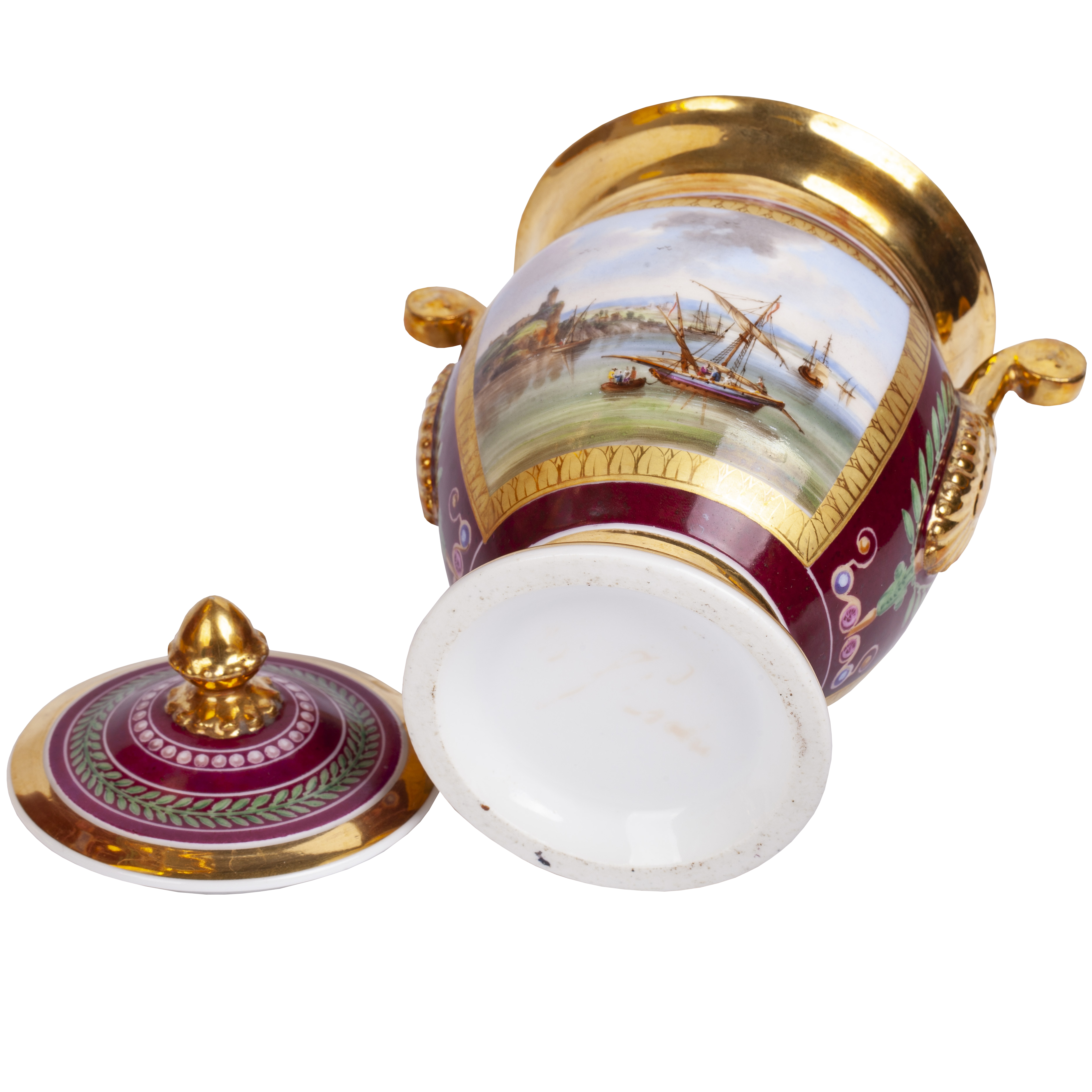
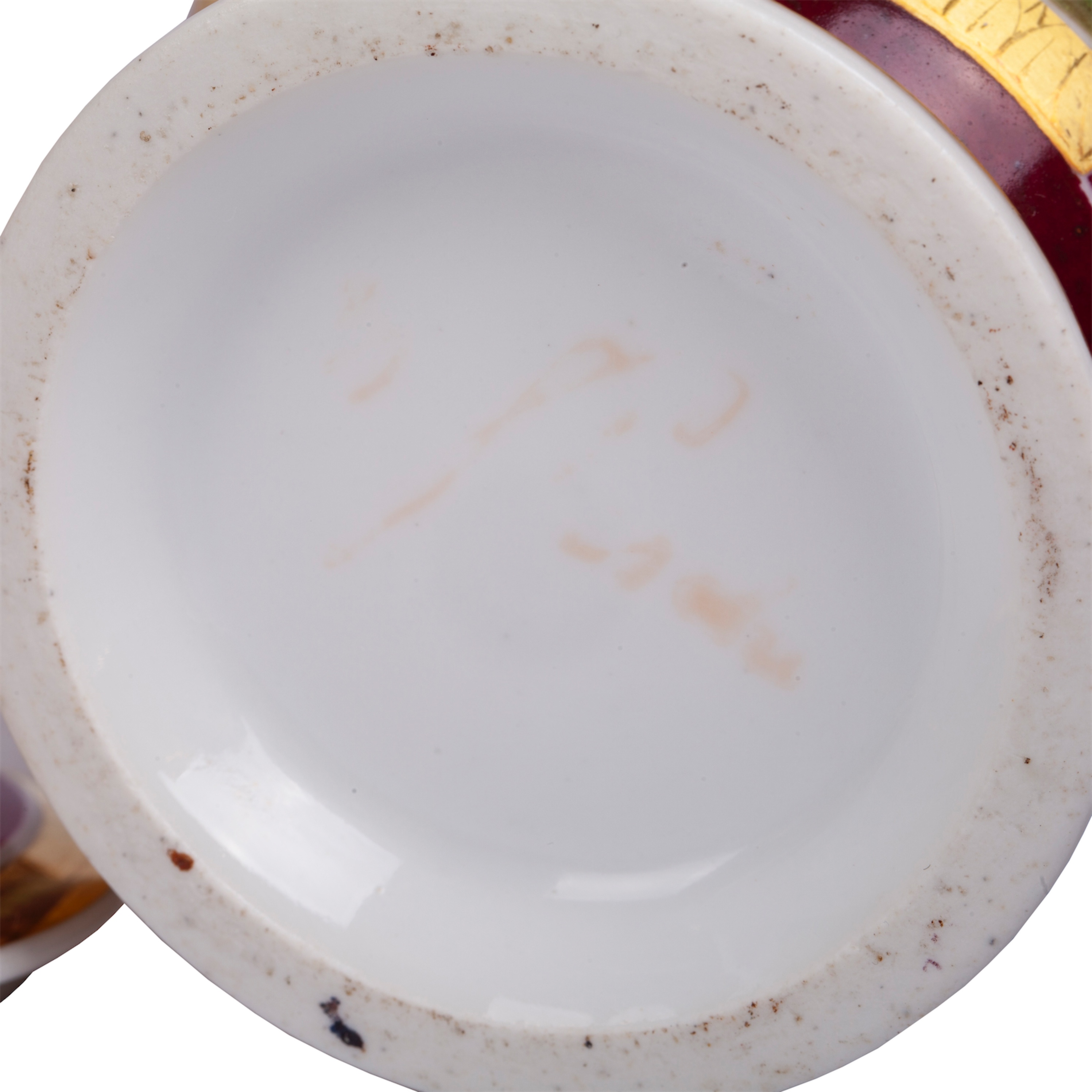
Estimate: 2500-3000€An interesting Russian porcelain coffee set with hand-painted views of Feodosia, produced at a private manufactory in Russia, late 19th century.
The set includes a coffee pot, milk jug, sugar bowl, and four cups with saucers.
Height of the coffee pot: 25 cm.This elegant ensemble is richly decorated in deep burgundy and gold tones, with finely painted landscape scenes depicting coastal views of Feodosia — ships in the harbor, fortress walls, and seaside architecture. Each panel is framed by gilded borders, while the upper sections of the vessels are adorned with floral garlands and neoclassical ornaments in vibrant enamels. The interiors and handles are fully gilded, reflecting the luxurious character of Russian porcelain of the period.
Starting price: 2000€
Estimate: 2500-3000€
Hammer Price: 2 000 € -
Lot 0146
Large Qajar Underglaze-Painted Pottery Vase, Persia
Estimate: 600-800€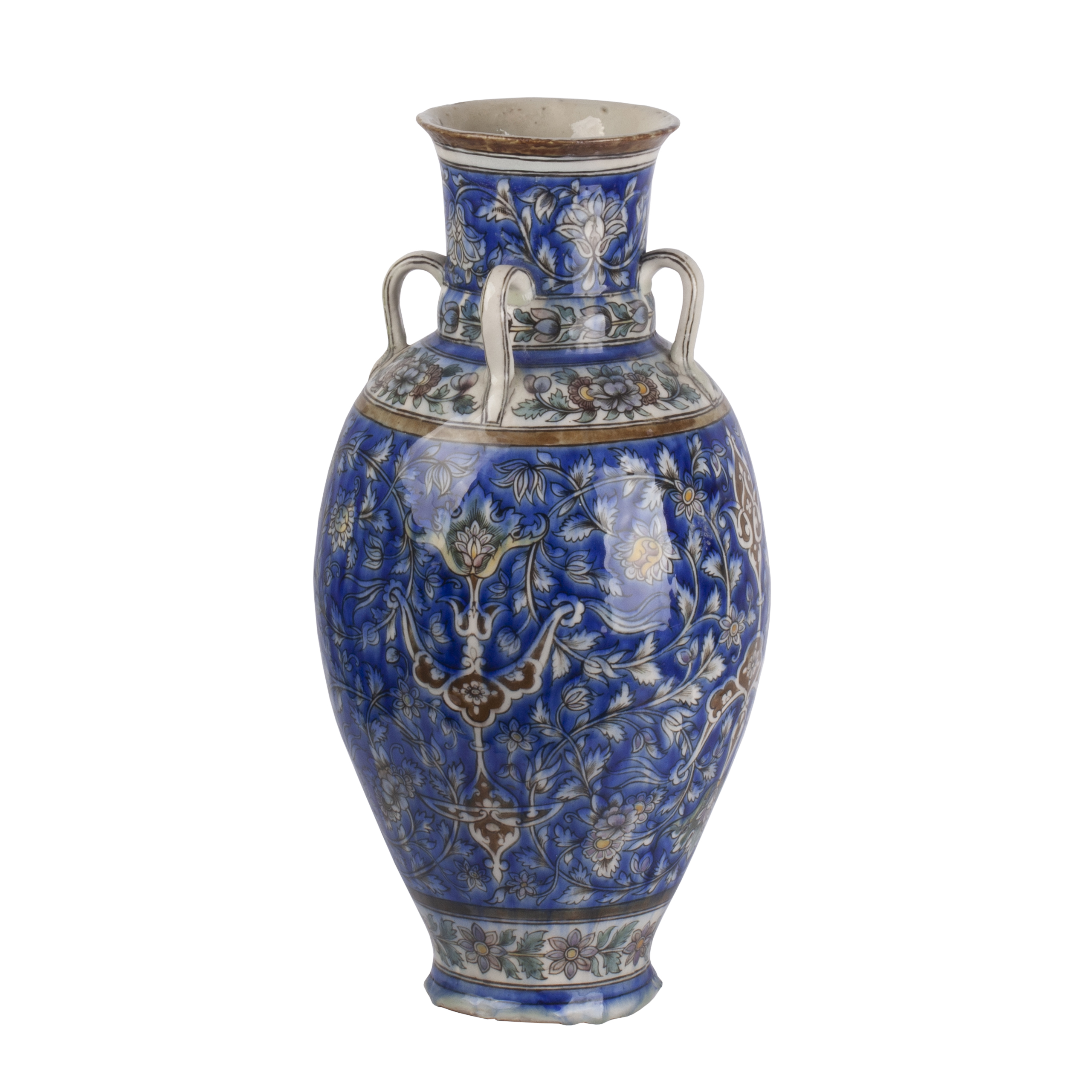
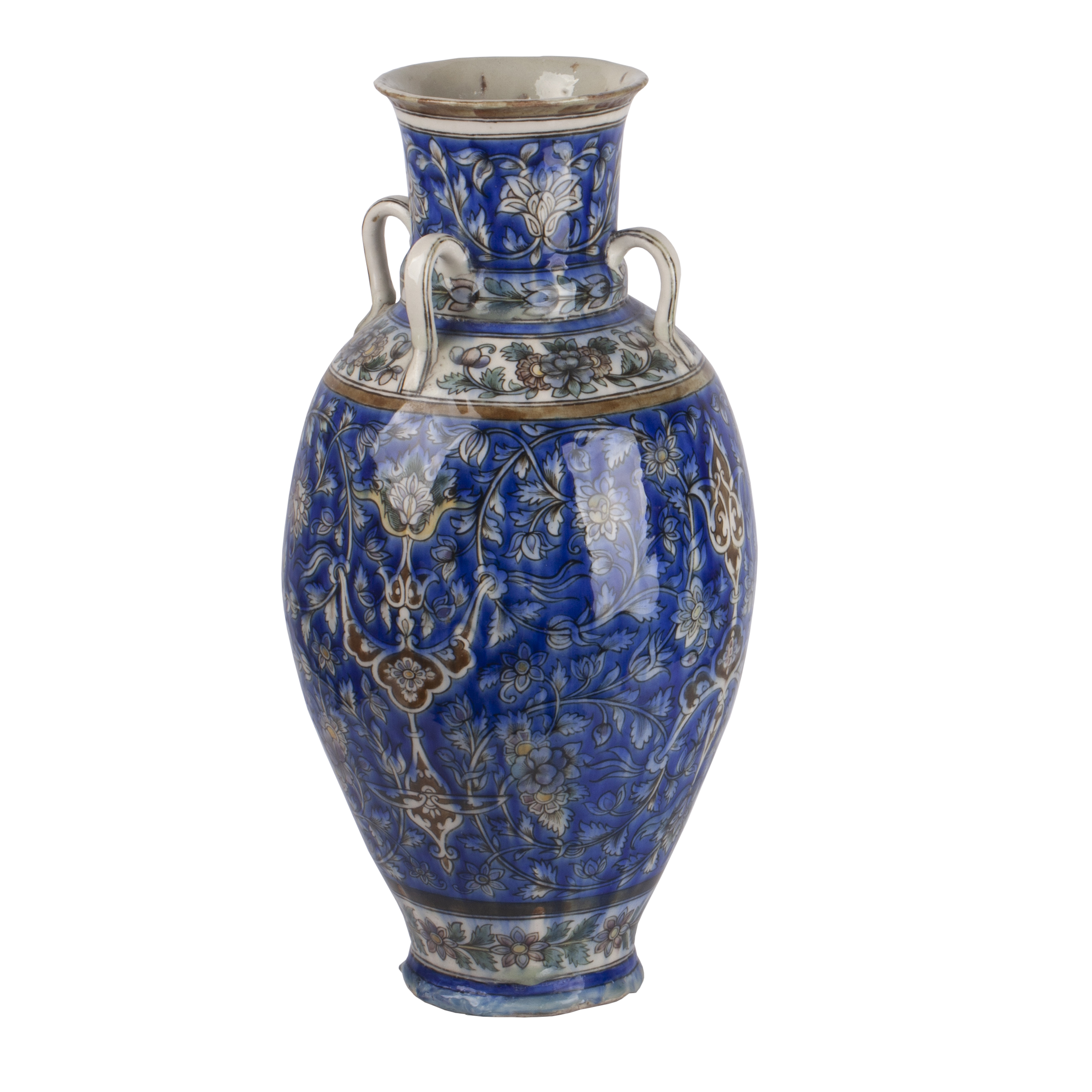
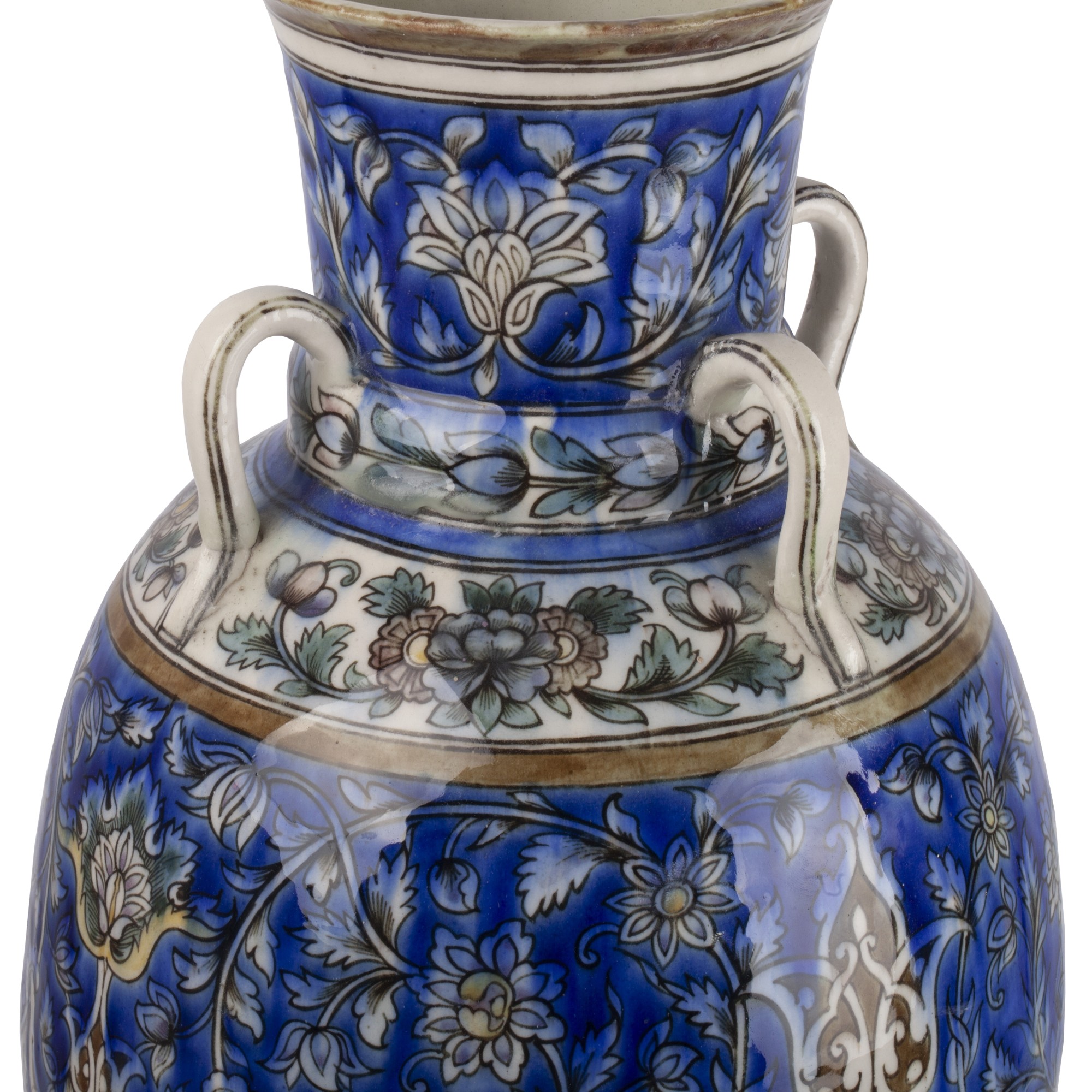
Lot 0146
Large Qajar Underglaze-Painted Pottery Vase, Persia
Estimate: 600-800€Large Qajar Underglaze-Painted Vase
Persia (Iran), Qajar dynasty, 19th century
Pottery (earthenware), polychrome underglaze painting with transparent glaze
Dimensions: height 50 cm
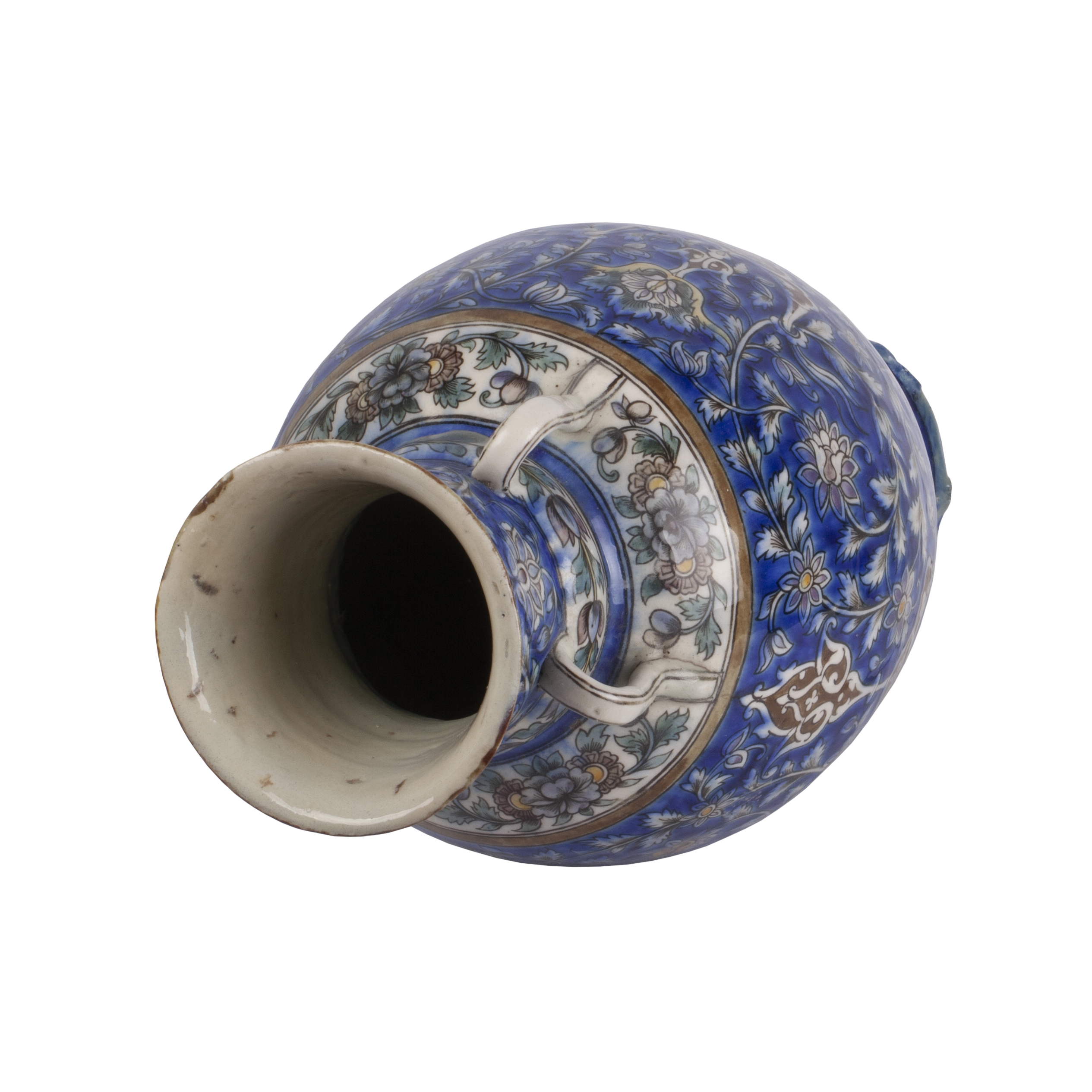
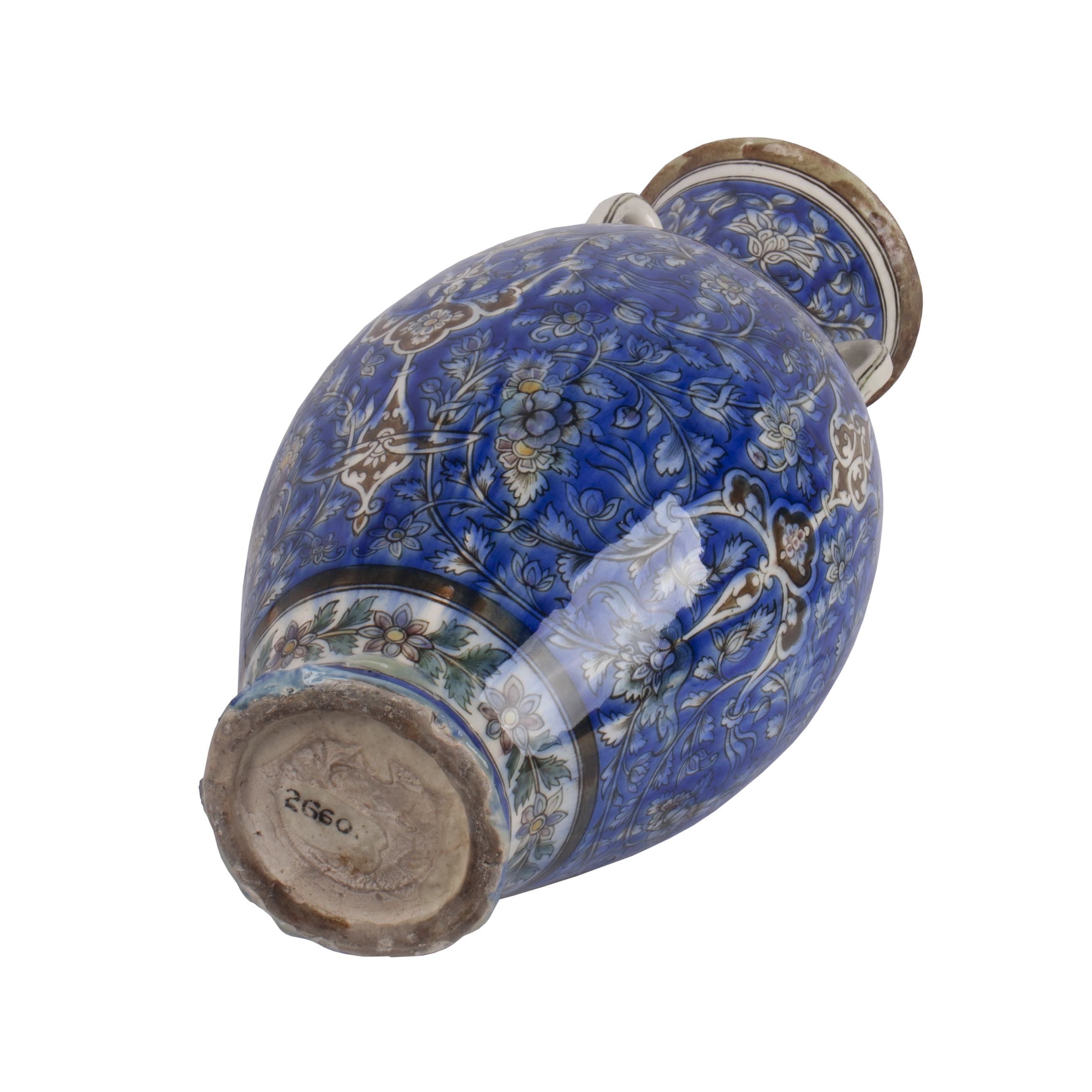
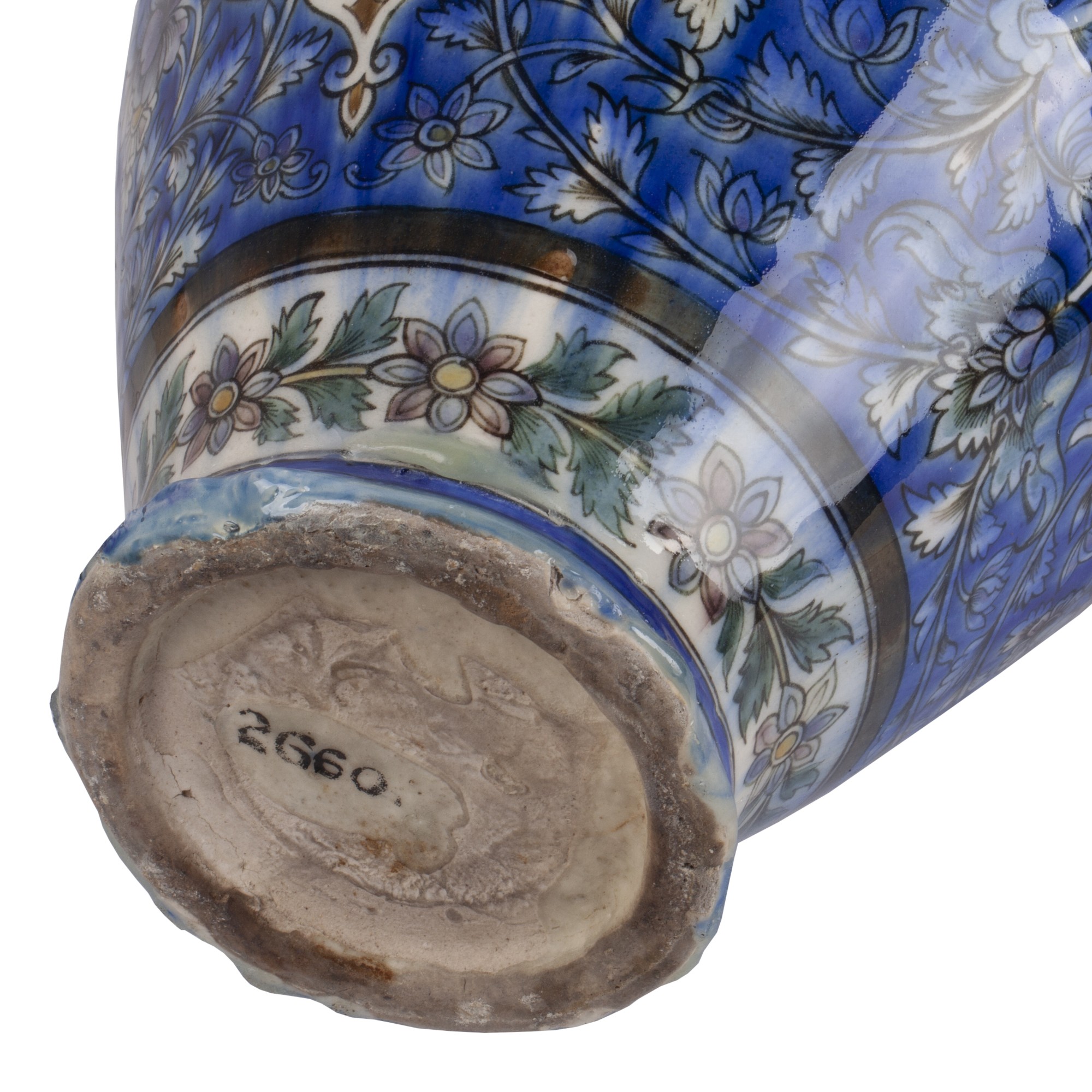
Marks: inventory number “2660” to baseTall piriform vase on a short foot, with a wide neck and everted rim; four strap handles join the shoulder to the neck. The body is richly painted under the glaze in cobalt blue, manganese, green and touches of yellow: scrolling foliate vines with rosettes and composite blossoms cover the main field, framed by floral bands at the shoulder and foot. Small cartouches punctuate the design, all outlined in dark slip to sharpen the detail.
The dense floral scrolls and deep cobalt ground are characteristic of Qajar ceramics, which revived earlier Safavid ornamental schemes while adopting a brighter, more graphic palette for large display pieces like this well-balanced example.Starting price: 400€
Estimate: 600-800€
Hammer Price: Not sold -
Lot 0147
Pair of Russian Porcelain Vases with a Floral Decoration by Gardner
Estimate: 1000-1200€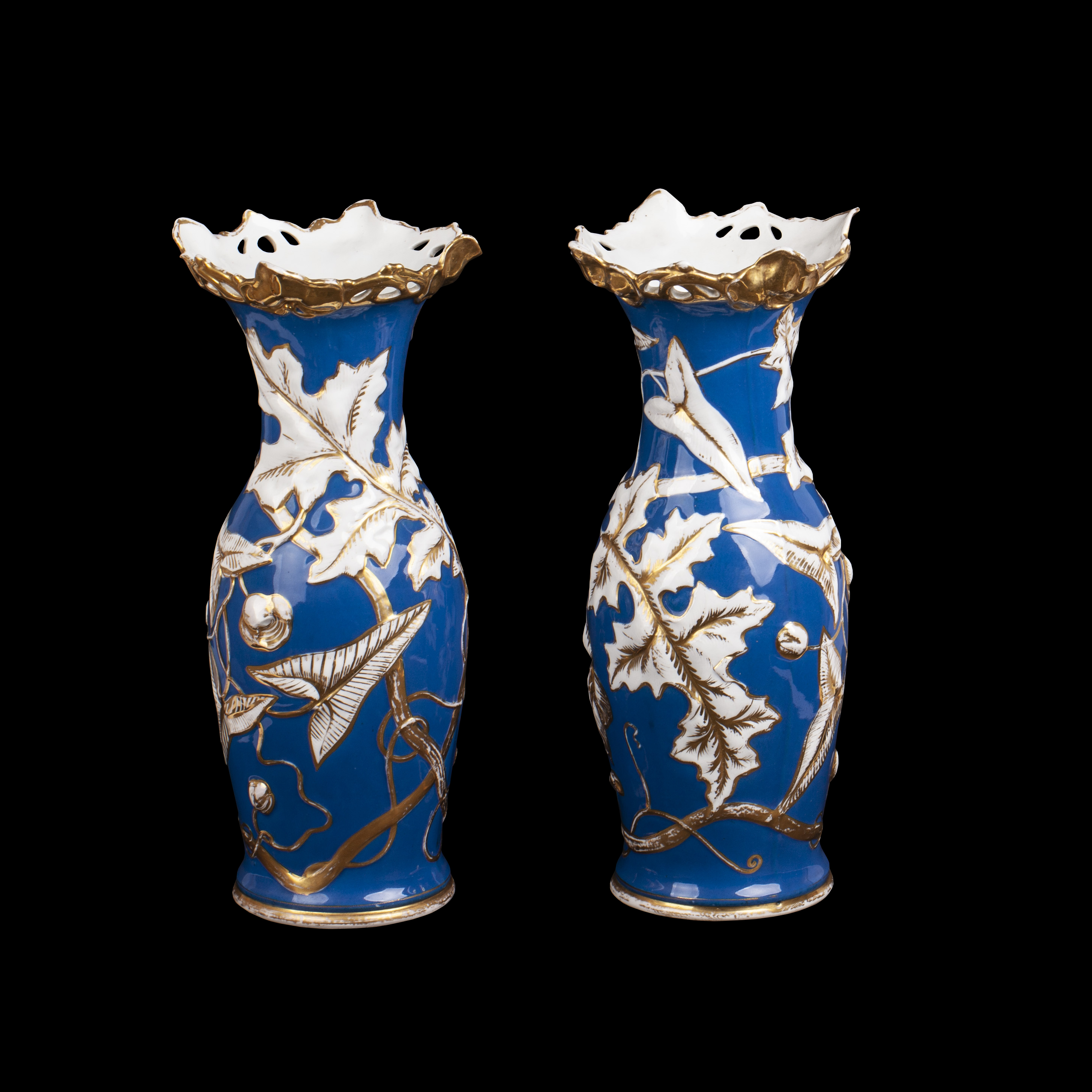
Lot 0147
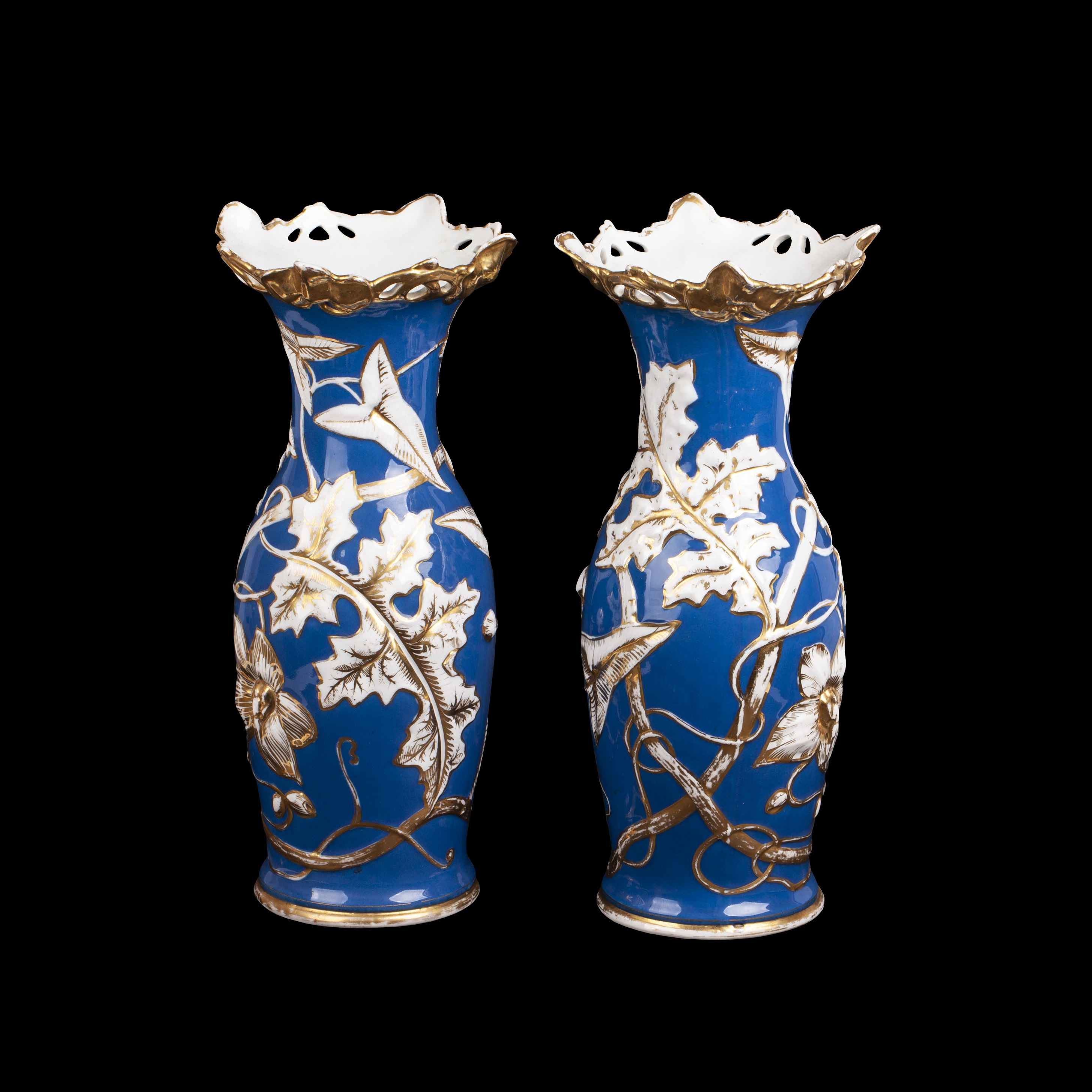
Pair of Russian Porcelain Vases with a Floral Decoration by Gardner
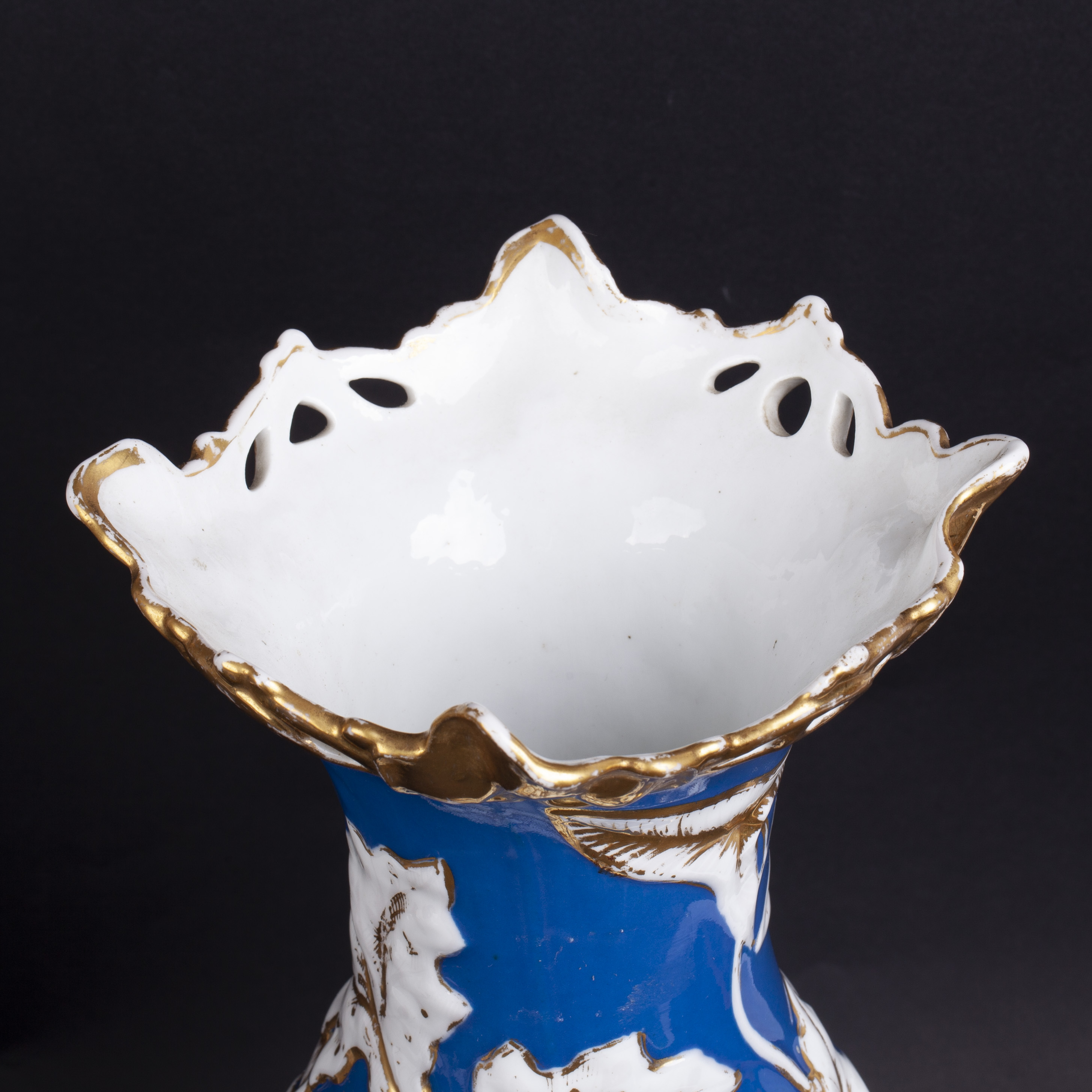
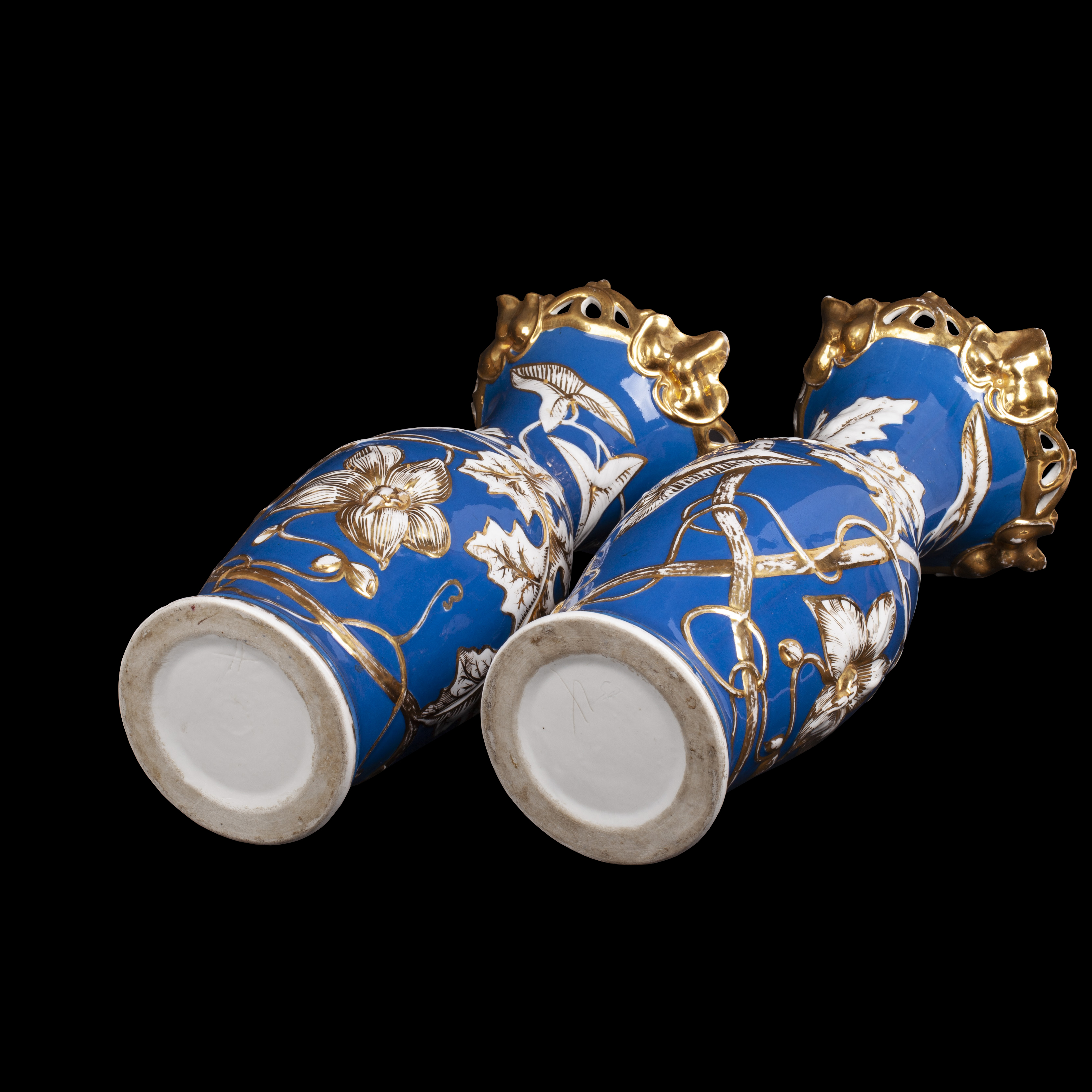
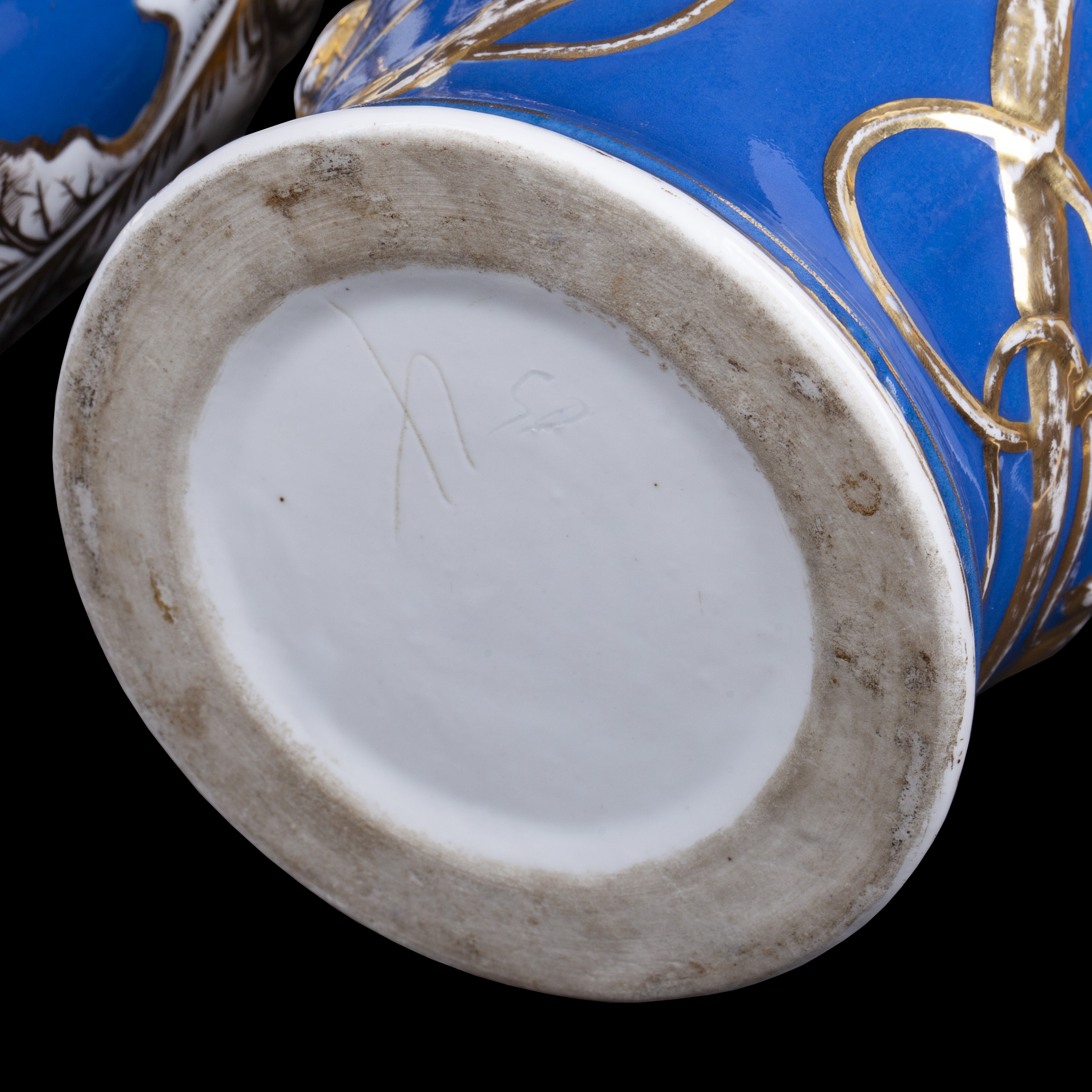
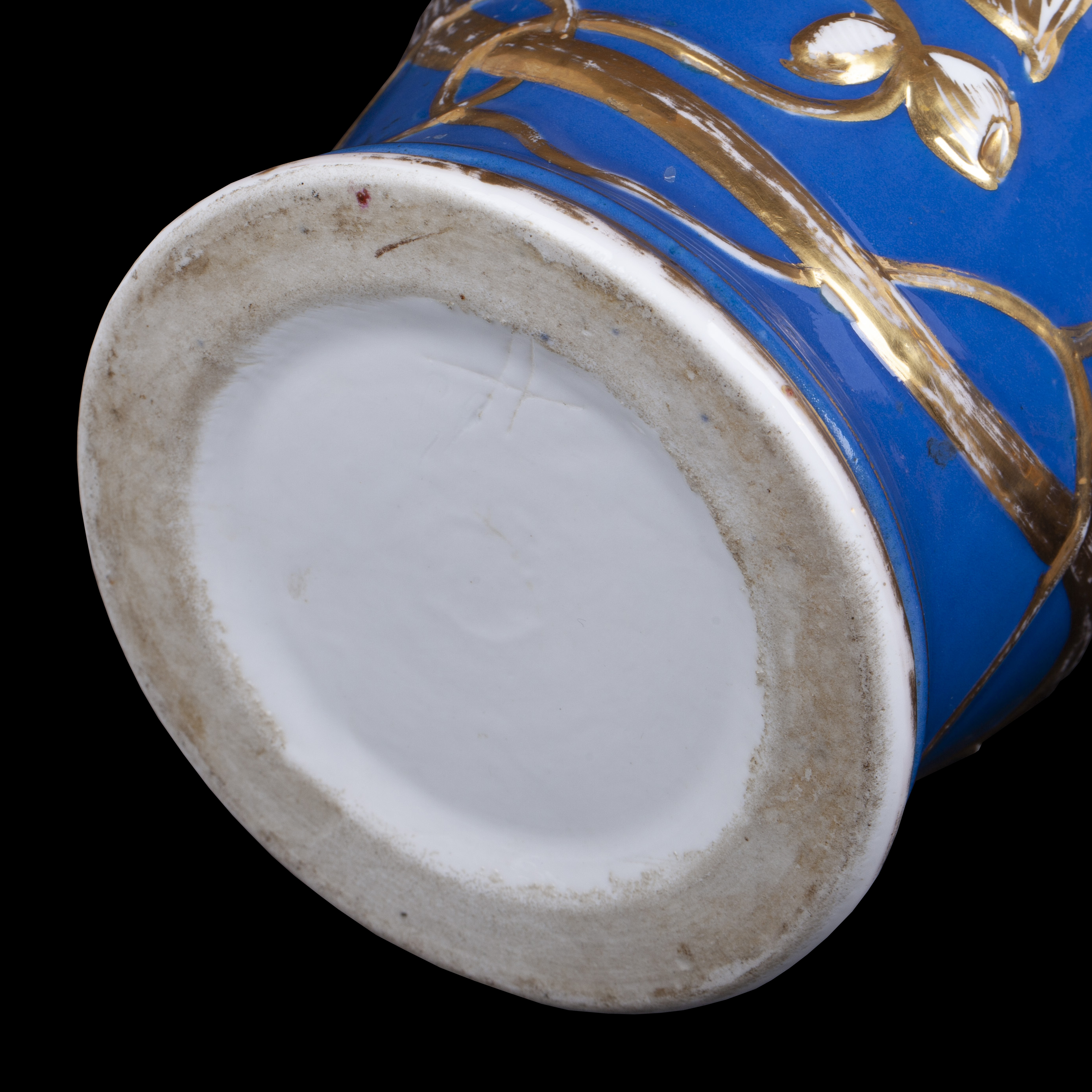
Estimate: 1000-1200€A pair of Russian porcelain vases with floral and botanical decoration, produced by the Gardner Manufactory, Verbilki, circa 1870.
Height: 37 cm.Each vase is crafted in elegant baluster form with a scalloped, openwork rim edged in gilding. The body is covered in a deep cobalt blue glaze, against which raised white and gold relief decorations of oak leaves, acorns, and intertwining branches stand out vividly.
The Gardner Porcelain Factory, founded in 1754 by Francis Gardner, an Englishman working in Russia, became one of the most renowned manufactories of the Empire. Over two centuries it produced masterpieces of porcelain art that graced imperial palaces and aristocratic collections across Europe.Famous for its custom-made services featuring family coats of arms, crowns, and monograms, the factory received special recognition from Empress Catherine II in 1785, who granted it the right to use the Moscow coat of arms on its mark. Later, in 1855, it earned the right to bear the Imperial State Emblem of Russia, a distinction given only to the finest manufactories of the period.
These vases exemplify the refinement, craftsmanship, and artistic sophistication of Gardner porcelain in the high historicist style popular during the reign of Alexander II.
Starting price: 800€
Estimate: 1000-1200€
Hammer Price: Not sold -
Lot 0148
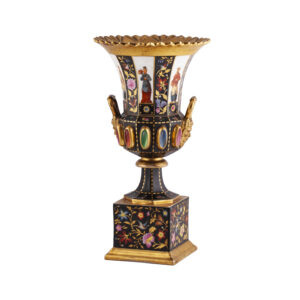
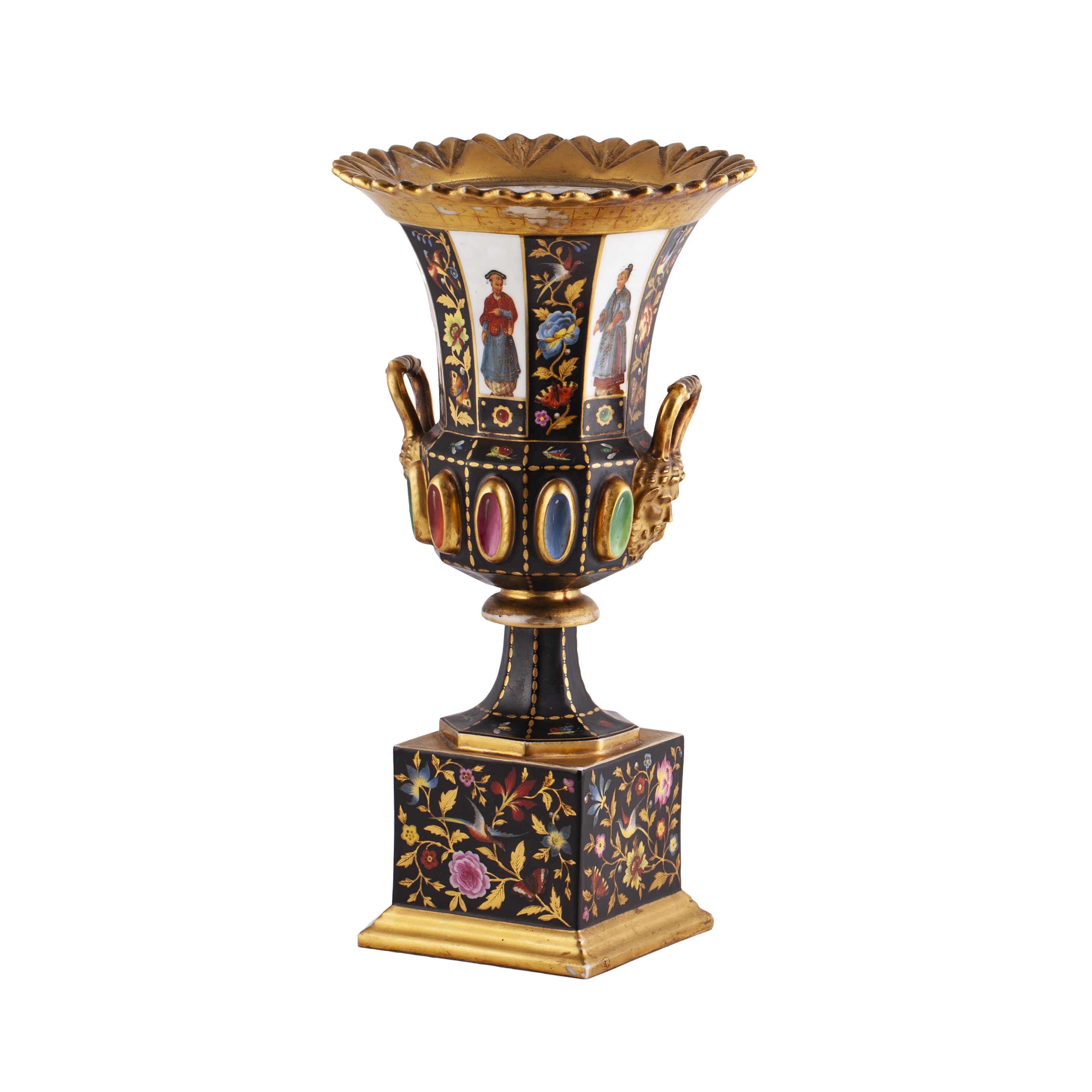
Rare Russian Porcelain, Gilded and Painting Vase in Chinoiserie Style. Period of Emperor Nikolay I
Estimate: 3000-3500€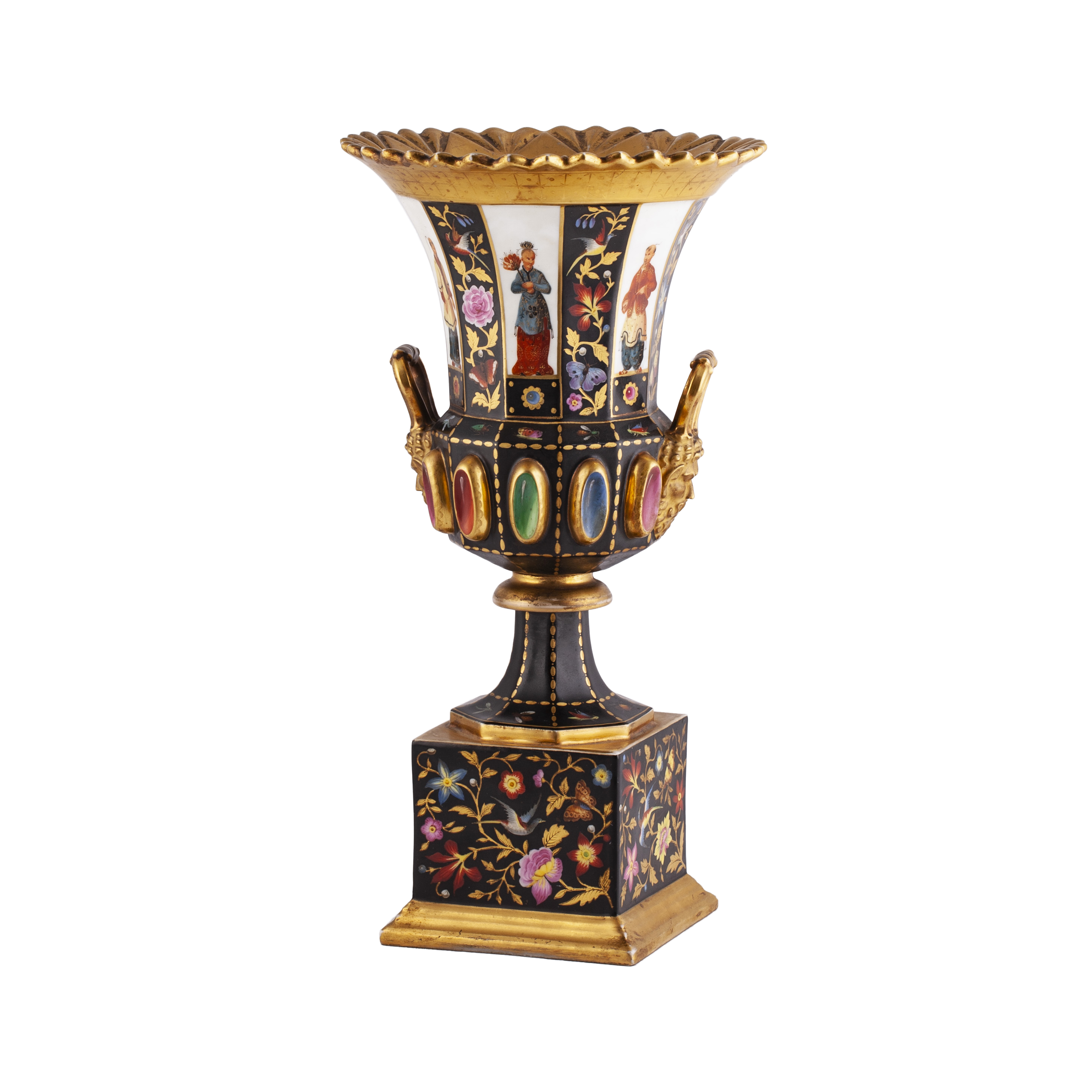
Lot 0148
Rare Russian Porcelain, Gilded and Painting Vase in Chinoiserie Style. Period of Emperor Nikolay I
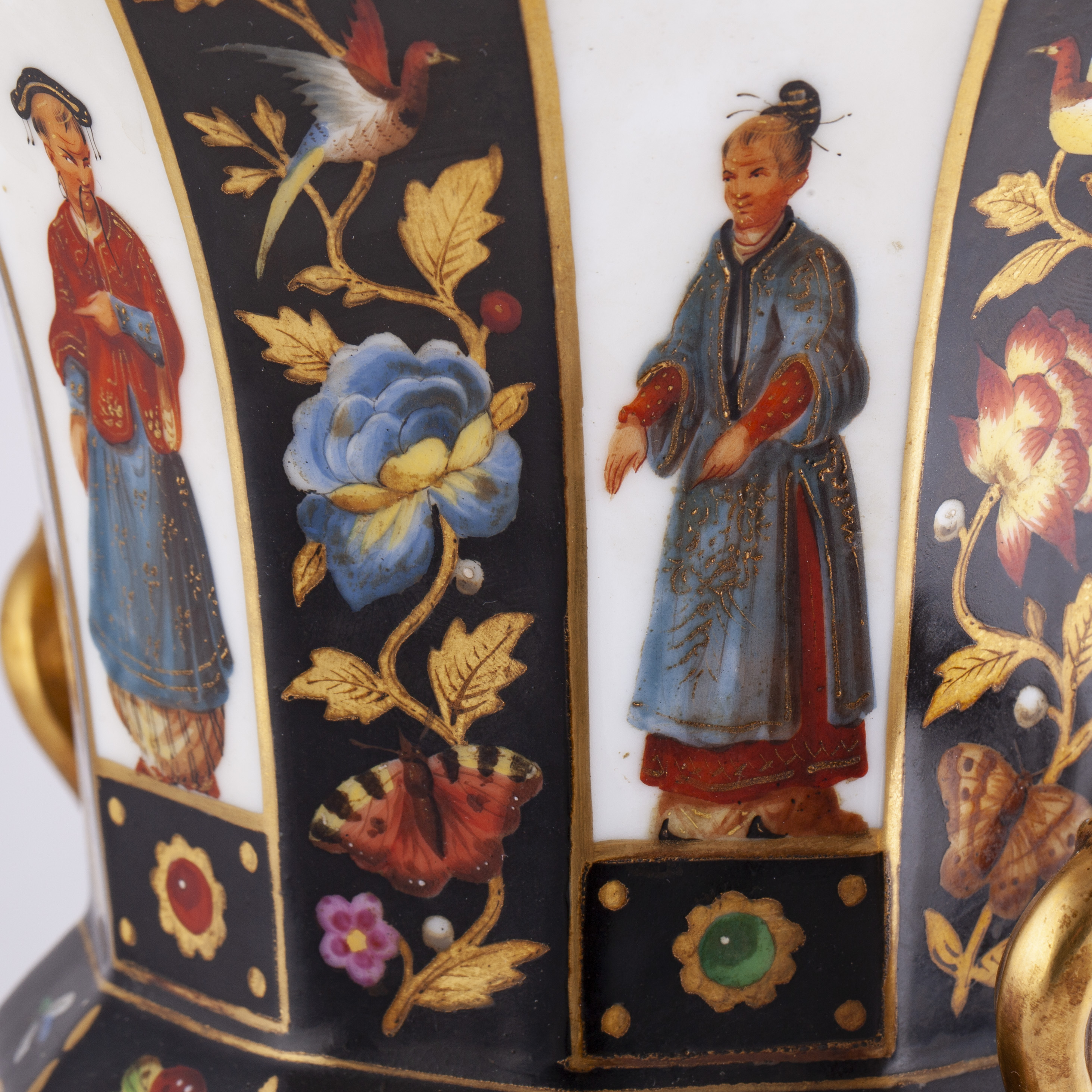
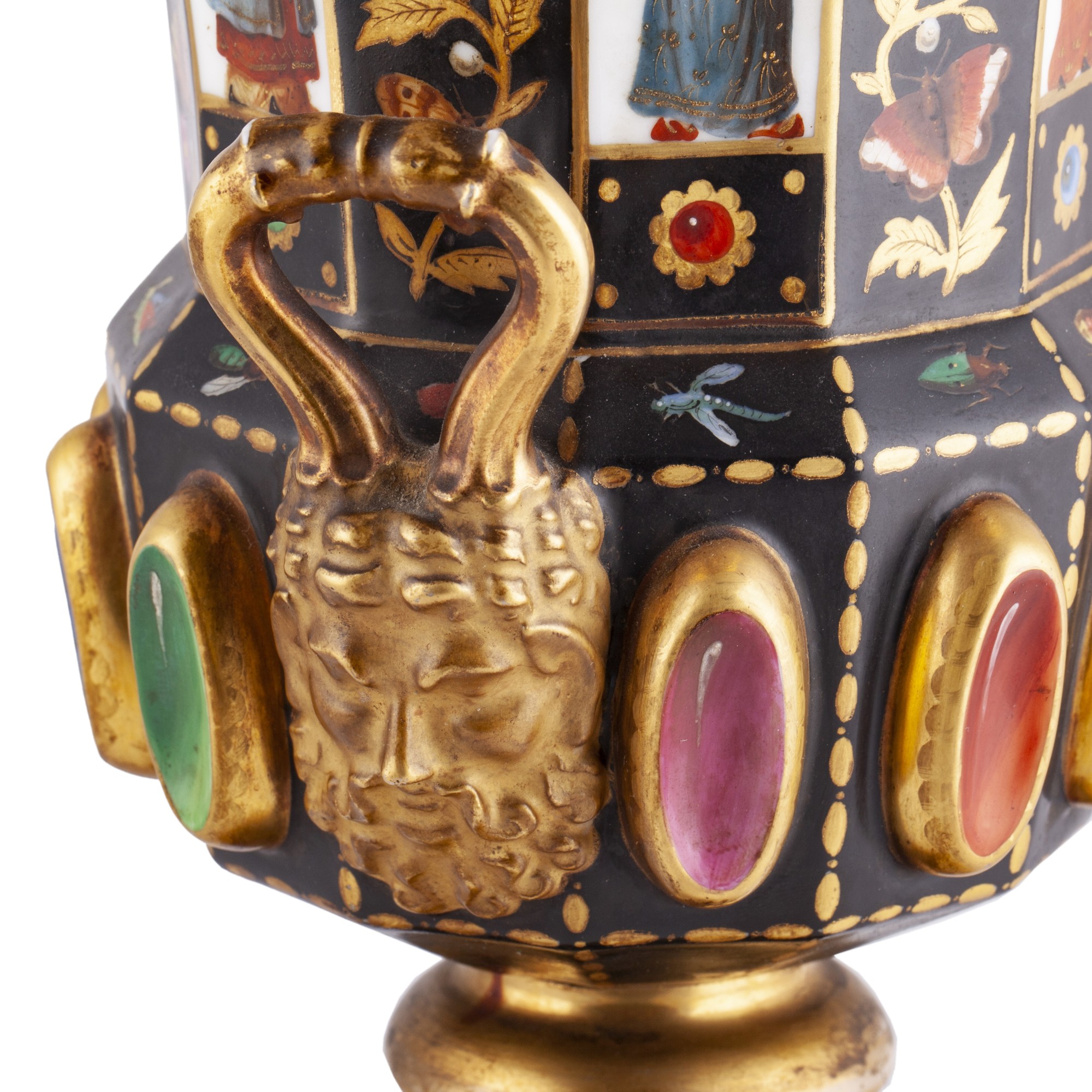
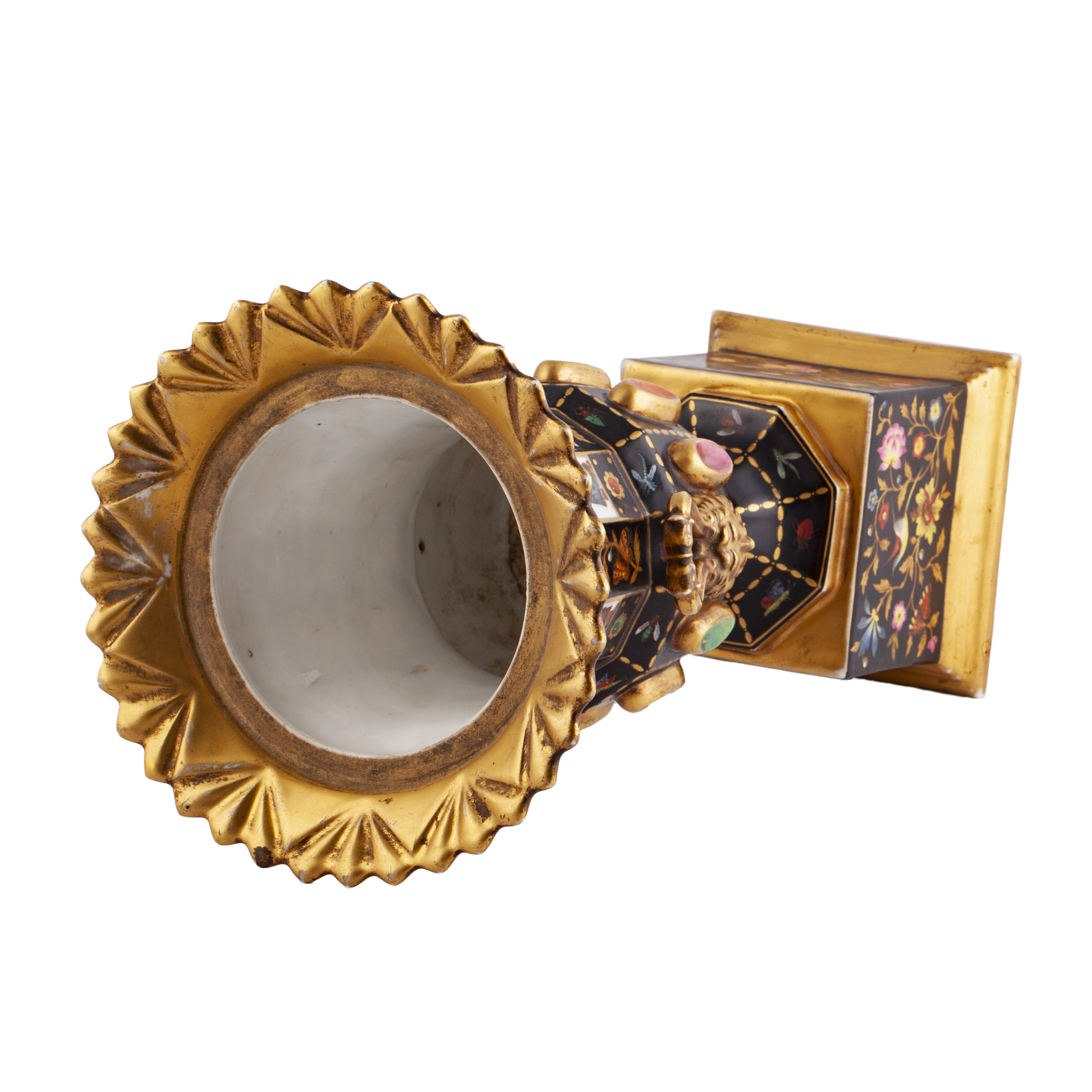
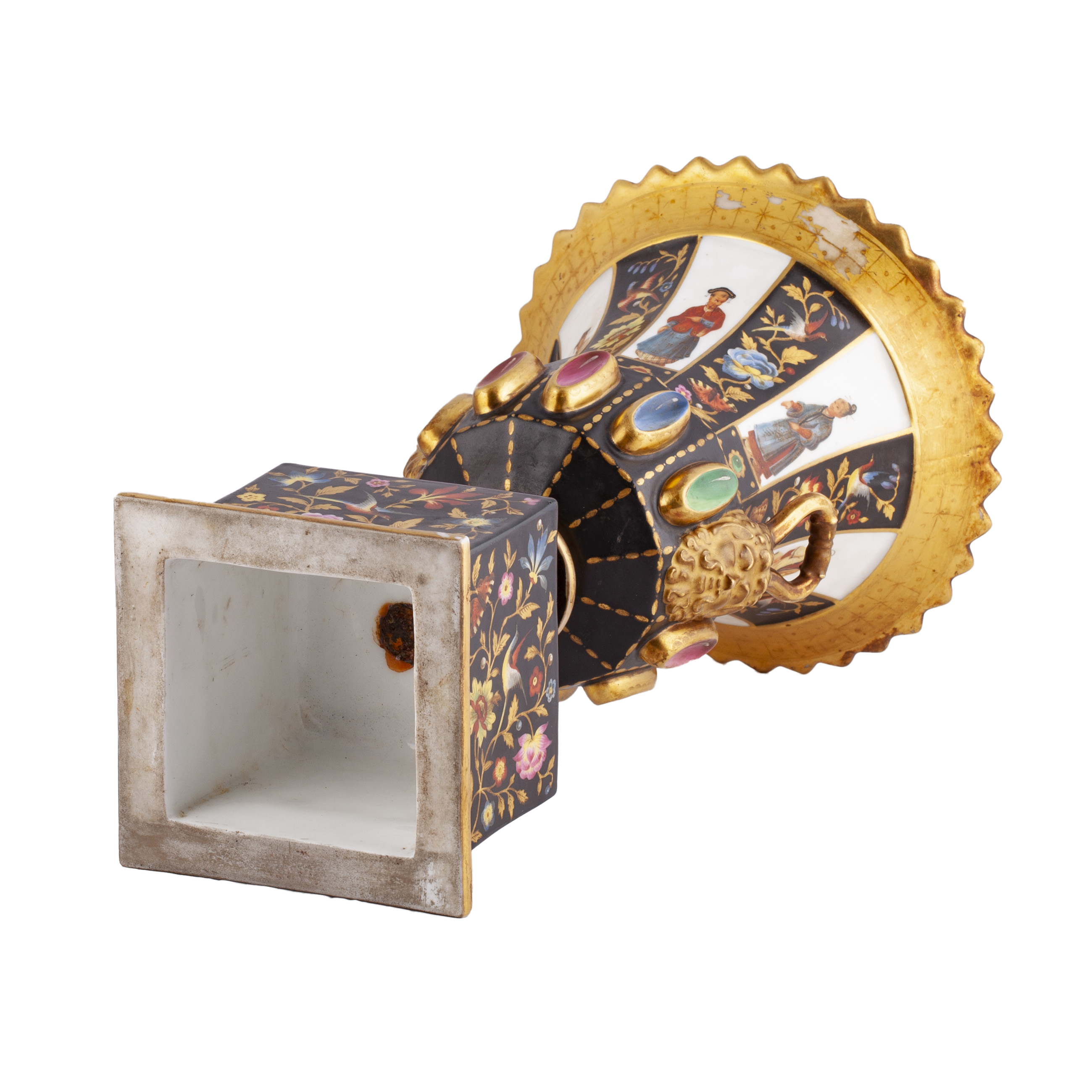
Estimate: 3000-3500€A rare Russian porcelain vase richly gilded and hand-painted in the chinoiserie style.
Attributed to the Imperial Porcelain Manufactory, St. Petersburg, period of Emperor Nicholas I (1825–1855).
Height: 37 cm.This elaborately decorated vase exemplifies the luxurious taste of the Nicholas I era, when the Imperial Porcelain Manufactory produced highly ornamental pieces influenced by both European neoclassicism and oriental decorative traditions.
The body is designed in a classical krater shape, with a flaring scalloped rim and twin handles modeled as mythological masks. The surface is divided into vertical panels featuring figures in oriental costumes, alternating with floral and bird motifs painted in vivid enamels over a black ground. The lower section is adorned with raised oval medallions in imitation of gemstones, surrounded by delicate gilded beading. The square base continues the floral theme with richly detailed bouquets and gold foliage.
Such works were often produced in small numbers for imperial residences or court presentation gifts. The combination of black background, multicolored enamels, and lavish gilding reflects the fascination with East Asian art that spread across Europe in the early 19th century.
A closely related example is known from Litfund Auction No. 175 (August 29, 2019, Lot 5), confirming this vase’s association with the St. Petersburg Imperial Porcelain Manufactory and its refined artistry of the Nicholas I period.
Starting price: 2500€
Estimate: 3000-3500€
Hammer Price: Not sold -
Lot 0149
Pair of Italian Maiolica Bottles, dated 1787, possibly Torre dei Passeri, Italy, 18th Century
Estimate: 3000-3500€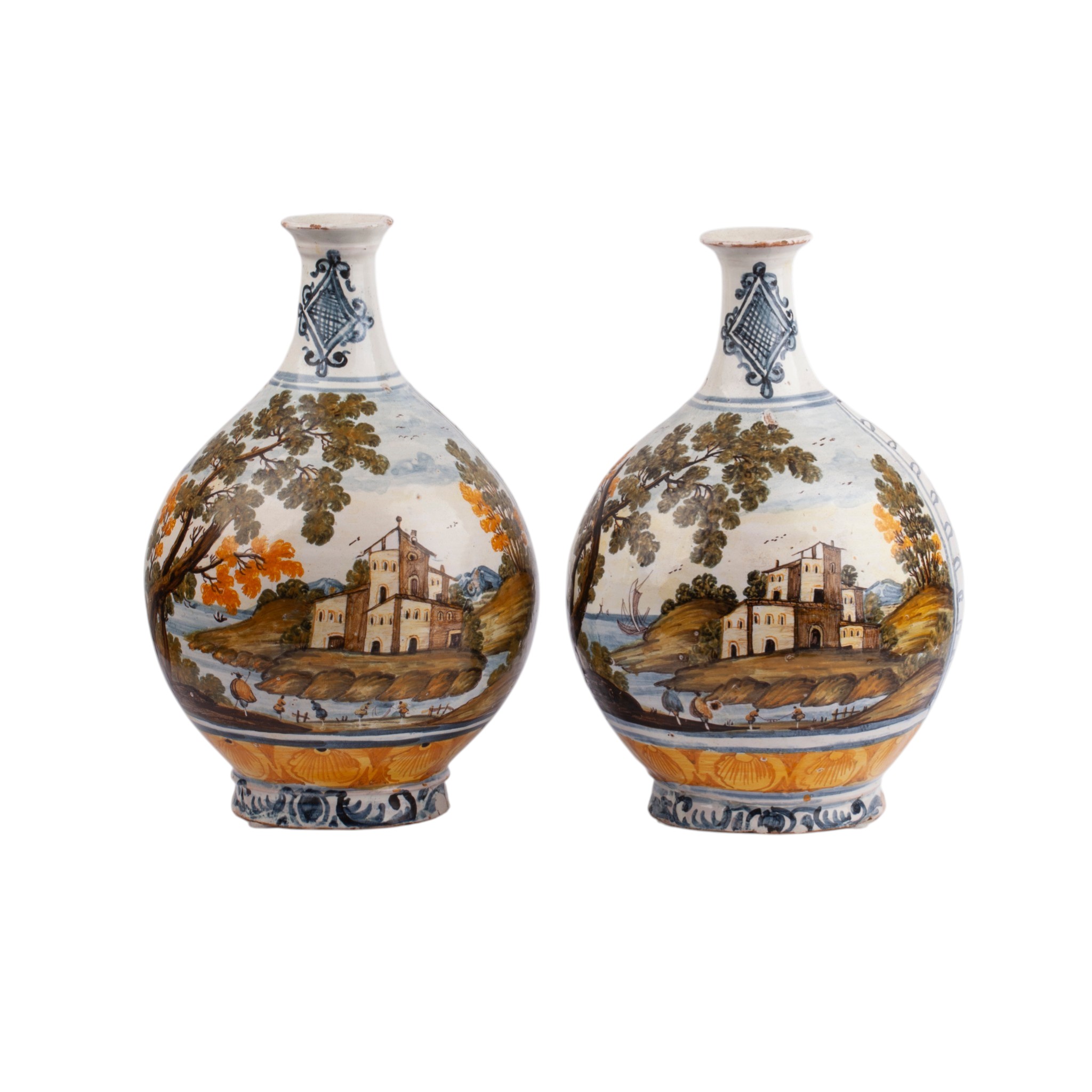
Lot 0149
Pair of Italian Maiolica Bottles, dated 1787, possibly Torre dei Passeri, Italy, 18th Century
Estimate: 3000-3500€Pair of Italian Maiolica Bottles, Each Dated 1787, Possibly Torre dei Passeri
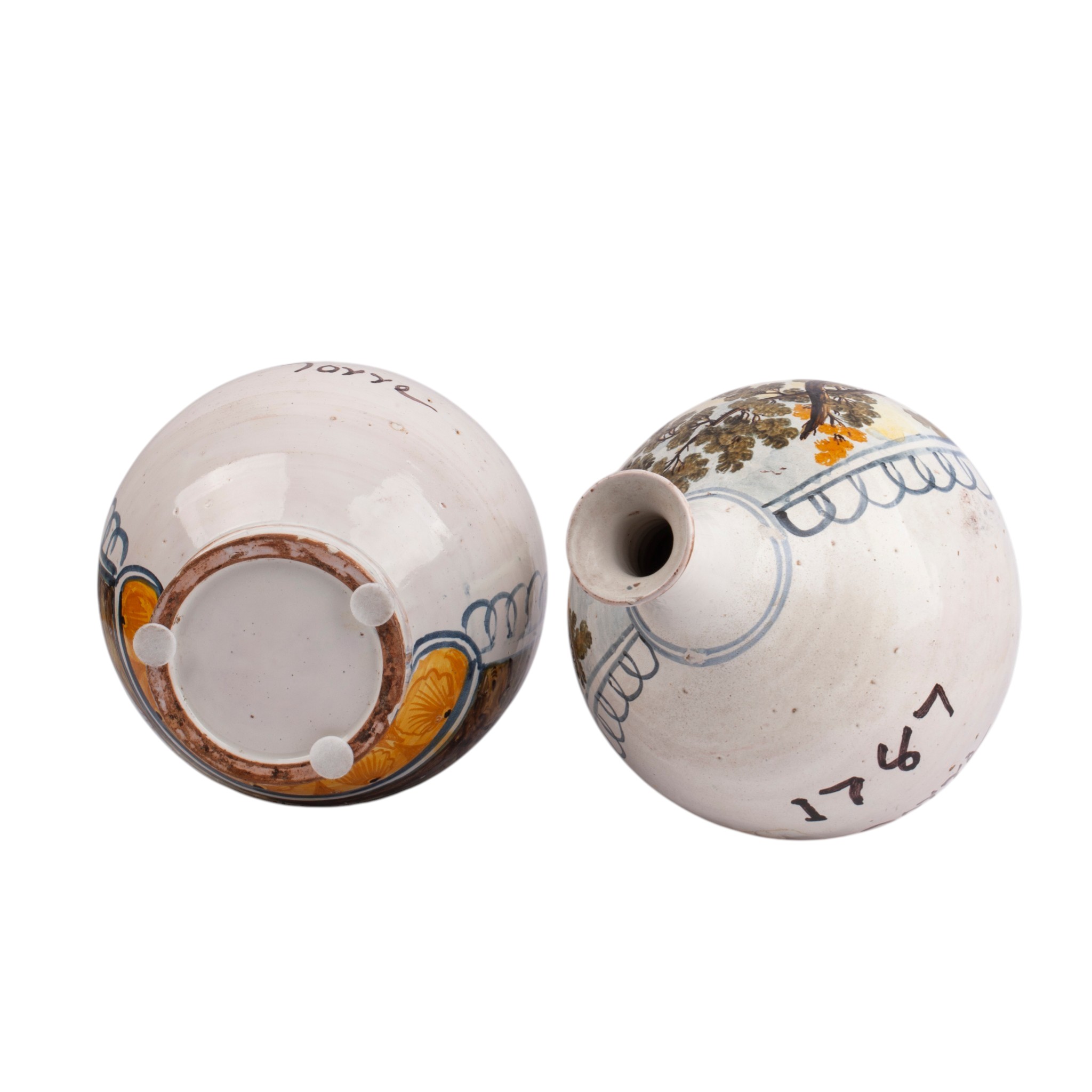
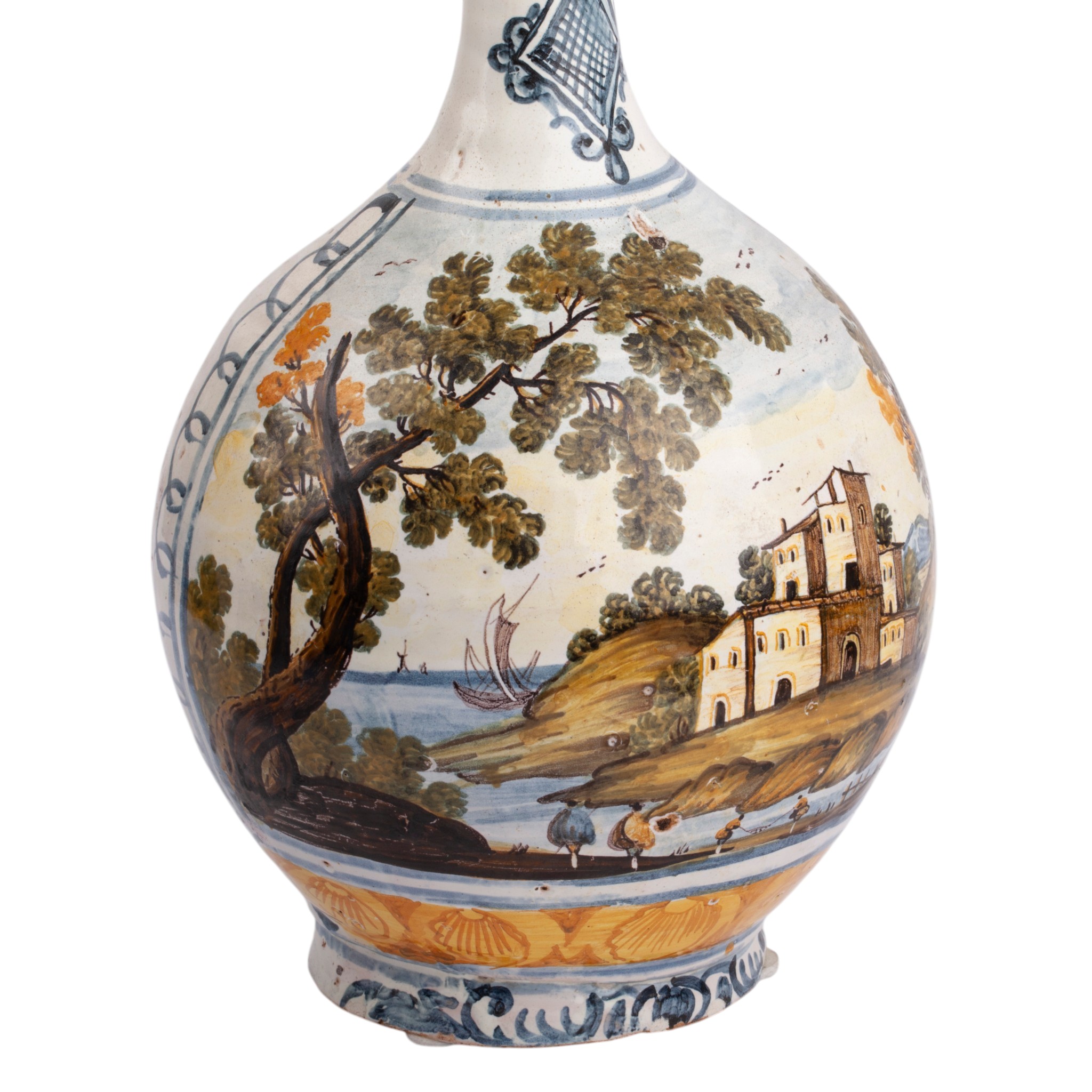
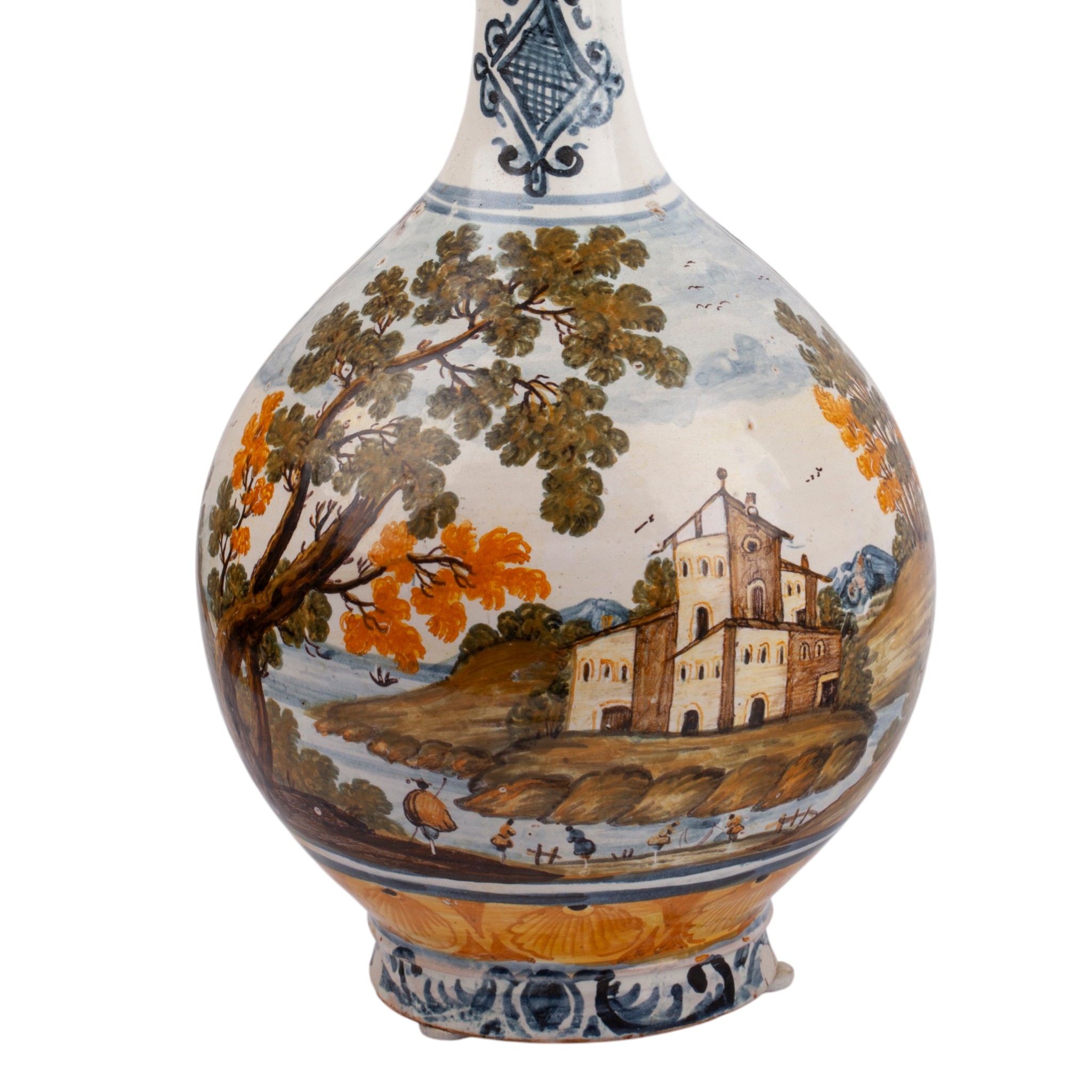
A decorative near pair of Italian maiolica bottles of pear-shaped form with slender necks, painted in polychrome with picturesque coastal landscapes featuring villas, trees, birds, and sailing vessels. The scenes are framed by blue and ochre ornamental borders, while the necks are enriched with blue lattice cartouches.
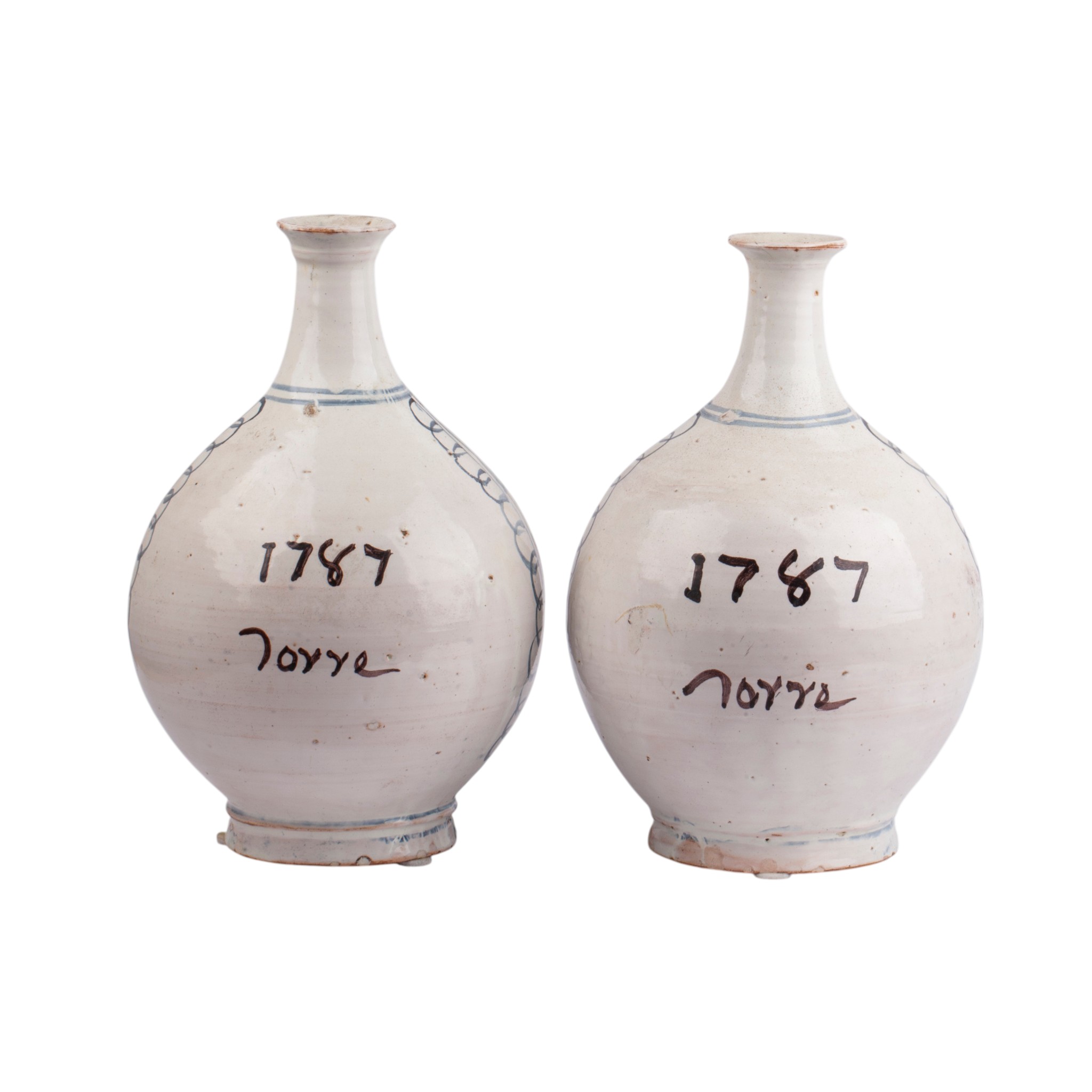
Each bottle is inscribed 1787 to the reverse, with a further painted word below that appears to read “Torre”, although this cannot be confirmed with certainty from the present photographs. On stylistic grounds, and in view of published comparisons with late 18th-century maiolica from Torre dei Passeri, the present pair may be connected with that tradition; however, the exact place of manufacture remains unconfirmed.
Comparable late 18th-century Italian maiolica forms and dimensions are known on the auction market, supporting the present attribution in broad terms, though not proving it conclusively.
Material: maiolica / tin-glazed earthenware
Height: 28 cm and 29 cmStarting price: 2500€
Estimate: 3000-3500€
Hammer Price: Not sold -
Lot 0150
Sèvres Porcelain Scent Bottles in Ormolu-Mounted Casket, France, dated 1765
Estimate: 2500-3000€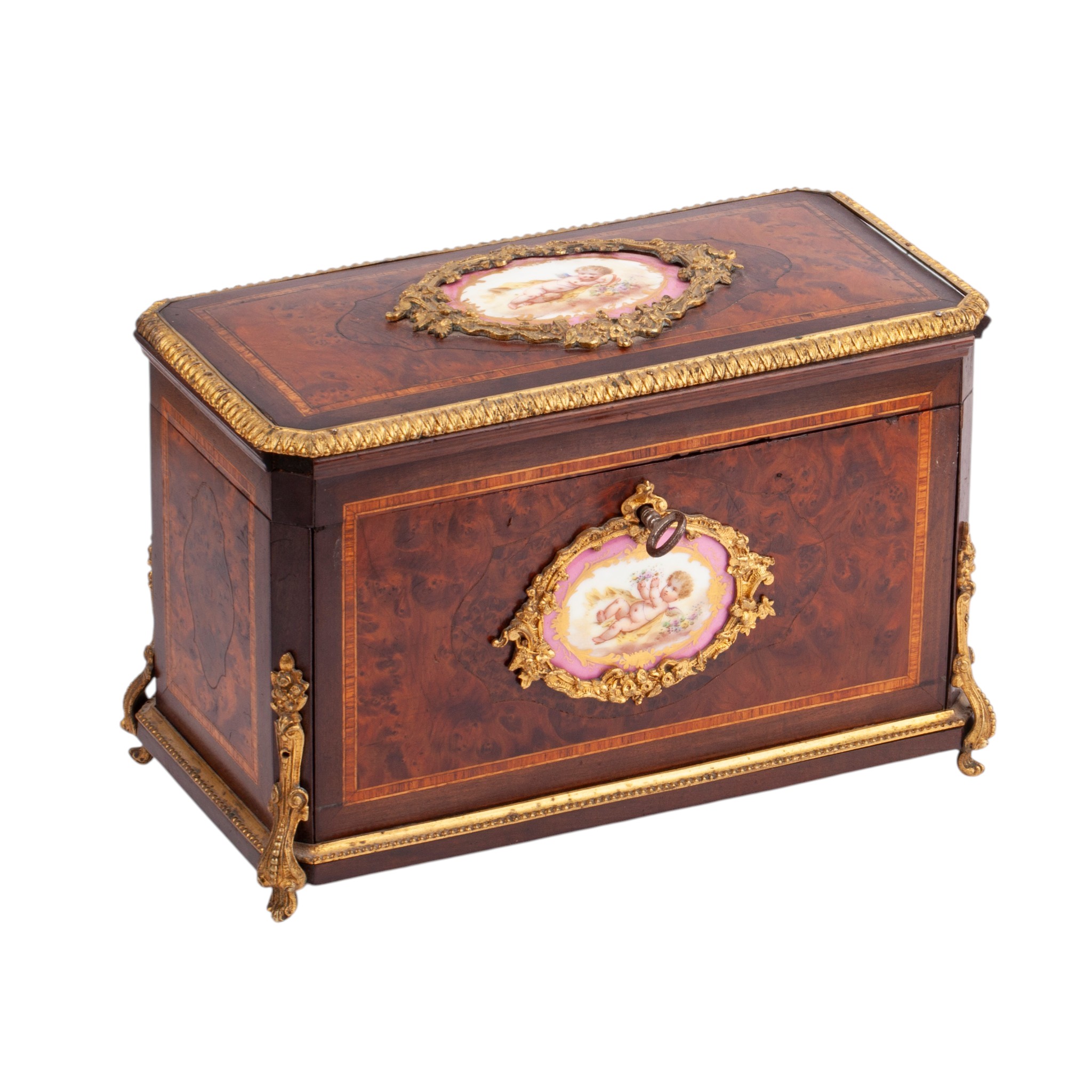
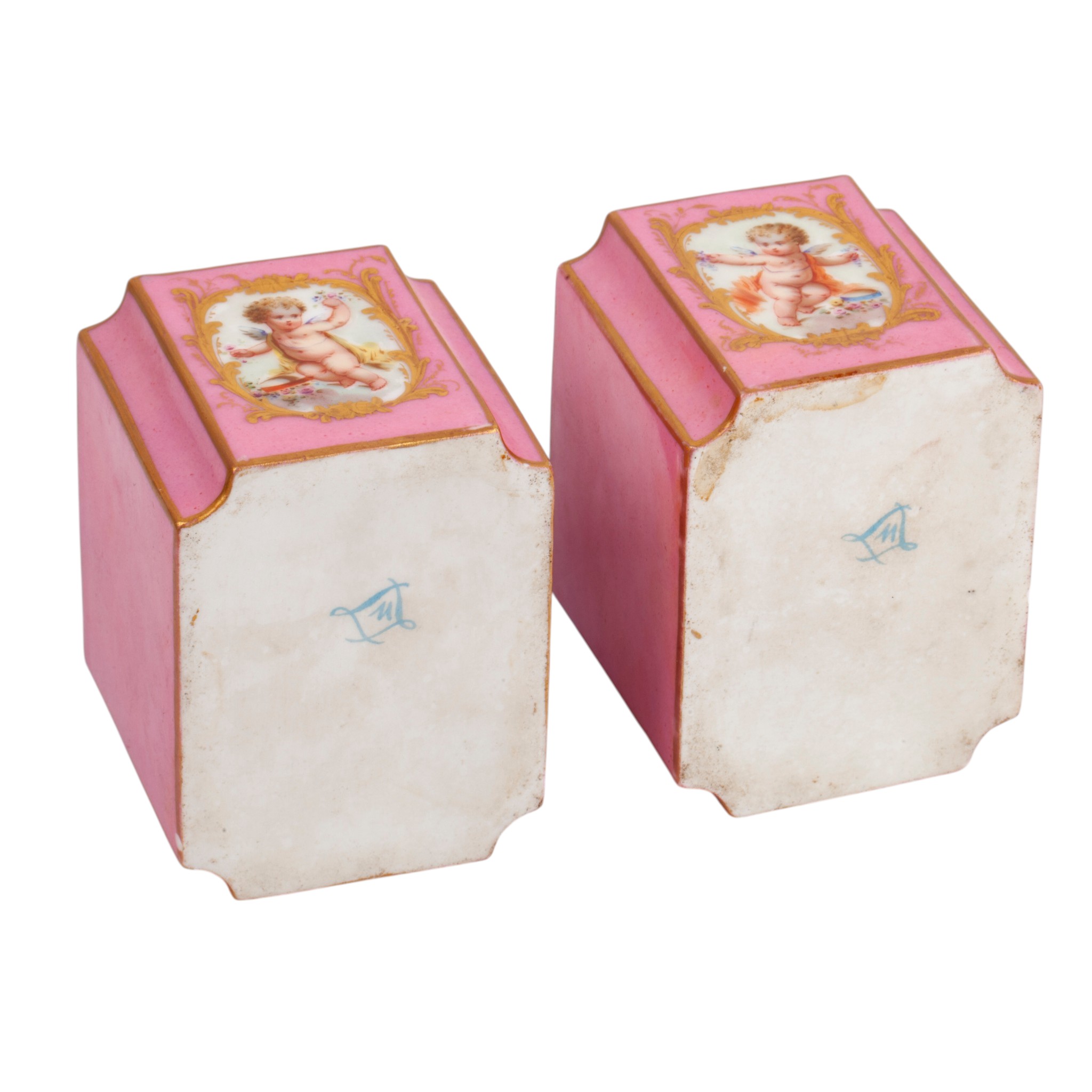
Lot 0150
Sèvres Porcelain Scent Bottles in Ormolu-Mounted Casket, France, dated 1765
Estimate: 2500-3000€Sèvres Porcelain Scent Bottles in Original Ormolu-Mounted Casket, dated 1765
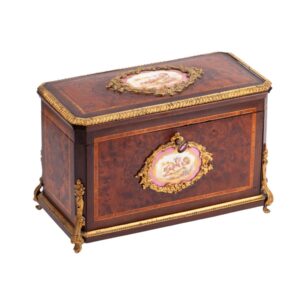
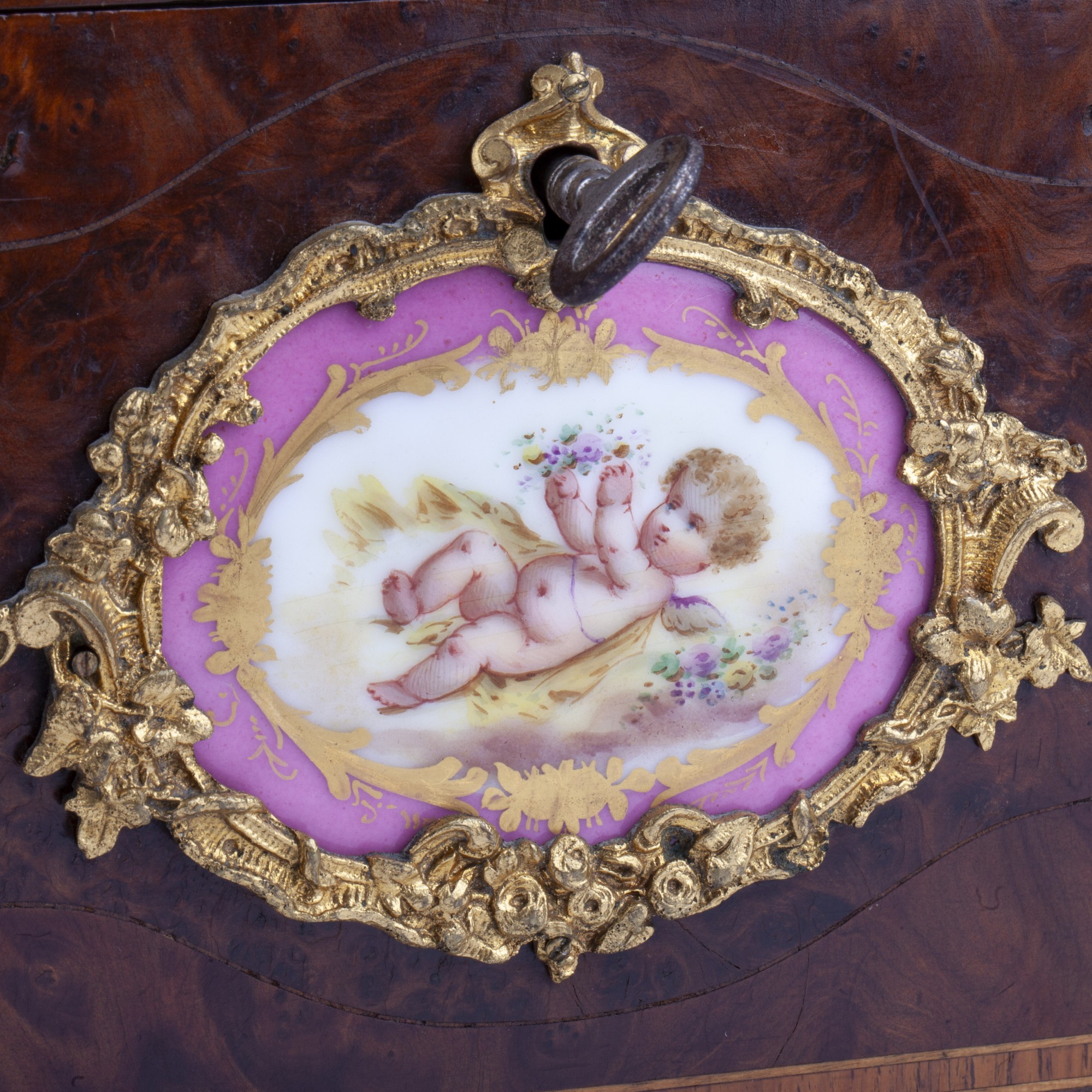
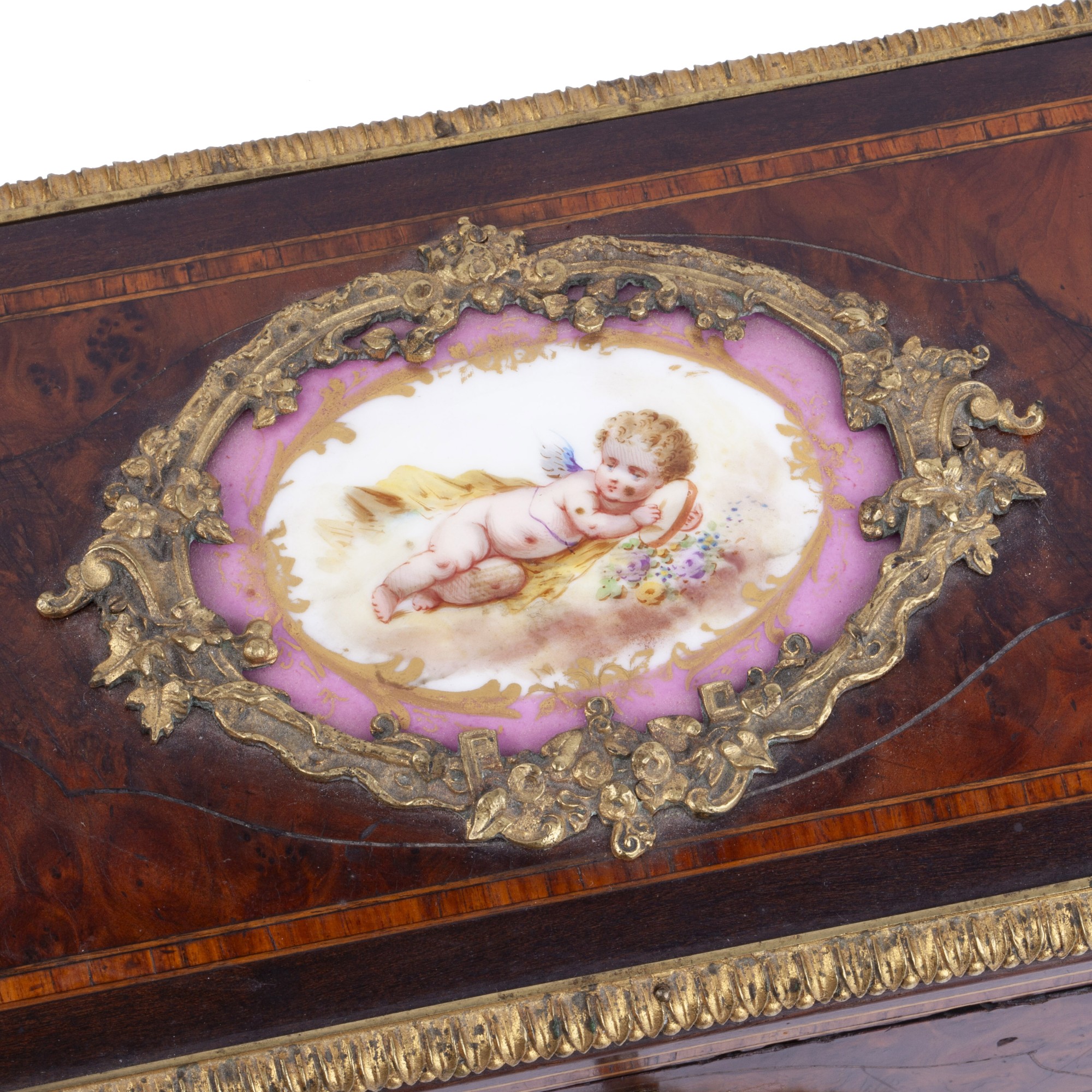
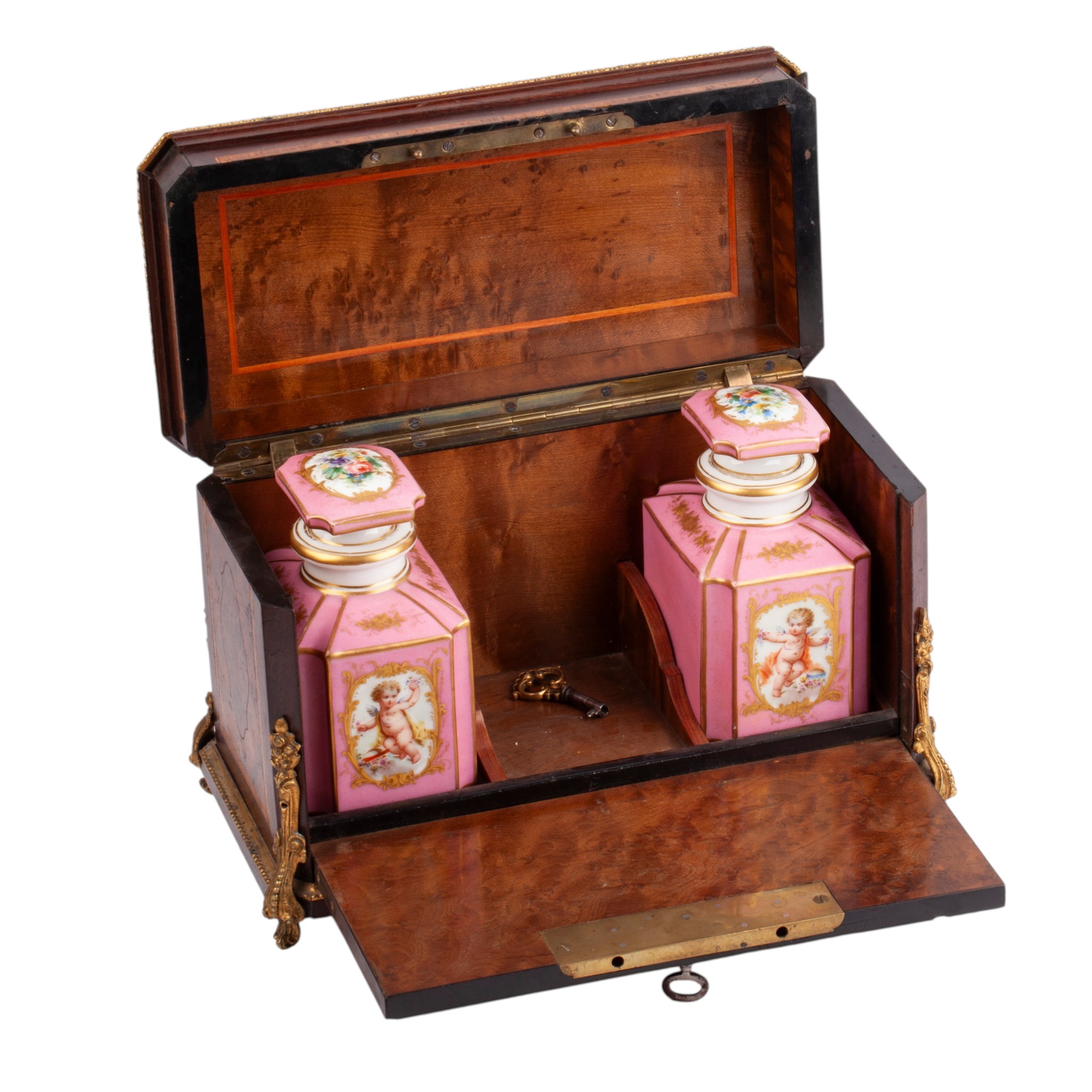
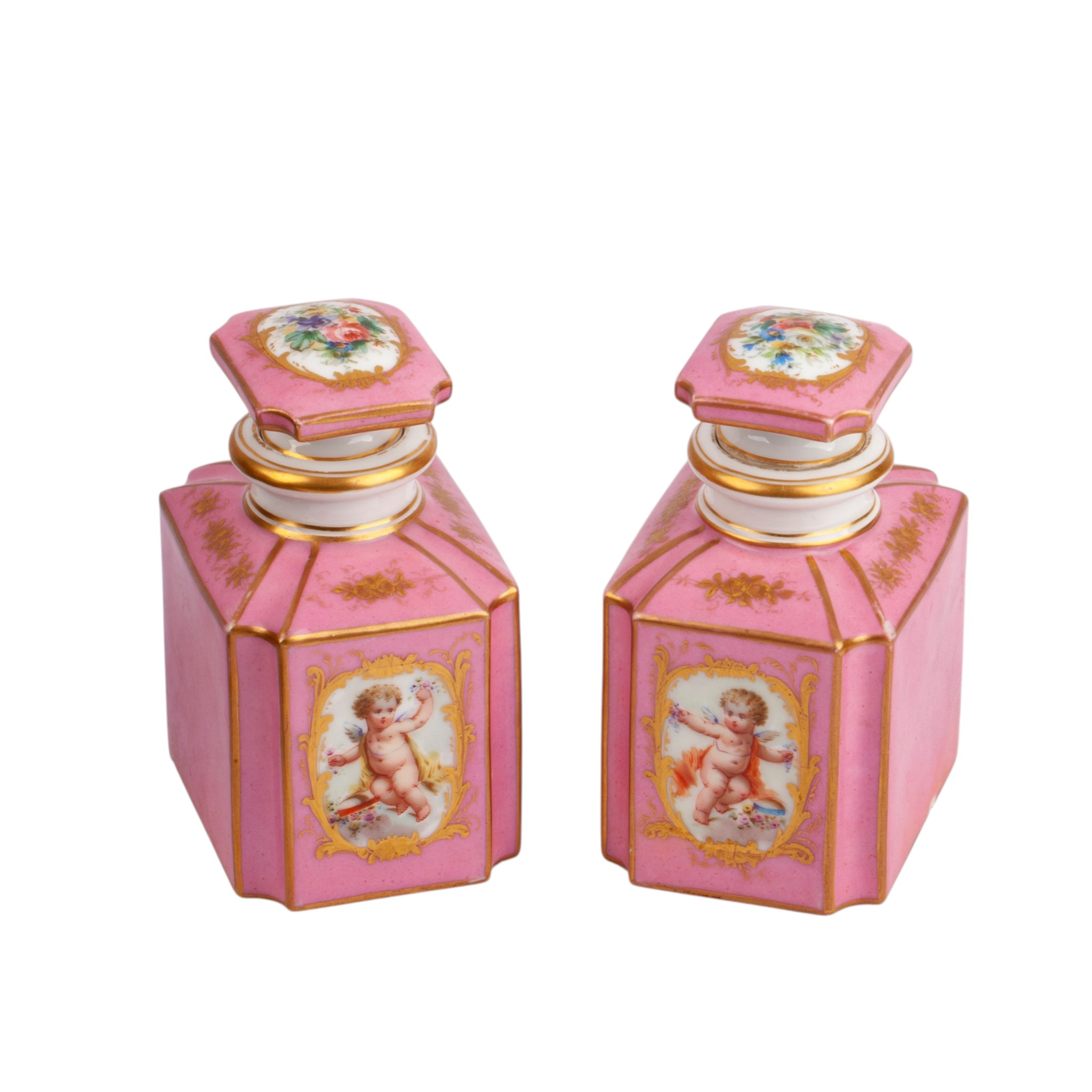
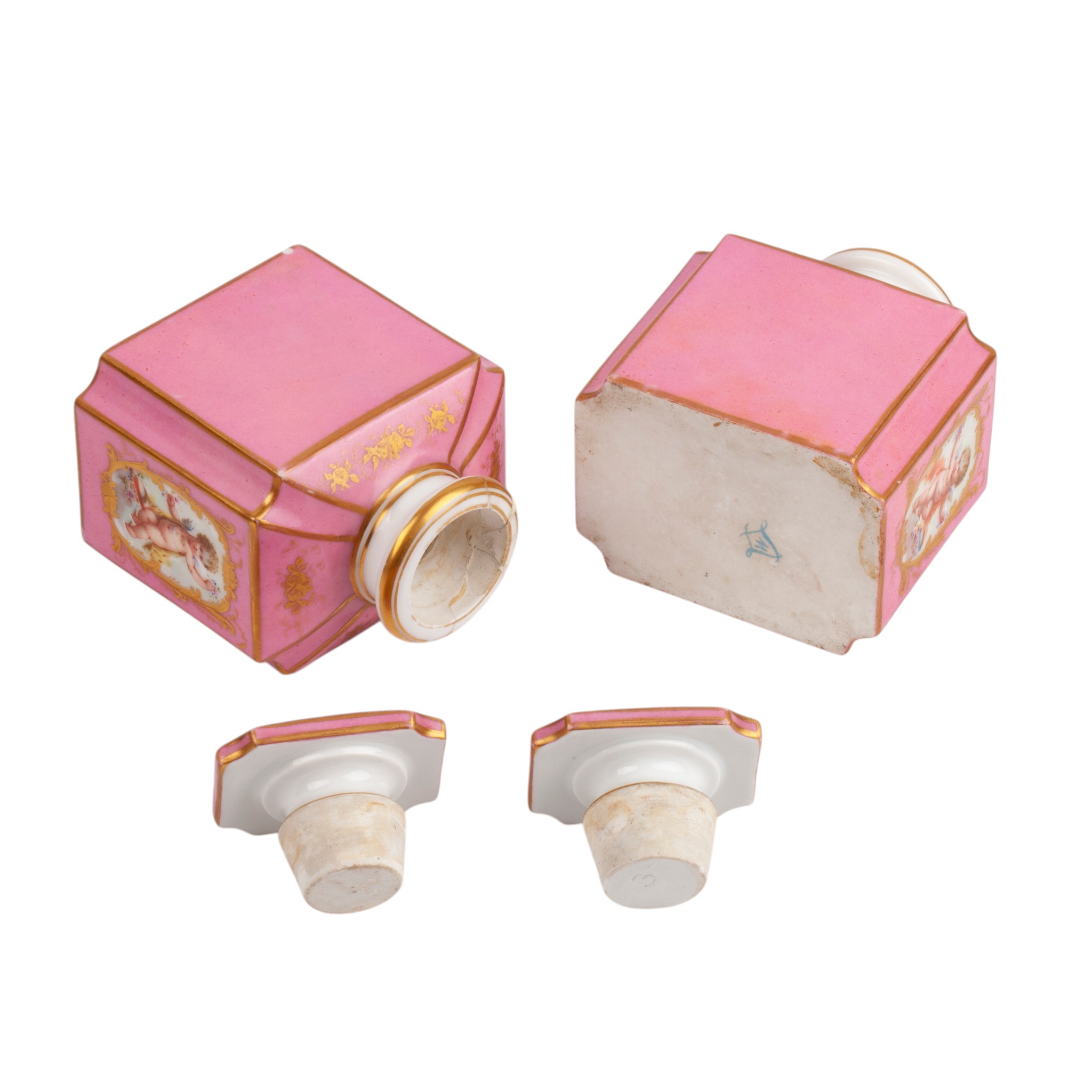
Fine Louis XV period perfume or toilet casket in veneered wood with gilt-bronze mounts, fitted with two pink-ground Sèvres porcelain scent bottles painted with cherubs and floral reserves, the lid and front inset with matching porcelain plaques in rocaille mounts. The underside marks and style are consistent with Sèvres porcelain of 1765: Sèvres used the interlaced L factory mark with a date letter, and the date letter M corresponds to 1765; 18th-century Sèvres marks of this type were typically painted in blue and date letters were in obligatory use from 1753 onward.
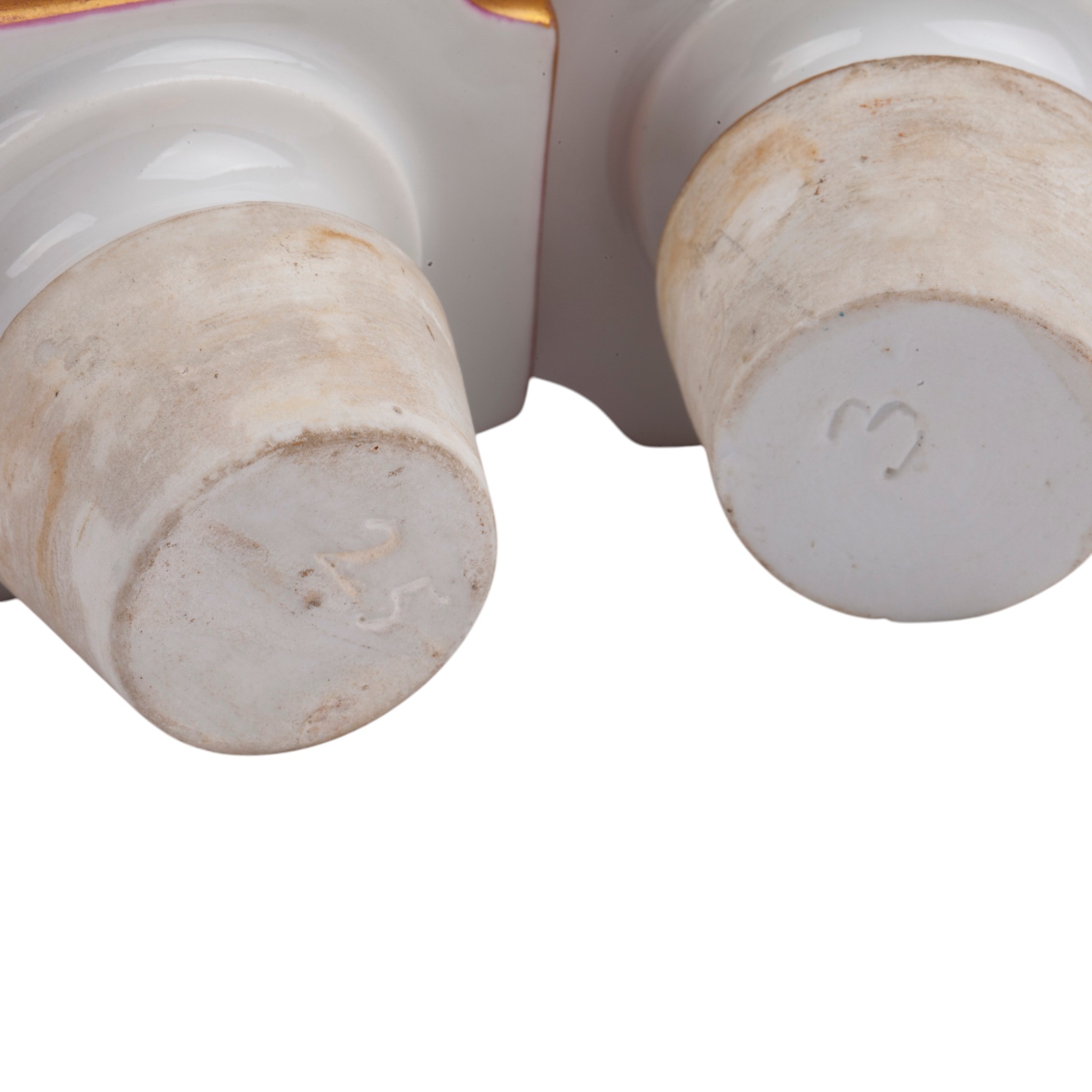
The pink ground is commonly referred to as Rose Pompadour. From the photos, the blue underglaze interlaced mark appears consistent with Sèvres, while the impressed numerals such as 25 and 3 are likely workshop or matching marks.
Condition:
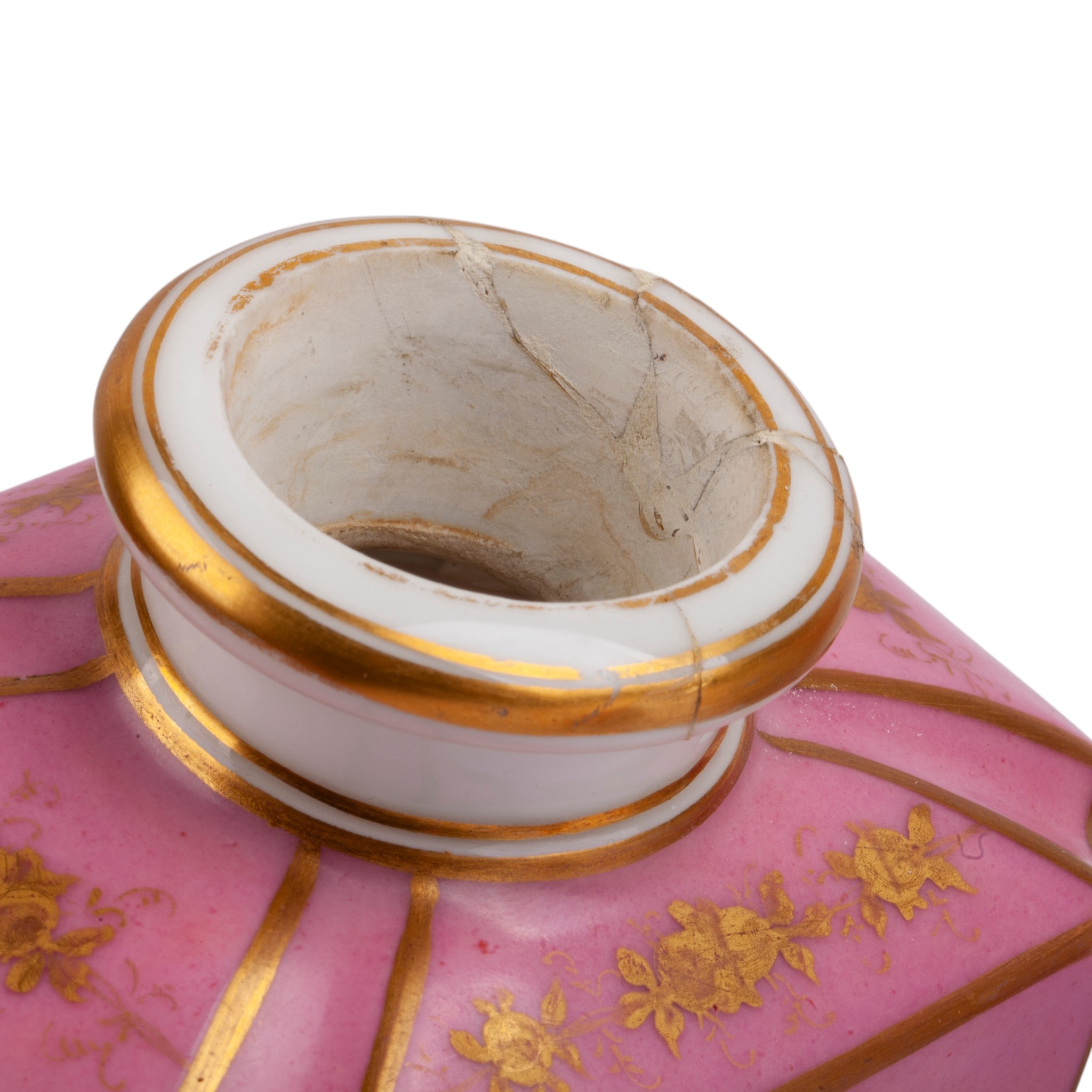
Good overall antique condition to the casket with age wear, minor rubbing, and surface wear to mounts and veneer. One bottle has cracks to the neck/rim area. General wear and minor kiln/manufacturing irregularities consistent with period porcelain.Dimensions of casket: 19 × 28 × 14.5 cm
Notes on marks:
Interlaced L factory mark in blue: consistent with Sèvres.
Date letter M: consistent with 1765.
Impressed numerals on stoppers/base: likely factory or assembly marks.Starting price: 2000€
Estimate: 2500-3000€
Hammer Price: Not sold -
Lot 0151
Russian Enamelled Copper Bowl Usolye (Solvychegodsk),18th century
Estimate: 5000-7000€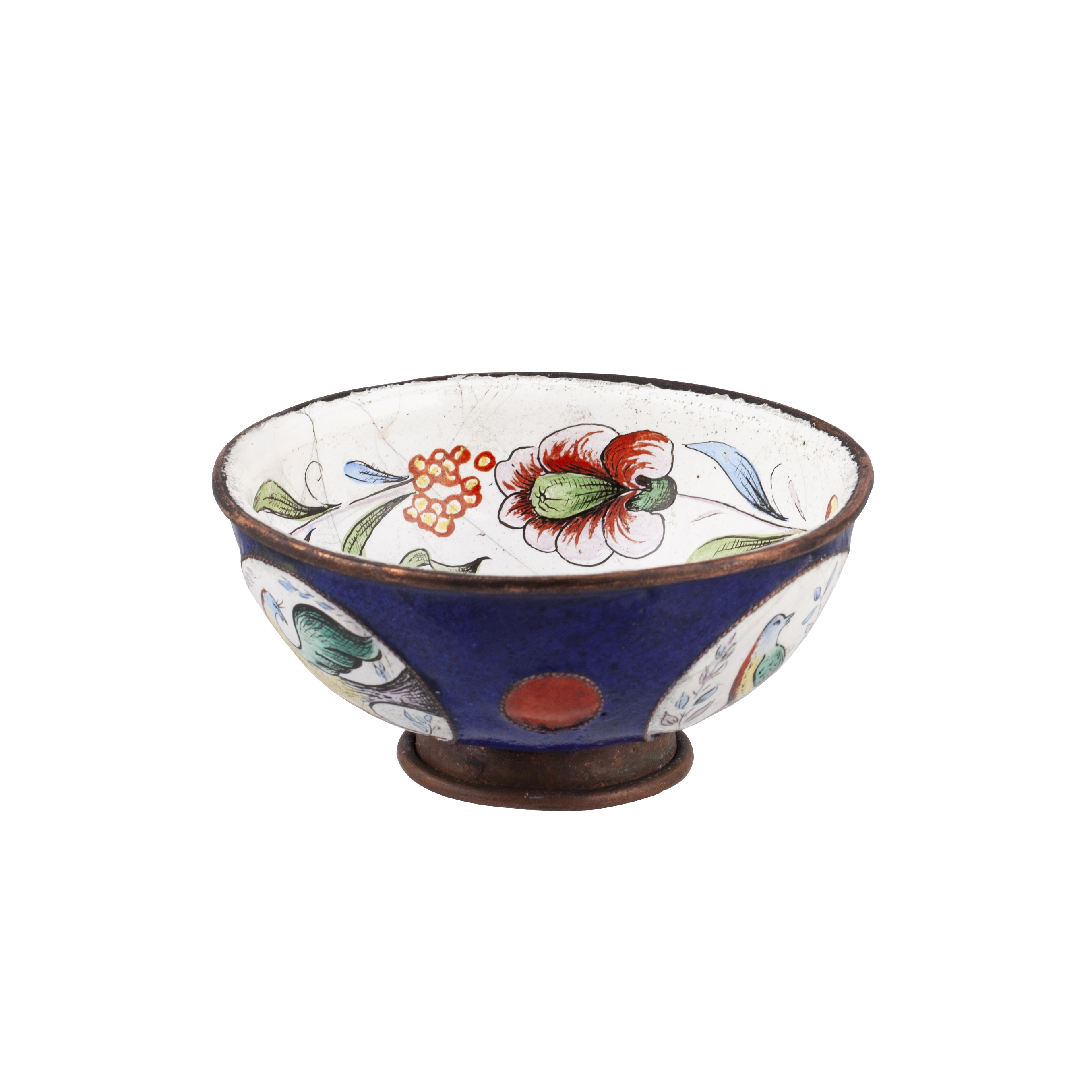
Lot 0151
Russian Enamelled Copper Bowl Usolye (Solvychegodsk),18th century
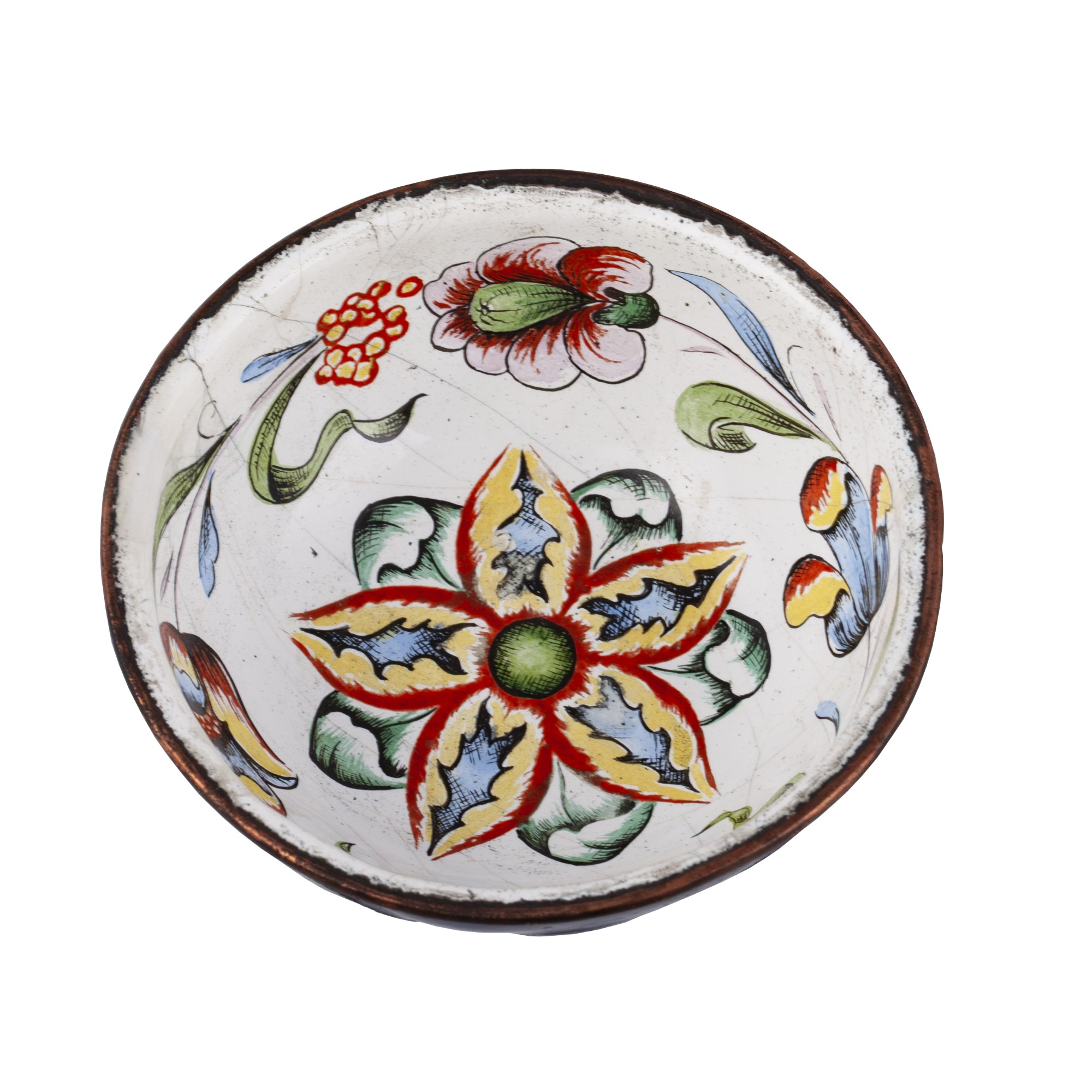
Estimate: 5000-7000€A Russian Enamelled Copper Bowl
Usolye (Solvychegodsk),18th century
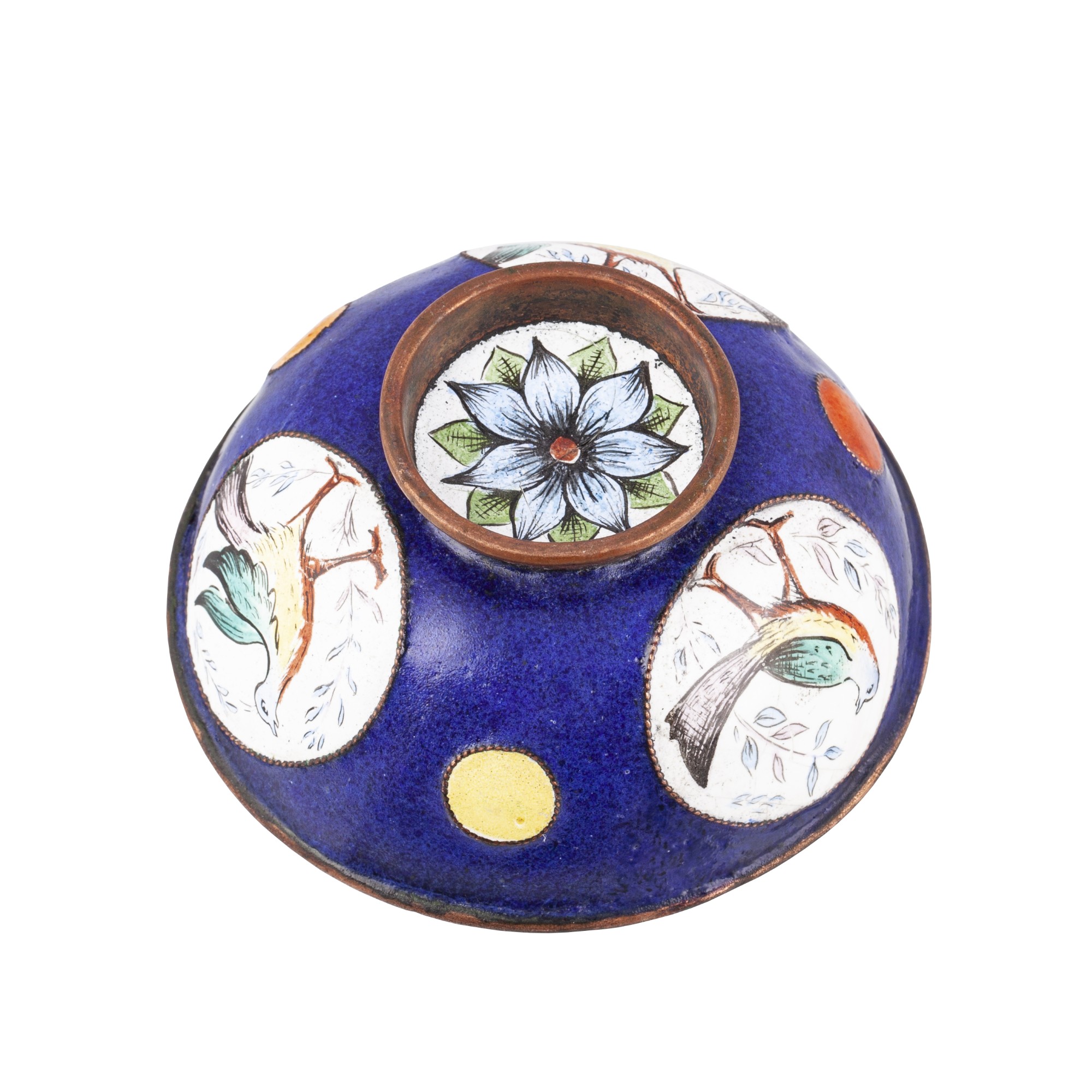
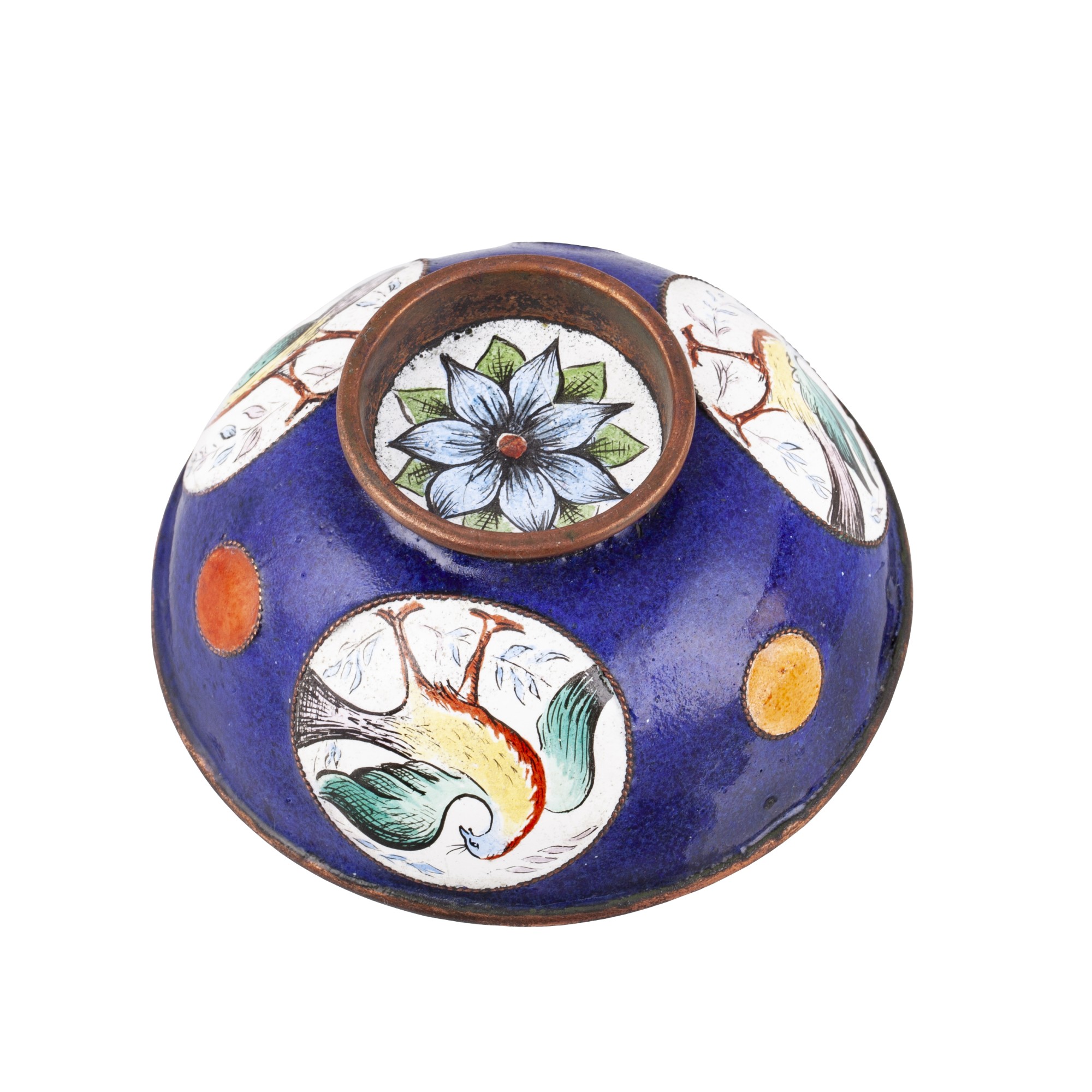
Dimensions: 4.5 х 9.5 х 9.5 cm.Finely painted in polychrome enamel with stylized floral and bird motifs on a white ground, framed by circular and oval medallions against a deep cobalt-blue background. The composition combines strong color contrasts and rhythmic ornament, characteristic of the celebrated Usolye enamel tradition of northern Russia.
Usolye (then known as Solvychegodsk) emerged as one of the principal centers of Russian enamel art in the sixteenth and seventeenth centuries, founded under the patronage of the Stroganov merchant family. The early workshops, originally staffed by Novgorod craftsmen, developed a distinct regional style distinguished by vivid color palettes and expressive linework.
By the mid-seventeenth century, Usolye enamellers mastered painted enamel on copper, depicting large-scale floral and zoomorphic compositions—tulips, sunflowers, birds, and animals—set against white enamel grounds and separated by twisted filigree borders. These works were prized for their decorative richness and often adorned festive cups, caskets, mirrors, and domestic vessels.
Comparable enamelled wares from Usolye are preserved in the collections of the State Historical Museum, Moscow, and the Armoury Chamber of the Moscow Kremlin.
Starting price: 4000€
Estimate: 5000-7000€
Hammer Price: Not sold -
Lot 0152
A Russian Enamelled Copper Bowl Usolye (Solvychegodsk), 18th century
Estimate: 8000-12000€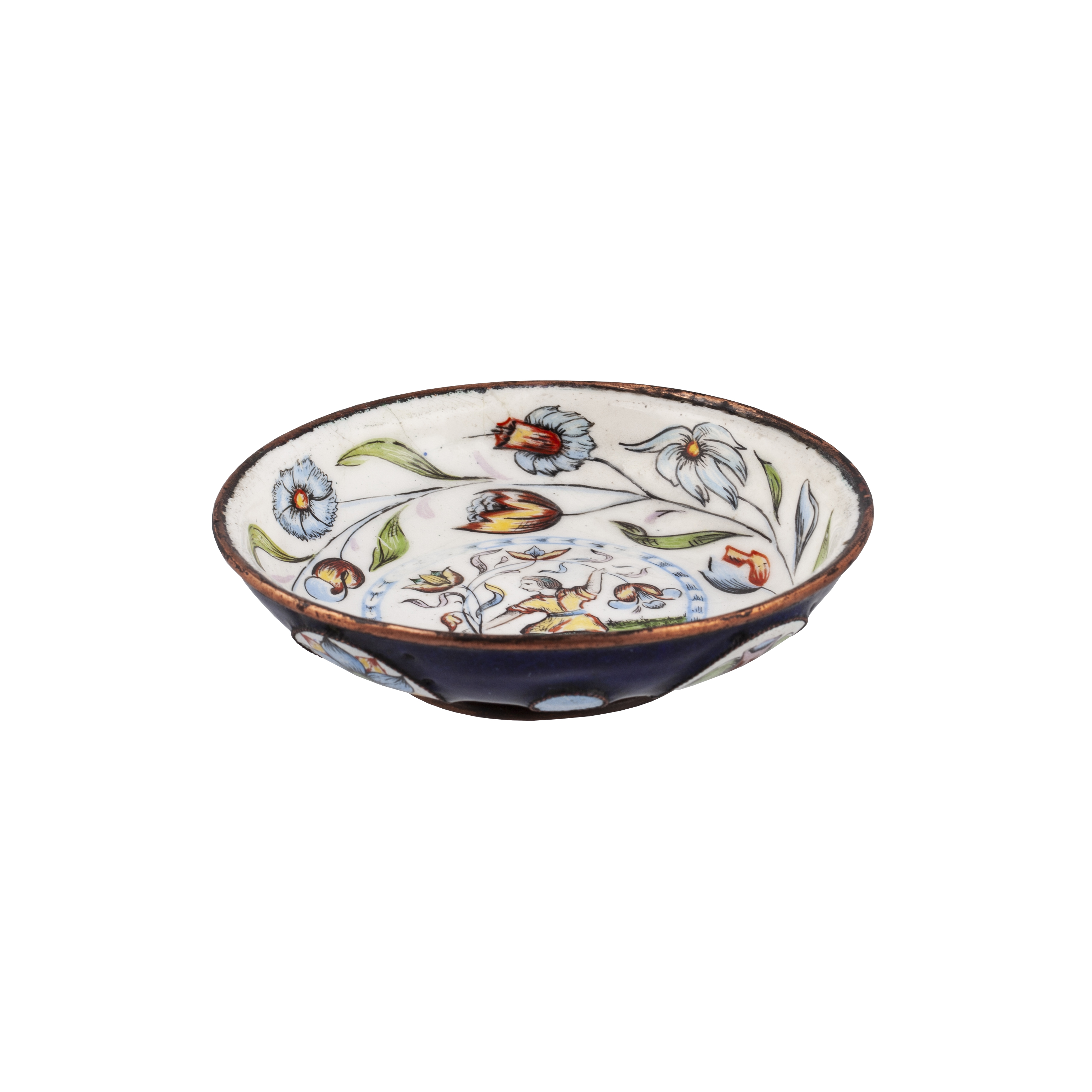
Lot 0152
A Russian Enamelled Copper Bowl Usolye (Solvychegodsk), 18th century
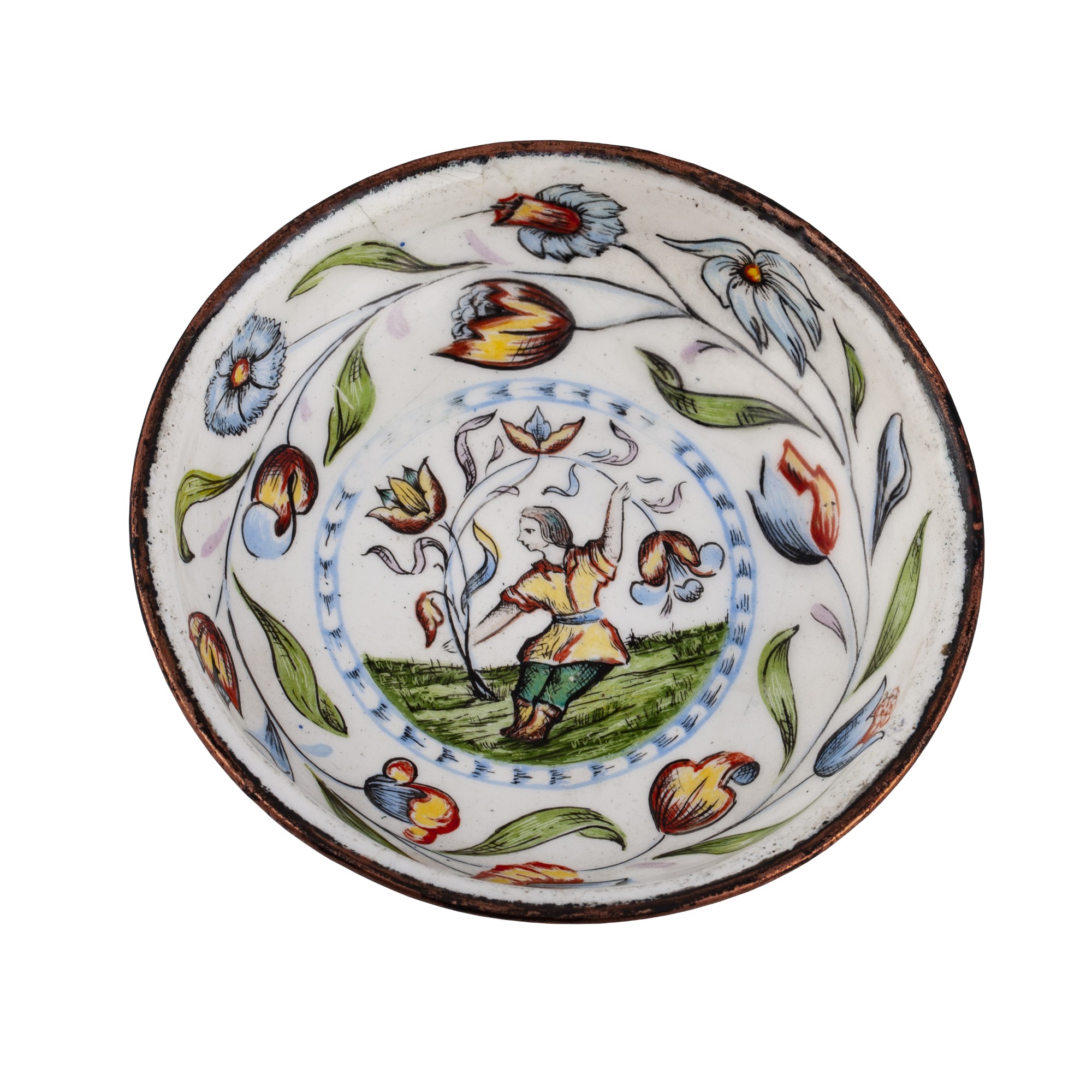
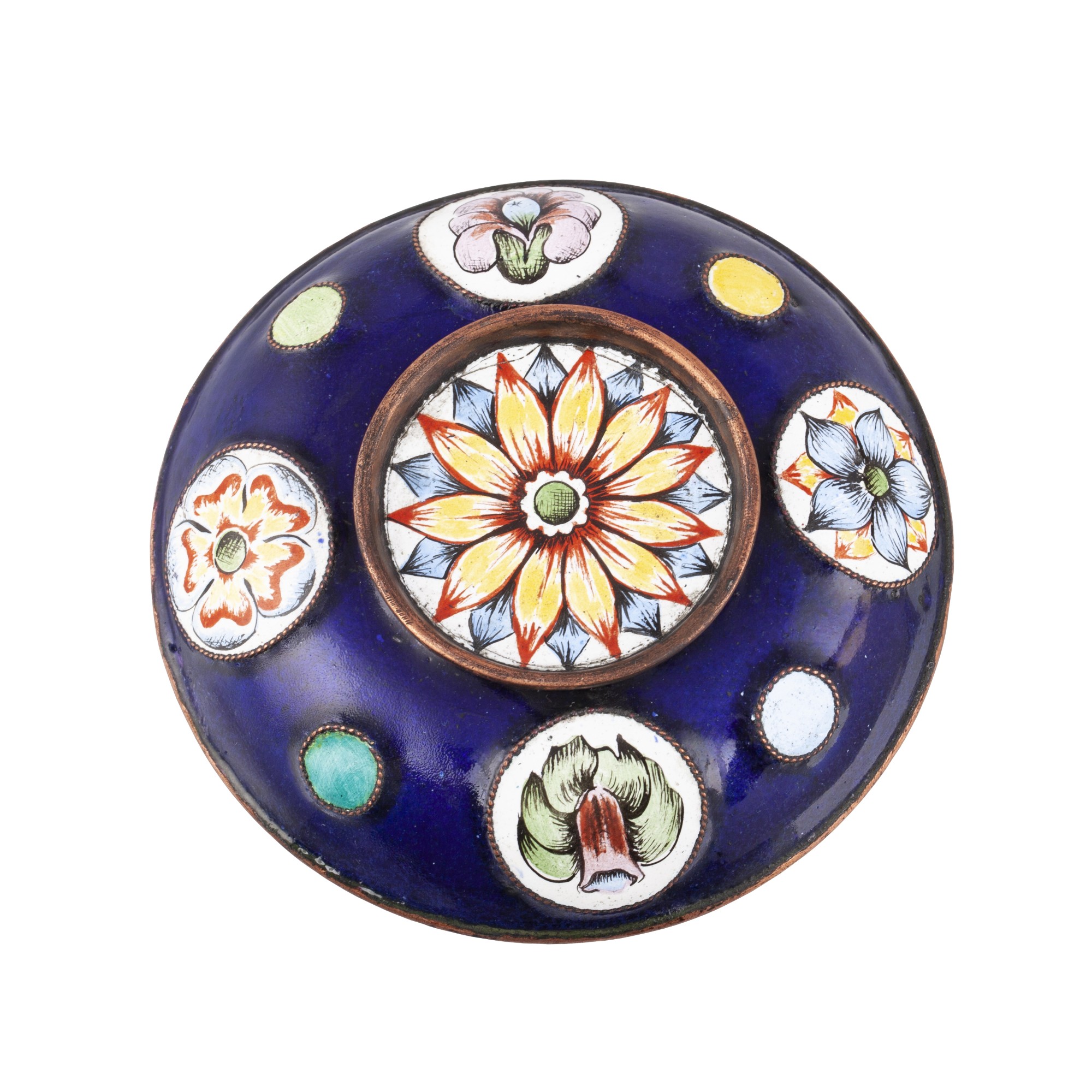
Estimate: 8000-12000€A Russian Enamelled Copper Bowl
Usolye (Solvychegodsk), 18th century
Dimensions: 2.5 х 10 х 10 cm.Painted in vibrant polychrome enamel with a central medallion depicting a dancing figure among tulips and foliage, the interior framed by scrolling floral ornament on a white ground. The exterior is richly decorated with floral motifs in circular reserves against a deep cobalt-blue background.
This bowl exemplifies the artistic excellence of the Usolye (Solvychegodsk) enamelling tradition of northern Russia, which flourished in the seventeenth century under the patronage of the Stroganov family. Originating from workshops established by Novgorod craftsmen in the mid-sixteenth century, the Usolye style is distinguished by its vivid palette, strong contour lines, and decorative rhythm derived from folk and wooden carving traditions.
By the second half of the seventeenth century, Usolye masters perfected the technique of painted enamel on copper, covering entire surfaces with colorful floral designs, birds, and narrative scenes. The favorite motifs included tulips, sunflowers, and whimsical figures inspired by both Russian folklore and Western engravings.
Comparable examples of Usolye enamelled wares are preserved in the State Historical Museum, Moscow, and the Armoury Chamber of the Moscow Kremlin.
Starting price: 6000€
Estimate: 8000-12000€
Hammer Price: Not sold -
Lot 0153
Russian Silver and Porcelain Caviar Bowl for the Eliseev Brothers Trading Firm, Moscow, Late 19th–Early 20th Century
Estimate: 6000-8000€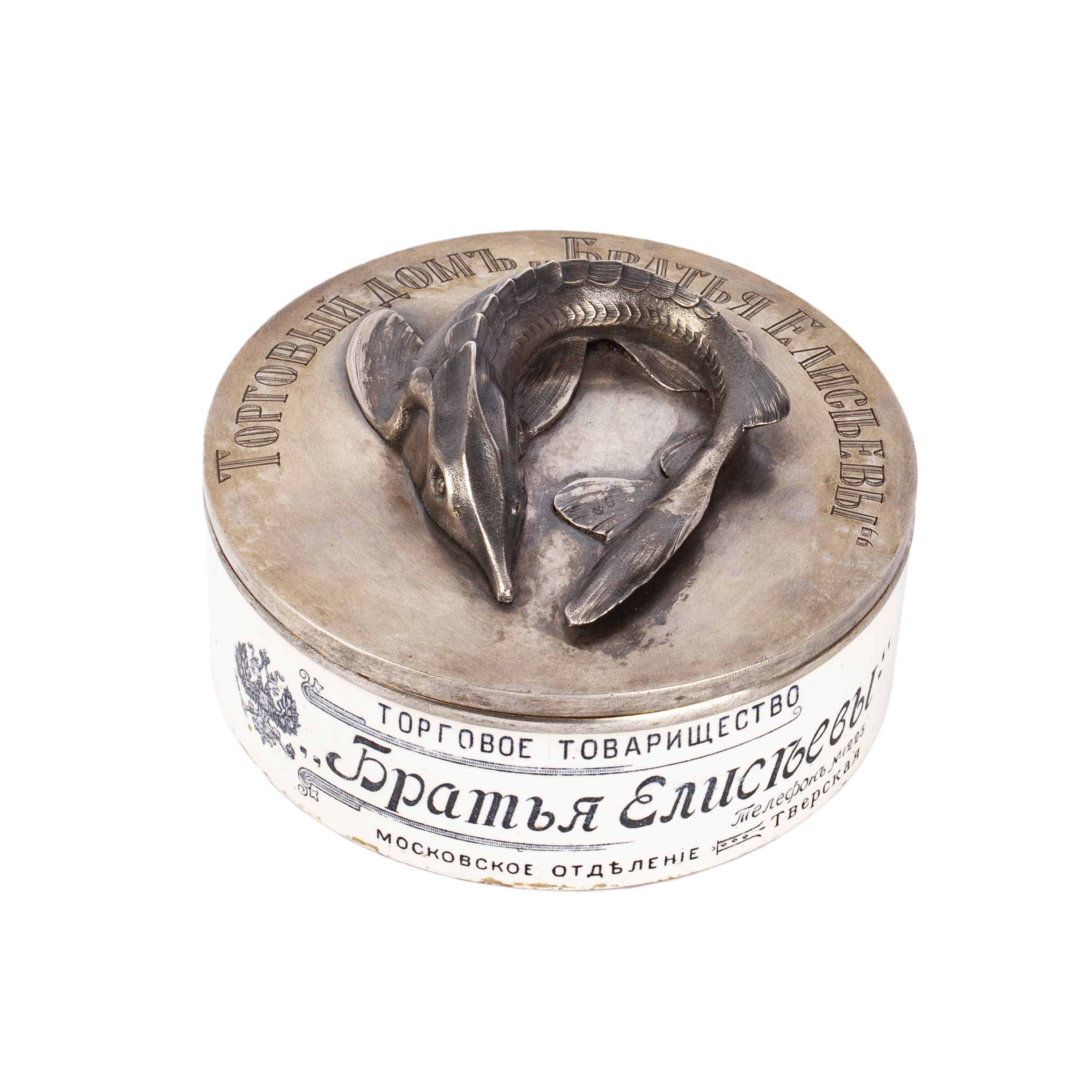
Lot 0153
Russian Silver and Porcelain Caviar Bowl for the Eliseev Brothers Trading Firm, Moscow, Late 19th–Early 20th Century
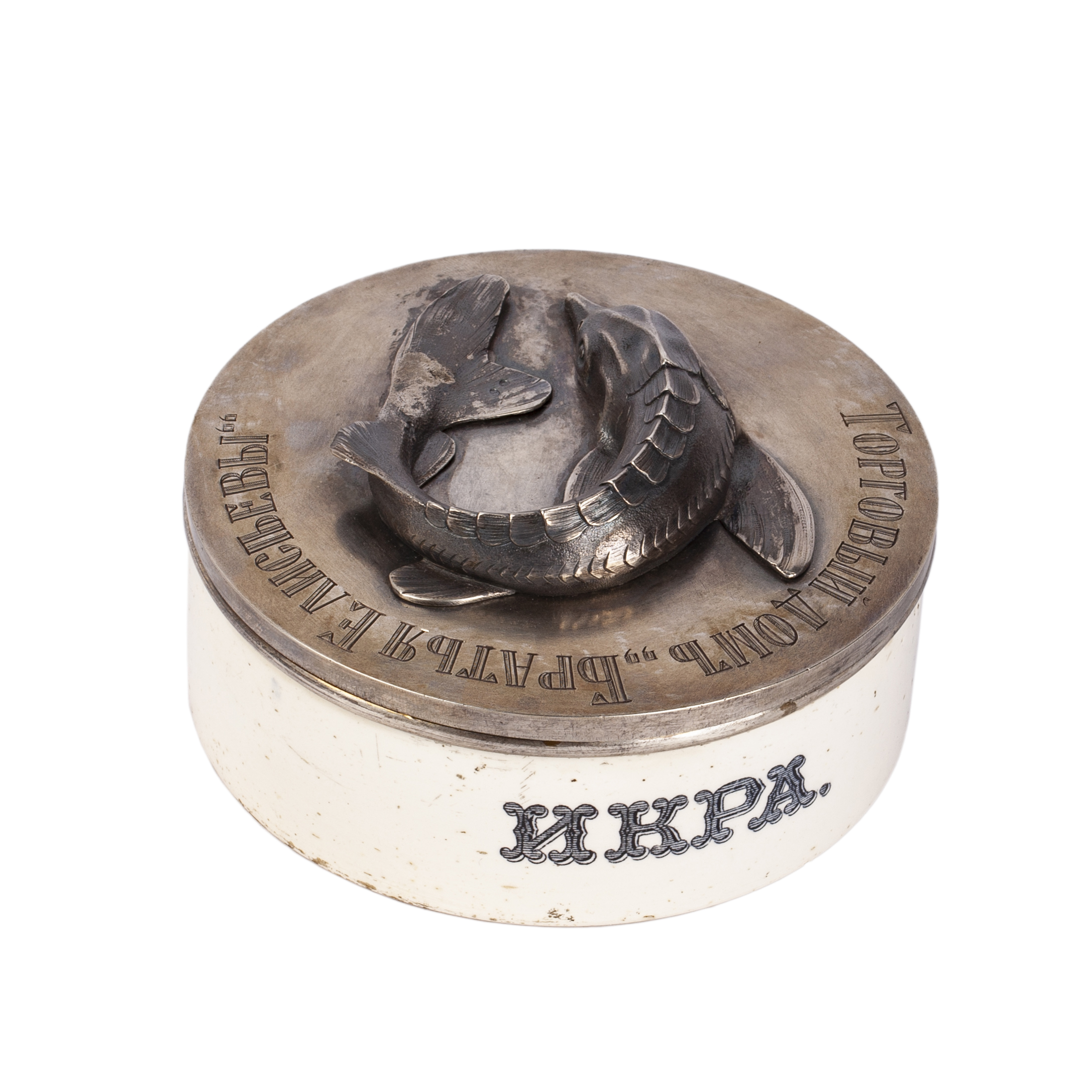
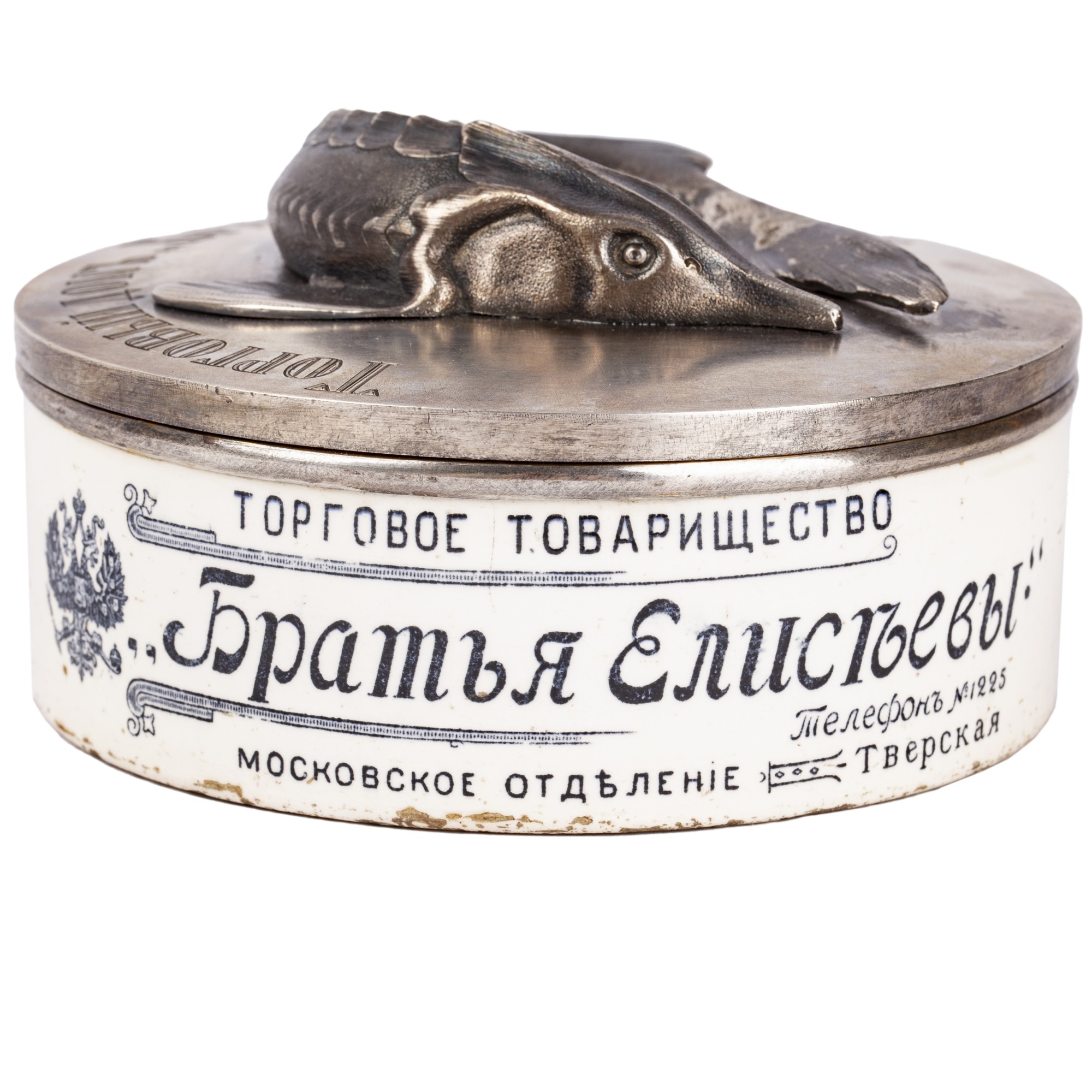
Estimate: 6000-8000€A Silver and Porcelain Caviar Bowl dedicated to Moscow branch of “Eliseev Brothers” trading firm
Moscow, workshop of Matvei Mikhailovich Lombardo, late 19th – early 20th century.
Silver, porcelain; casting, chasing, engraving, lithograph painting on porcelain.
Dimensions: 7 × 12 × 12 cm.
Total weight: 494 g.
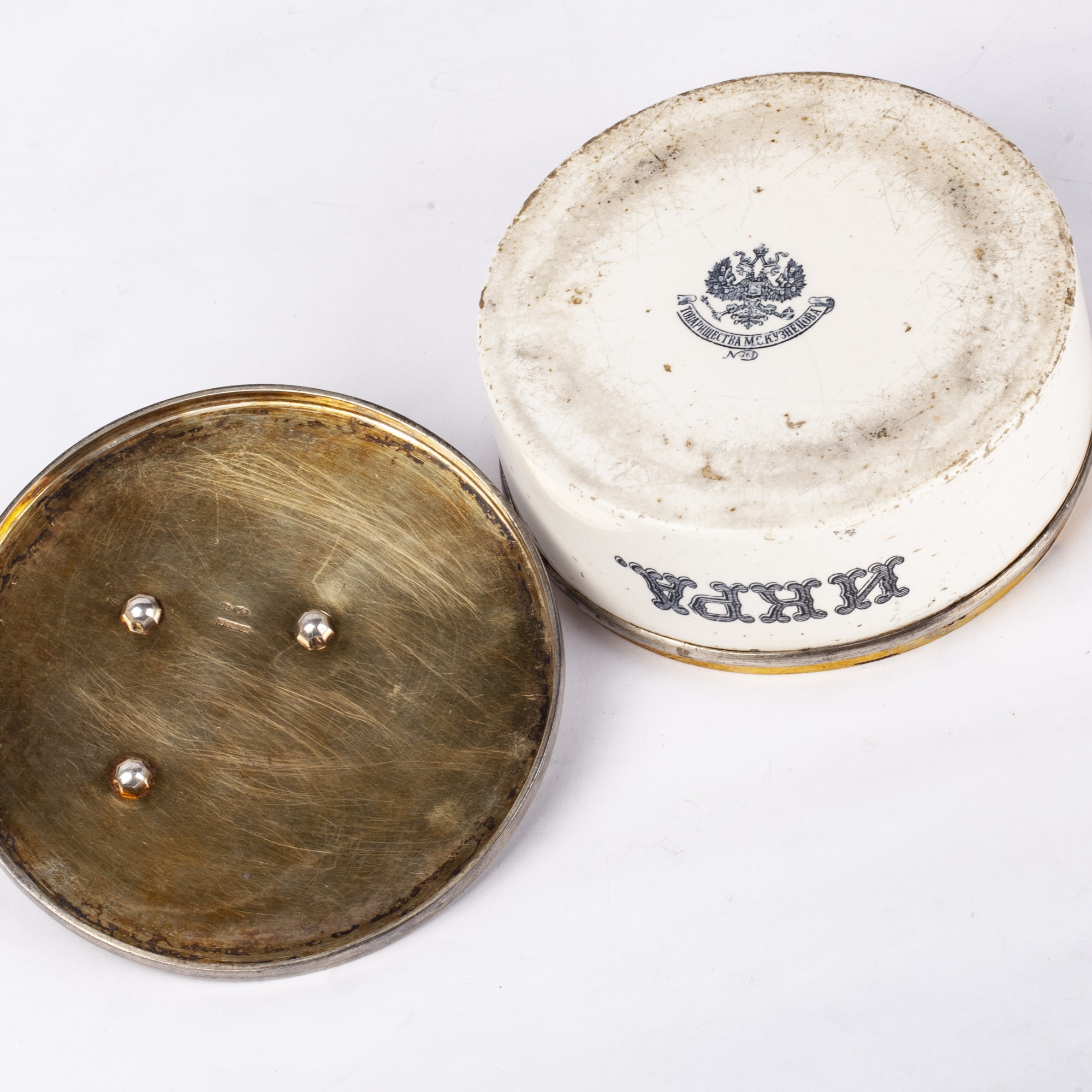
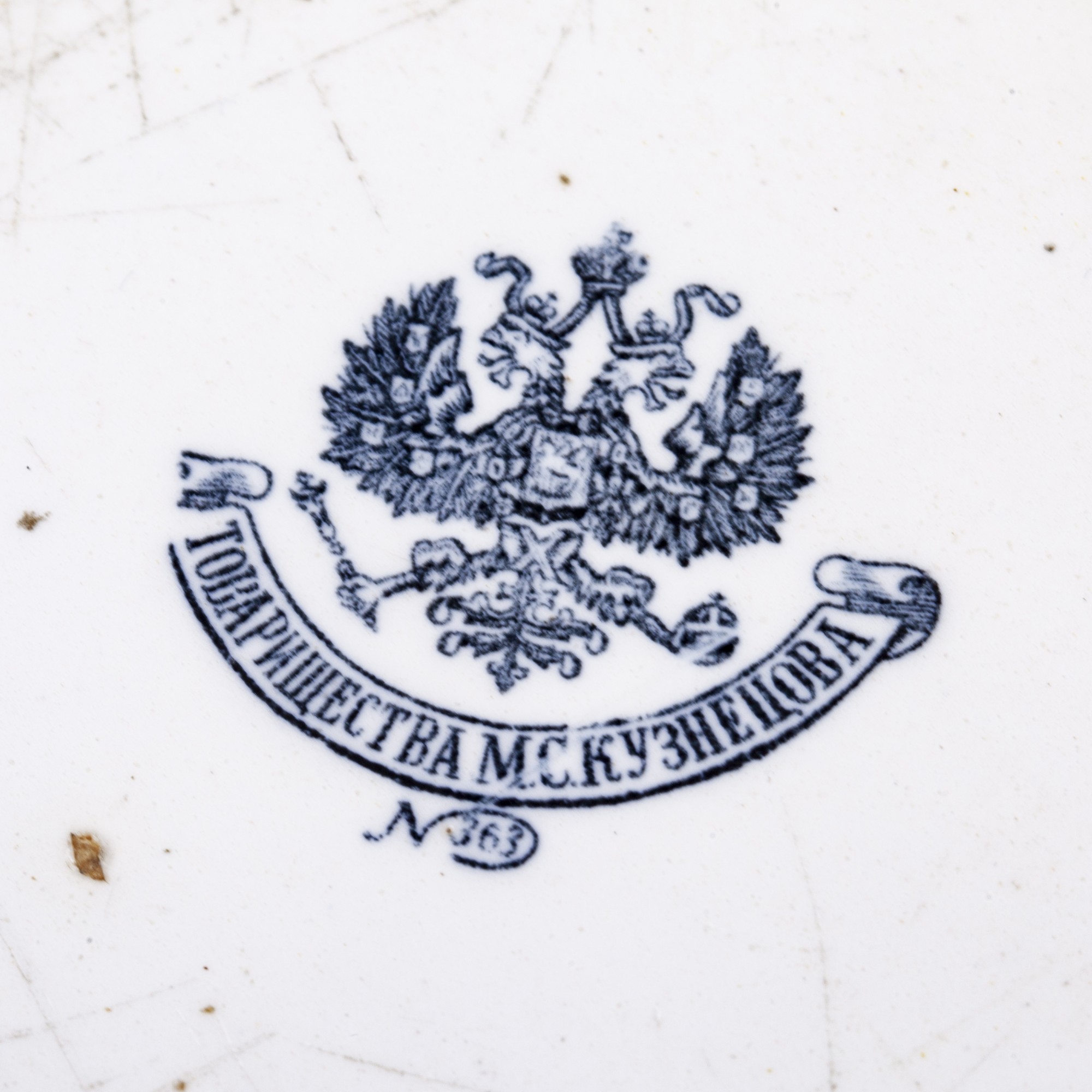
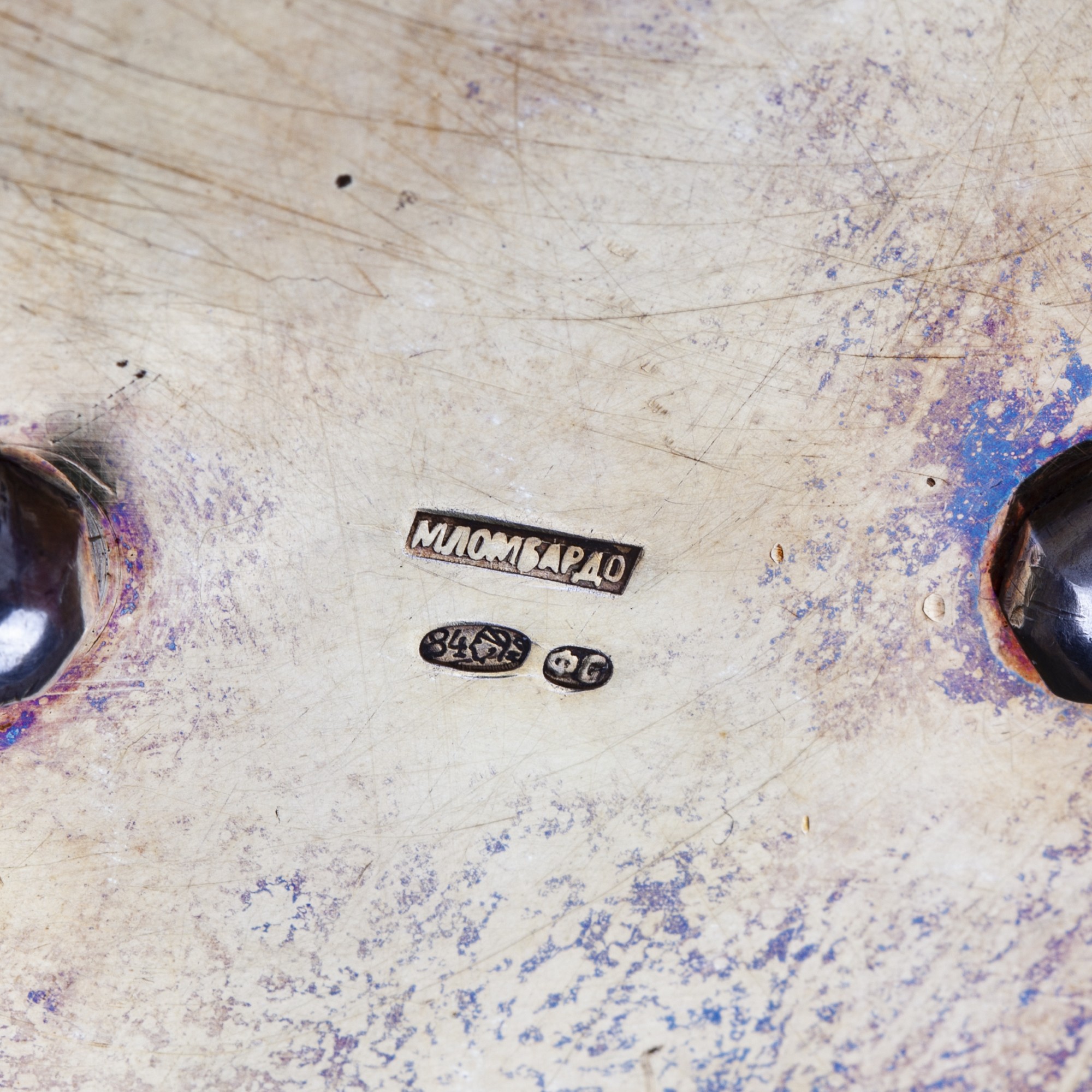
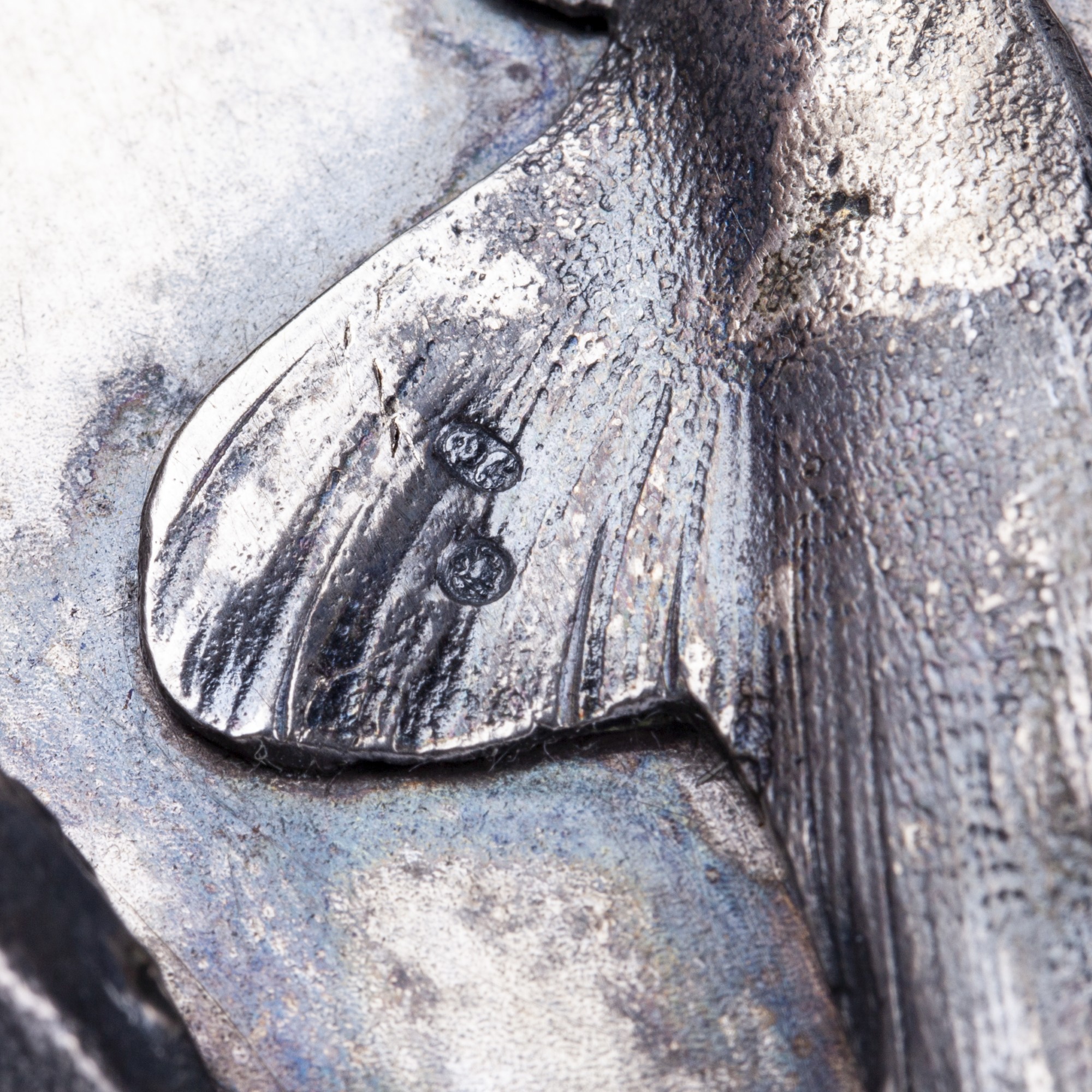
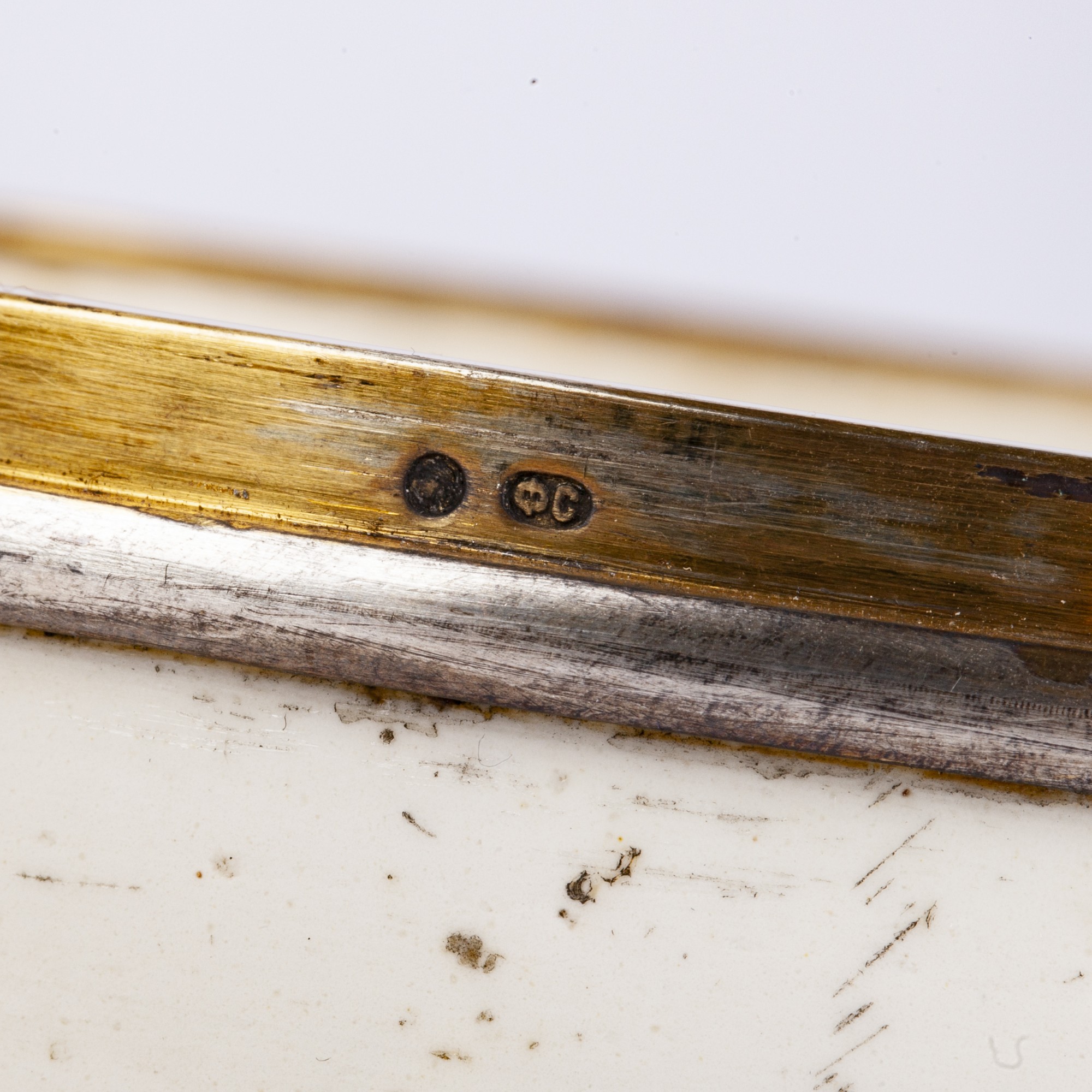
Marks: maker’s mark of “ФС” and M. Lombardo as trade firm; Moscow assay mark; 84 zolotniki silver standard.
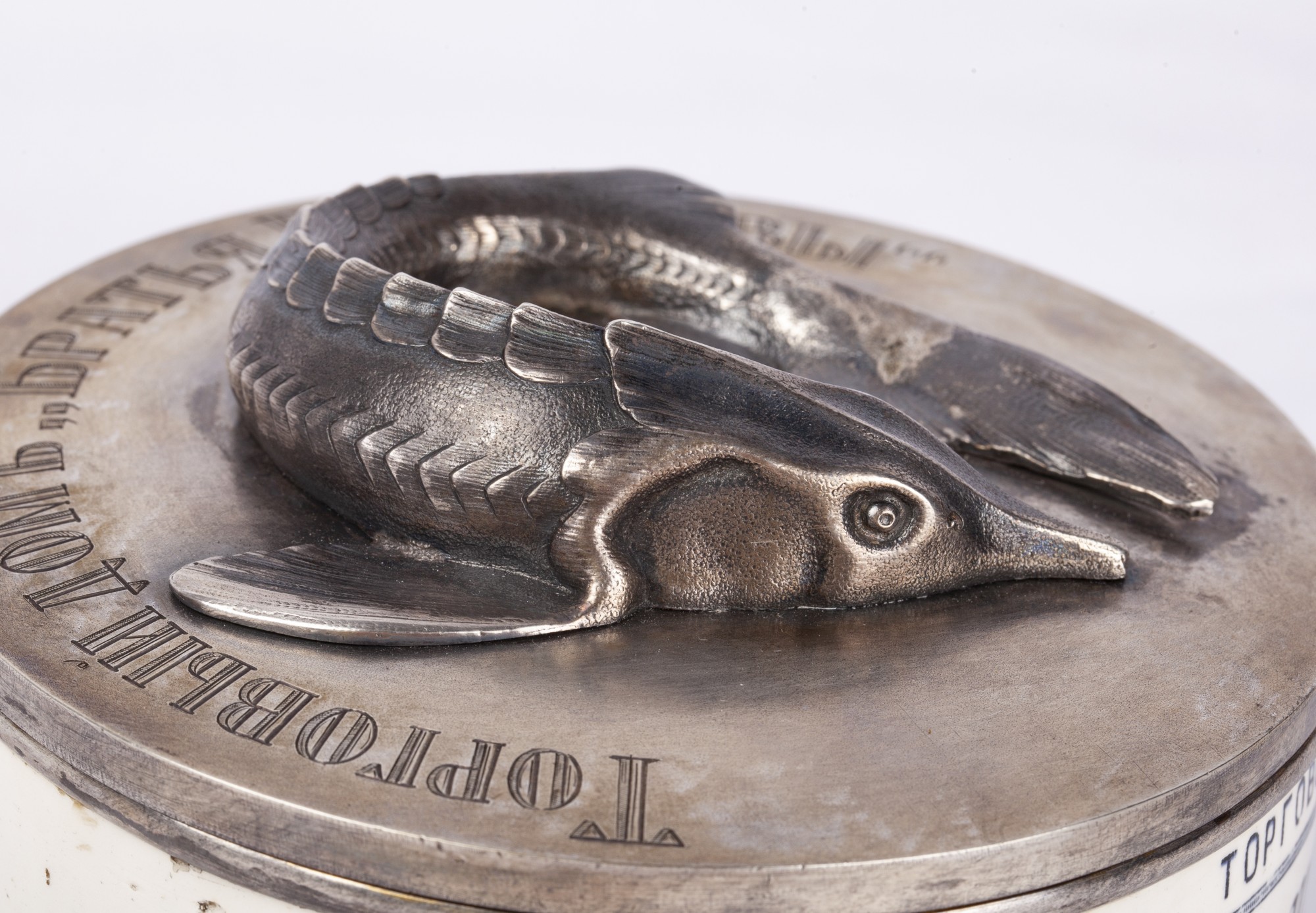
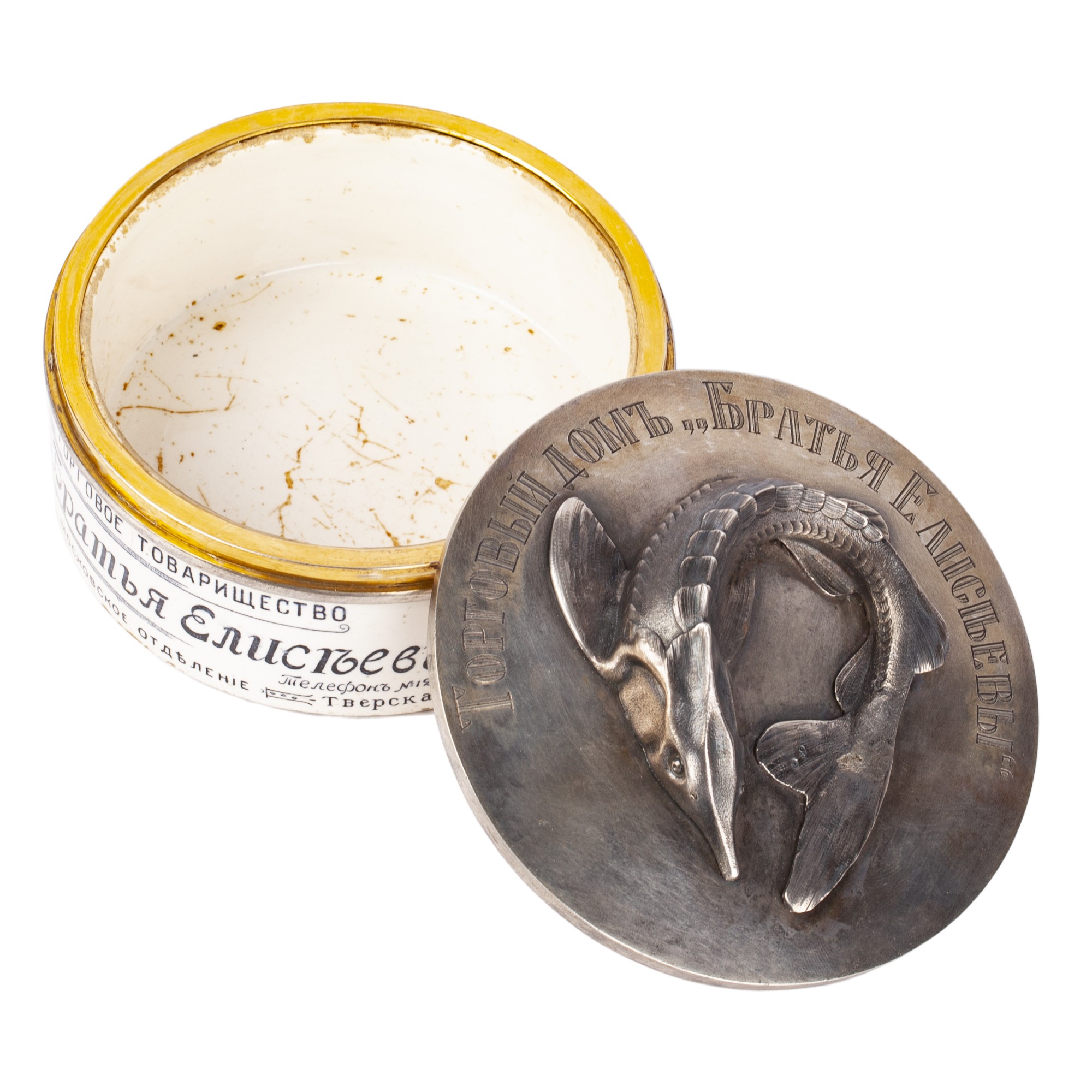
The caviar bowl is formed as a circular porcelain container with a silver lid, surmounted by a naturalistically modelled figure of a sturgeon. The white porcelain body is decorated with printed inscriptions of the trading partnership “Eliseev Brothers” and the Russian Imperial double-headed eagle. The body bears the inscription: “Торговое товарищество Братья Елисъевы, Московское отделение” — “Trading Partnership Eliseev Brothers, Moscow Branch.”
The silver lid is conceived as both a decorative and advertising emblem. Around the rim is engraved the inscription “Trading House ‘Eliseev Brothers’,” while the centre is applied with a sculptural sturgeon curled into a ring. The fish is finely rendered, with chased details of the dorsal scutes, elongated head, fins and tail. T==
Matvei Mikhailovich Lombardo was one of the well-known Moscow silversmiths of the late Imperial period. Active from the 1880s until 1917, he owned both a workshop and a jewellery shop on Kuznetsky Most in Moscow.
The trading house Eliseev Brothers was among the most celebrated gastronomic enterprises of the Russian Empire. Its shops in St Petersburg and Moscow were not merely commercial premises, but splendid urban showcases of refined taste and modern retail culture. The famous St Petersburg store on Nevsky Prospect, opened in 1902, became one of the architectural and social landmarks of the city, while the Moscow branch on Tverskaya continued the same tradition of theatrical and luxurious presentation.Starting price: 5000€
Estimate: 6000-8000€
Hammer Price: Not sold -
Lot 0154
Russian Art Nouveau Silver and Porcelain Salt Cellar in the Form of a Throne, Moscow, 1908–1917
Estimate: 2500-3500€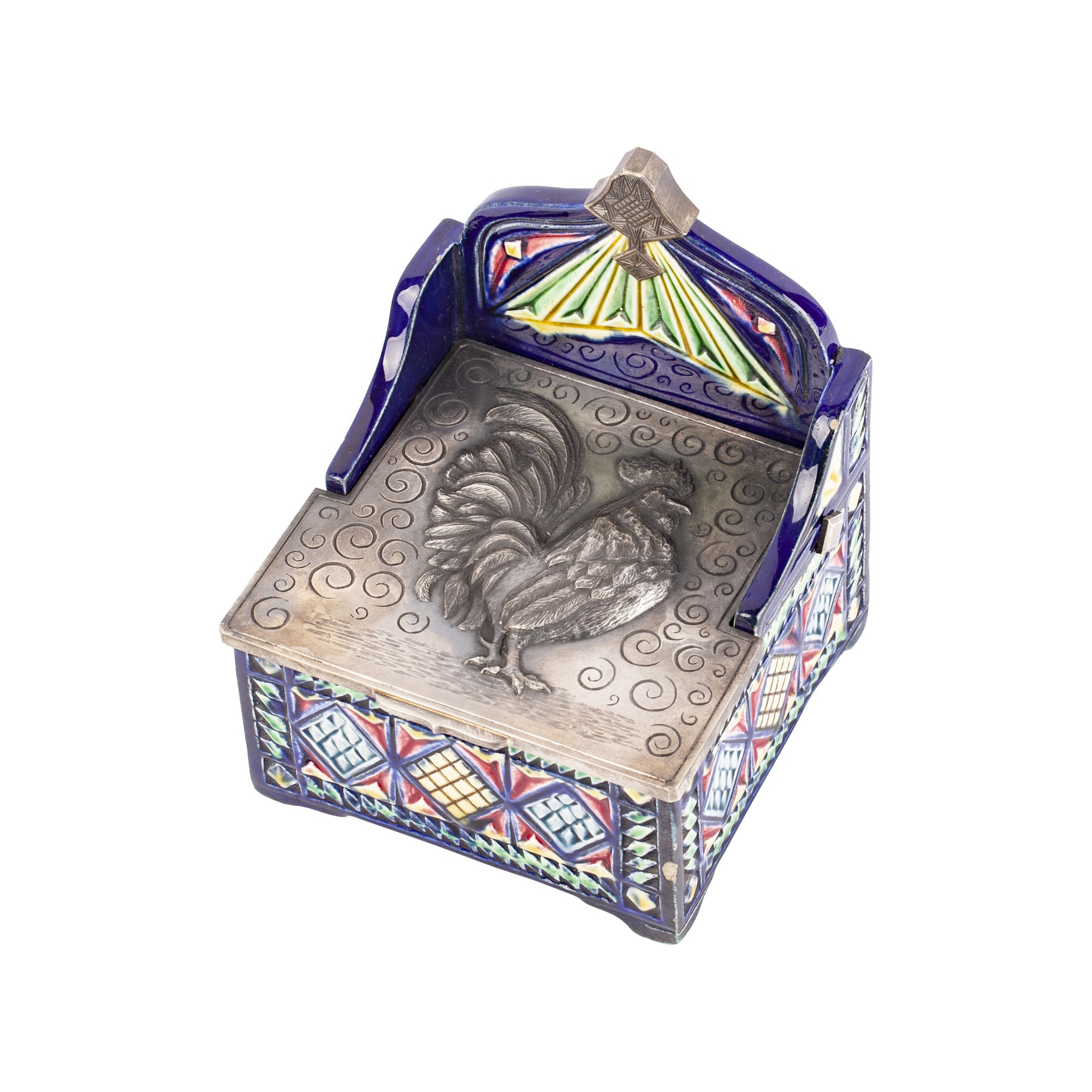
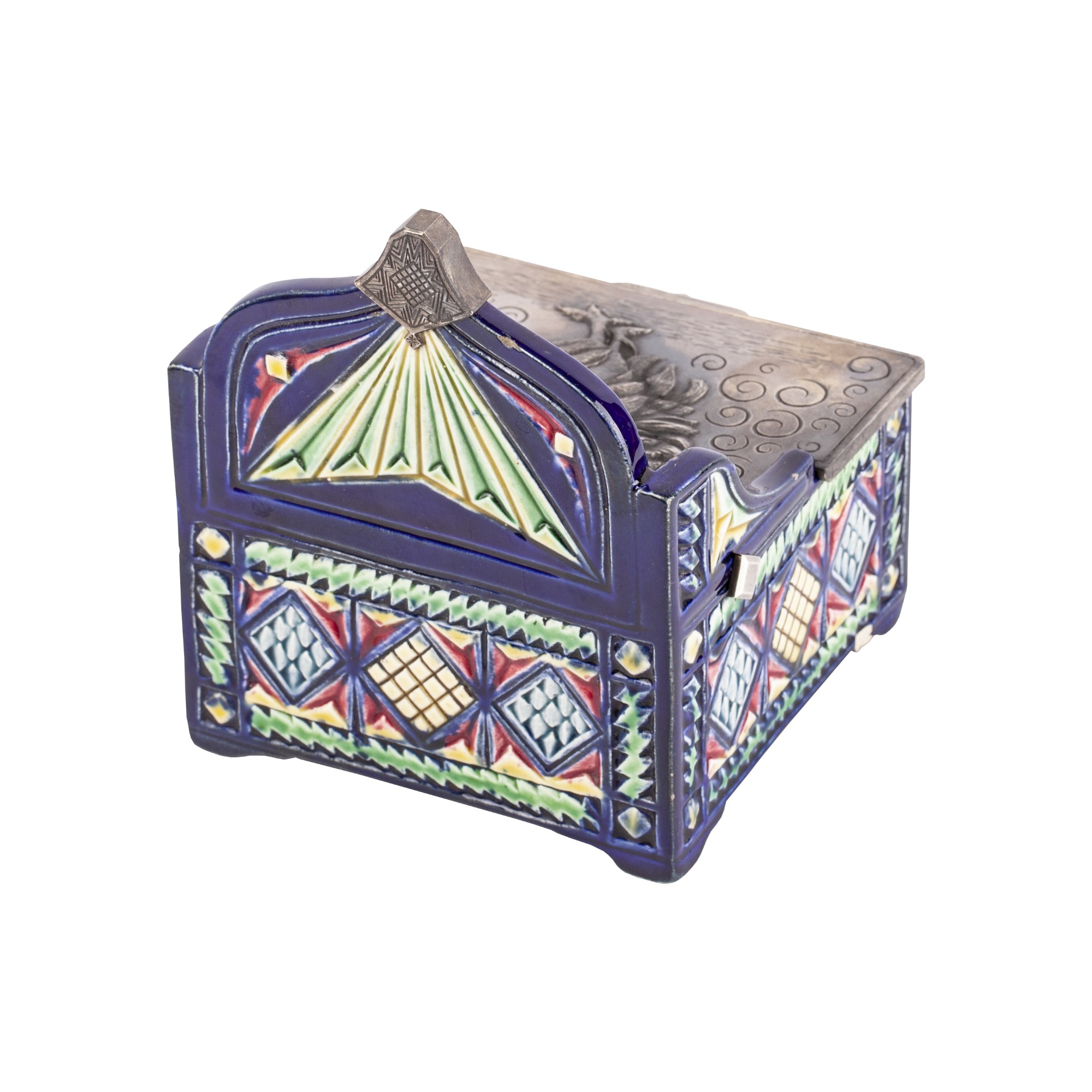
Lot 0154
Russian Art Nouveau Silver and Porcelain Salt Cellar in the Form of a Throne, Moscow, 1908–1917
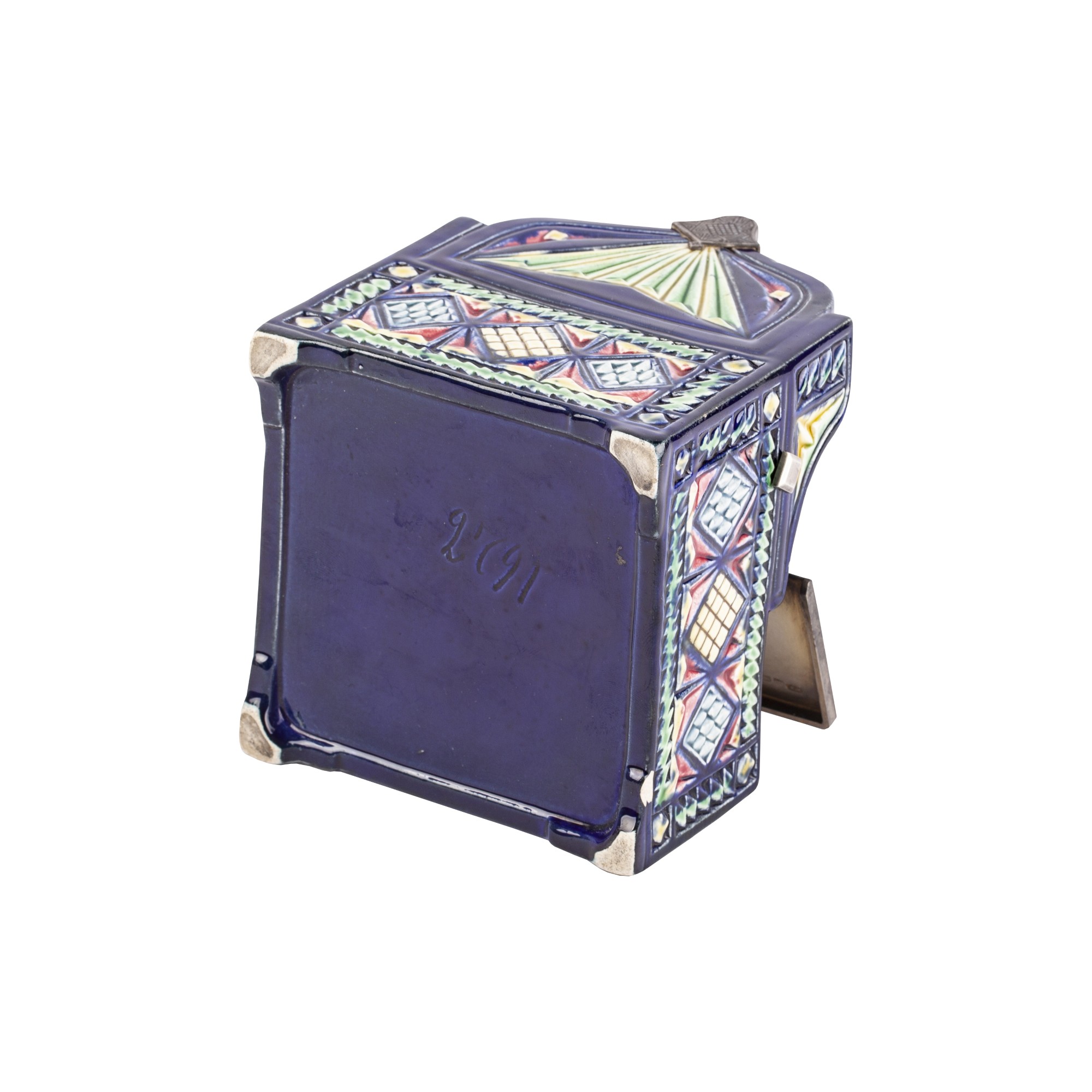
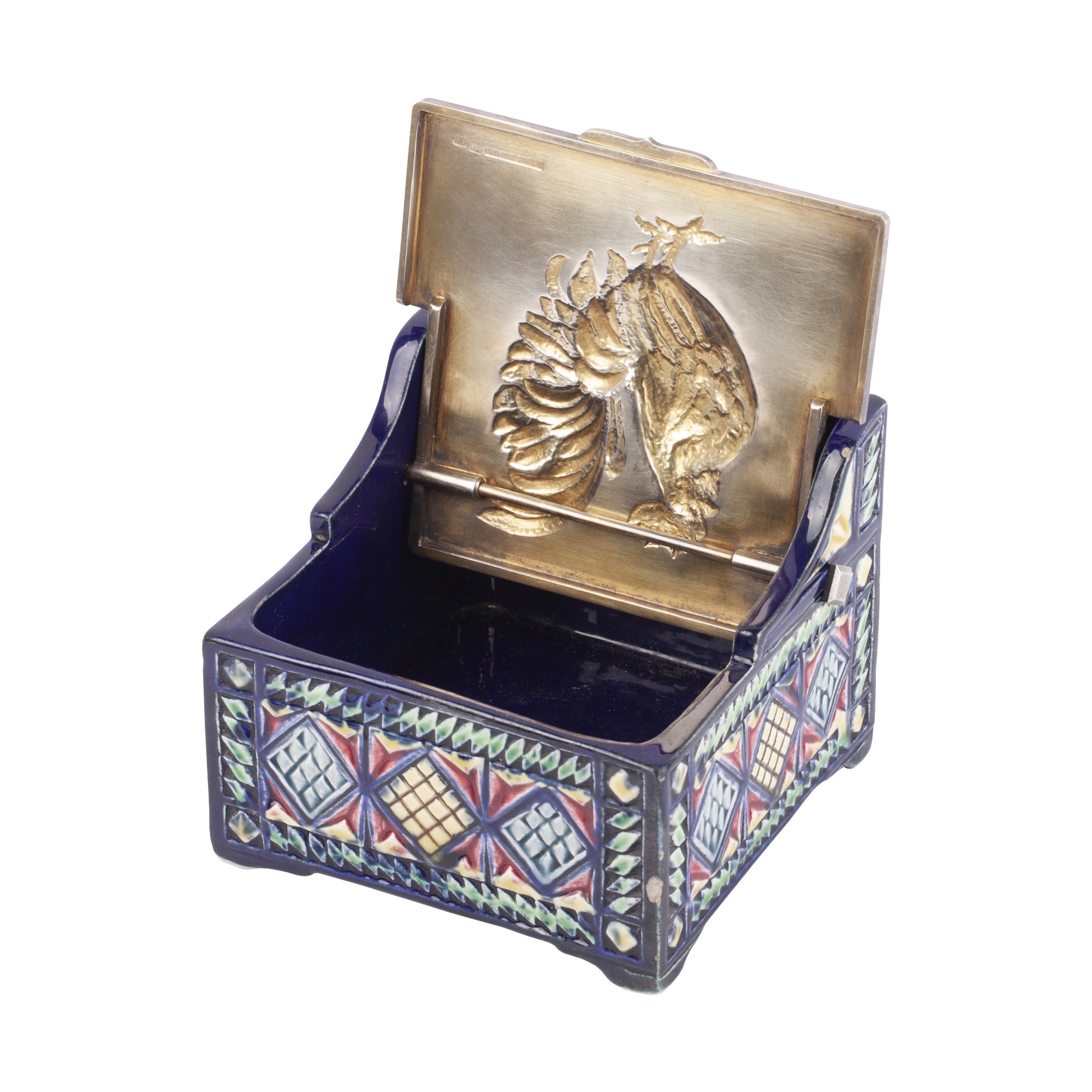
Estimate: 2500-3500€A Russian Art Nouveau Silver and Porcelain Salt Cellar in the Form of a Throne
Moscow, firm of Nemirov-Kolodkin,made by the 3rd Moscow Artel, 1908-1917.
Silver, porcelain, polychrome glaze; casting, chasing, repoussé, engraving, moulding, glazing.
Dimensions: 13 × 11 × 11.5 cm.
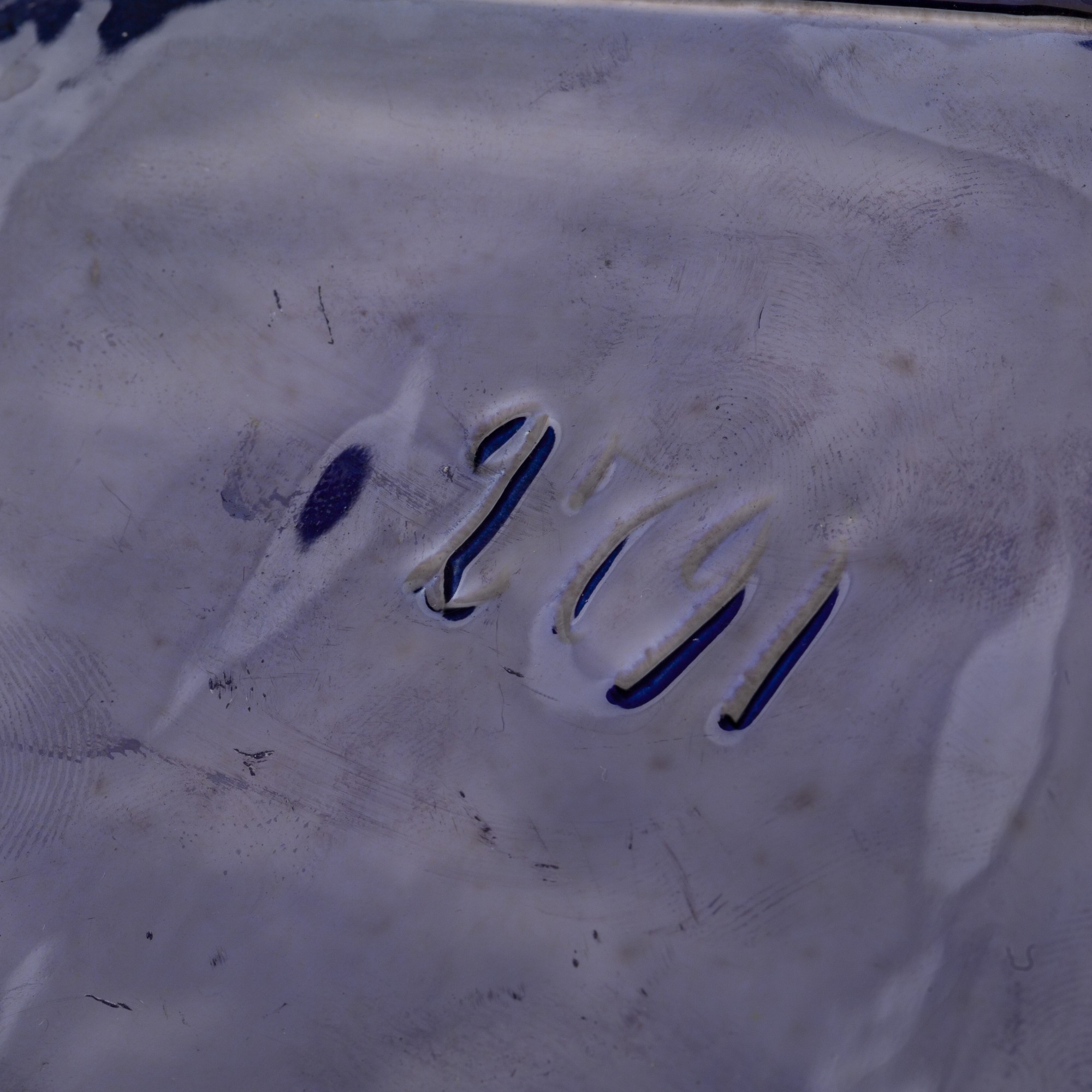
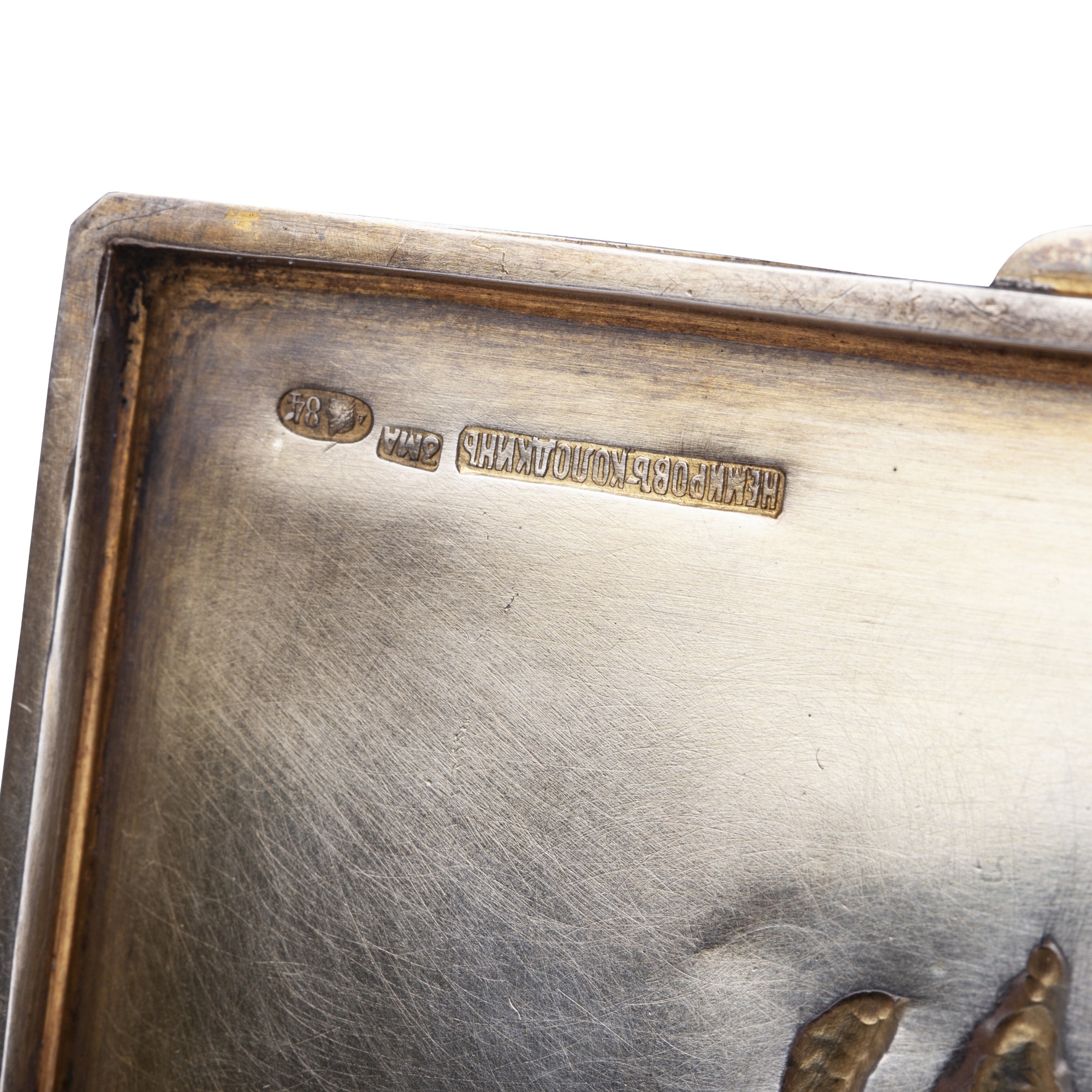
Marks: retailer’s mark of Nemirov-Kolodkin; mark of the 3rd Moscow Artel; Moscow assay mark; 84 zolotniki silver standard.
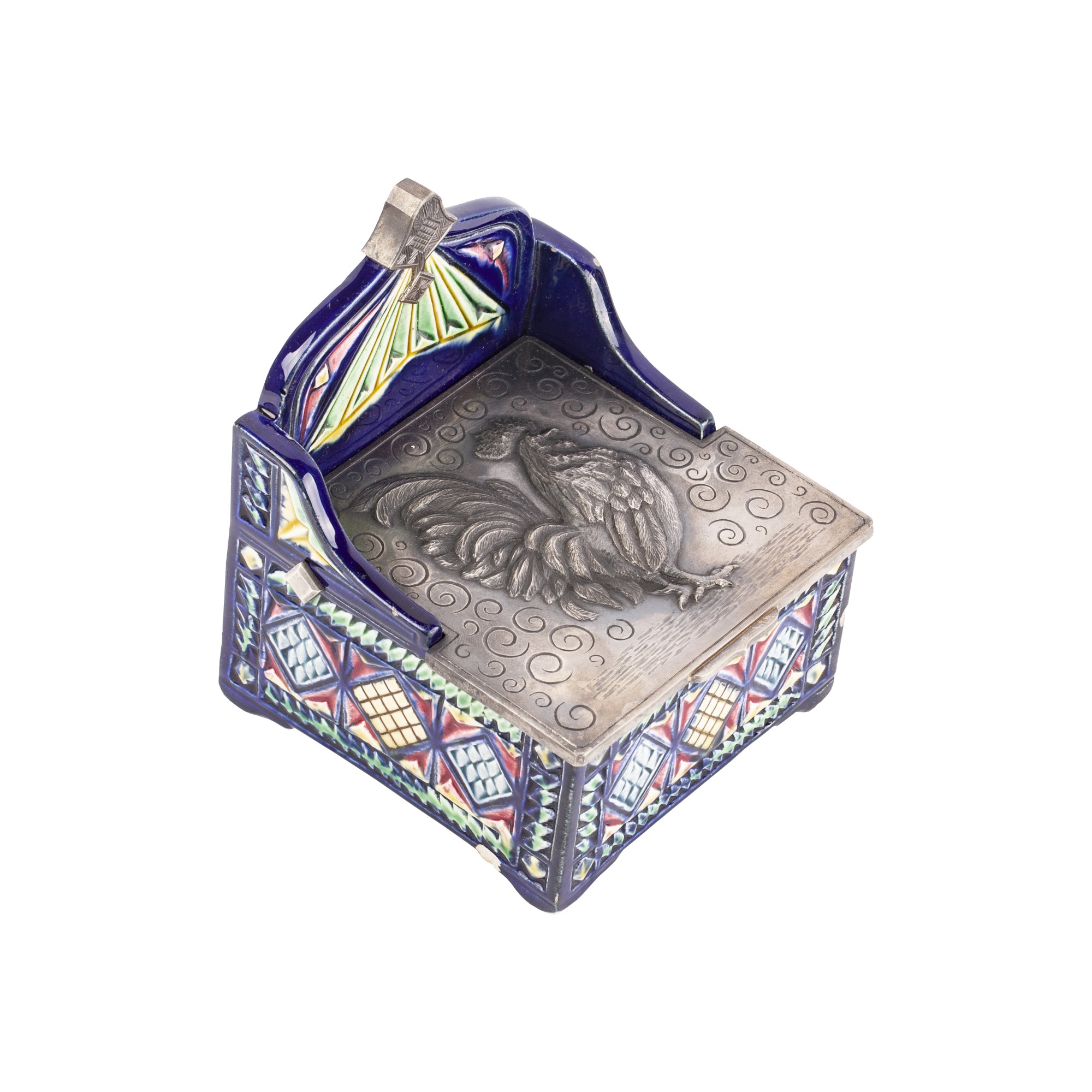
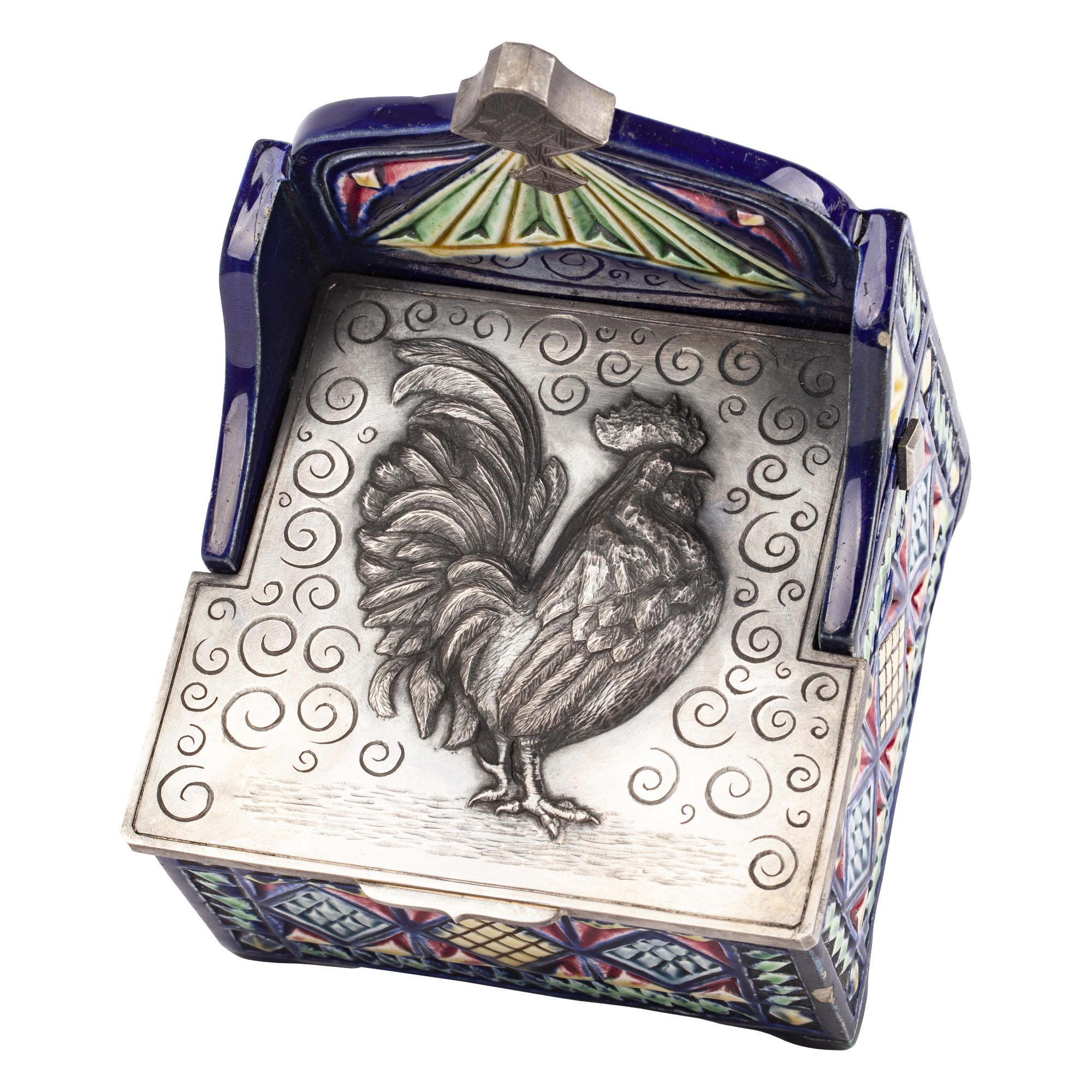
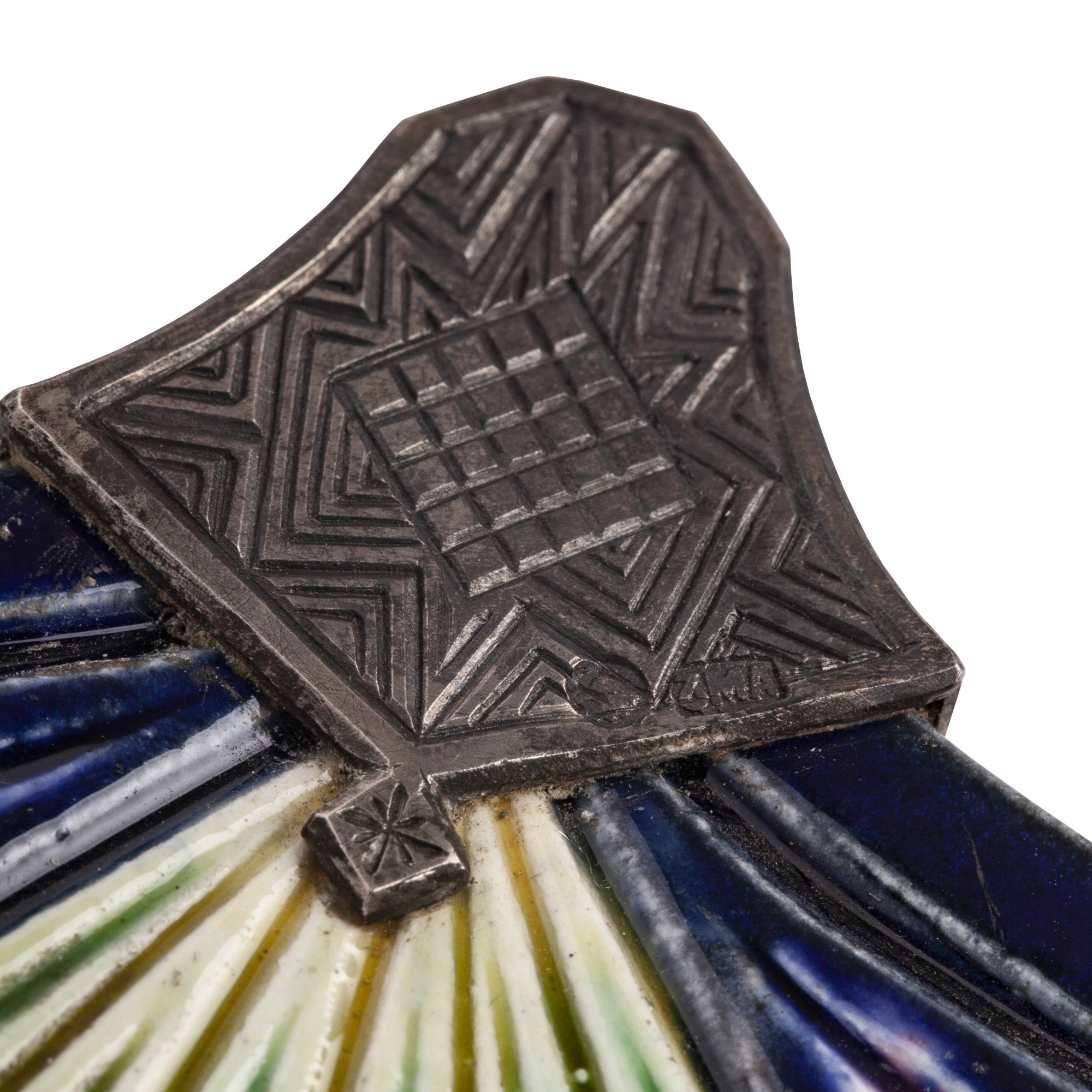
A rare Russian Art Nouveau salt cellar designed in the form of a traditional russian throne “sthool”. The body is made of richly glazed porcelain, with deep cobalt-blue borders and brightly coloured geometric ornament in green, yellow, red and pale blue. The architectural structure, with raised back, side supports and stylised panels, evokes a miniature princely seat or a fairy-tale terem throne.
The hinged silver cover is decorated in relief with a proud cockerel standing among engraved spiral ornament. The bird, rendered with finely chased plumage and a high tail, introduces a distinctly Russian folkloric note.
The firm of Nemirov-Kolodkin was one of the important Moscow suppliers of silver objects in the late Imperial period. Its founder, Nikolai Vasilievich Nemirov-Kolodkin (1819-1886), a merchant of the first guild, jeweller and philanthropist, established a successful firm that continued after his death under his relatives and successors. From 1876 the firm supplied silver tableware for the Imperial kitchen, selecting individual workshops and artels according to the level and nature of each commission.
The object was executed by the 3rd Moscow Artel, whose mark appears on the silver element. The artel form of production emerged in Moscow silverwork in the early twentieth century and is closely connected with the flourishing of the Art Nouveau style. The 3rd Moscow Artel is known for highly accomplished works, including pieces retailed by leading firms and connected with the circle of craftsmen who had worked for or supplied Fabergé, Ovchinnikov, Khlebnikov and other major houses.Starting price: 2000€
Estimate: 2500-3500€
Hammer Price: Not sold -
Lot 0155
Russian Fabergé Jewelled Silver-Mounted Ceramic Kovsh, Moscow, 1908–1917
Estimate: 9000-12000€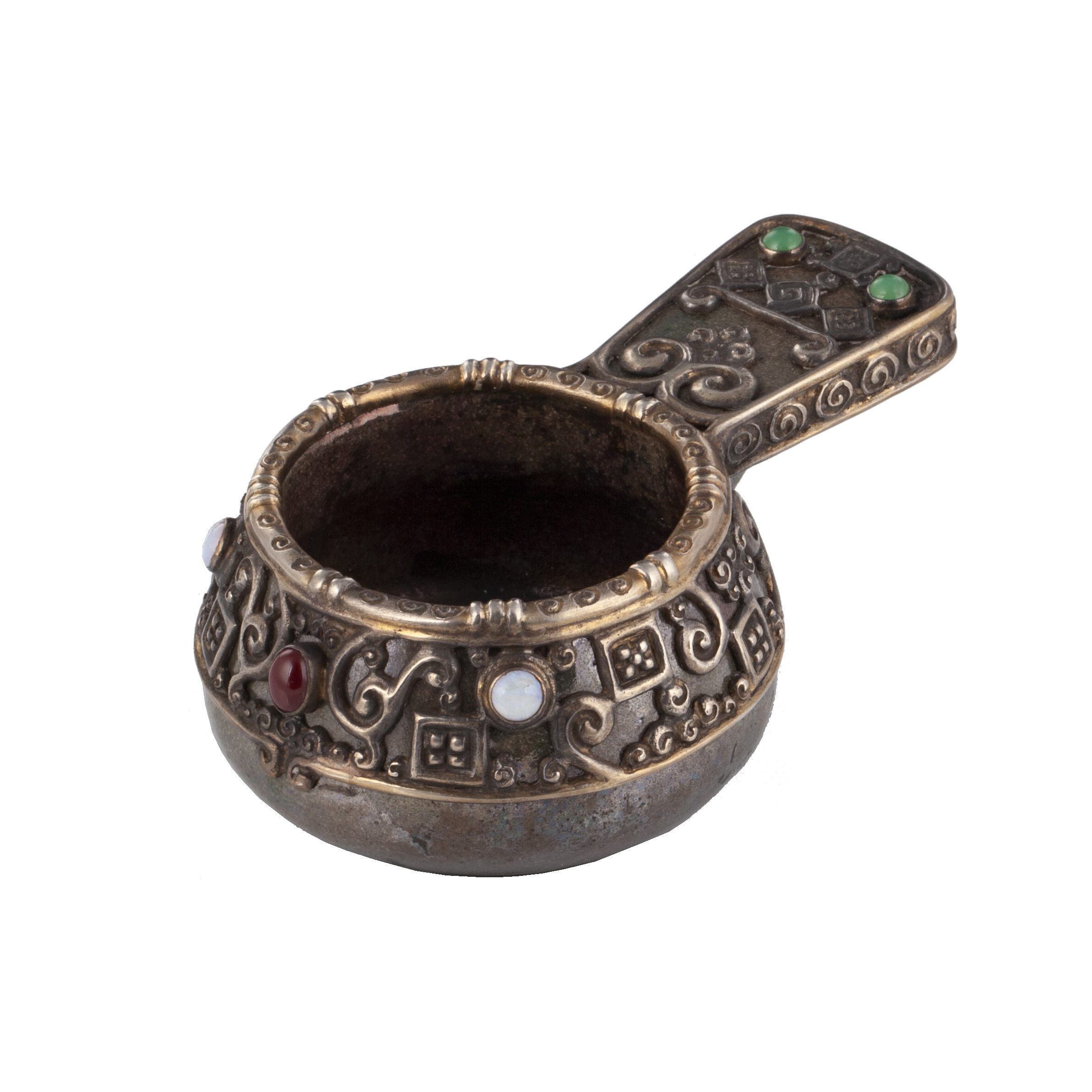
Lot 0155
Russian Fabergé Jewelled Silver-Mounted Ceramic Kovsh, Moscow, 1908–1917
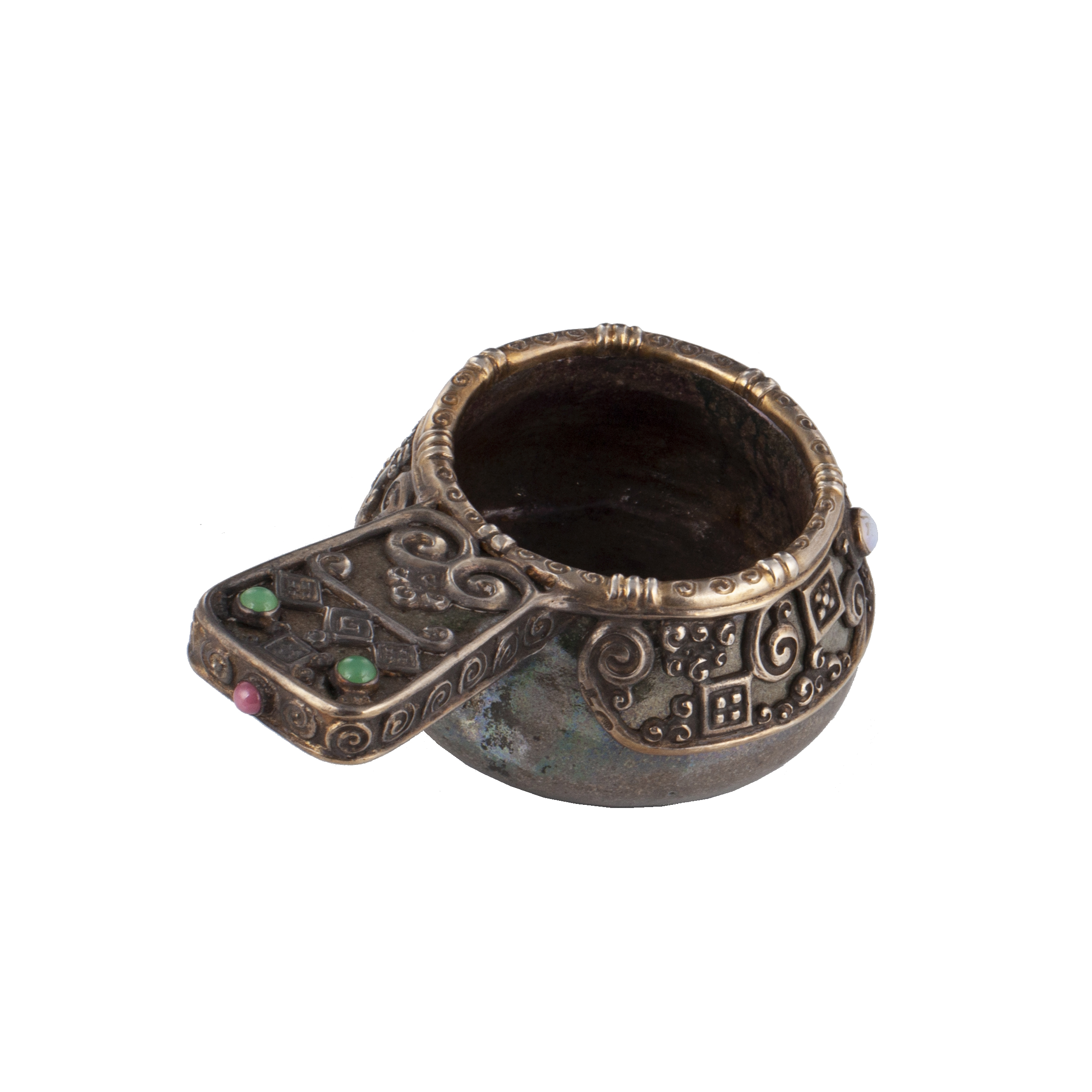
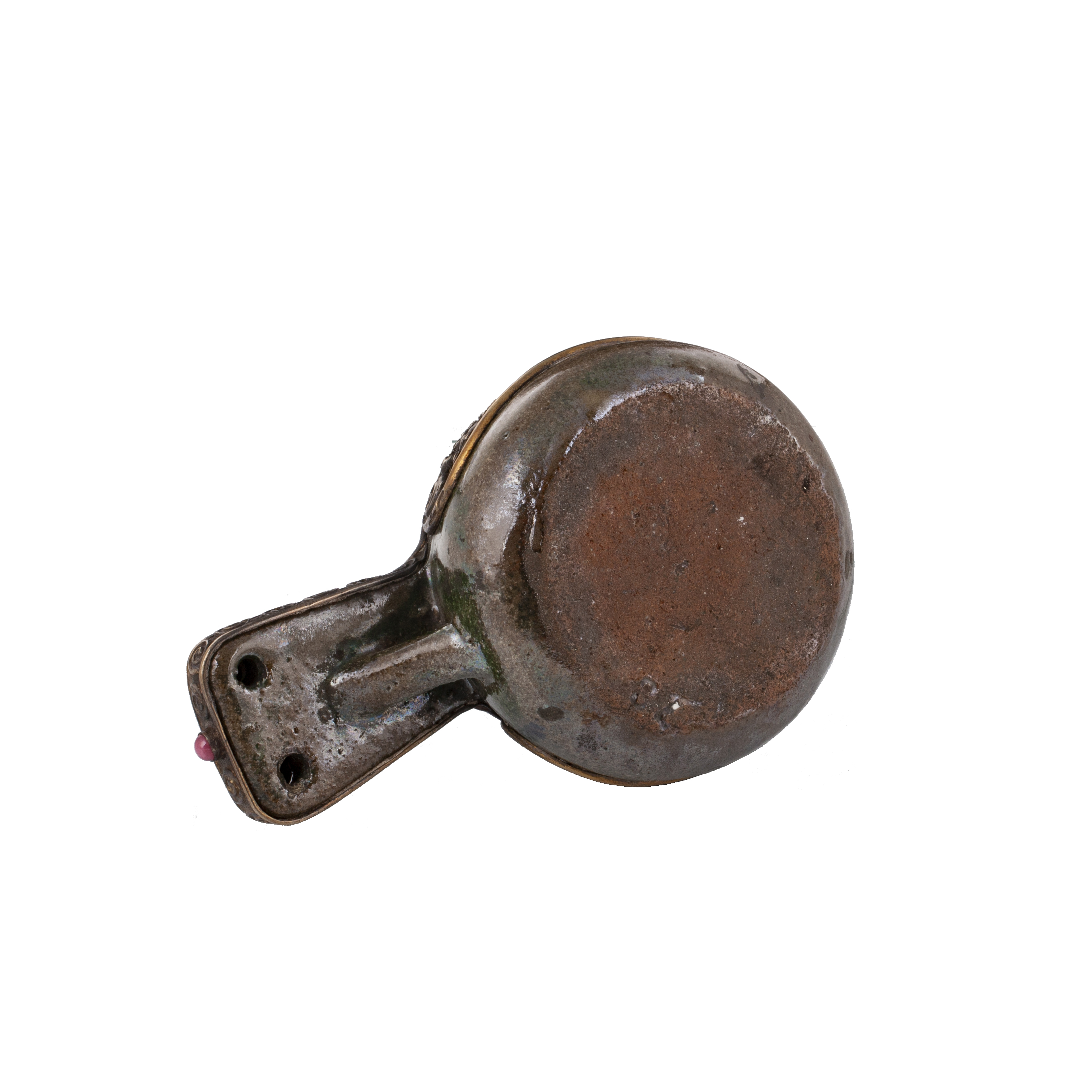
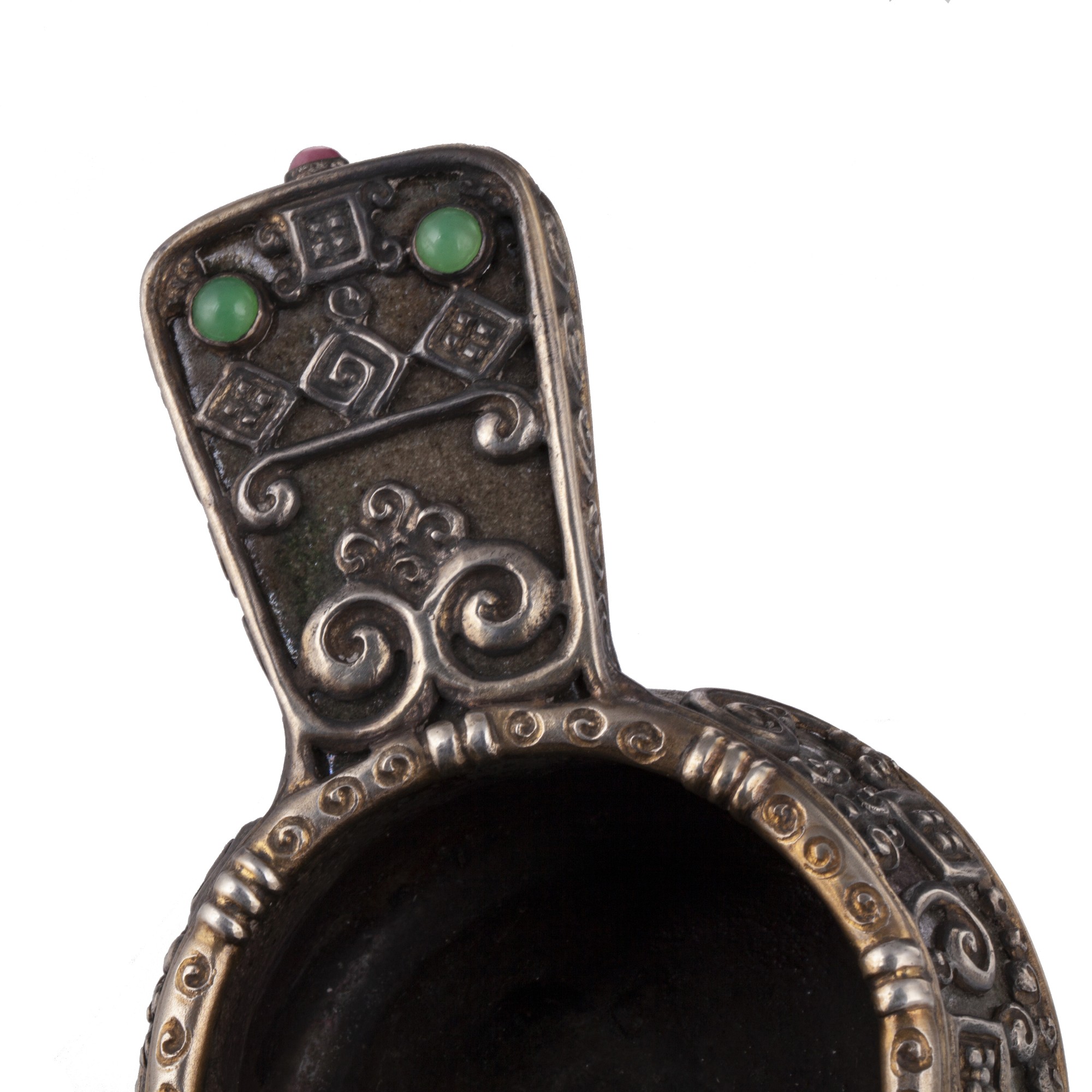
Estimate: 9000-12000€A Rare Fabergé Jewelled Silver-Mounted Ceramic Kovsh
Moscow, firm of Karl Fabergé, ceramic body attributed to the Imperial Stroganov School, 1908-1917.
Ceramic, silver, cabochon stones; moulding, glazing, casting, chasing, repoussé, stone setting.
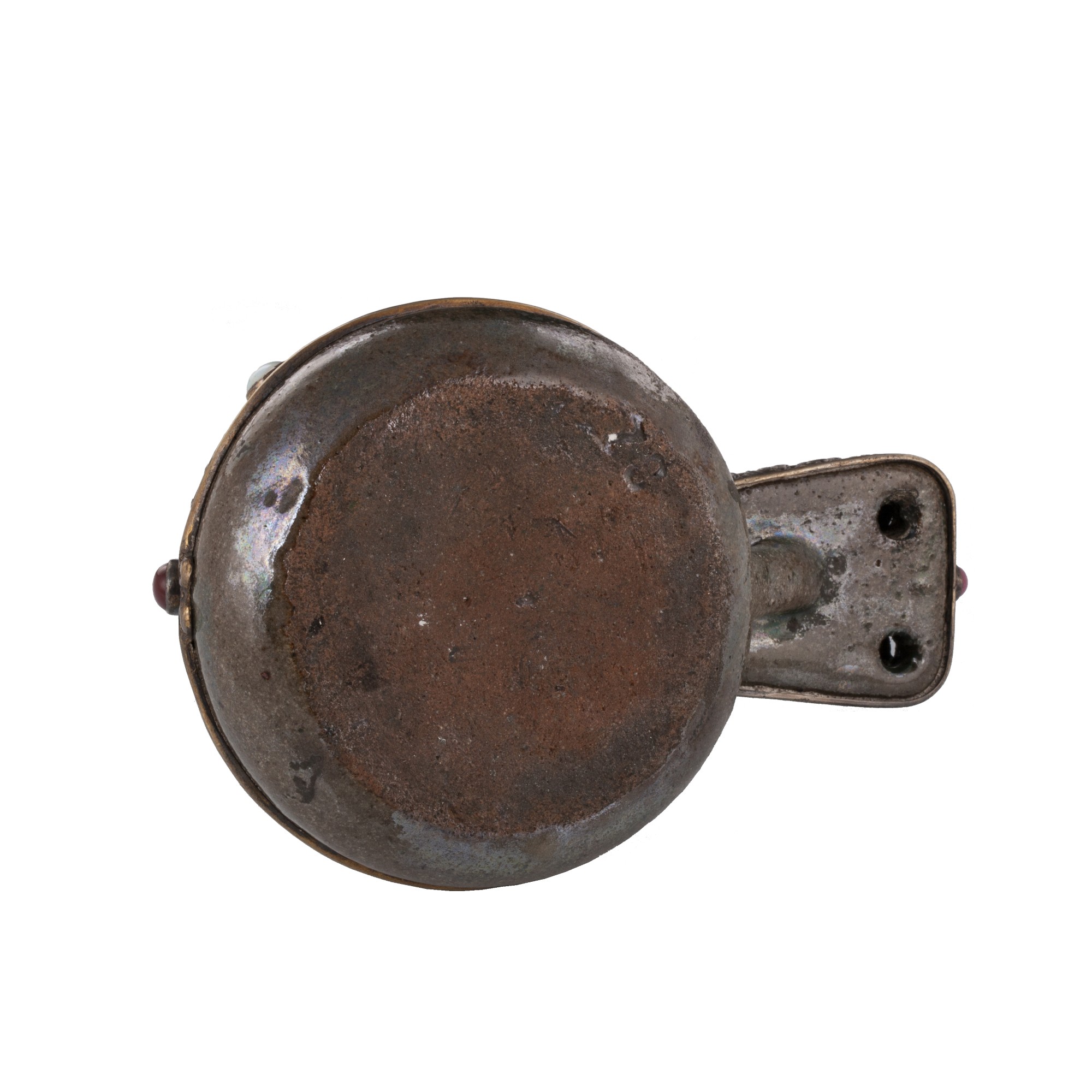
Dimensions: 5.4 × 14.2 × 9 cm.
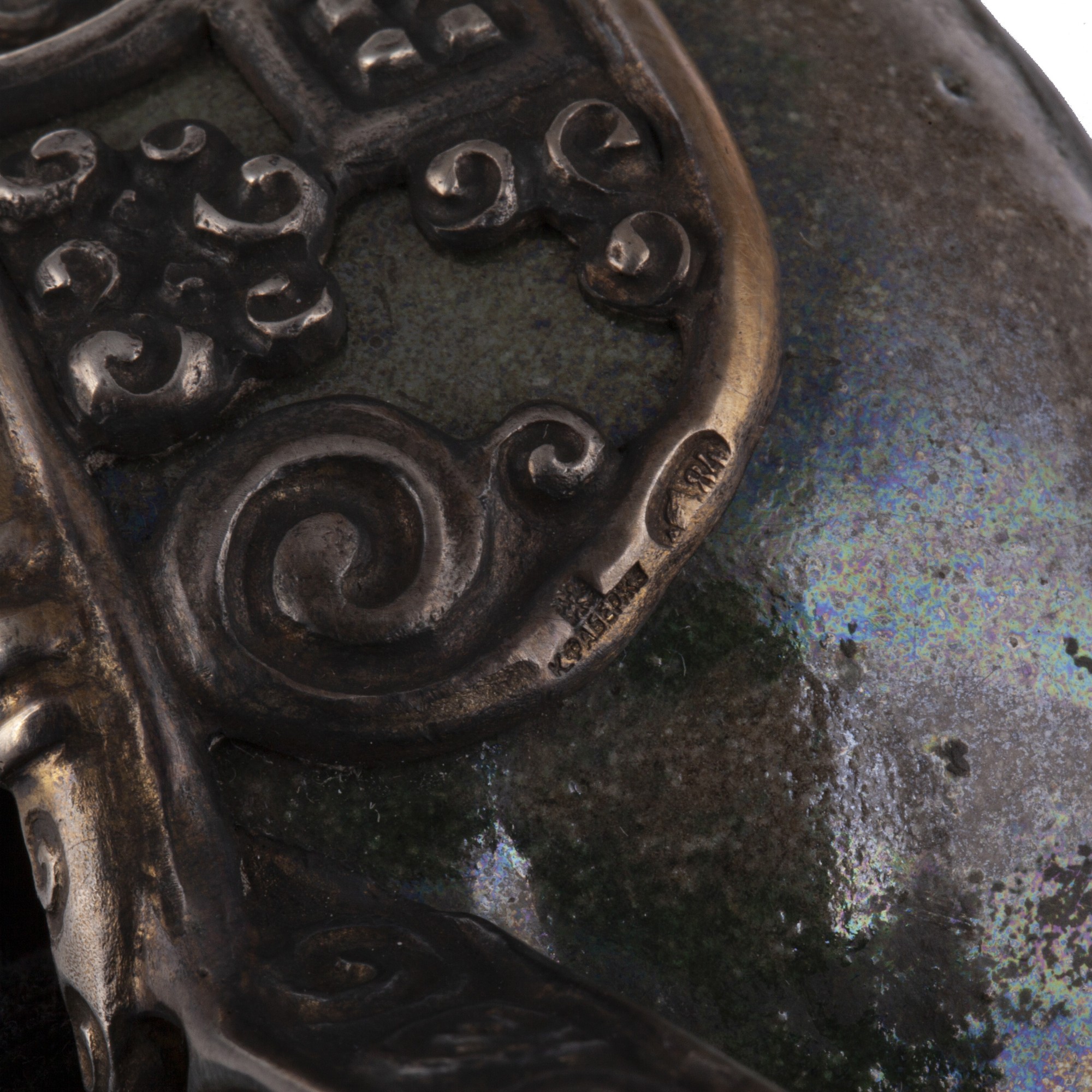
Marks: firm mark К. ФАБЕРЖЕ beneath the Imperial warrant; Moscow assay mark; 84 zolotniki silver standard.
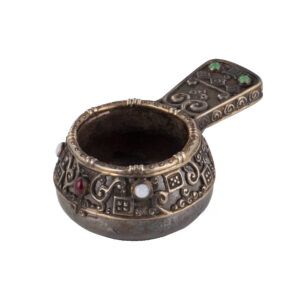
A rare kovsh of rounded bowl form with a broad flat handle, combining a dark glazed ceramic body with a richly worked silver mount. Around the upper register runs an applied silver band with dense relief ornament of scrolling tendrils, stylised geometric motifs and small cabochon stones, including green and red accents. The handle continues the same ornamental language, with raised silver scrolls and inset green cabochons.
The form refers to the traditional Russian kovsh, a ceremonial drinking vessel deeply associated with Muscovite court culture and national decorative idioms. Here, however, the type is reinterpreted through the artistic language of the early twentieth century: heavy ceramic mass, dark glaze, abstracted ornament and jewelled silver mounts create an object that belongs equally to the world of historical revival and Russian Art Nouveau.
The ceramic body associated with the production of the Imperial Stroganov School, whose workshops played an important role in the renewal of Russian applied arts around 1900. Such ceramic objects were sometimes mounted in silver by leading Moscow workshops, among them the firm of Fabergé.
The Moscow branch of Fabergé differed from the St Petersburg establishment in its stronger engagement with Russian national style and silver production. This was partly due to Moscow’s long-standing position as a centre of silversmithing and decorative metalwork. The firm employed and collaborated with artists and craftsmen connected with the Stroganov School, whose training combined drawing, modelling, metalwork, enamel and practical workshop experience. Students and teachers of the school worked with major Moscow firms, and the influence of the Stroganov artistic environment is clearly felt in the national-romantic and ornamental character of many Fabergé Moscow objects.
See similar objects: https://www.christies.com/en/lot/lot-5564848 https://www.sothebys.com/en/auctions/ecatalogue/2008/russian-art-n08428/lot.403.htmlStarting price: 8000€
Estimate: 9000-12000€
Hammer Price: 12 000 € -
Lot 0156
Russian Silver-Gilt and Cloisonné Enamel Beaker Set in Case (2 pcs), Moscow, 1908–1917
Estimate: 12000-15000€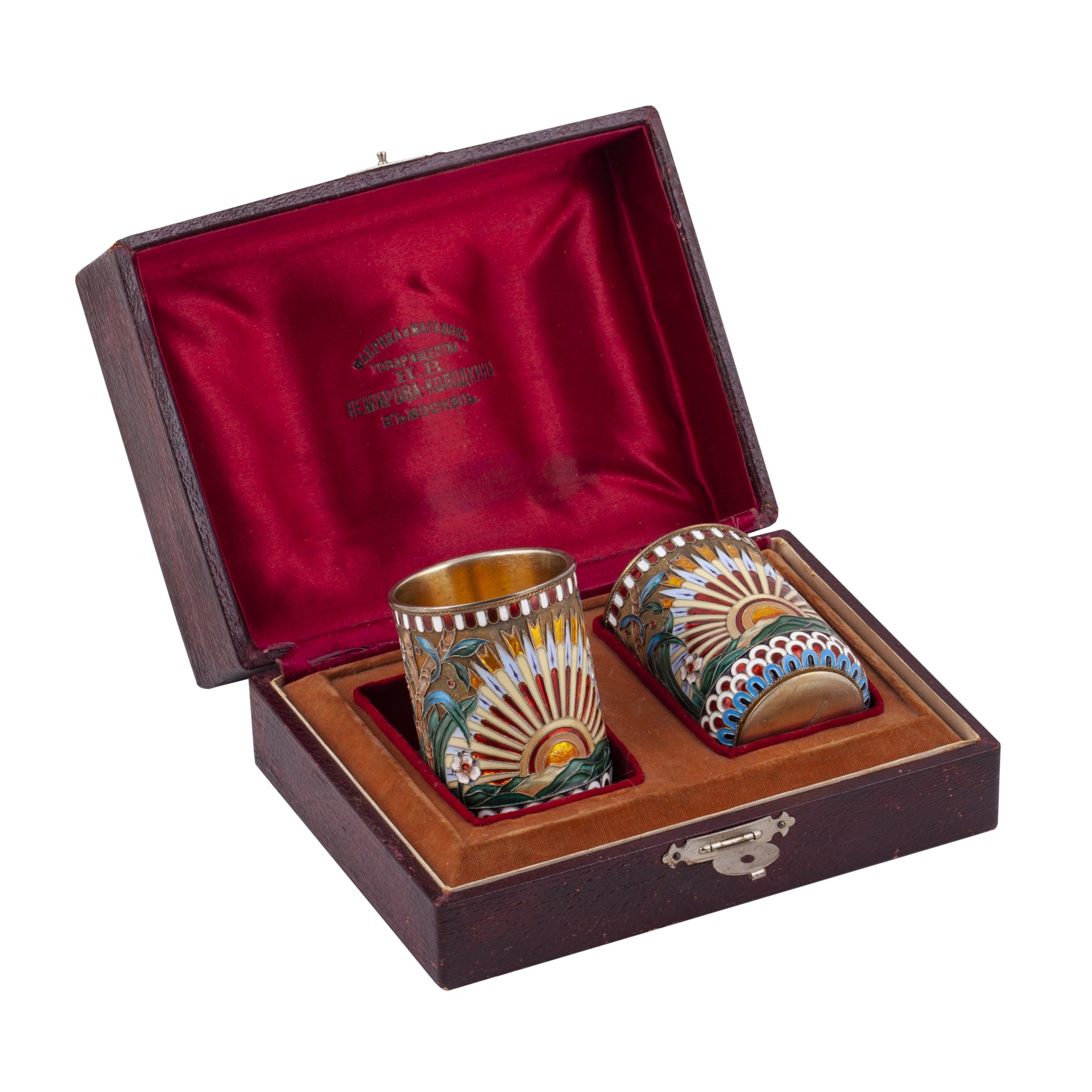
Lot 0156
Russian Silver-Gilt and Cloisonné Enamel Beaker Set in Case (2 pcs), Moscow, 1908–1917
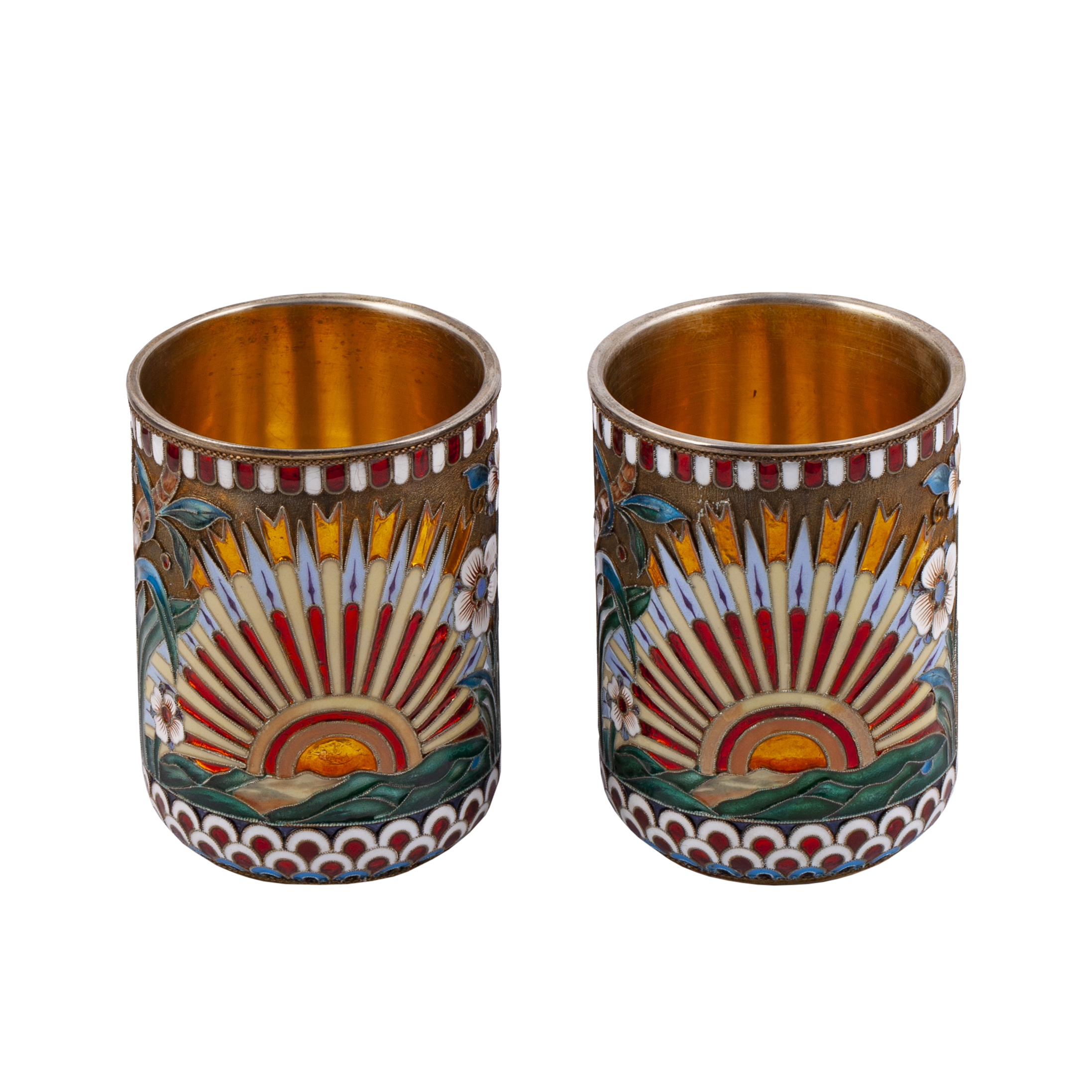
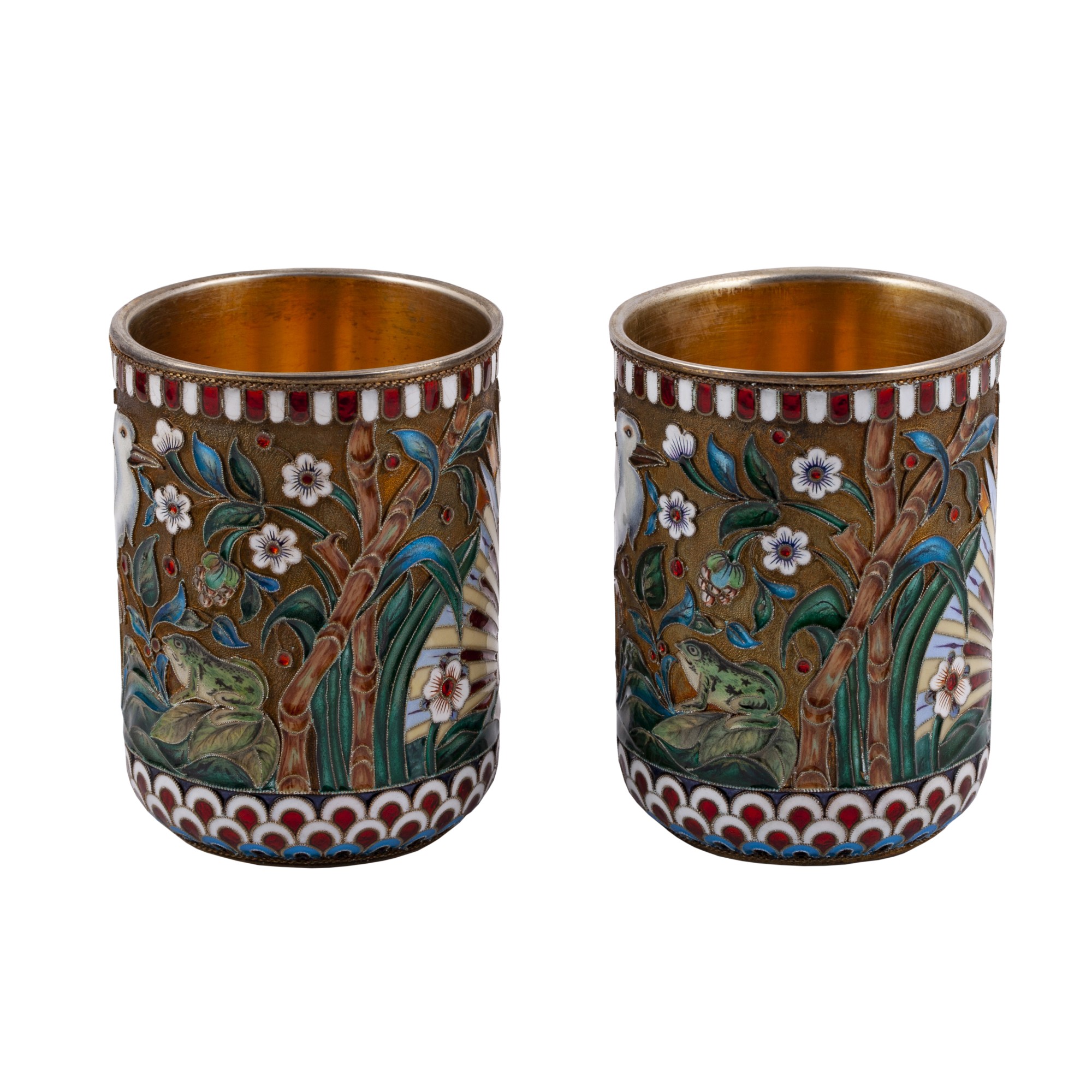
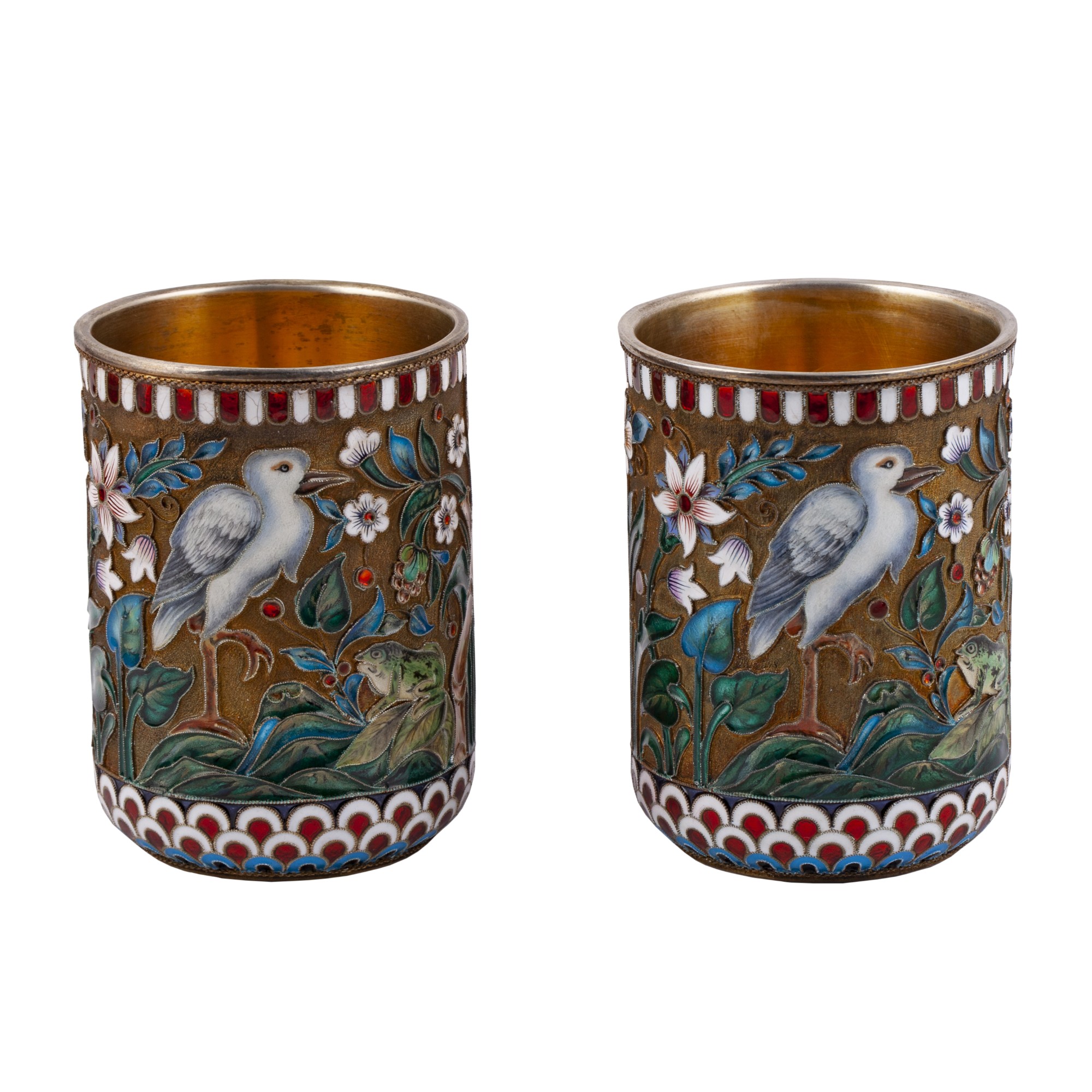
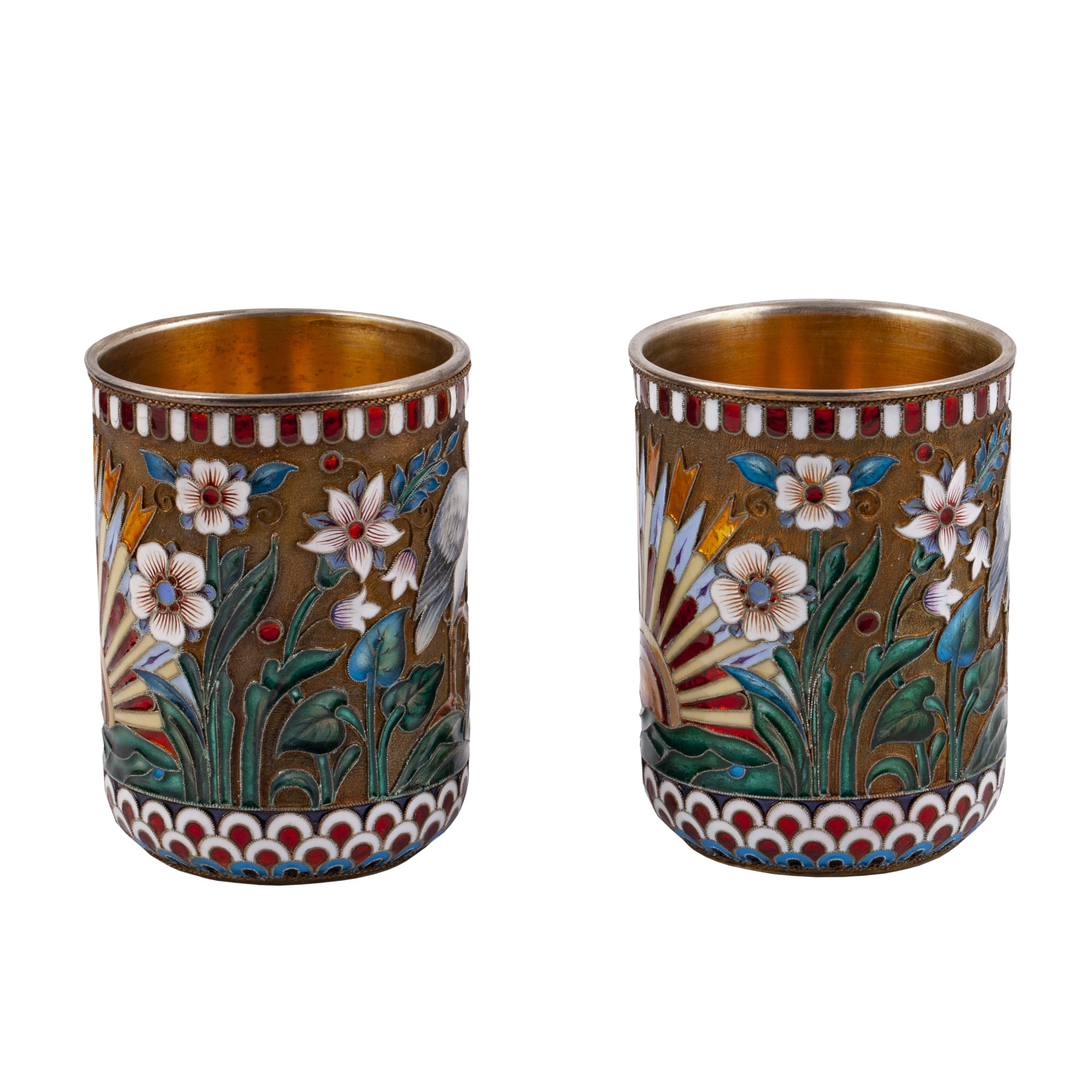
Estimate: 12000-15000€A rare Russian silver-gilt and cloisonné enamel beaker set, in the original fitted case.
Moscow, Third Moscow Artel, retailed by the firm of N. V. Nemirov-Kolodkin, 1908-1917.
Silver, gilding, cloisonné enamel; repoussé, filigree, enamelling, gilding.
Height of each beaker: 7.5 cm.
Total silver weight: 282.6 g.
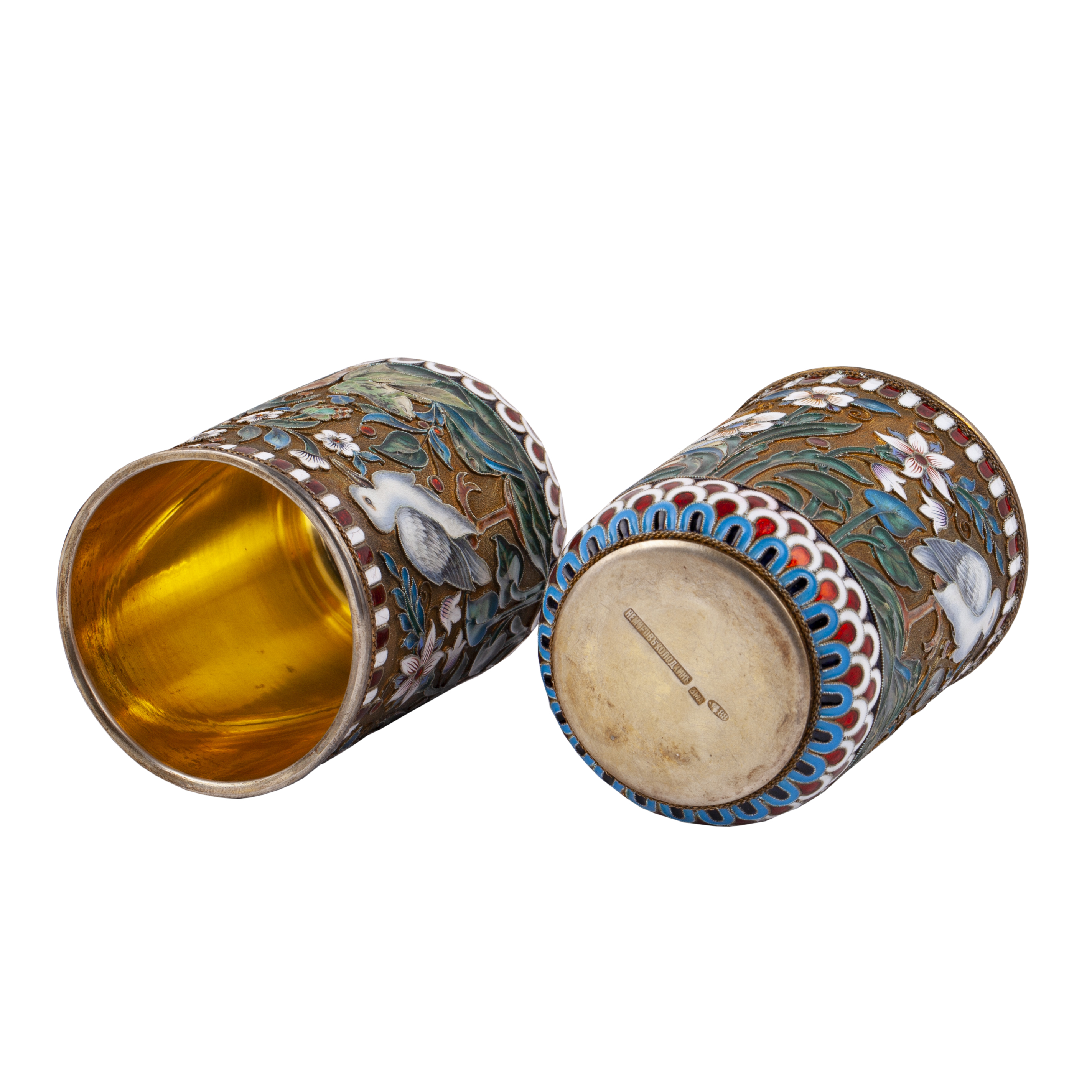
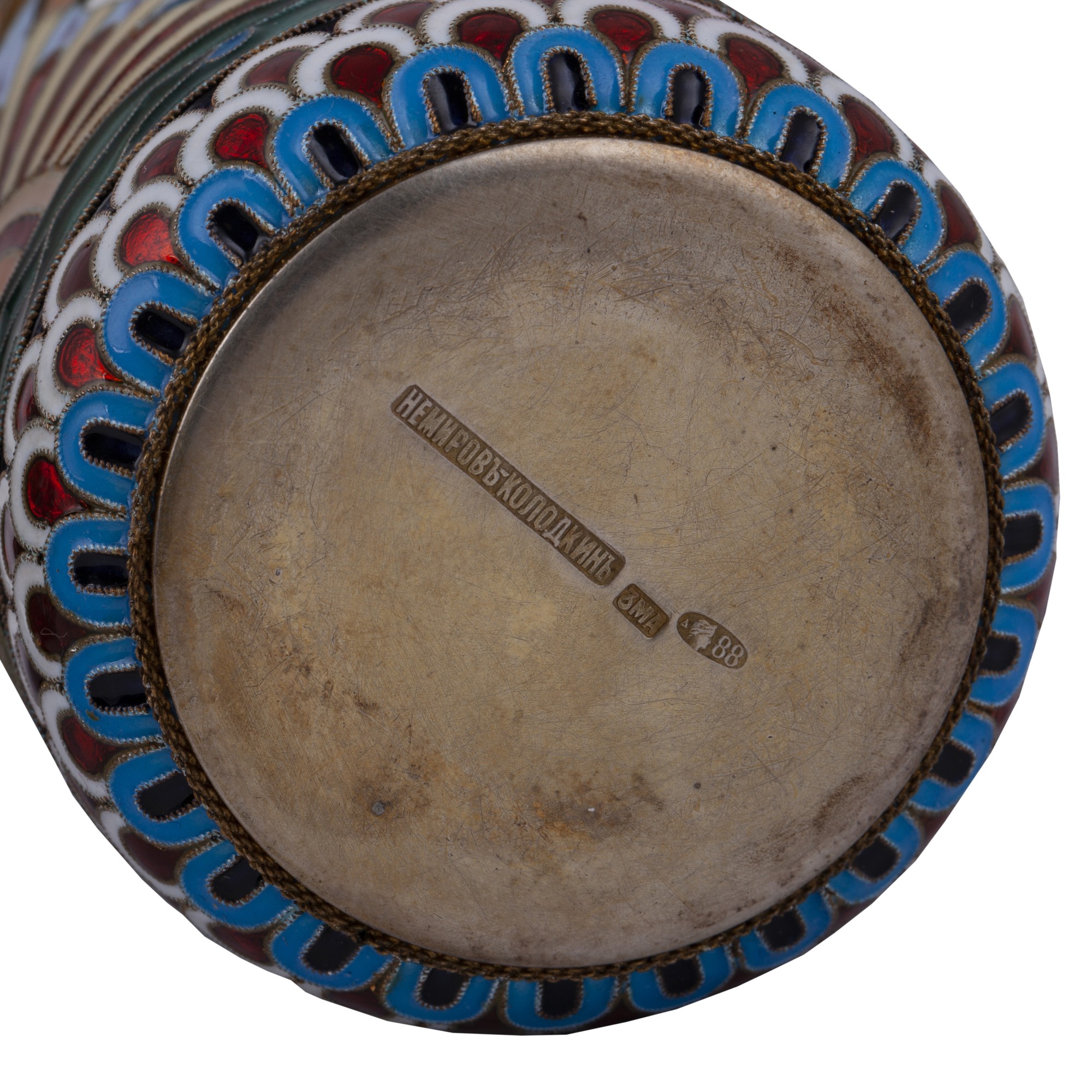
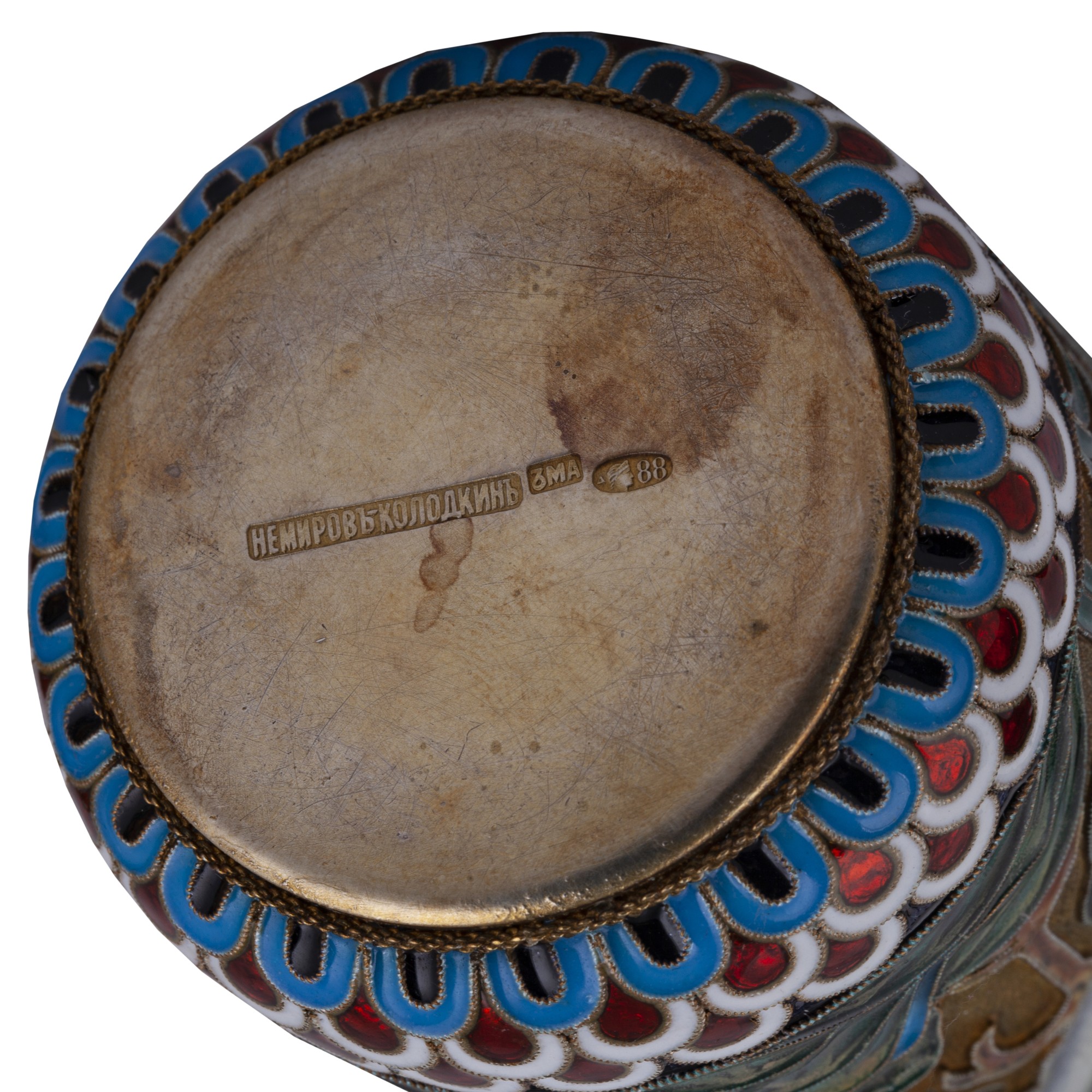
Marks: maker’s mark of the Third Moscow Artel, “3МА”; Moscow assay mark with 88 zolotnik silver standard; retailer’s mark “Немировъ-Колодкинъ”.
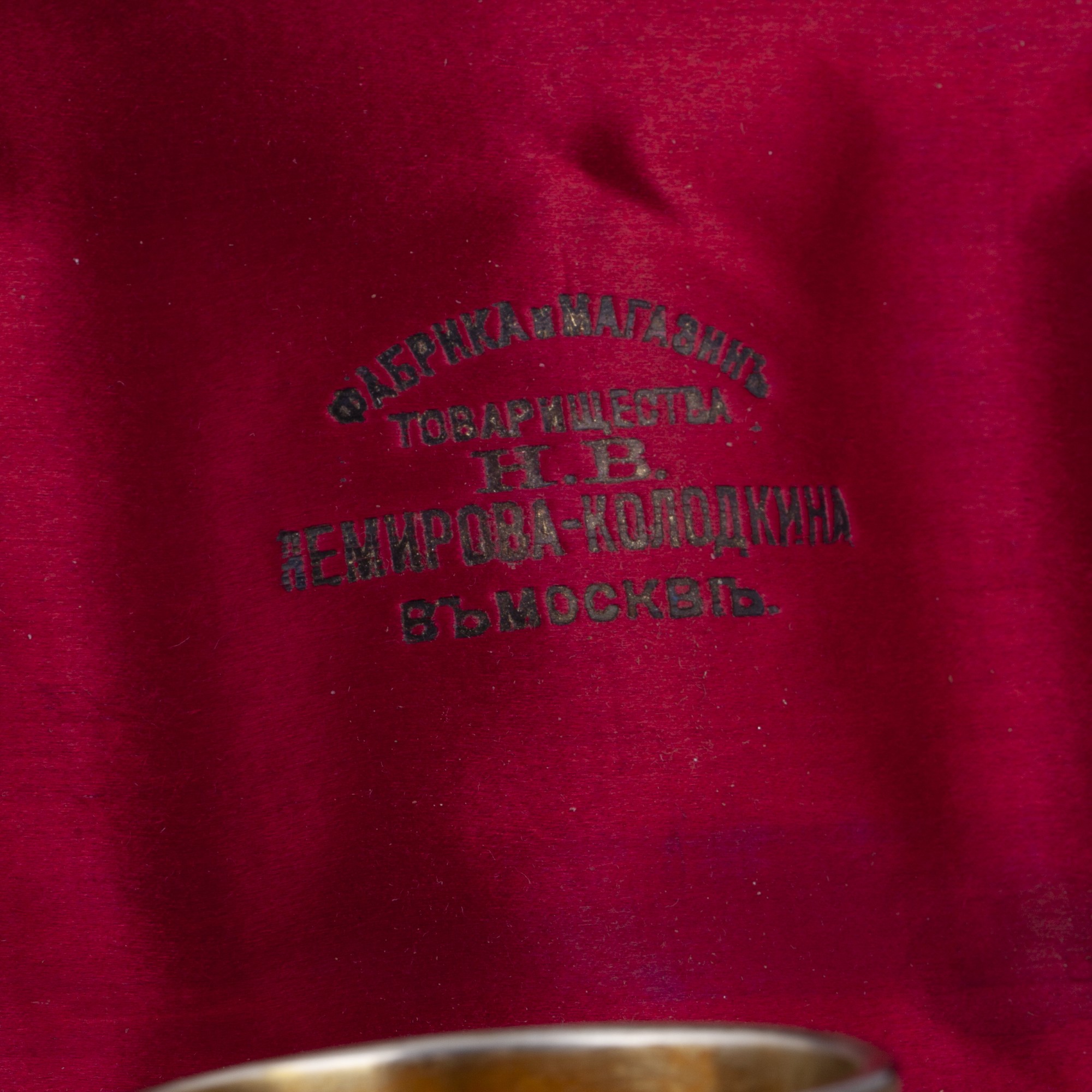
Case: original fitted wooden case, the interior stamped in Cyrillic: “Фабрика и магазинъ Товарищества Н. В. Немирова-Колодкина въ Москвѣ”.
A pair of cylindrical silver-gilt beakers, richly decorated in polychrome cloisonné enamel and holds in the original fitted presentation case.
The principal reserve is made by a stylised sunrise over rolling hills, its radiating rays rendered in red, cream, pale blue and amber enamel. The reverse side is decorated with a poetic naturalistic scene: a white bird standing among flowering branches and broad green leaves, with a small frog below. The composition combines the ornamental language of the neo-Russian style with the decorative refinement of Moscow Art Nouveau. The upper and lower borders are formed by repeated scalloped and arched enamel motifs in white, red, turquoise and dark blue, creating a rhythmic frame around the central scenes.
The set was produced by the Third Moscow Artel, one of the most accomplished Moscow silver workshops of the late Imperial period. Artel production occupied a significant place in Russian decorative art of the early twentieth century, particularly in the field of enamelled silver. Many such workshops were connected with the same professional milieu that supplied or had previously worked for the great Moscow and St Petersburg firms, including Fabergé, Ovchinnikov and Khlebnikov.
The retailer, N. V. Nemirov-Kolodkin, belonged to the important circle of Moscow suppliers of silver and luxury objects. Founded by Nikolai Vasilievich Nemirov-Kolodkin, merchant, jeweller and philanthropist, the firm became known for high-quality silver tableware and presentation pieces. From the late nineteenth century it supplied silver objects for the Imperial household, commissioning work from selected Moscow workshops and artels according to the character of each order.Starting price: 10000€
Estimate: 12000-15000€
Hammer Price: Not sold -
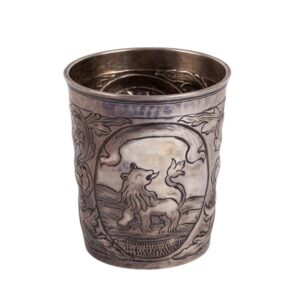
Lot 0157
Russian Silver Stopka (Charka), Moscow, Russia, 1757, 18th Century
Estimate: 1000-1200€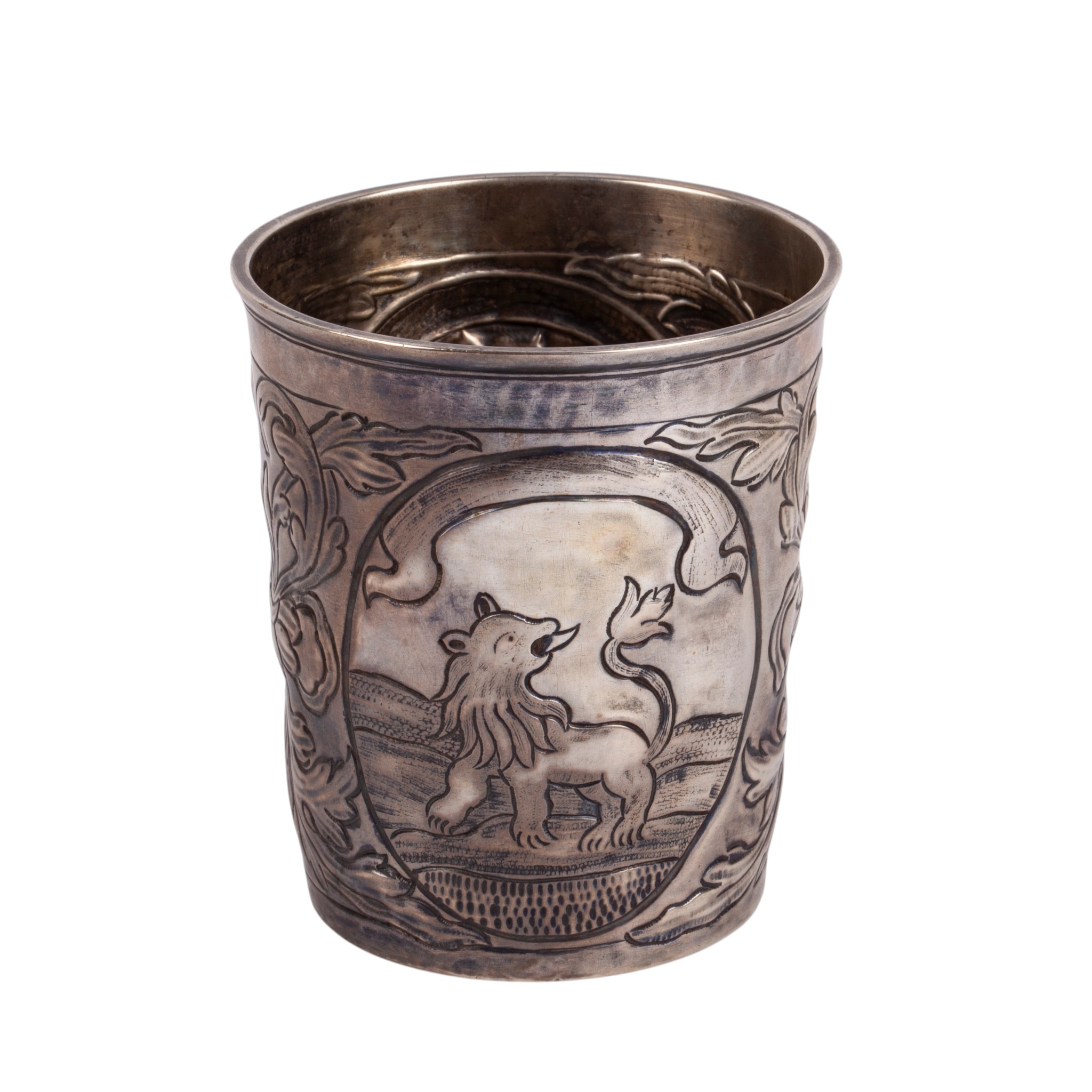
Lot 0157
Russian Silver Stopka (Charka), Moscow, Russia, 1757, 18th Century
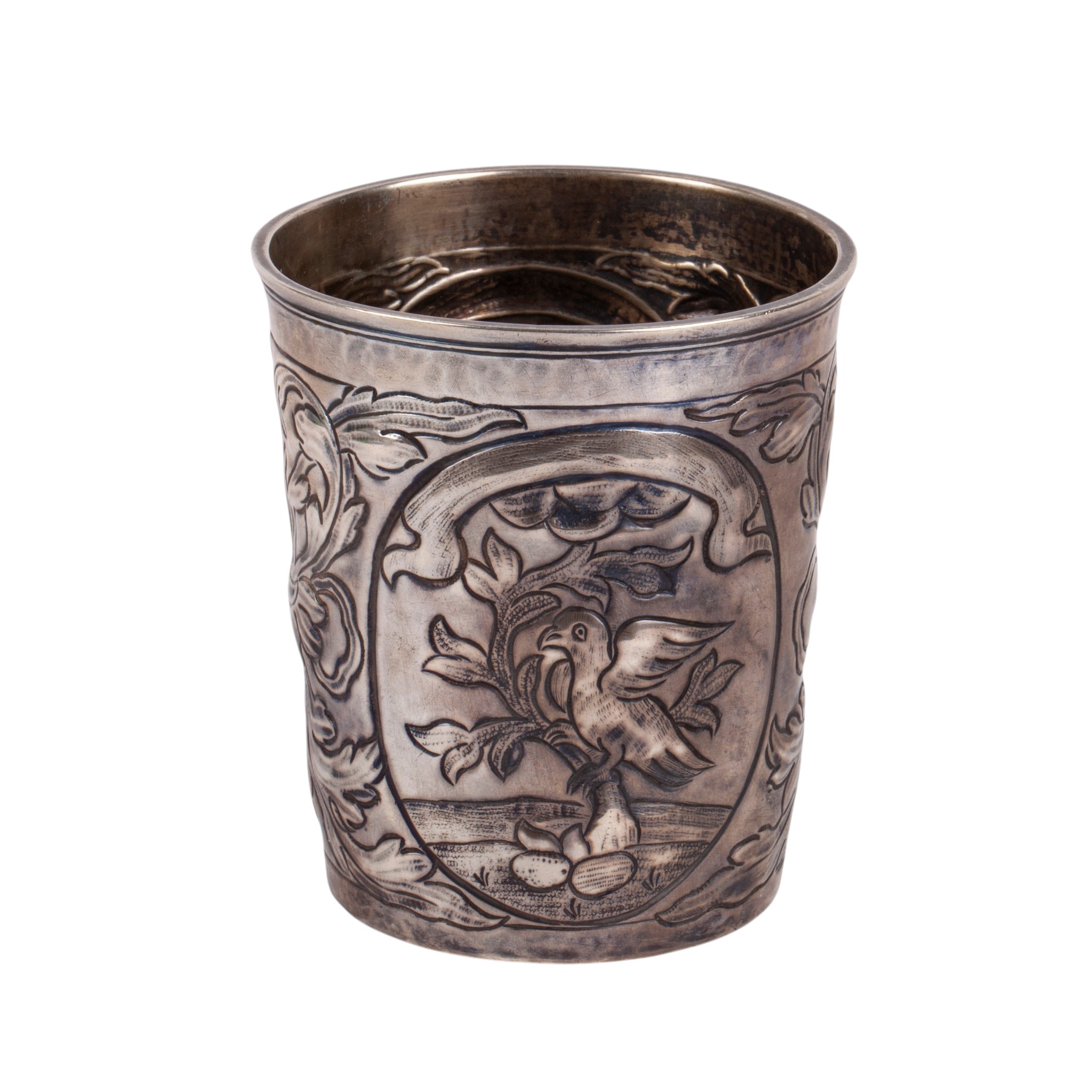
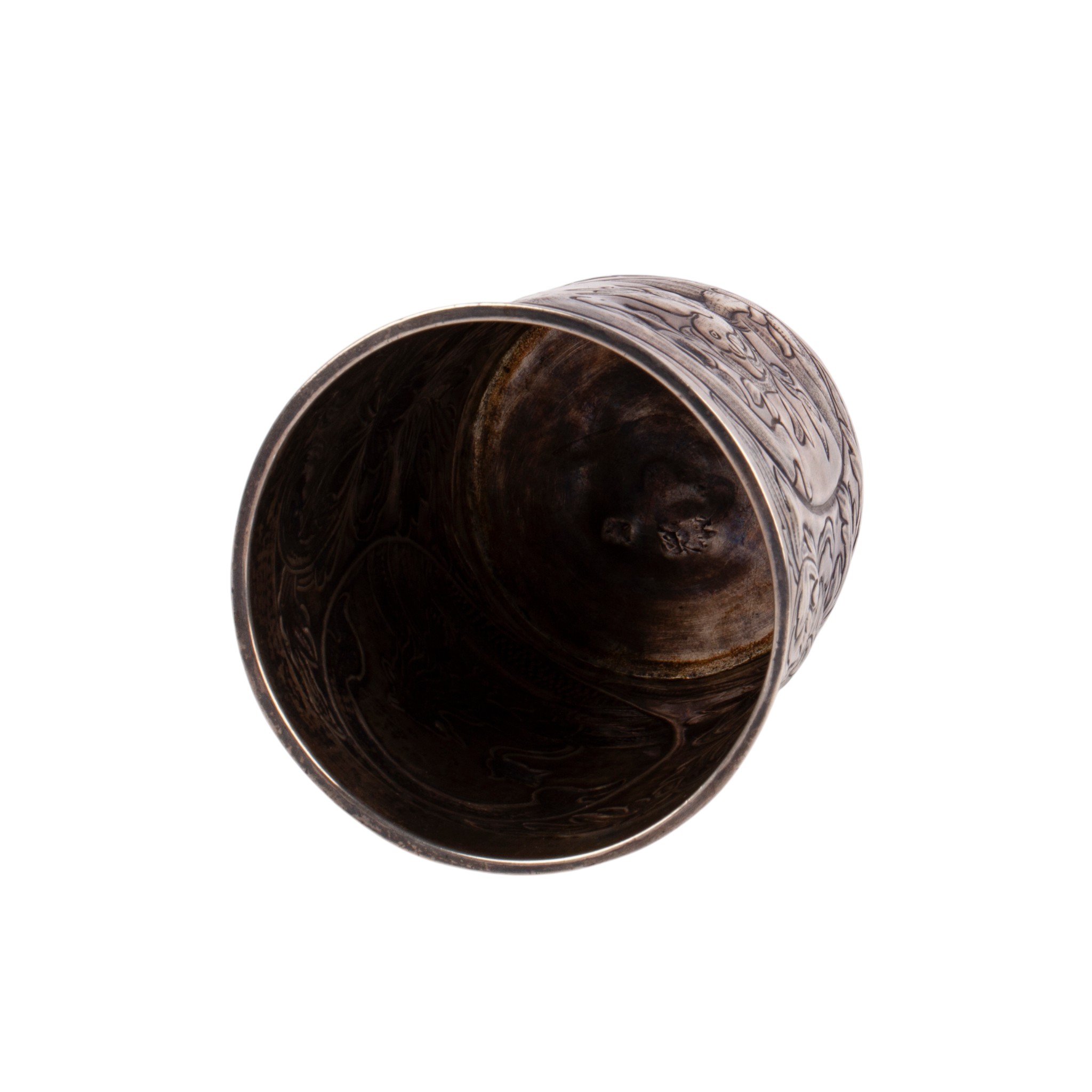
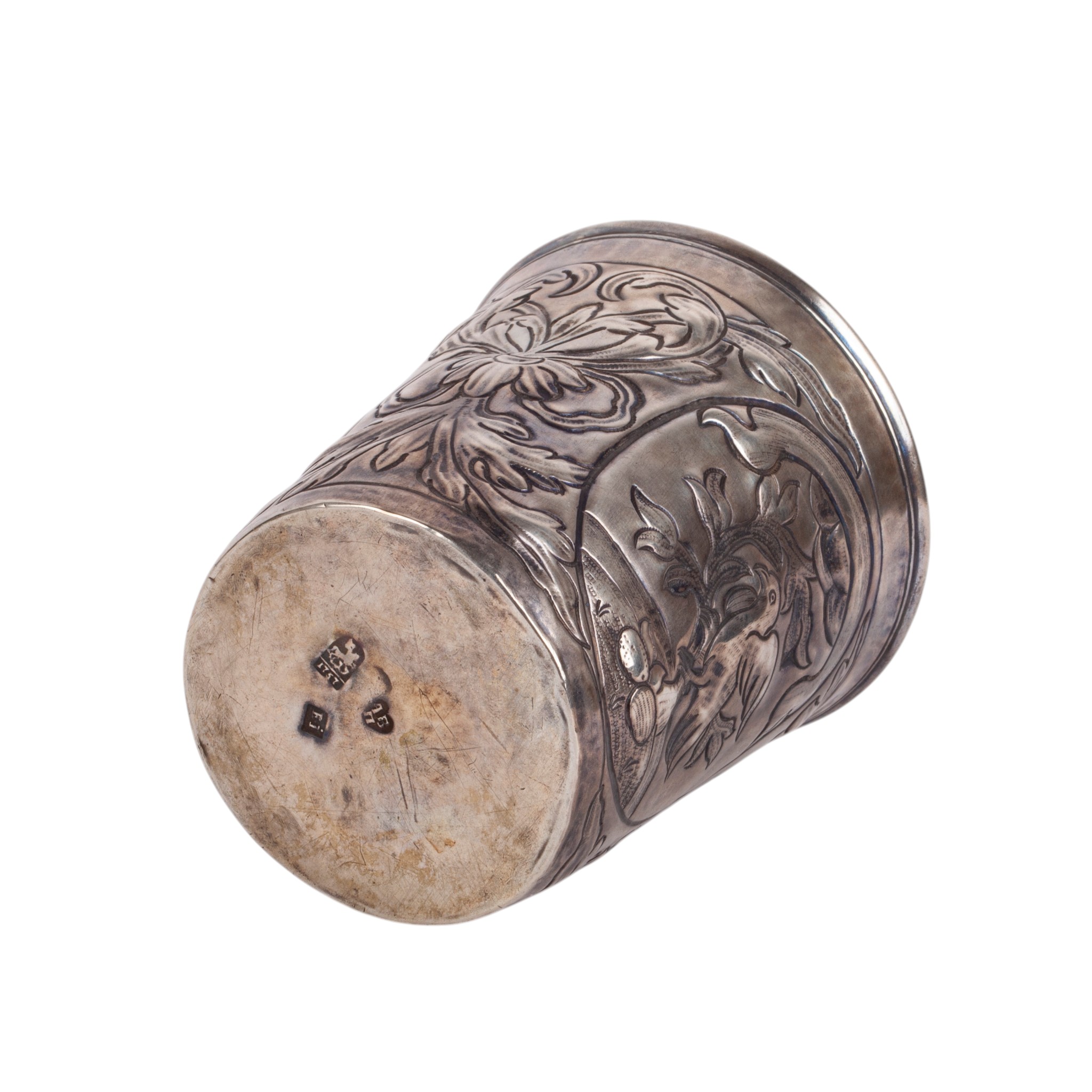
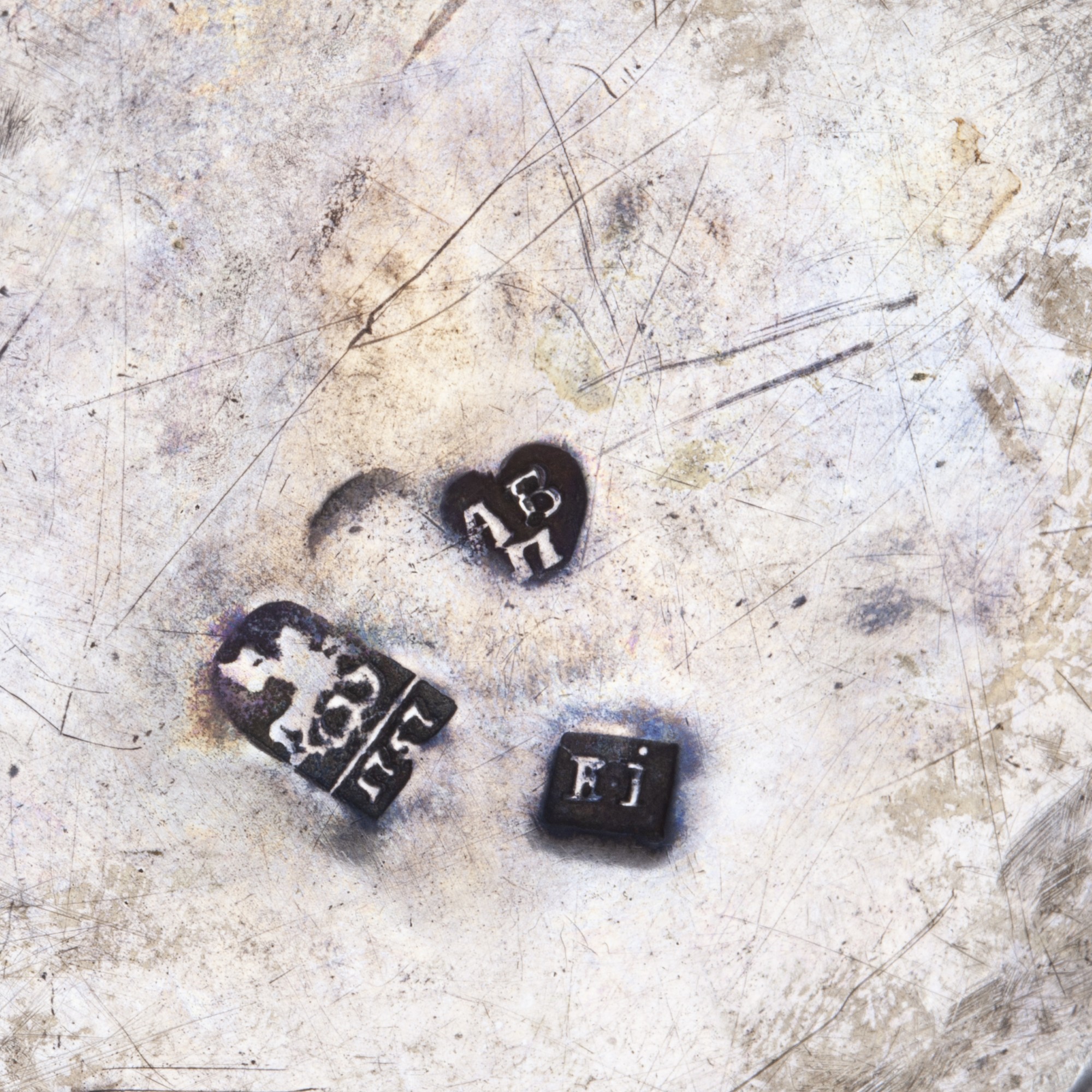
Estimate: 1000-1200€Russian silver stopka / charka, Moscow, 1757, 18th century. Of tapering cylindrical form, finely chased and engraved with rocaille ornament and cartouches enclosing allegorical and heraldic-style motifs, including a lion and a bird among floral scrollwork. A fine mid-18th century drinking vessel with gilt interior.
Height: 8 cm
Weight: 84.4 gStarting price: 700€
Estimate: 1000-1200€
Hammer Price: Not sold -
Lot 0158
Russian Silver Stopka (Charka), Kostroma, Russia, 1769–1813, 18th–Early 19th Century
Estimate: 1000-1200€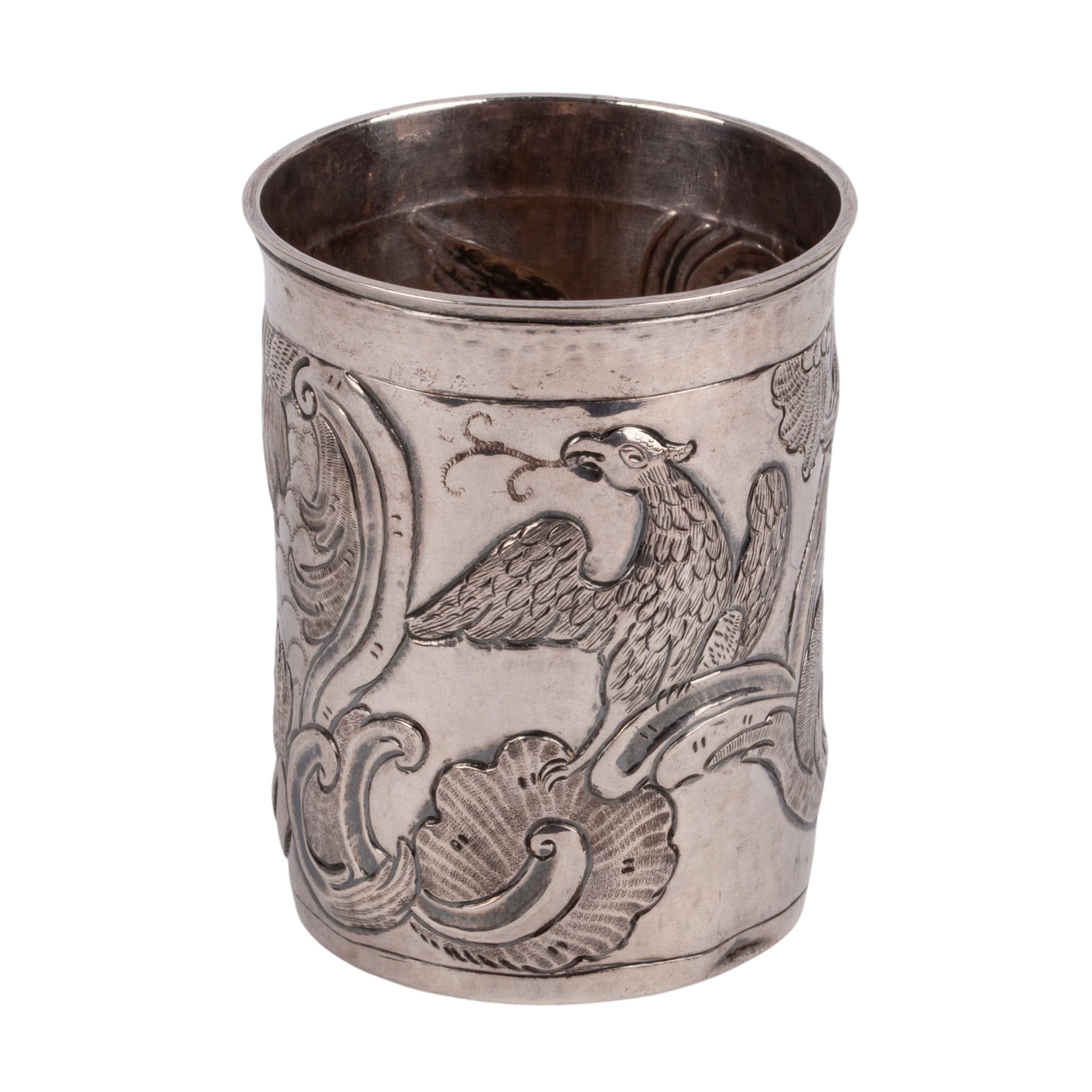
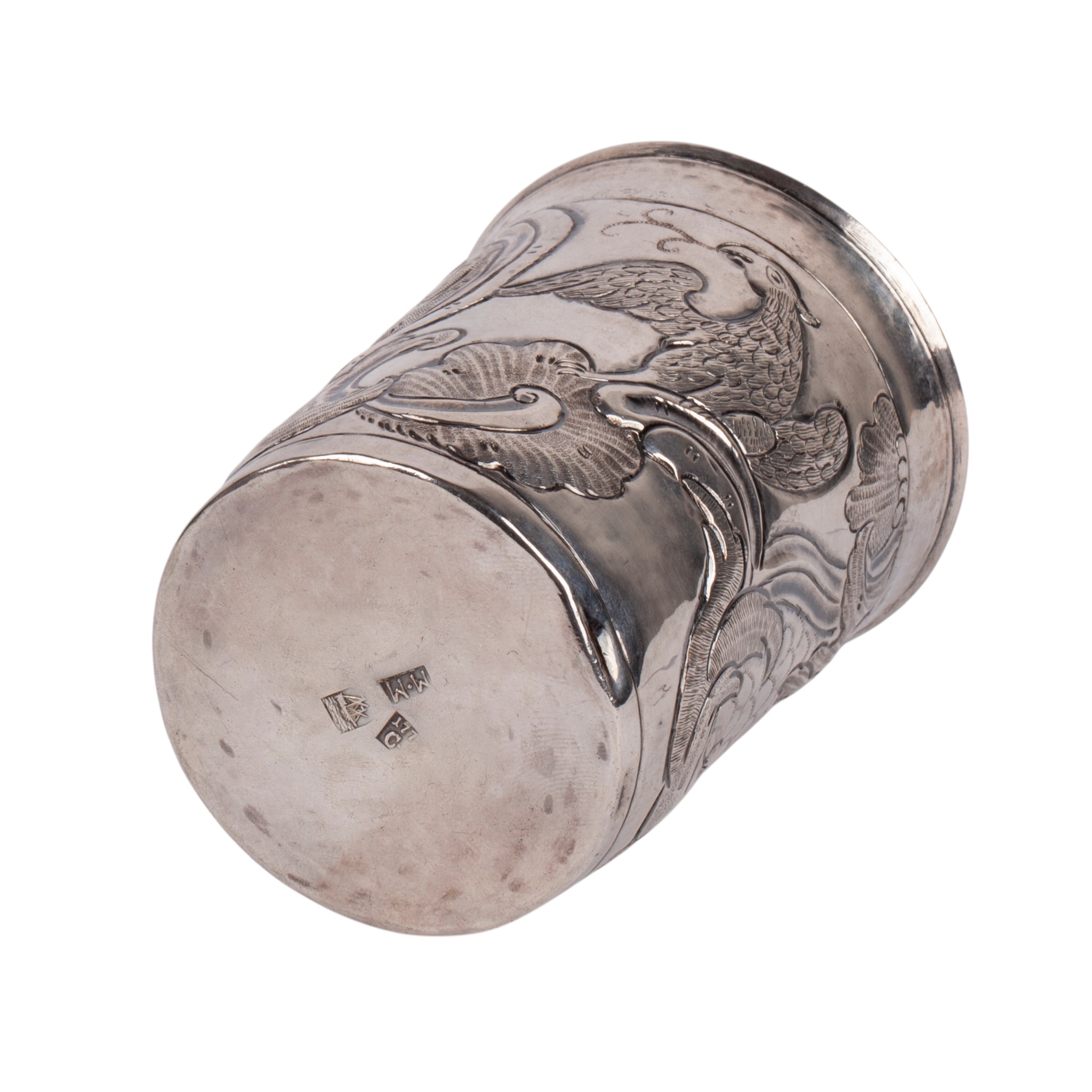
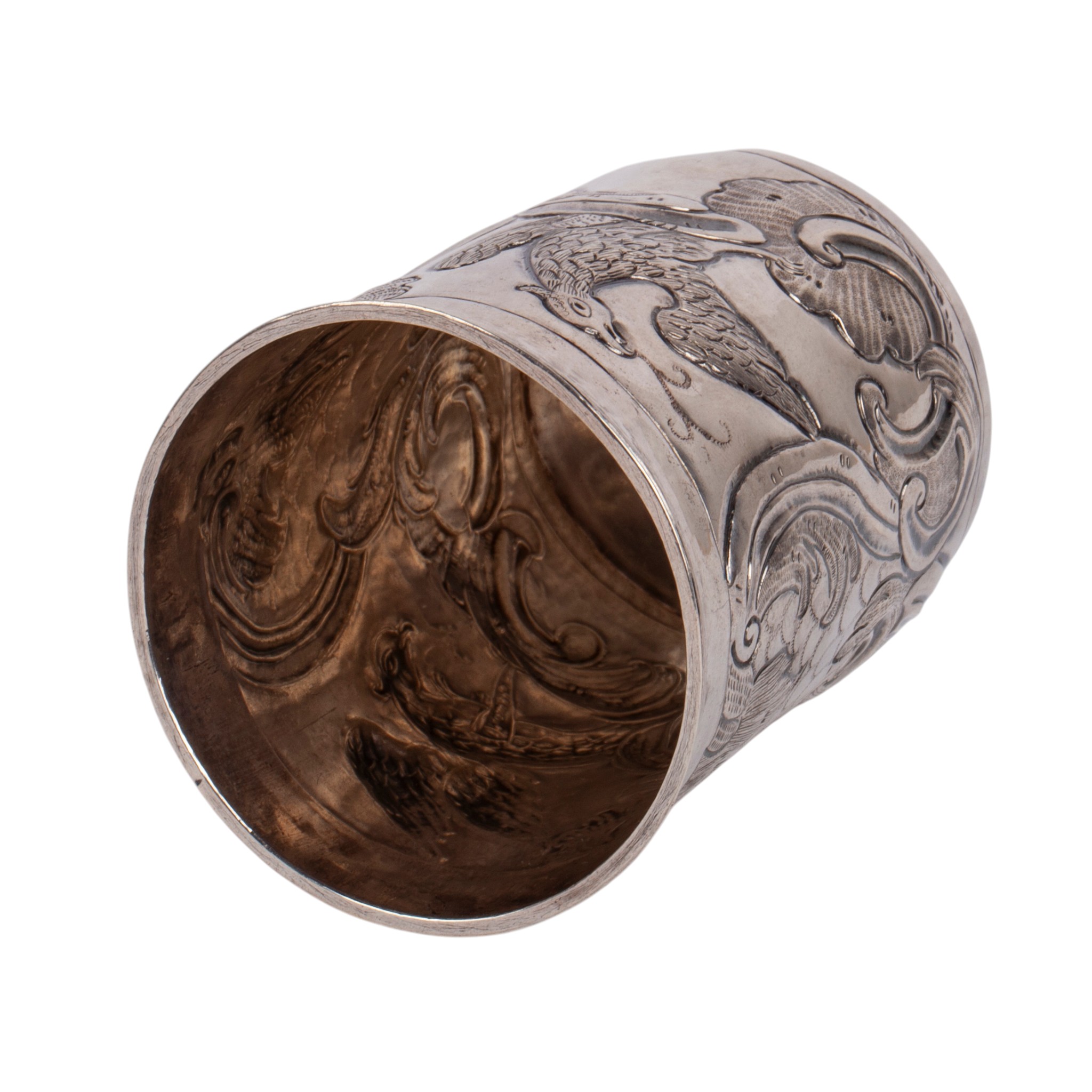
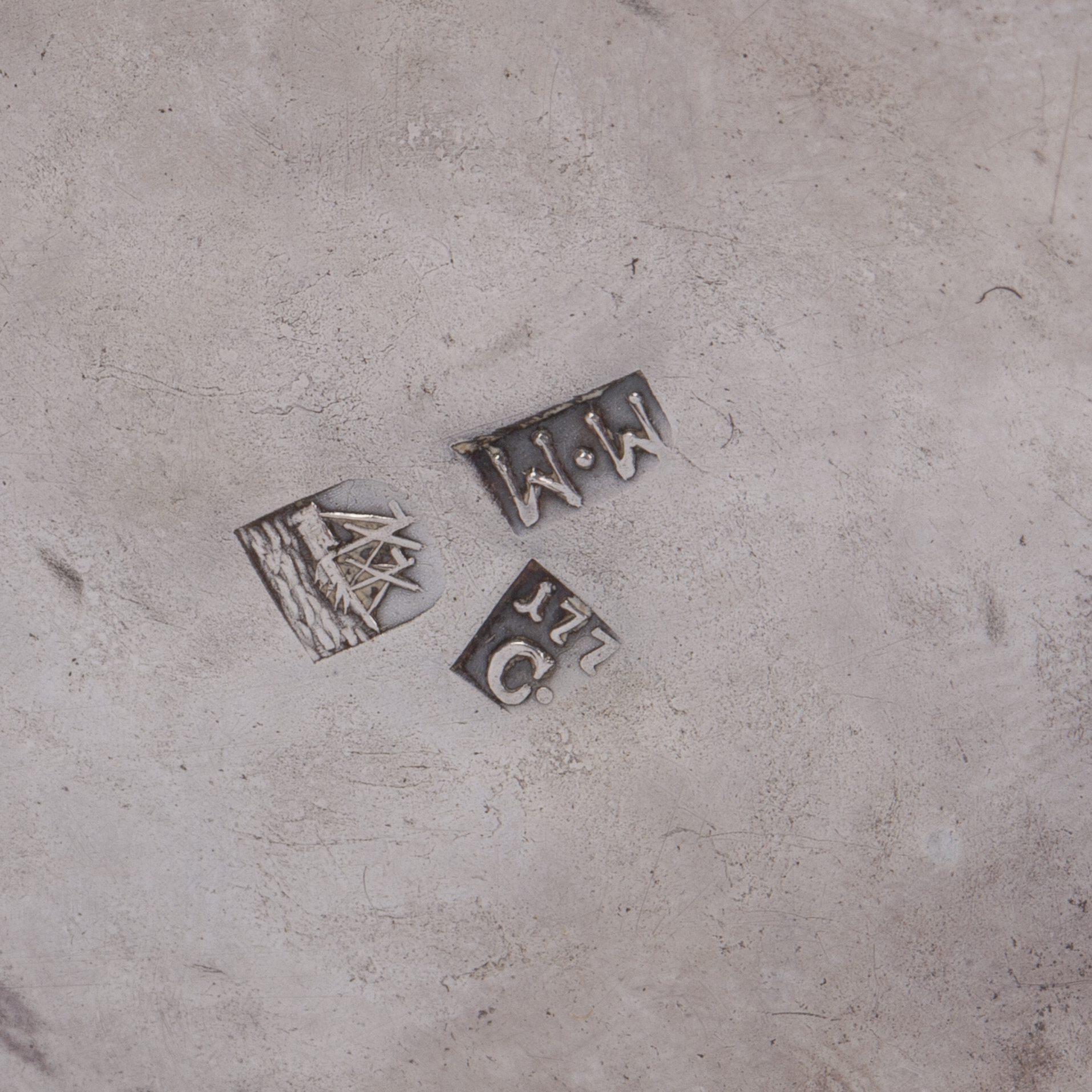
Lot 0158
Russian Silver Stopka (Charka), Kostroma, Russia, 1769–1813, 18th–Early 19th Century
Estimate: 1000-1200€Russian silver stopa / charka, Kostroma, 1769–1813, 18th–early 19th century. Of tapering cylindrical form, finely engraved and chased with bold scrolling ornament and cartouches enclosing stylized birds and foliate motifs. Gilt interior.
Height: 7.6 cm
Weight: 68.2 gStarting price: 800€
Estimate: 1000-1200€
Hammer Price: Not sold -
Lot 0159
Russian Silver Stopka (Charka), Moscow, Russia, 1781, 18th Century
Estimate: 1100-1300€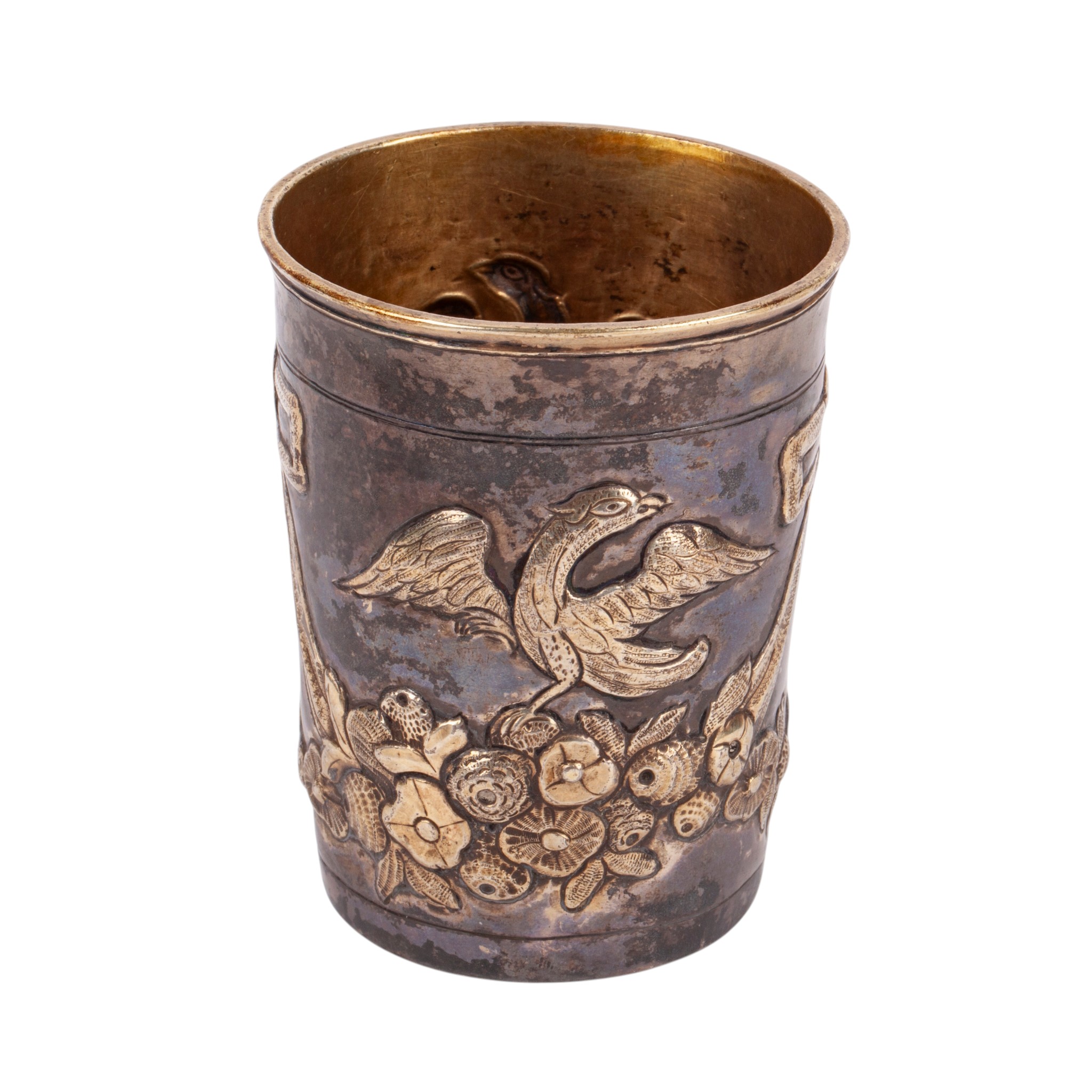
Lot 0159
Russian Silver Stopka (Charka), Moscow, Russia, 1781, 18th Century
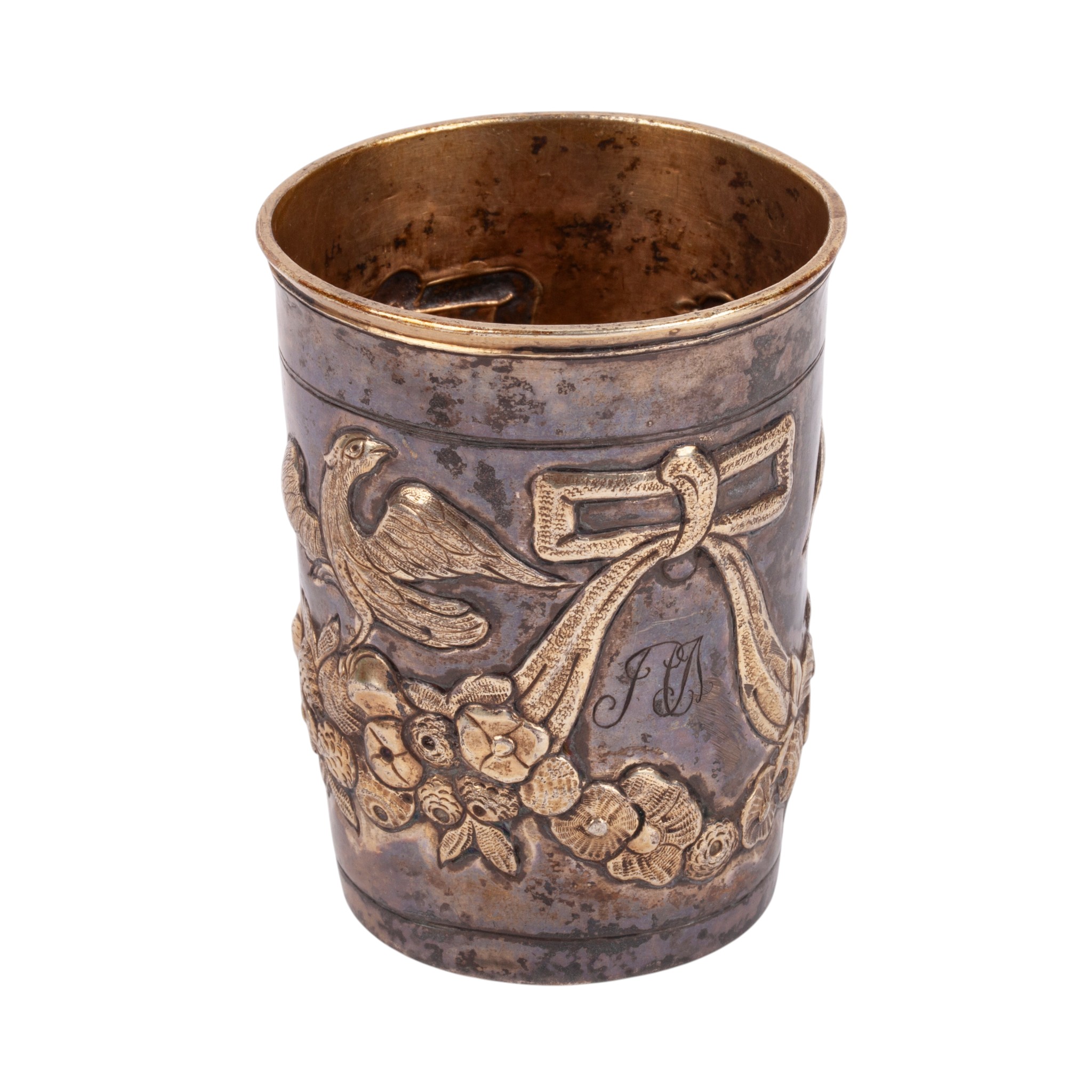
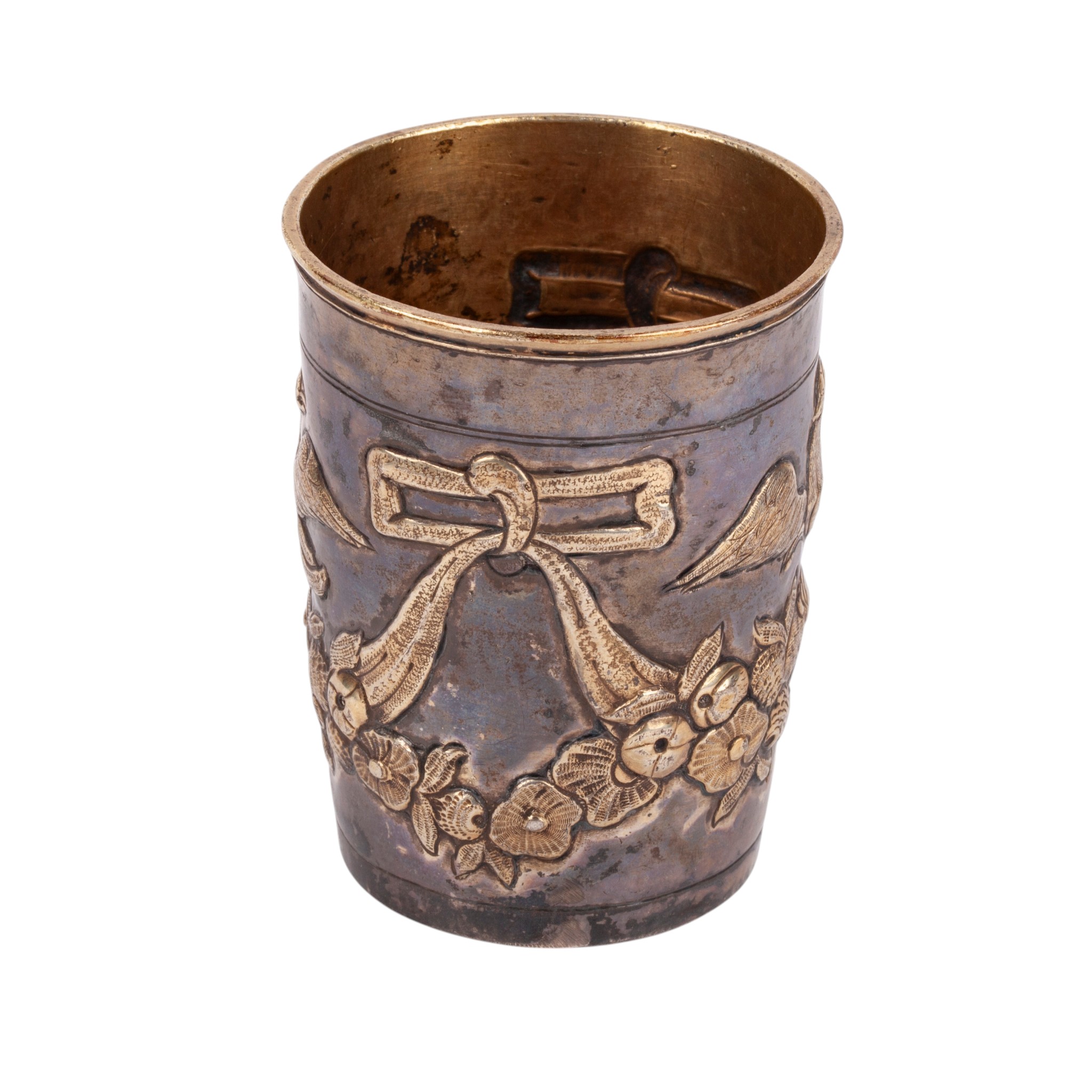
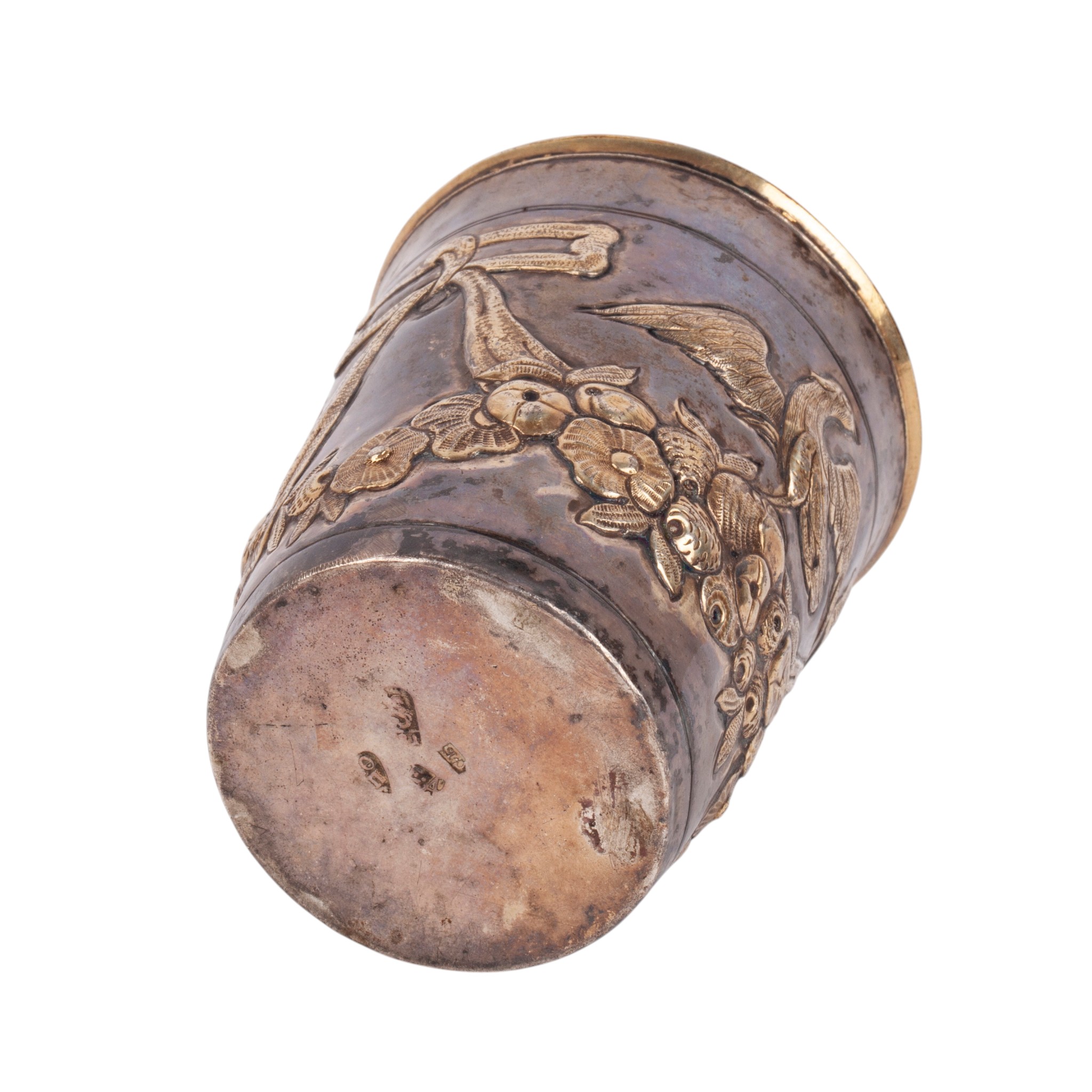
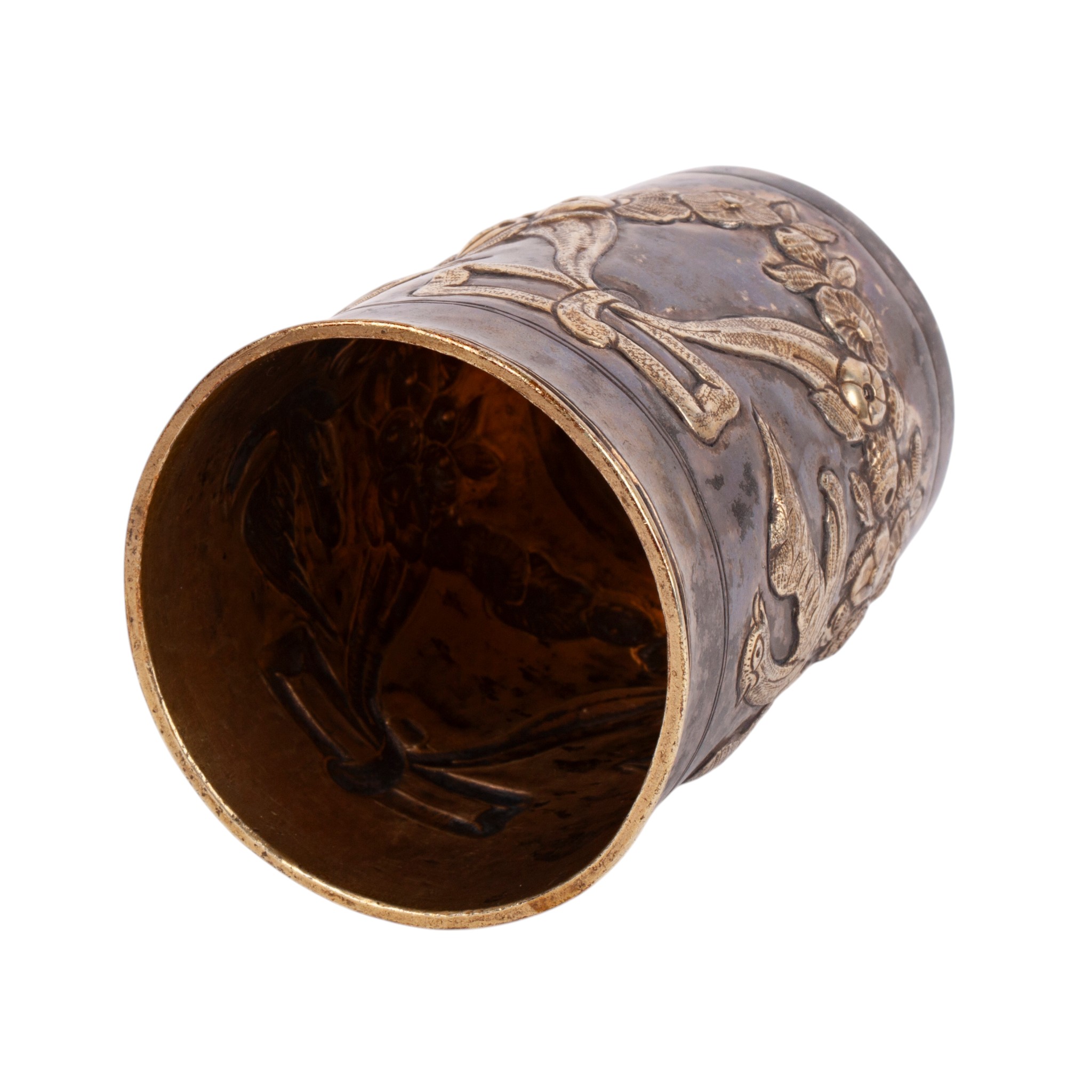
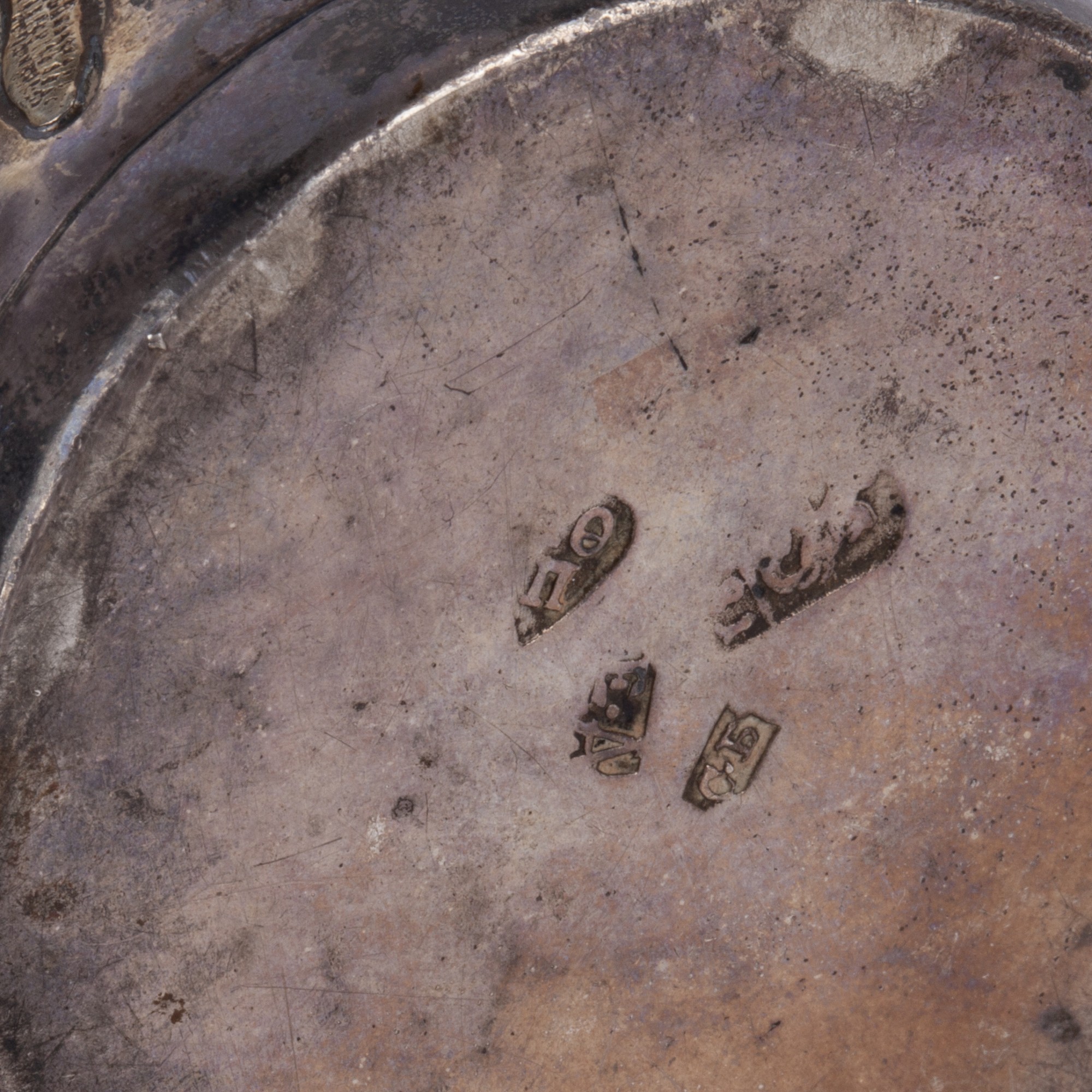
Estimate: 1100-1300€Russian silver stopa / charka, Moscow, 1781, 18th century. Of cylindrical form with gilt interior, richly decorated in relief with birds, ribbons and floral garlands, and engraved with monogram PA. Marked to the base.
Height: 8 cm
Weight: 75 gStarting price: 900€
Estimate: 1100-1300€
Hammer Price: Not sold -
Lot 0160
Fabergé Silver-Gilt Beaker in the 18th-Century Taste, St Petersburg, late 19th century
Estimate: 1500-1700€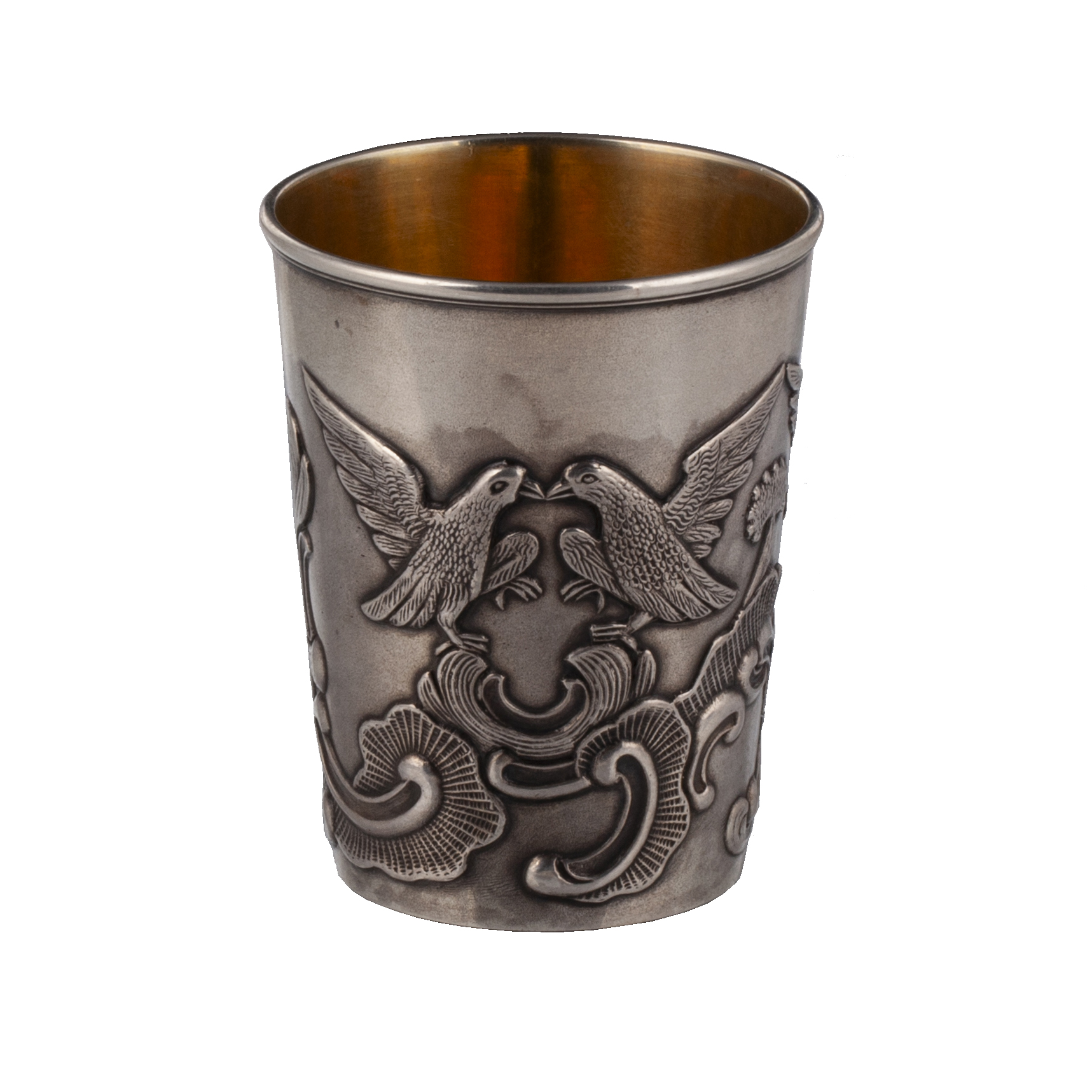
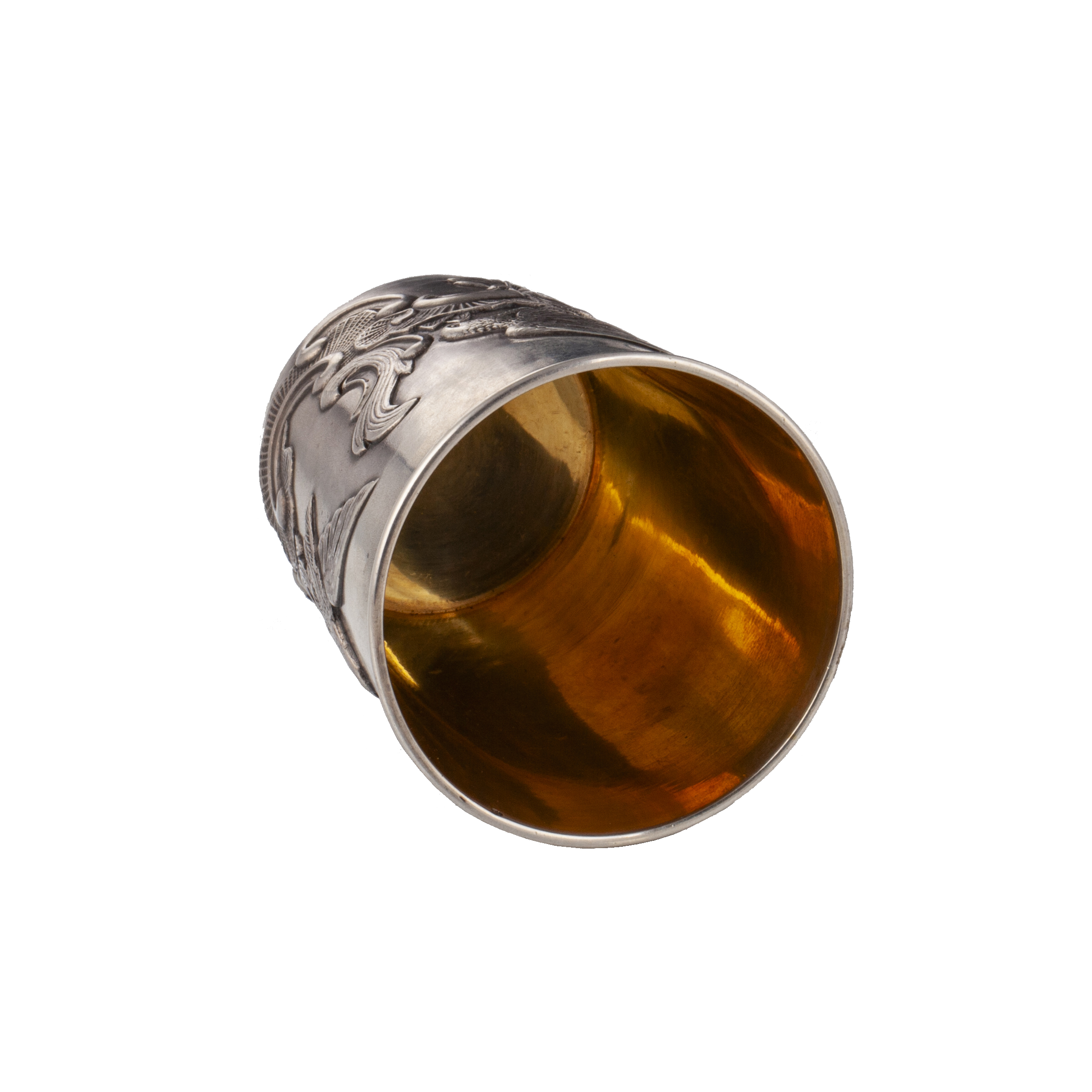
Lot 0160
Fabergé Silver-Gilt Beaker in the 18th-Century Taste, St Petersburg, late 19th century
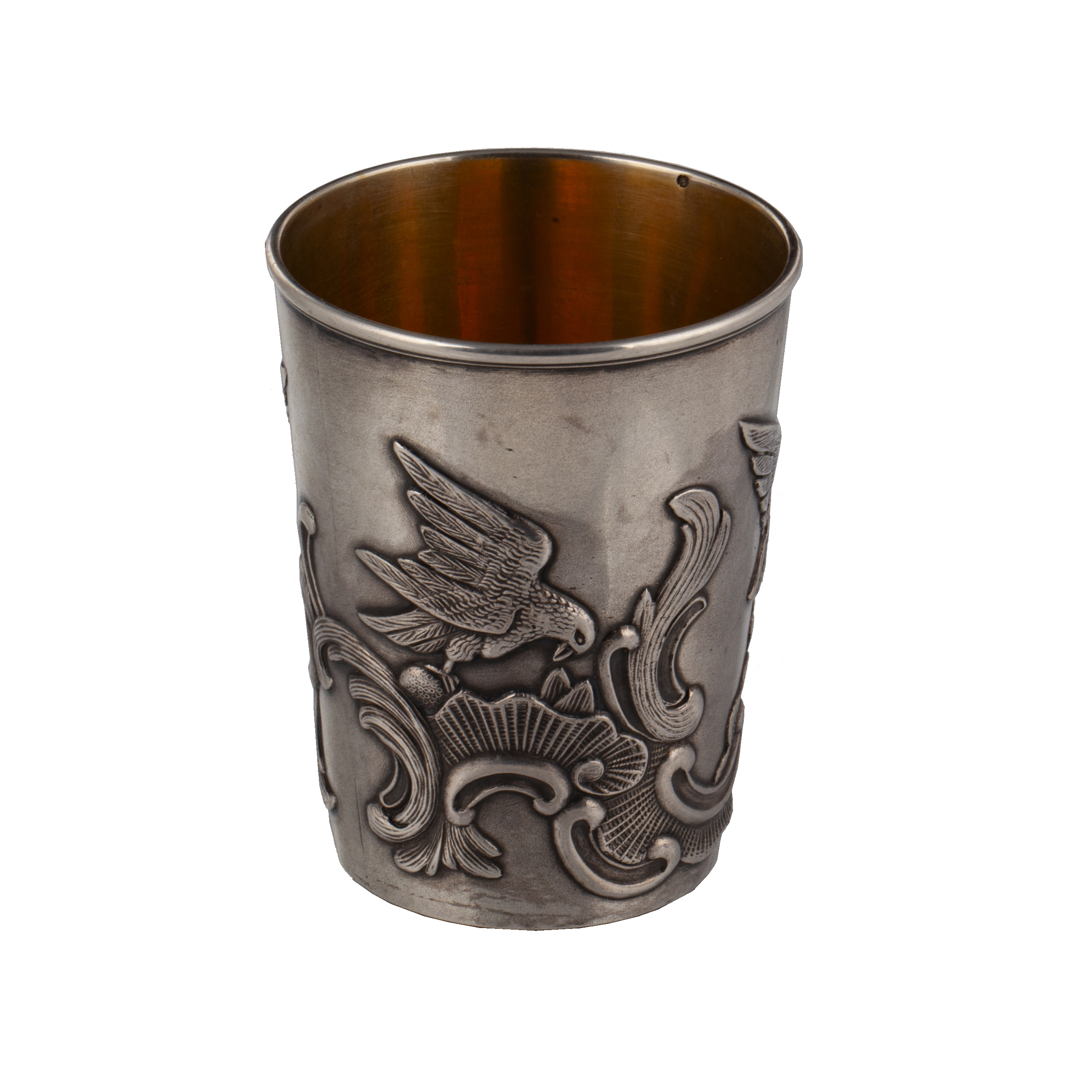
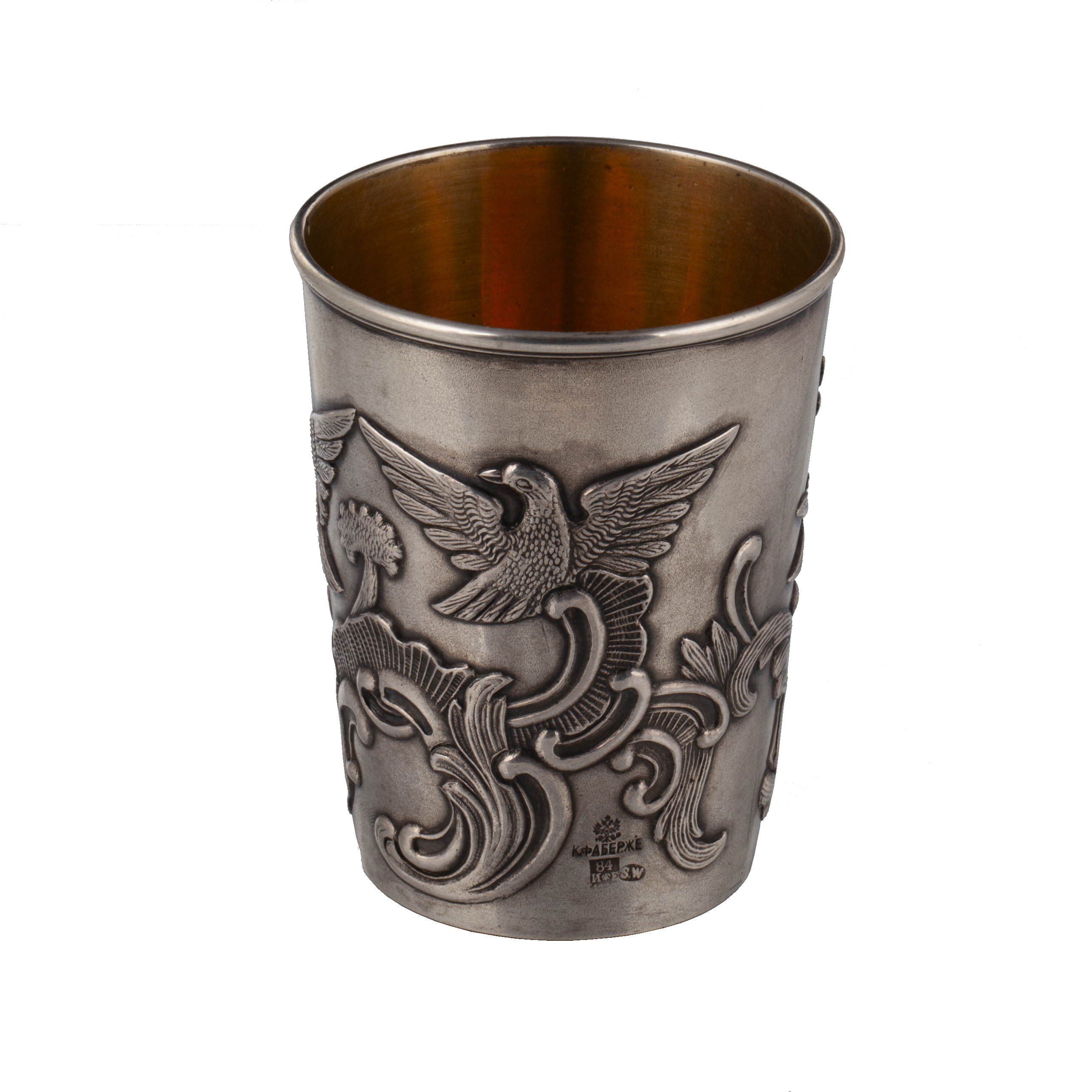
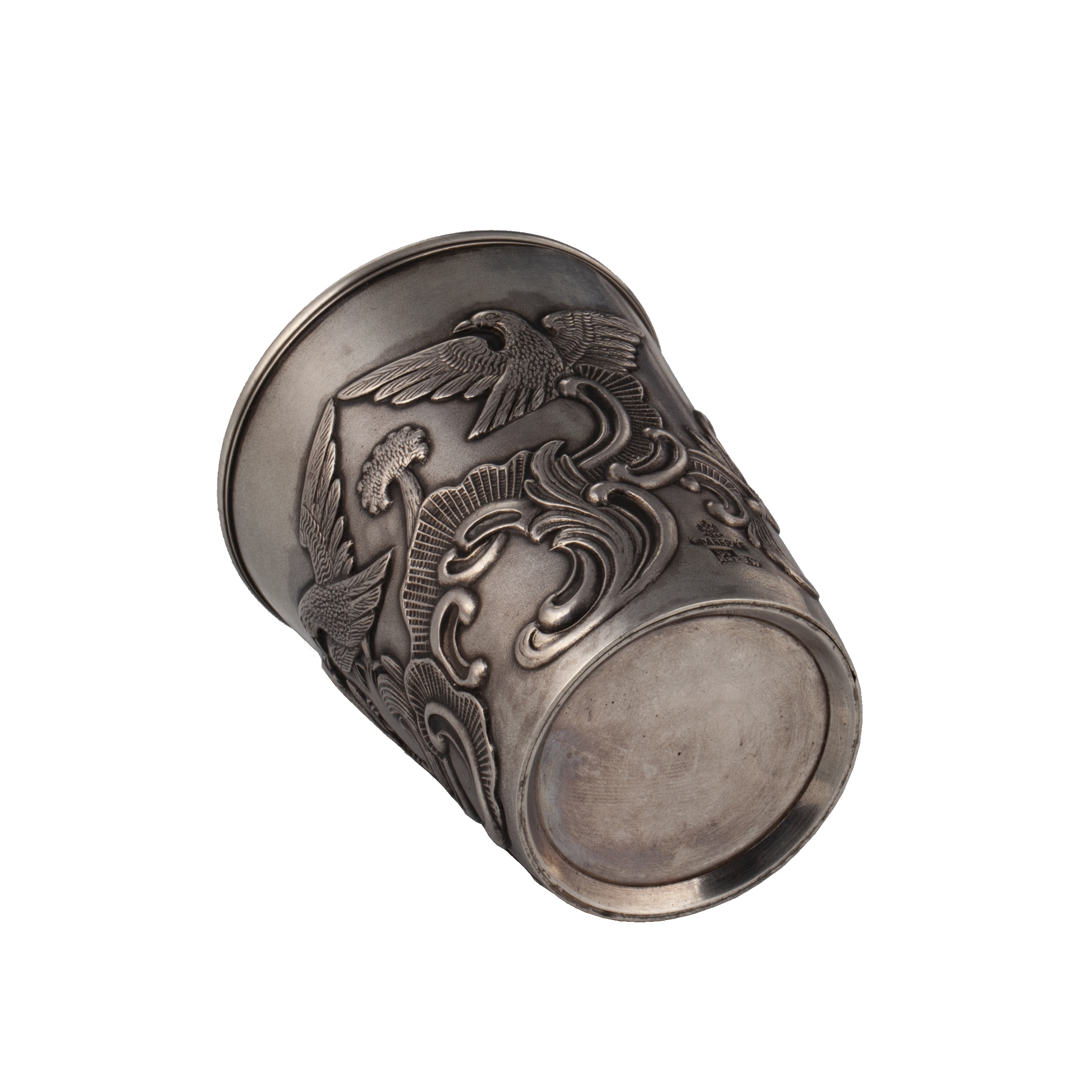
Estimate: 1500-1700€A Fabergé silver-gilt beaker in the 18th-century taste.
St. Petersburg, firm of Fabergé, workshop of Stefan Wakeva, late 19th century.
Silver, gilding; raised and chased decoration.
Height: 7.5 cm
Diameter: 6 cm
Weight: 145.2 g
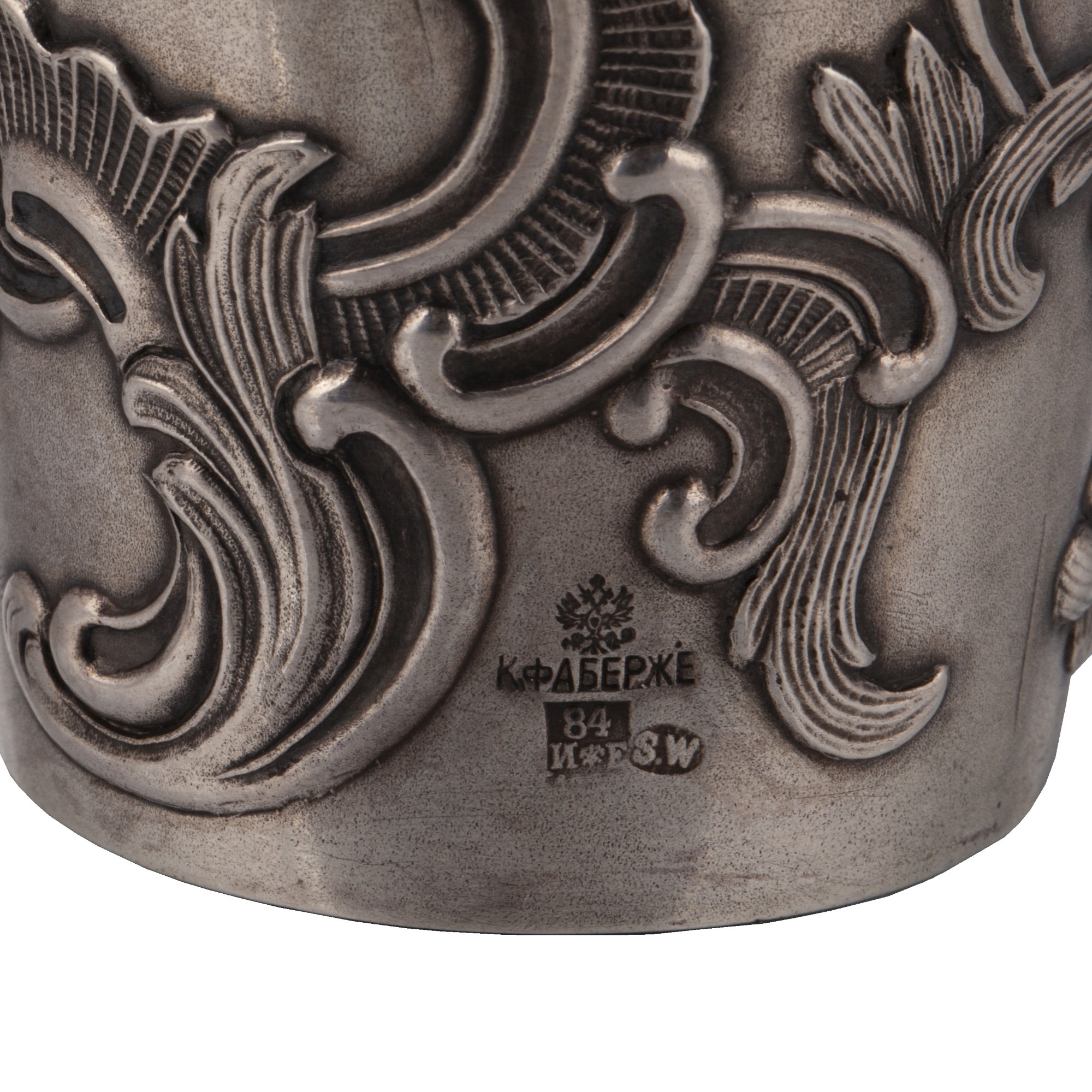
Marks: Fabergé beneath the Imperial warrant, maker’s mark of Stefan Wakeva , 84 standard silver mark, and St. Petersburg assay mark.
A finely worked silver beaker of tapering cylindrical form, the interior richly gilt and the exterior ornamented in high relief with an elaborate composition in the Rococo Revival manner, consciously evoking eighteenth-century decorative models. The body is encircled by asymmetrical scrolling foliate forms, shell-like motifs and stylised floral sprays, among which appear pairs of confronted birds and a smaller bird perched amid luxuriant rocaille ornament.
The maker, Stefan Erikovich Wakeva (1833-1910), a Finnish-born silversmith, was among the accomplished Capital’s mastets who executed works for the Fabergé firm. Established in St. Petersburg from a young age, he became a master craftsman in 1856 and was later noted as a chaser of silver. In 1882, while working for the firm of the heirs of Sazikov, he was recommended for distinction at the All-Russian Art and Industrial Exhibition as an exceptionally skilled and diligent master. By the 1890s he maintained his own workshop on 5th Rozhdestvenskaya Street and fulfilled commissions for Fabergé, contributing to the high standard of silver production associated with the firm.Starting price: 1200€
Estimate: 1500-1700€
Hammer Price: Not sold

Providing Antique Auctions